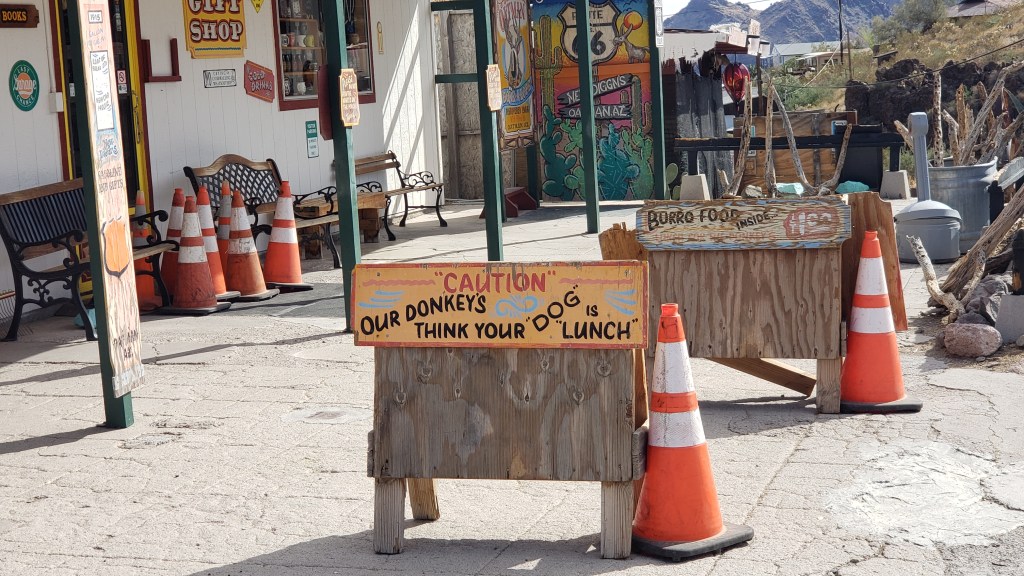
“Go to Oatman and see the wild burros, but don’t take your dog out of the car or they’ll bite its head and rip its scalp off,” the tourism representative in Laughlin, Nevada told us. How could we pass up something that local and unique? We might never get the chance to meet murder donkeys again, so, with the agreement Ruthie would stay safely in Nippy, off we went.
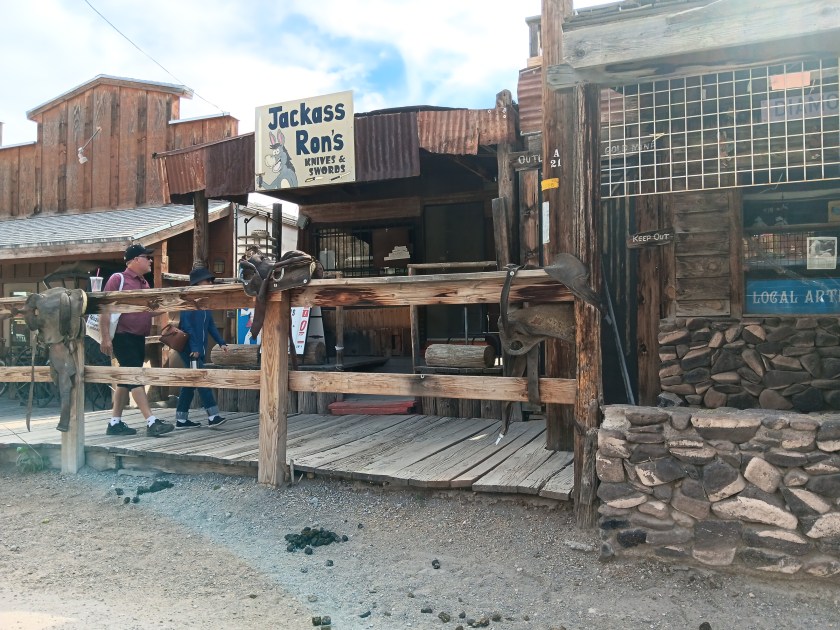
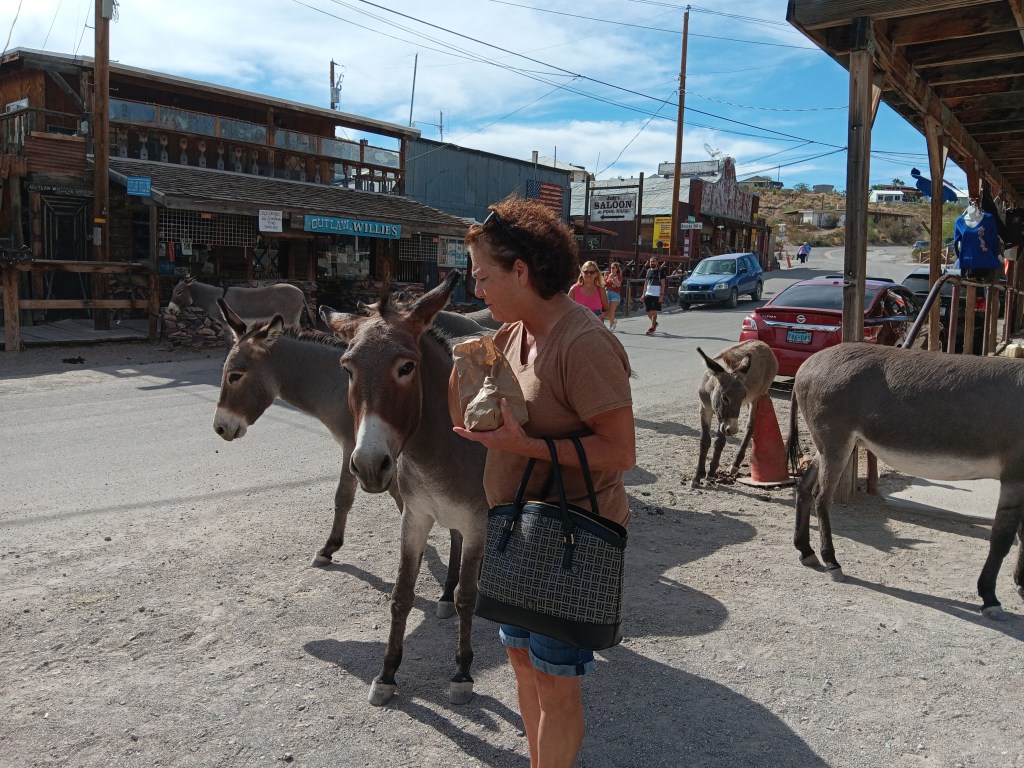
The burro’s face in the upper left-hand corner represents what’s to come.
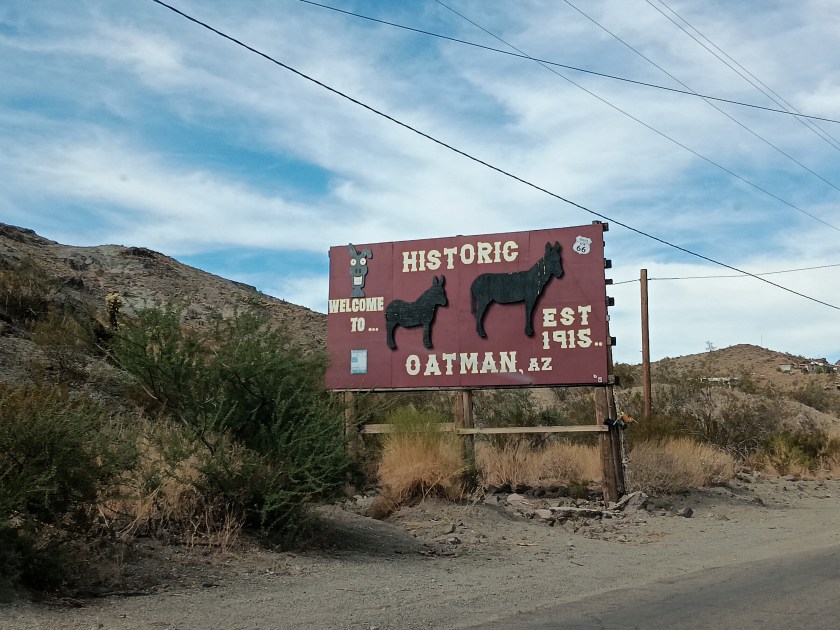
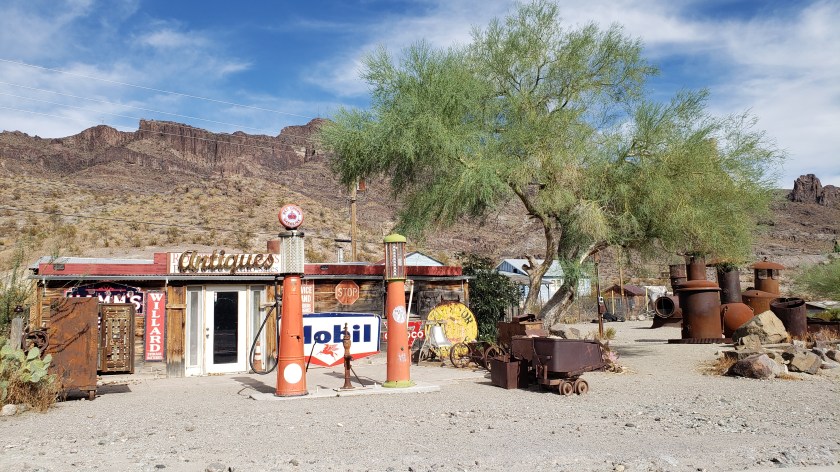
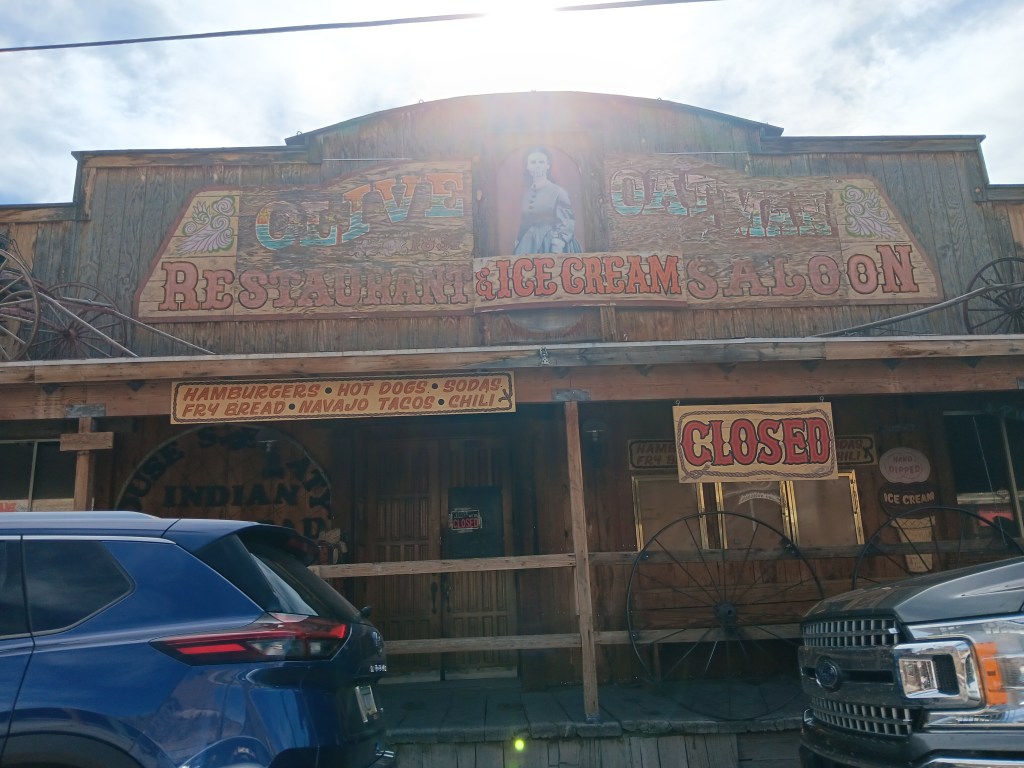
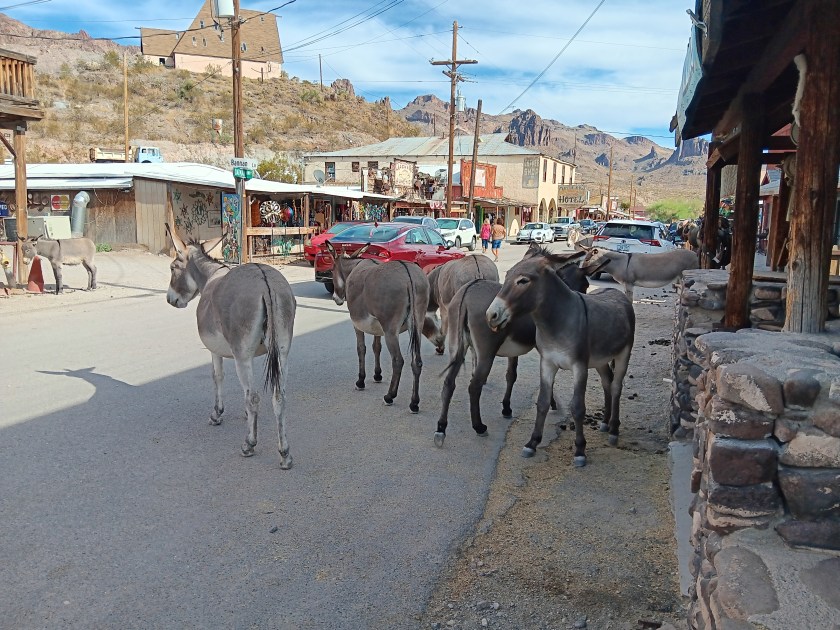
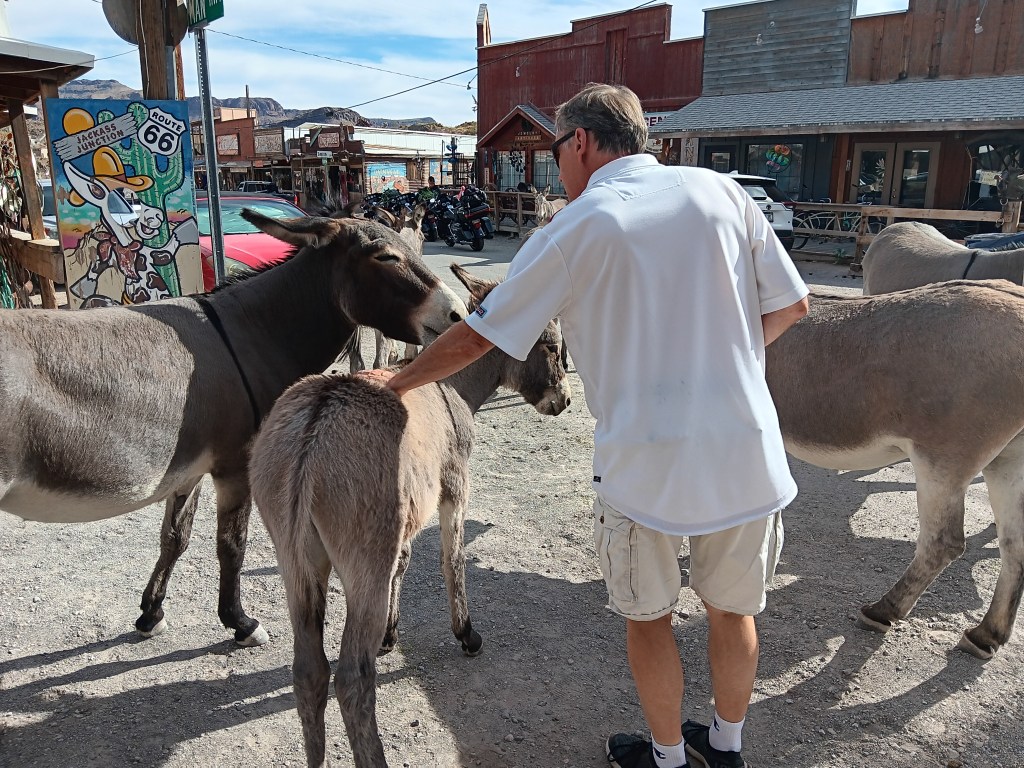
Oatman, Arizona, 30 miles from our campground in Laughlin, Nevada, has two claims to fame. First, it was the place where Clark Gable and his bride, Carole Lombard, spent their honeymoon night. Second are its wild burros, who wander through the tiny town at will, entering stores, begging tourists for snacks, and weighing up your dog’s potential as their next hearty meal.
There are signs everywhere warning tourists about this penchant for bloodshed, but that didn’t stop some people from walking their tiny canines right down the town’s only street, like sadists waving tasty cakes under the noses of starving insane asylum inmates. And it was clear the burros weren’t shy about partaking, should the opportunity present itself. You could see it in their eyes.
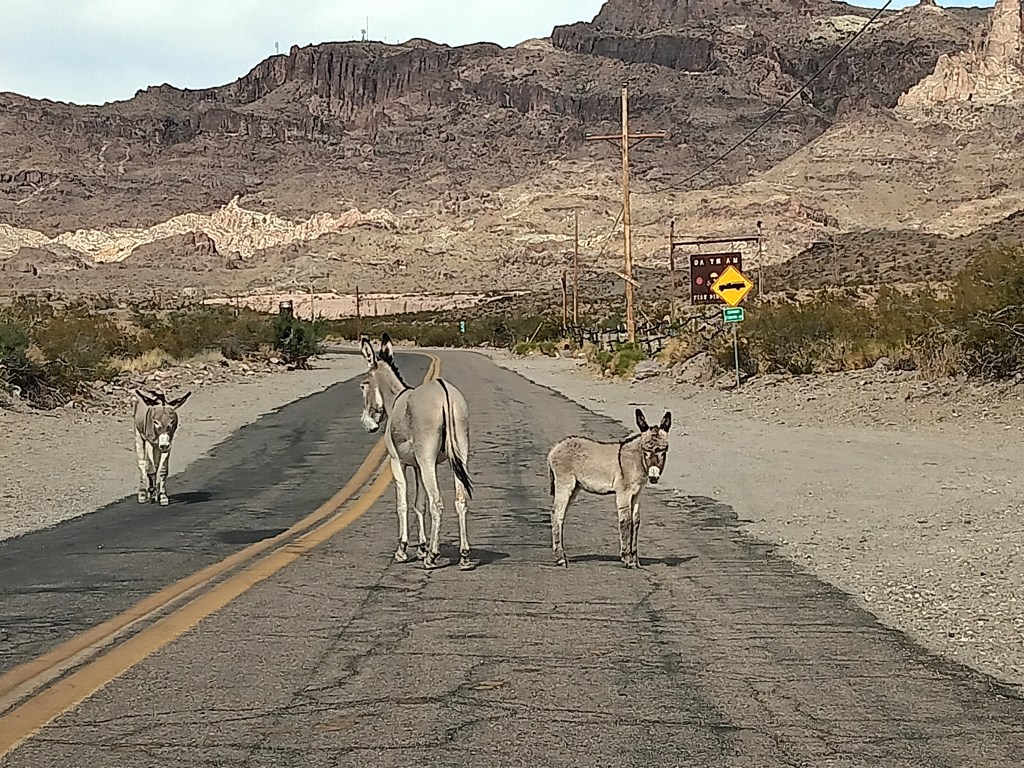
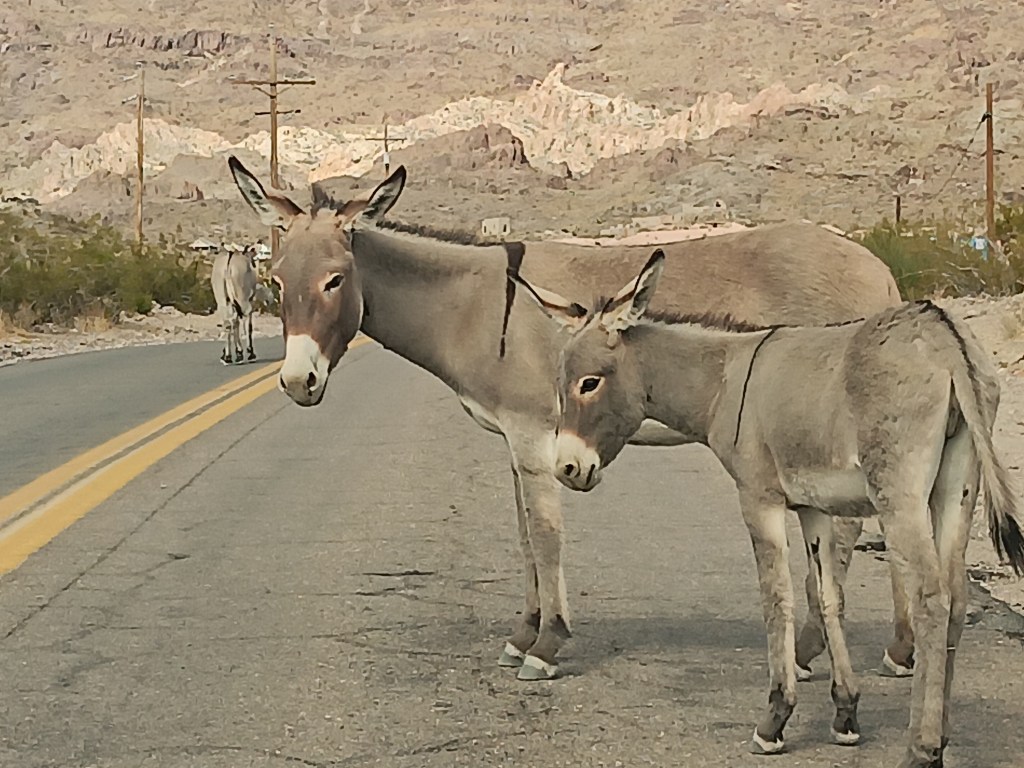
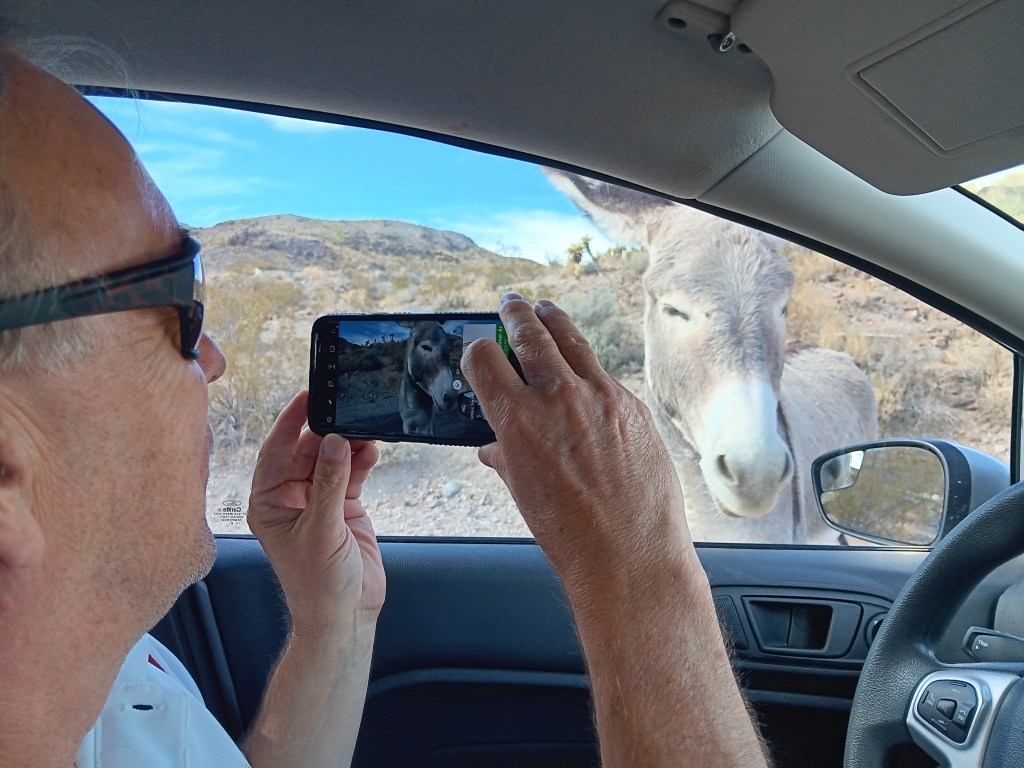
The first burros we met before reaching town were friendly. A mama and her baby gave us passing glances, while their companion had no problem at all coming straight up to the car to see if anything other than raw dog meat was on offer.
The specimens in town were pushy bastards, happy to pose for photos but even happier to kick each other, bite each other, and act in all manner of unsociable ways if they thought it would get them to the front of the line with tourists who were handing out hay pellets the size of a human fist, which could be purchased by the bagful in several of the stores.
Tourist does not like pushing!
With Ruthie and her fuzzy scalp locked securely in the car (with all the windows cracked to let the breeze in and a promise we’d be back in just a few minutes), we headed to the Saloon, which the visitor center lady said was a “must see,” but stopped short of telling us why. “I don’t want to spoil it for you,” she said.
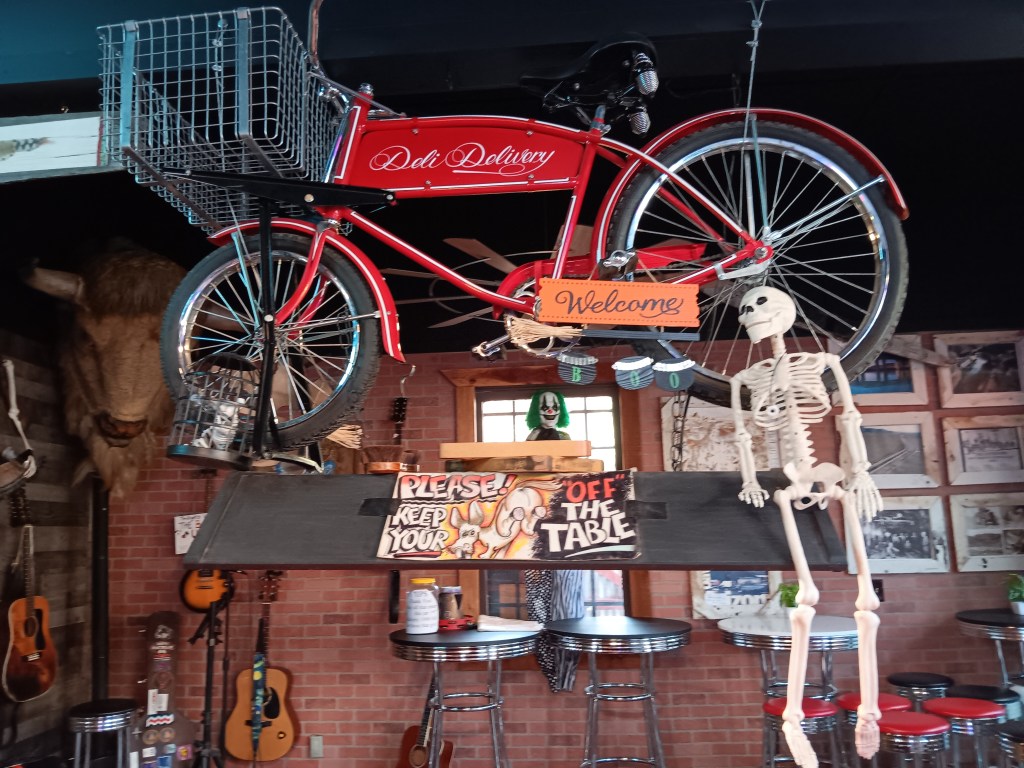
It didn’t help that there were three saloons, and we didn’t know which one she meant. The first one we popped our heads into was quirky, but reasonably so.
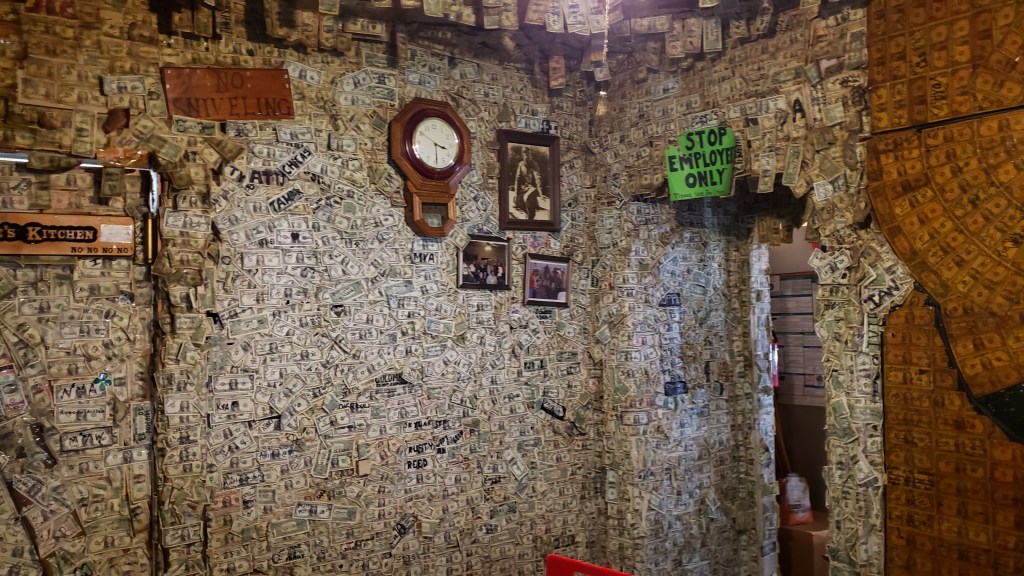
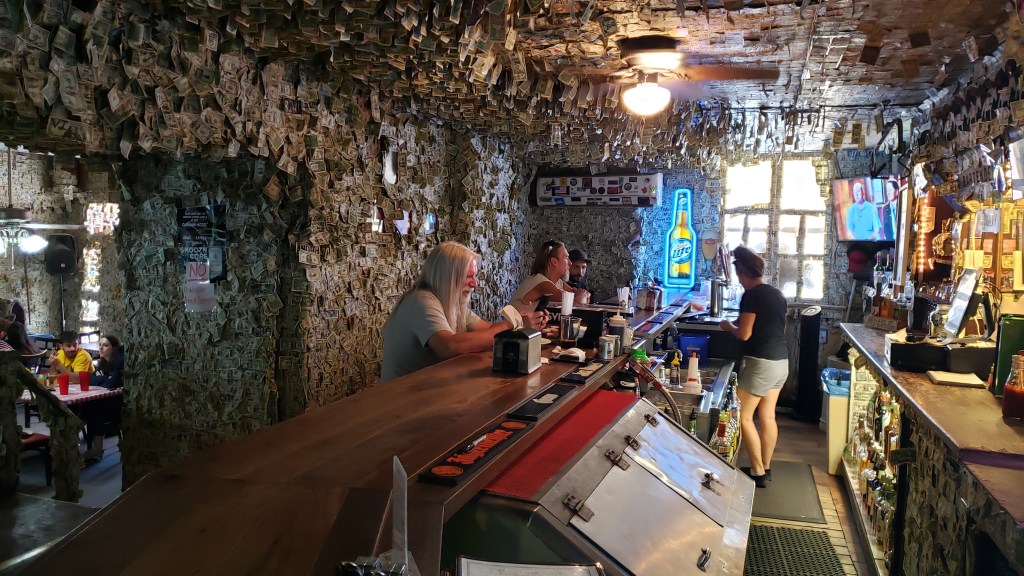
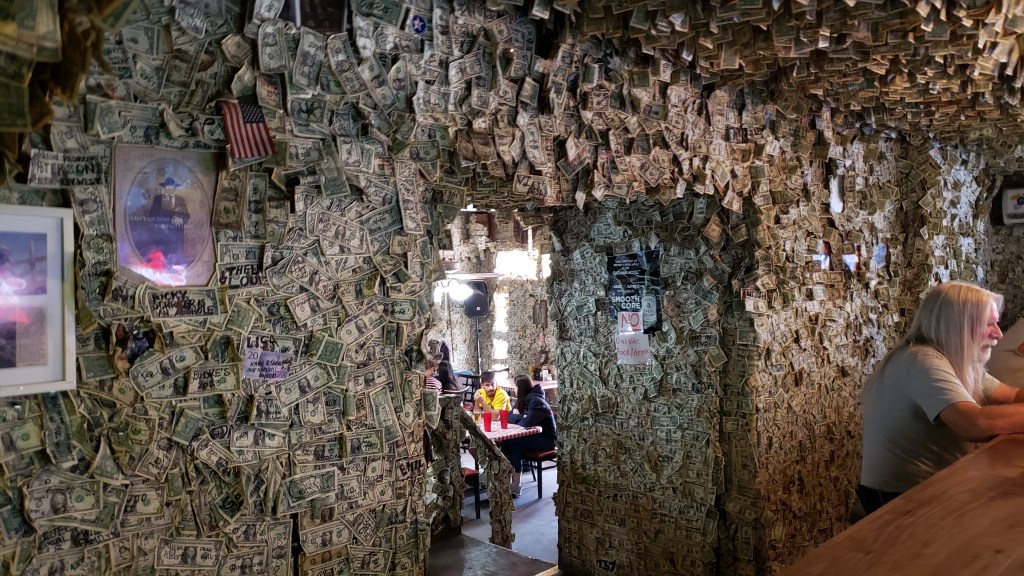
The second one, however, was the most outrageous example we’d ever seen of bars that encourage their patrons to staple dollar bills to the walls. This place was literally covered in money; nearly $400K, in total, we were told.
What the actual…!
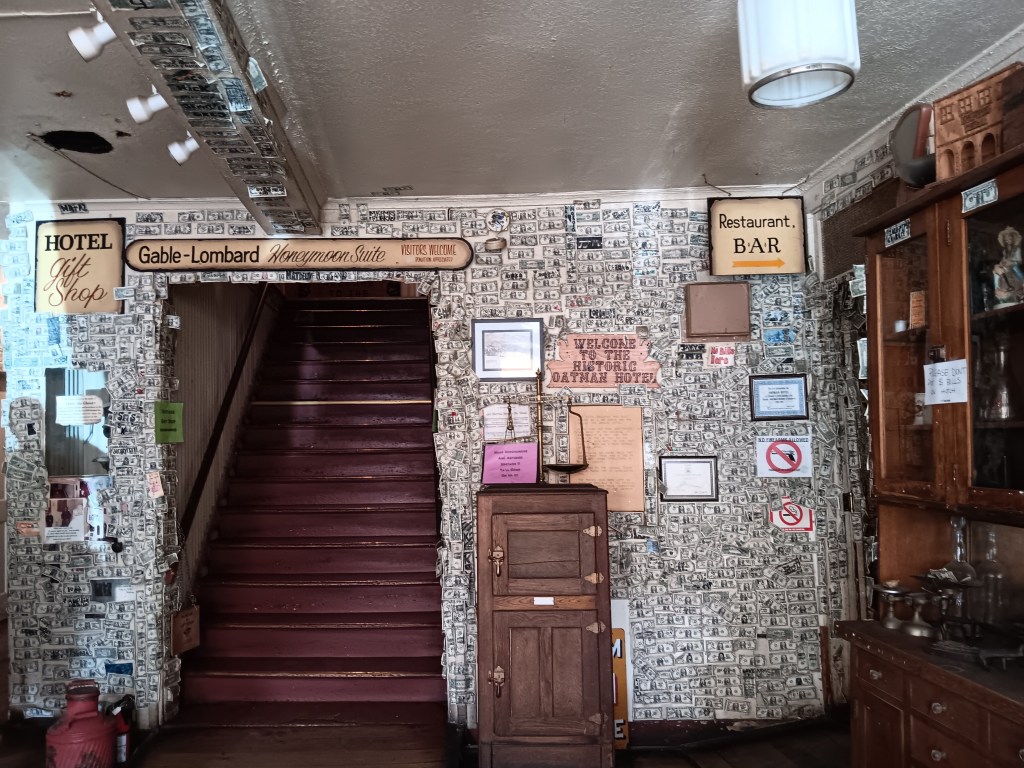
Dollar bills were hanging in their thousands from the rafters, stapled to the doors and the walls, and crammed onto every available surface, not just in the bar, but in what appeared to be four or five rooms, a stairway, and probably upstairs too, though we didn’t make it that far.
We’re pretty sure this was the saloon the visitor center lady meant.
If there was a freakier bar in town than this one, we probably didn’t want to see it.
There is a room covered in dollar bills beyond this one. Maybe there are two. It was hard to tell.
The new Mr. and Mrs. Gable’s fame didn’t hold a candle to all that cash, but their names were immortalized on a hand-painted plank nailed above the doorway leading to the hotel rooms, which created an uncomfortable mental image of them climbing the stairs on the way to celebrating their wedding night.
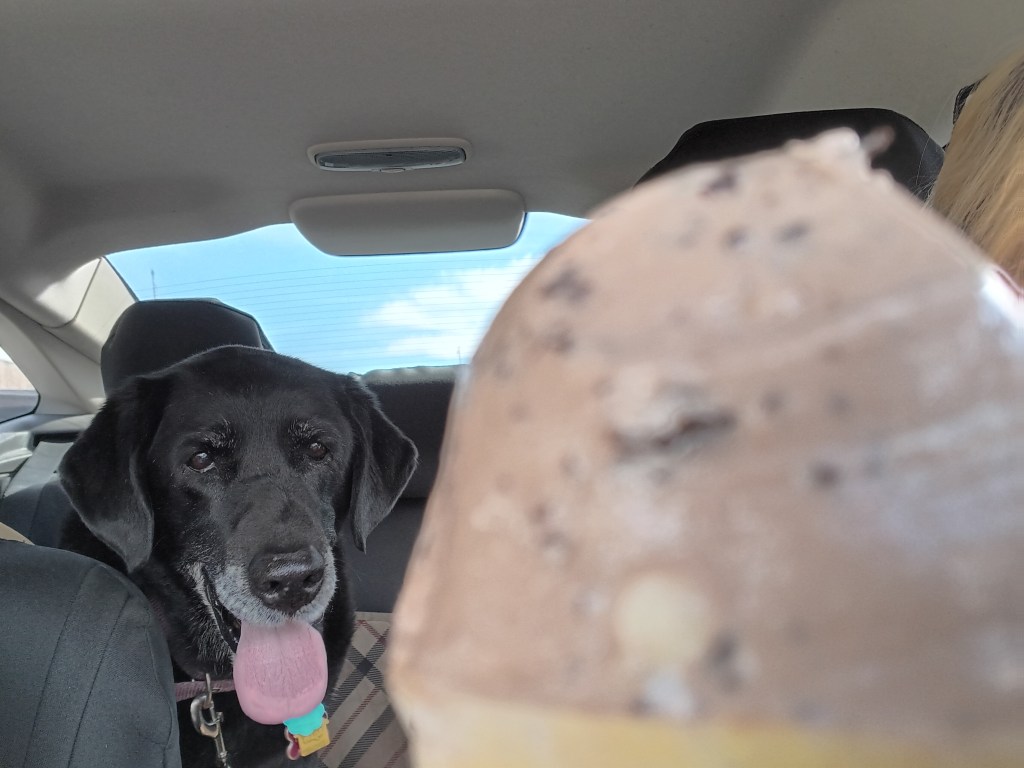
We took some photos, made all the appropriate “Oh, my God” noises, purchased two ice cream cones, and headed back to Ruthie, whose fur was all intact, even if her attitude wasn’t. She hates being left, we hate leaving her, but there are times when it’s for her own good, and we felt virtuous as we enjoyed our cones, congratulating ourselves for having saved her life, even though she’ll never know it.
She did get the bottom of each of our cones, so life was good!
You’re tired of reading about canyons, we’re tired of writing about canyons, so it’s time for some Vegas, baby! Almost.
Interstate 15 made for a very long day’s journey from Cedar City to North Las Vegas, with the added “thrill” of the Virgin River Gorge, a pass through the mountains that was so intense Susan had to drive Nippy through it while Simon hooted and hollered and had a hellofa great time taking the gorge’s grades in Fati. Sometimes you have to split up to keep everyone’s sanity intact.
There are no photos of this pass, of course, since Simon’s full focus had to be on the road and Susan’s was on praying for Simon’s safety. He was perfectly safe, as he knew he would be, and we made camp for four days in Vegas once we put the gorge behind us.
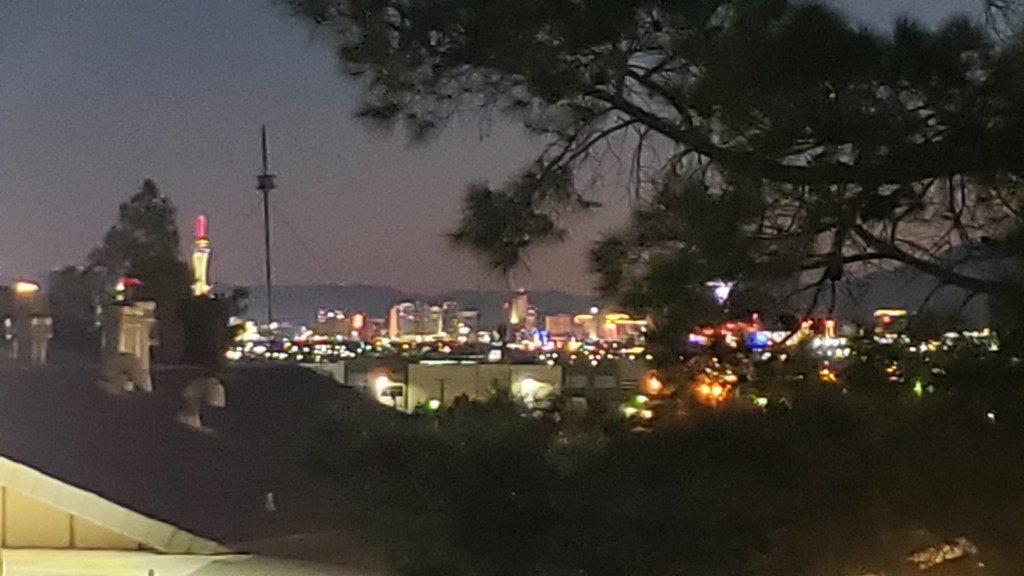
Our view of the Strip out Fati’s living room window.
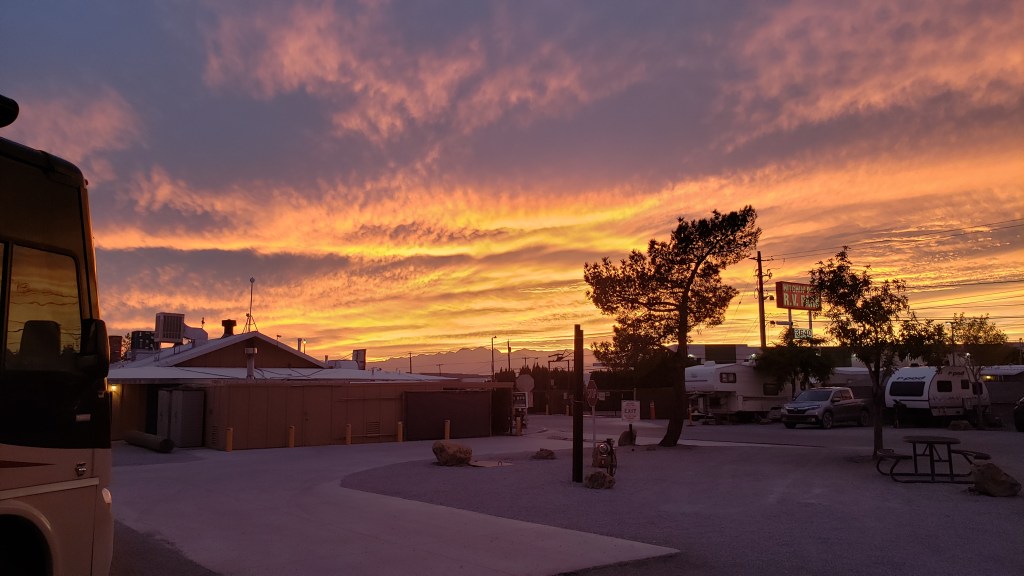
The sunsets were spectacular!
Valley of Fire State Park had been our goal for this leg of the trip, and we originally intended to spend three nights in a campground inside the park. Unbeknownst to us, Valley of Fire began a reservation system two days prior to our visit (it had been first-come), and we missed our window of opportunity. In the end, it did us a favor. It would have been a challenge getting Fati into the campground.
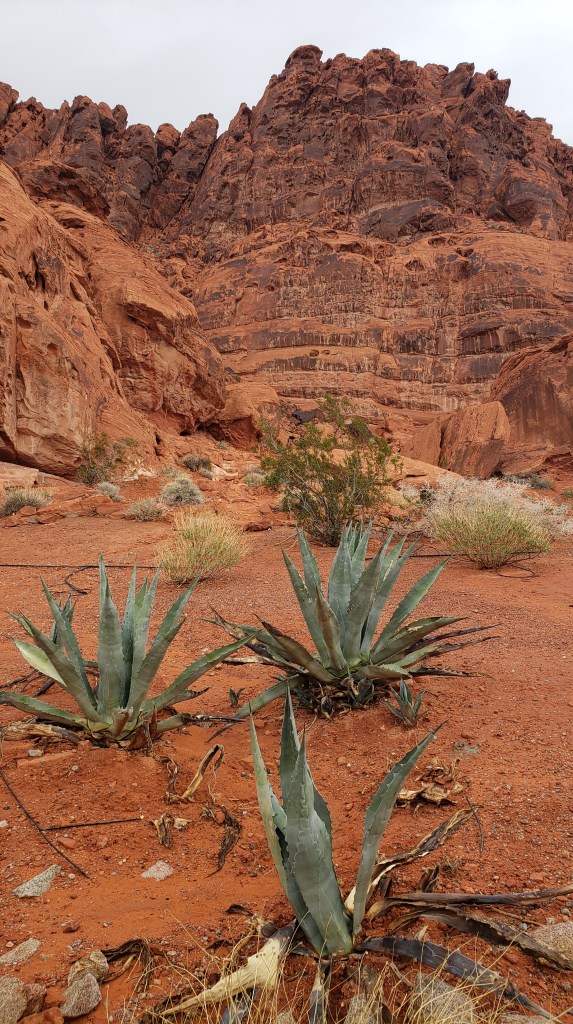
Instead, we visited in Nippy and spent a lovely afternoon enjoying the outstanding crimson Aztec Sandstone hills and pale limestone cliffs that were laid down and risen up during the Jurassic and Paleozoic eras, respectively. During the Mesozoic Era, 20 million years ago, this area was a sea.
We’ll only show you a small snapshot, since you’ve already seen more rocks than any blog should make its readers endure.
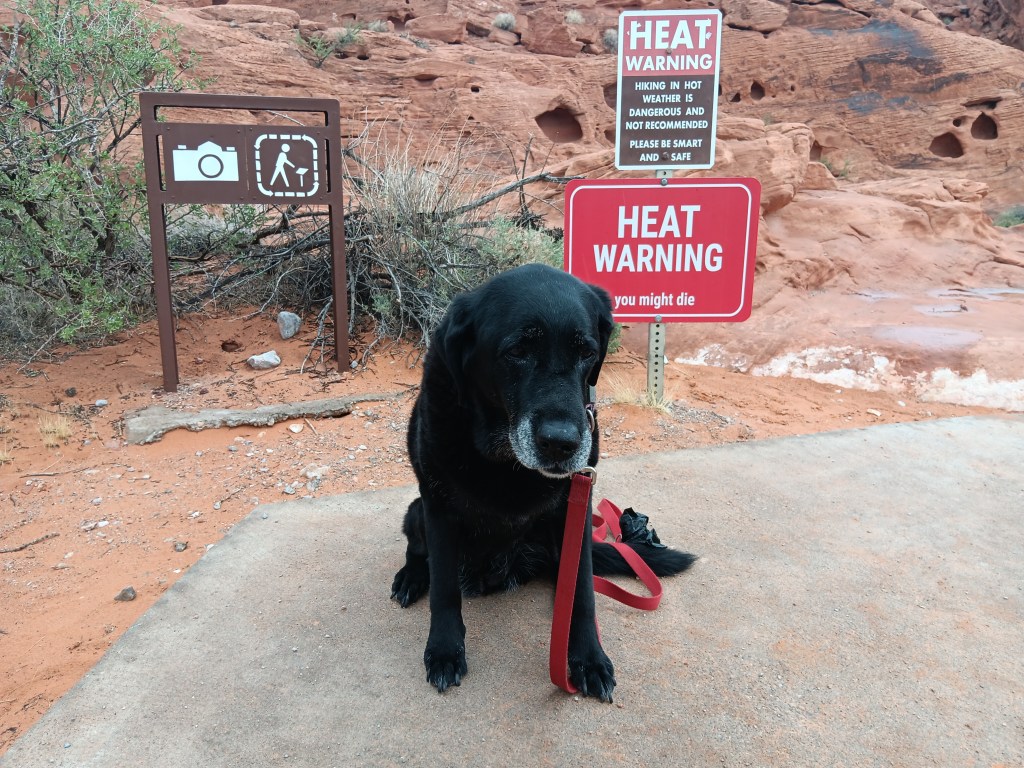
The color of that sand!“Yikes!”
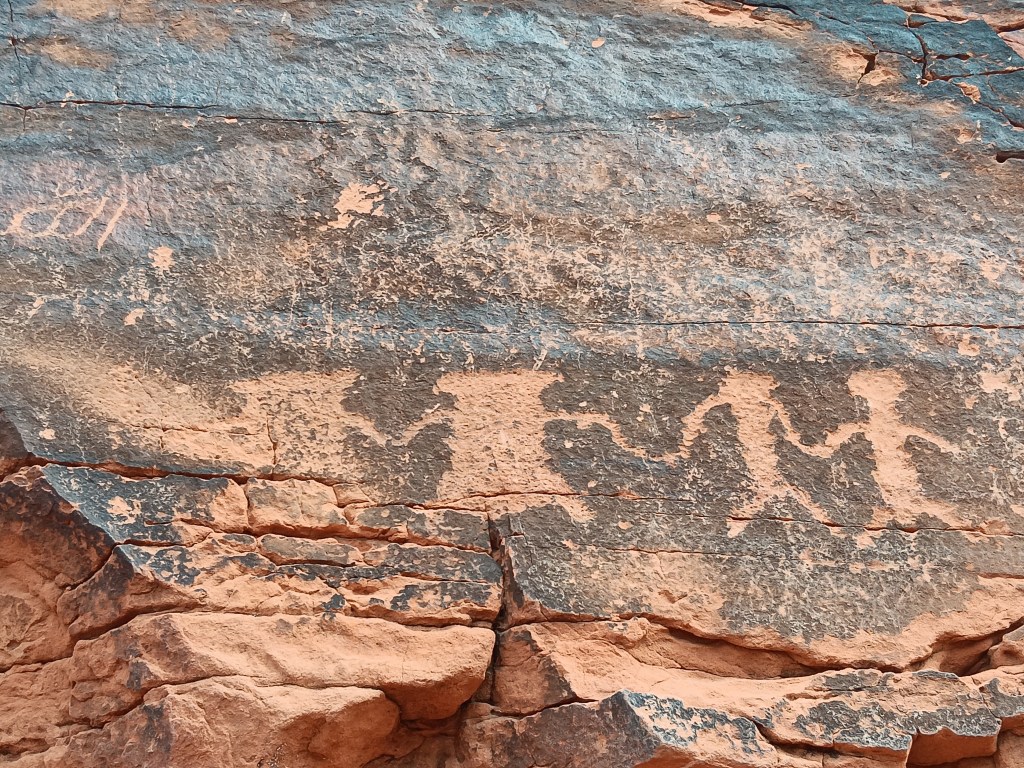
Petroglyphs in Valley of Fire were more recognizable as human than most we’d seen.
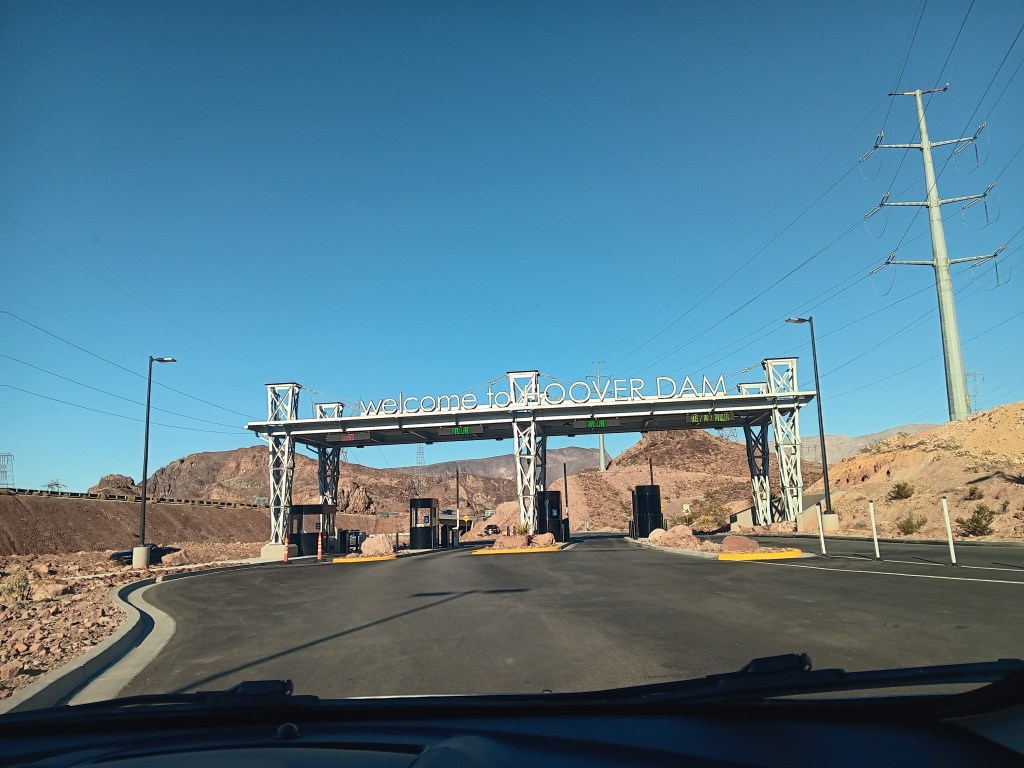
Hoover Dam was sort of on the way back to Vegas, so we took a little detour to see this human-made marvel of engineering. To say the guard at the security gate was “unhelpful” when we asked if there was a parking area before the dam would be an understatement. “It’s too complicated,” he said, and waved us through.
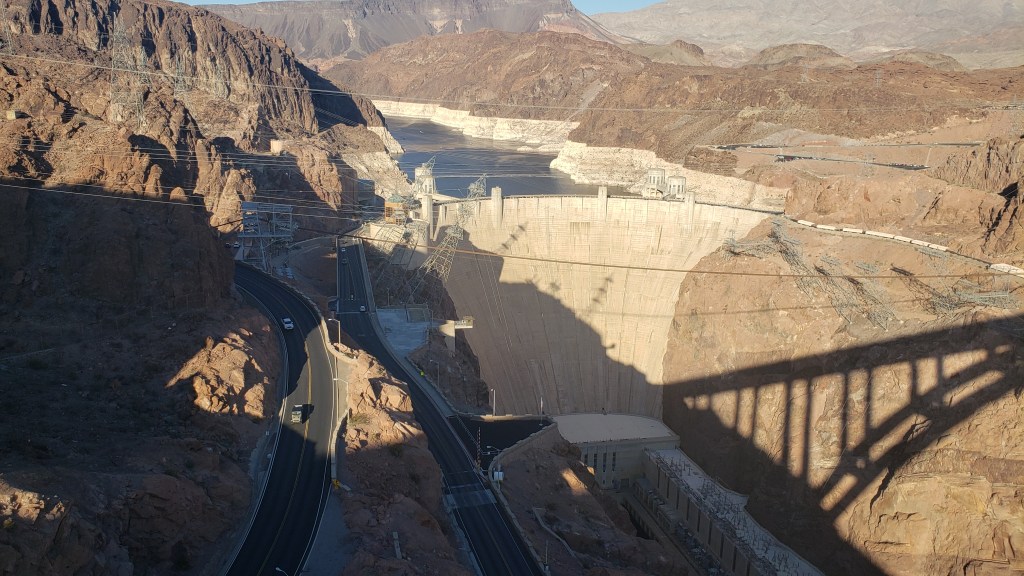
The answer to our question is “Yes.” The Mike O’Callaghan-Pat Tillman Memorial Bridge just beyond the security gates not only had a parking lot, it had the premier view of the Hoover Dam for those who enjoy high places suspended over an 890-foot drop to the Colorado River.
Dam that’s big!
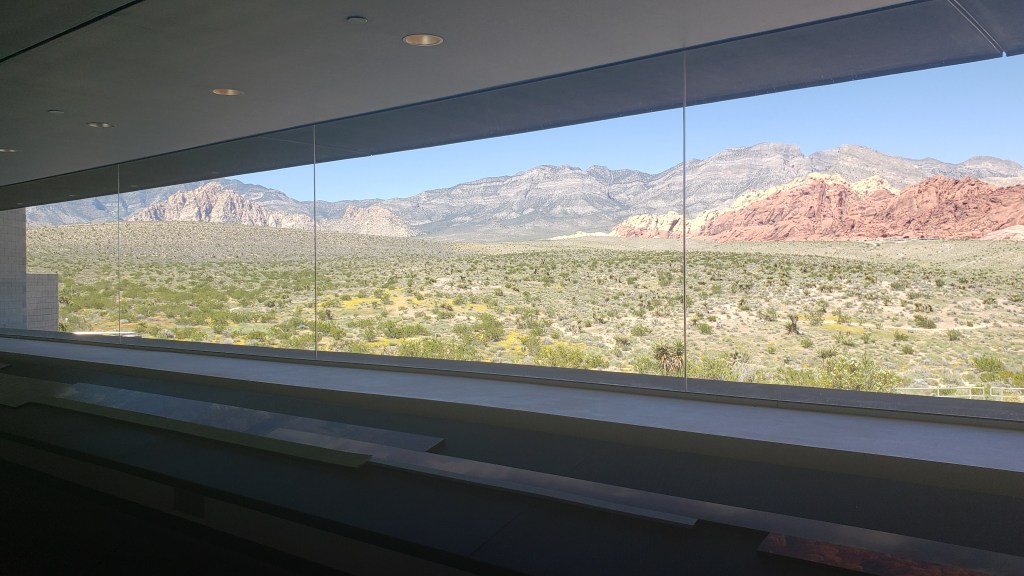
The next day offered perfect blue-sky weather for a trip out to Red Rock Canyon, which featured the best Visitor Center we’d seen so far, and a feature-packed scenic drive that hit every high note. But I’m going to run screaming from the room if I have to post many more photos of rocks, so here are three, and we can only highly encourage you to put this superb park on your itinerary next time you’re in Nevada. It’s lovely.
This isn’t a mural, it’s a wall of windows in the Visitor Center that looks out onto the park. How fabulous is that?
This isn’t a rock, but this lady rocks! We got the impression she’s a dog walker who’s taking her charges on a field trip.
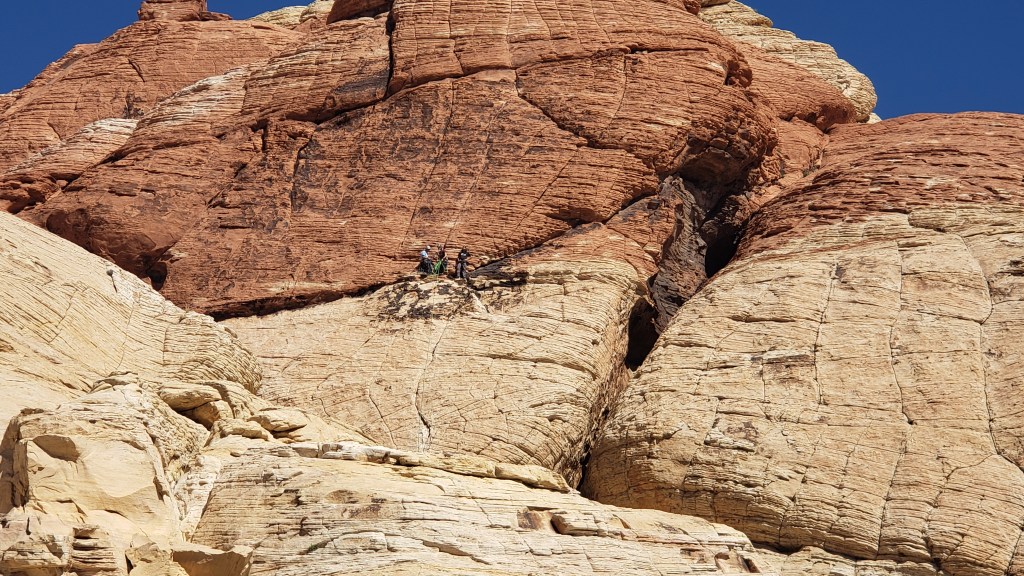
Climbers (smack in the middle of this photo) who are much more adventurous than us. We watched them scale what seemed to be a flat wall.
Our third full day was intended to be a work day “at home,” but the lure of the Strip was too strong. We decided to check it out during the day, then return for its famous after-dark personality in the evening.
Simon had the brilliant idea of booking Ruthie for a grooming at PetSmart, which would buy us about two hours of free time to go into a few casinos for the atmosphere, and give her some spa time for a bath, tooth brushing, and nail trim. Bellagio was our goal, and we’d fit in Cesar’s Palace and the Venetian if we could.
Bellagio’s lobby.
Simon risking it all on one pull of the handle (not really; we didn’t actually gamble at all, though Simon probably would have had he not been offered the choice between this, or buying $6 coffees nearly every day. Susan’s no fun when she goes all financially practical).
In the end, we only had time for Bellagio, but we did get to see the fountain show, which was probably worth our time. It only does two musical numbers, the first of which was the National Anthem, and the second was the hauntingly beautiful Con te partirò (Time to Say Goodbye), sung by Andrea Bocelli and Sara Brightman.
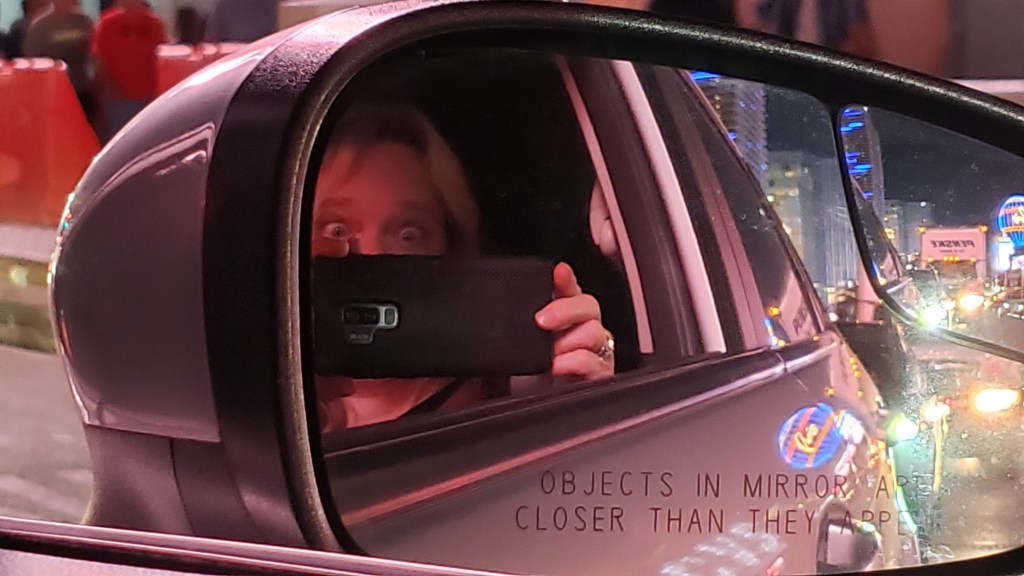
We kept trying to time our Selfie for the biggest water bursts, but never knew when they would happen.
The Sphere opened on September 29, 2023, but they were doing “rehearsals” while we were there.
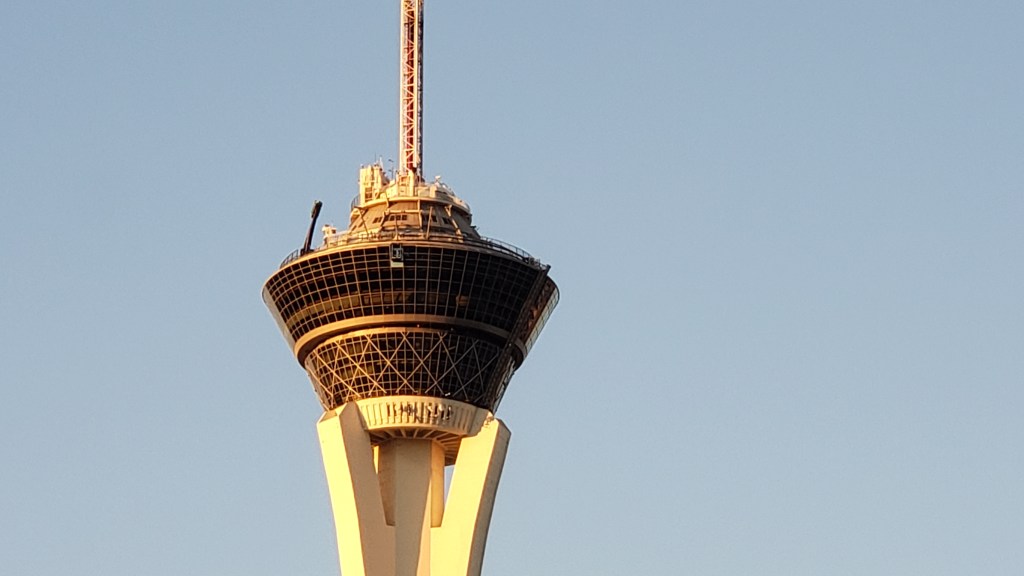
The black “arm” sticking up is the X-Scream thrill ride at the top of the Strat. It rocks forward and backward, dangling riders 866 feet above the Strip and suspending them there until they pass out cold. No, wait, that would just be me (Susan). Other people seem to love it.
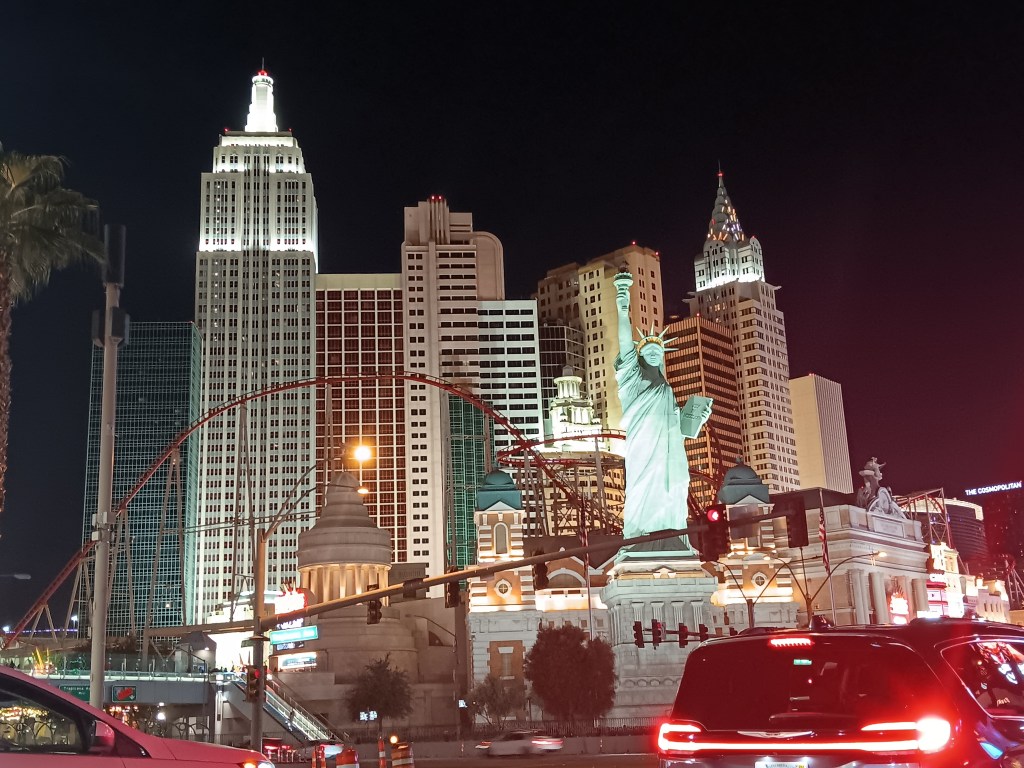
New York, New York hotel and casino
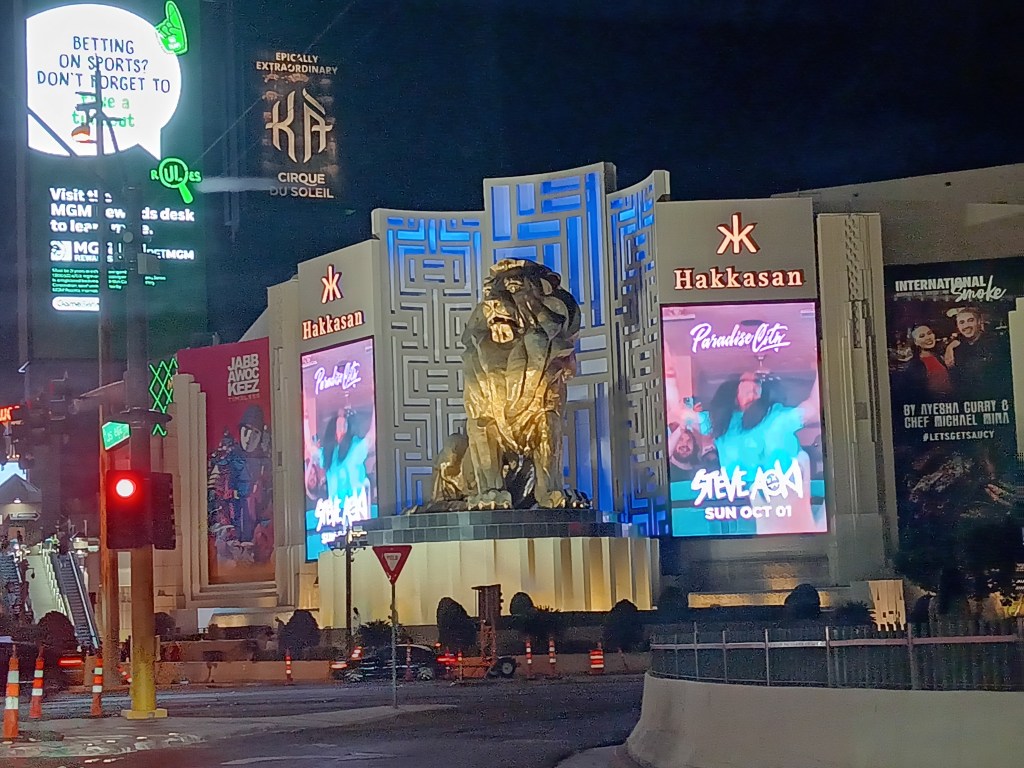
Outside MGM Grand. So many lights and video ads!
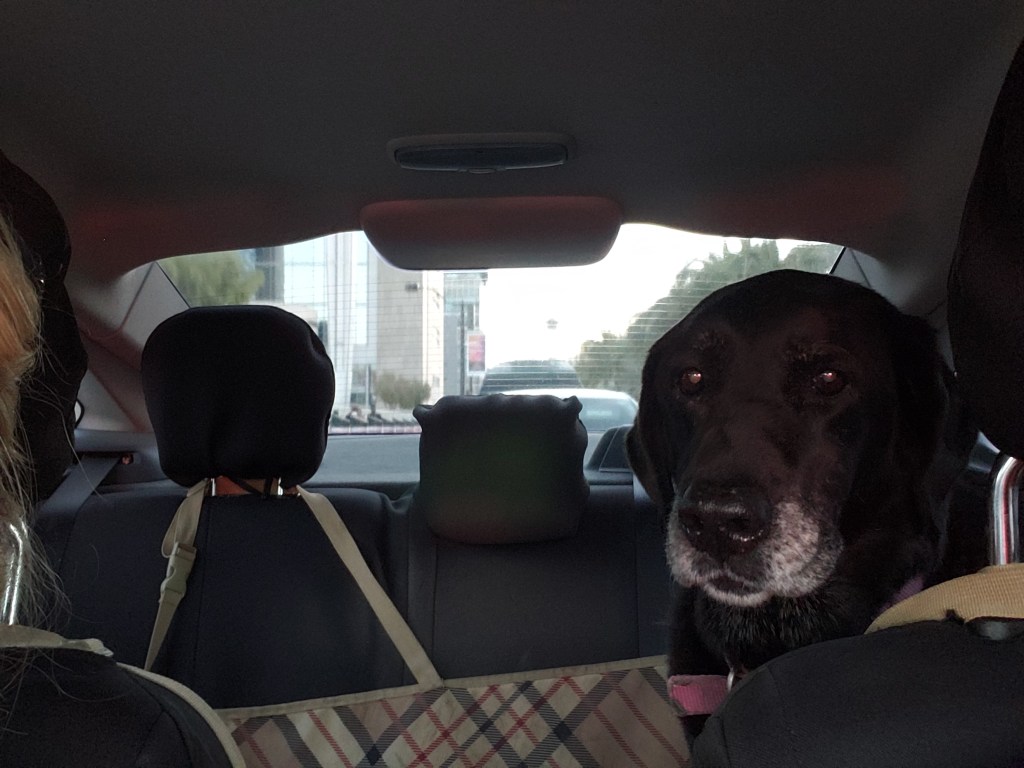
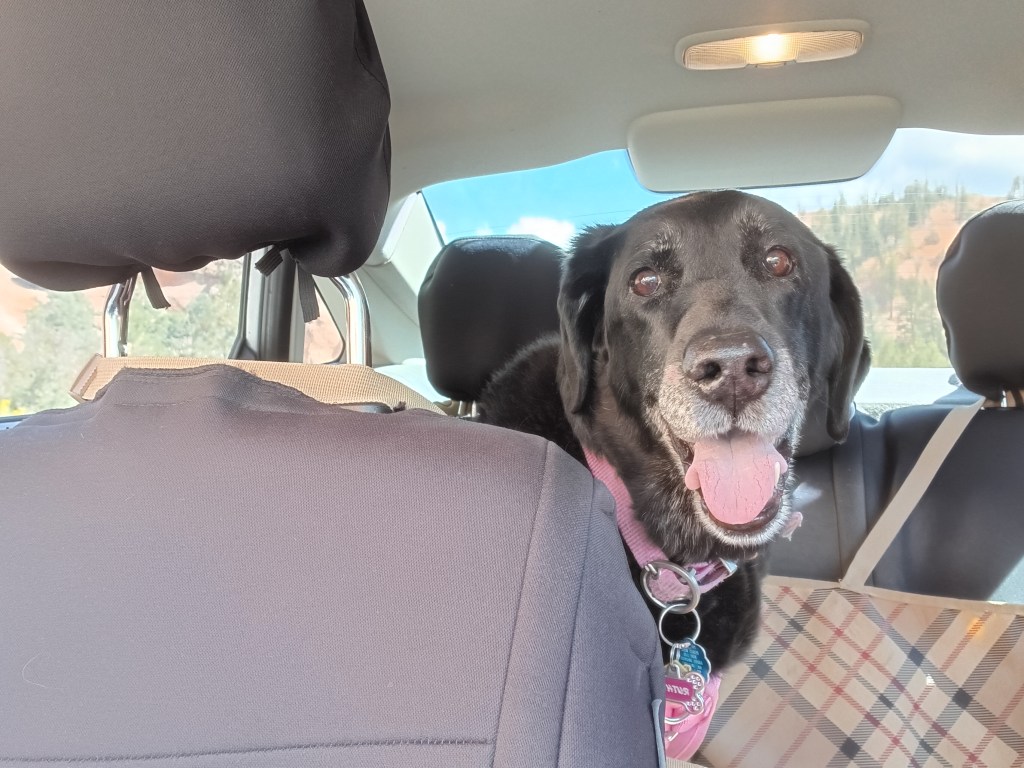
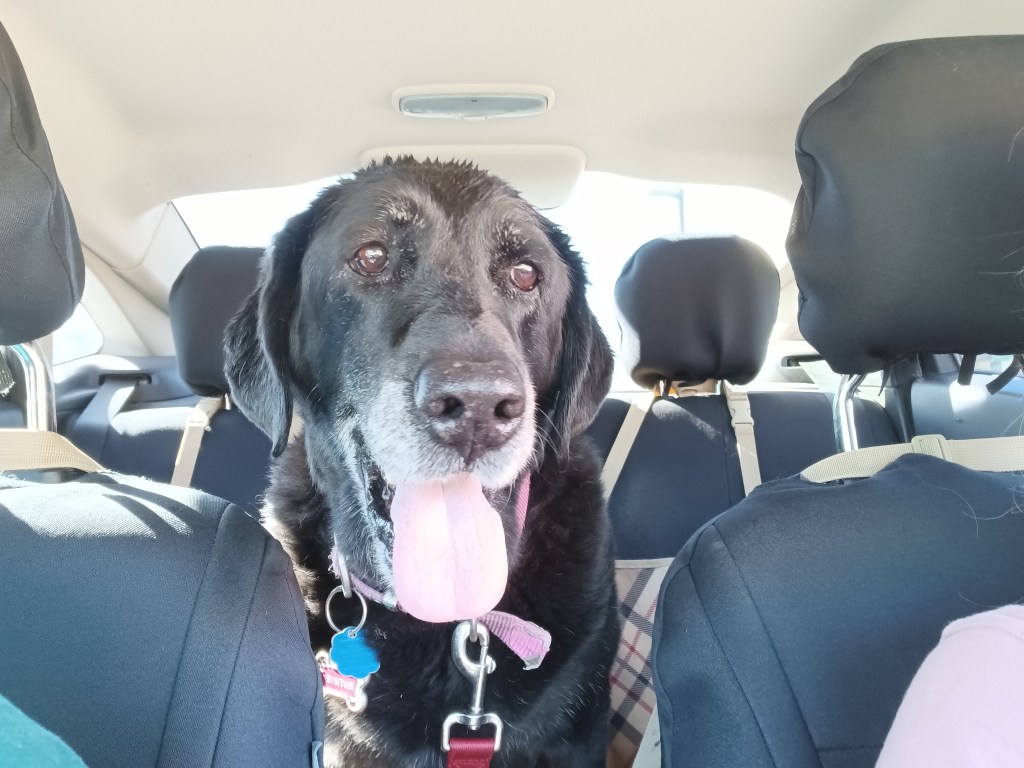
Ruthie often lays down in the back seat while we’re touring, but she was riveted along the Strip.
The famous pawn shop from television’sPawn Stars.
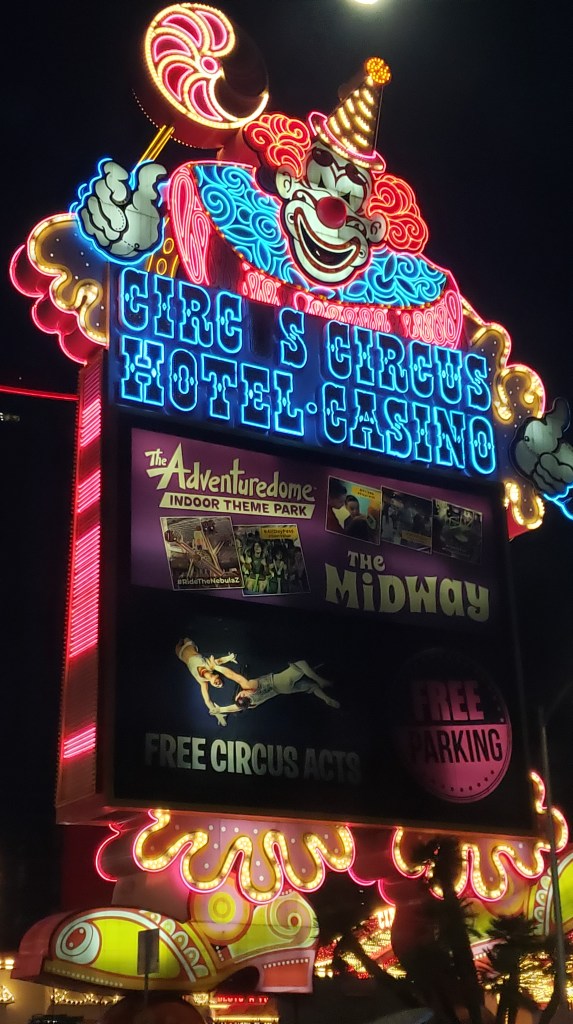
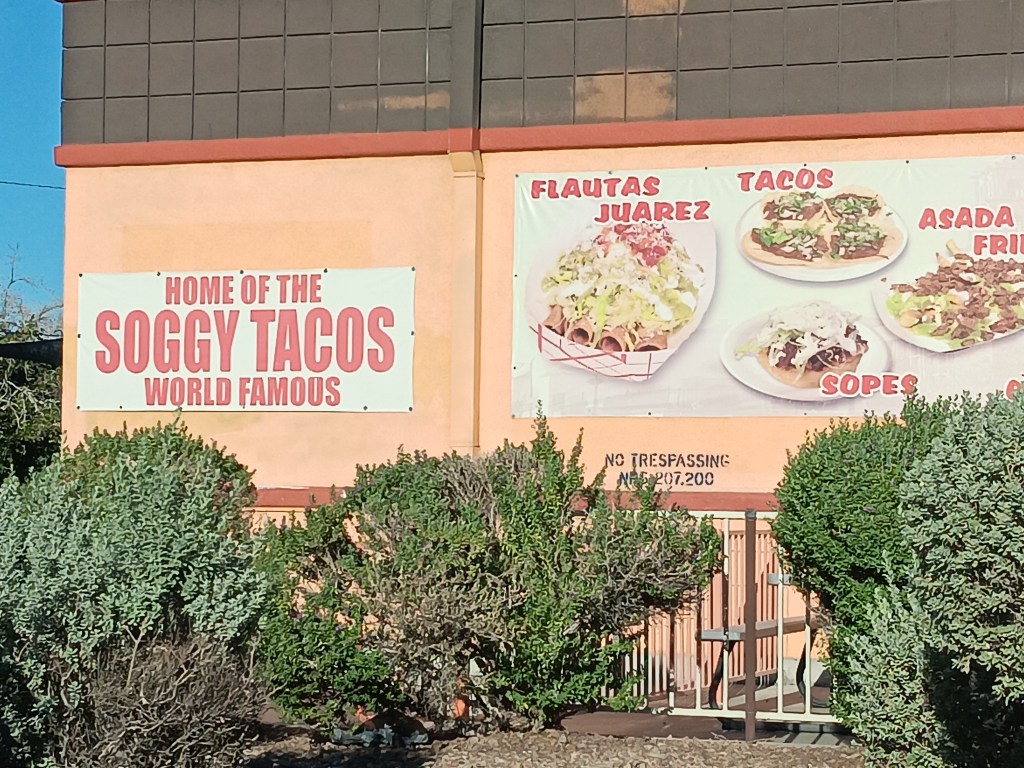
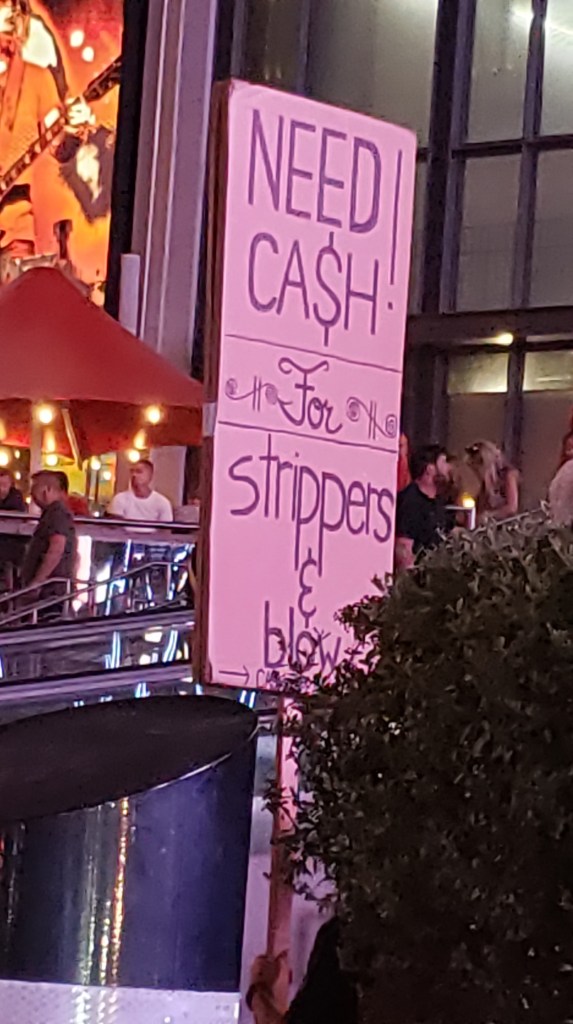
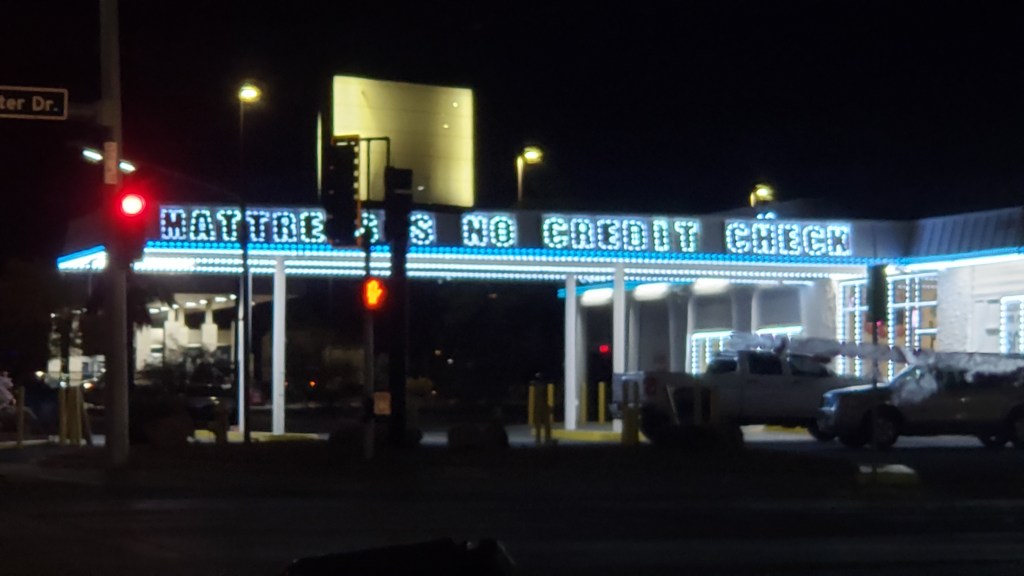
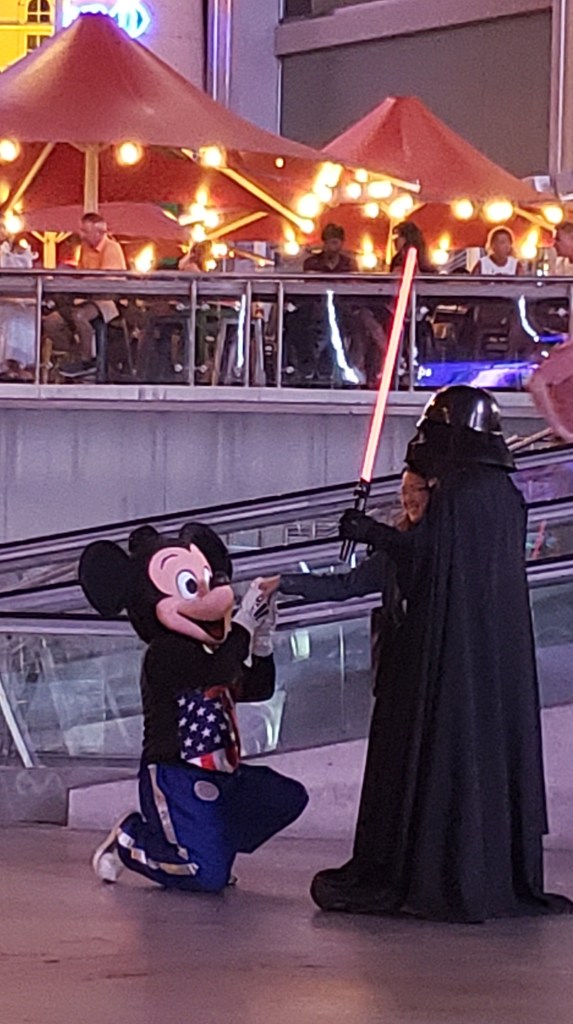
Even more captivating than the casinos were the bizarre sights we kept seeing, so we’ll share a few of them with you and hope they brighten your day, as they did ours.
Is that a selling point?
His mother must be so proud!
Mattresses with no credit check? The promise you didn’t know you needed.
Mickey, NOOOOOOOO!!!
Ummmm…well….okay, then!
We were ready to leave Las Vegas when the time came. Little did we know we’d have an even more bizarre town waiting for us at our next stop.
Throughout our journey, we’ve had to modify our plans around Ruthie, and we’ve done so happily, since one of our goals was to give her the best of what time she has left. Another one of our goals was to see as many National Parks as possible, and in Southern Utah those two desires collided.
“I’ll go wherever you take me!”
From our base in Cedar City, we were 77 miles from Bryce Canyon National Park, and just 20 miles from Zion National Park, two places that were high on our list of must-do experiences. They were places Susan’s parents had really enjoyed and, because of that, they had an emotional pull, too.
Grand Staircase Escalante National Monument and Capital Reef National Park were also on our radar, but after much discussion we came to the conclusion we couldn’t do everything or we’d end up frazzled and exhausted…again. So Bryce and Zion were “it.”
But not so fast.
Before we visit a place (usually months or, in some cases, years) we do our research. When it came to Zion, however, we’d dropped the ball. In some places, rules changed with the pandemic and, from March to November, Zion can only be visited via shuttles. No-dog shuttles.
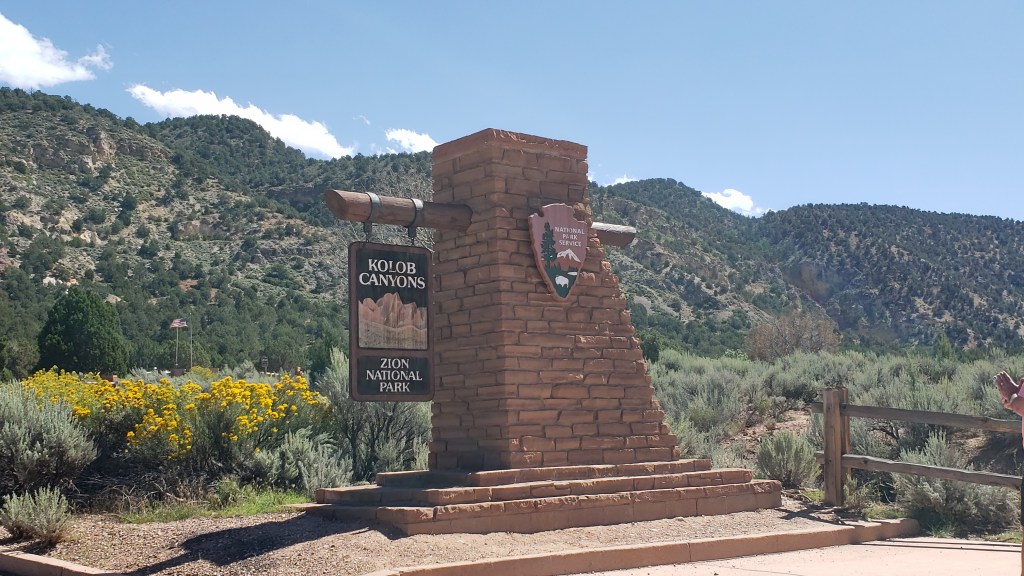
The single exception was Zion’s Kolob Canyons on the north end of the park, and with that, the plan fell into place.
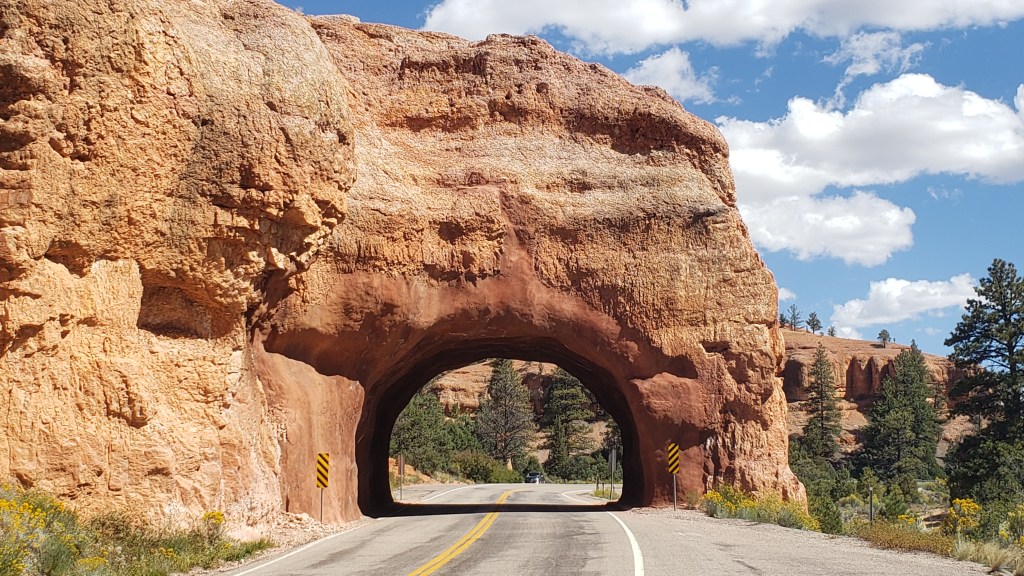
Bryce Canyon contains the largest collection of hoodoos in the world, and while we’d seen a LOT of canyons over the past weeks, this one promised something different. Even before we reached the park, we passed through the ridiculously gorgeous Red Canyon on Scenic Byway 12, which almost would have been enough on its own.
Not as small as Needles Eye, but still rather exciting.
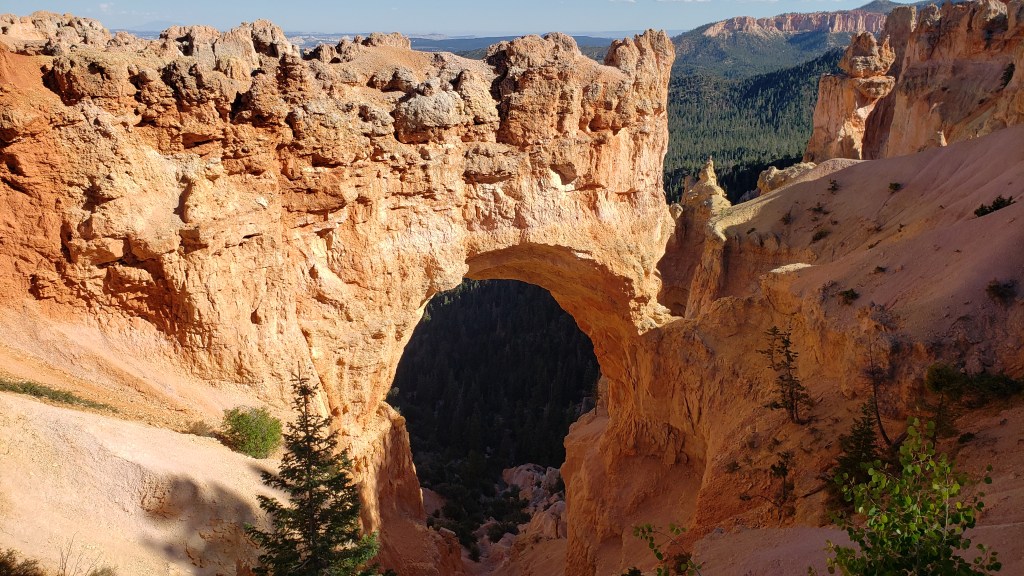
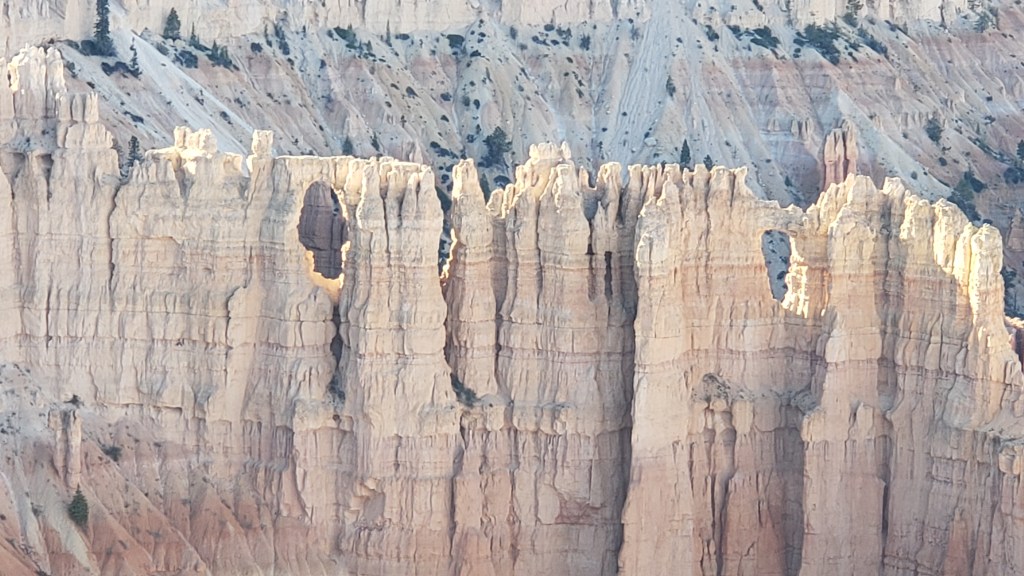
From the Badlands in North Dakota to Utah’s magnificent landscapes, we’ve repeatedly said, “How did that happen?” The short answer is, wind, water, and time. The longer answer in Bryce is, its distinctive formations began as flat rock on an ancient sea bed, uplift of land that created plateaus, which then weathered into “walls” with vertical gaps between them, then into “windows” (big holes in the rock, like we saw in Arches), and finally into the oddly-shaped, sticky-uppy hoodoos we see today.
Each of the park’s overlooks offered a different perspective:
Natural Bridge (elevation 8,627 feet) is an example of the “window” phase of the plateau’s erosion.
Obligatory selfie.
Hoodoos taking on their distinctive shape.
The park’s crownlng glory, Bryce Amphitheater. Click on photo for video
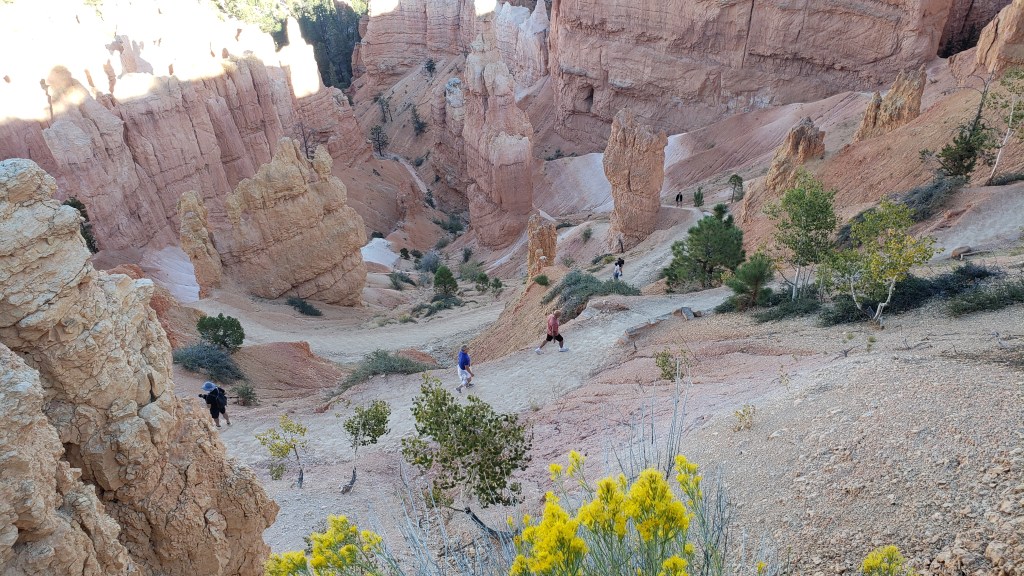
A pathway leads to the floor of the Amphitheater, but with temperatures at the summit in the 90sF, neither of us were prepared to endure the heat in the canyon.
We were put to shame when we caught sight of a bride and her groom hiking back up, with a photographer in tow. Anyone who has ever worn a wedding gown knows what a feat this was for the bride.
Everyone at the overlook clapped and wished them well as they rejoined their wedding party.
Kolob Canyons in Zion National Park was even more straightforward. An easy drive, entry with our America the Beautiful pass, and we were in. But only for three miles, as the scenic-drive road in the park was damaged due to a weather-related rock slide.
Ruthie really appreciated the cooler wind blowing through the canyon.
These 2000-feet-high canyon walls were pretty much all we could see, having walked a short stretch of the road beyond the barriers that were put up to prevent car travel.
It was a very limited way to appreciate Zion, but sometimes that’s how it goes, and with all the rock walls we’d seen in Utah, life was still worth living.
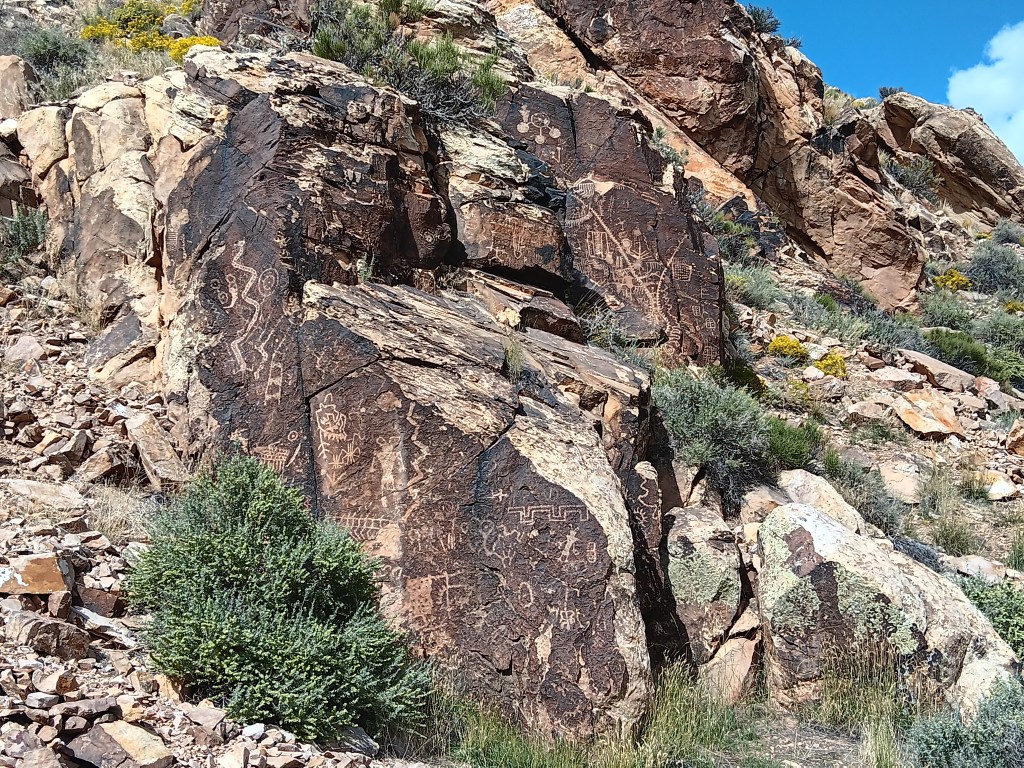
The next day we pointed Nippy north for a trip to Parowan Gap, a wind-and-water-created hole through a mountain that was used by Native Americans who left their stories etched into the deep crimson walls. And it was these petroglyphs that drew us to the area.
Other than three kids on motorbikes racing down the road, the gap was absolutely still and silent. We clambered around enjoying the petroglyphs, wondering at their meaning, and, in that stillness, it was easy to imagine nomadic tribes pausing to rest, play, soak up the beauty, and go about their daily lives.
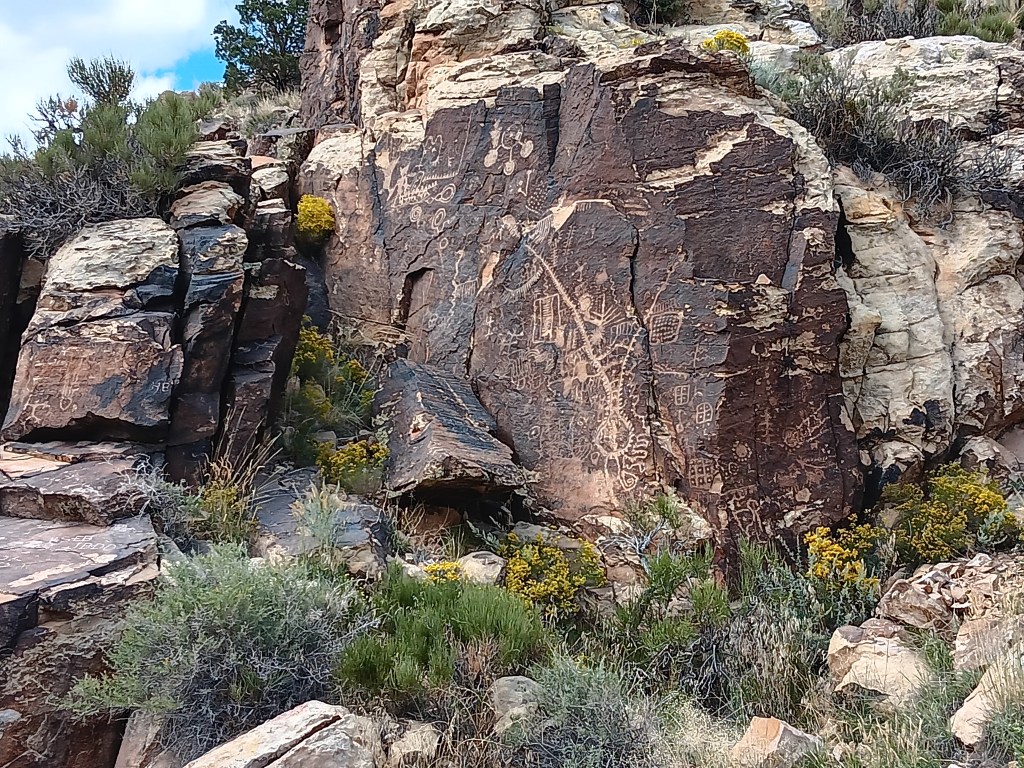
The petroglyph roughly in the center of the photo is now called the Zipper Glyph, for obvious reasons. Its meaning isn’t known, but it’s thought to be a marker of travel days, first one way then another, from the summer solstice (the circle at the bottom). It may have been used as a means of tracking where game would be throughout the seasons.
As we stood admiring a particularly large set of petroglyphs, the most haunting, soul-stirring sounds of an ancient flute melody gently caressed the breeze, and for a moment we could imagine it was an echo of the people who used the area for a thousand years.
Turn your volume up, listen closely, and you can hear the flute. Click on photo for video
Instead, it was Michael. Michael comes to the gap now and then to play his hand-carved flute, because, he says, he likes the acoustics.
The spirits of those who once passed through here like Michael’s playing, and he has had several encounters with them, he told us. It was easy to believe. Even Simon, who holds no particular belief in such things, agreed there was something special –and spiritual – happening in the gap.
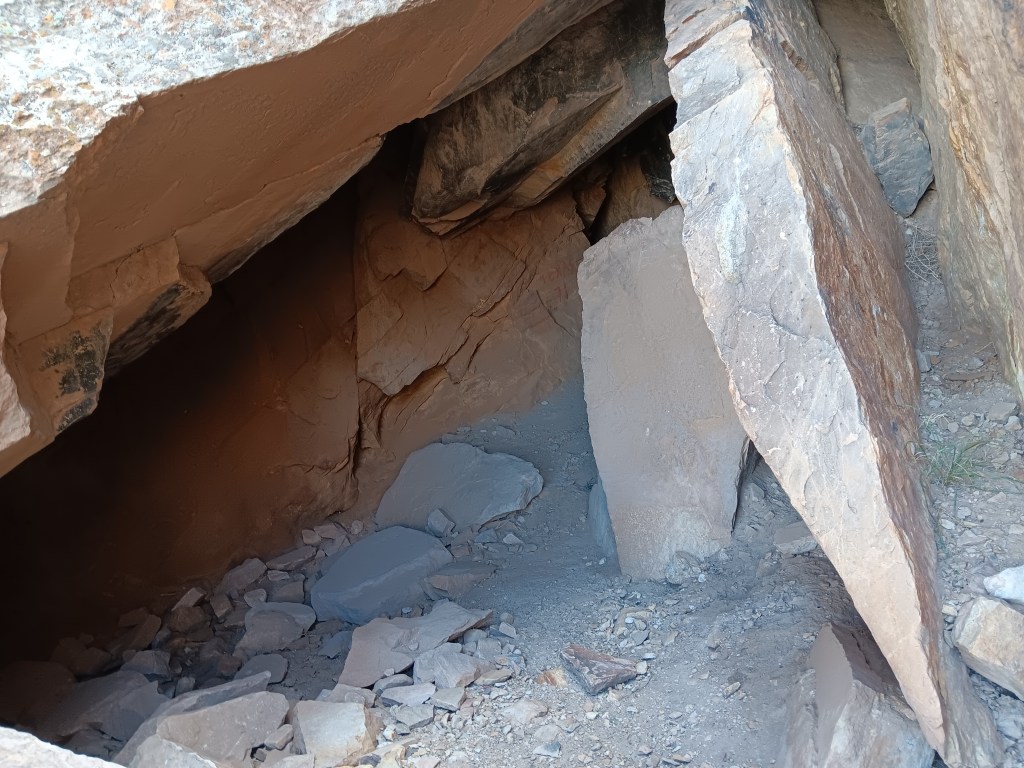
This cave entry leads to a place where the tribes’ shamans meditated during their time here.
I’m tempted to stop this blog here, and just bask in the memory of such an extraordinary experience. We did have a rather startling return trip that included an unexpected climb up a mountain range to a ski resort town called Brian Head (elevation 10K+) and a journey through Cedar Breaks National Monument…
…but let’s just let the memory of the flute music sooth us into a happy stupor, and call it a day.
Simon had been to the Grand Canyon, but Susan had not. The South Rim was on our schedule, but with the change in our itinerary in Month Two, we now had the option to fit in the North Rim as well. Could we make it happen from 156 miles away? You know we could!
Donkey’s years ago (“a long time ago” for our U.S. readers), Simon visited the South Rim during his first trip to the States. We had heard the North Rim was pretty special, and much less crowded. While it would be a very long day, we agreed to make the trip, reckless vagabonds that we are!
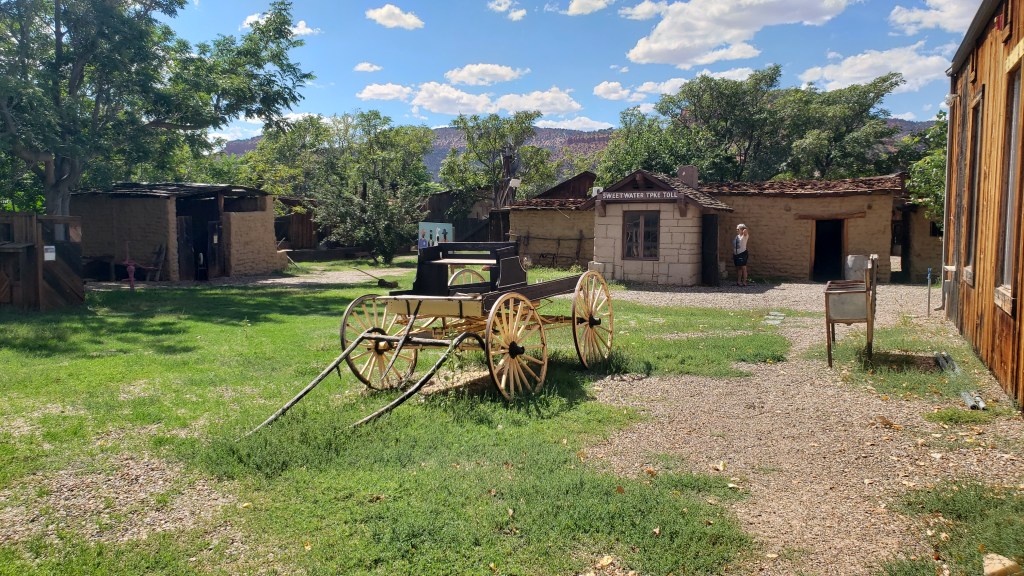
Our dear friend Richard recommended a stop at Little Hollywood Land in Kanab on the way to the North Rim, for its Western movie props. Simon was all in; he absolutely loves that sort of thing.
Little Hollywood is as kitschy as it comes. Homespun, quirky, it’s a curiosity for those who don’t know the old Westerns well, and if the AARP-aged man visiting with his son and pointing out all the little details is anything to go by, it’s a delight for those who do.
Some of the movie location props we saw were:
The backdrop for Kenny Loggins Live from the Grand Canyon concert in 1991
The barn and homestead sets used in the Clint Eastwood movie, Outlaw Josey Wales
The barn
Inside the homestead
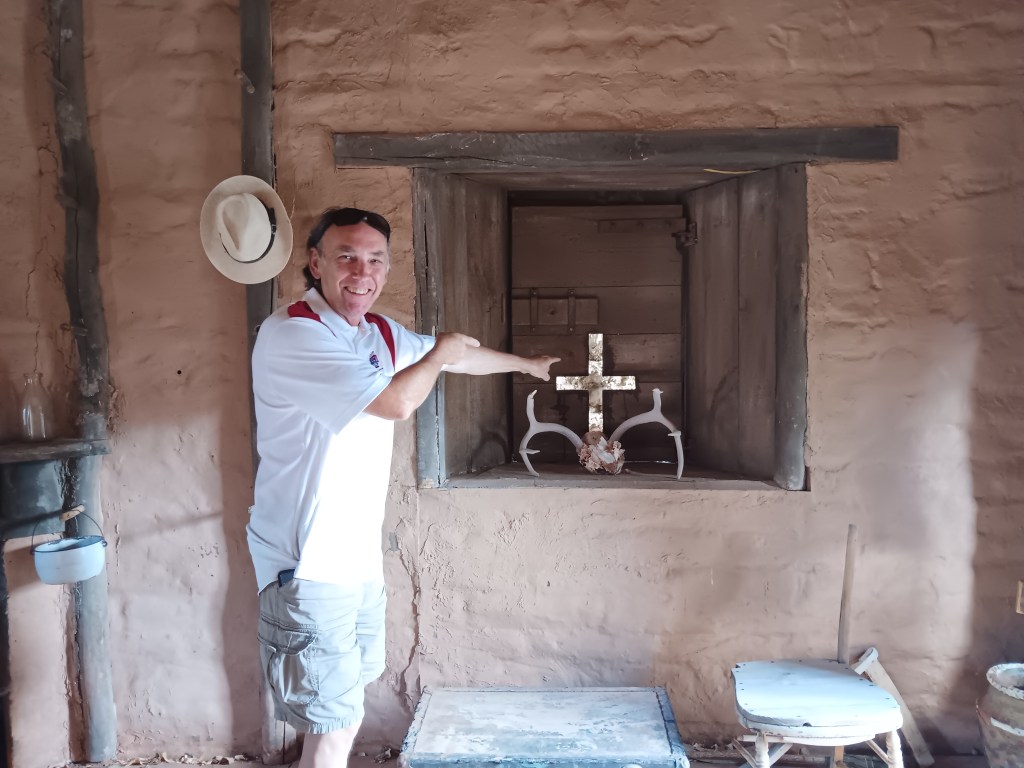
Simon, pointing at the cross-shaped window that featured in the movie’s final, dramatic gun battle.
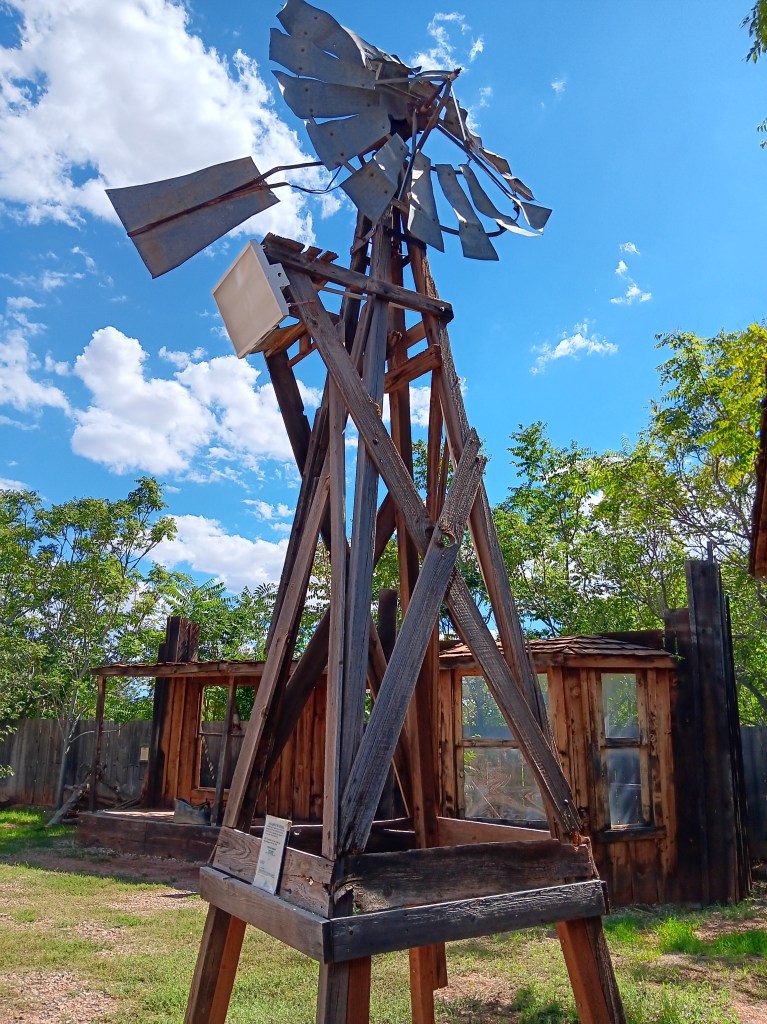
And many more, along with a smattering of atmosphere props
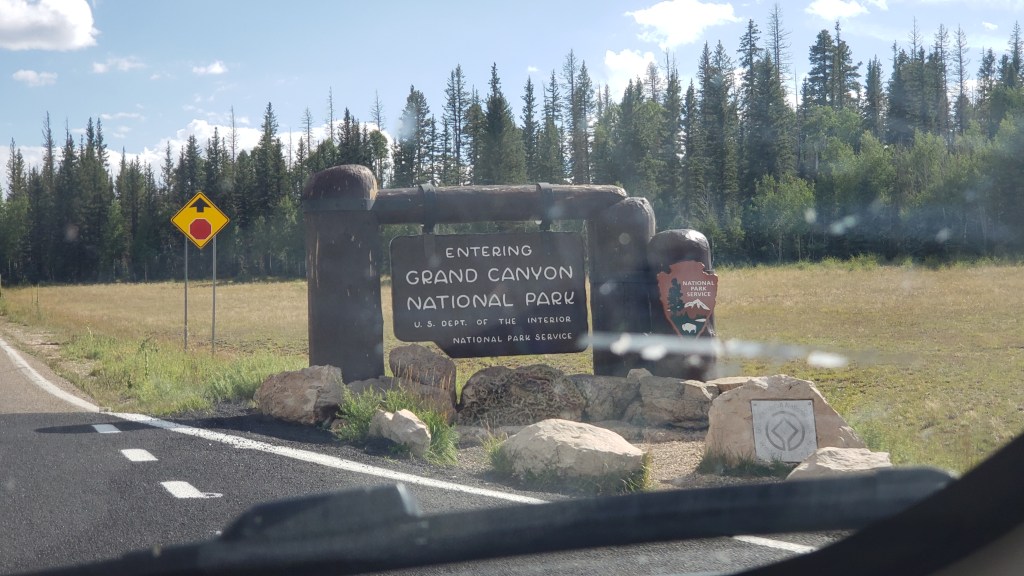
The drive to the Grand Canyon felt like it took forever once we left Kanab. This is pretty much what we saw the whole way:
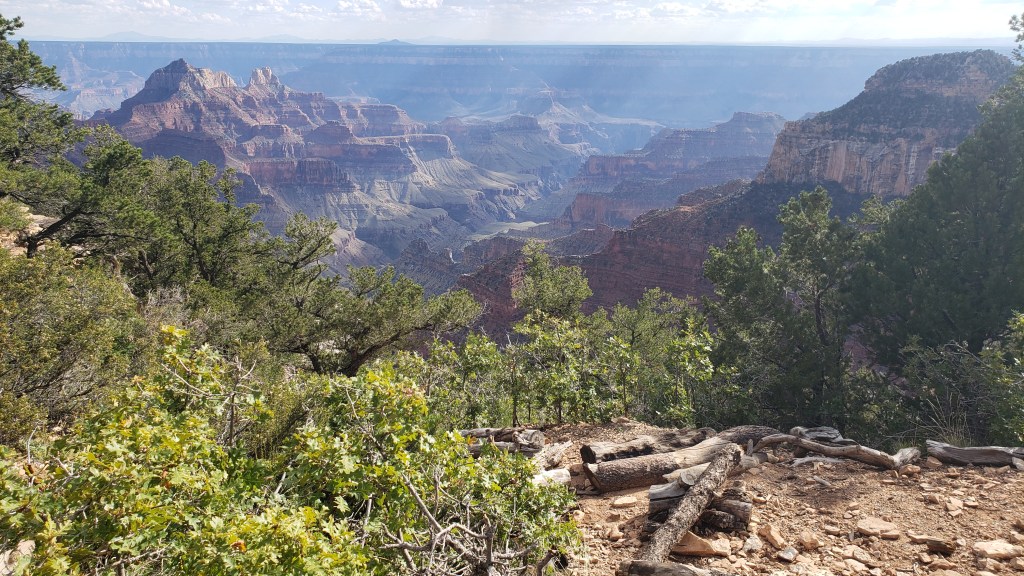
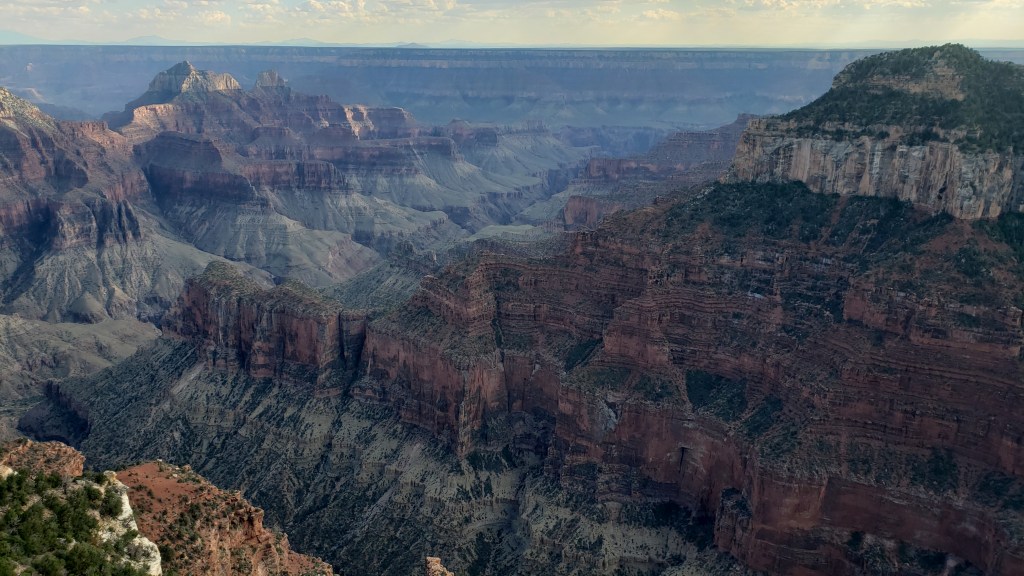
But once we arrived, the WPM (Wows Per Minute) cranked right up. We took the advice of previous visitors and made the drive from the entry straight to the end of the scenic road, then drove back and stopped at the overlooks, which were now on the right-hand side of the road, saving us from having to cross traffic to get to them.
It was the right decision. There was some pretty dicey roadway those last four miles, with big drop-offs and no guard rails, so it was better to get that over with quickly so that Susan could enjoy the rest of the visit.
Again, it’s impossible to get the scale. You’ll see people part-way into this video, which helps give some perspective.
Click on photo for video
The “mood” of the canyon changes, depending on how the light hits it, and this has always been something that intrigues me (Susan). Some might say I relate to “moody,” but that’s a discussion for another time.
Simon scampered around the park like a squirrel on a mission, taking all the narrow pathways and leaning out over all the railings, and as part of his exploration he discovered a room inside the lodge where guests staying at North Rim check in for their accommodation.
The room had huge windows overlooking the canyon, and while it was right on the edge of a drop-off, like most overlooks are, he took me by the hand when I returned from getting Ruthie settled in the car with some water, and said, “Come see this.” I’m SO grateful for that loving gesture, which gave me a view with a sense of safety.
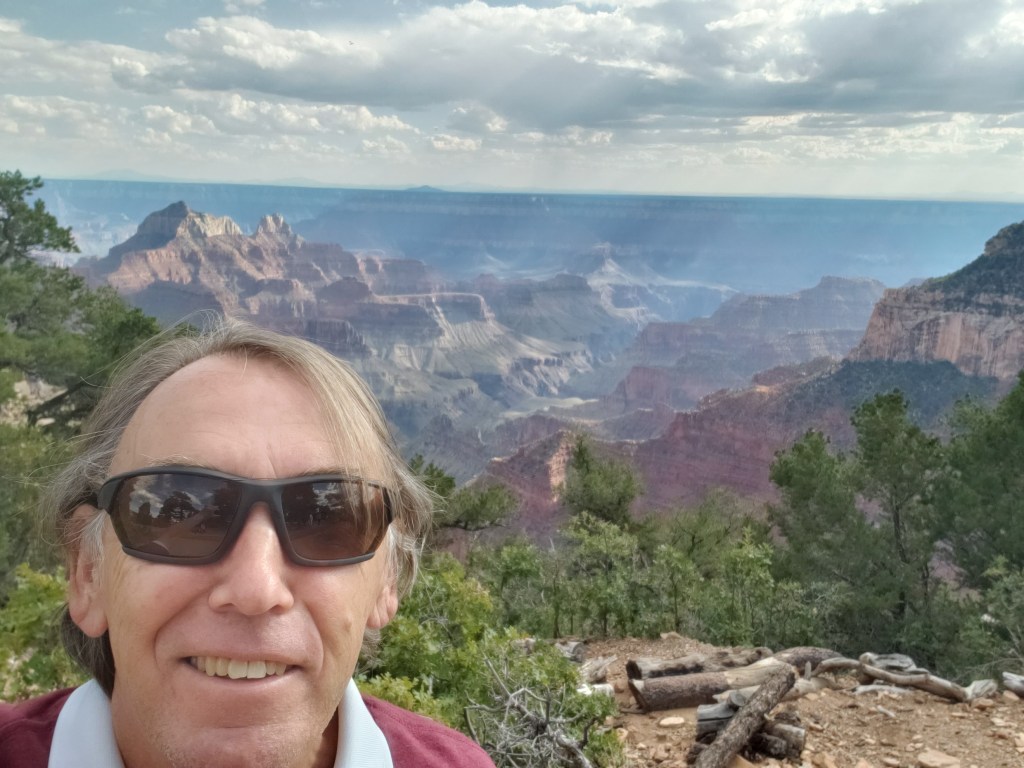
This is an incredibly proud moment. Tears may have happened.
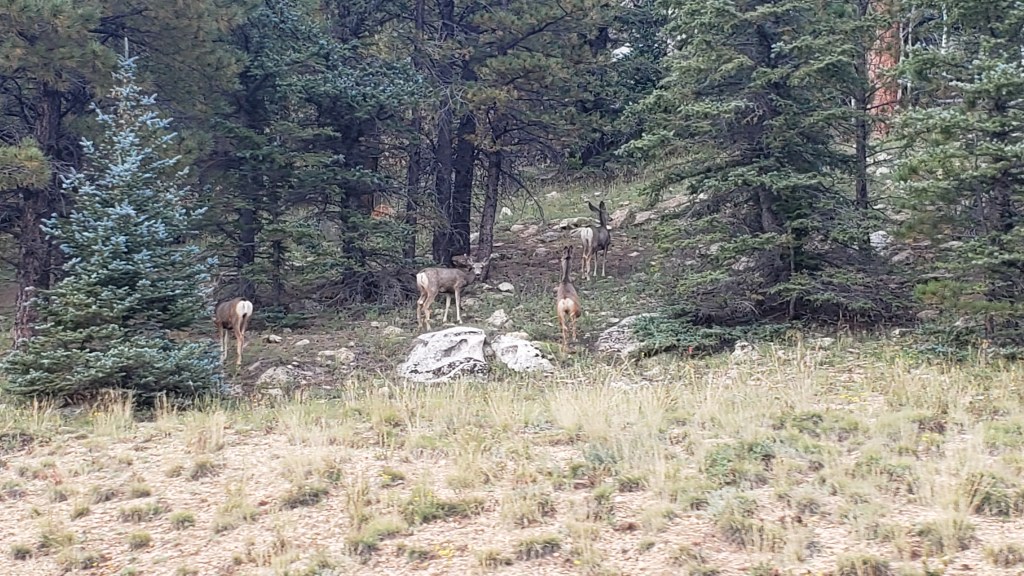
On the way out of the park we were treated to a wildlife sighting, which capped off the day just right.
Mule deer doing mule deer stuff
We had two more major National Park experiences coming up, and one unexpected mini canyon. While it was nowhere near as grand as the Grand Canyon, the emotional impact of little Parowan Gap would prove immense.
When it comes to mind-blowing scenery, Utah looks at all the other states and says, “Hold my beer.”
From its gargantuan red-rock mountains that glow as if lit from within to world-class National Parks featuring formations you can hardly get your head around, Utah takes the WPM (Wows Per Minute) and cranks them up to eleven.
Warning: There will be a lot of photos of rocks in this blog. Get coffee or tea, or something stronger. We’ll wait.
After a Wallydocking in a Walmart parking lot the night before, our next stop was a golf course campground in Payson, Utah, where we parked Fati for four days, two of which we spent 150 miles away with a couple of nights in a Green River hotel within striking distance of Arches National Park, Moab, and Canyonlands National Park.
The drive to Green River was every bit as scenic as anything we would see beyond the paid-for side of a National Park entry gate. Highway 6 goes through the Wasatch Mountains, delighting us with a dazzling array of towering rock formations in endless shades of red; rolling yellow hillsides; and bare-rock mountain tops.
What planet are those rocks from? Otherworldly.
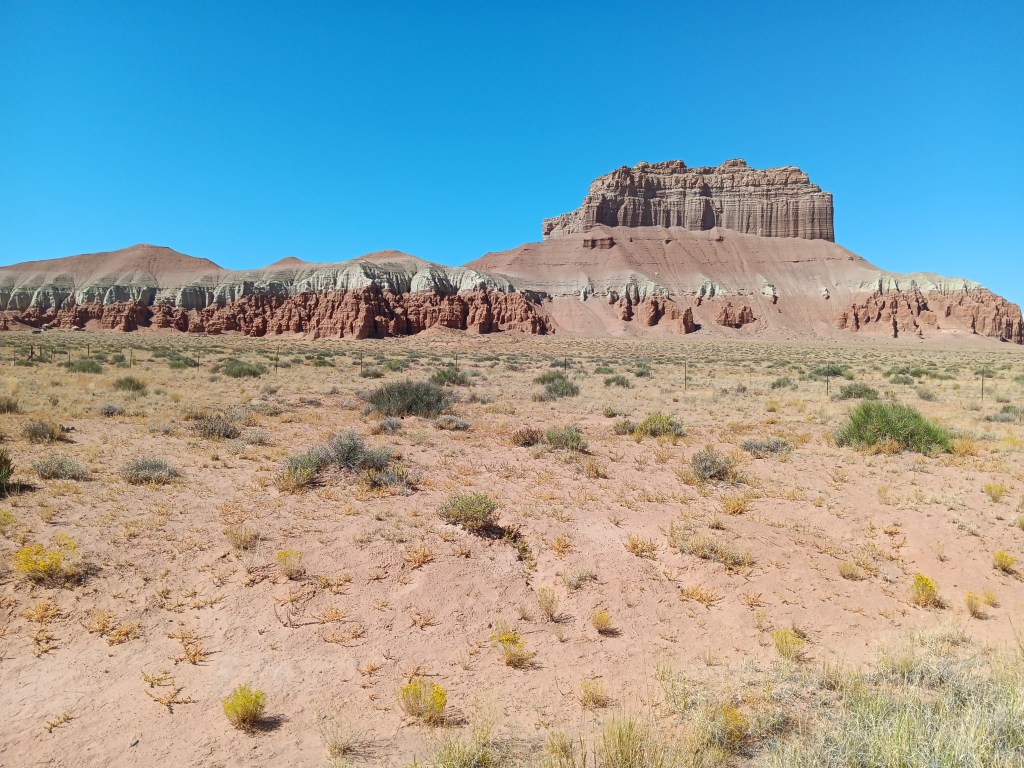
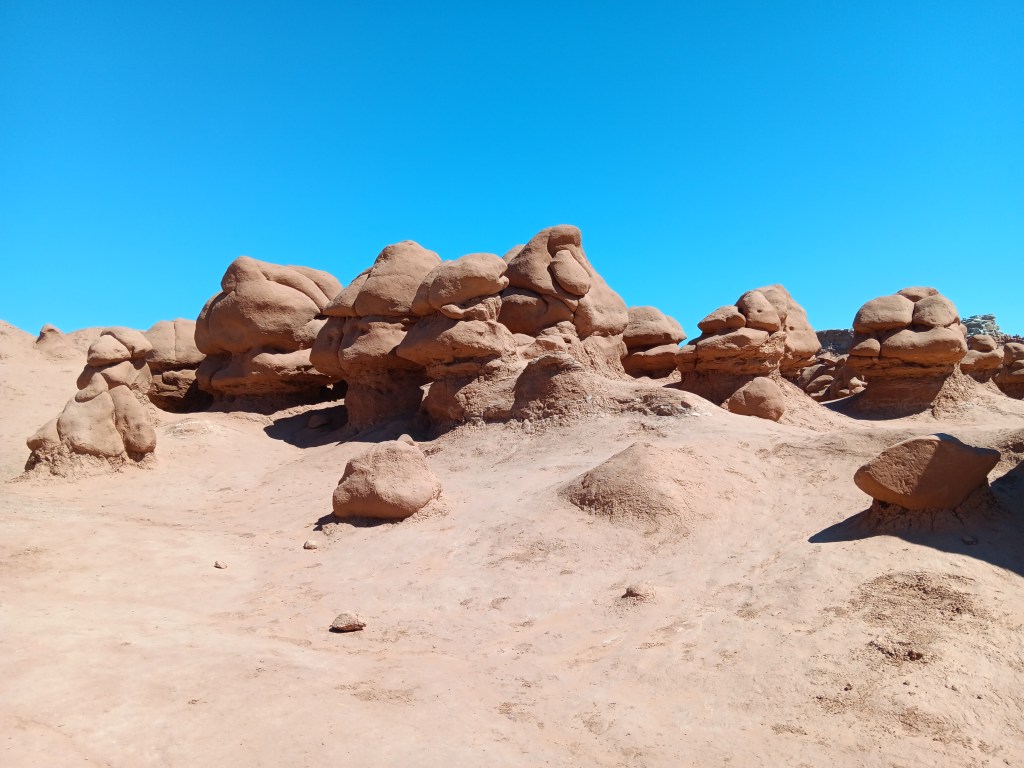
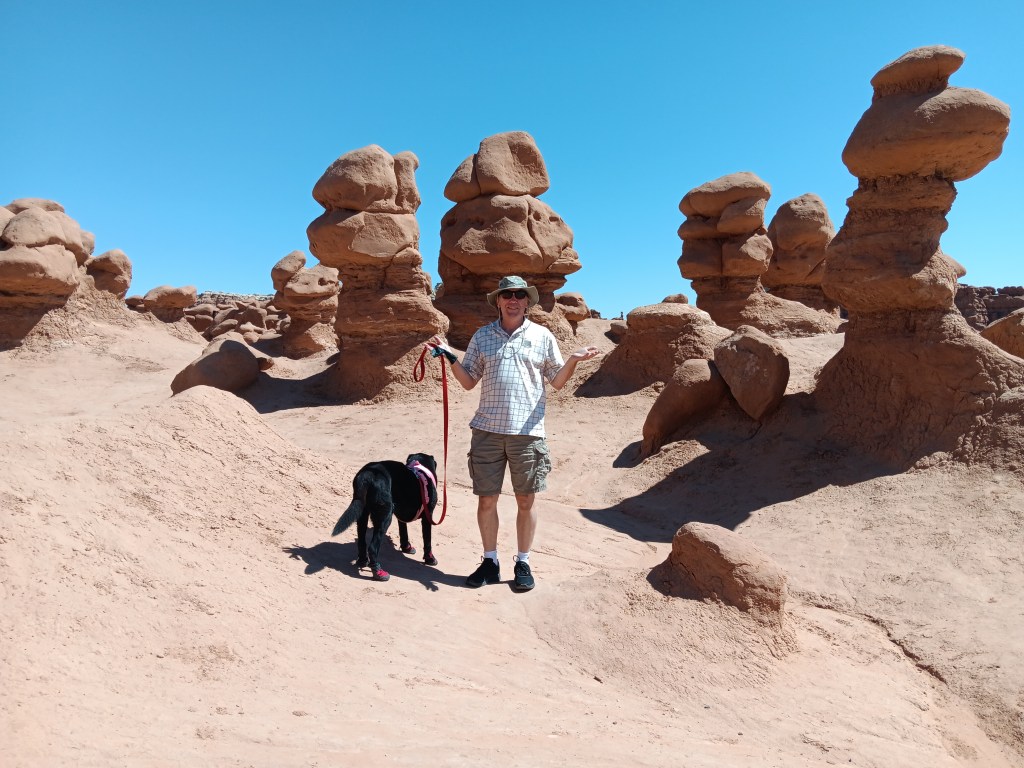
Before checking in to the hotel for two nights, we made a detour to the charmingly named Goblin Valley State Park, a three-square-mile valley filled with adorable Entrada sandstone “goblins.” Their official name is “hoodoos,” but the formations that don’t look like giant potatoes do have a sense of bulbous-headed gremlins about them.
As we drove down the road toward the park, one rock feature in particular caught our attention. From far away, it looked like the Ritz Carlton hotel in Orlando. Closer up, it morphed into the Jedi Temple from the Star Wars movies. Ancient, abandoned, filled with a quiet sadness, it told a story that spoke to something in Susan’s psyche in a way other mountains had not.
Ritz Carlton Orlando or ginormous rock structure? You decide!
Is it just Susan that sees the Jedi Temple? It’s okay to say if it’s just Susan…
Once in the park, the temperature was too hot for Ruthie to go hiking for long, but we spent some time wandering the first of three valleys, and felt we’d more than gotten our money’s worth.
If these are goblins, that last photo is the Jedi Temple. Don’t argue with me (I mean, Susan) about this!
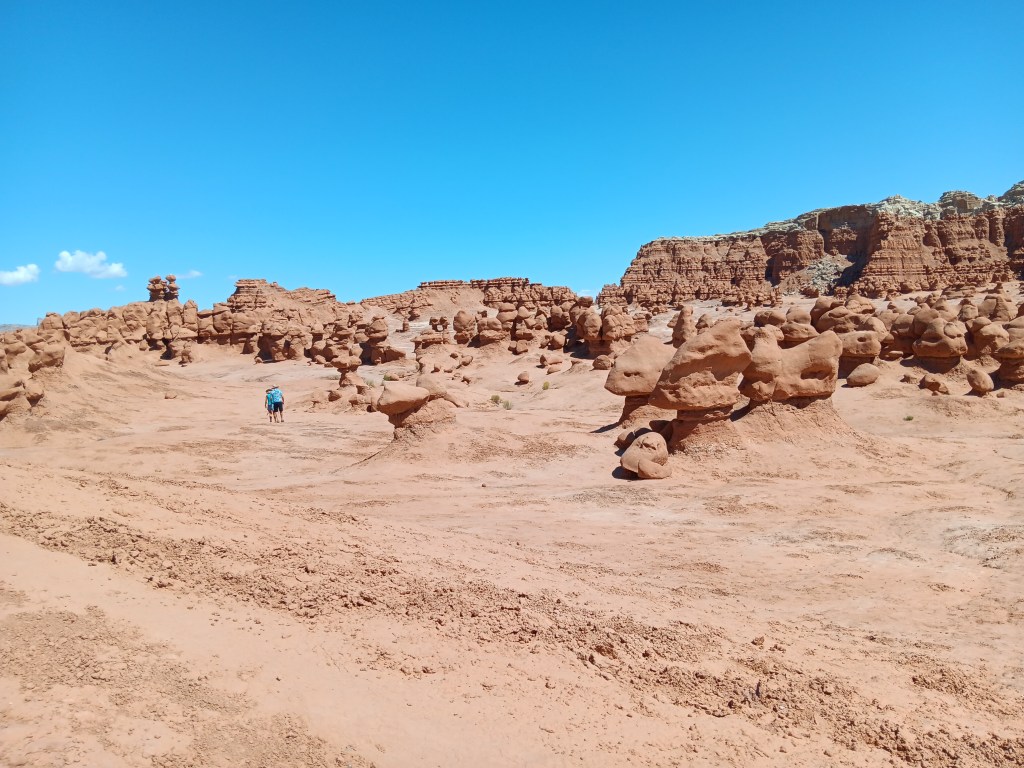
Tiny people giving some perspective to the scale of this place.
From the valley floor to the heights of a butte far above the Colorado River, Canyonlands National Park was our next stop, for its Islands in the Sky scenic drive.
By now you know this sort of territory is pure bliss for one of us and extremely challenging for the other, but we didn’t come all this way not to see these spectacular parks, so we each enjoyed the views from within our personal comfort zones.
Click on photo for video
Click on photo for video
The road you see in the second video, above, is the Shafer Trail, and it’s not a walking trail. It’s a crazy-person driving trail, and we have reliably heard that one man’s wife nearly jumped out of their truck from pure fear when they mistakenly took that road instead of the tourist-friendly scenic drive. Thrill seeker? This is your road!
Simon will post a video of that road in use on our YouTube channel (Veness Travel Media), so be sure to look for it soon (and subscribe!). You may want to put on brown pants before you watch, because…d@mn!
We’ll let you enjoy the overlooks as we saw them.
Islands in the Sky mesa is 1000 feet down from where we were standing, and this canyon is another 1600 feet down. A trail leads to the bottom of the canyon, but we didn’t take it (as if we have to say that!).
It’s like the earth just shattered.
The next morning we set off for the town of Moab, just on the edge of Arches National Park. We couldn’t enter the park until 3 p.m. due to its timed-entry reservation system, and our time was later than we would have liked. We had previously scored a morning entry for another date, but had to give it up when we changed our original itinerary.
But the Moab Visitor Center lady not only showed us how to modify our reservation on our phone, which got us in an hour earlier, she also recommended we visit Potash Canyon until our entry time arrived. And golly Bob howdy, were we ever thankful for her recommendation!
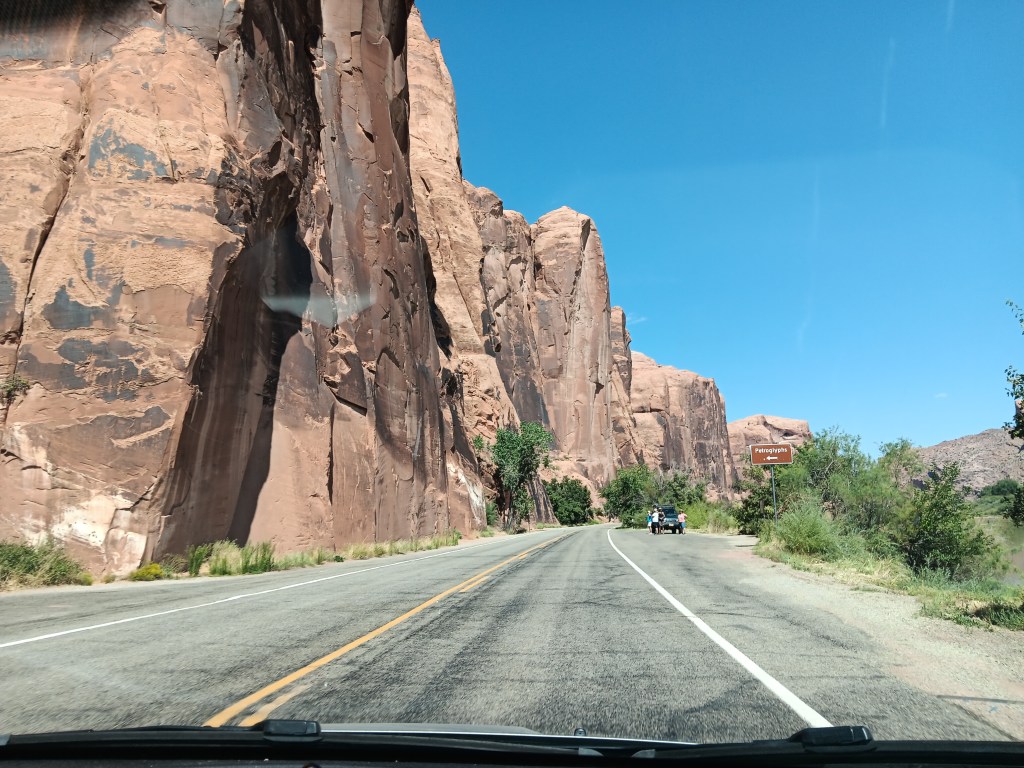
Just driving through the canyon was scenic enough.
This gives you an idea of how high the canyon walls are. The people on the side of the road are looking at something pretty special, and we’ll join them in a minute.
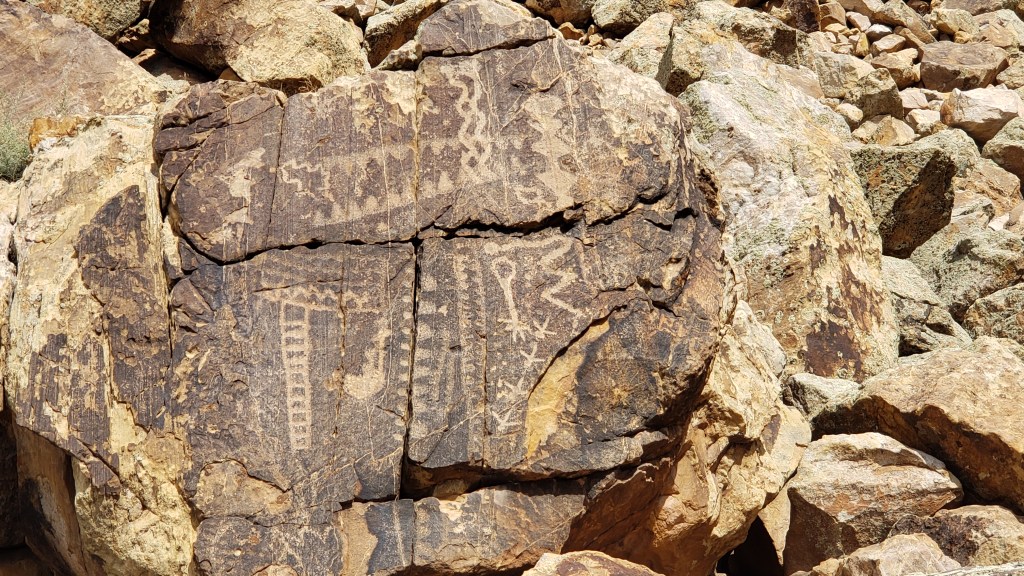
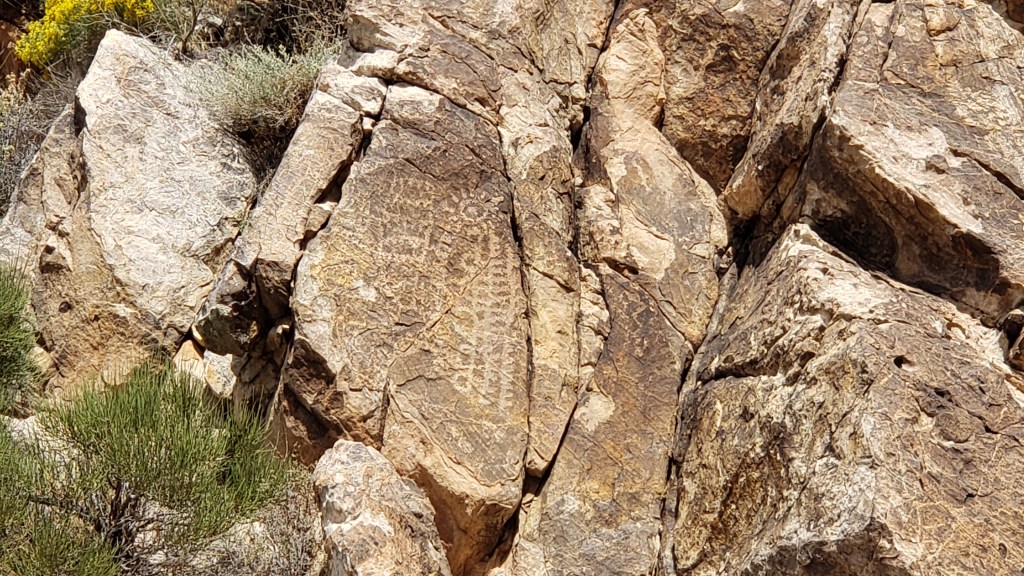
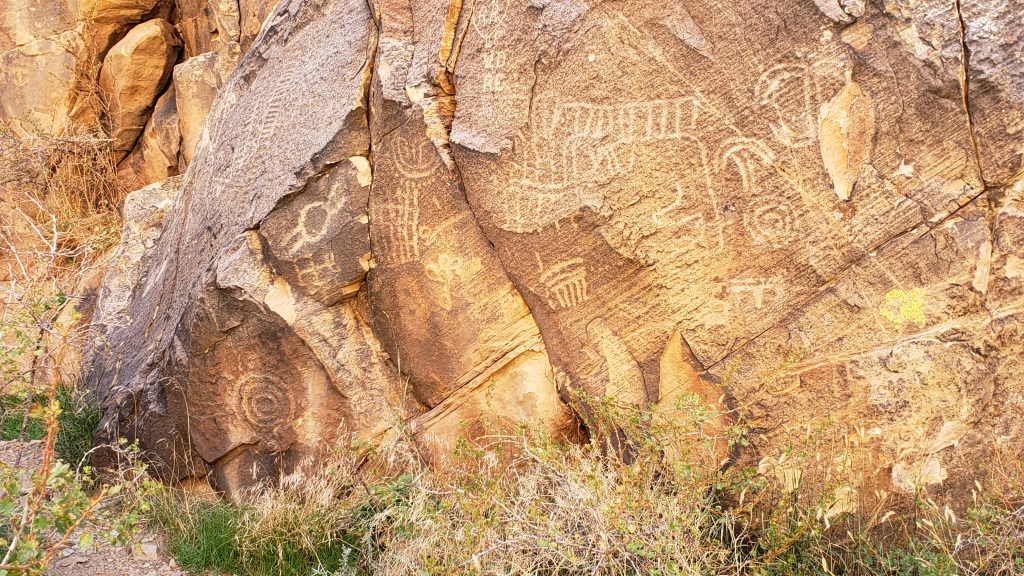
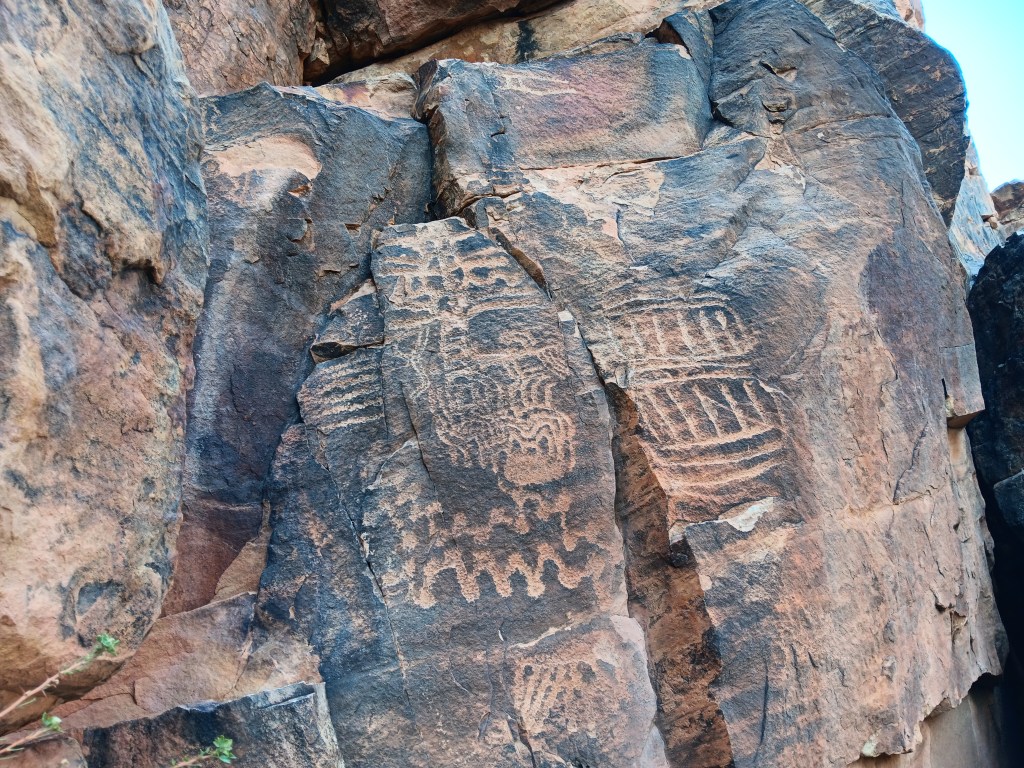
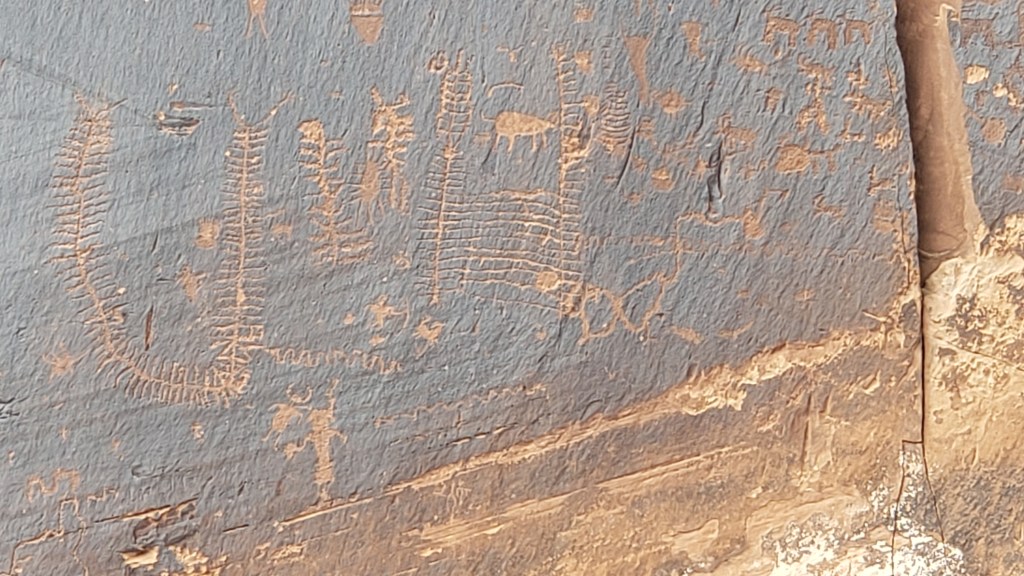
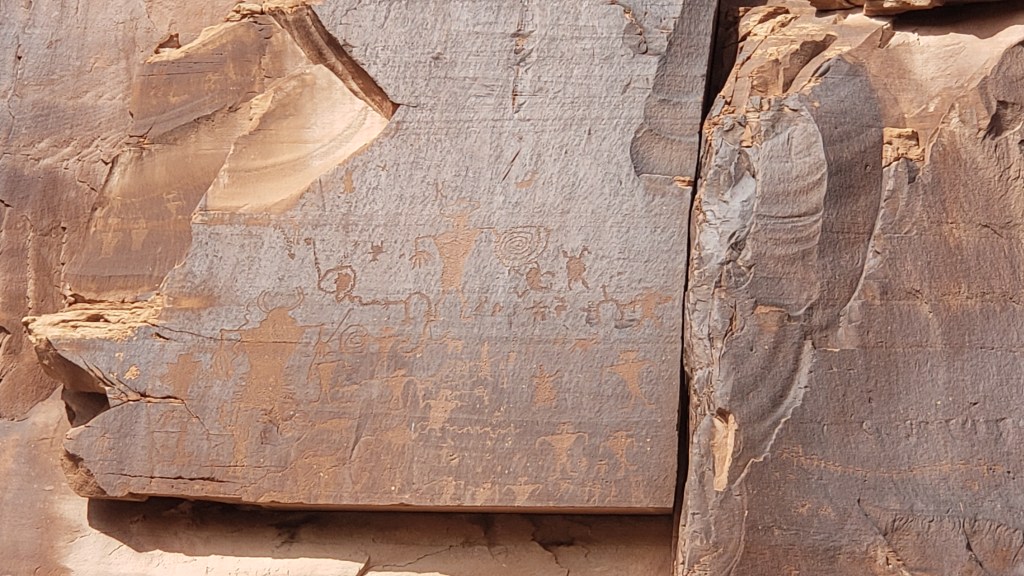
The Potash Road drive was a “trip back in time,” to use a very overused phrase. Turnouts along the road allowed people to stop and admire the petroglyphs etched into the sandstone mountainside, primarily by the Freemont tribe, between 600 and 1300 A.D.
The petroglyphs here were mainly markers of time, but also included bears, snakes, bighorn sheep, and other figures.
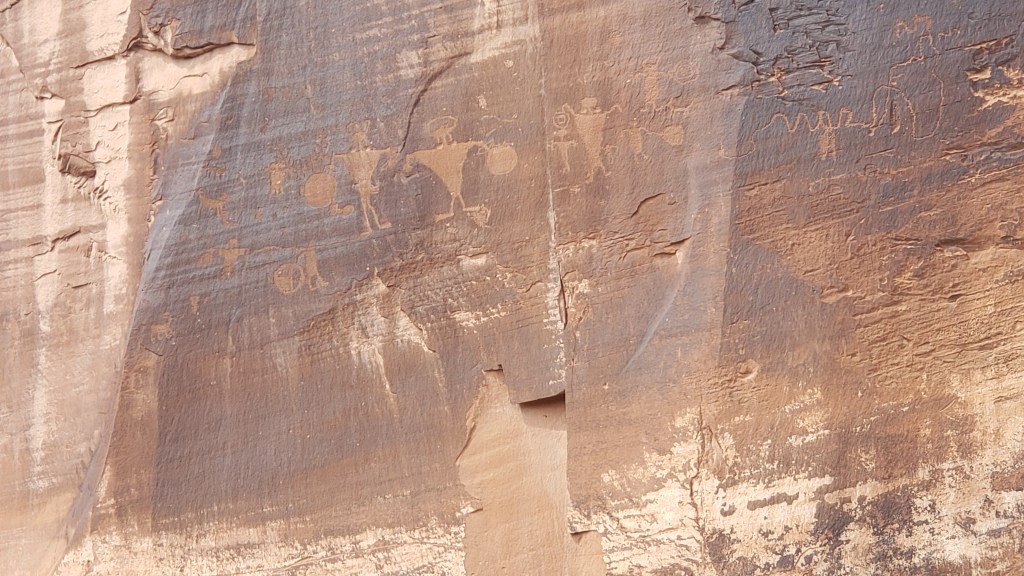
Warriors in these petroglyphs are holding shields. Some are also holding hands, showing how the people formed human chains to round up whatever animals they were hunting.
You can just make out the human figures dressed in horned headgear and what look like triangular costumes.
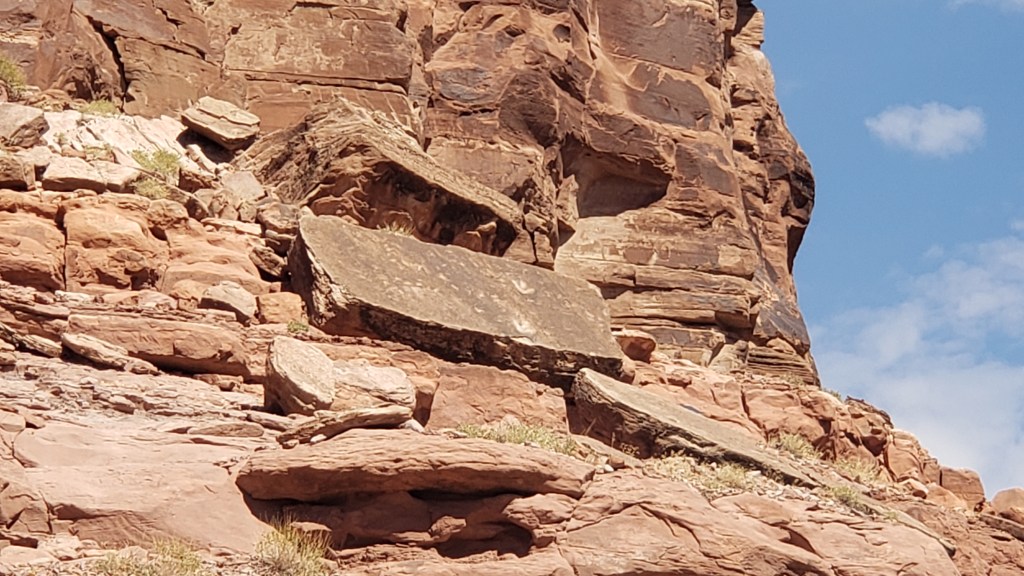
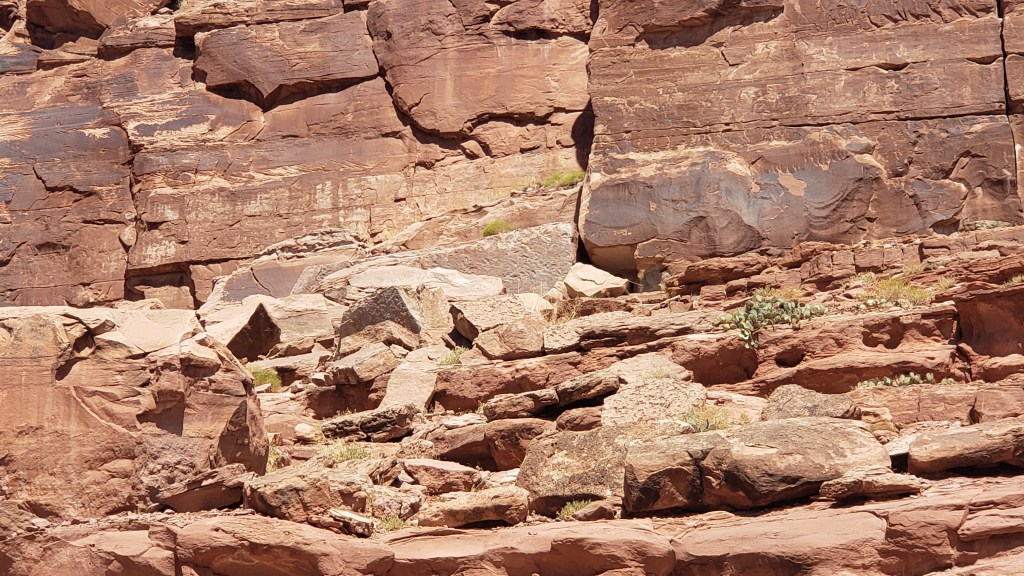
Further along we found Poison Spider Dinosaur Track site, where a scramble up the boulders rewarded scramblers with up-close views of dinosaur tracks left during the Jurassic era. It was much too hot for a long hike, and Ruthie couldn’t even do a short hike over those boulders, so we experienced the footprints through our binoculars, and snapped a photo of the ones that were easiest to see from the parking area.
The two small, white things that look like three-toed prints on the right-hand side of the rock facing outward are dino footprints.
It’s hard to make out amid all the boulders, but see that flat slab that looks like concrete, standing upright, facing forward (smack in the middle of the photo), to the left of the darkest part of the canyon-side and above smaller white/gray boulders? There are lots of tracks from a small dino on that slab. You can see why Ruthie (and we!) couldn’t quite get to them.
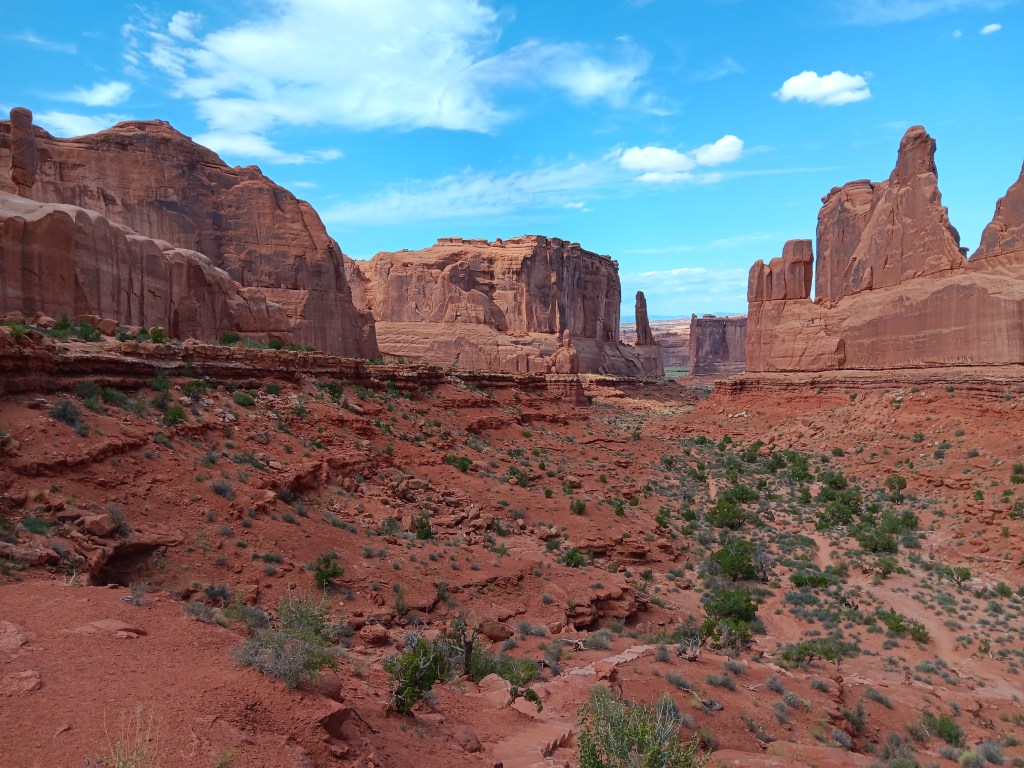
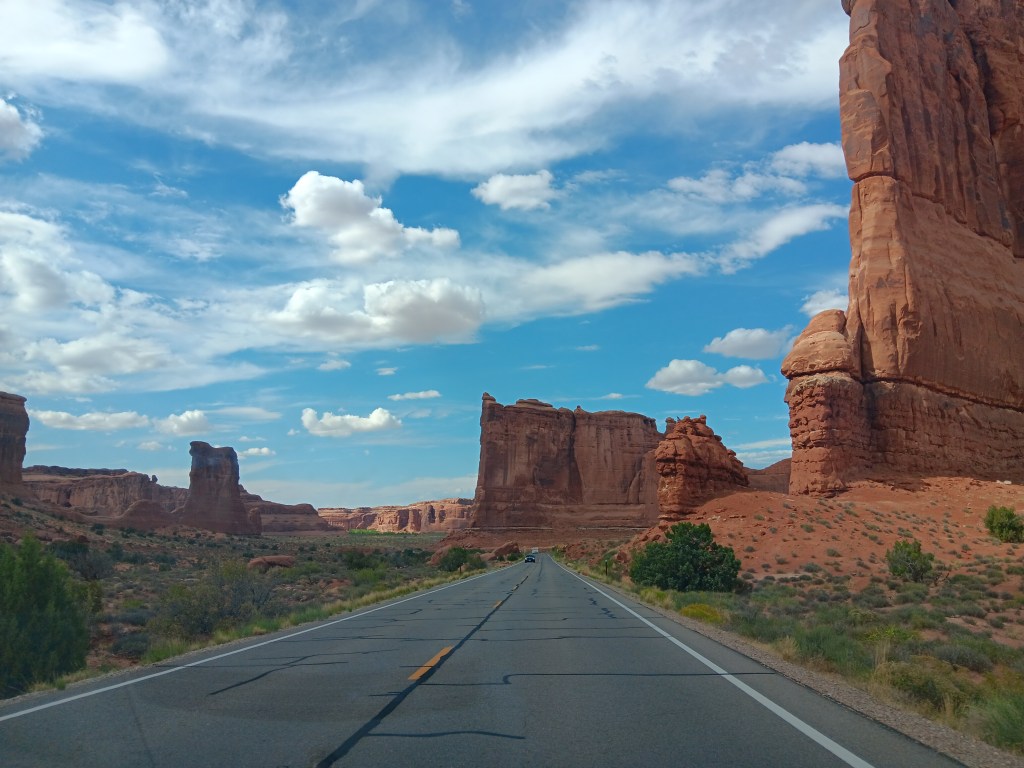
When our Arches timed entry arrived, we made the winding trip up to the plateau from which the park’s features could be seen. We’ll leave you to enjoy the highlights…
This is taken from about 500+ feet above the bottom of this little canyon. You can just make out a lighter-colored hiking trail leading down to the bottom.
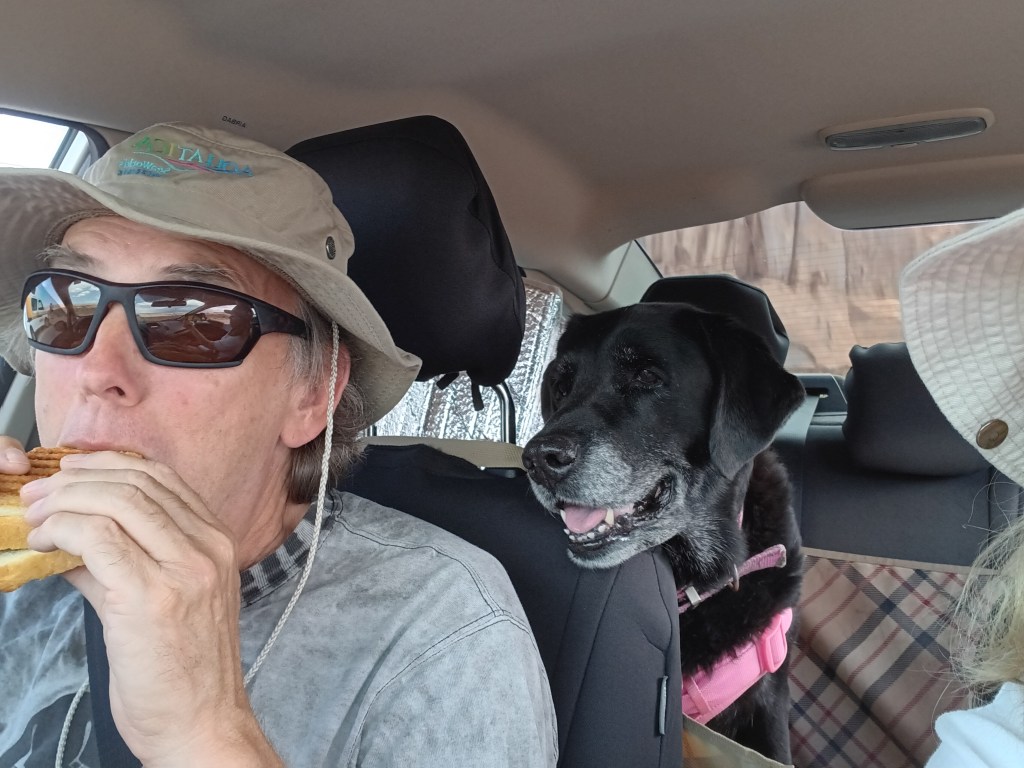
We stopped for a bite of lunch with a view. Two of us were happy. One of us was not.
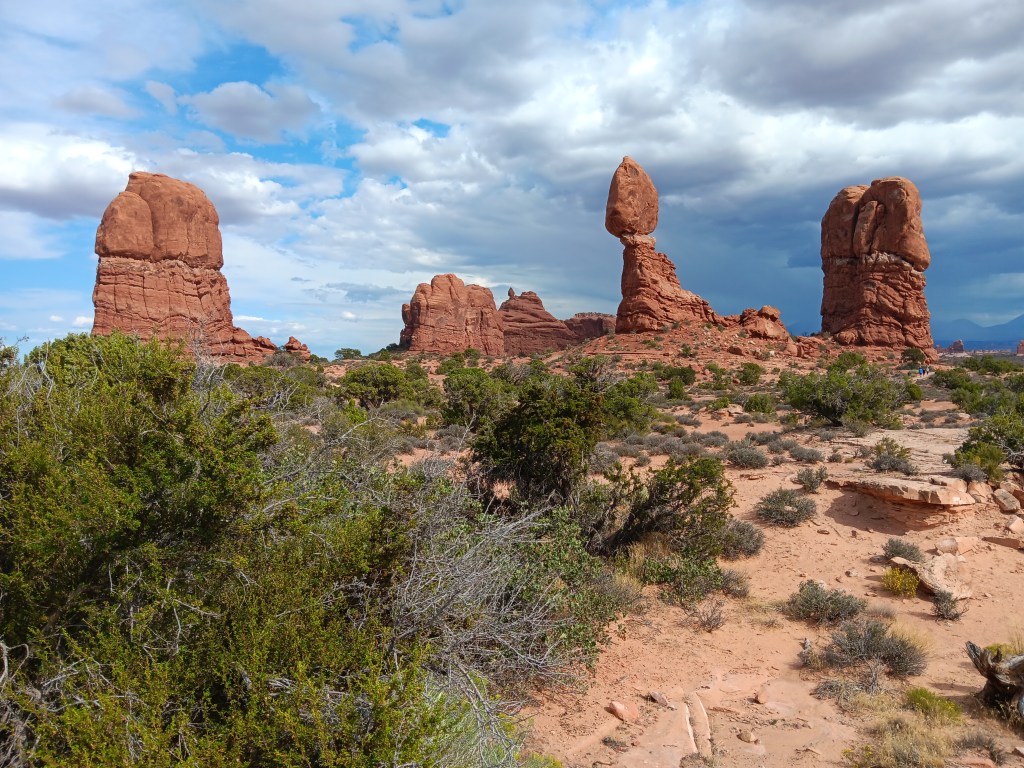
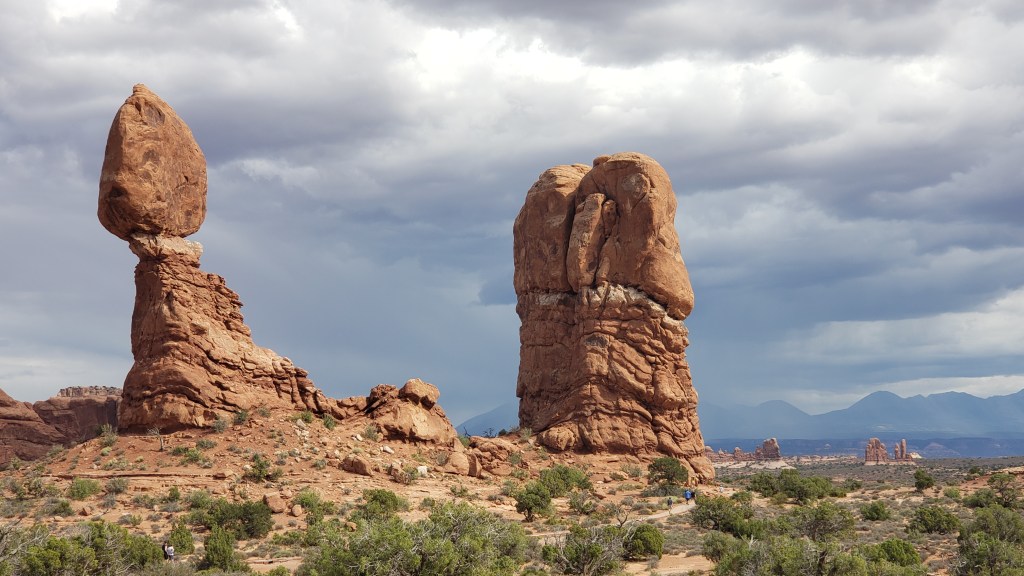
This famous formation is Balancing Rock. It’s near-neighbor, Chip (as in, Chip off the ol’ block) toppled over in 1974.
The broken “pedestal” to the right of Balancing Rock is where Chip used to be.
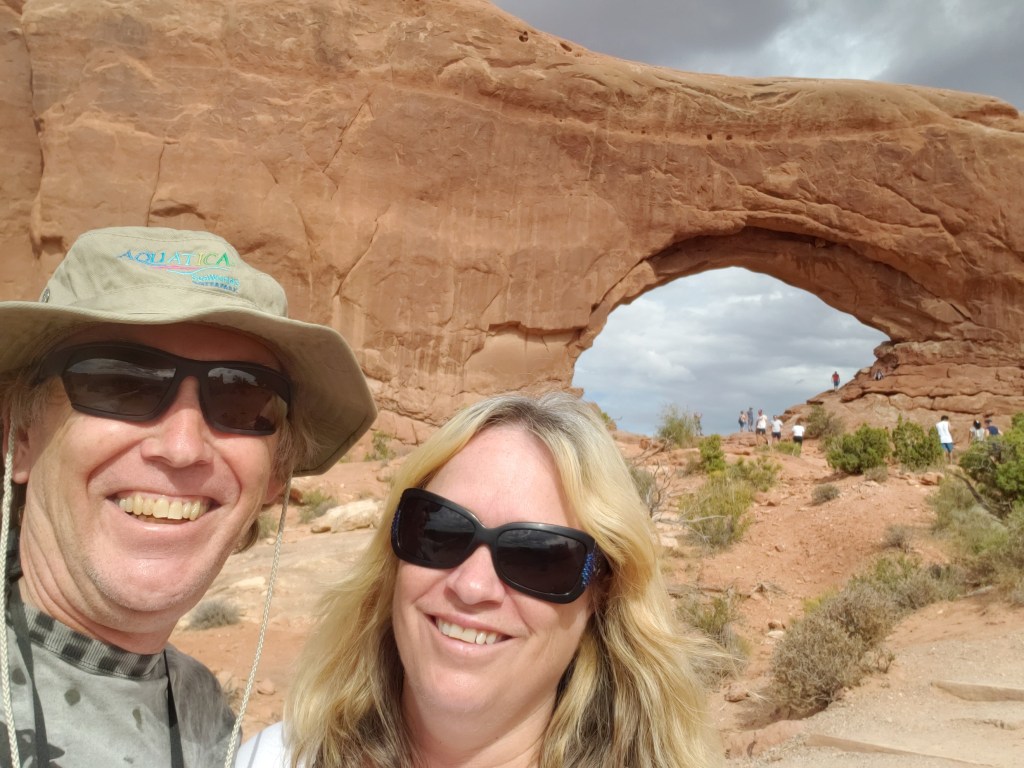
We did make the long, hot, uphill walk to the arch. Here, we’re just starting to wear out.
There are signs everywhere telling people to stay off the delicate sandstone. Naturally, that rule doesn’t apply to SOME people, like those nature-wreckers on the far right side of the inner arch. Don’t be them!
Because he can’t help himself.
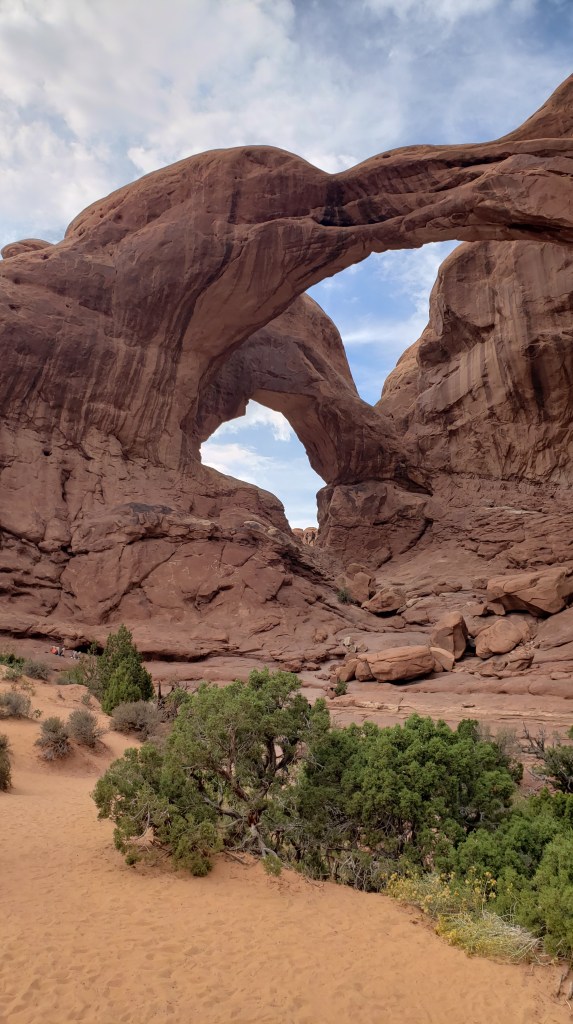
This is Double Arch. It looks pretty big from here, but…
…it’s huge. You probably can’t see them in the photo, but there are people climbing on the rocks inside the arches. That’s how big it is.
We spent a long time in the park, doing little hikes and marveling at the immensity of it all. But something even more immense was on our radar, if we could just make it happen.
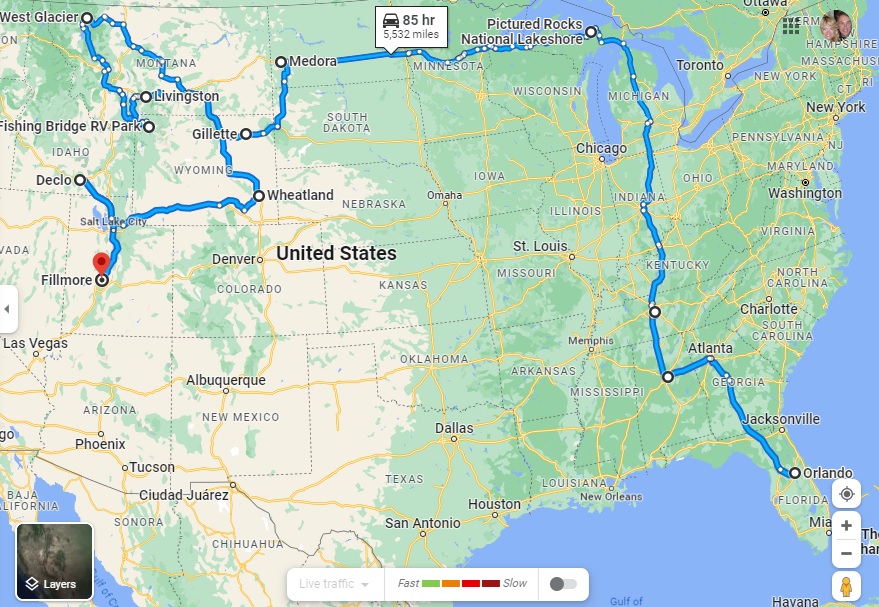
Highlighting our fourth month on the road and the route so far – all 5,929 miles of it
After three months of fairly hectic traveling, our four-month mark shows that we have come the shortest distance for any month of the grand RV trip to date, from Wheatland in Wyoming to Fillmore in Utah (via what looks like a strange detour to Declo in Idaho, but which was the best way to see some of Idaho without putting too many miles on our RV).
Our mileage for Month Four was therefore just 868 miles, compared to 1,318 last month, 1,239 in Month Two and a whirlwind 2,504 in the opening month.
The total distance in Indefatigable (or Fati for short) since we left Orlando is now 5,929 miles.
The slower pace has been deliberate, of course. We realized that we were trying to pack too much in to this crazy 10-wheeled adventure and we have purposely changed both our itinerary and our pace of travel to avoid the mental and physical breakdowns we experienced in the first two months.
The key has been to identify an area that allows us to explore in multiple directions for a week or so, and then use our tow car, Nippy, to do more of the exploration.
To that end, we have actually gone an additional 9,621 miles in Nippy in those four months, almost 3,000 of them in the past month alone. That total includes a spur-of-the-moment trip into Canada from Montana, our overnight excursion to Rocky Mountain State Park in Colorado and an extensive day trip to the Flaming Gorge in Utah, both from Wyoming.
Our total mileage for the trip so far is therefore a whopping 15,550, or 3,887.5 a month!
The next month could see us top that record for Nippy, too, as we plan on basing ourselves in southern Nevada for trips into Southern California. As ever, this is an – ahem – moveable feast, but you can be sure to read all about it here!
If there’s a massive crack in the earth, Simon wants to explore it. Southern Idaho seemed to be riddled with them, from the modest Box Canyon to the gargantuan gorge in Twin Falls, a rift so long and deep it had become a world-renowned location for the extreme sport of Base Jumping.
We had a long day in store as we left Fati at the campground and drove west, with Box Canyon State Park, Thousand Springs State Park, and Bruneau Dunes (the tallest single-structure sand dune in North America) as our goals.
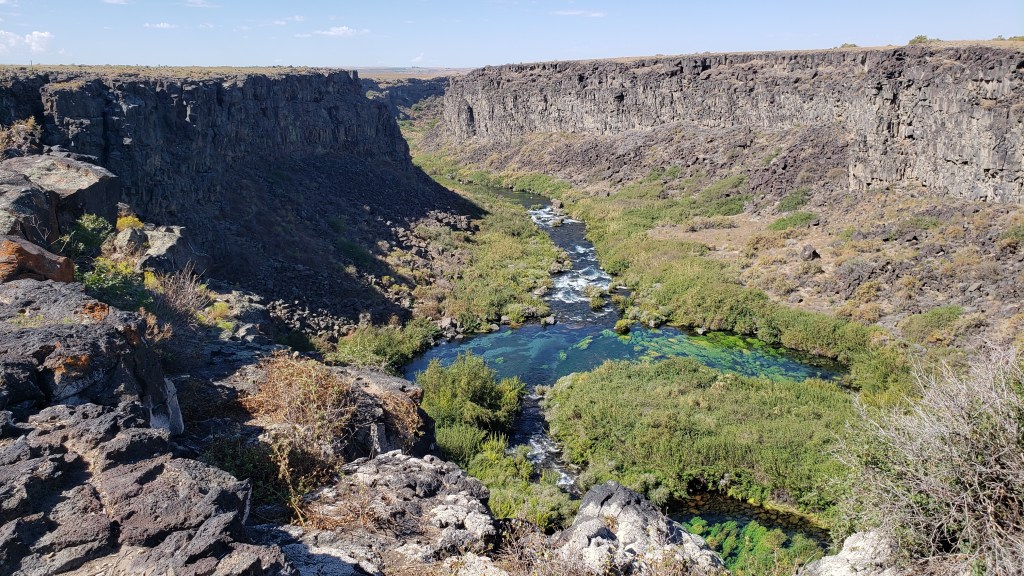
Box Canyon State Park proved to be more of an overlook than an actual park, what with being surrounded by cow farms and having nothing but a porta-potty at the dirt parking lot, though if we’d had the inclination we could have hiked from the top of the canyon to the clear, bright-aqua waters of the river below. But you already know that’s not something we could (or would) do with a senior dog in tow.
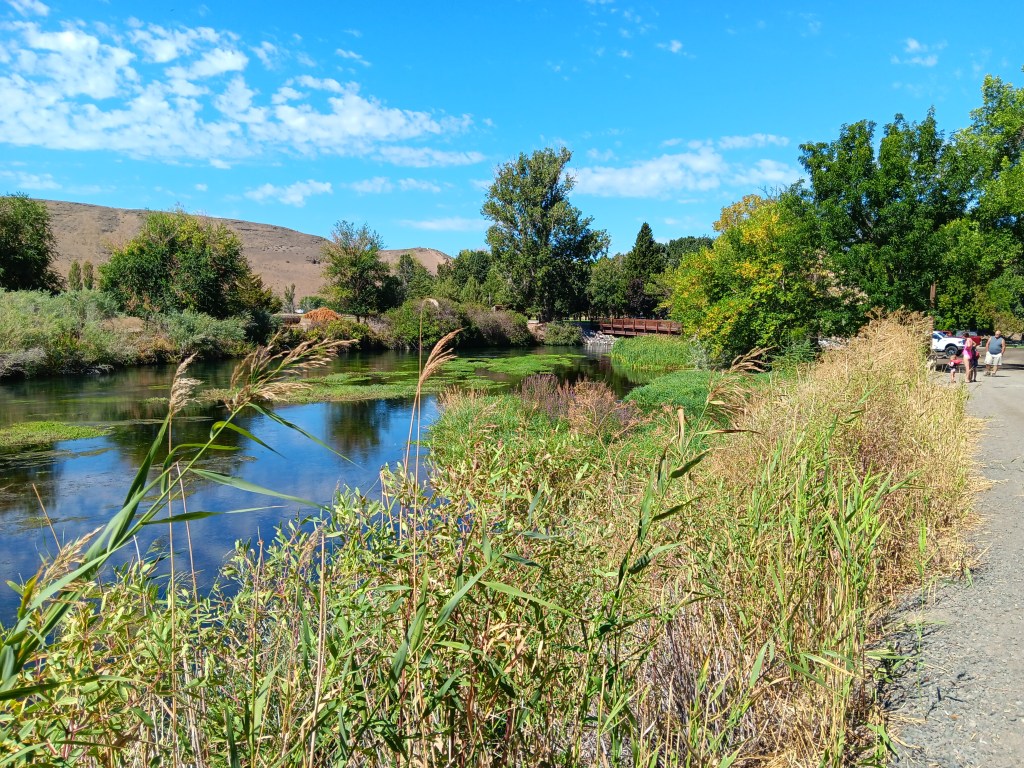
Thousand Springs also found us wandering aimlessly. The road down to the springs was steep and winding, and either a thrill or unpleasant, depending on which one of us you ask. But as so many locations we’d visited in Idaho had done, this one closed on Labor Day, which was the day before our visit.
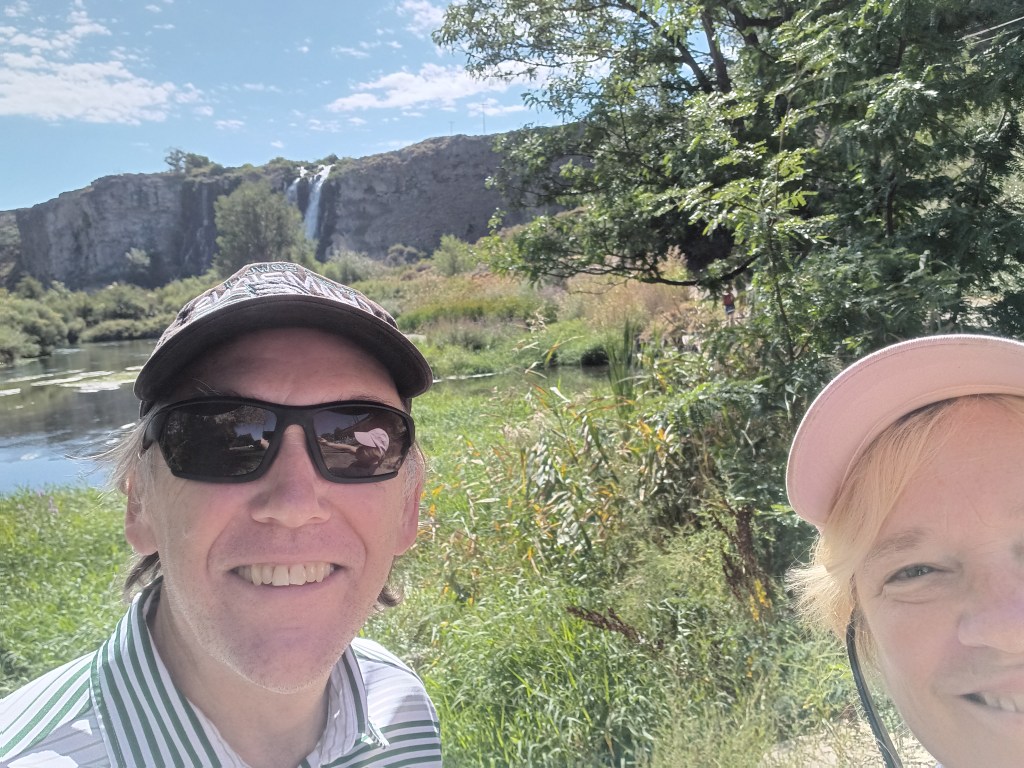
We enjoyed the falls, just to say we’d done something, then headed to the day’s headliner attraction.
Along with Craters of the Moon, one of our original must-see locations in Idaho was Bruneau Dunes State Park, where our plan was to rent a couple of sand sleds, climb to the top of the dunes, and freewheel our way back down, with me sitting on a board with Ruthie on my lap and Simon taking the plunge wakeboard-style.
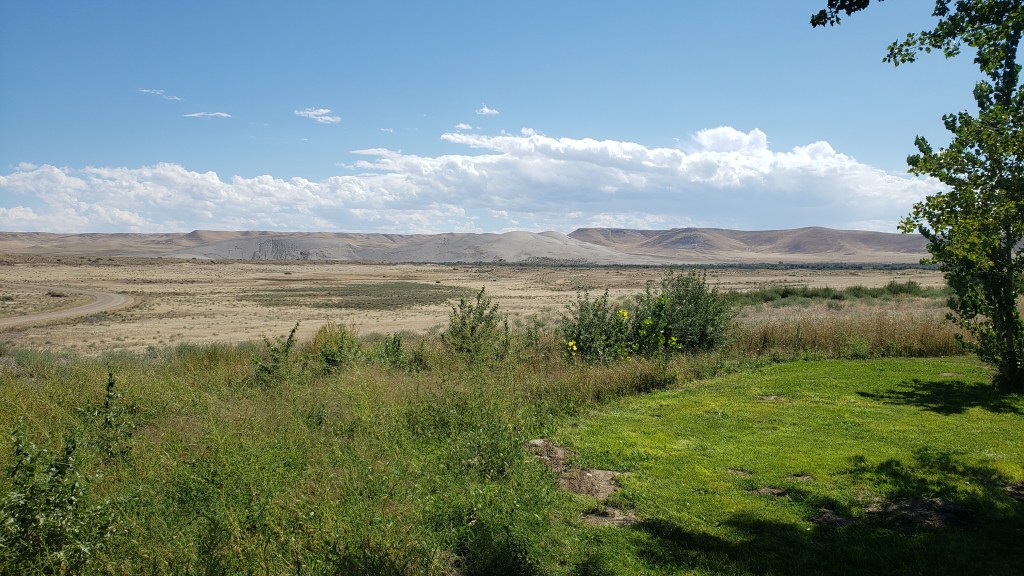
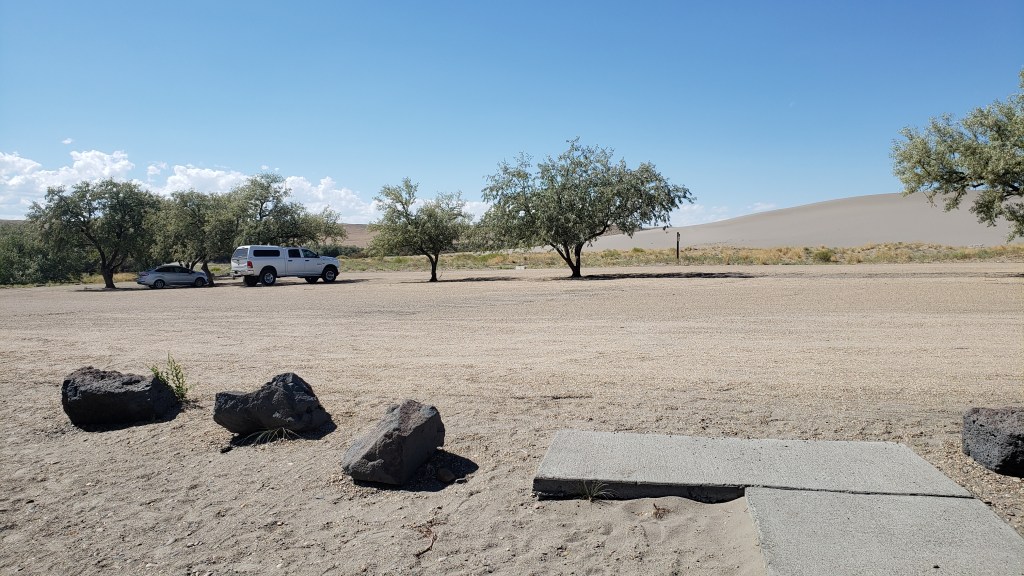
The dry, gravely landscape and fascinating trees reminded us of our trip to Botswana, where Simon went to school for a few years.
It was a ridiculous idea. Sure, the sand would probably prevent any broken bones when we came crashing down, but one of us was bound to get injured, and Ruthie would never tolerate the walk up, or the slide back down. We were saved from ourselves when the early afternoon temperature edged up to 90F, ten degrees hotter than it had to be for the Visitor Center to suspend all sled rentals.
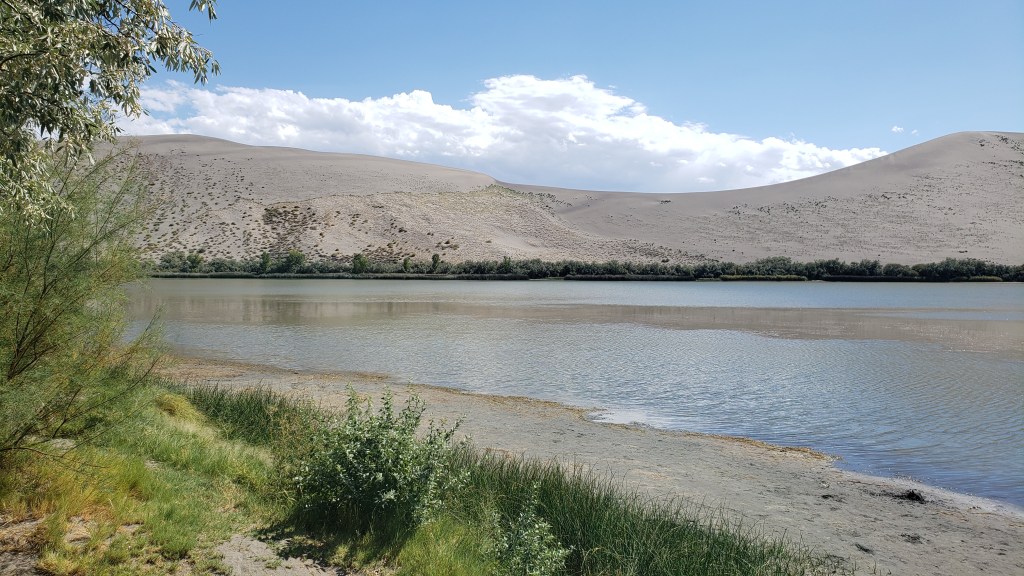
The trip wasn’t a waste, though. We had a nice picnic in the shade of a pavilion by the river, then sweated our whatsits off with a climb up the smallest dune.
Oh, look! Another lunch whose components have nothing to do with one another!
Ruthie doesn’t like it when we’re not all huddled together in a group, and we knew she’d want to follow whoever went up the dune first. So we put her booties on to save her paws from the blistering sand, and told her to climb as high as she wanted to, and no higher.
Click on photo for video
Click on photo for video
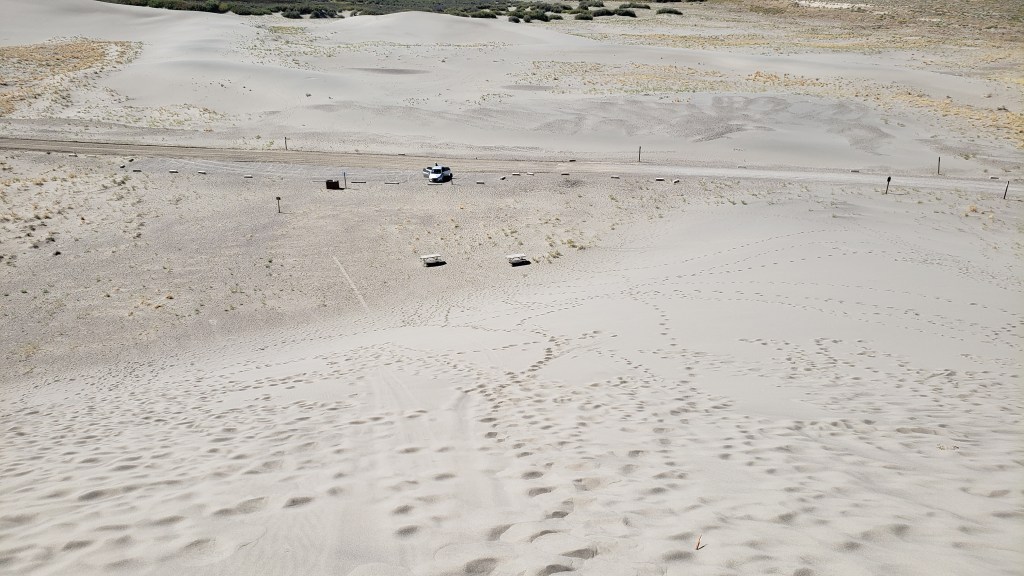
View of Nippy from the top of the dune.
We weren’t exactly batting a thousand in terms of WPM (Wows Per Minute), though we definitely enjoyed what we’d been able to do, so Simon decided a quick detour to Malad State Park was in order, for one more chance to stand on the precipice of a deep crevasse and lean out over it as far as possible.
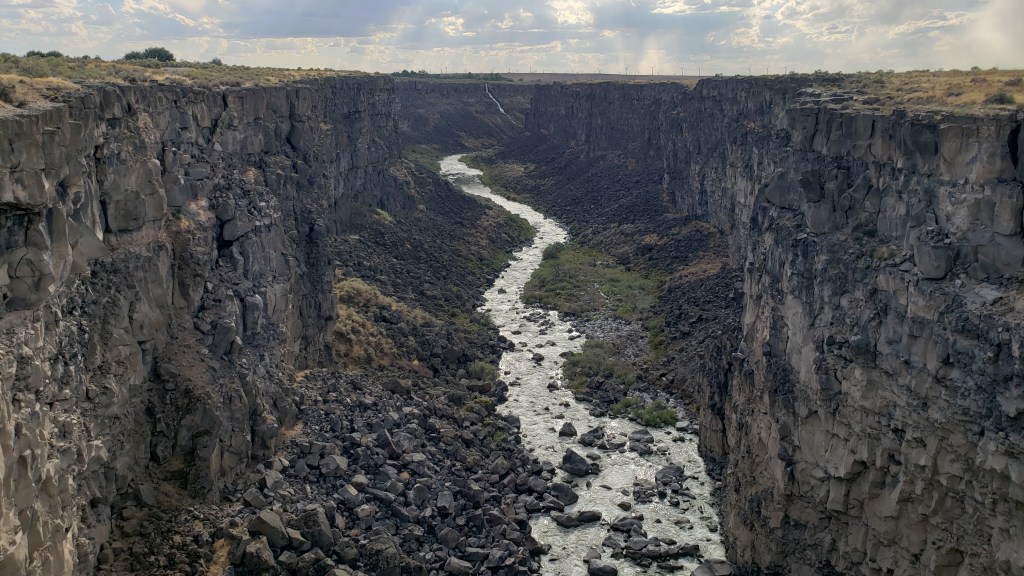
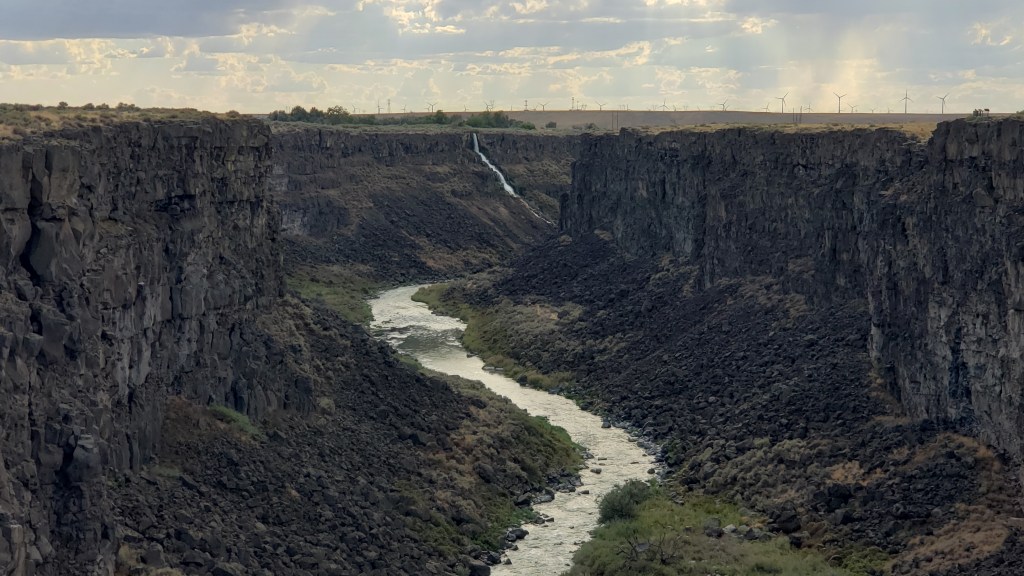
Here you get some small idea of the length of this gorge, with the tiny white line at the back being a waterfall.
Zoomed in a bit more, you can see the waterfall a little more clearly. We’re constantly amazed at what rivers can do to solid rock, given time.
Happily, there was a long, metal bridge spanning the gaping fissure, which gave him an excellent view of the river below. Ruthie joined him, and her bravery was rewarded with a little butt scritch.
But it was our next day’s trip out to Twin Falls that cranked the thrill factor up to eleven. We knew we wanted to see the famous Perrine Memorial Bridge, and we hoped with all our hearts there would be a base jumper or two.
The bridge spans the Snake River, a waterway made famous by the Lewis and Clark Expedition as they journeyed west in an effort to discover what, exactly, the country had gained through the Louisiana Purchase, and where, exactly, that land purchase ended.
That isn’t why it’s famous now, though, at least not with extreme thrill seekers. Today, it has a well-earned reputation as hallowed ground, being the only place in North American where it’s legal to base jump, year-round.
Our hopes of seeing someone jump were met twenty-fold. All day long there are jumpers taking the dive into Snake River Canyon, either as singles or in tandem, some of them longstanding pros, some entering into it for the first time. Some dove in head-first, others did somersaults, but however they left that ledge, it was massively impressive to spectators lining the stone wall along the edge of the gorge.
Click on photo for video
You can feel the anxiety in this person before jumping. Click on photo for video
We made it a point to speak with a few jumpers, and hit absolute gold when we met Sam.
Former military paratrooper Sam never said anything about being Tom Cruise’s stunt double, but if he’s not, I’ll eat a pound of liver and onions from a filthy truck stop deli (no I won’t; I’d never do that). He looks like Tom’s twin, he speaks as if he’s dealt with media all his adult life, and he’s possibly the best advertisement for fitness and extreme sports you will ever find.
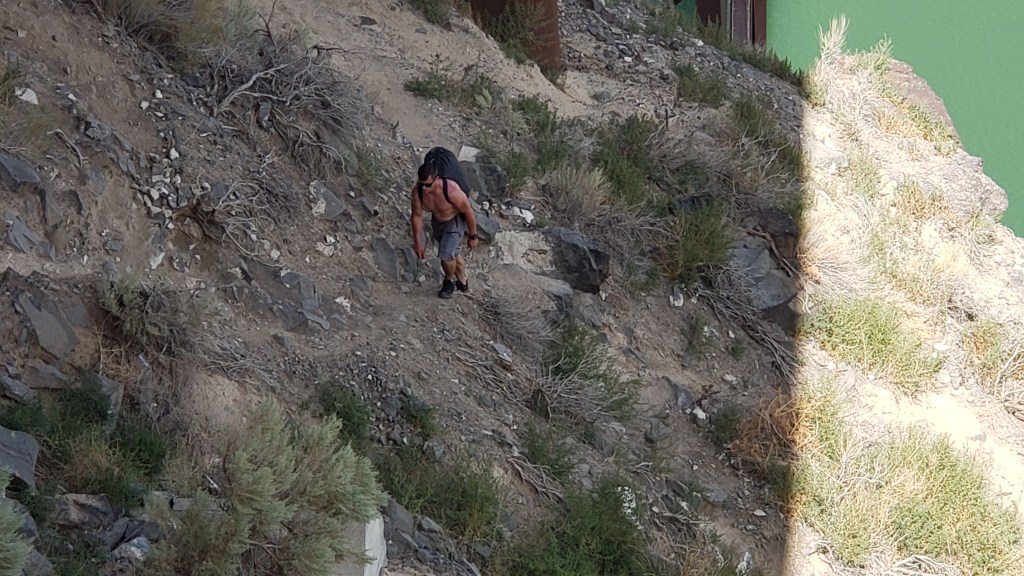
We chatted for about half an hour, then watched him walk out to the middle of the bridge, climb over the railing, stand on the narrow ledge, and swan-dive into the gorge. His parachute opened, and he soared effortlessly to the target point on the side of the river.
It was an astounding feat, but even more incredible was that jumpers then have to repack their parachutes and climb the rocky cliff out of the canyon. Sam scaled the cliff as we looked on, and gave us a final comment as we waved goodbye. “That’s the hard part,” he said.
This is Sam. Sam just jumped. Sam is now hiking up a 5,500-foot gorge. Strive to be like Sam in all your endeavors.
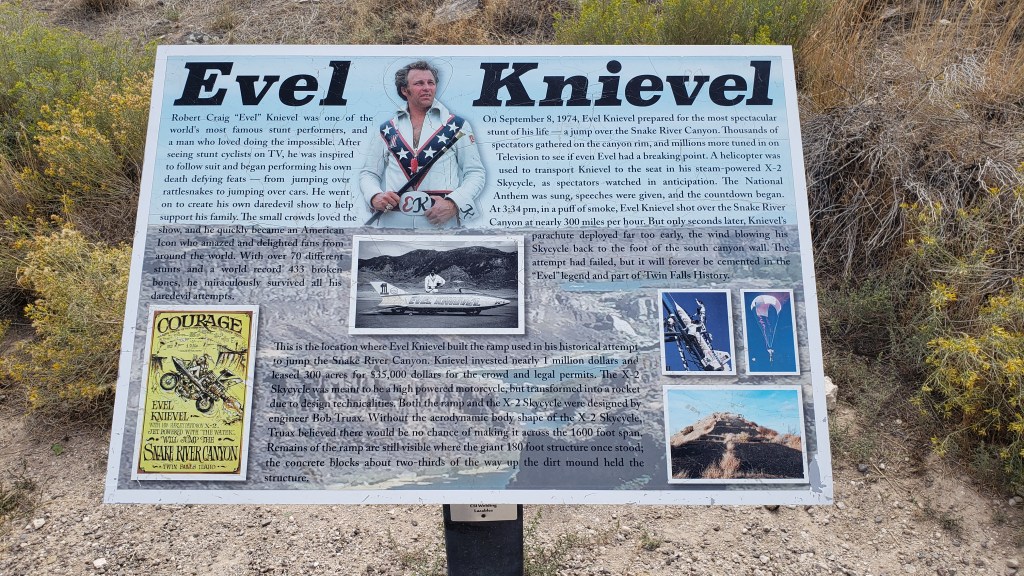
We could have watched all day, but it was getting a bit too hot for Ruthie, so we cranked up Nippy’s A/C and drove to the nearby Evel Knievel Jump Site. Those of us with birth years starting with the number 1 probably all remember the crazy daredevil whose unrealistic motorcycle stunts led to 433 broken bones over the course of his 15-year career as a performer.
You probably can’t see this photo large enough to read the panel, but somehow we only took a few photos of the site, so this will have to do.
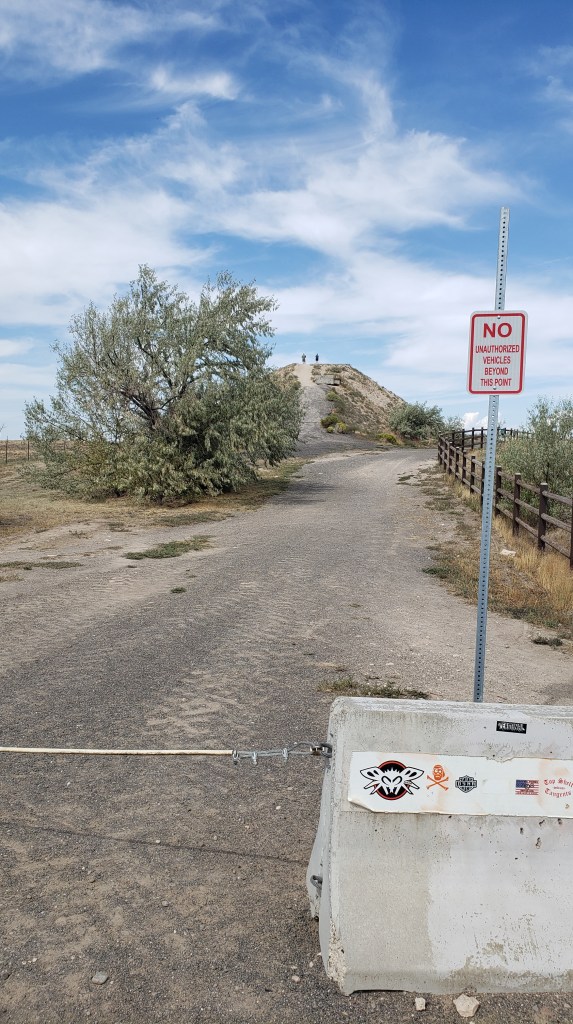
The dirt ramp he used for a jump over the Snake River Canyon in his X-2 Skycycle steam-powered rocket is still there. He didn’t make it from one side to the other, of course, and, as we stood at the top of the jump, we were pretty sure he never really intended to make it.
That hill in the background is the ramp.
He blamed it on his parachute opening right after take-off. We blamed it on the fact that no one with an ounce of knowledge about physics could ever think that ramp was going to be enough to launch him one-quarter mile across the canyon. But never mind; it was an epic stunt, and we were delighted to discover our visit was exactly 49 years, to the day, since that fateful jump which, although he survived it, proved to be his last.
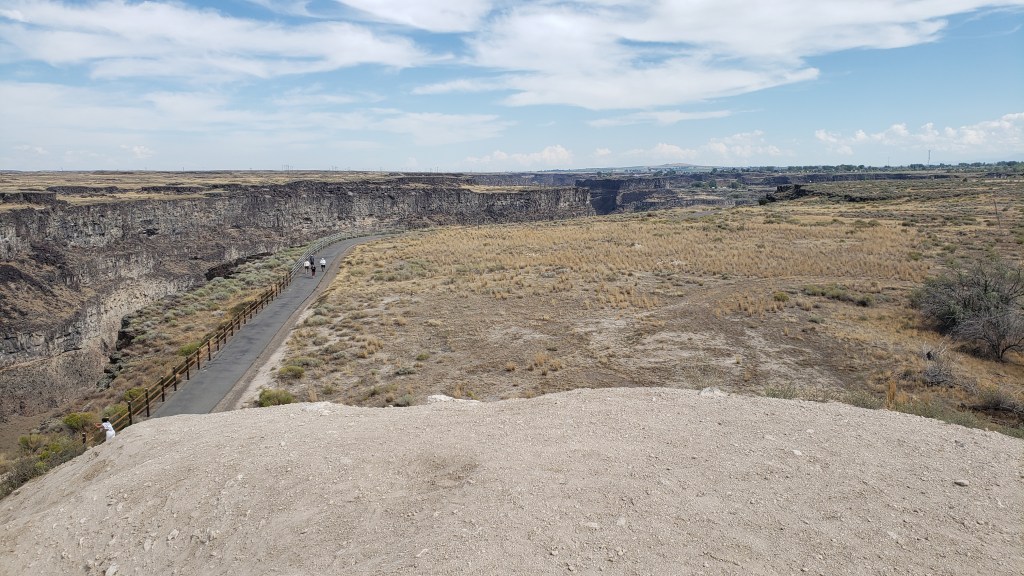
View from the top of the ramp, looking over the right side. The gorge is that dark part, with a walking path to its right.
Shoshone Falls was our final stop of the day. Dubbed the “Niagara of the West,” the 212-foot-tall, 900-foot-wide, horseshoe-shaped falls are the largest natural falls in North American (yes, bigger than Niagara). They caught the attention of travelers along the Oregon Trail, and are still a tourist attraction today.
How it started. Photo from Wikipedia
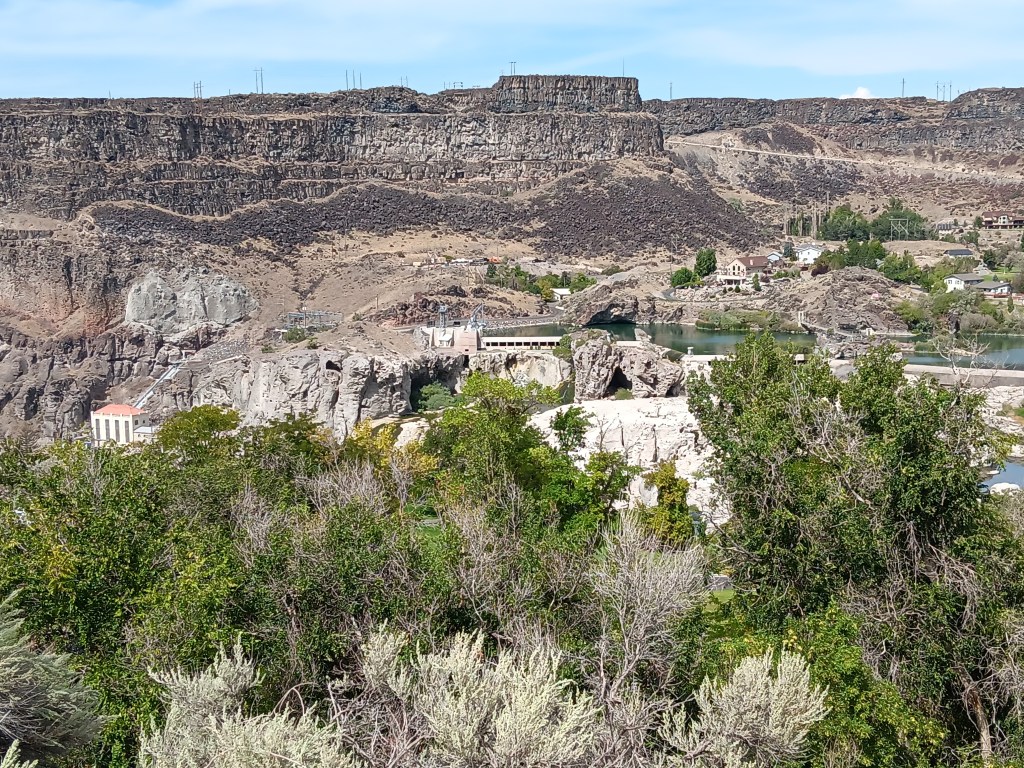
How it’s going. The falls should be flowing over those two white rocky areas immediately below the long, horizontal white building in the center of the photo.
Unfortunately, due to a dry summer, the water level was too low for the falls to flow, so we skipped the drive down into the park, looked at the bare rock from above, and rewarded our day with a cold beer, shrimp tacos, and a hearty salad on our way back to the campground, before leaving Idaho and returning to Utah for its grand National Parks the next day.
Technically, Idaho wasn’t a new state for us. We’d flown in to Idaho Falls several years ago, and made the 108-mile drive to Yellowstone in Wyoming. But, clearly, we were new to Idaho, as evidenced by the Sheriff in Richfield who caught sight of our Florida license plate and “escorted” us out of town.
Our suspicious nature wasn’t helped by Susan taking random photos of weird road signs while the Sheriff was behind us, or Simon making an extremely abrupt turn onto a lonely back road, having nearly missed our GPS’s warning that the turn was coming up. Richfield’s Finest responded by following us all the way to his county’s border to see us off.
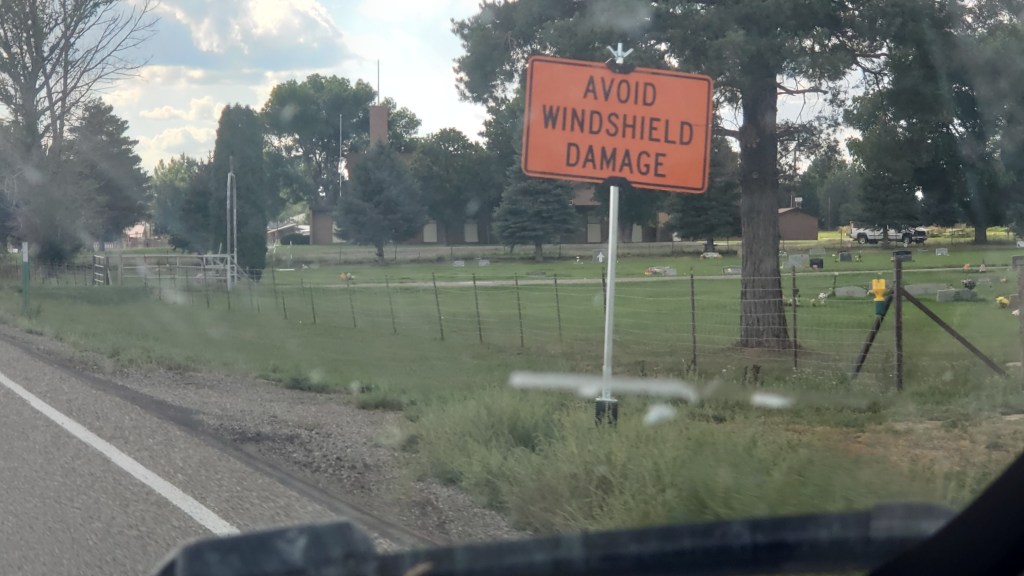
We don’t have a photo of the Sheriff, because we’re not crazy, but we did wonder about this sign. HOW do we avoid windshield damage, and damage from what? Pedestrians? Squirrels? What? Isn’t this something every driver wants to avoid from the moment they purchase their car?
The several-mile drama unfolded after our visit to Craters of the Moon National Monument and Preserve, the reason we were in Idaho in the first place. If you’ve been following along, you know we made a change to our original itinerary, and because of that our time in Idaho was in doubt. But both of us were eager to see the otherworldly park, so we booked a week in the area after our time near Salt Lake City, which opened up the opportunity to also see City of Rocks National Reserve, Shoshone Falls, and massive piles of the vegetable for which the state is famous.
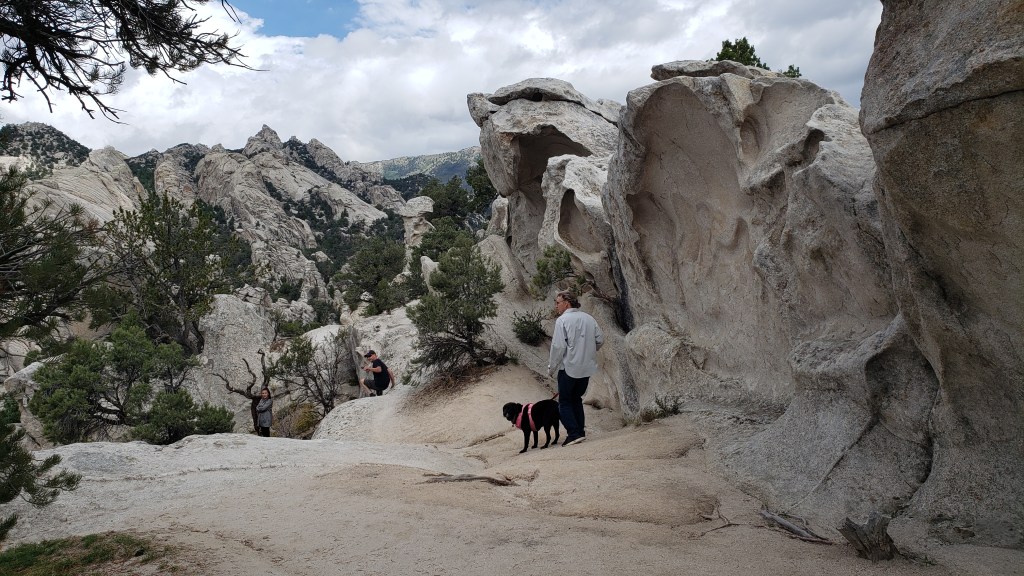
City of Rocks is a world-class playground for rock climbers, but its history includes emigrants passing through on the California Trail from 1843-1882 and, prior to that, use by native peoples. Its oldest rocks date back 2.5 billion years.
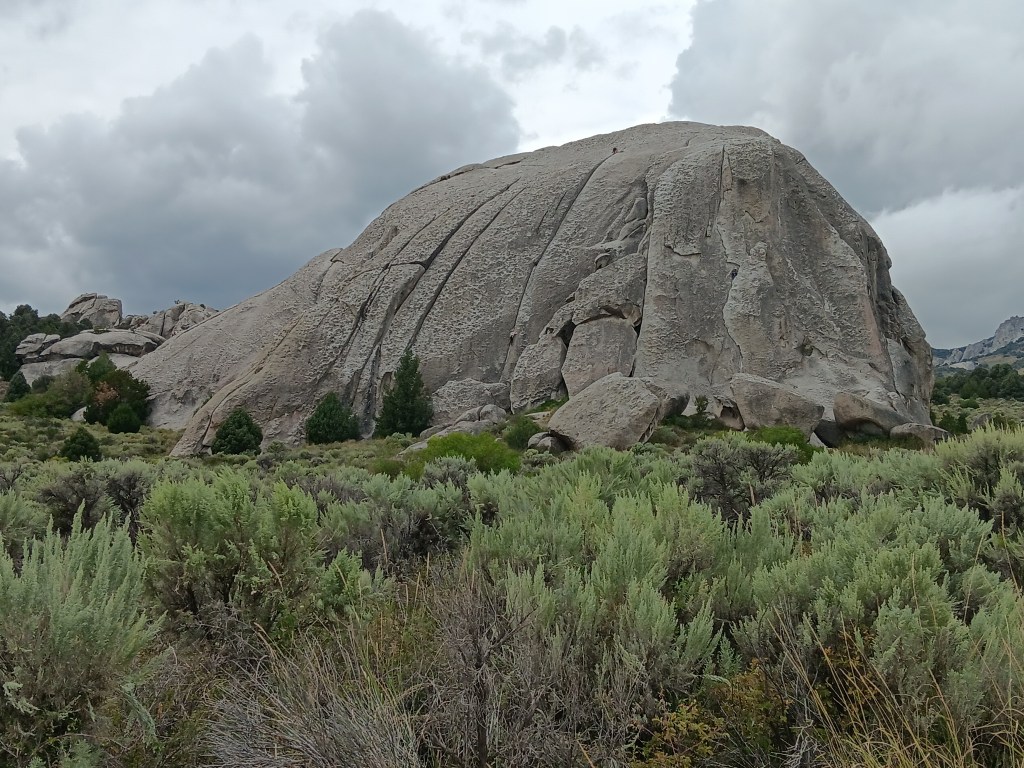
Really old rocks.
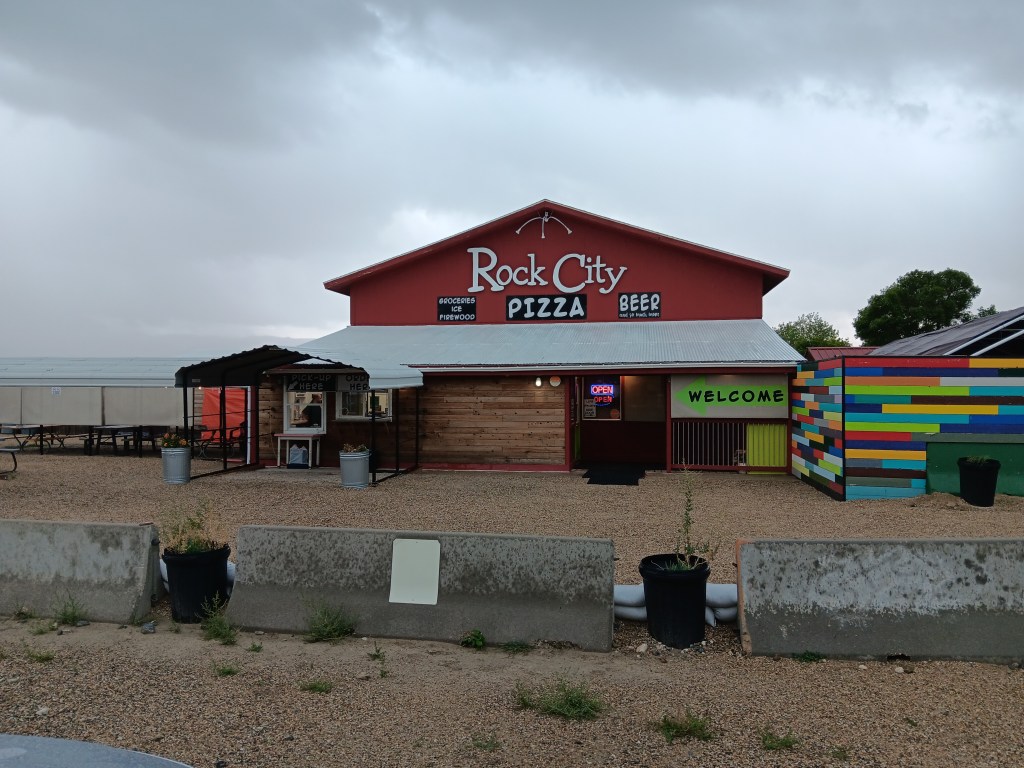
We were there for the scenery, though we didn’t know what to expect. A stop at the Visitor Center resulted in two useful suggestions from ranger Robb: Don’t take little Nippy on the rough road beyond the Bath Rock formation, and stop at Rock City for the best pizza you’ll ever eat and the only craft beers for a hundred miles.
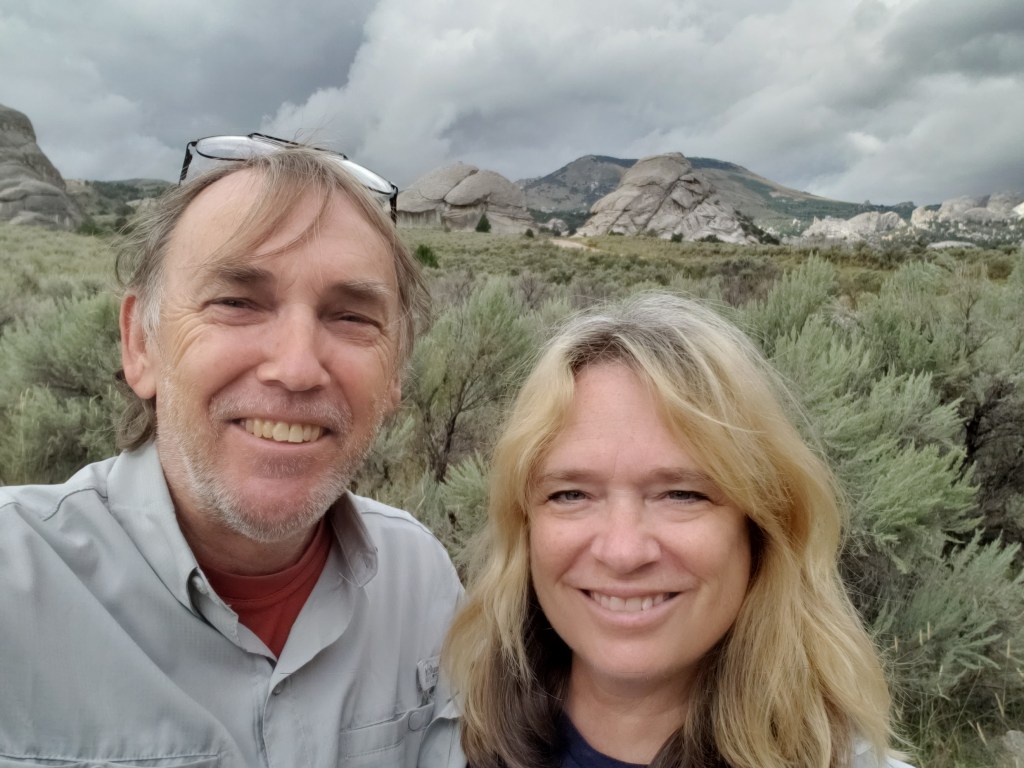
Obligatory selfie!
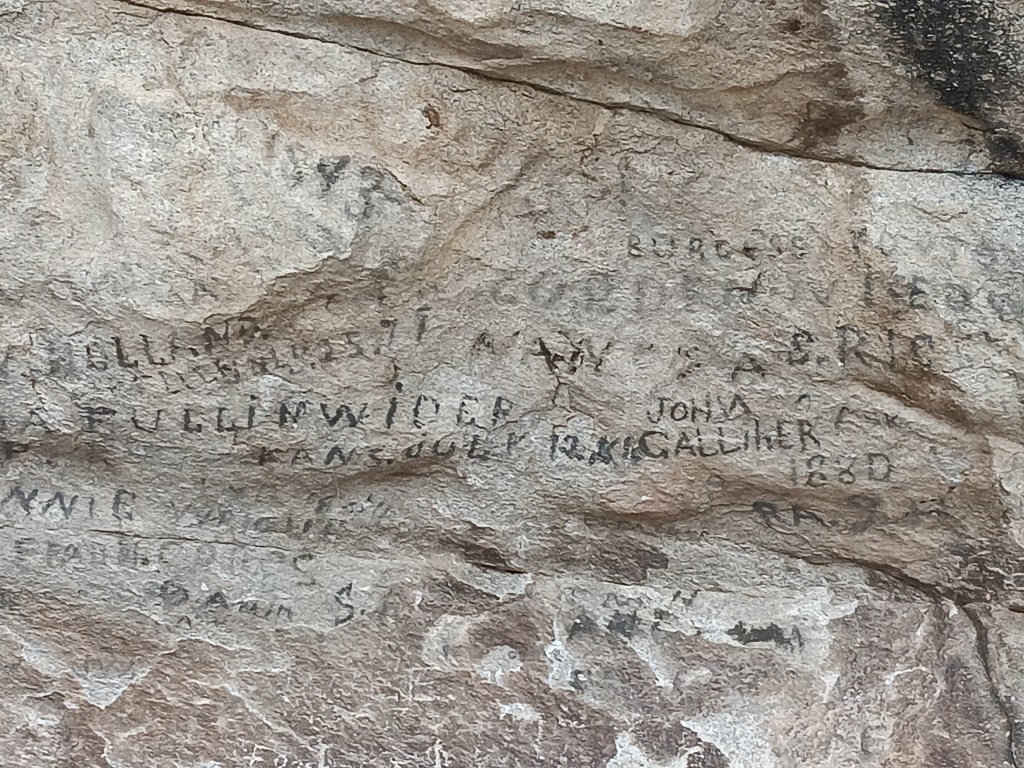
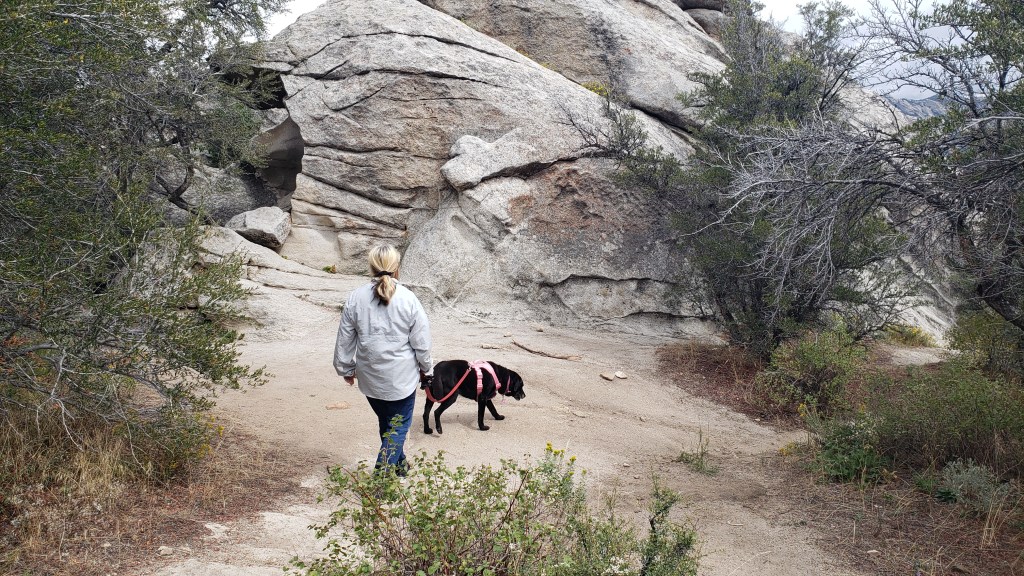
The park is entirely dog-friendly, with a handful of dramatic geological features, starting with Camp Rock (a.k.a. Register Rock). There, we found signatures and dates from emigrants who passed by, pausing to leave their names and sometimes a short message, written in axle grease.
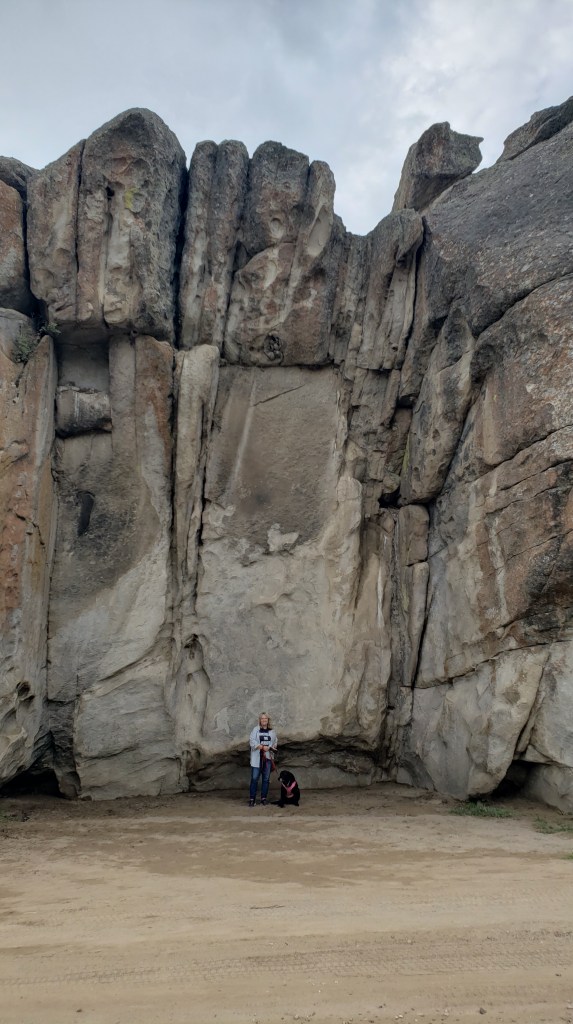
The rocks here are not small; this one was the smallest.
Next along the byway was Elephant Rock, and we were told it was a great place to see climbers. Sure enough, there were several making their way up (and down) the rock face.
The “trunk” of the elephant is on the left, but you can’t see it in this photo.
Look carefully and you’ll see a climber just above the horizontal boulder on the ground (the third one to the left of the boulder in the foreground), and another climber near the top of the fissure the lower climber is scaling.
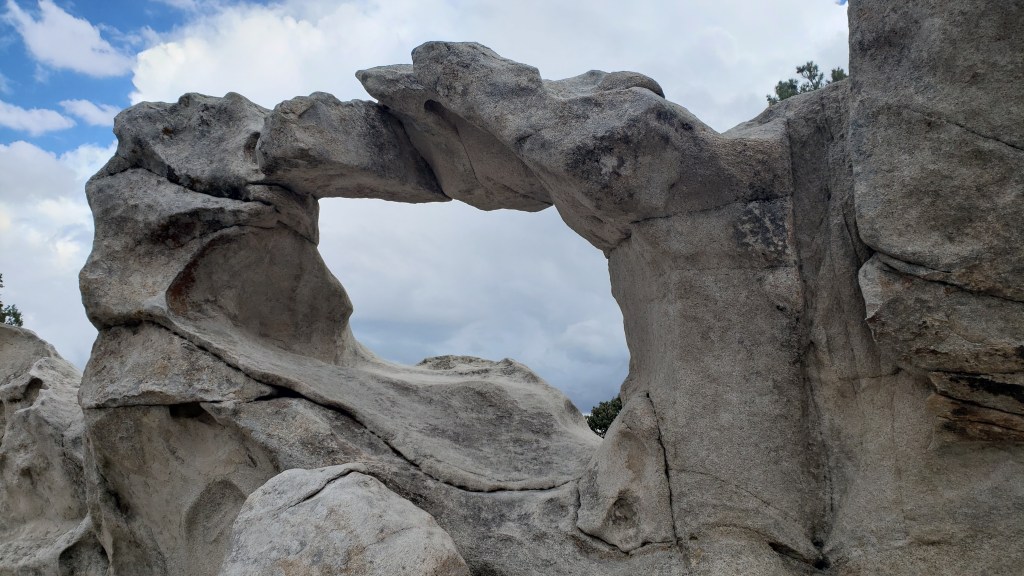
The trail to Window Arch, just beyond Elephant Rock, was only 250-feet long, but included some of the most dramatic views.
As with most photos, you can’t get the scale of this place.
We ended at Bath Rock, a spiritual place, Robb at the Visitor Center told us, where his grandmother used to take him and his sister when their parents were traveling, and she’d “bathe” in the positive energy to remove the negative energy she was covered in. Energy which, his sister told him, was all his fault.
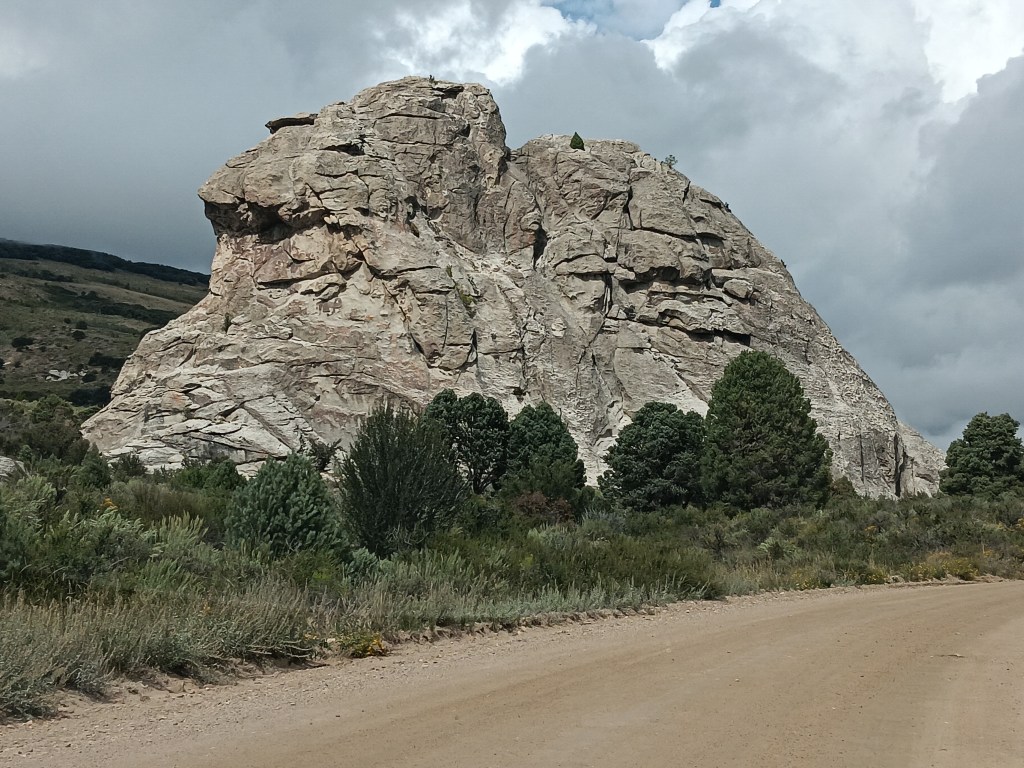
Bath Rock. Bathe in its healing powers!
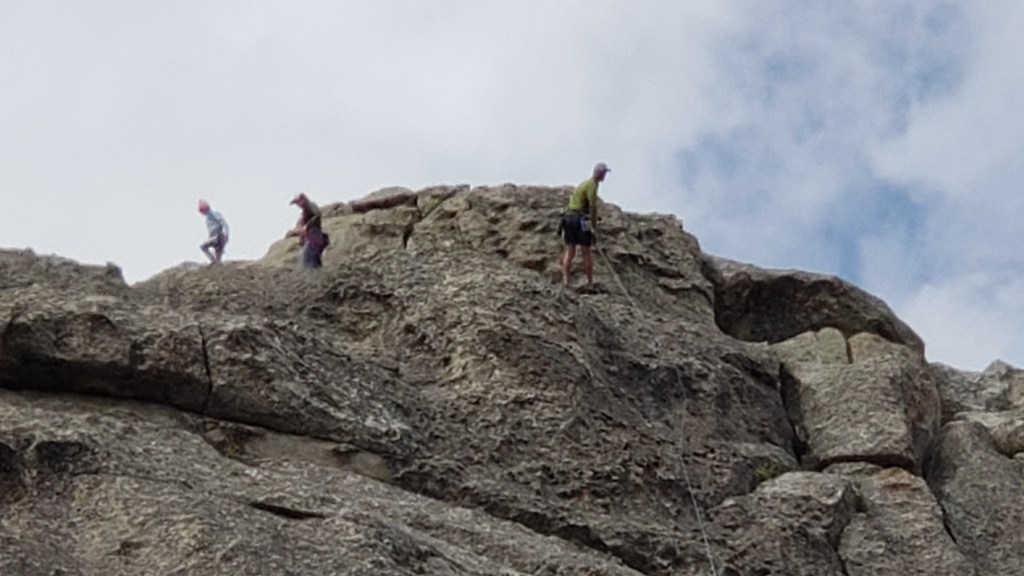
Bath Rock was active with climbers, but a storm was brewing in the distance, so we enjoyed their activities for a while, took a little stroll along the trail, then headed out of the park for an al fresco pizza lunch.
People who are braver than us.
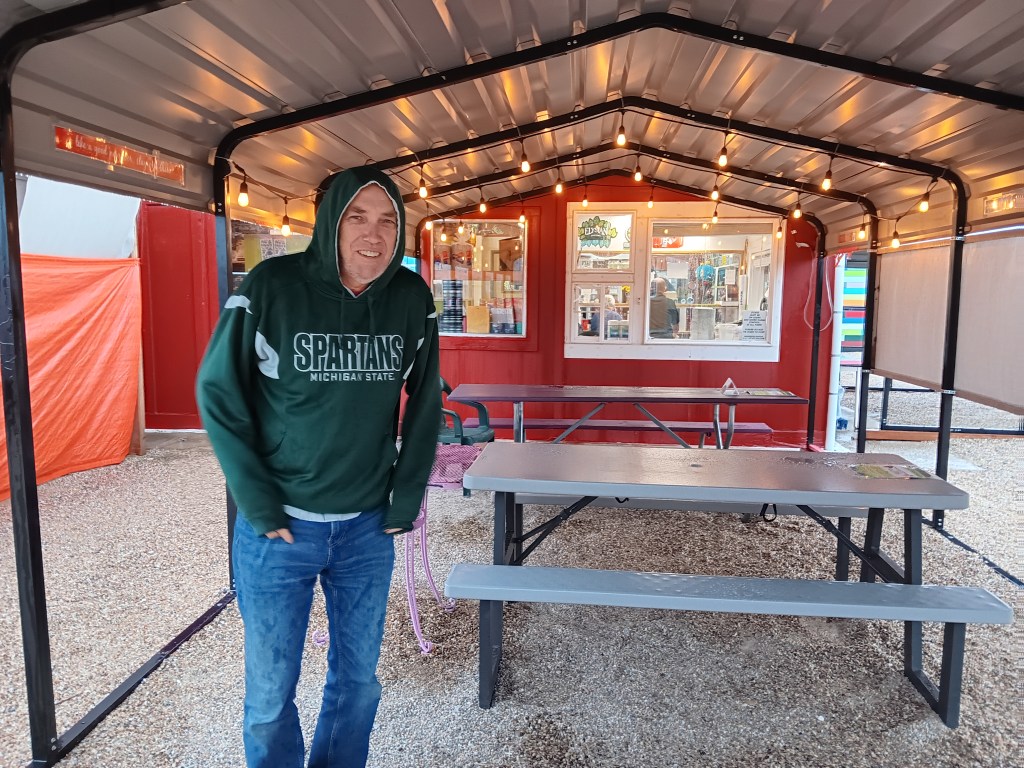
The storm had other plans. It hammered down rain, sending bolts of lightning perilously close to the gravel we were standing on, directly under a metal roof.
It was really cold, too.
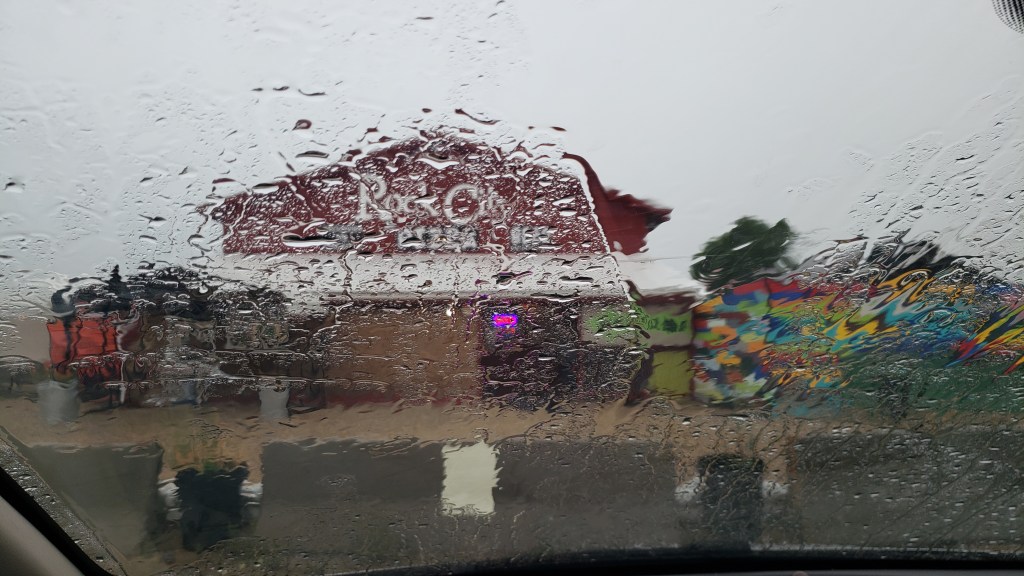
We high-tailed it to the car, watching water pool alarmingly around the store and its picnic area, which added credibility to the Flash Flood warning we’d heard the store employees mention while we waited for our pie to bake.
Our view.
City of Rocks made a terrific afternoon out, in spite of the rain, and we were even more excited for our trip to Craters of the Moon two days later.
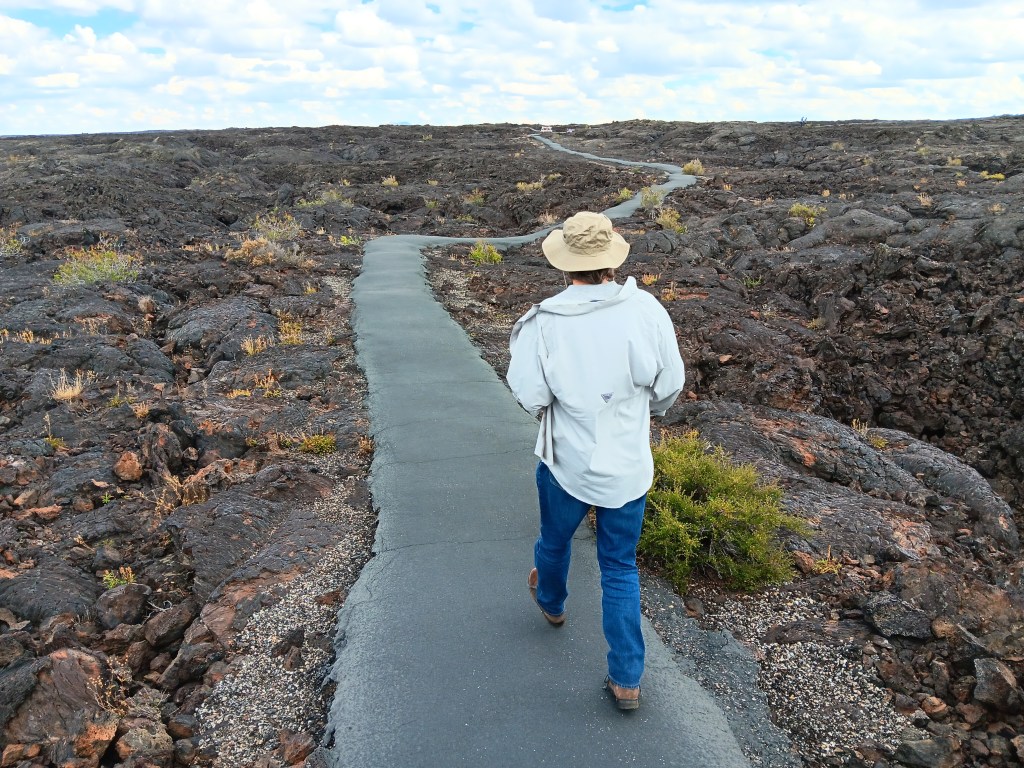
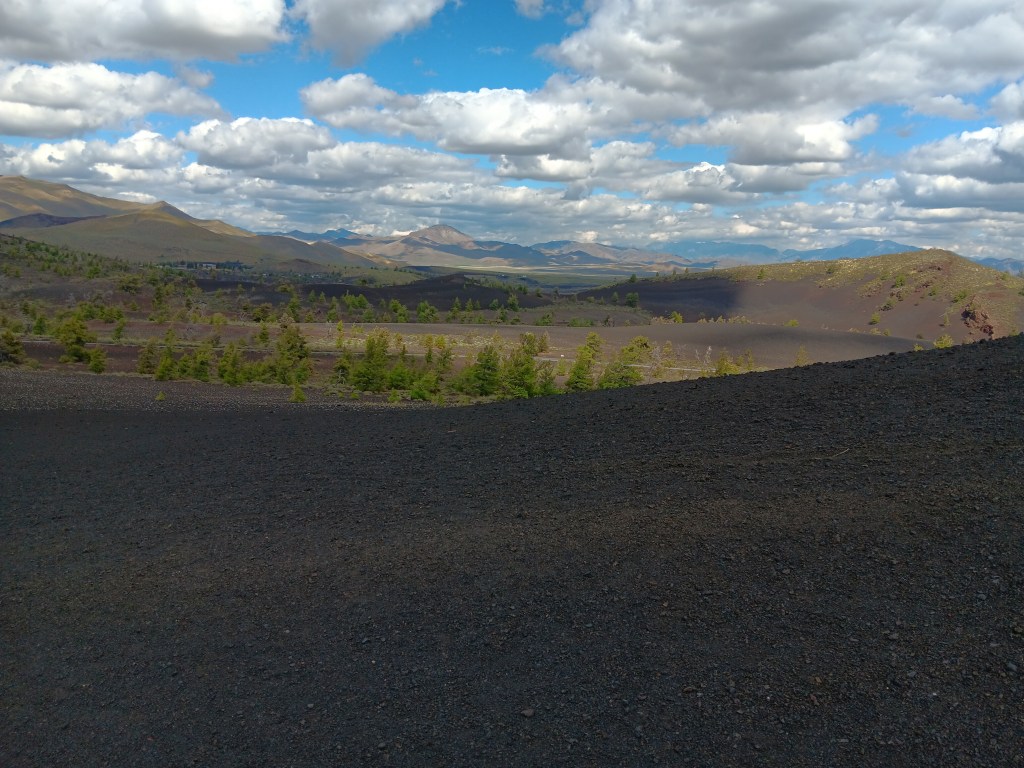
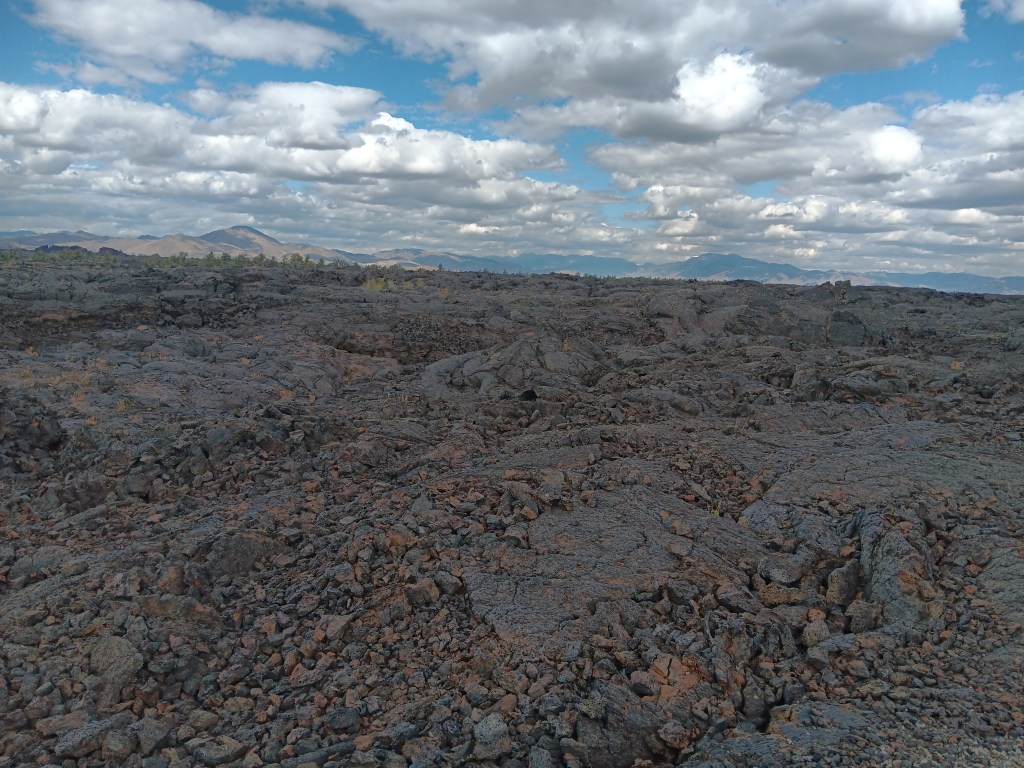
Our $20 America the Beautiful Senior Pass got us into the park for free (we’ll just add here that we’ve literally saved hundreds of dollars using this wonderful National Parks pass), and we marveled at the seemingly endless lava fields and features that were formed when molten lava oozed through cracks in the earth compliments of the 50-mile fissure known as the Great Rift.
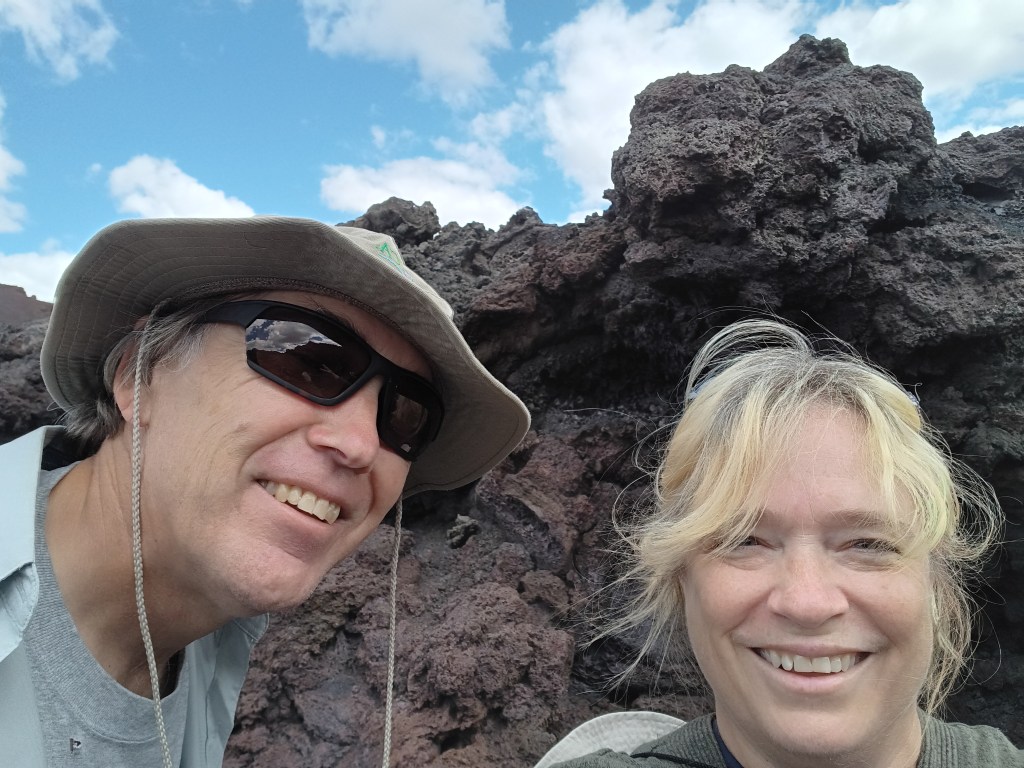
Who are these people, and why are they always laughing?
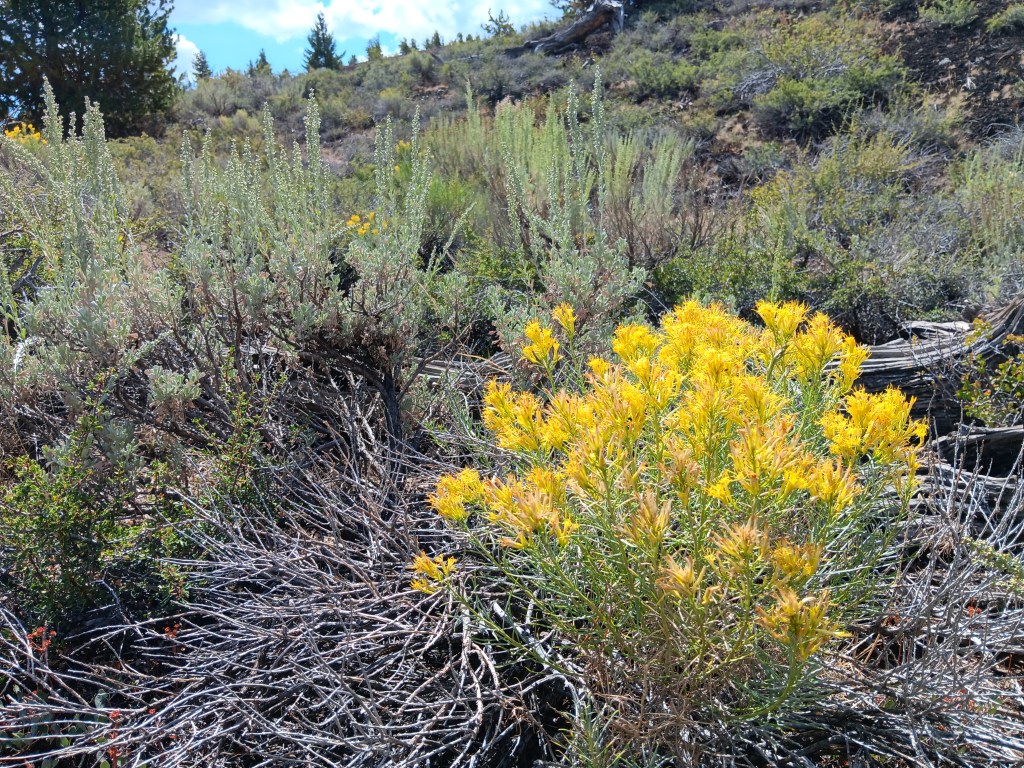
Our first stop along the seven-mile scenic loop was a hike up the powdery Devil’s Orchard cinder cone, a gentle start to our visit, punctuated by a surprising variety of flora.
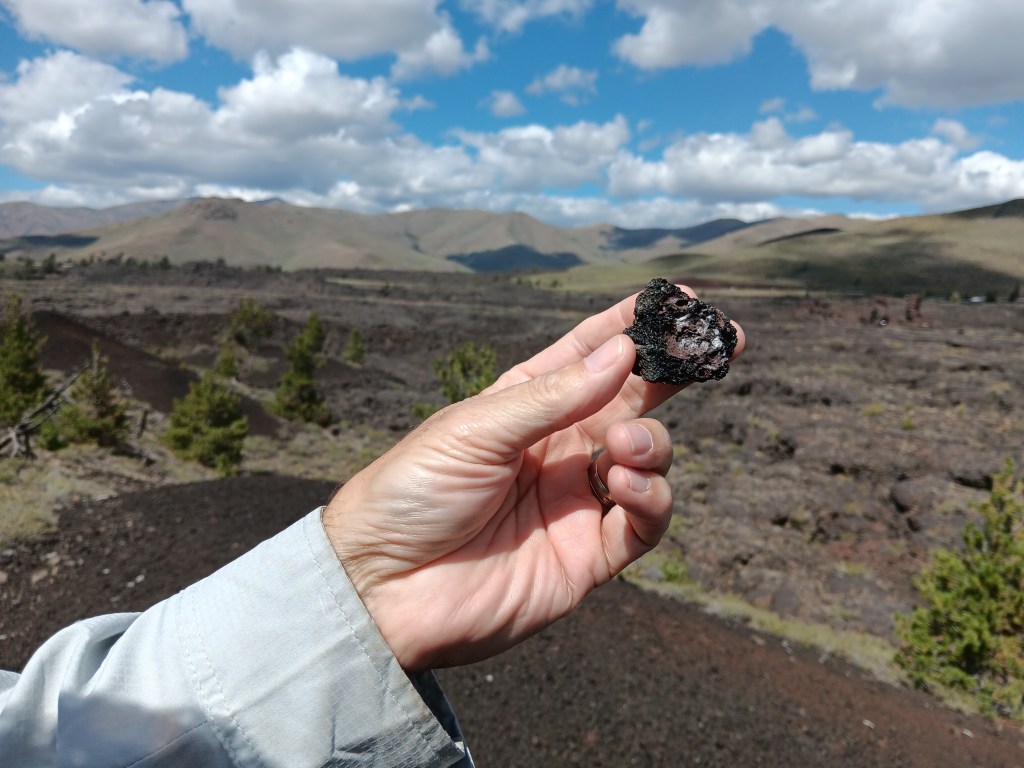
The volcanic rock here was feather-light.
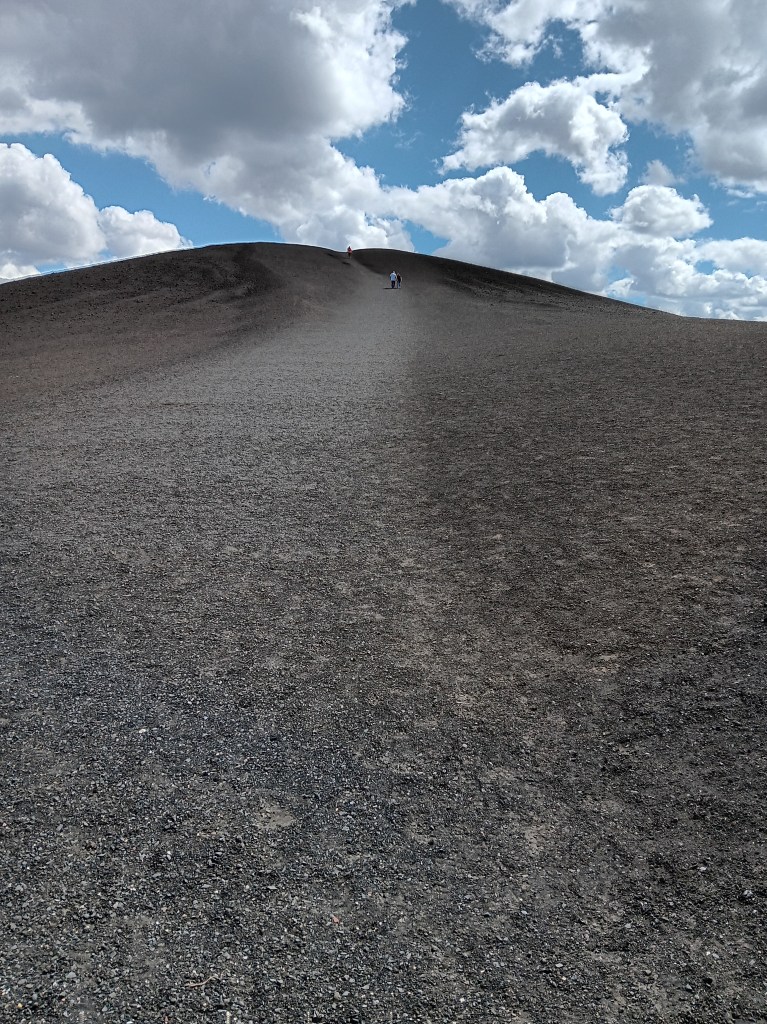
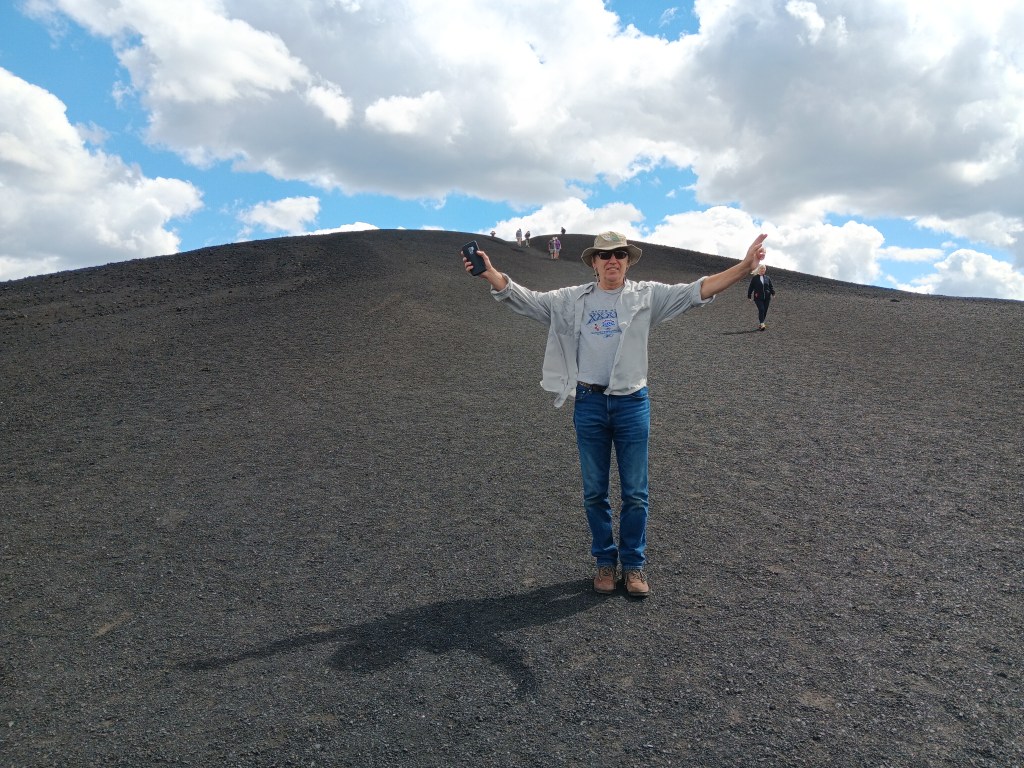
Inferno Cone was much higher, with a well-worn, crunchy path to the top of not one, but three rises with magnificent views over the valleys and to the mountain ranges beyond.
You can just make out the people climbing the hill.
The view from one of the rises. It’s way, way down.
Guess who made it up to the third rise? Him!
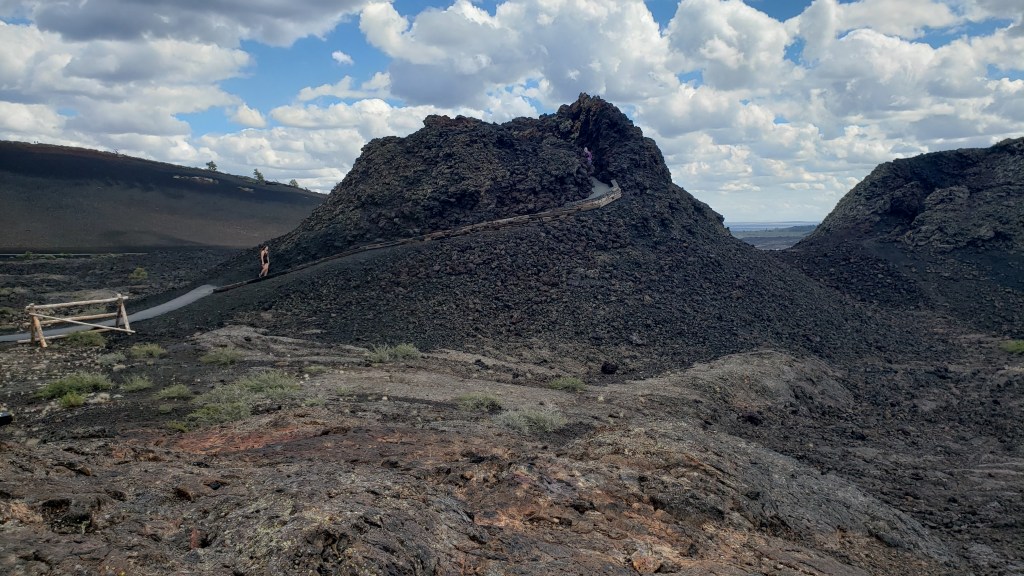
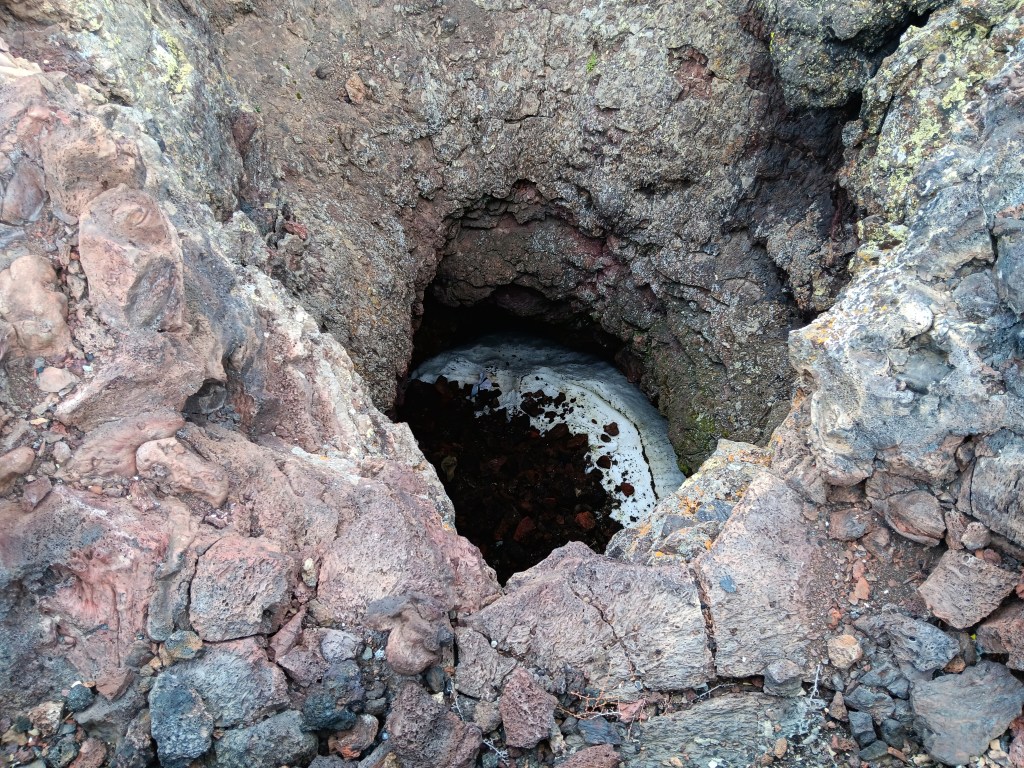
It felt fabulous to be out walking, and we were loving the interactive nature of the features. A second short hike of just a few hundred feet saw us looking into two Spatter Cones, the first of which still had ice at the bottom.
You can see the pathway leading up to the part of this splatter cone where you can look down into it.
That white stuff is ice. The second splatter cone had three or four hats in it.
We took all the side roads off the main loop, and had several WPM (Wows Per Minute) passing miles and miles of lava fields and curious “cinder gardens.”
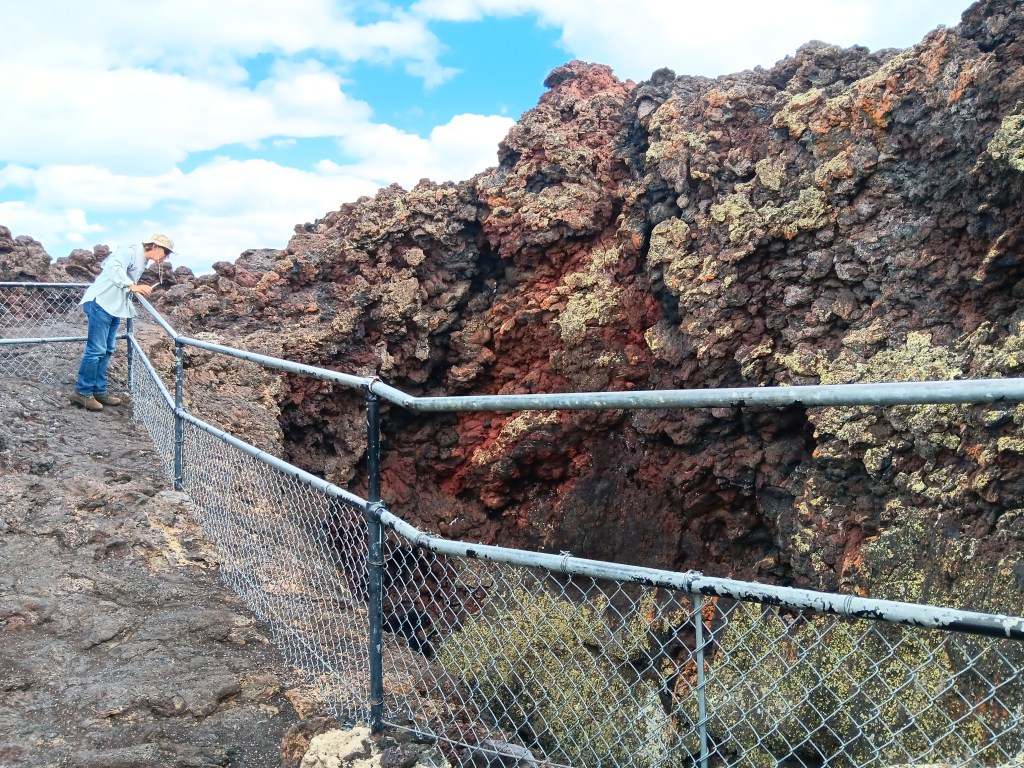
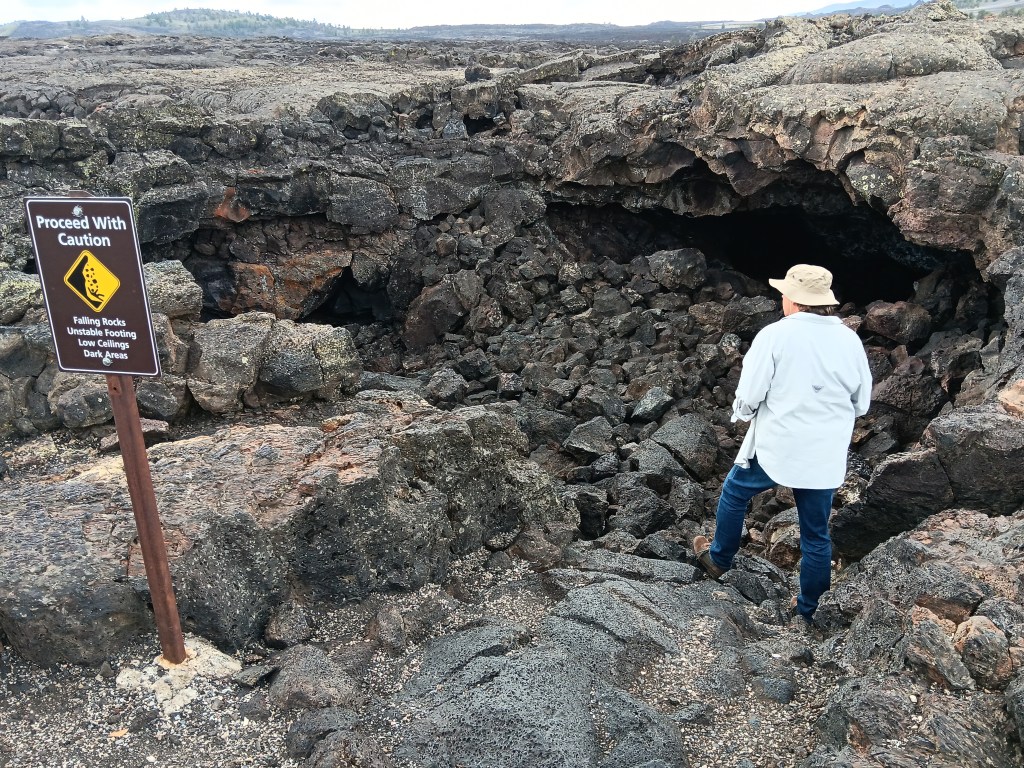
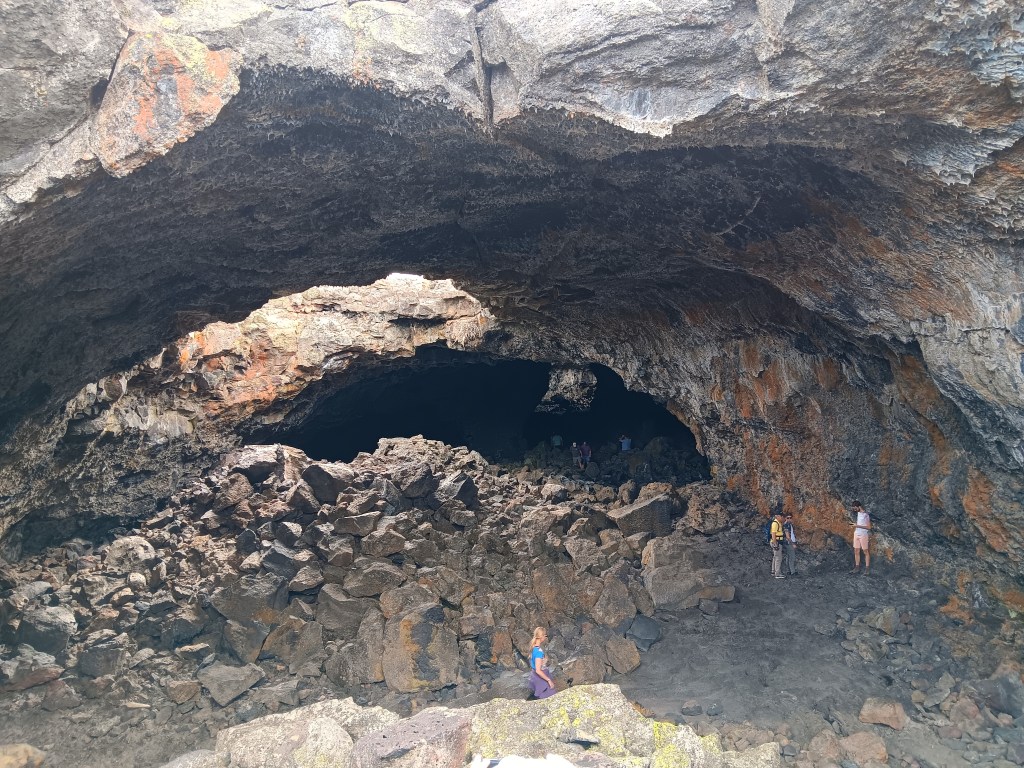
But our absolute favorite WPM was the Caves Area, where visitors could descend into some of the caves that formed when lava tubes collapsed.
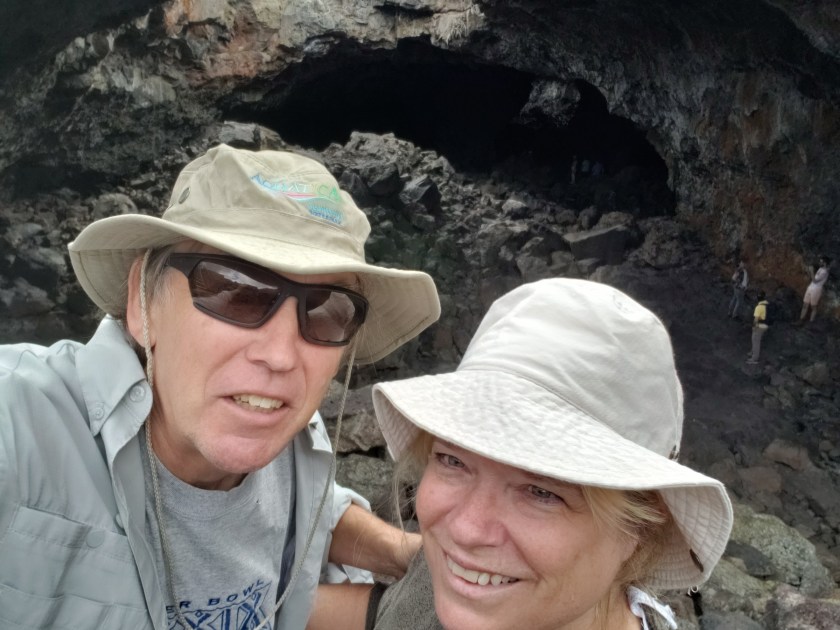
Precarious perch for a selfie inside the cave!
Sheriff of Richfield being the slightly humorous (if also slightly unnerving) exception, it had been a fantastic, unforgettable day. Our return trip to Village of Trees RV Park had one more surprise in store.
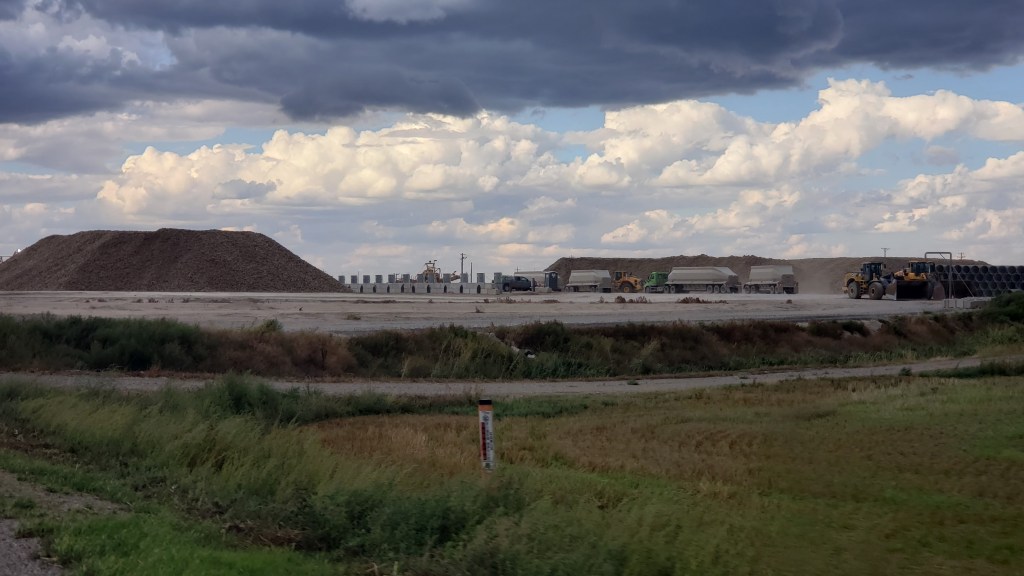
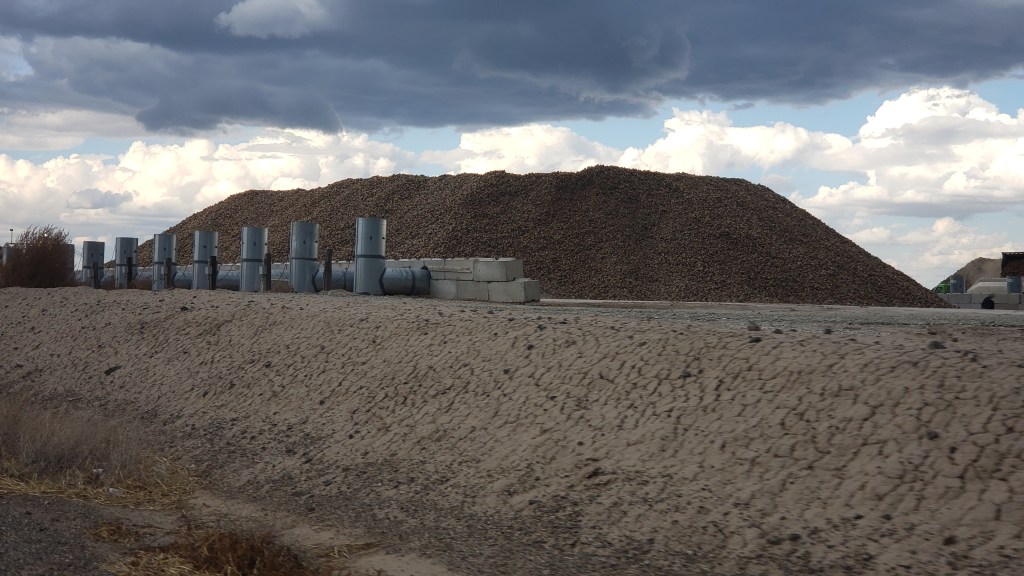
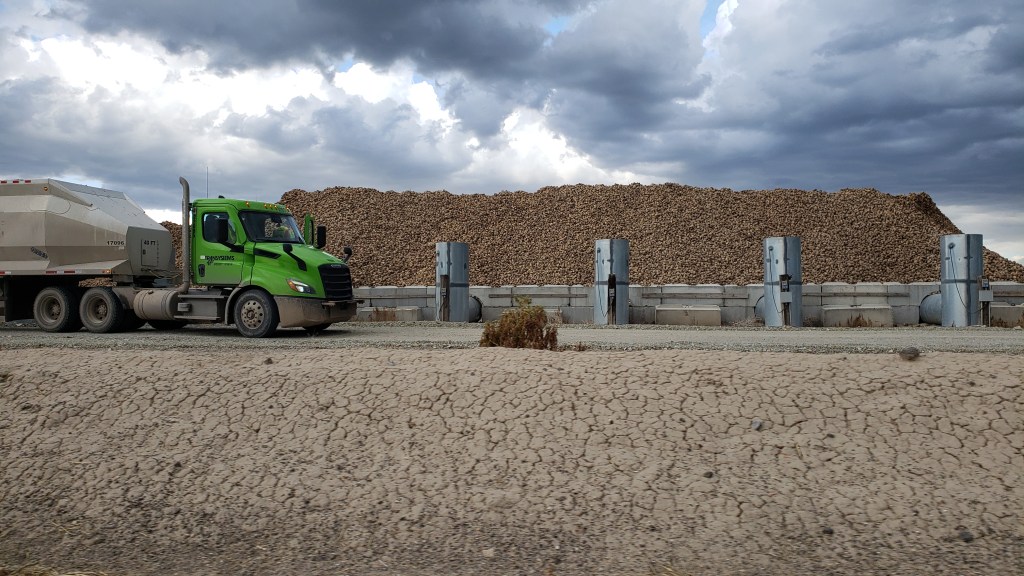
We’d been unreasonably excited by all the trucks we’d seen carrying Idaho potatoes from one place to another, but we didn’t expect the absolute thrill of two massive mounds of potatoes getting ready for transit. We shouted and pointed and laughed out loud at the piles and our incredible luck!
Those piles aren’t wood or sand or dirt. They’re potatoes!YAY!
One more potato photo.
Okay, last one, I promise!
We know that’s sad and maybe even worrisome, but we’re proud of our little quirks, and of our ability to find joy in the small stuff.
Today marks four months since we locked the door to our house in Florida and set off for a year-long adventure in an RV. Here’s what we learned during the past month:
When you’re the passenger doing 62 m.p.h. down the highway and a spider appears next to your open window’s screen, don’t try to hit it with a flyswatter. It’s only going to swing back at you and drop down into your bra.
It’s astonishing how fast you can rip your shirt and bra off on the highway while doing 62 m.p.h.
You can’t watch TV while Wallydocking (parking for the night in a Walmart parking lot) because you don’t have any electrical hookups or internet, but with all those “fascinating” people doing “fascinating” things, you’ve got hours’ worth of entertainment. Dive deep into the voyeuristic madness!
Even if the weather forecast calls for 0% rain for an entire year, the sky is bright blue, and there are no clouds within a hundred miles, the answer to “Should we close the windows” when you leave the rig is always “Yes.” Do not even bend this rule.
If you opt for a tow vehicle that’s great for city driving and gets fabulous gas milage (like, say, our little Ford Fiesta, Nippy), there will be a moment during your travels when you’ll stop wondering why everyone pays a sh1t-ton of money for a four-wheel or all-wheel drive. Bone-jarring dirt roads that lead to all the really cool scenery will be the reason you’ll say, “Oh, NOW I get it.”
Your tank sensors may have been honest with you at one point, but once they start lying about how much they contain, you’ll stand in front of them every day and say things like, “What the hell are you talking about? I just emptied you, and I know you’re not half-full after one flush!” You know they’re lying, they know they’re lying, but you won’t be able to resist telling them they’re lying.
You know exactly how long you have before your black tank needs emptying, even when the sensor lies to you.
Half of your time cooking in your rig is spent moving things from one place to another. Bowl goes here, move plate, rearrange bowl when pan comes out, put food there, now move it here, shift the dish towel, move food again, trip over the dog, move plate twelve inches…and on and on and on.
There are times when your big fears will be right in your face. You can decide to face them by shouting things like, “I deny this reality!” and “You have no power over me, demon [insert fear here]!” to cope with the situation. It’s also okay to say “No, I’m not doing that,” and you need no other excuse.
We suspect we’re not alone in having two places we always bash on something. Like, every single day. For Simon, it’s his head and feet. For Susan, it’s her shoulder blades and shins. We do not know why this is so, but we do undeniably know it is so.
By now we’re feeling pretty comfortable driving our 11-ton rig, even though we’ll never feel completely comfortable. It’s an awesome responsibility, and, most of the time, a genuine pleasure. Except on crappy roads. That always sucks.
Drive the car and stay in a hotel if that’s the only way you can reach a fabulous place accessed by roads your rig or your nerves shouldn’t be subjected to.
When you’ve spent just over a month with nothing breaking or needing replacement, you don’t even dare mention it, but you also feel the full exhilaration of this lifestyle and you cannot believe how lucky you are to be able to participate in it.
Utah is known as the “beehive state,” honoring that industrious bug’s reputation as a hard worker, and its state of mind unexpectedly became our state of mind, too, with a project that had us tied to our 36-foot home for several days. We took a breather from touring in Nippy, with a few breaks that saw us “hiking” in a mountain canyon and braving a gawd-awful stench to reach an island surrounded by a lake that’s nine times saltier than the ocean.
Layton, Utah, our base for eight days, was having a heat wave. Fati’s innards reached a temperature high enough to be uncomfortable in mid-afternoon, so we headed Nippy toward Salt Lake City for a drive up Millcreek Canyon in the Wasatch Mountains, the only canyon that allows dogs, we were told by the Visitor Center.
It was a scenic canyon, if somewhat unremarkable, unfortunately overshadowed by the immensity of the canyons we’d already toured in Montana and Wyoming, but the scent of pine trees and the cooler temperatures made it a perfect outing for a couple of hours.
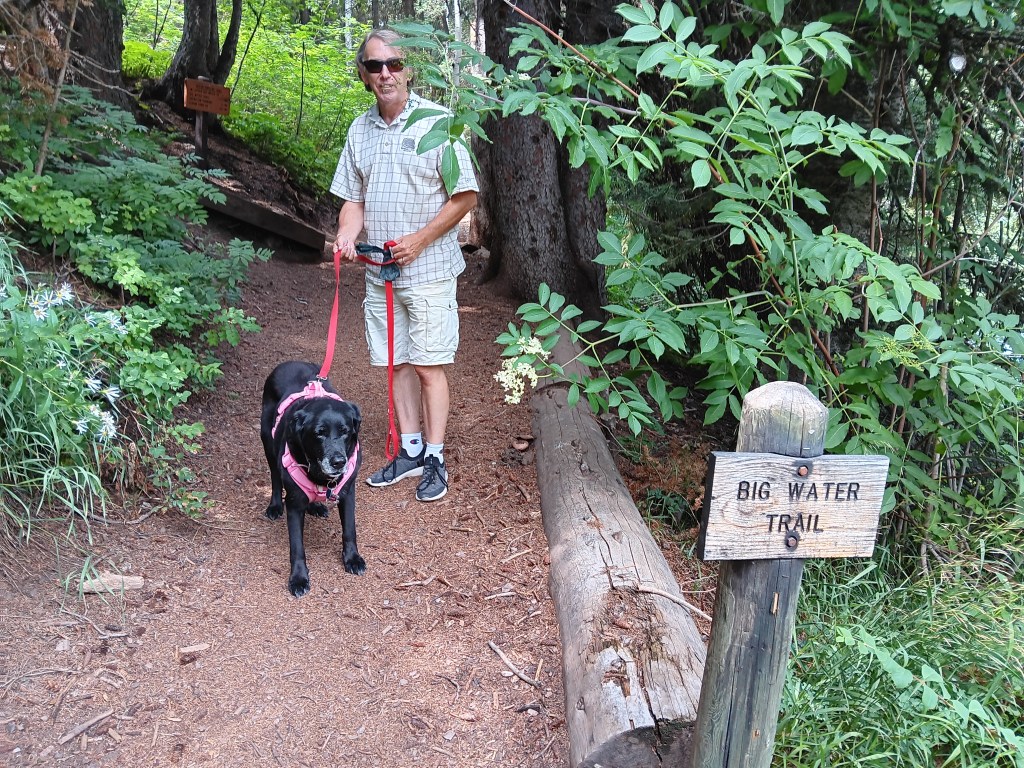
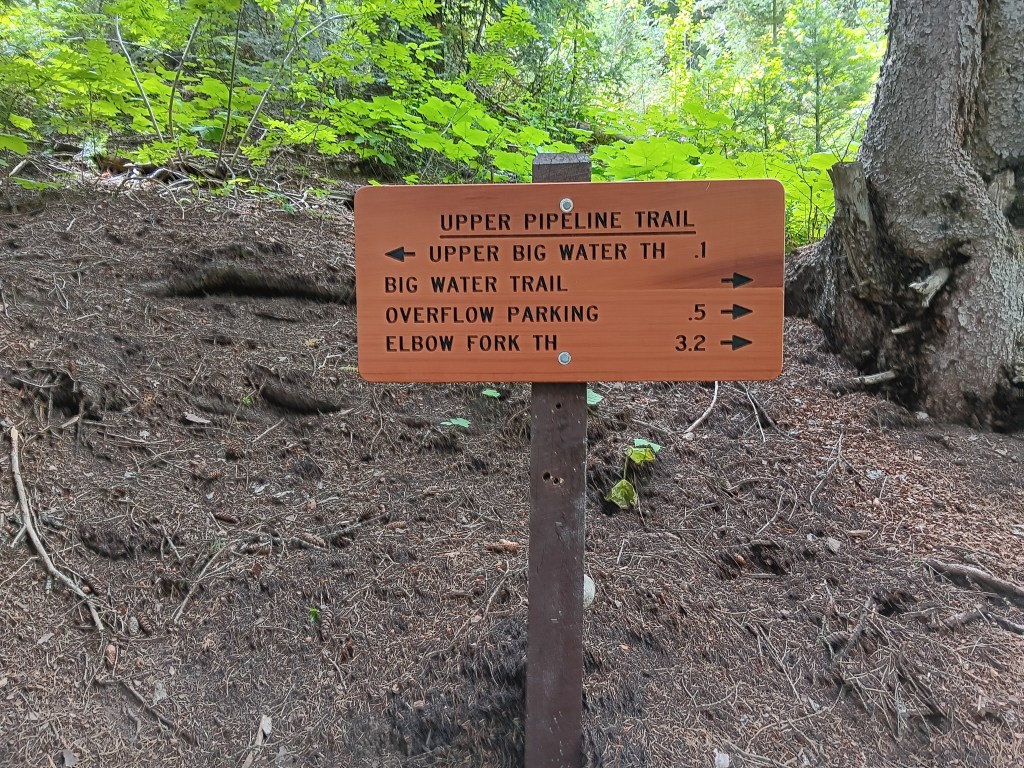
We stopped for a short hike near the top of the mountain, mainly to stretch our legs a bit. And short it was. We saw the sign indicating Big Water Trail (elevation 7,900 feet), which seemed to be just about right for Ruthie; a mile is pretty much her limit.
We started off, loving the sound of crunching pine needles under our feet.
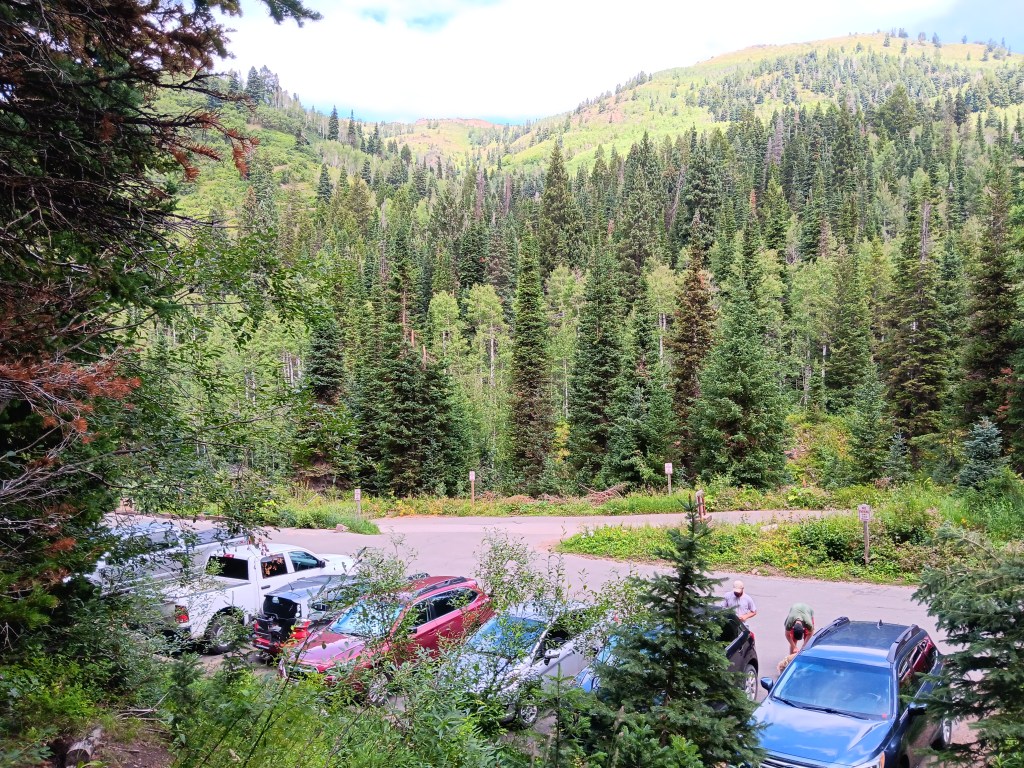
Within a few steps, the trees opened to reveal the parking lot where we’d just left Nippy, and the mountainside beyond.
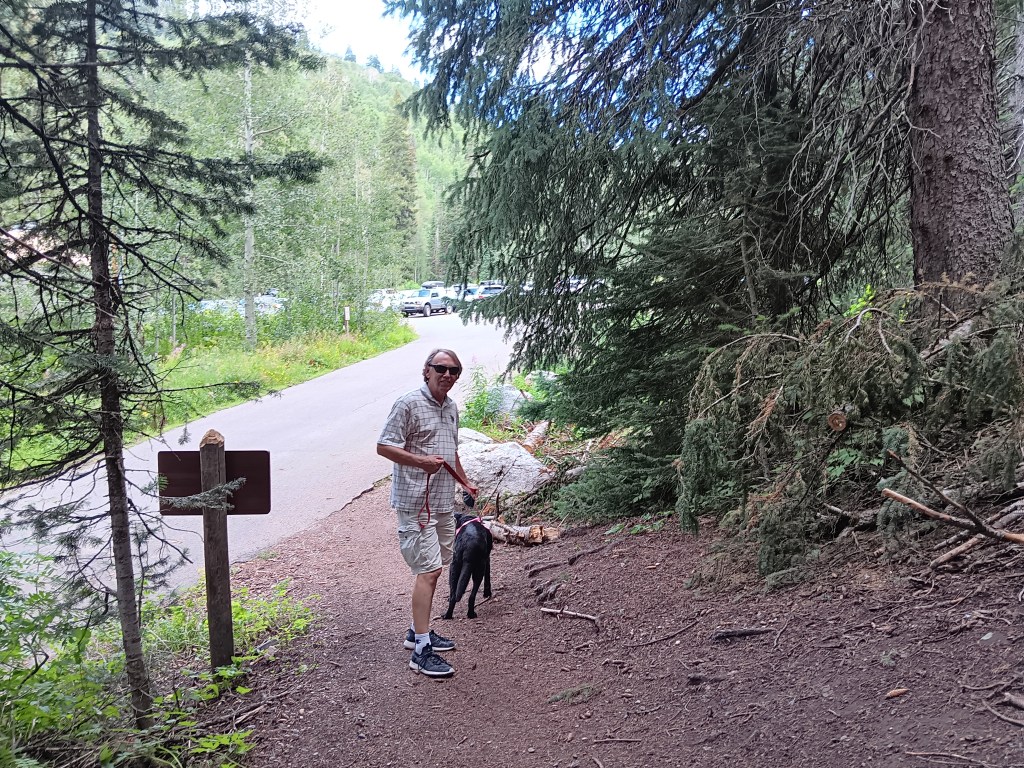
Three minutes later we reached the end of the trail. What the…….!
Shortest hike in the history of hikes, and we should have noticed the sign indicated 1/10 of a mile, not 1 mile. But we’d been prepared to walk the full mile, so it still counts as healthy exercise, right?
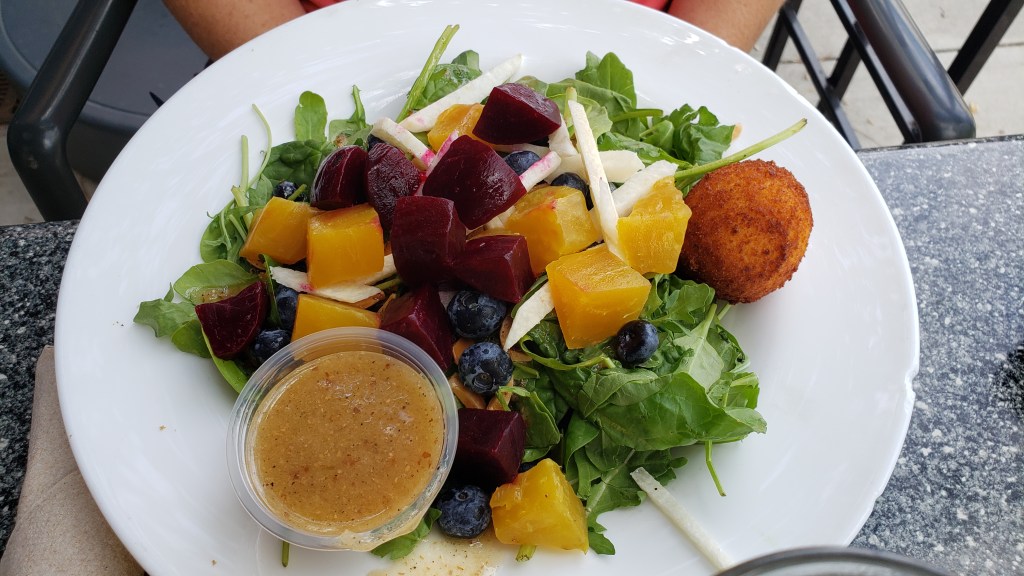
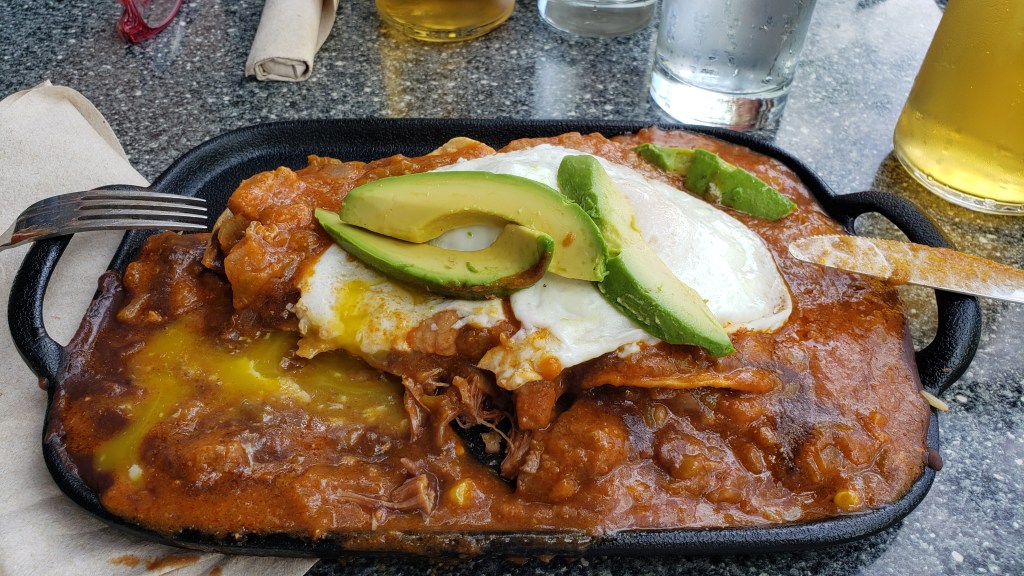
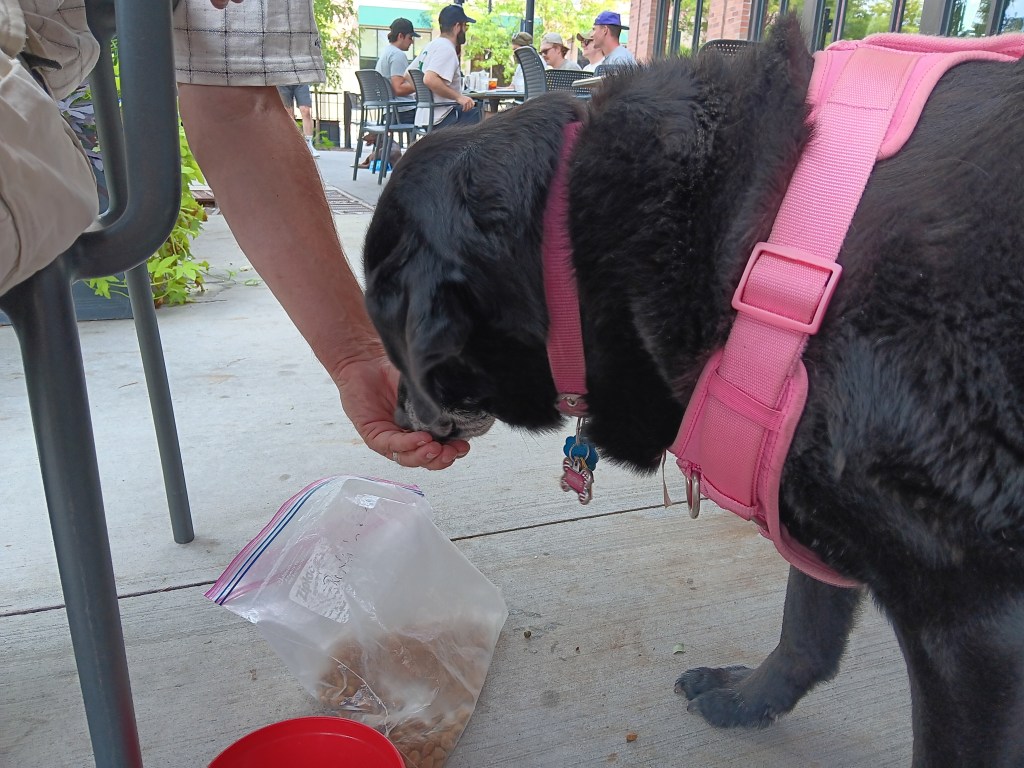
We toasted our athleticism with a visit to Wasatch Brew Pub, where Susan had the Superfood Beet Salad and Simon had the Huevos Rancheros, an unholy assemblage of pork chili, refried beans, queso fresco, lemon crema, and corn tortillas, with two eggs and fiesta rice. Ruthie had dog food.
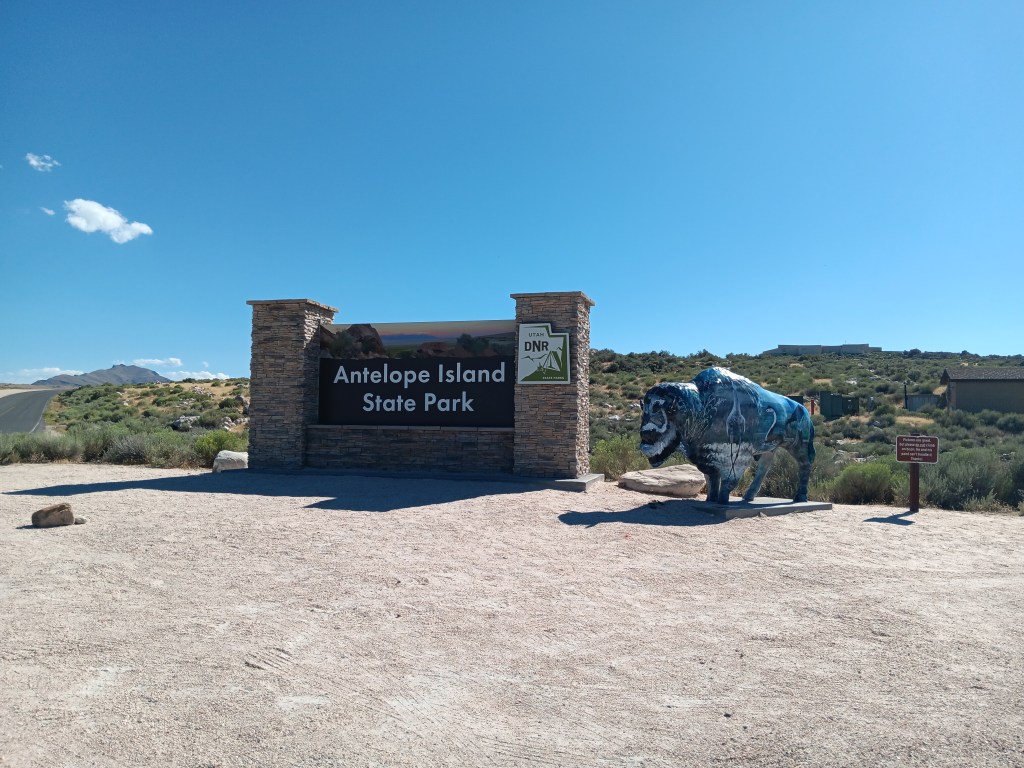
Another afternoon outing saw us taking the long Davis County Causeway out to Antelope Island State Park, situated in the Farmington Bay arm of the Great Salt Lake.
It was close enough to Layton for us to still have Nippy’s windows rolled up and the A/C on High when we arrived, but we soon had them rolled down, enjoying the small breeze wafting across the salt flats, where a billion birds were going about their daily bird stuff.
Click on photo for video
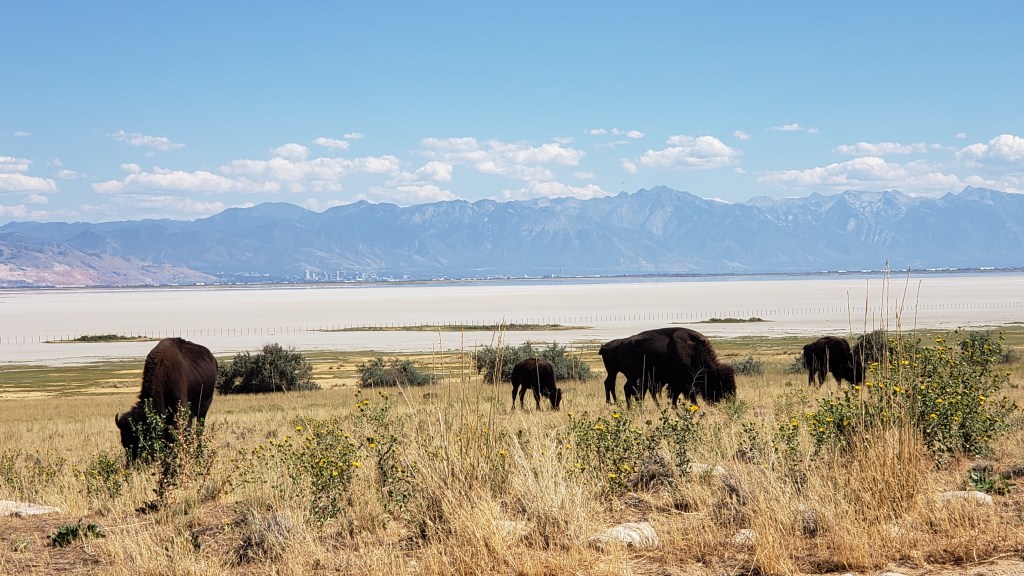
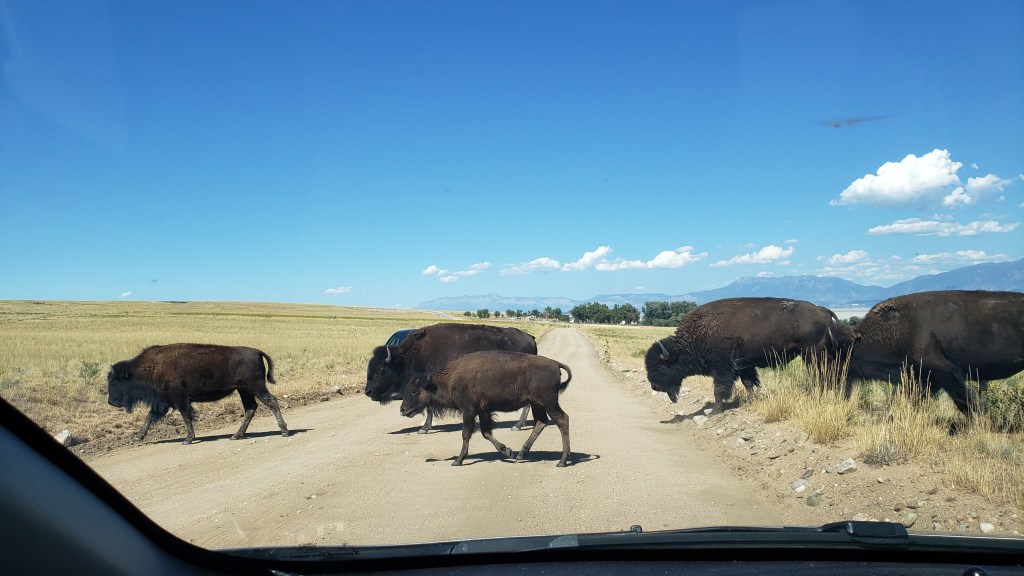
Although the island (really a peninsula) was (wrongly) named for its antelope (pronghorn) population, bison are the dominant mammal now, due to their importation thanks to a conservation effort, after wild horses, thousands of sheep, the Church of the Latter Day Saint’s grazing cattle, and a plague of grasshoppers ate up all the foliage.
It was fascinating looking out over the Great Salt Lake, marveling at how low the water was and how many migratory birds were filling up on brine flies and other bugs. It was no wonder the area was (or, at least, used to be) a sought-after birding spot.
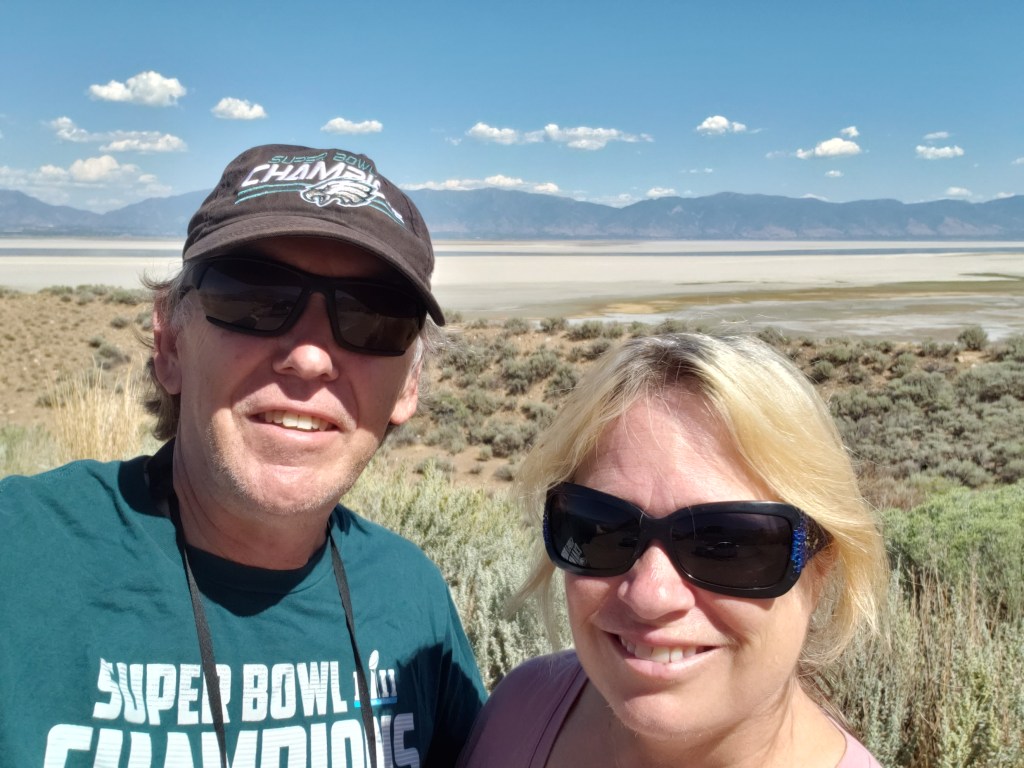
This isn’t birds or bugs. This is us, with the mostly-dried-up Great Salt Lake behind us.
Before we left the island, Simon wanted to “have a paddle” in the water (for our U.S. readers, that’s “go in up to your ankles” in U.K.-speak), so we drank some water, gave Ruthie some water, felt the sand to be sure it wasn’t hot, and agreed we’d turn around if we thought it would be too much for our sweet old dog.
The water was much further away than it appeared from the parking lot, and it really was just too hot to be out in the sun for long, so about 2 minutes into it, we turned around and went back to the car.
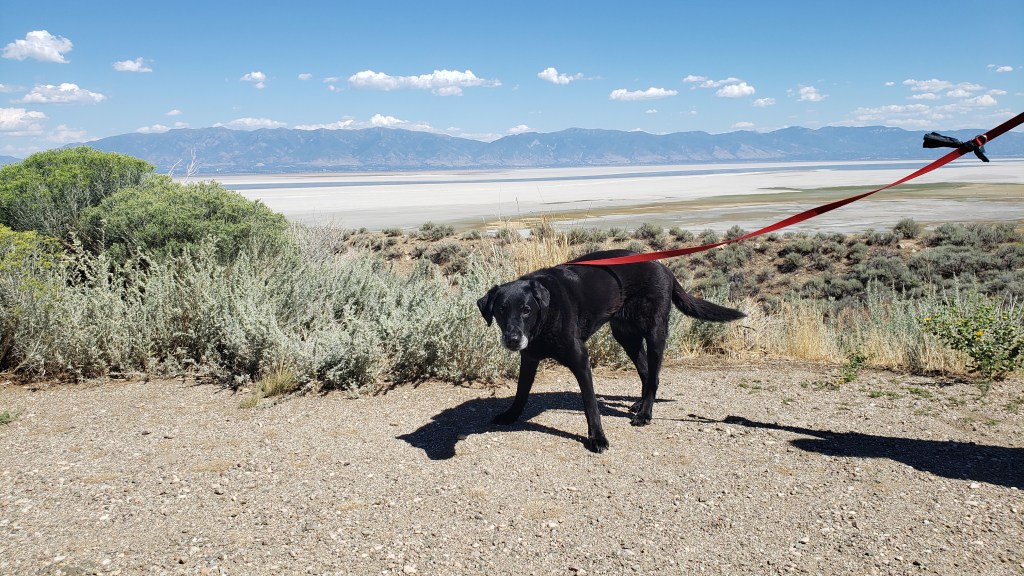
Ruthie, pre-beach-walk, weighing up her options if she’s forced to hike on the sand.
It was then that Ruthie had a full-blown attack, flailing around the back seat, dropping to her belly, trying to jump back up but falling down again, and shaking her legs as if in agony. It looked like she was having some kind of seizure, and we were afraid her brain had fried from the heat.
We quickly felt her fur to see how hot it was, checked her paws for burns, looked between her toes to see if anything was lodged there, and reassured her again and again that she’d be okay and we were there for her. Then, we rushed her over to a hose at the nearby shower station and doused her with cold water in an attempt to cool her down quickly and save her life.
Once the sand was washed off her paws, she bounced around like a joyful puppy, skipping and smiling all the way back to the car. We gave each other looks that showed we both realized the diva side of her personality had come out, and she just didn’t like the sand on her feet.
Ruthie with a fancy hose-water hairdo.
As we crossed the causeway again, this time with our windows rolled down, the most nasal-nauseating smell wafted into poor Nippy. Like the seal-covered rocks we boated around in Chilean Patagonia, those billions of birds stank to high heaven, and we cried out in horror at the assault on our senses.
Ruthie’s dramatic spasms and the bird stink notwithstanding, it had been a fabulous afternoon, and a good way to say goodbye to Utah for a week while we explored what southern Idaho had to offer.












































 Veness Travel Media