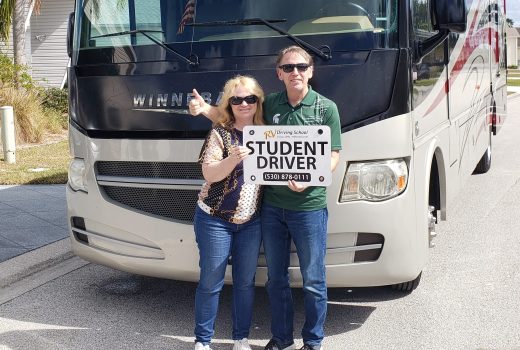

We’re used to living and working together 24/7, but being in a tiny space all the time isn’t the same as being in a house with several rooms. So how do we live, work, and organize a space that compresses down to a single aisle with just a bedroom, bathroom, and living area? Here’s how.
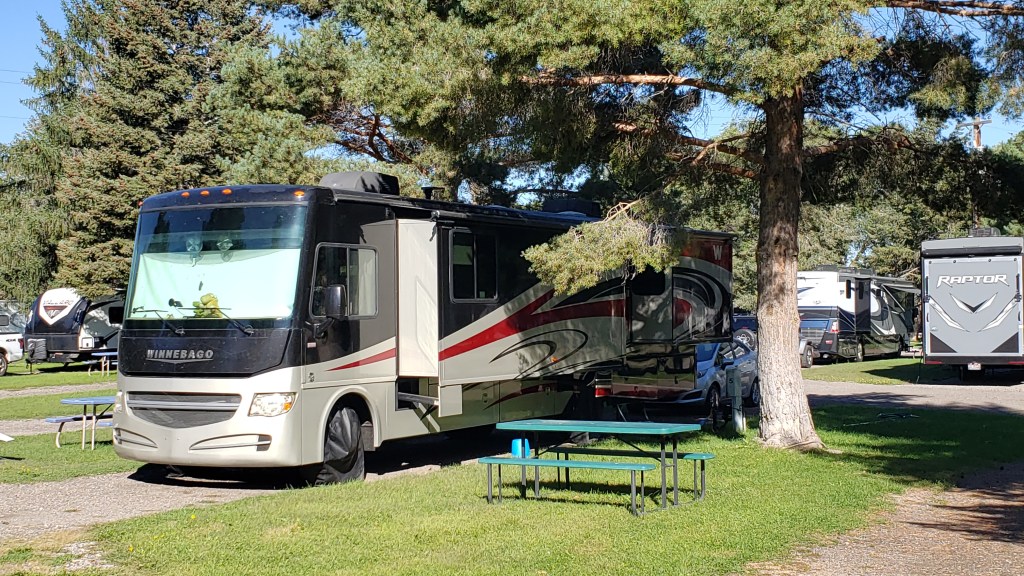
Admittedly, our 36-foot Class A motorhome is massive compared to some rigs (the smallest one we’ve seen being literally just a mattress on the inside and a tiny covered shelf with a sink on the outside), but it’s not all that big compared to the really big rigs.

Naturally, with space at such a premium, we have to be incredibly organized. Our living area breaks down to the “basement,” the cab, the galley, the bathroom/shower, and the bedroom. Everything has a place, and everything has to be in its place or we’d have total chaos. Let’s take a tour, starting with the basement.
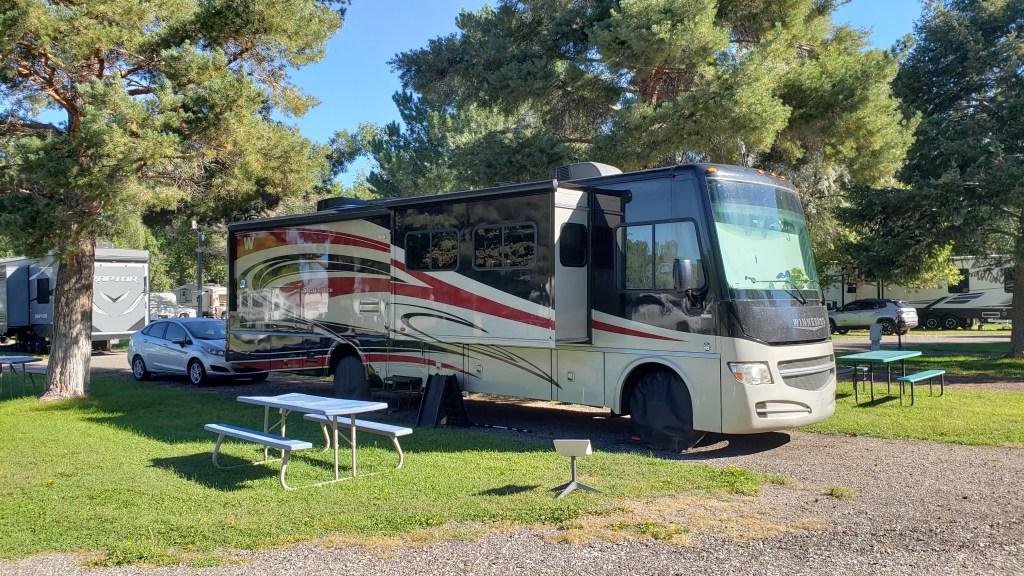
Along with opposing slide-outs that make our galley/living room seem like a ballroom, one of the features of our Winnebago Sightseer that really attracted us to it was the storage space under the rig. As we’ve traveled, each “bay” became organized according to a specific use.
First, we have a bay filled with the stuff we use in a campground. Ruthie’s ramp and tie-outs (plus anything of hers we store) goes in it, along with our outdoor mat, shoe mat, chairs, folding tables, tire covers, and miscellaneous stuff. A small bay to the right of this one has two boxes with mechanical stuff that helps power our electricity.
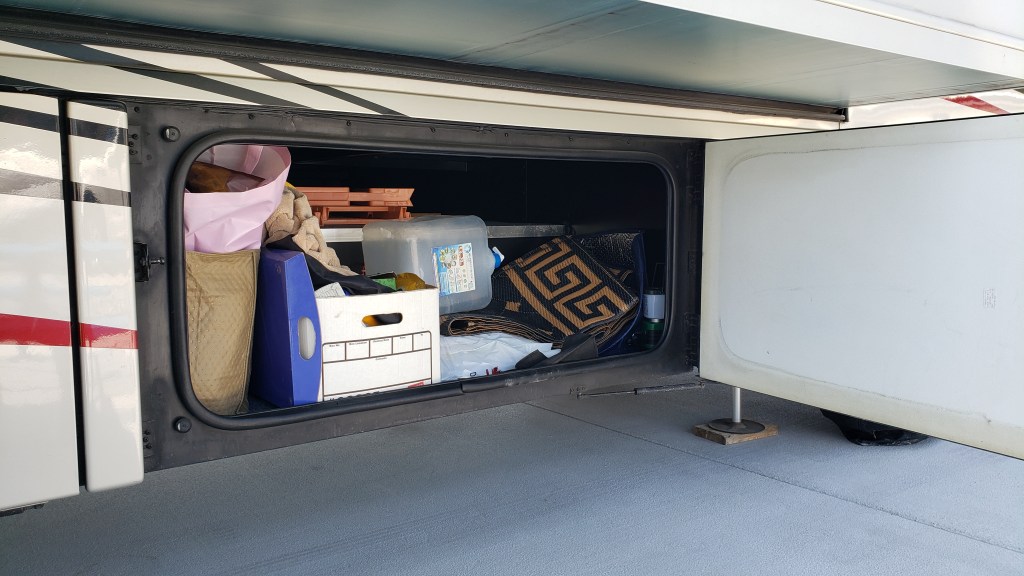
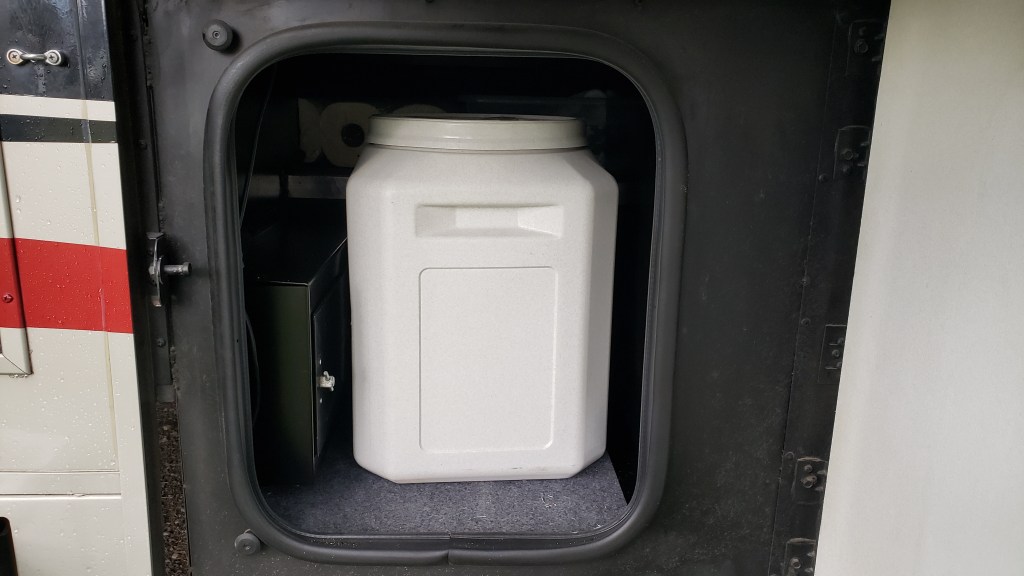
The second bay holds Ruthie’s big food container, a small shelf, and some mechanics for the rig. We fill a smaller container from this one, which we keep inside the rig so we don’t have to open the big one twice a day.
Next is a small bay with our inverter, some extra rolls of paper towel (which we use a LOT, including to wipe the dishes before we wash them so the least amount of fat or food goes into our gray tank and causes smells), and the router for our Starlink internet system.

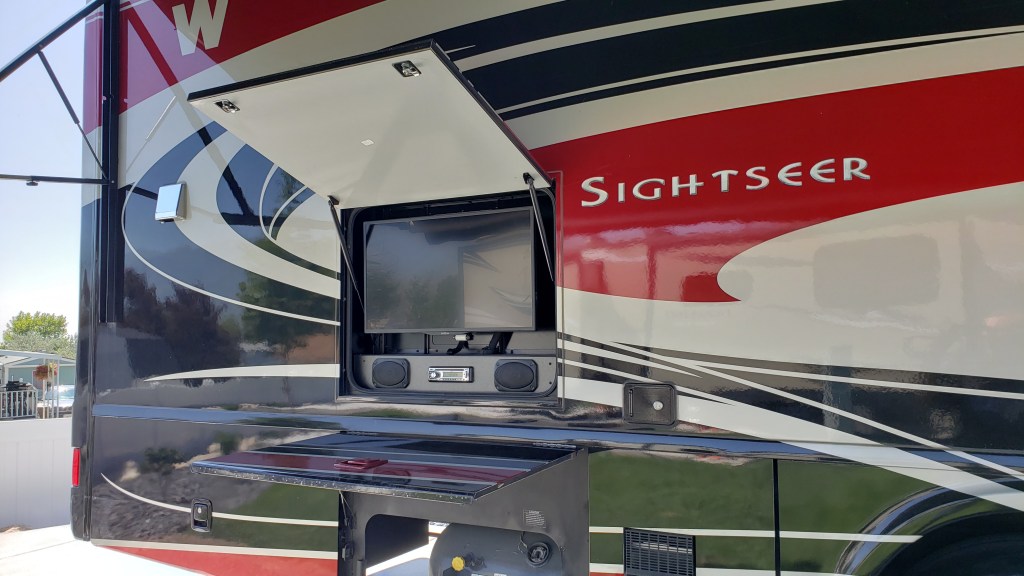
The propane tank has its own bay. Above the propane tank and end bay is our outdoor entertainment system (TV and radio). We’ve used it exactly twice so far, since we’re generally out touring or inside working.
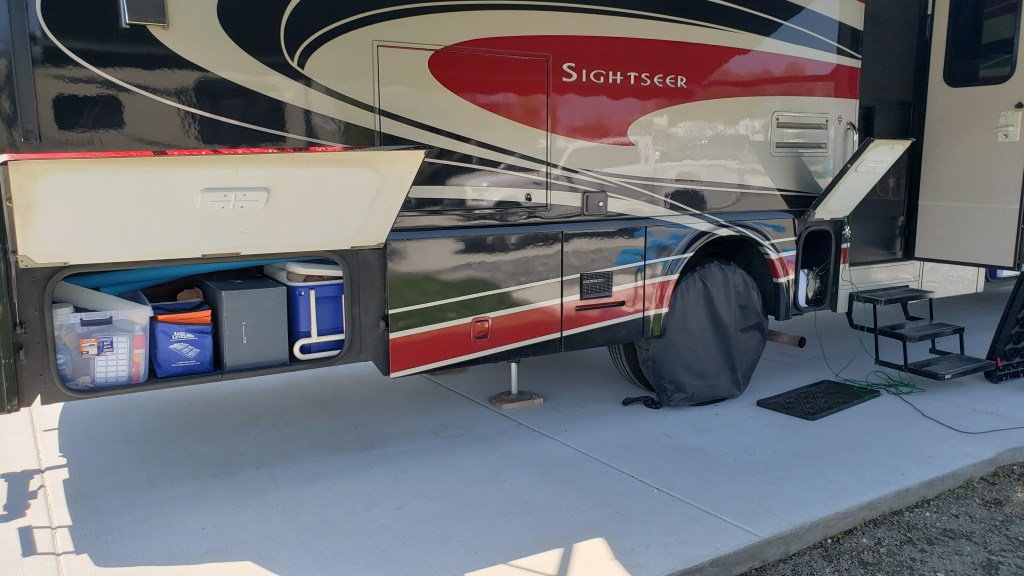
And finally, the rear bay on this side has our emergency stuff (cones and LED flares in case of a breakdown, plus a foam fire retardant), jack pads, pool noodles that go on the slide-out edges to save our noggins when the inevitable bumps happen, the box we store Starlink in, and “extras” of things like toilet paper, tissue, soap, and such.
On the other side of the rig we have a bay with our fresh water hose, plus extras items such as shampoo, first aid stuff, laundry detergent and other necessities that need replacing fairly often, plus our broom and Swiffer.

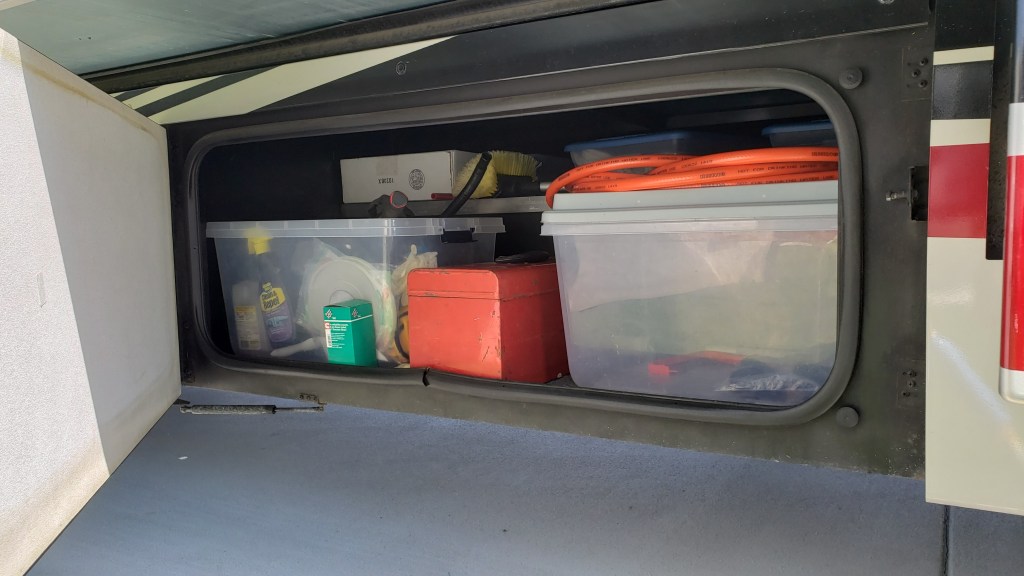
Then comes the icky bay, which holds cleaning and maintenance supplies, a tool box, our sewer hose, and the black tank flushing hose.
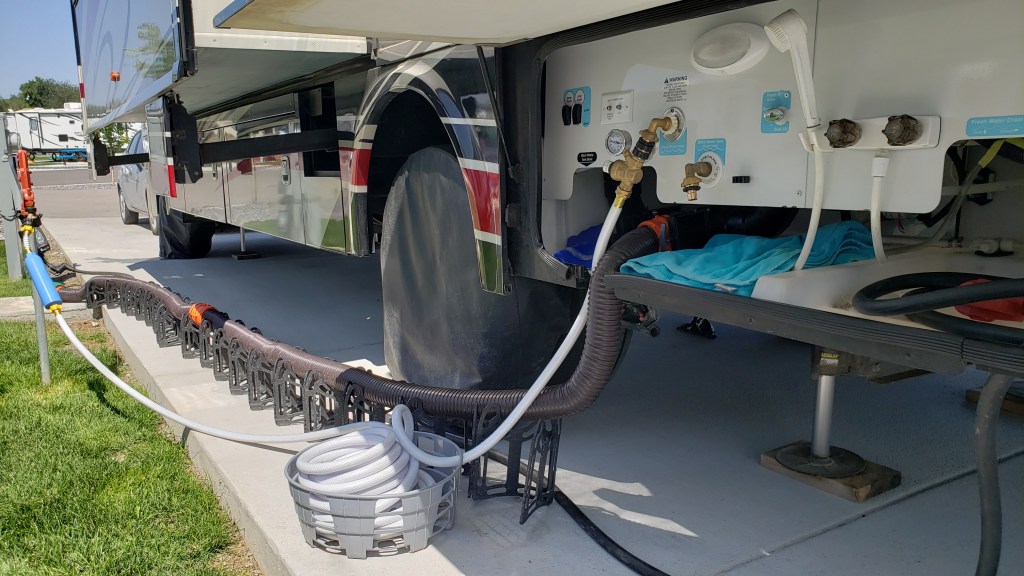
The “wet bay” is where all our electric/water/sewer hookups are located, and the place where the black tank and gray tank dump from. We also have an “outdoor shower,” (really just a hose with a shower head) which we have yet to use. A good place for washing muddy boots and stinky dogs, probably.
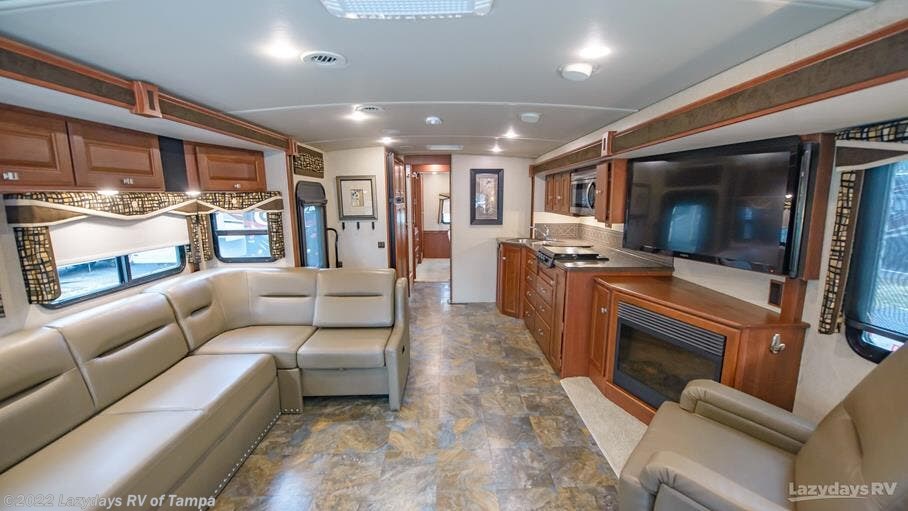
Heading inside, the door leads to the galley. This is our main living space and our kitchen.
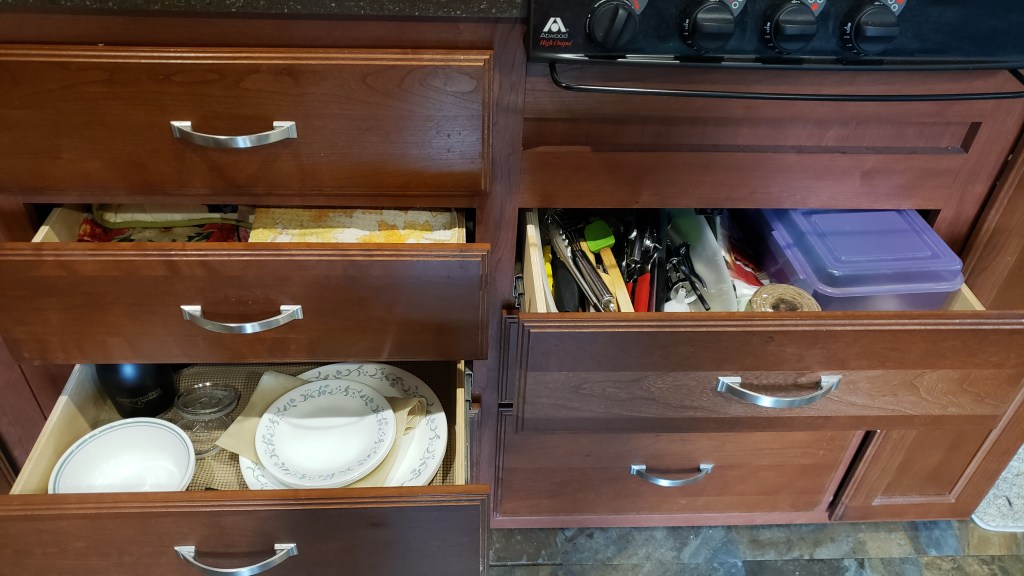
Dishes, pots and pans, dish cloths and towels, silverware, and cooking utensils live in the drawers, while non-perishable foods live in the cupboards. The small Instant Pot, Air Fryer, and electric kettle live on the counter, with non-slip pads under them so they don’t slide when we’re in transit.

There is a big space (relatively speaking) under the sink that holds cleaning supplies, a baking sheet, a dish-drying pad and rack, garbage can liners, our UV water filtration system, and the ever-important bottle of gin. Cutting boards hang next to it.

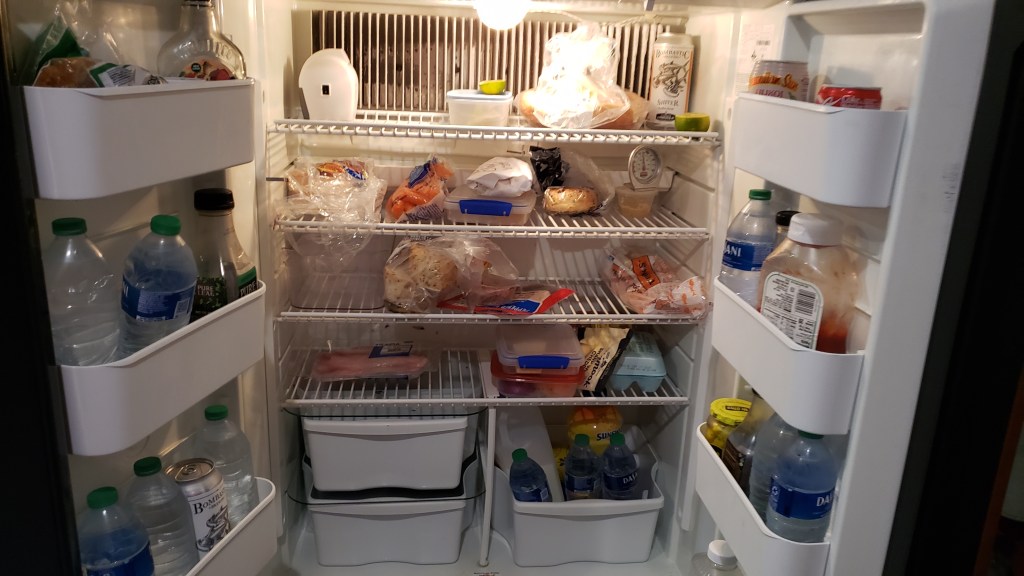
Across the aisle from the sink is the refrigerator and freezer, with our carbon monoxide detector below it.
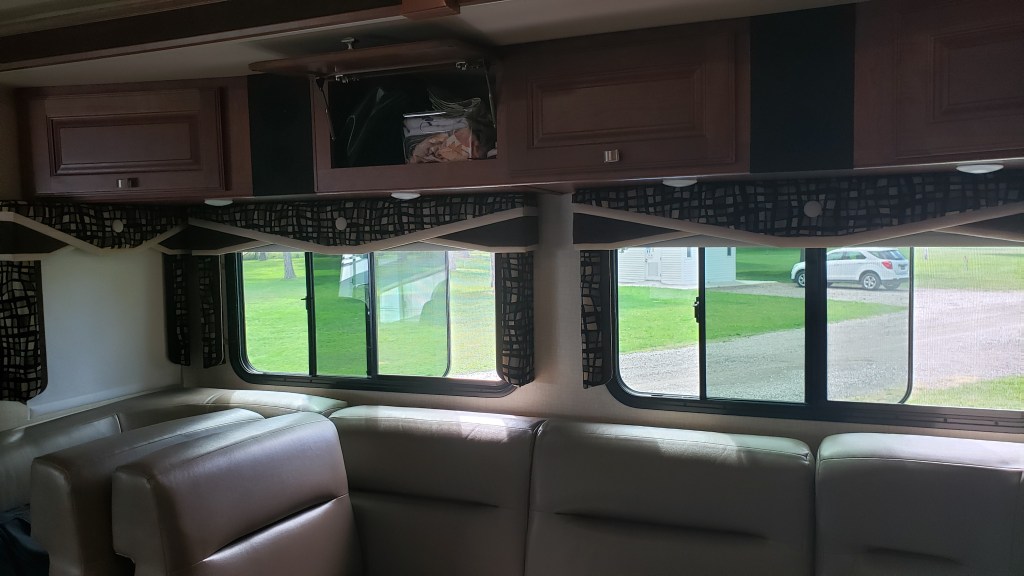
To the right of the kitchen is the living space. Our U-shaped couch (which folds down to make a queen-sized bed) and a drop-leaf table serve as our dining area and our work space. The table has storage in it, which we use for the little fan we bought to help keep the air moving on hot afternoons when the A/C could use a little help.

Above the sofa is storage space for games we play when we’re dry camping (no water, electric, or sewer hookups) and don’t have TV reception; table cloths, placemats, and paper plates for dry camping; Ruthie’s medications; and RV books, plus miscellaneous small tools and other items, such as markers and face masks.
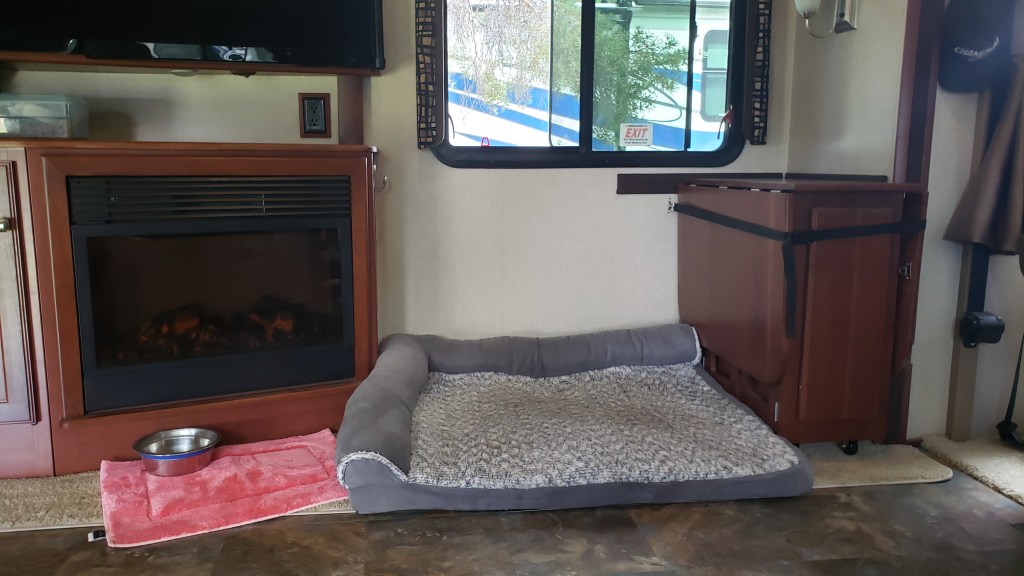
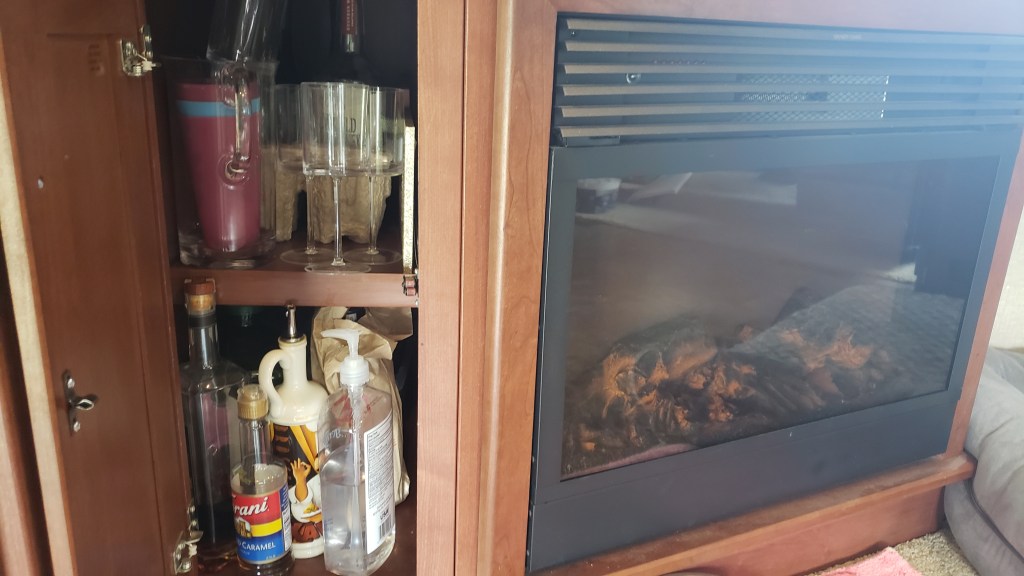
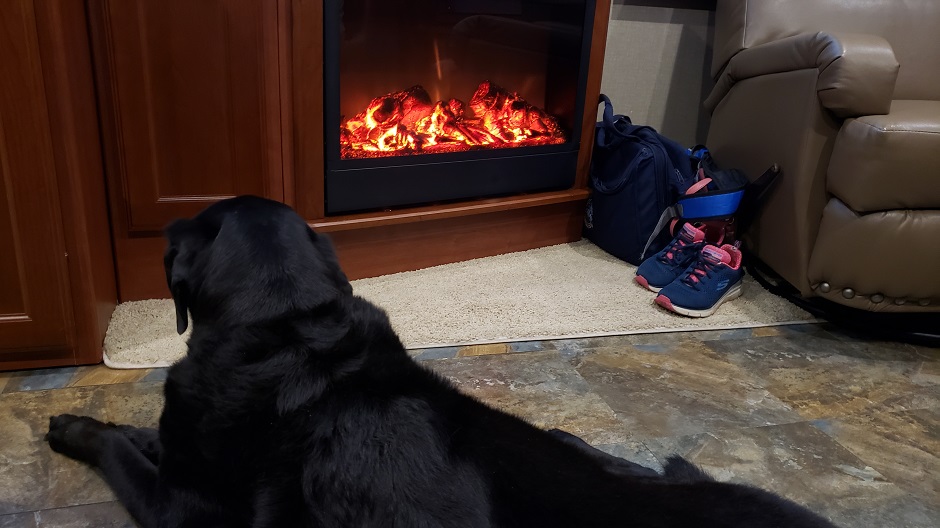
A fireplace under the TV warms this space beautifully on cool mornings and evenings. We’ve used it far more than we thought we might. The cupboard to the left of the fireplace is our “bar,” with wine, wine glasses, whatever Simon is drinking at any given time, and some miscellaneous stuff. It sounds more exciting than it is.
Ruthie’s bed is here, too, in a space that had a reclining chair (which we removed before we left home) and the table folds down and stores next to her while we’re in motion.
The cab is where all our technology and maps live, including an RV GPS, Tire Pressure Monitoring System, DVD player, and things like a high-beam flashlight and our high-visibility vests for roadside emergencies.
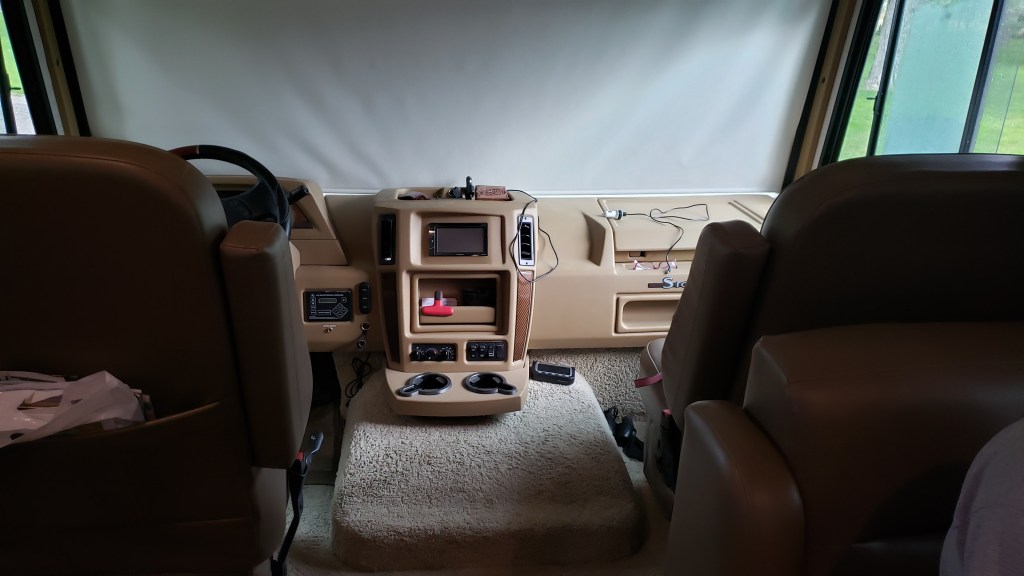
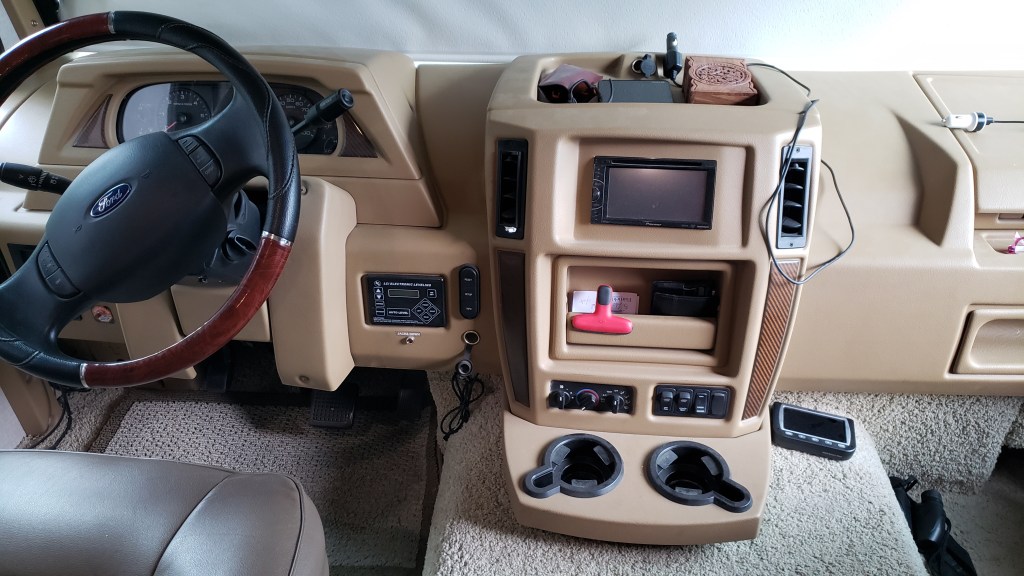
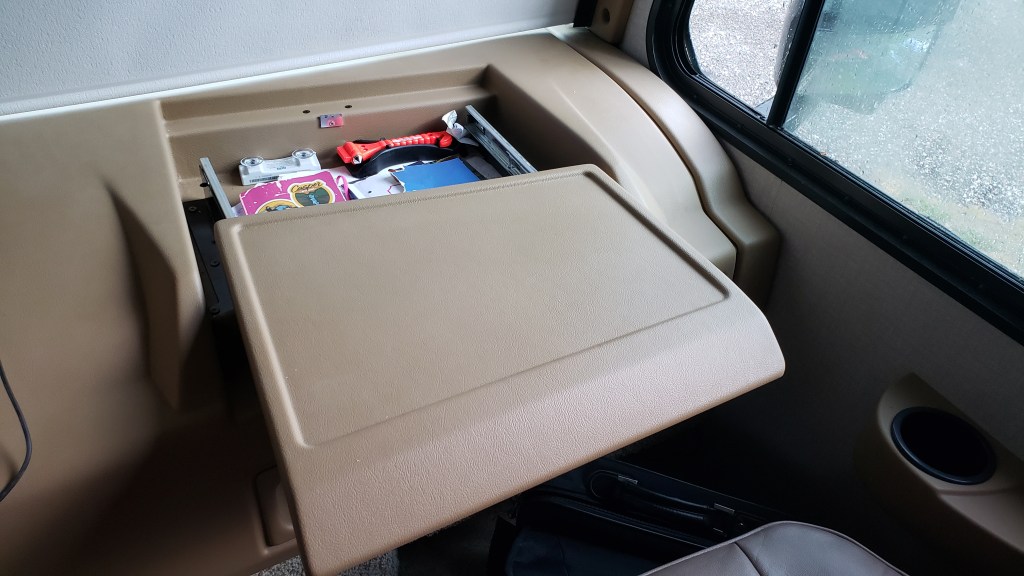
The passenger side of the cab has a space where we keep vital info such as campground membership forms, Ruthie’s vaccination records, and other things campground hosts might want to see, plus a book in which we record each campground location and details, and a book in which we record milage each time we move, the time of day we left the campground, and other boring details.
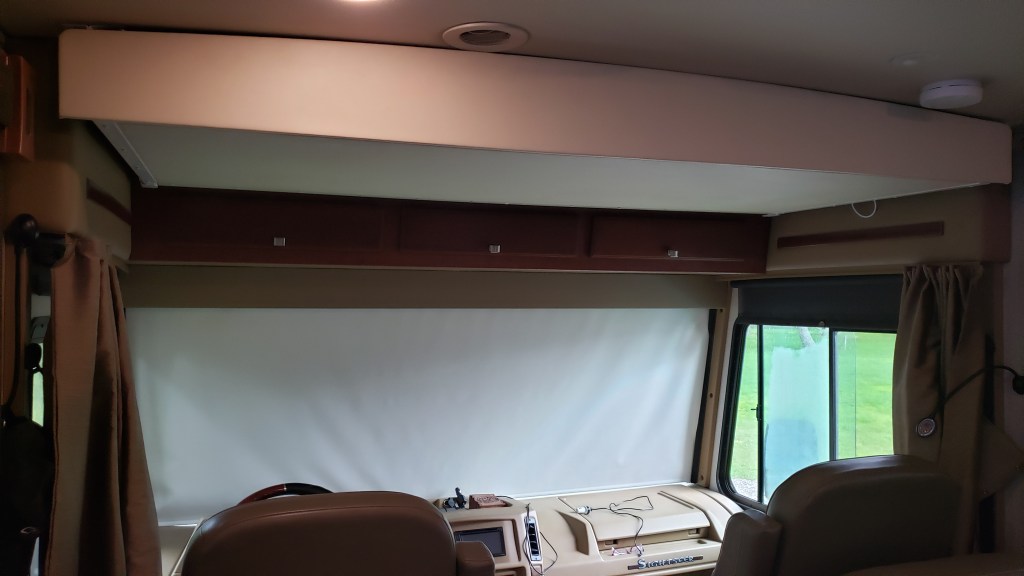
Above the cab is our “guest room,” which is really just a pull-down bed. Before we left home, we removed the thin mattress and now use that area for winter clothes and heavy bedding storage.
To the left of the galley is our bathroom. The shower is on the left-hand side of the aisle (and it doubles as a drying area on laundry day, when we don’t want to take the time to dry things in the washer/dryer, or heat up the bedroom with dryer mode) and on the right-hand side, behind a door, is the toilet, sink, cupboard, and drawers.

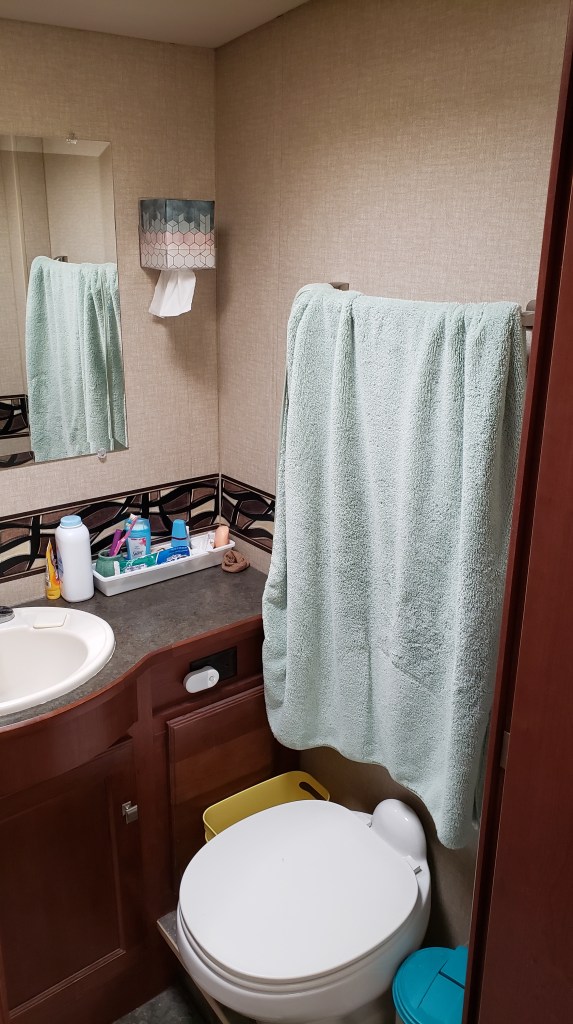
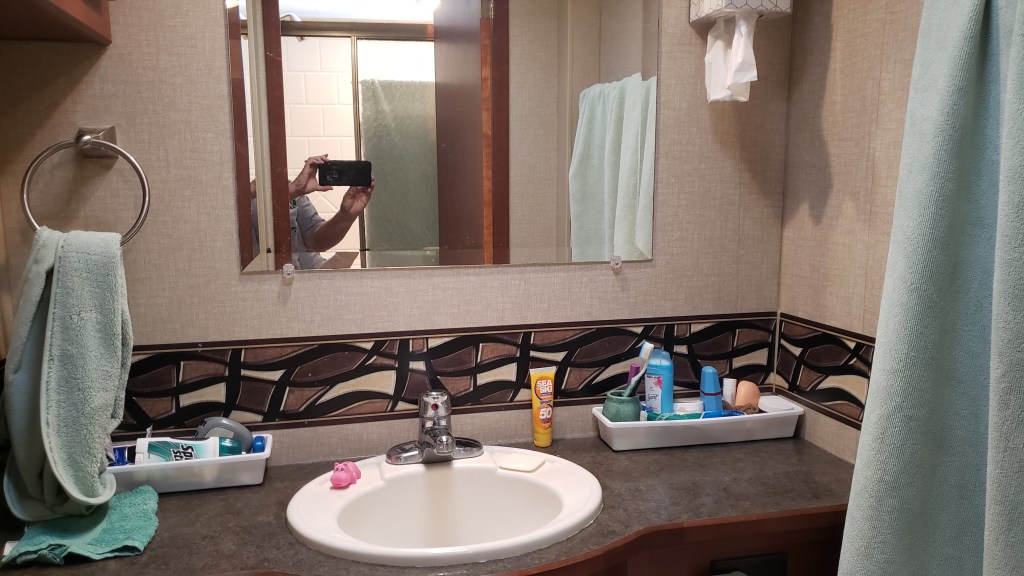
Long, thin containers hold our toothbrushes, toothpaste, and other daily necessities. Each of our containers lives on the countertop while we’re in camp, then they go into the cupboard above and to the left of the sink when we’re in transit. Three drawers hold things like hairbrushes, powder, first-aid stuff, and the like. Toilet paper, Happy Camper black tank treatment, and cleaning supplies live under the sink.
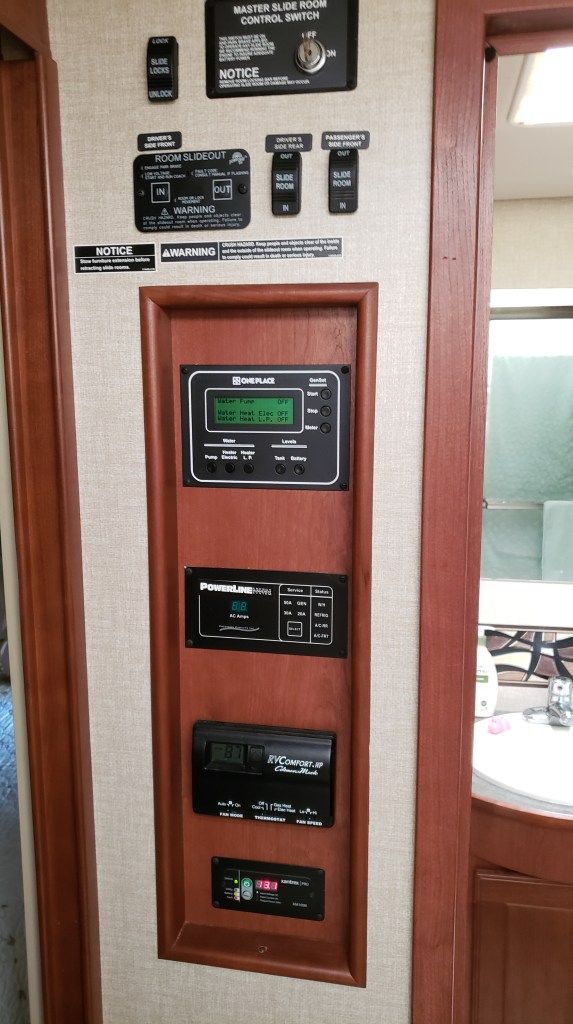
To the left of the bathroom is our “command center,” with monitors for our tanks, buttons to turn our generator and hot water heater on and off, a monitor that shows what power source we’re using (campground “shore” power, generator, or house batteries) and a monitor that shows the health of our house batteries. At the top are buttons that bring the slides in and out.
Next comes the bedroom. Our King bed is on a motorized base, so it “folds up” (to a degree) when we’re in transit and the slide-out is in, and folds down when we’re at a campground.

We each have drawers and half of the closet space for clothes, shoes, etc. There is an A/C in the ceiling here, too (a second A/C is in the living space).
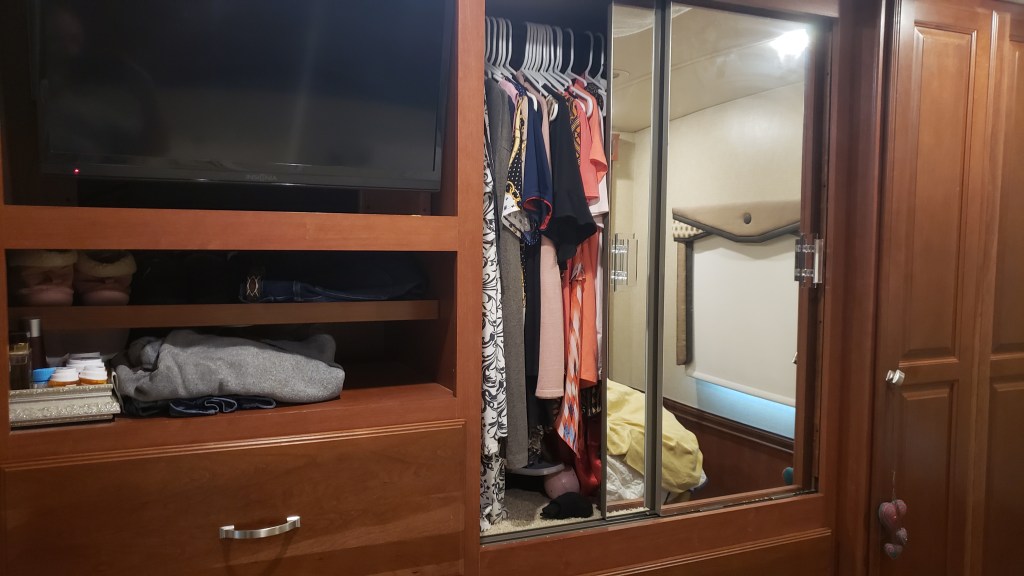
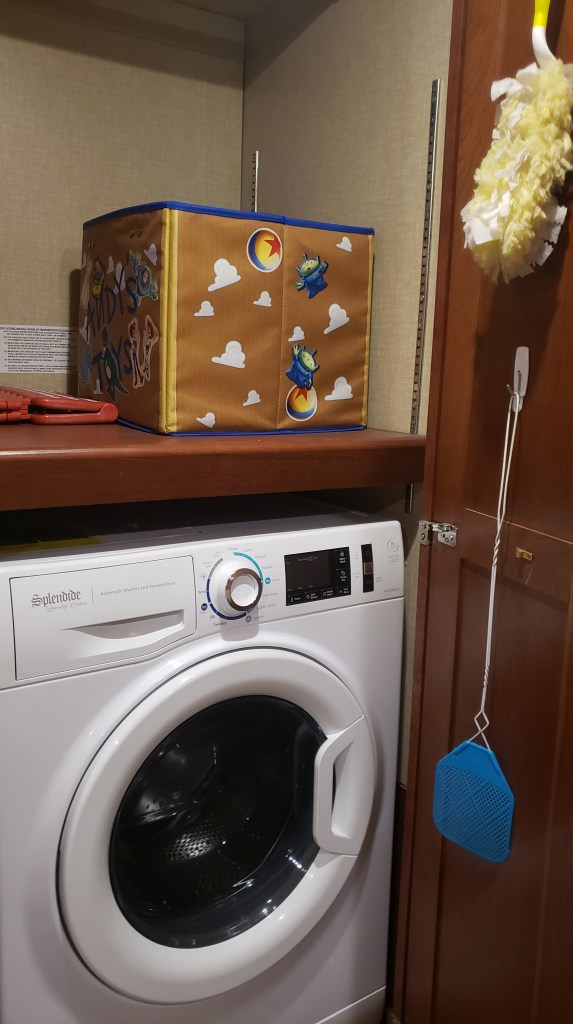
The far corner is where our combo washer/dryer lives, along with a duster, laundry soap and fabric softener, a short step-stool, and the like. We don’t make the most of this cupboard, but we probably should.
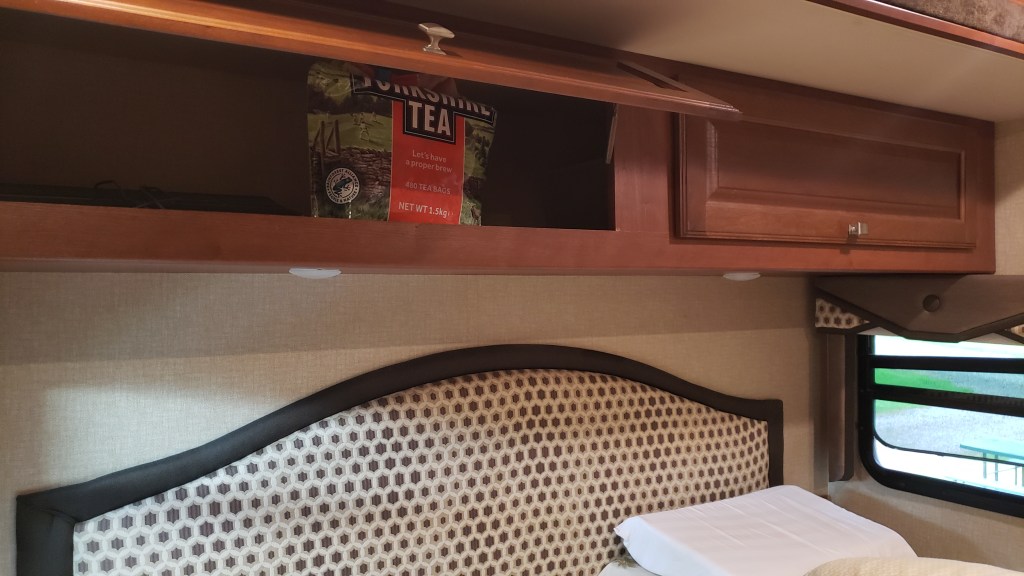
Above the bed is more storage, but at the moment it only has things like extra towels and sheets, and a massive bag of tea bags given to us by dear friends in the U.K.
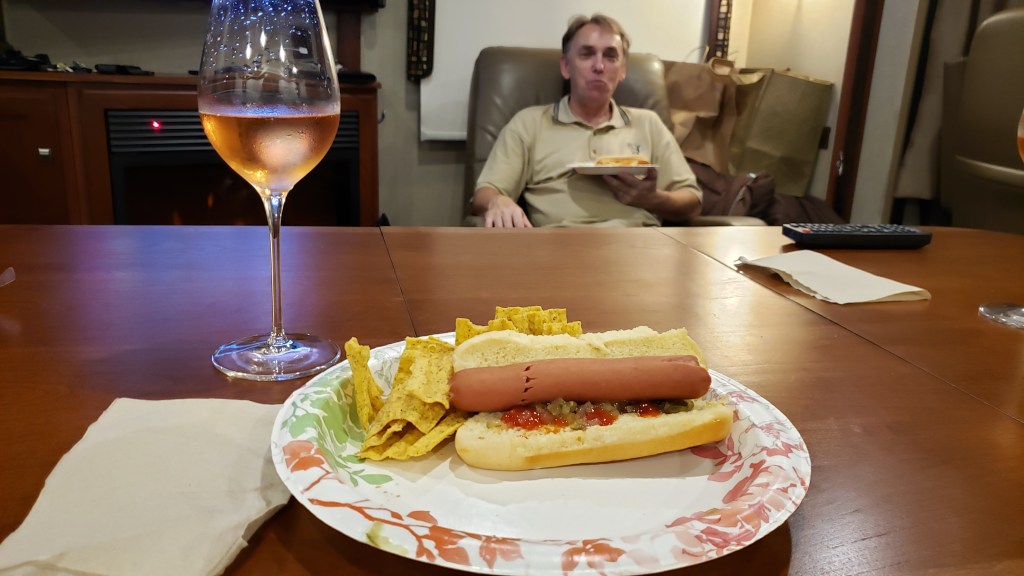
So that’s our house on wheels! And it really does feel homey when we’re settled in for the evening, watching some TV, having a drink, and eating whatever gets thrown together and called a meal.
We were very conservative when we loaded the RV, and the weigh station we stopped at in Florida showed we were 2,000 pounds under our maximum allowable weight. We like to keep it that way, for better gas milage and easier mountain driving.
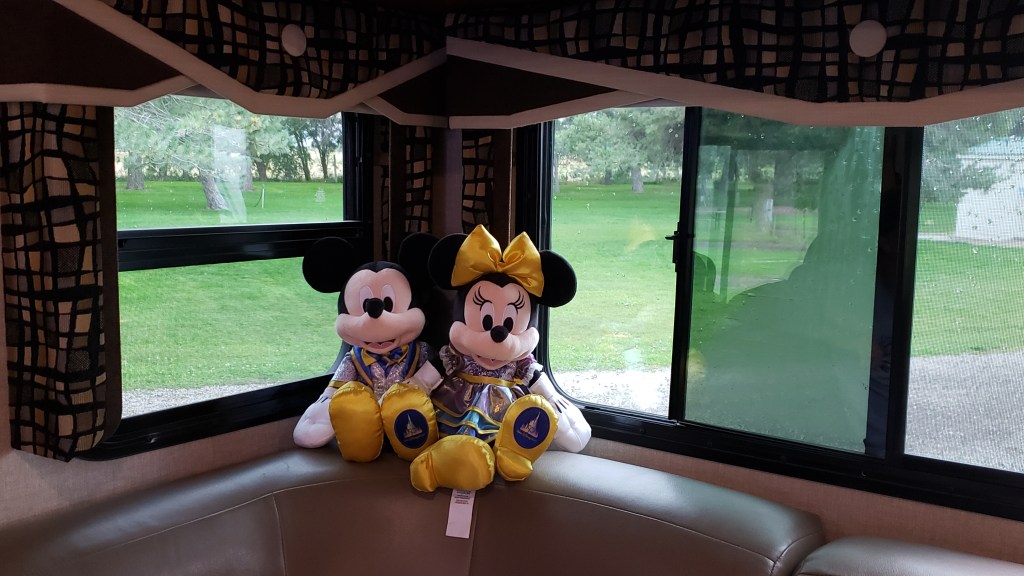
Oh…and Mickey and Minnie sit on one corner of the sofa, to remind us of home.

 Veness Travel Media
Thanks for the tour. What a lovely home of wheels. How are you handling being away from home four months now and only about half way? I kinda envy you. How fun.
LikeLiked by 1 person
It’s kind of odd, but we’re just starting to really realized we’re actually DOING this. That it’s not just a long vacation, it’s a year-long experience. There are times when we miss certain things about our house (long, hot showers; not having to think about everything so much; missing Young Son and being a bit sad about not seeing his cat’s newborn kittens), but we’re also really comfortable with all the travel, especially now that we’ve slowed down. We’re finding the right balance between touring and staying “home,” and we’re enjoying it more than we did in those first two months.
More than anything, we feel so incredibly blessed to be able to do this at all. There is an enormous amount of gratitude that really humbles us, and we appreciate things so much more. What an adventure!
LikeLike
It’s incredible to think that you are driving all of that around! You have to be so well organised to be able to lay your hands on what you need at short notice. I’m sure there was a learning curve. Ruthie really does have a great life😃
LikeLiked by 1 person
There is something truly wonderful about having your own bed and your own bathroom with you at all times. 😉
Ruthie has a new lease on life. She really does seem to be loving this!
LikeLike
The tour of the RV was very interesting. It is amazing how much you can fit in a very confined space.
LikeLike
They’re so well designed. And we often feel we’ve got more with us than we really need.
LikeLike