We entered the new-to-us state of South Dakota on June 19, eager to see more of the Dakotas after a fantastic stay in the northernmost state in the Midwest. We’ve got a week in Hermosa, then 3 full days in Sturgis, to see Custer State Park, Crazy Horse, the town of Custer, Deadwood, Badlands National Park, Needles Highway, and Six Grandfathers, now known as Mount Rushmore.
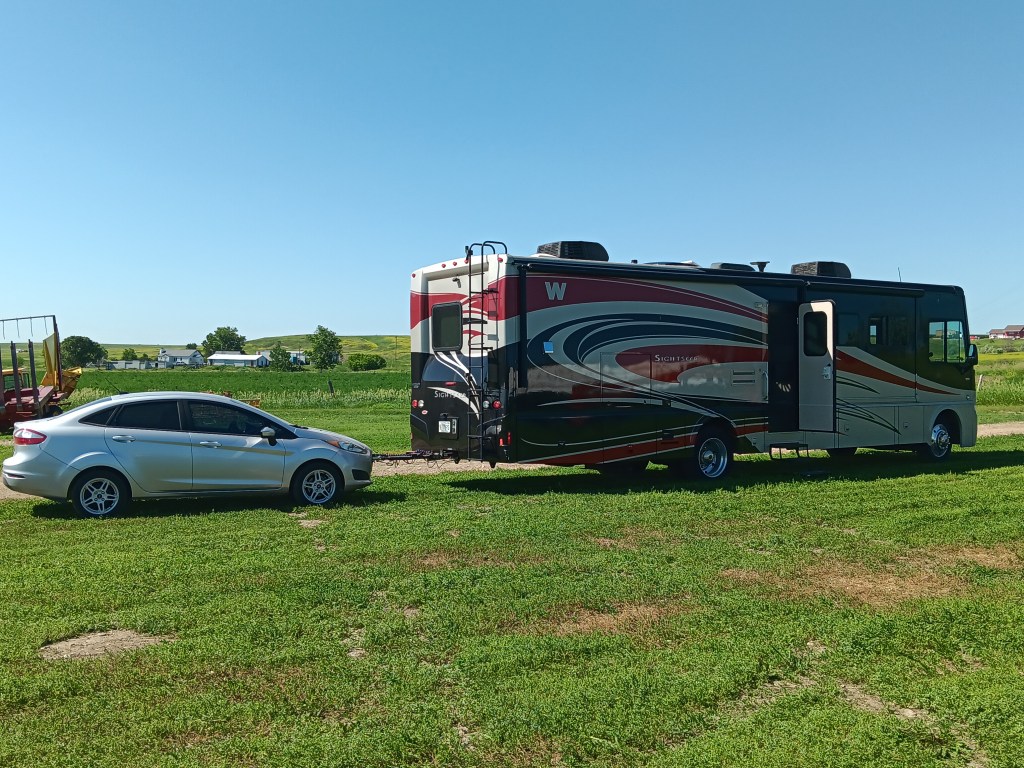
To break up the long trip from Medora to Hermosa, we had an overnight stop at Harvest Host location, Belle Valley Ancient Grains in Newell, SD, which felt incredibly rural but was just minutes off the highway heading south.
We learned about the ancient grains owner Brian is farming, and came away with whole Spelt and White Sonora Wheat that we’ll make into grain bowls and hot cereal.
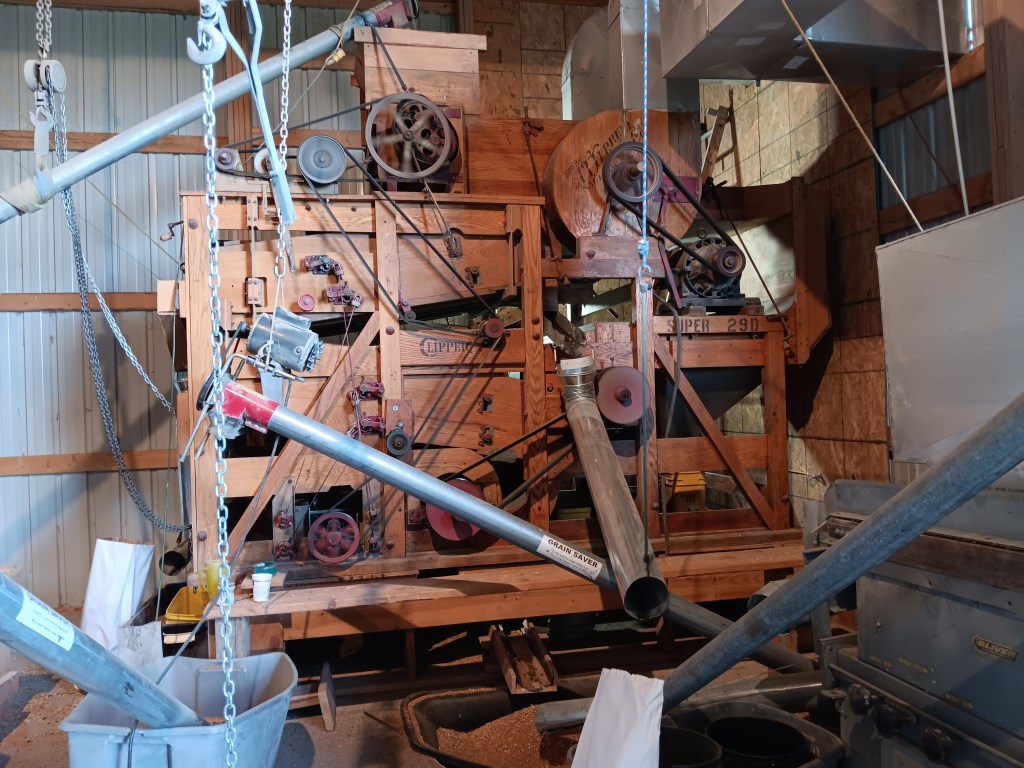
The 1950s machine Brian uses to separate the grain from the waste, before putting it through high-tech machines that finish the job.
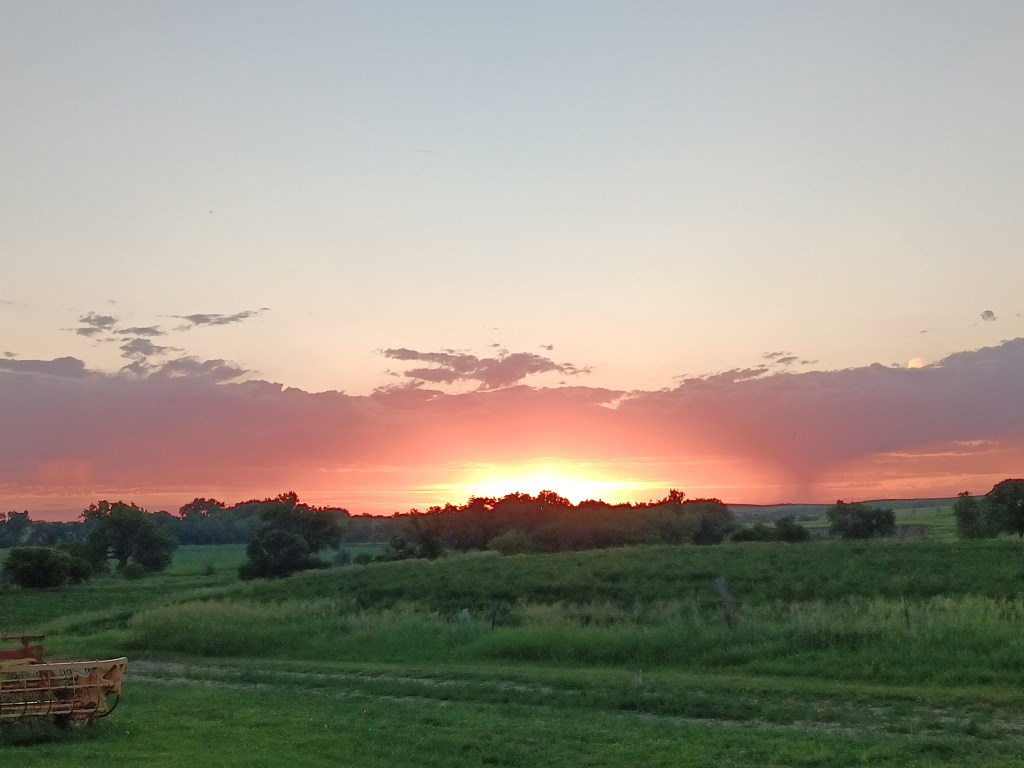
It’s hard to beat a stunning sunset over pastoral land
Then it was on to Hermosa, with a butt-clenching 11 miles through construction cones on a highway with a speed limit of 75mph. You can imagine the number of cars that passed us after the construction zone ended. We’ve decided their honking and single-finger salutes are congratulatory celebrations of how well we navigated a tight lane with harrowing twists and turns, and we felt very special indeed.
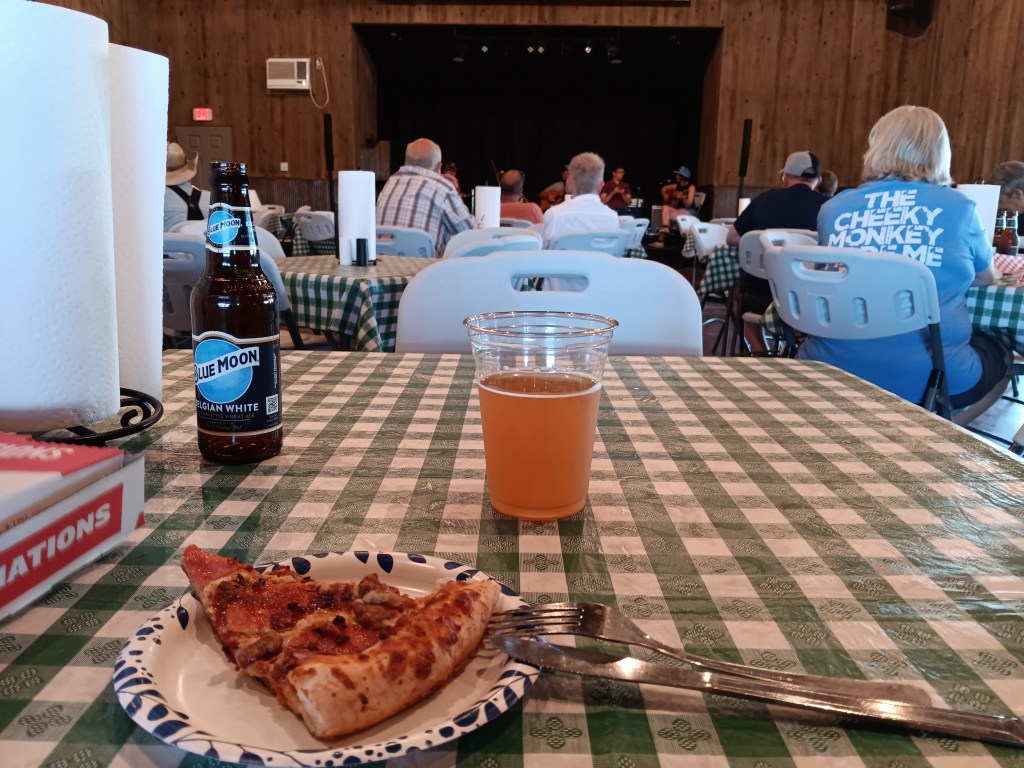
But enough of that, and on to the touring. We settled in at Heartland RV Park, enjoyed a pizza and live music at the campground’s event center, and had a relatively quiet night (rain is loud when you’re in a metal can), then made our way to Badlands National Park the next morning.
Happy boy!The karaoke was good, and the pizza was great!
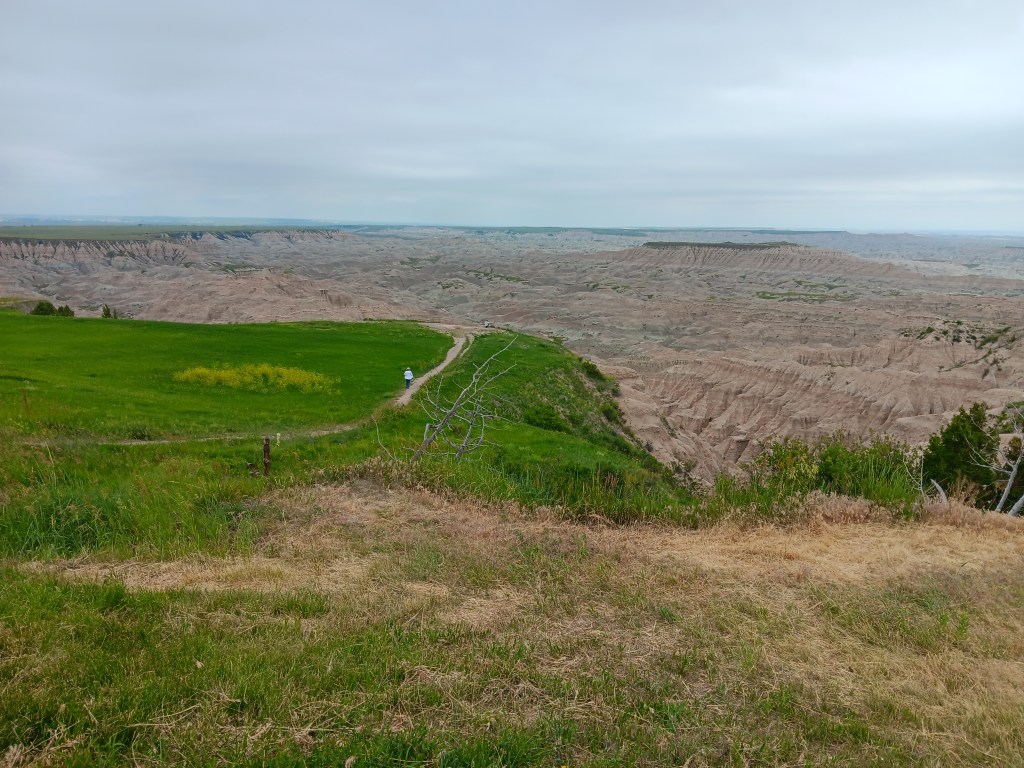
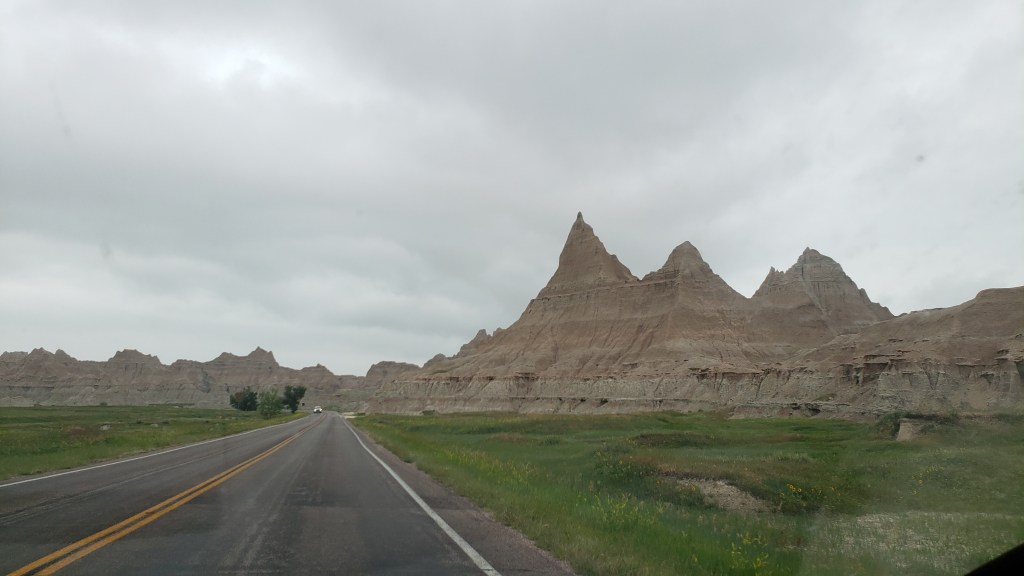
It was quite cloudy and windy all day, but that didn’t deter us. We were on a mission to see something other than the rolling hills we’ve been driving over, and even before we reached the park, the landscaped changed. Immediately off the highway, the hillsides on either side of us opened to two massive valleys, with structures completely different to the ones we saw in Theodore Roosevelt.
For scale, that teeny tiny white dot you can barely see at the end of the dirt pathway on the far edge of the plateau is Simon, and a lady who had just come from the Black Hills is in the foreground.
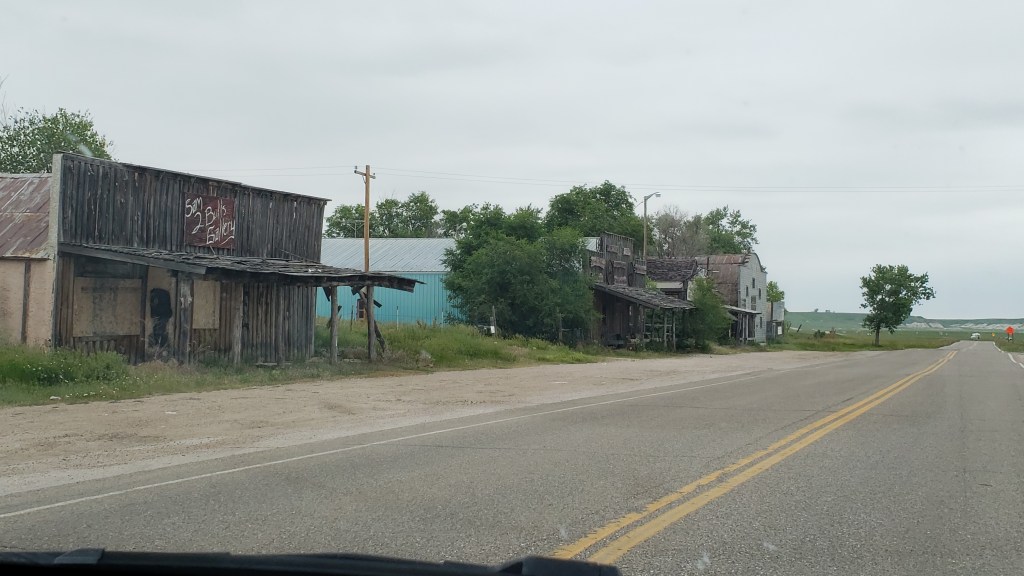
We made a quick stop at the Visitor Center, where they told us we could find gas in the appealingly-named town of Scenic if we needed any, but when we found it, it had obviously been a dead town for years. Decades maybe. The gas station had a price of $5.55 per gallon, so we’re guessing the place drew its last breath back when Jimmy Carter was President. Luckily, Nippy is very sippy, so we didn’t need to fill up until evening.
Is Scenic scenic? You decide!
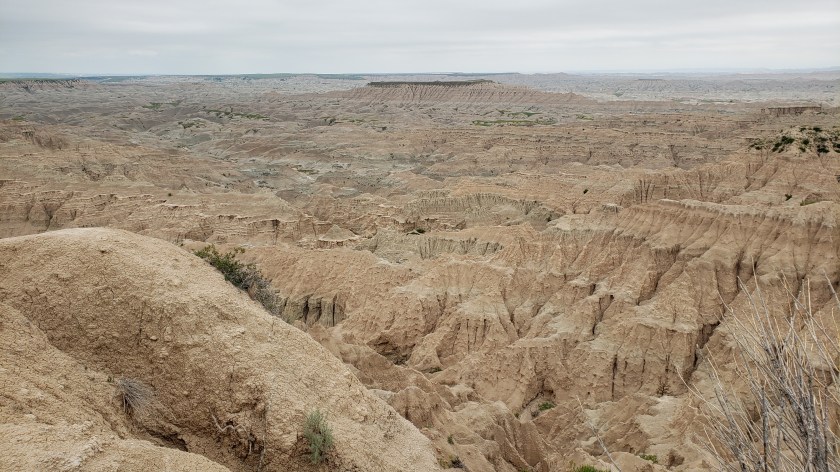
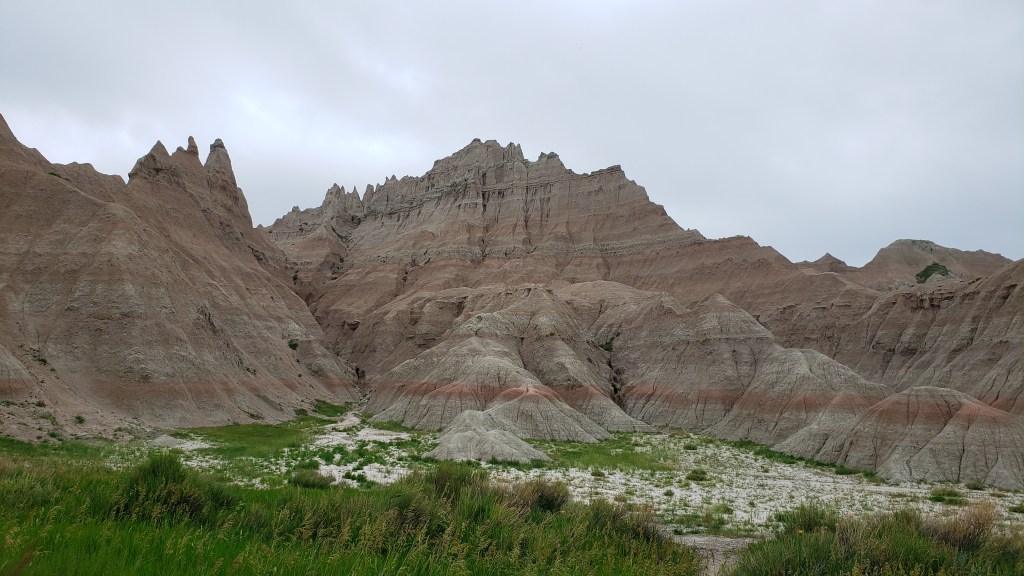
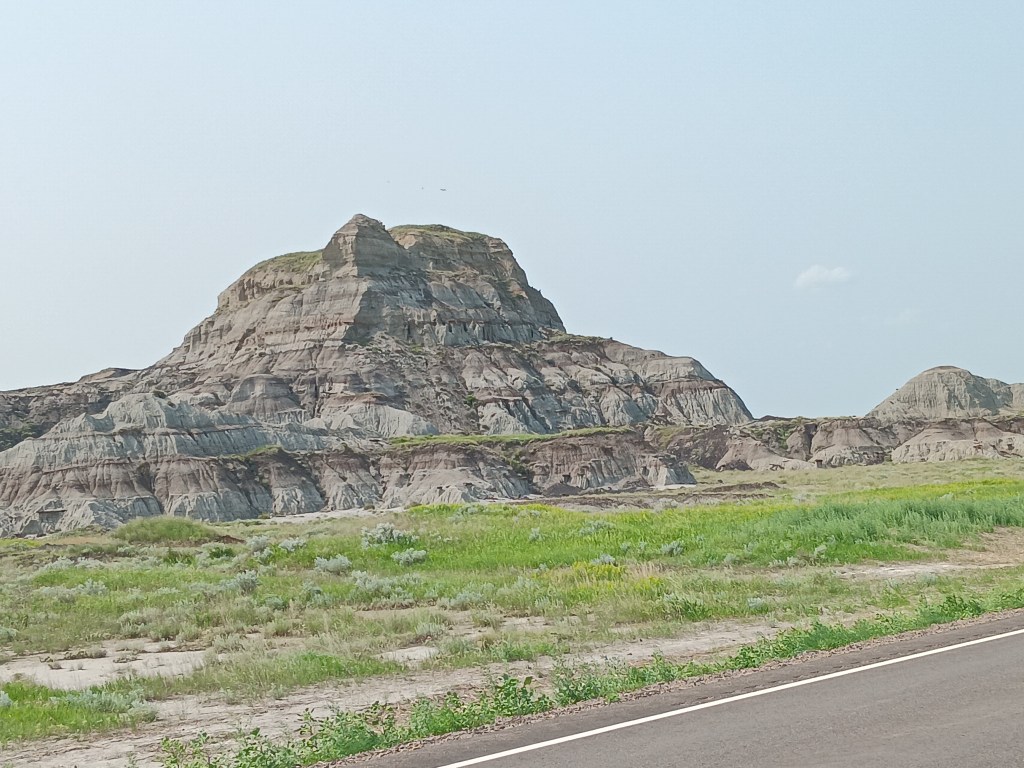
Once we reached the first outcroppings, it was obvious we were in an entirely new landscape. The peaks were sharper at the top and more angular as they descended, with a softer, more “melted” look when we got up close.
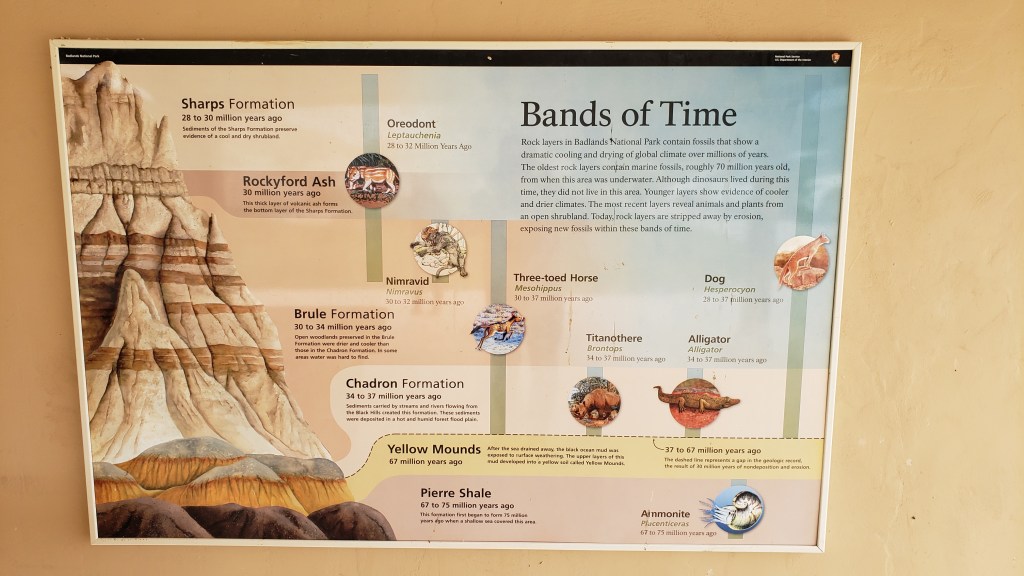
We were given a guide that showed what each later represented, moving from the oldest layers at the bottom to the youngest at the top.
The badlands here were created by runoff that washed into an inland sea as Colorado’s Rocky Mountains rose into existence. We could see the layers when we took a short hike into a wide canyon, and the ground we were walking on was primarily the finest silt imaginable. Just like walking on talcum powder.
The white pathway feels exactly like talcum powder
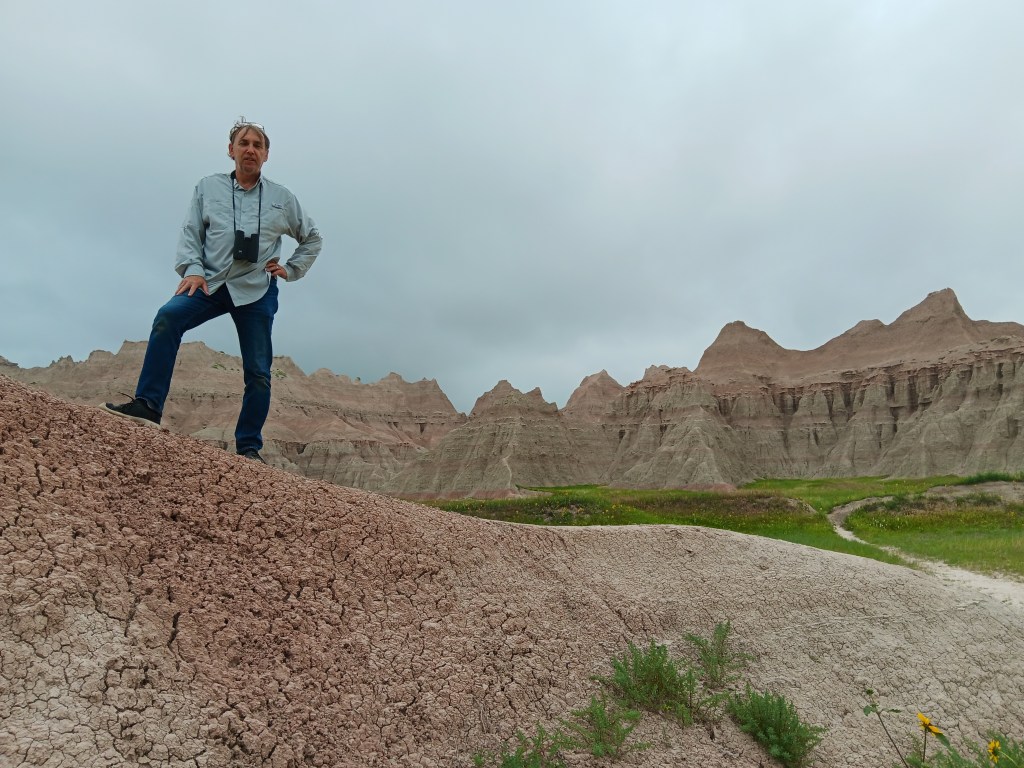
Other areas in the same canyon were like petrified mud, hard enough to create hills you could stand on but also dry and cracked on some surfaces.
This ancient sediment is described as “popcorn” rock
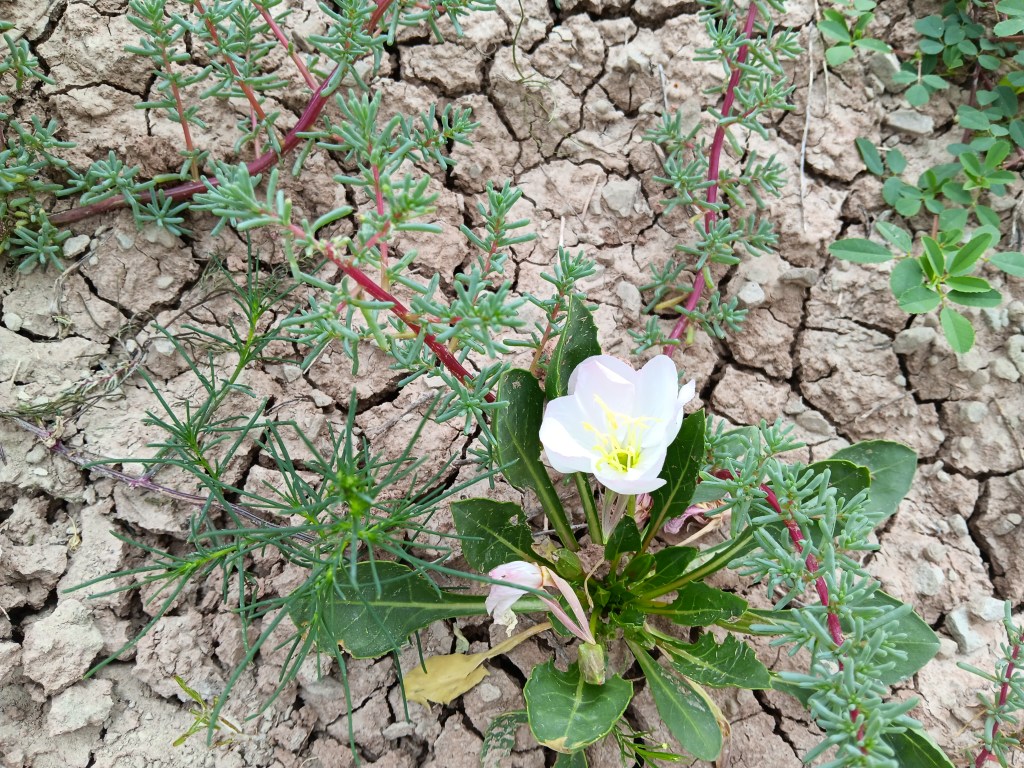
Even on that barren surface, the most delicate flowers have taken hold.
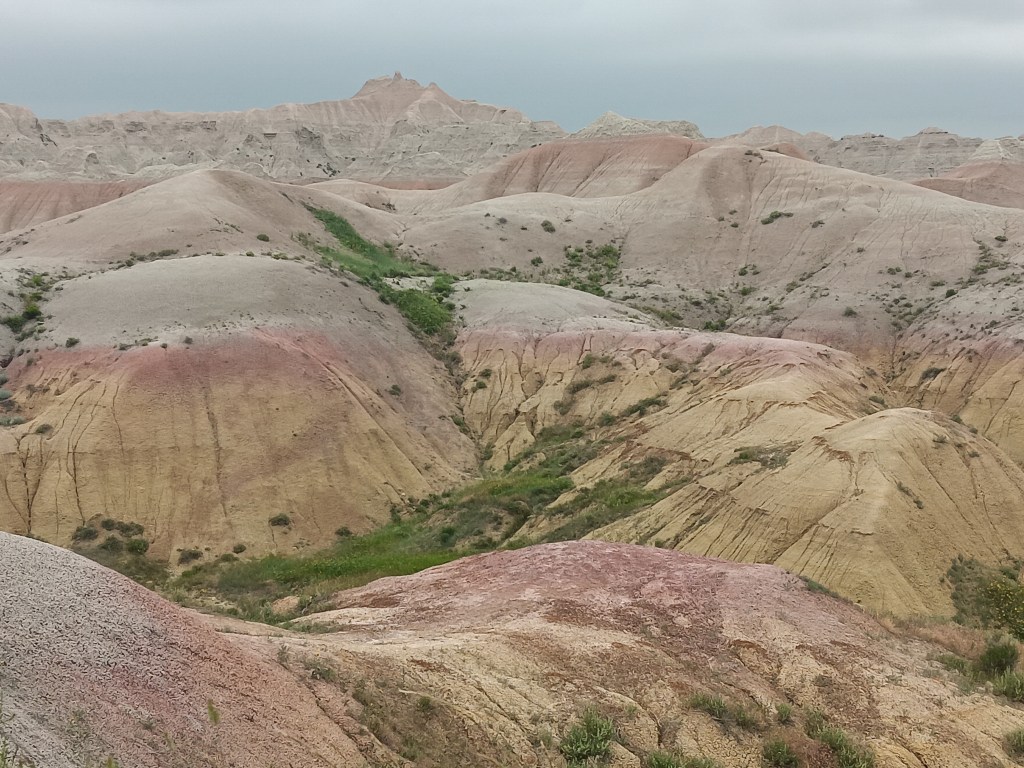
Another surprise were the “yellow mounds” (called paleosols) that were left when the inland sea drained away and chemicals from its plants left staining of yellow, red, purple, and gray. Against the cloudy sky, they’re less striking, but when sunlight hits them they positively shine.
Some yellow mounds we saw were only yellow, while most were multi-colored. We missed the sunlight photos, but you can imagine.
We could post a few hundred photos from the park, but we’ll spare you that and instead share a few from the absolutely bizarre town of Wall, our exit point from the park as we headed north to Hermosa.
Normally, commercials on TV and billboards along highways have zero impact on us. But Wall Drug Store is too smart for that, and the sheer number of billboards they’ve installed made it inevitable Simon would have to see what all the fuss was about.
Our introduction to Wall
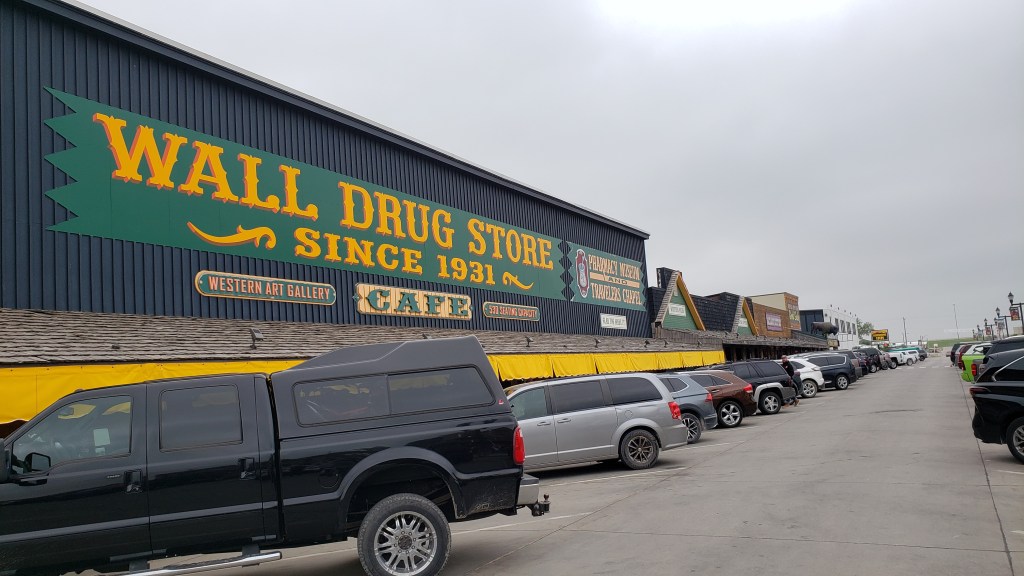
Like Buc-ee’s, if you’ve been there, you know. Wall Drug Store is just…massive. Like, a full city block massive.
Not all of these storefronts are Wall Drug Store, but most of them are
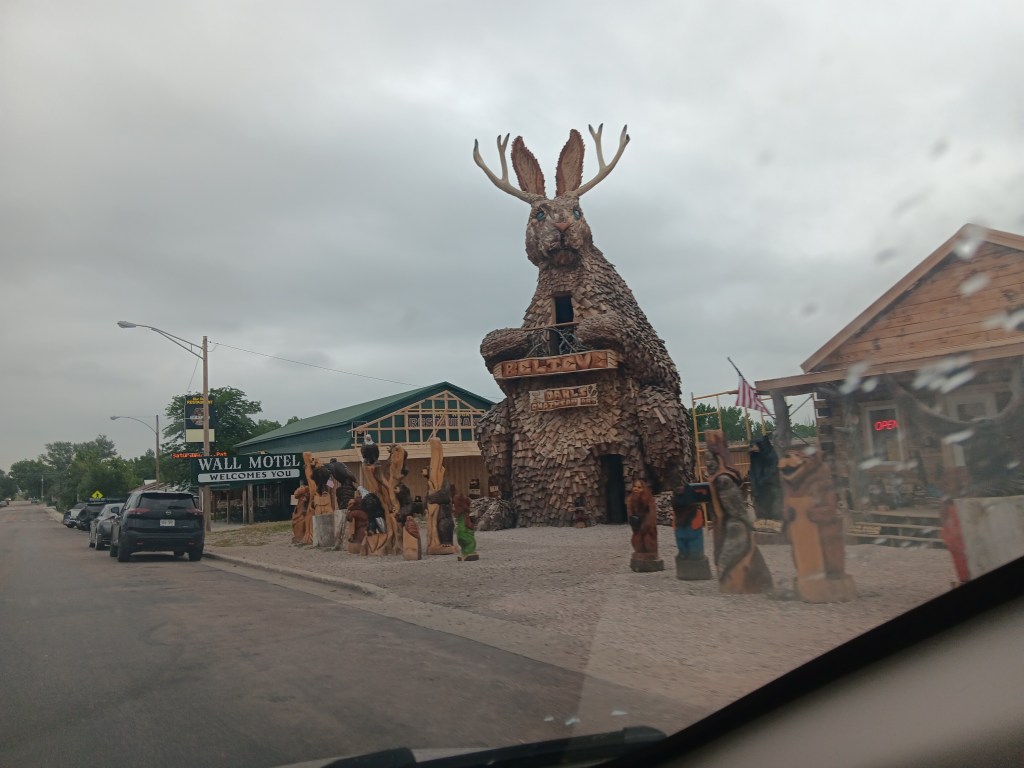
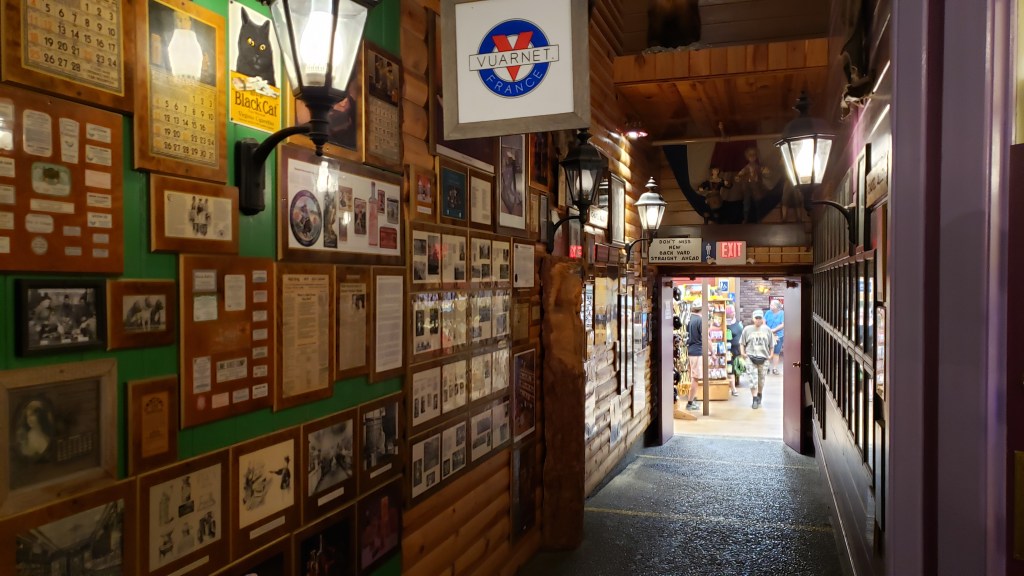
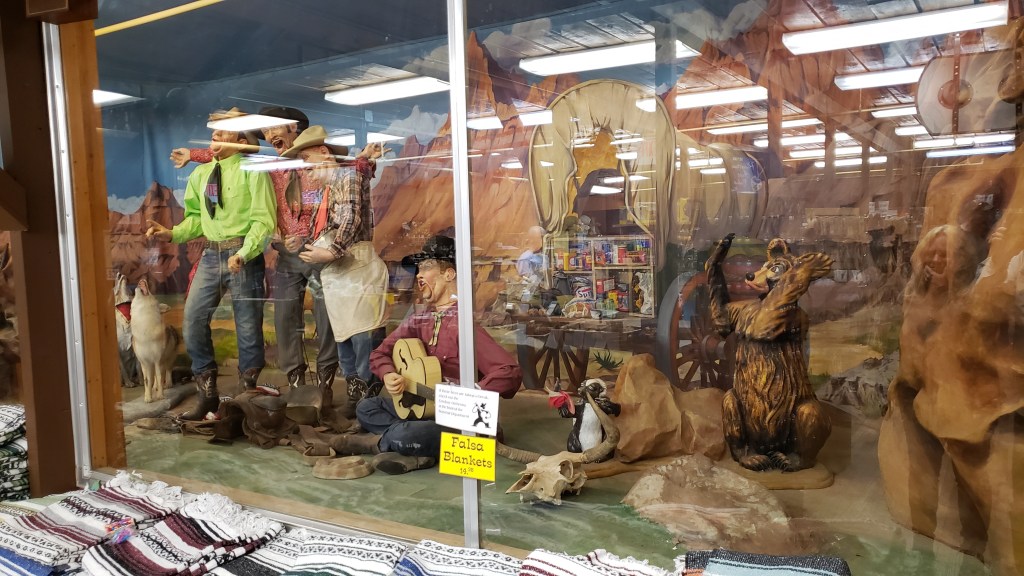
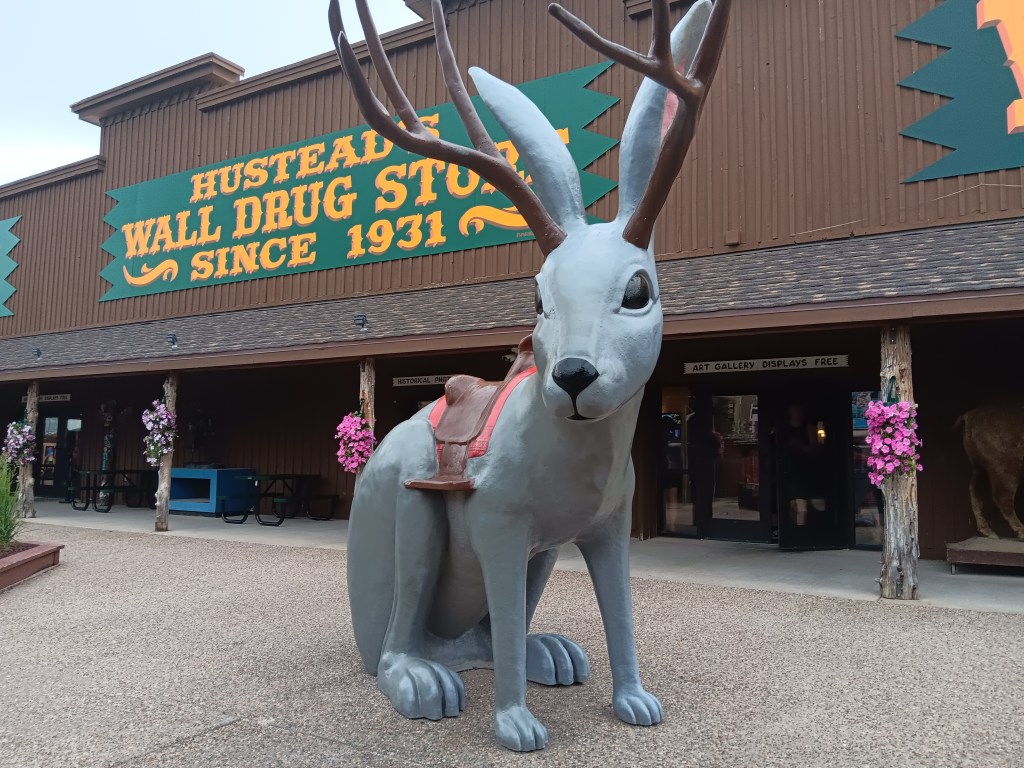
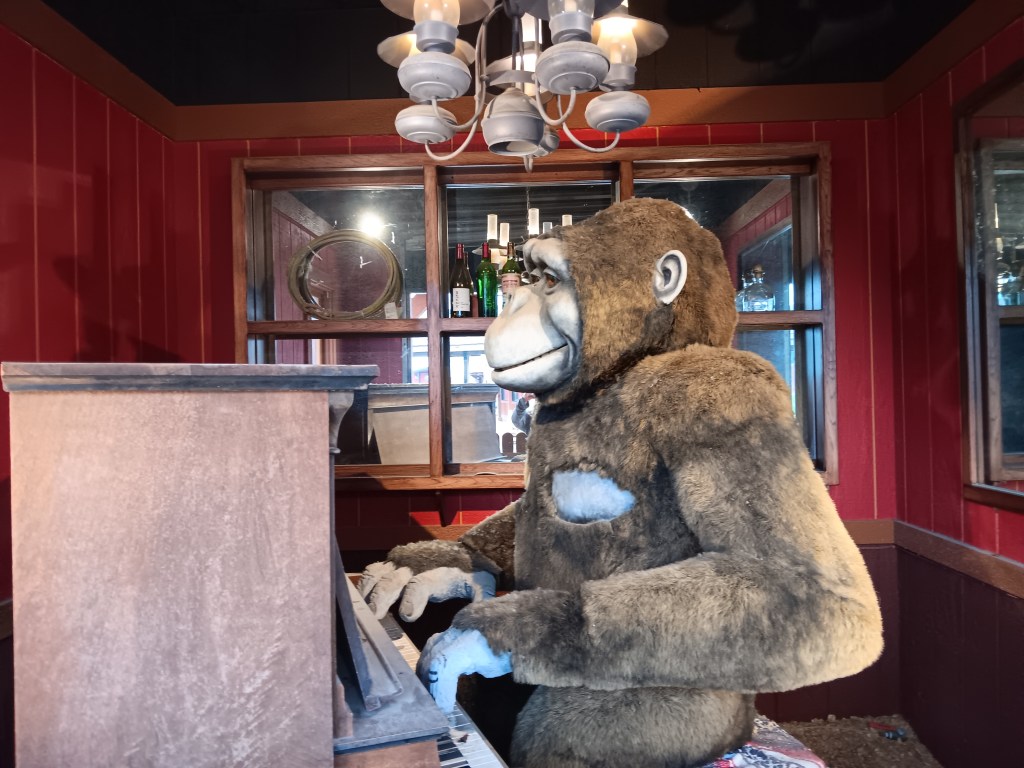
Want a billion shot glasses, T-shirts, cups, mugs, magnets, and every other form of tourist crap you can imagine, all wrapped up in interactive stuff that includes a jackalope the kiddies can sit on, a gorilla animatronic playing a piano, and an insane trio-plus-one of mechanical cowboys singing in a wild-west setting of howling coyotes and an upset bear? Wall Drug Store has all of it and much, much more.
This is a terrible photo, but there was no way to avoid the glare. Still, it softens the full horror.
Why?
We didn’t buy anything. We didn’t even try the “free water” the store so proudly advertises on the front façade. But we’ll remember Wall Drugs with the same fondness we remember that wacky gas station with a beaver as its mascot.
Tomorrow (subject of our next blog) would see us making the first of many trips into Custer State Park, and we’ll just say that at $20 for a seven-day pass, we absolutely got our money’s worth.
Nobody should be smiling when encountering a sight like this
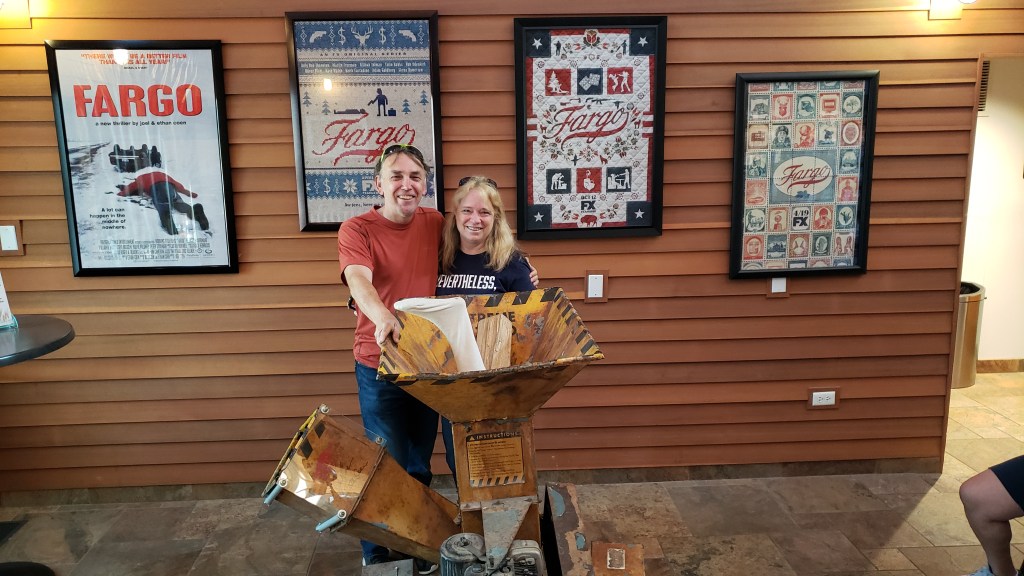
Simon loves the dark comedy movie, Fargo, with its relentlessly evil villains, the dogged heroine Marge, and that chipper no one who has ever seen the movie can forget. The Chipper prop now lives at the Fargo-Moorehead Visitor Center, and it was the reason we put Fargo on our Grand Adventure route.
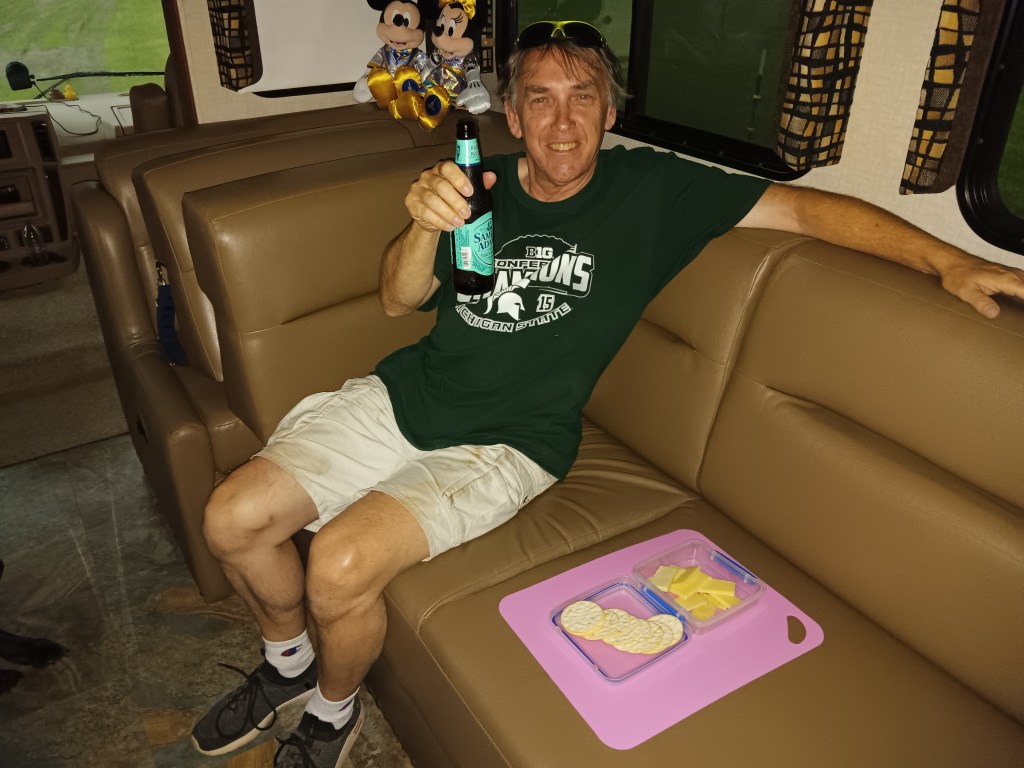
We stayed at a Harvest Host in Minnesota the night before, celebrating Simon’s birthday in high style with cheese and bikkies (crackers for us U.S. folks) and a beer, since we had no access to electricity and didn’t want to use up our batteries (generators aren’t usually allowed at Harvest Hosts), plus we’d had a celebratory lunch and were too full for much more.
Birthday beer out there on the edge of the prairie (okay, right ON the prairie)
The host location was a farm with horses, goats, chickens, cats with newborn kittens, and a gangly, year-old dog named Pooh Bear.
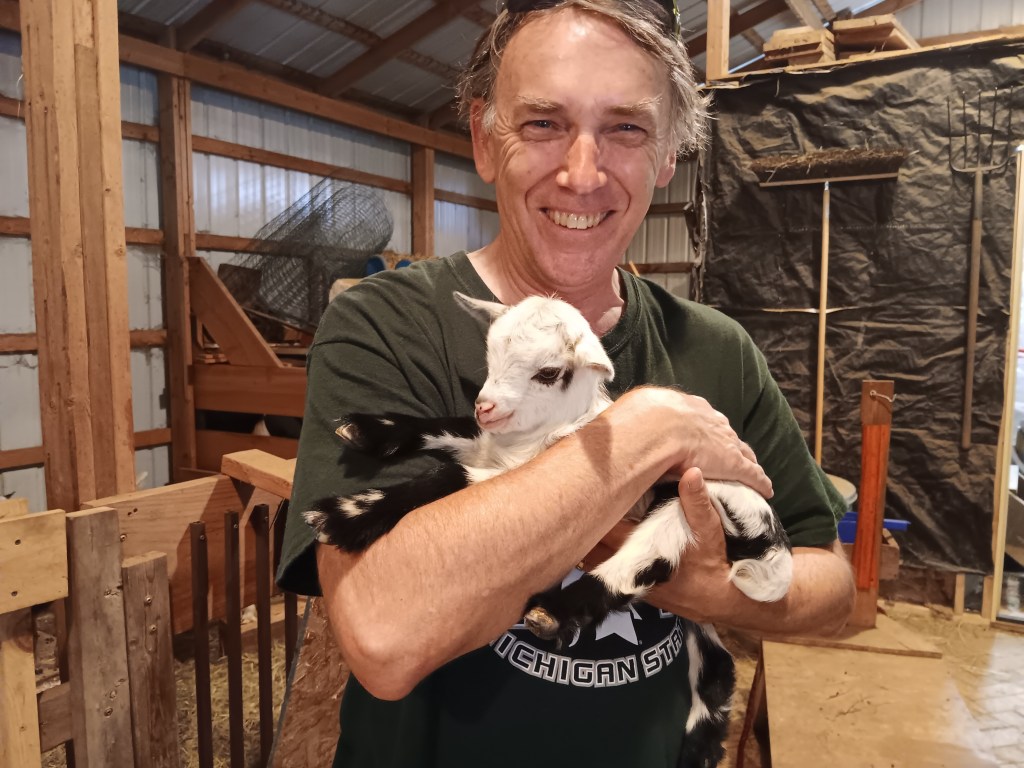
It’s so soft!
We got to hold a three-day-old baby goat, meet the newborn kittens, and Simon, always ready to try his hand at something new, milked a mama goat.
We then spent the evening sitting on the front porch chatting with the owners, and felt it was exactly the kind of experience we were hoping to have during this journey.
The next morning we made the short trip into North Dakota, where we had another Harvest Host stay, this time at a winery, and while the sweet wines weren’t to our taste (neither was the eyelid tick), the food was good and we met another RVing couple who had come in from Oregon, which passed a happy couple of hours before heading back to the rig for the night, with a strong wind whipping through the prairie grasses as a small storm rolled past, which we loved.
Moody sky, but we only had a little bit of rain as the storm went past
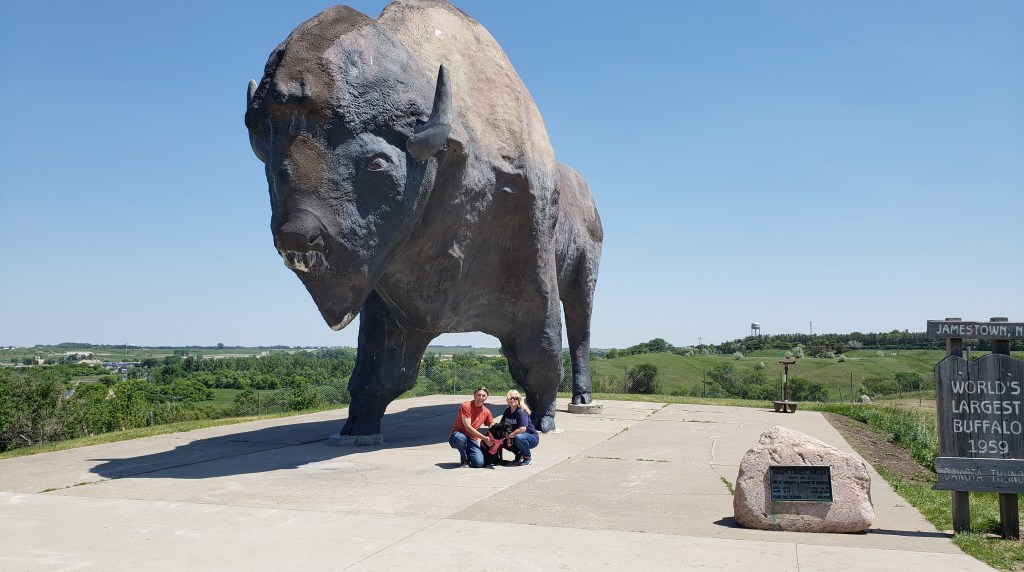
Bismarck was our next destination, with a detour off the highway into Jamestown to see the World’s Largest Buffalo.
Imagine the droppings….
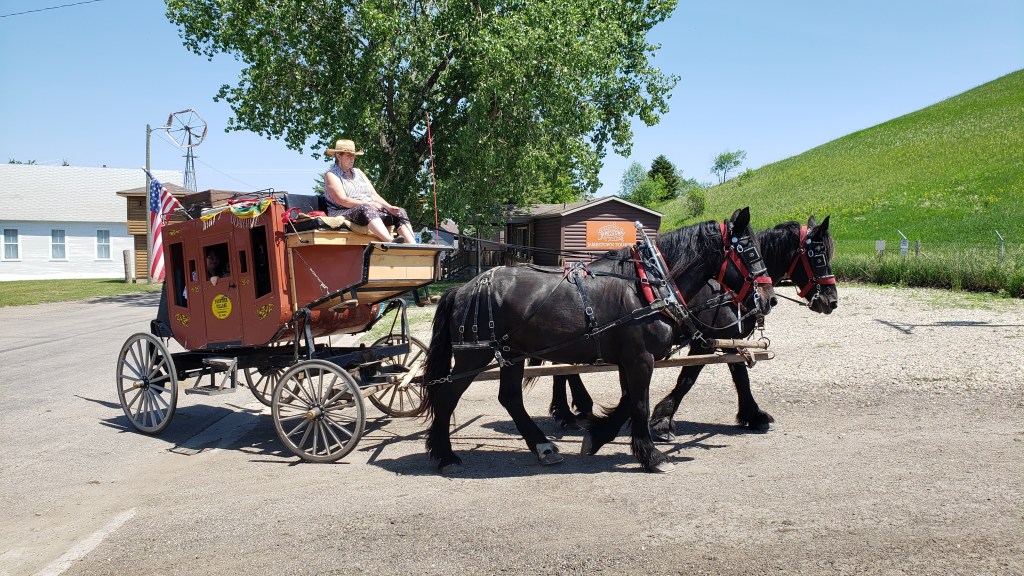
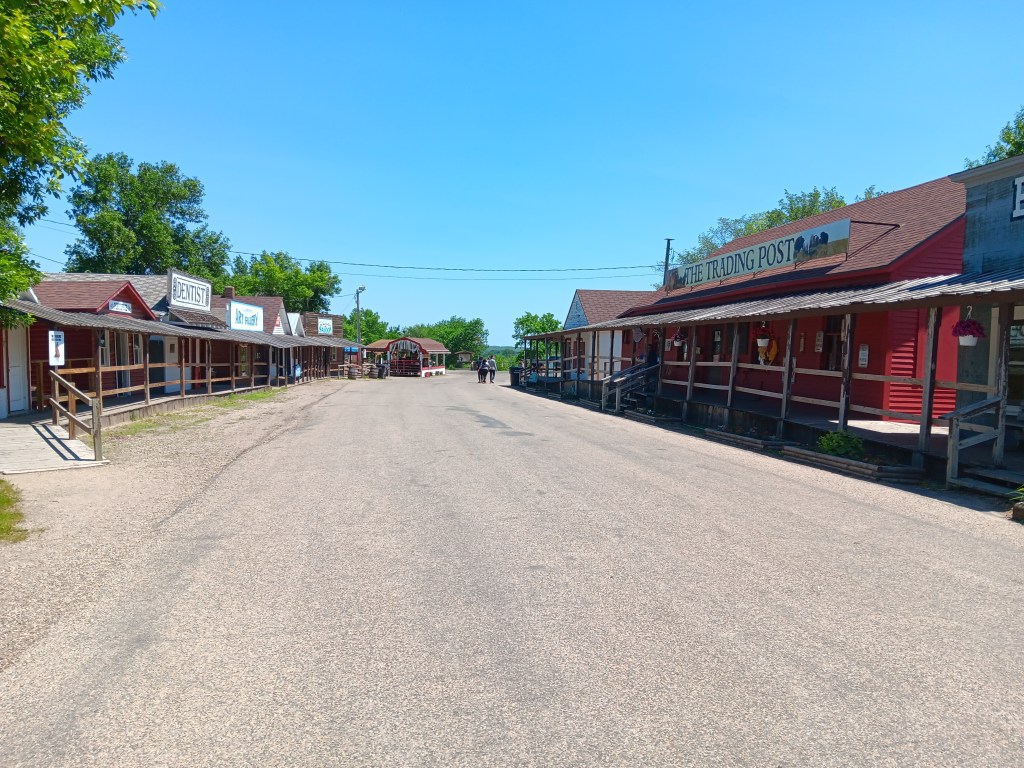
The roadside attraction included a touristy town with stagecoach rides, and it made for a nice diversion on our way to Bismarck.
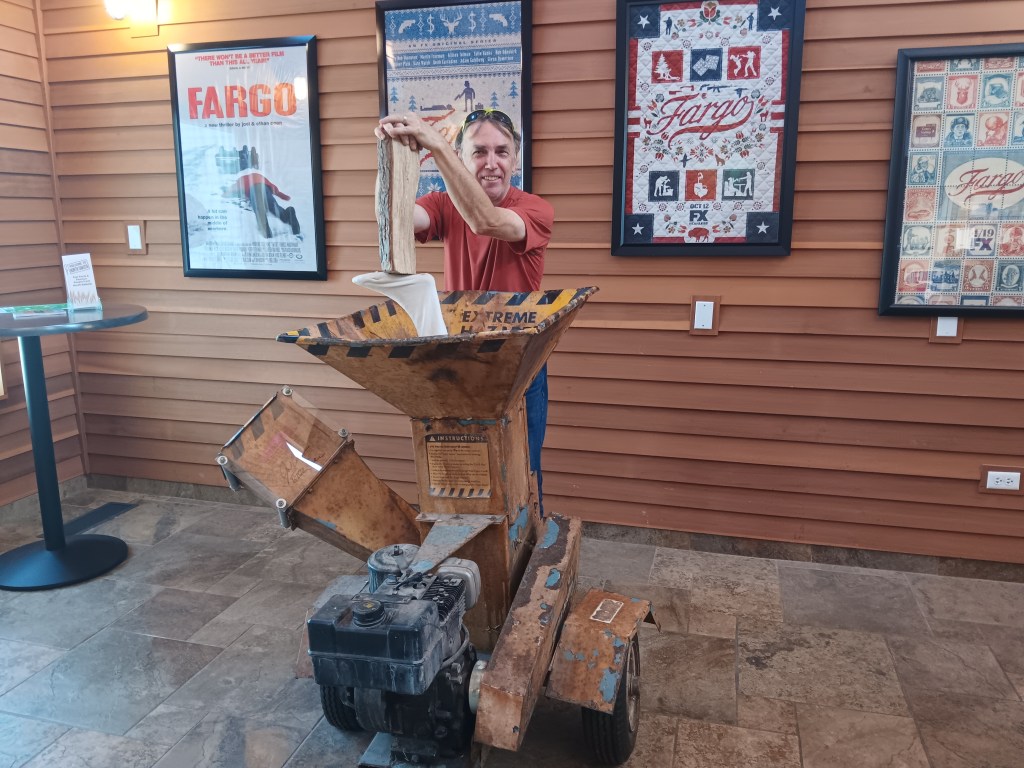
We woke up early and headed back to Fargo for a photo op with the infamous Chipper. If you don’t know the movie Fargo, it’s the means through which the hapless main character gets turned into the human equivalent of ground beef, thanks to a crazy man with a passion for gruesome murders [Note: Leg in Chipper = hint].
Non-gory recreation of a very gory scene
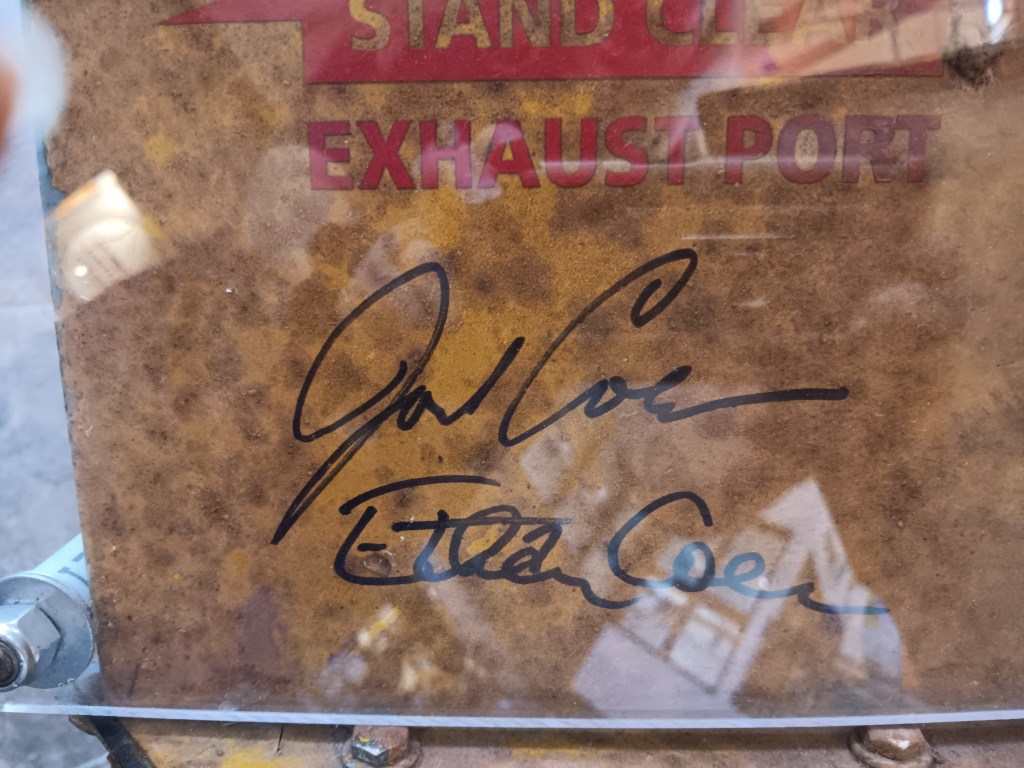
The Coen brothers (Fargo’s producers and directors) signed the Chipper, but there was no way to get a photo of their signatures without glare, so here they are, just as obscure and unfathomable as the movie the brothers created.
Appropriately scrawled across the “exit”” end of the chipper, where whatever you shove into it blows out. Across the snow. All bloody.
Our next campground (with full hookups!) was Hillcrest Acres in Bismarck, a small, pretty place appropriately located on a hill, a forerunner to the scenery we’d see as we drove around the area for the next few days.
Fati getting comfortable
Countless times, we wondered how those hills (variously called “buttes,” “hills,” “points,” and “ridges”) formed, why most were grassy but some were bare, and why glacial movement made North Dakota so undulating, but Michigan so flat. Wind and water played their part, but we’d like to talk with a geologist to find out more. That’s one of the beauties of travel; it inspires curiosity.
These odd outcroppings are everywhere
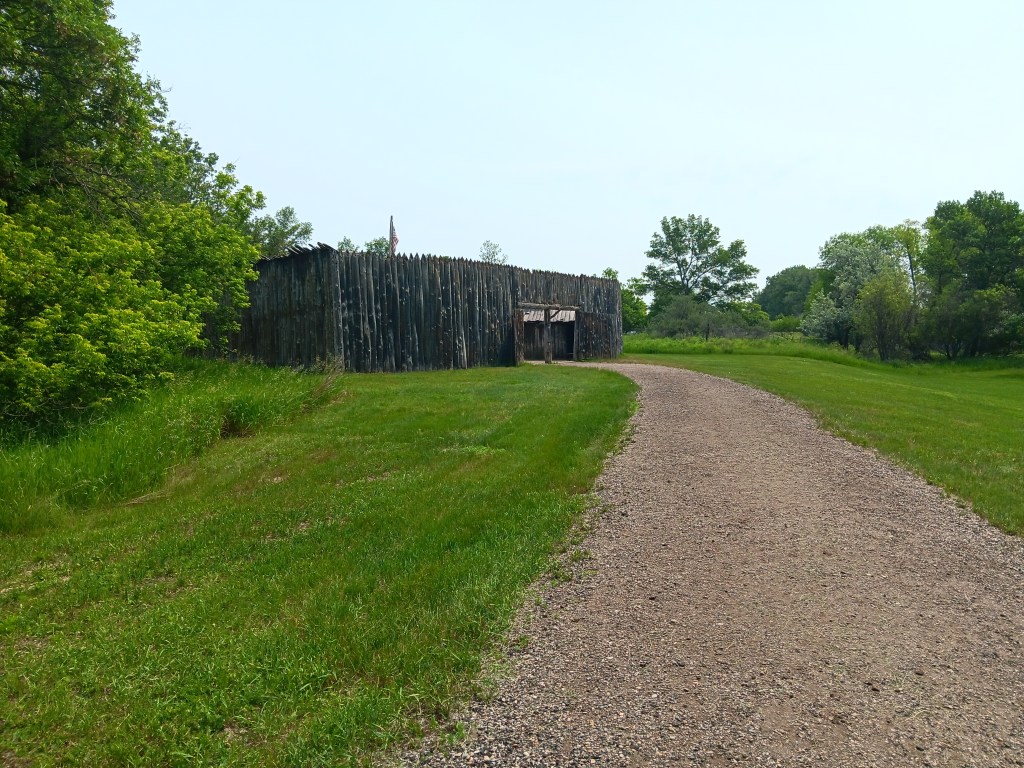
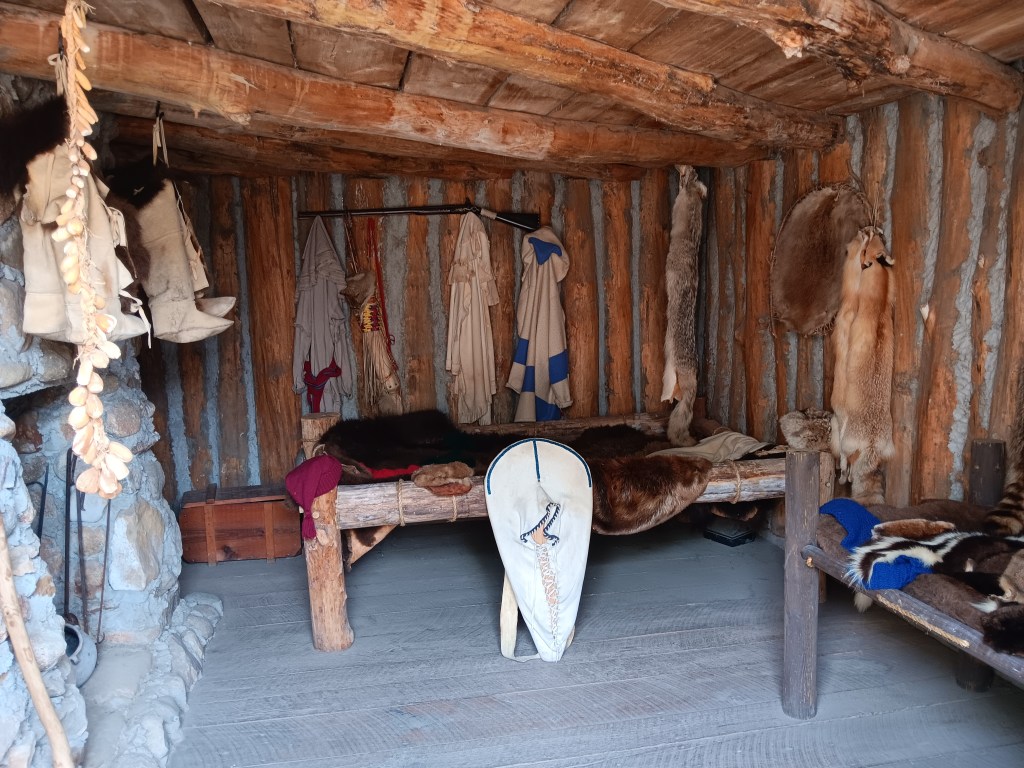
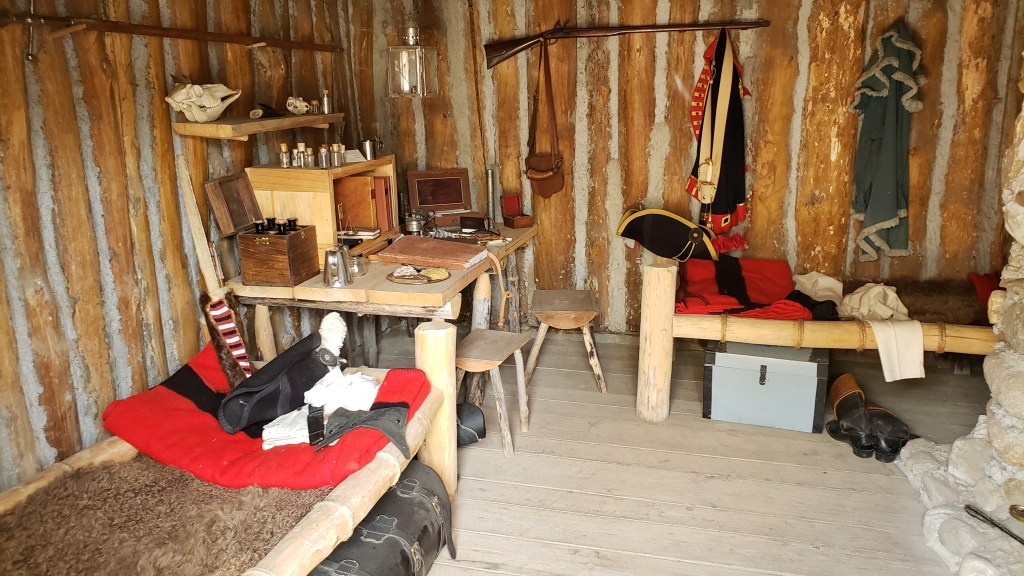
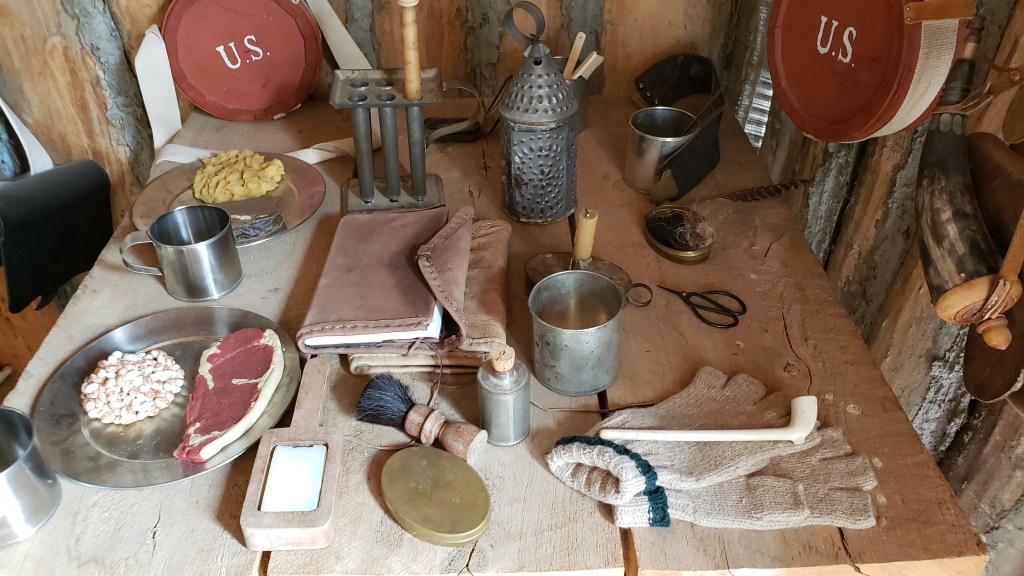
Our first full day took us to Washburn, where we discovered the restored Fort Mandan, in an area the Lewis and Clark expedition spent the winter of 1804. The fort had various tiny rooms, such as quarters for soldiers, interpreters, and the captain, plus a smokehouse, blacksmith, and storage room.
Ruthie was absolutely captivated by the Sargent of the Guard’s quarters and didn’t want to leave. We don’t know why, but she was very clear about wanting to stay.
We tried not to read too much into it, but “past lives” certainly came to mind
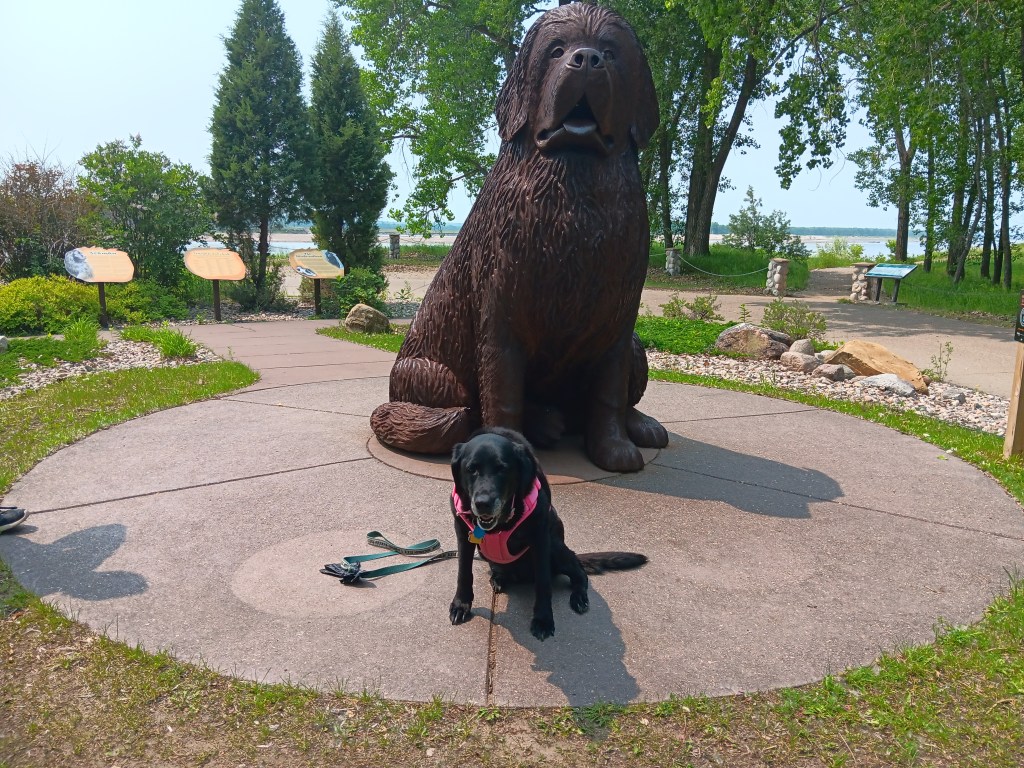
She was less captivated by the statue remembering Seaman, the faithful Newfoundland dog who traveled with the expedition, but she dutifully sat for a quick picture.
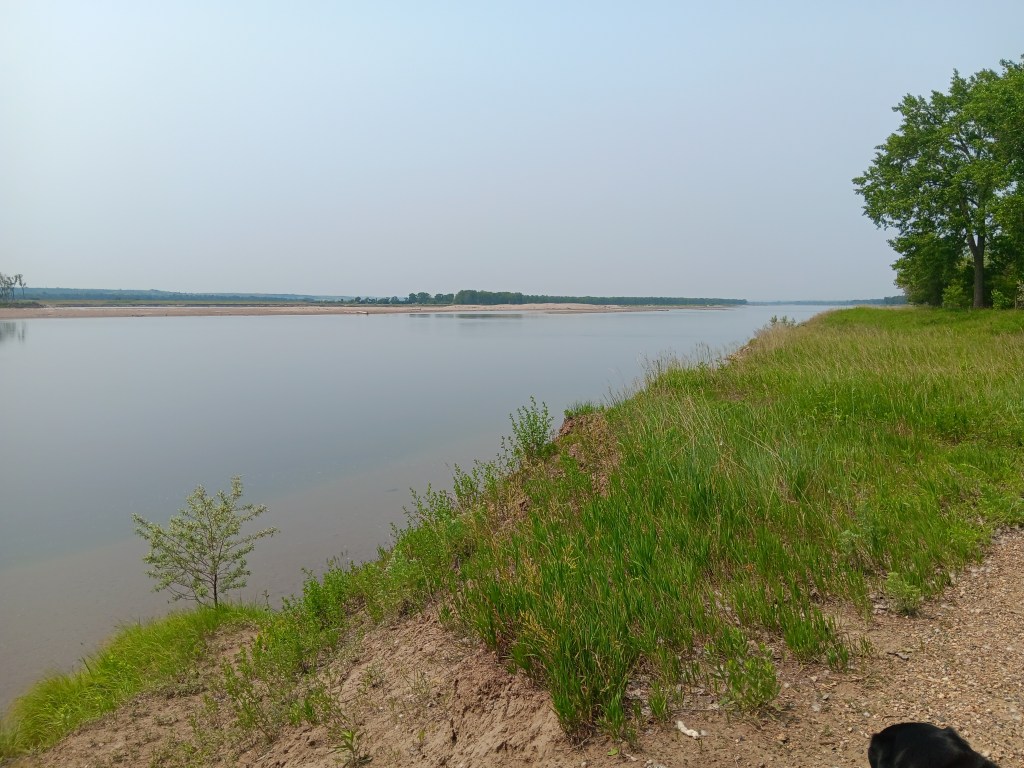
A short stroll beyond the statue rewarded us with our first up-close view of the Missouri River, whose waters were low and many big sandbars could be seen. We would cross over the Missouri several times in the following days.
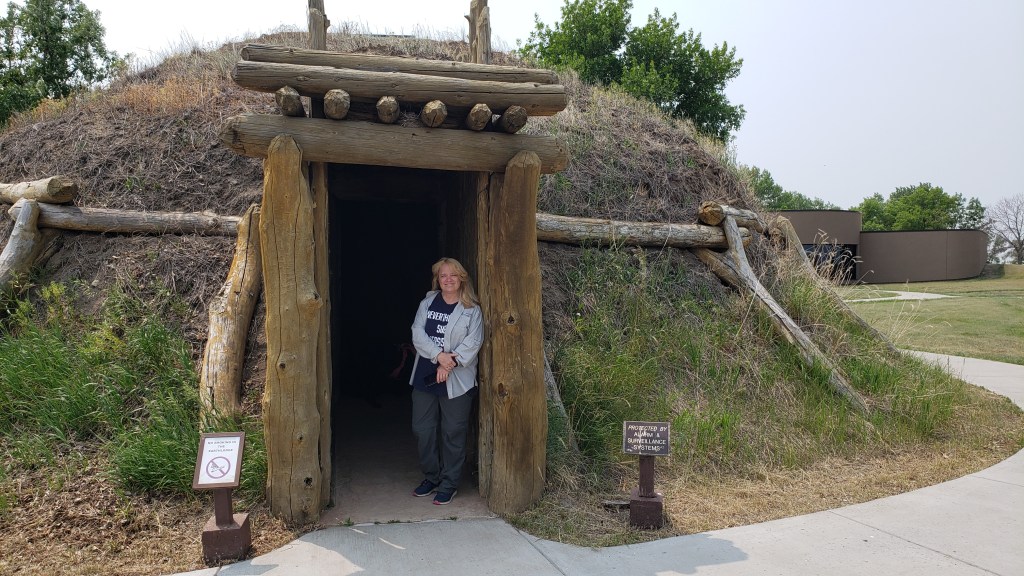
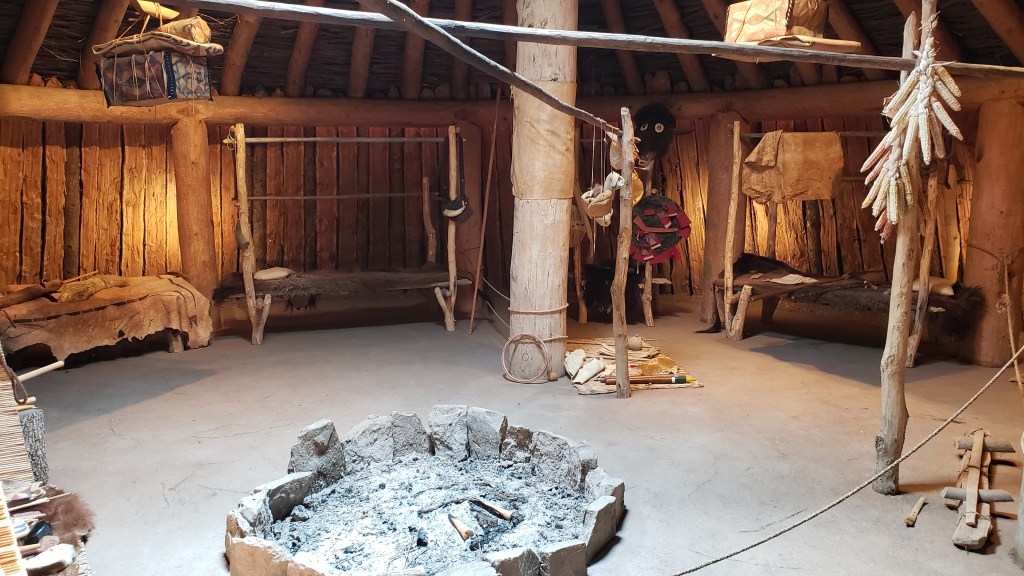
Just a short drive away from the fort was the Knife River Indian Villages National Historic Site (using their cultural terminology, not the terminology we might have chosen), with a recreation of a Native American earthlodge that marks the area many tribes used as a trading center.
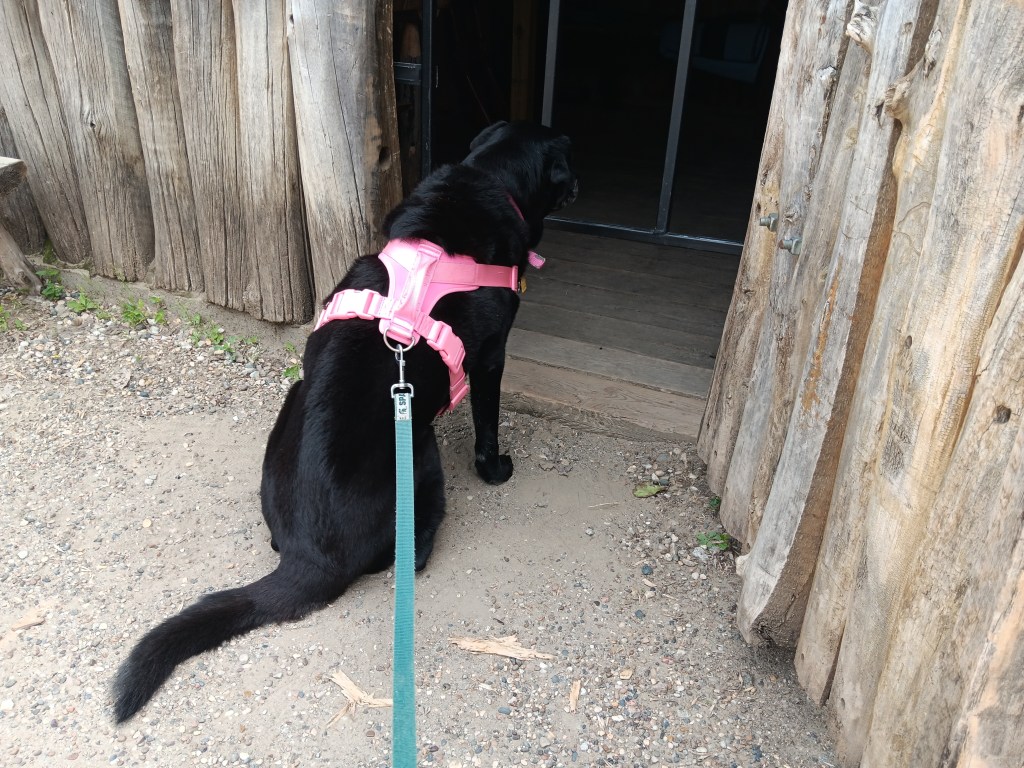
A buffalo hide acts as the doorway into the lodge, and inside the temperature is about 10 degrees cooler. A deep, smokey smell permeates, which gave us a small sense of what living inside it would have been like. Ruthie lost her mind in there, loving all the new sniffs.
Ignore the man pants and man shirt
The visitor center here was superb, giving an excellent overview of two tribes and their lifestyles. Although the day was cool and we could safely leave Ruthie in the car for a short time, we had to turn down the host’s offer to watch a movie, as our Floridian sensibilities made us uncomfortable leaving her for very long. But the exhibits were terrific, and we felt we learned more about the people who once lived there.
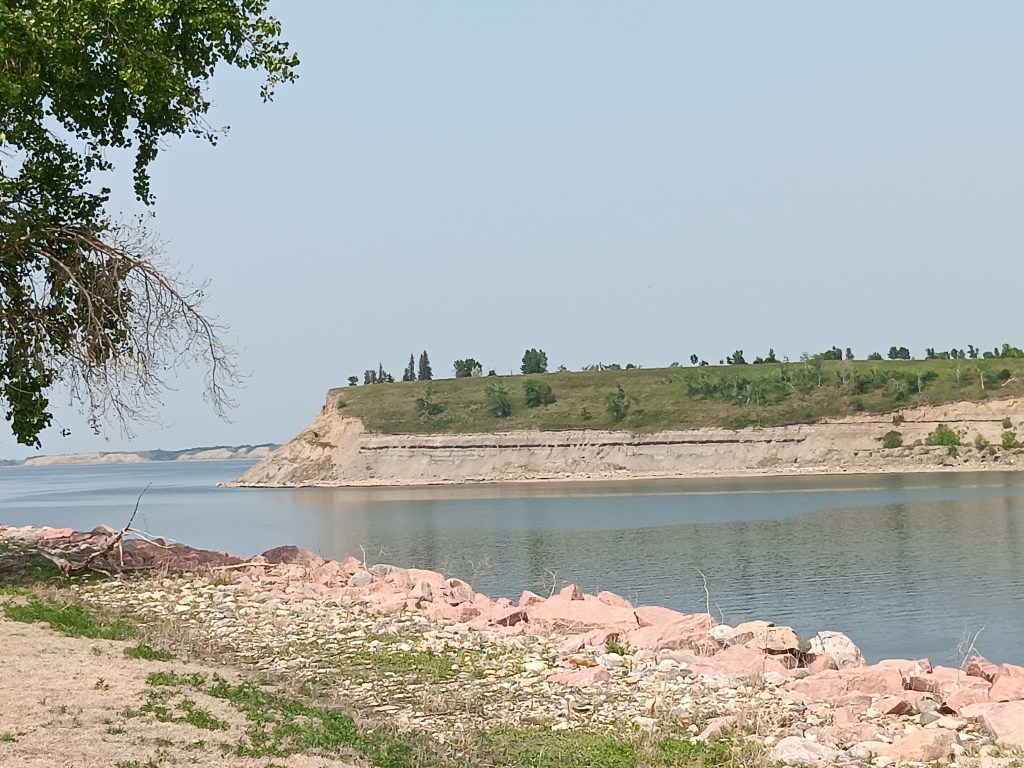
We drove further west for Lake Sakakawea (pronounced here as Sah-KAH-kuh-WEE-uh, not Sack-a-juh-WAY-uh), a huge lake set below stark cliffsides, which must be ideal for boating on summer weekends. The history of the lake is, predictably, one of eminent domain, force, and the subsequent throwing-of-a-bone in naming it after a famous figure who (it is my opinion) probably had as little say in her destiny as the land that now holds the lake named for her did.
A small slice of Lake Sakakawea
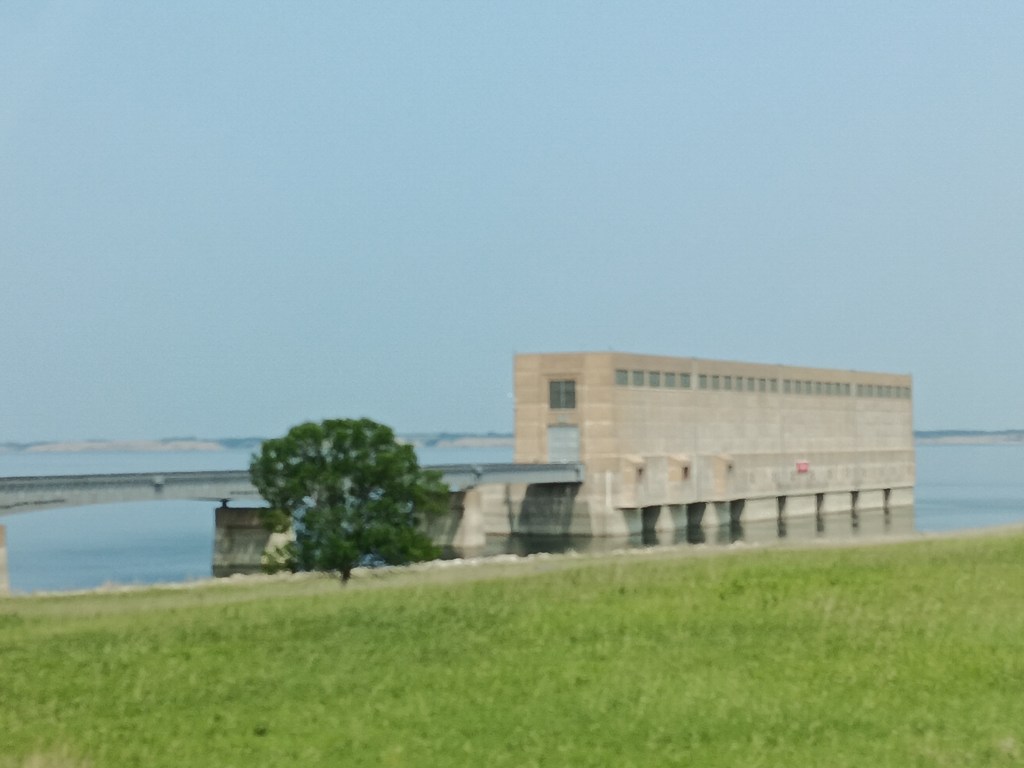
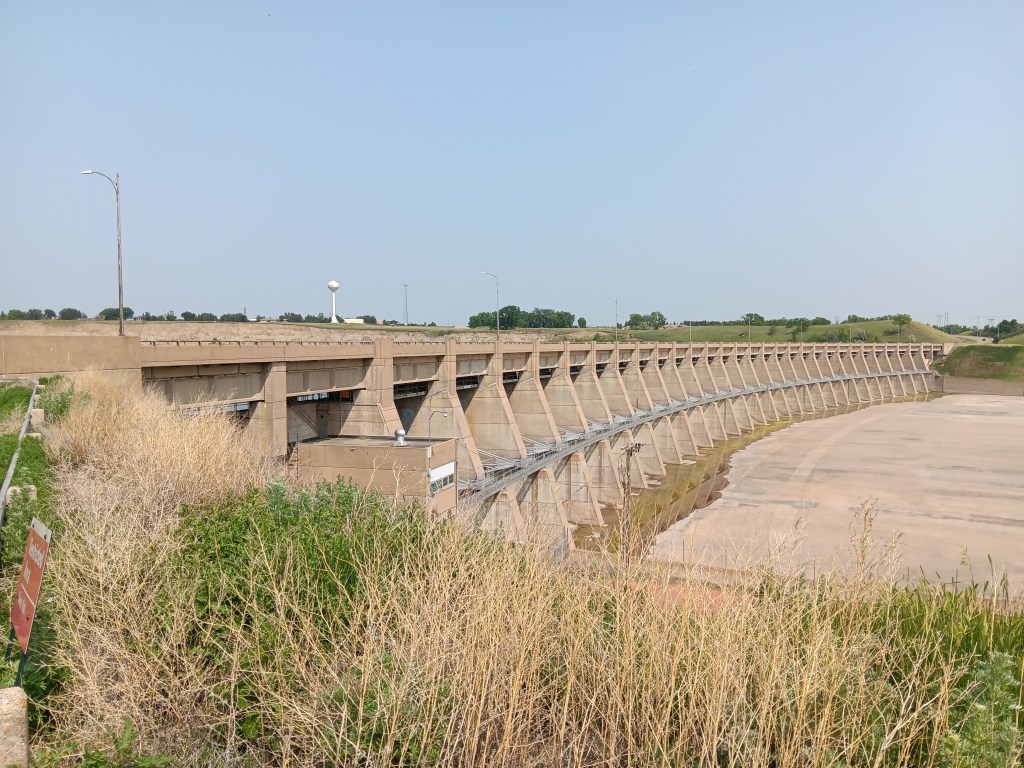
This is the site of two-mile-long Garrison Dam, a three-part set of structures built by the U.S. Corp of Engineering in 1953, that includes a pump station…
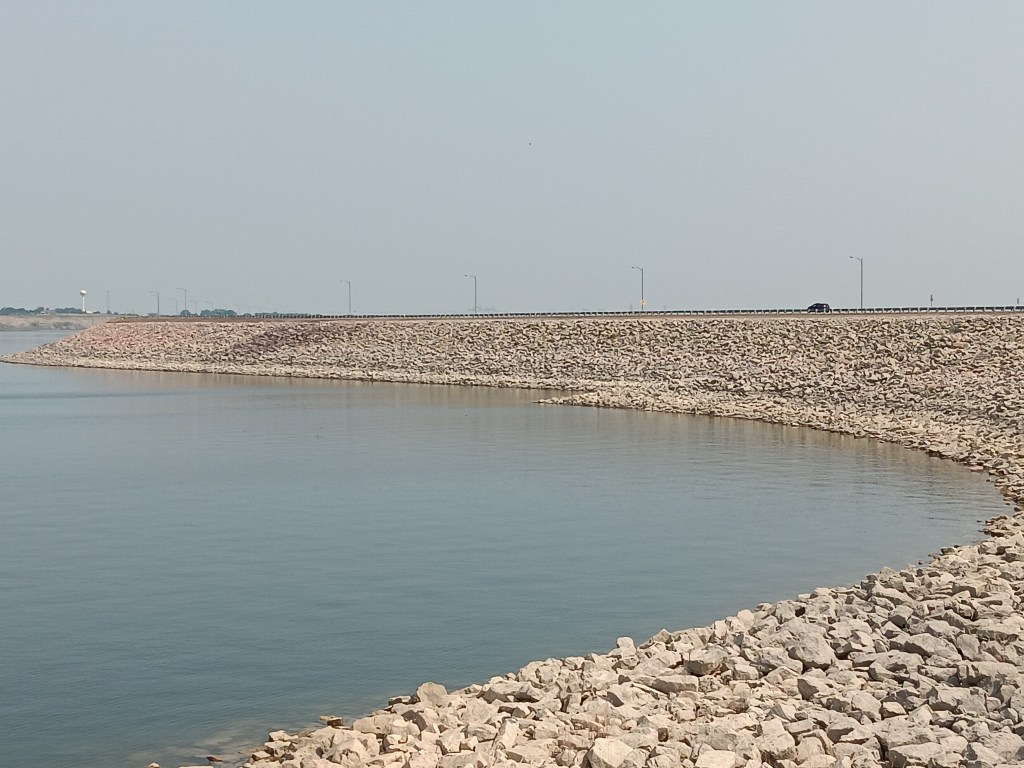
…the dam itself…
…and a spillway that helps route water back into the Missouri when levels get too high. Neither of us are geeky in that way, but it was truly fascinating, and we spent a fair bit of time pointing and saying, “I wonder what that’s for….”
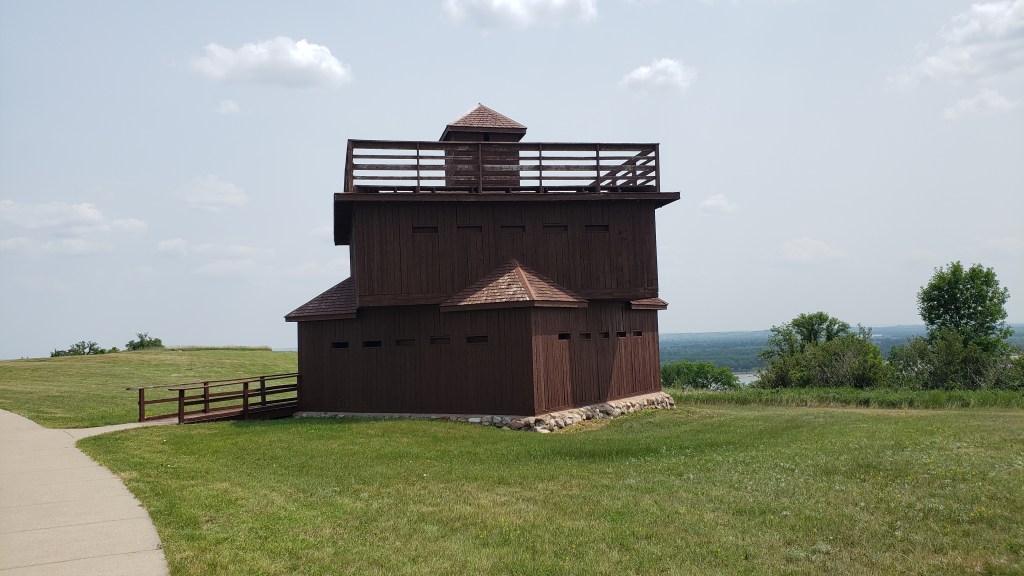
North Dakota’s oldest state park, Fort Abraham Lincoln State Park ($7 to enter), was our next stop, with three re-created blockhouses overlooking the Missouri River. On breezy summer days, the many narrow lookout windows must have afforded an excellent breeze. In winter, it must have been cold enough to freeze the brass whatsits off a monkey.
One of the three blockhouses
There are several of these narrow windows all around the blockhouse, some with fabulous views
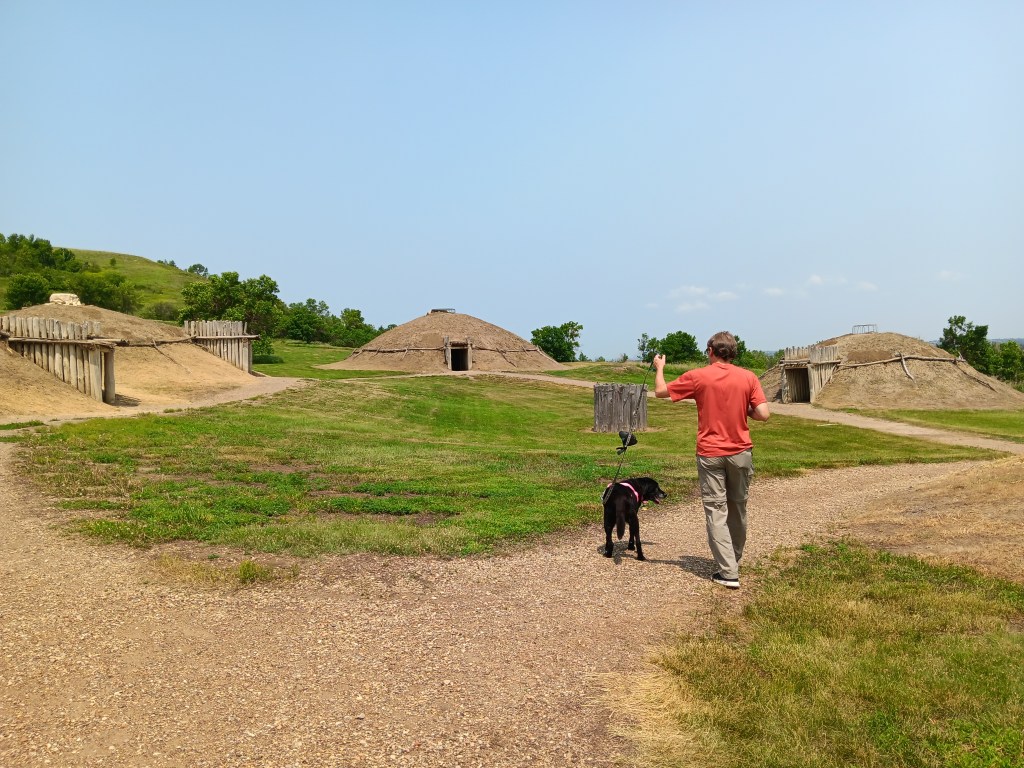
On-A-Slant Indian Village was within the park’s boundaries, too, and the earthlodges here were beautifully displayed, along with panels that described life in the Mandan tribe village from 1575-1781.
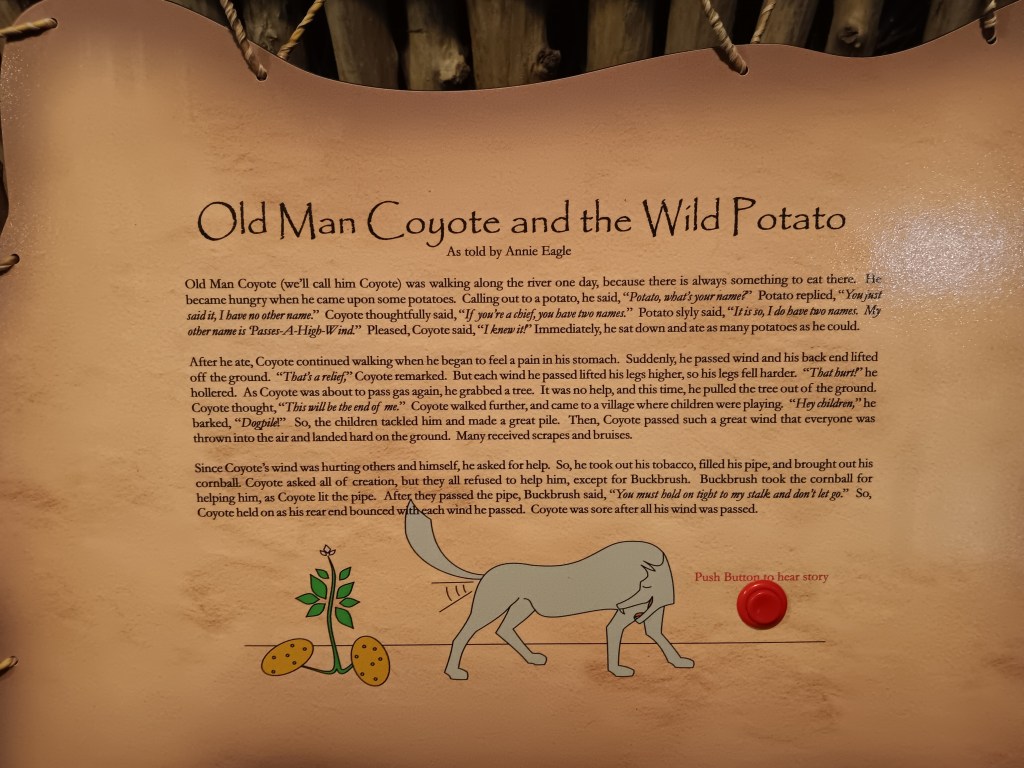
We were captivated by the idea that boys in the Mandan culture learned to shoot with accuracy by playing a game that involved throwing a hoop into the river and shooting an arrow into its moving center. According to an exhibit we saw, it was their belief that the dead buffalo they found floating in the river with each spring thaw were a result of these games. All of the children would have been treated to funny stories that told important tales.
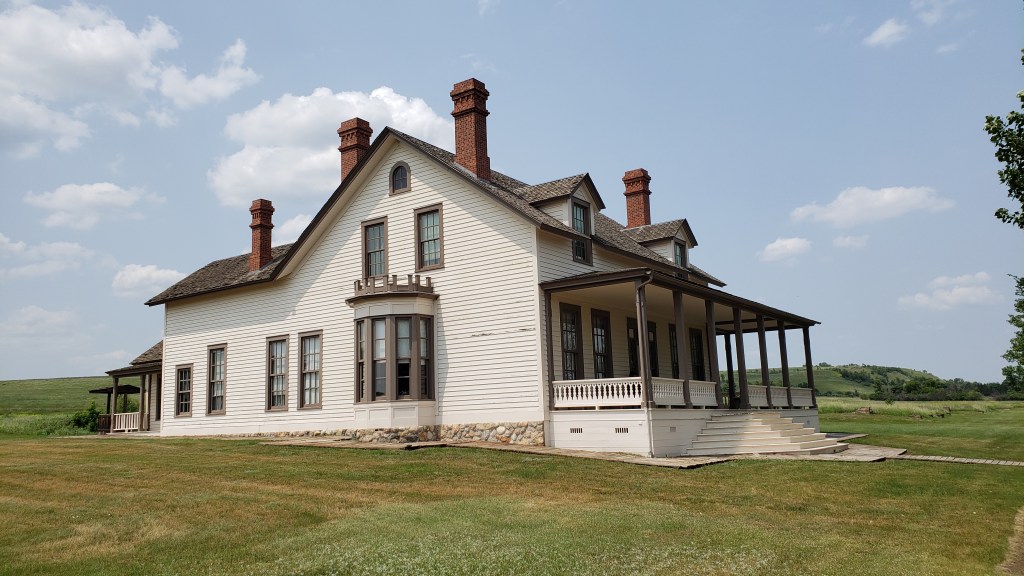
On the way out of the park, Simon made a quick right turn when he saw a sign for Custer’s House. We couldn’t take Ruthie in it, so we agreed Simon would check out the house while Ruthie and I waited in the car with the air conditioner on.
Spot the docent? No, you don’t, and neither did Susan
Twenty minutes later he was still standing on the house’s porch, so the following phone call ensued:
Susan: Hey. What’s going on? Simon: Oh. Yes. It’s nice to hear from you. Uh-huh. I’ll let you know when I’m there. Susan: What the hell are you talking about? I can see you standing on the porch, so I’ll certainly see you when you get back. Simon: Okay, thanks! All the best. Bye for now.
When he got back to the car, he detailed the conversation a docent sitting on the porch (whom I couldn’t see) had at him. Not with him, at him. Simon asked what rank Custer was during the war, and 20 minutes later he knew everything from Custer’s blood type to his favorite dessert and whether he preferred tighty-whities or boxer-briefs. (Okay, not really, but the docent talked for a full 20 minutes, and Simon had to pretend I was someone important so as to break off the dissertation gently and with respect).
For those who cannot bear not knowing, it turns out Custer was a Lieutenant Colonel during the battle at Little Bighorn, but was a General during the Civil War and was allowed to keep that designation as an honorary title when that bloody war ended.
We finished the day at Standing Rock, an important stop along the Native American Scenic Byway. Our goal was to visit Sitting Bull’s burial site, which we found after many wrong turns, having blown past it on the way into town. Most people probably do that, too. There is only a small sign on the side of the road that indicates where this great man’s resting place is (or rather, was; he’s since been moved at the request of his grandchildren).
The grand brochure we were given at the Fargo visitor center did not prepare us for what we found at Standing Rock. Perhaps we missed the highlights, though we’re not quite sure how we could have. Instead – and we’re assuming a LOT, all of which may be wrong – we found a town completely void of energy, as if a total lack of opportunity and a heaping helping of injustice held the place and its people in a state of downcast limbo. We’ll end our sweeping assumptions there, and, with heavy hearts filled with compassion, put our energy into hoping all good things come to the people who, by choice or by historical force, make it their home.








 Veness Travel Media