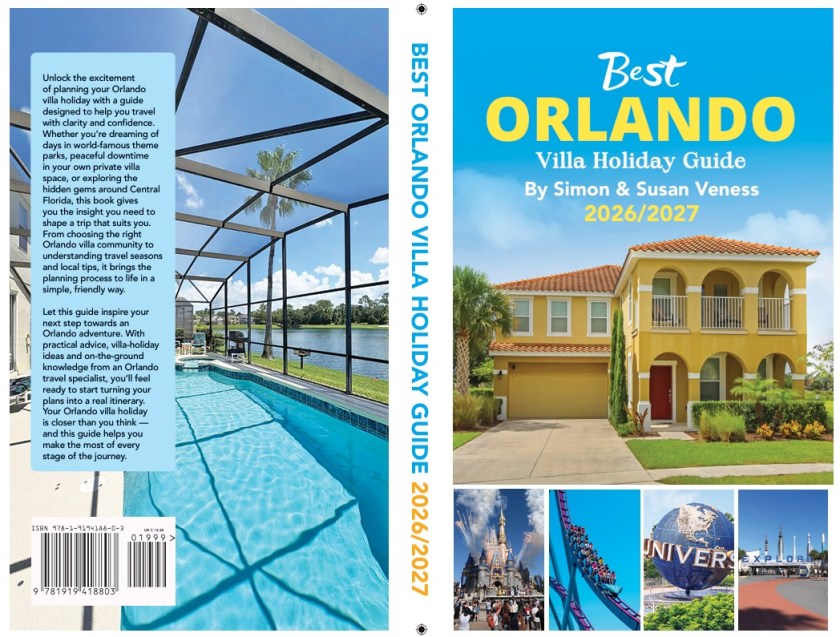
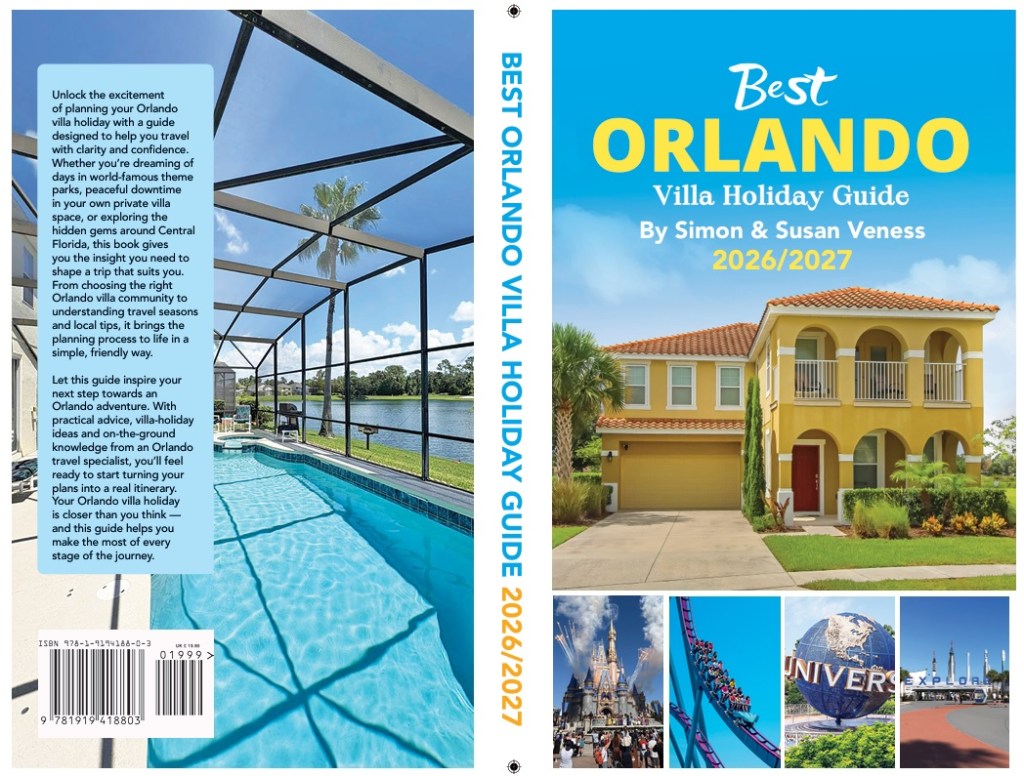
Well, no sooner do we commit details of our new book to print (see our last blog!), than here comes the real thing, hot off the press and twice as pretty. Yes, it’s the very first copy of The Best Orlando Villa Holiday Guide, and it’s looking mighty fine in our latest video:
It’s the first time we’ve seen it and we’re delighted with the sharp look and general layout and design. It’s been a while in the production stage, but it’s now on sale at all good UK bookshops and online with both Waterstones and Amazon.co.uk. Be sure to seek it out!
OK Brit Guide fans, this one’s expressly for you. Although our long-running guidebook died a slow and painful death in 2024, we have been quietly working to salvage the content and find a new home for it. And find a new home, we have.
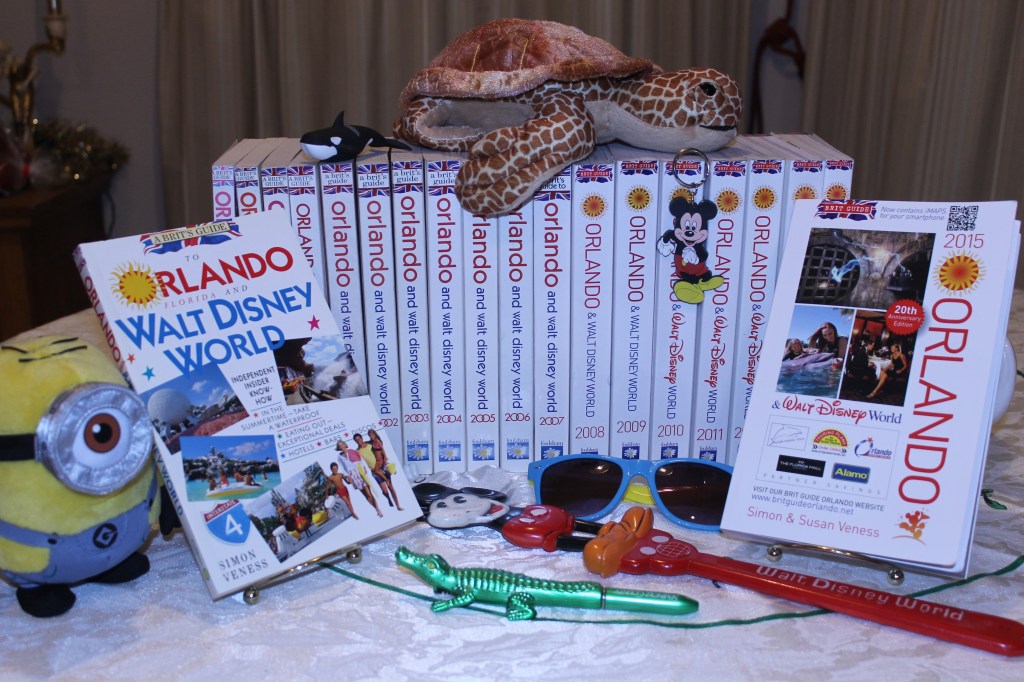
The 29-year run of the Brit Guide was something of a phenomenon in guidebook terms, taking on the well-established big-budget travel series and coming out on top year after year as the UK’s best-selling guide to any destination. But now it has a successor. Step forward the Best Orlando Villa Holiday Guide.…!
Yes, we know, it’s a bit wordy, but the new UK-based publisher is well aware of the ever-growing market for villa holidays in Central Florida, hence they wanted to be right up front with this aspect of things. And, if we’re honest it’s something we should have done a while ago. The villa market is a real speciality in the Kissimmee area, and we needed a specialist to cover this area, hence the well-travelled Lizzie Best was recruited to write this section. We have to say, the information, and the way it is presented, far exceeded our expectations (and our ability to replicate it!).
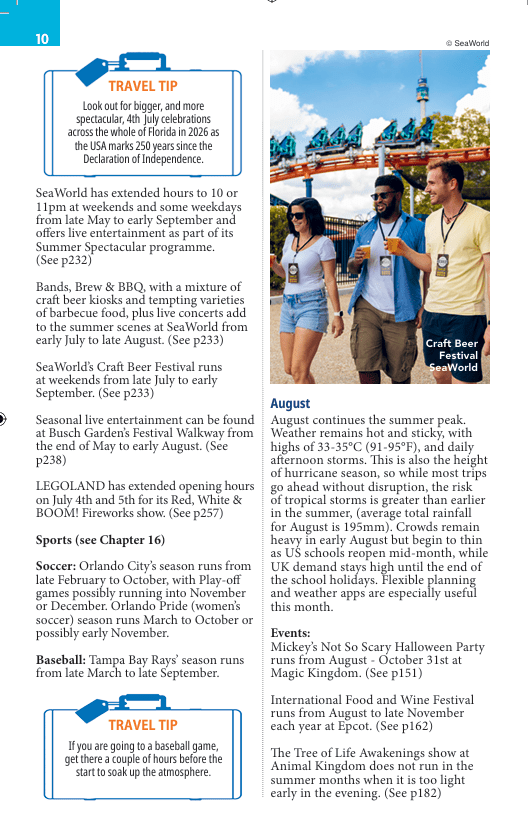
In fact, with new layout and design, we think it looks even better than the days with our previous publisher. The colour is sharper, the design is more imaginative and the content has a bit more zing to it, having been given a complete overhaul and rearranged in a number of sections, including a month-by-month guide to what’s happening in terms of events and sports, as well as the weather (!).
A sample page from the new book
The chance to look at all the various Brit Guide content from a fresh perspective has led to a number of changes in the general flow of the book as well, while we have been able to add a lot more practical content when it comes to preparing for the holiday and getting to grips with matters like ride-share transport, toll roads in Florida (of which there are a lot) and travel insurance. We’ve added a section on Tampa Airport, in addition to Orlando and Melbourne, and boosted the Getting Around chapter with more advice and insight on child car seats, the essential Visitor Toll Pass and other driving practicalities. And the detail on villas, and all aspects of choosing the right villa and villa community, is second to none, with a comprehensive look at the logistics, value and places to stay, as well as things like grocery shopping and using barbecue grills.
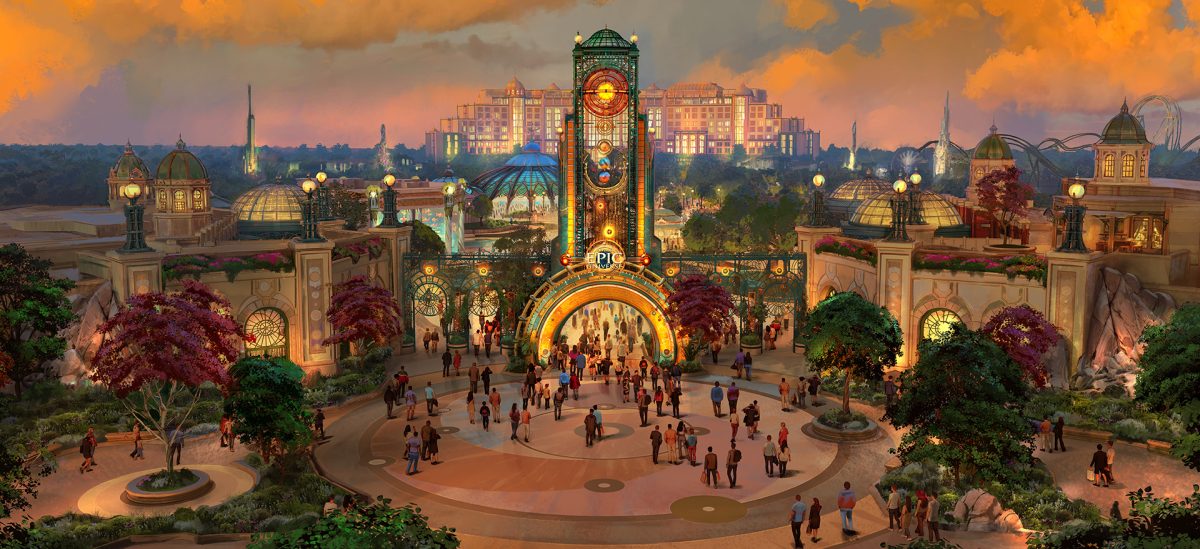
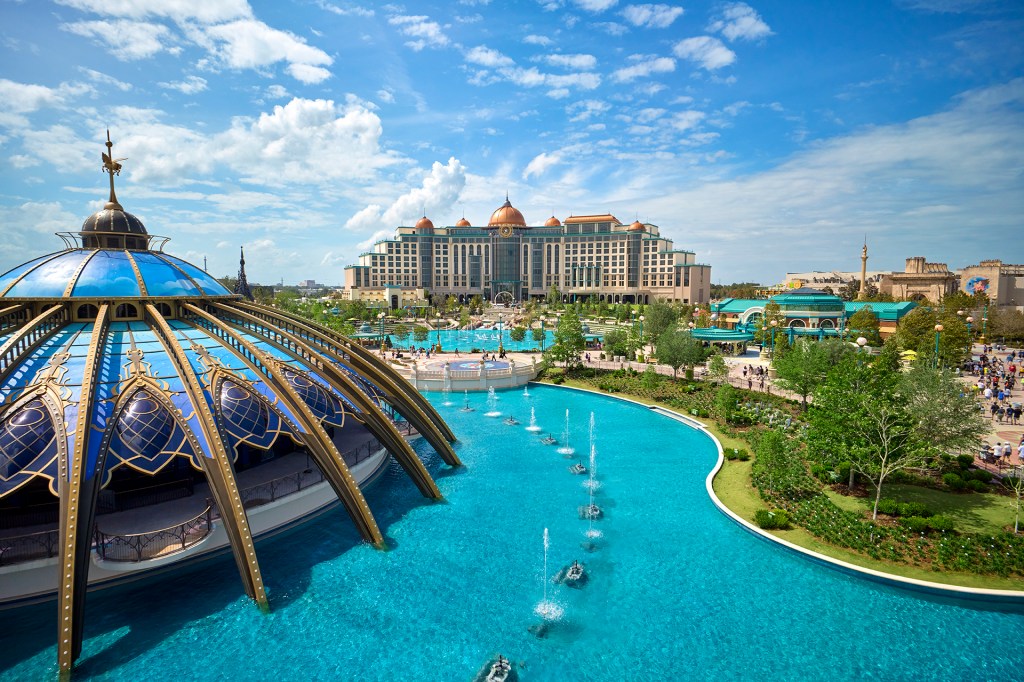
Another big change is with the theme parks chapters, perhaps not surprisingly following the opening of Universal Orlando’s new Epic Universe park, which is quite stunning. Now, all the main attractions are grouped together in one mega chapter, while a second chapter looks at other attractions, like Wild Florida and Mount Dora, that are all worthwhile Days Out in and around Orlando.
The full Epic Universe panorama
Of course, there are still chapters devoted to the essentials of Shopping, Dining and Sport, while we have re-worked the old Beyond Orlando section to give it a Florida Beaches focus that should have extra appeal to all our UK visitors.
In many ways, we’re grateful for the chance to re-work large parts of the old content and make it seem fresh again, and we thoroughly enjoyed the full write-up on Epic Universe, which is simply gorgeous to look at. There’s more in the pipeline, too, so be sure to follow all our updates on our Instagram account.
So, a final farewell, then, to the Brit Guide; and hello, Best Orlando Villa Holiday Guide (phew!).
As we come to the end of another year in the life of two weary-but-happy travel writers, we are able to look back on a truly remarkable 12 months, culminating in the launch of our latest book, 111 Places In Orlando That You Must Not Miss.
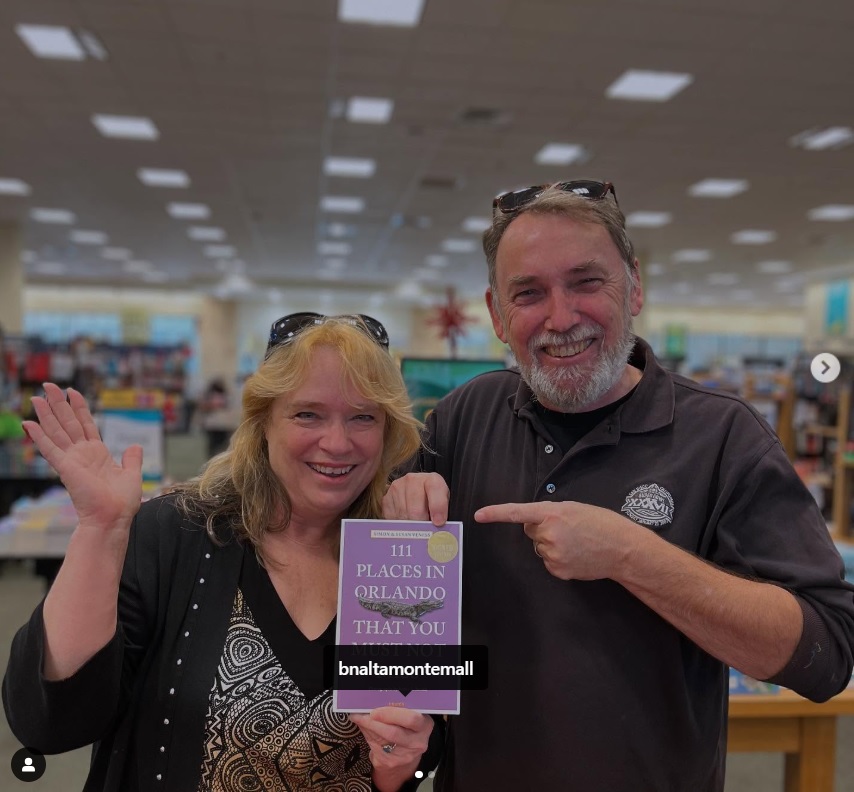
Making sure our local Barnes & Noble store has a signed copy of the book!
Back in January, we were holed up in Donna, Texas, at the beginning of the homeward leg of our grand A Year On The Road RV adventure across the USA, taking a breather as we figured out the final four-and-a-half months of the trip. In the end, we continued with Plan B (our re-routed itinerary after discovering New Mexico gets a fair bit of ice and snow!) to travel the full length of the Texas coast and then hop through each of Louisiana, Mississippi and Alabama before returning to Florida. It all worked out well, albeit, we lost our beloved Ruthie the Rescue to an ongoing medical condition (and old age) in May.
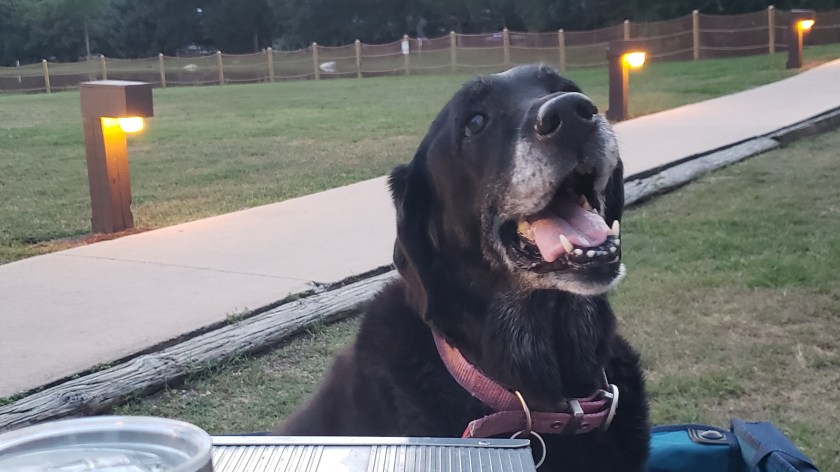
A happy dog – Ruthie did so well on our big RV trip, but then faded quickly on our return home
The rest of the year has been devoted to getting our Orlando lives back in shape, catching up with work back in The Theme Park Capital of the World – and launching our new book. The 111 Places guidebook was a happy coincidence of a contact on LinkedIn flagging up an opportunity for us, and we were delighted to dive into a different side of Orlando, the non-theme-park side, for what is now our 52nd book. While part of an existing – and highly popular – book series by German publisher Emons, it gave us the opportunity to spread our wings and delve into a completely different side of The City Beautiful, one which doesn’t get a lot of publicity.
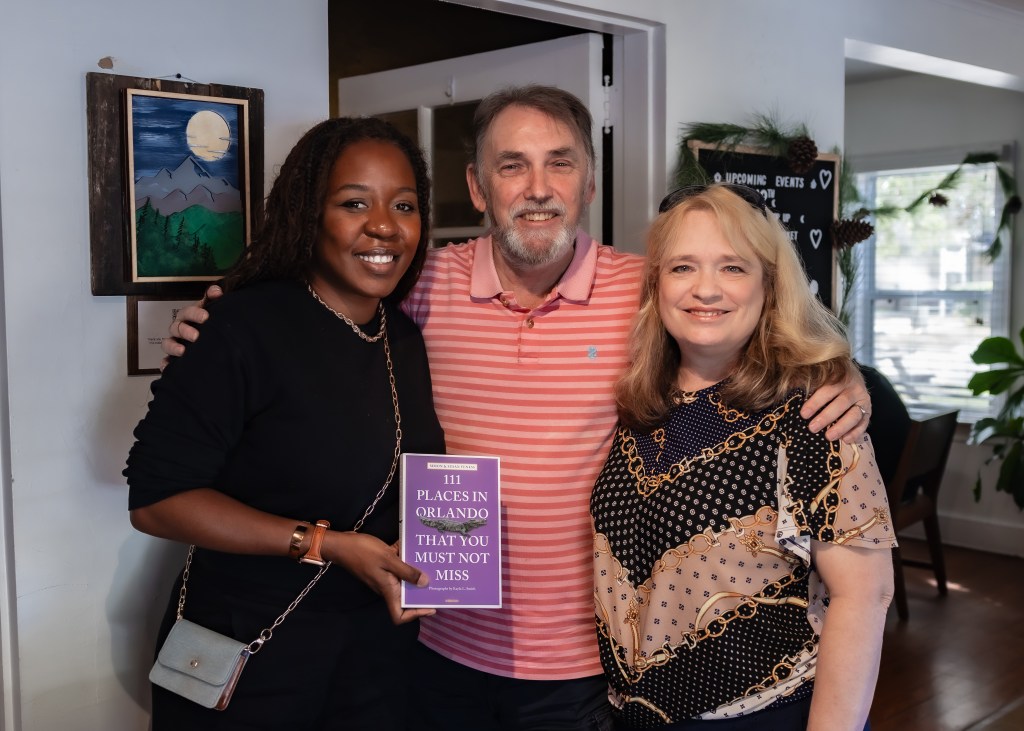
The 111 Places in Orlando team – us with photographer Kayla L. Smith
The simple fact is, there is more to this huge tourist destination than meets the eye – much more, in fact. There is a wealth of history, art and culture, as well as a thriving downtown district scene, and some unique restaurants. All of this, plus some of the quirky and offbeat places that most cities can boast, and more can be found between the pages of the new book, studded as it is with wonderful photography by Orlando photographer Kayla L. Smith. This is a book we are immensely proud of, and we hope everyone who buys it discovers something new, exciting and captivating about the city we call home. There are 111 stories just waiting to be discovered (along with another 111 that are linked to the main Places!).
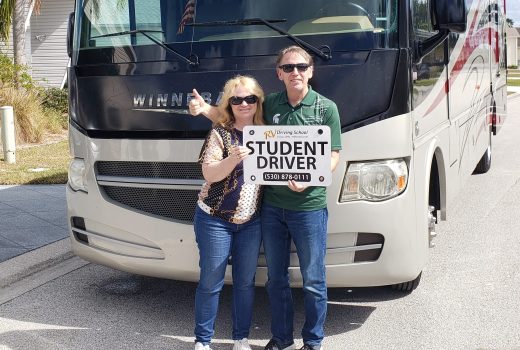
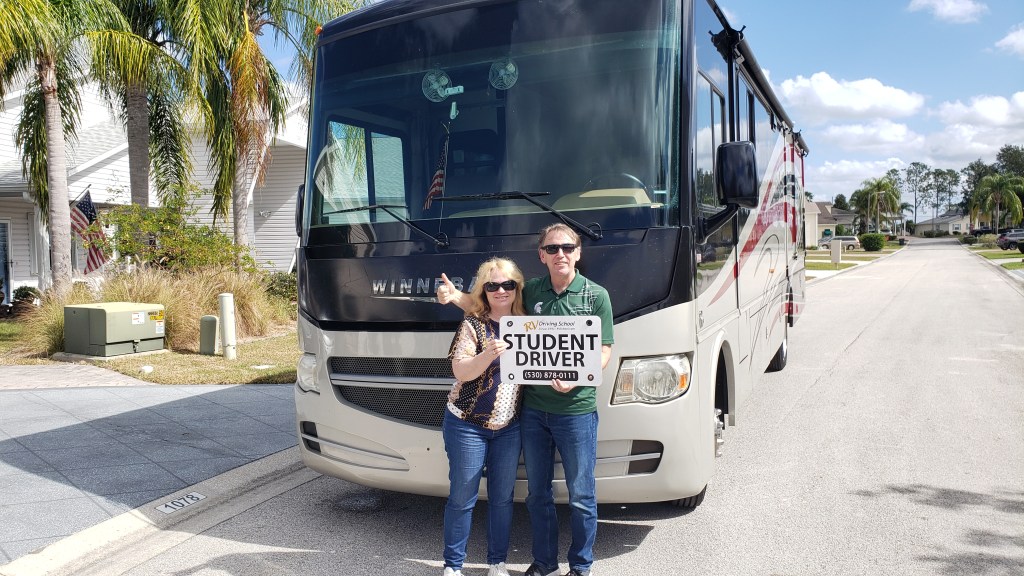
How our epic Year On The Road adventure started – with driving lessons!
And that’s our (basic) story of 2024, at least for now. There will be more new adventures in 2025, although we don’t know what they will be yet. We are probably going to take a step away from our Brit Guide work for the immediate future, but there will be another edition in Susan’s Hidden Magic of Walt Disney World series in the not-too-distant future, plus more about our Year On The Road adventure. We’re hoping to get back to Europe for some (long) overdue travels there, and we also want to see more of the USA’s east coast. We do plan more RVing at some stage, but we might need an extended break first! In the meantime, we’d like to wish all our family, friends and followers the happiest of Holidays, and a peaceful and prosperous New Year –
Florida and Orlando have been in the international headlines for major hurricane events in the past few weeks, but that shouldn’t be a major deterrent for our visitors. We discuss why in our latest blog for AttractionTickets.com:
Time goes slow when you’re faced with a major, life-threatening hurricane. With Hurricane Milton churning a destructive path directly towards Florida, the hours take on a slow-motion effect that elongates the temporal nature of things. In short, minutes feel like hours, and hours an eternity.
For three full days, we kept a watching brief – on seven different TV channels! – as what was originally an area with just a “40 per cent chance” of developing into a tropical system flared up in dramatic fashion. With a speed that stunned meteorologists on all seven stations, Milton became a Goliath of the Gulf, a deadly mass of wind and rain.
Its steady move across the super-heated waters of the Gulf of Mexico became a mesmerizing fixation, from Category One to Category “HOW big?” with an inexorable menace. We were on first-name terms with a monster.
Each day, we were told how unusual it was for a hurricane to be barreling due east into the Sunshine State, feeding on the climate-enhanced unseasonal warmth. Each day we learned more about the mechanics and terminology of tropical storms. And each day we considered the options in our tree-lined avenue just northwest of Orlando. Should we stay or should we go?
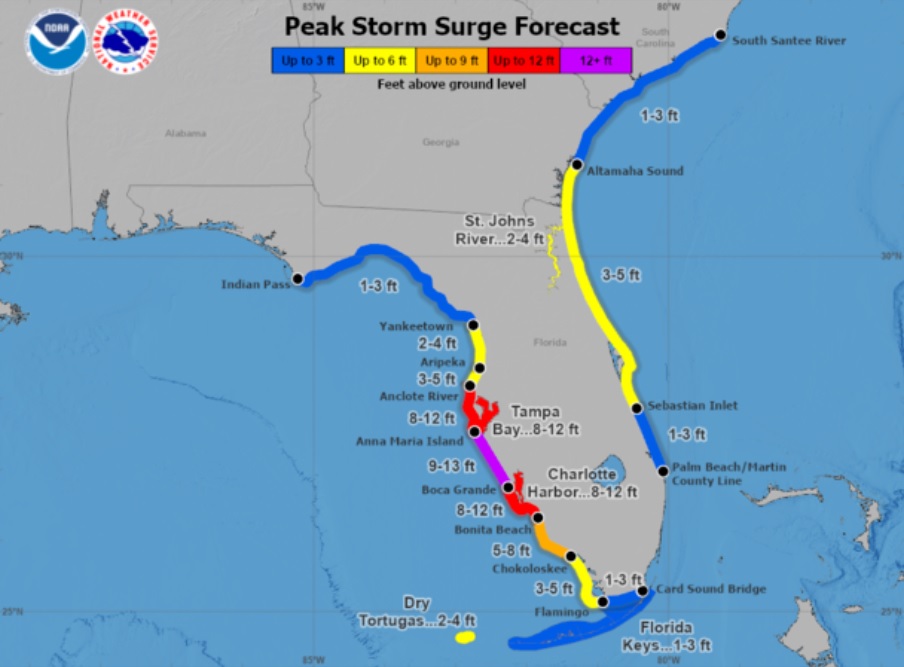
Over on the coast at one of our go-to beach destinations of St Pete Beach, we heard the Mayor of Tampa broadcasting the bald, grim message of “If you stay, you will die.” She also added: “If you’re in a single-story house and we get a 15ft surge, which means that water comes in immediately, there’s nowhere to go. That home that you’re in ultimately will be a coffin.” They definitely weren’t sugar-coating anything. The storm surge associated with Milton promised to be record-breaking and life-taking, and “unsurvivable” became the word of the day, every day.
A full 110 miles inland, the storm surge was not our concern, albeit we viewed the threats to places we loved, such as Anna Maria Island, Longboat Key and Sarasota, with utter horror. Fresh from the widespread coastal devastation of Helene, no-one was in any doubt of what a direct hit would achieve after the extended ravages of the September hurricane.
But, away from the coast, our concerns were more about the effects of continuous hurricane-force winds on the ranks of the 50ft live oak trees dotted along the front yards of each house in the neighborhood. Oh, and tornados.
Yes, we had been fore-warned over and over again – from 20 years of hurricane seasons – that the storm, once ashore, was likely to generate the destructive forces of EF2’s, the small-scale but utterly devastating side-effects of the big storms; totally unpredictable and completely random. Tornados are the really scary thing about hurricanes, and the idea of one suddenly arriving in the middle of the night is the stuff of genuine nightmares.
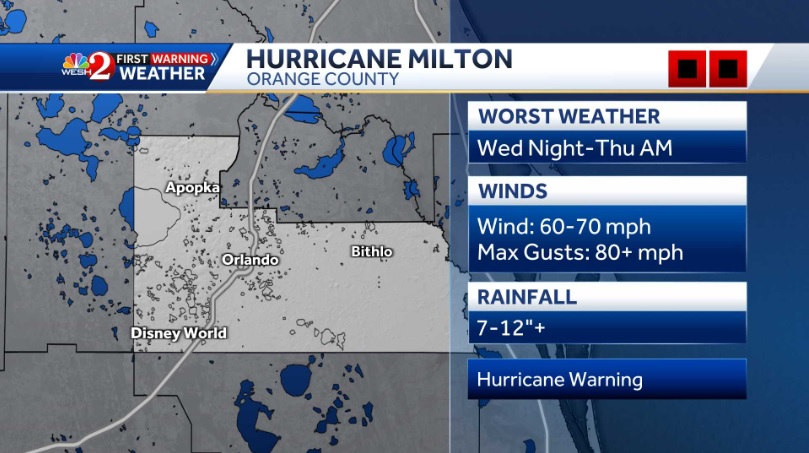
The odds were still in our favor, though. Northwest Orange County stayed consistently on the fringe of the main predicted path. We might get gusts of 80mph, but sustained winds would be “only” in the 60s. It was, in theory, a survivable level of force. True, we also faced up to a foot or more of torrential rain, the kind that comes down in massive sheets at up to three inches an hour, but, with our sub-division on a slope, and two enormous retention ponds to handle the overflow at the bottom of the street, that wasn’t a prime concern.
Therefore we weighed up the odds day by day, and stayed put. In truth, there was really nowhere safe within a few hours’ drive that we could bug out to. The – thankfully – mass exodus from the coast quickly filled up the hotels and motels of north Florida (where there were still places open after Helene), while many from the southwest headed east across Alligator Alley for the presumed sanctuary of Miami, which was just about the only location in south Florida that looked likely to escape the worst ravages of Milton.
Ah, Milton, what an inopportune name. The 17th century British poet of that name never made any mention of hurricanes that we know of, but his most famous work, Paradise Lost, was the kind of harbinger of doom that we could have done without. Our little patio bore rustic signage that insisted “Welcome to our piece of Paradise.” The unintentional irony of Milton’s poem was truly supreme.
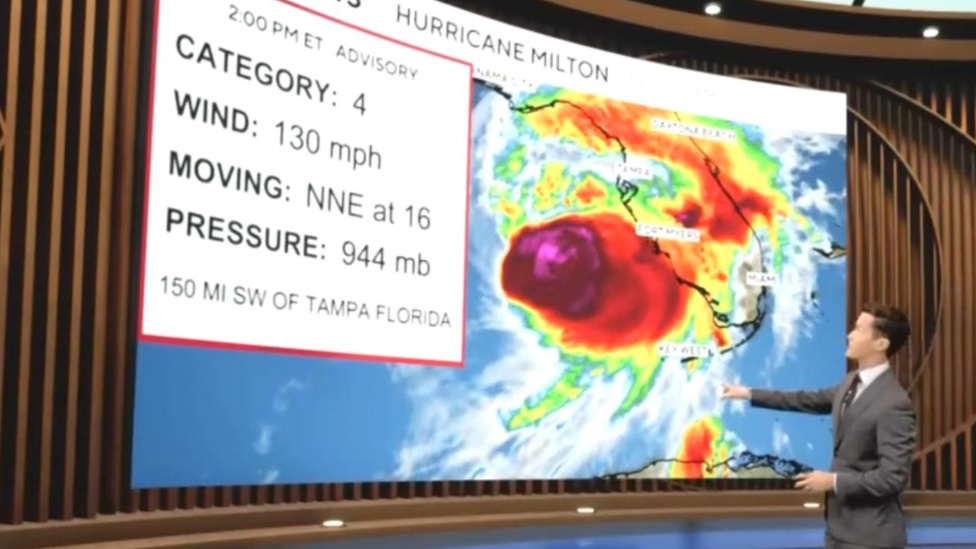
October 9 dawned much as its two predecessors had, overcast and drizzly. The TV stations – each of WFTV 9 Central Florida, Channel 13 Tampa Bay, Accuweather, Weather Nation, Fox Weather, CBS Miami and ABC News Live in turn – all told the same, looming story. Milton was still tracking steadily northeast, dropping from a Cat 5 to Cat 4 but with a widening stormfront as it closed in on land.
There was the possibility of wind shear and dryer air feeding in, though, which provided hope of a late lessening of Milton’s intensity. Wind shear – the enemy of all major storms – was one of the terms we had come to have an intimate understanding of thanks to the meteorological outpourings of the previous days. We cheered for wind shear and rooted for dry air as the possible twin saviors of the state.
Neither force had any appreciable effect on Milton’s forward march, though. As noon passed, the localized rain dried up for an hour, a seeming olive branch for our location from the weather gods. Not so on the coast. The weather radar showed thick, angry orange-red bands of monsoon-like rain, and an increasing smattering of tornado warnings for much of east coast Florida, while those ever-perky meteorologists talked of “tornadic supercells,” “areas of inundation,” “mandatory evacuations,” and “high-tide cycles” (which, apparently, go hand in hand with “record storm surge”).
And still the time crawled on. At 1:00pm it felt like we’d already been awake all day, held in a state of stasis by the oncoming Armageddon. We were getting wind gusts of around 15mph, but nothing to seriously disturb the foliage, and certainly nothing to make us second-guess our decision to stay. Yet.
At 1:05pm we had our first Tornado Watch alarm on the weather radio, a little gadget that makes up for the fact that Florida doesn’t have tornado sirens like the states to the north that experience more – and bigger – tornados as a matter of course. The radio warning would wake the dead, let alone anyone sleeping, hence we don’t expect to get much shut-eye tonight. A Tornado Watch is only an indication that the conditions are ripe for tornados to form. If we get a Tornado Warning, it’s time to hunker down. At 1:20pm, there was a Tornado Warning for Polk County, 70 miles south of us. And then two. And then four. After 30 warnings, we unplugged the radio. You can only listen to the same warning a few times before it drives you plum nutty.
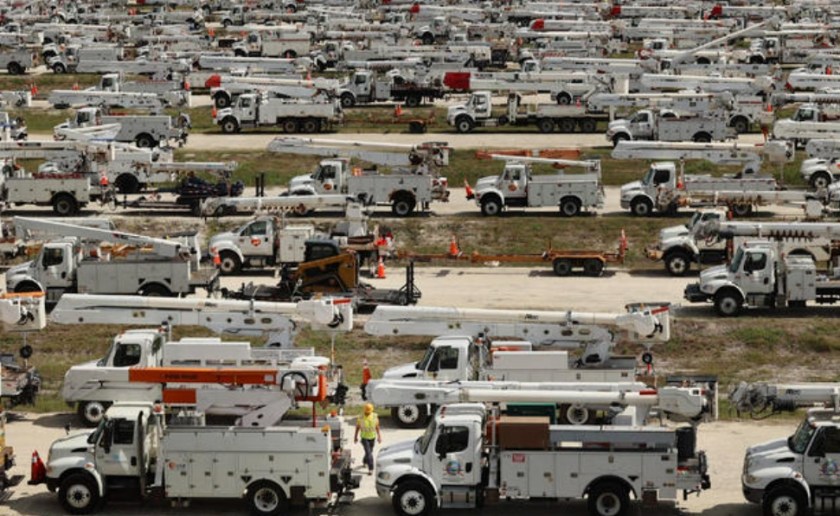
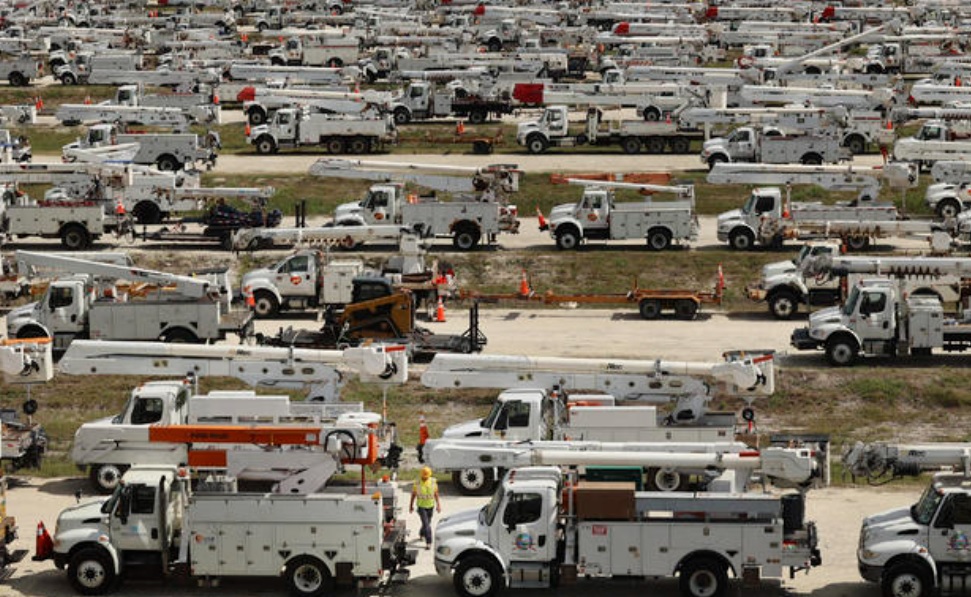
As part of every hurricane preparedness build-up, there are now hundreds of electrical repair crews, all waiting to see exactly where they will be needed
Oh, and before we go any further, for anyone wondering why we don’t just hunker down in the basement against the possibility of an EF2, it’s because there ARE no basements in Florida. None. Here, on what is basically a narrow strip of alluvial sand that sticks out into the sea, if you tried to dig one, you’d have an indoor swimming pool instead of a basement.
At 1:25pm, the first heavy rain arrived. Milton itself was still a good 300 miles away but those outer bands sweeping across the southern half of the state were now starting to stretch their flood-inducing tentacles well to the north, albeit in sporadic bursts.
On local station WFTV, the two main meteorologists were fast working themselves into a frenzy keeping up with a multitude of tornado warnings popping up through south and east-coast Florida and steadily working their way north. Within half an hour, they were juggling with a dozen or more warnings, each one moving steadily closer to Orange County and Metro Orlando.
The word that kept popping up was “Unusual.” It was “unusual” to see such strong tornado indications from the outer bands of a hurricane in October. It was “unusual” to see them on the ground longer than a couple of minutes. And it was “unusual” to be seeing so many in such a short space of time. For the deadly Hurricane Ian in 2022, there had been a round dozen confirmed tornados in Florida in total. Now, we had potentially more than 12 in just a few hours.
Of course, by “unusual” they meant “screamingly extreme and insanely dangerous.” They were just being polite. By 3:30pm, we had the first tornado warning for Orange County, although, happily, it was way over in the rural southeast corner of the county, away from any major population centers. But, with Milton still at least five hours away from landfall, it was a sobering burst of tornadic torment. This, too, was “unusual.” Sadly, for at least six people in the Port St Lucie area, it was tragically fatal, caught by the spawn of Milton in an extraordinary and unforeseen outbreak.
The skies started to darken noticeably around 5:00pm, and not just because sunset was approaching (the actual sundown hour was officially listed as 7:02pm). One of the biggest of Milton’s outer bands was passing across Orange County and the dark-grey, rain-filled skies were being pulled across the region like a gigantic sun shade. Lake Nona, the vibrant, high-tech community in south-central Orange virtually disappeared under a particularly angry orange-red blob on the weather radar.
The 5:00pm National Hurricane Center update also gave us an important revision of the storm’s track, for the first time showing it as “probably” coming ashore on or just south of the city of Sarasota, which, if it holds, will be a major relief for a Tampa Bay that had been warned to prepare for a 10-15ft storm surge. Instead, it will be on the flip side of the surge and should escape the kind of ravages that had the mayor giving her dire warnings of death and destruction only a few hours earlier. Beautiful Anna Maria Island may also escape the worst of it, too.
Conversely, Sarasota itself, plus Venice Beach, Englewood, Port Charlotte, Punta Gorda, Fort Myers and the islands of Sanibel and Captiva could all be facing utter ruin from the massive storm surge generated on the southern side of the storm. At this stage, Milton has been fueled by several hundred miles of super-warm Gulf waters, and the evening rendezvous with the Florida coast promises to be apocalyptic for them, possibly even worse than the damage wrought by Ian just two years ago.
By now, we have prepared our little ‘escape room,’ in a corner of the passageway from the lounge into the bedroom. We have hauled a mattress out of the spare room and propped it up ready to jump behind (with some of our essential valuables, documents, phones, flashlights and external hard-drives) in case of a night-time tornado. The bathtubs have been filled with water to use to flush the toilets if the water supply is cut off, and we have a case of bottled water and plenty of fruit and sandwich fixin’s to keep us going if the power also goes out. The fact we are on the underground power grid of the neighboring high school – which is an official evacuation center, and hence has its own back-up generator – is in our favor, though.
At 7:00pm., wind gusts are up to 27mph, but we’ve been told to expect 60-plus during the night, albeit some of the estimates are dropping in light of Milton reaching land a good few hours ahead of the original projected time of midnight to 2:00am, and as a Category 3, not 4. The TV pictures of the Gulf coast are not so heartening, though, while the tornado outbreak to the south and east has the meteorologists scrambling for comparisons. With 17-plus confirmed tornados, it is by far the biggest outbreak the state has ever seen in a day, and there are some eye-popping videos of the twisters crossing main roads, downing power lines and wrecking buildings. This level of tornadic action was definitely NOT on Florida’s pre-hurricane bingo card, and the TV talking heads are at a slight loss to explain this particular extreme. The best they can manage is that the highly-charged outer bands of Milton ran headlong into the wind shear of an advancing cold front descending through the state, leading to this unprecedented spate of tornados.
Rain remains high on the agenda, however, especially in the area immediately north of the eye of the hurricane. The St Petersburg/Tampa area has been warned to expect up to 18 inches of precipitation tonight, with that intense layer of wind-driven cloud also expected to track inland towards us in the Orlando area. Once again, we’re happy to live on an appreciably sloping road, which is most assuredly not the case for most of flat, featureless Orlando.
16 Hours Later…..
We shut down our computers around 9.00pm and hunkered down in front of the TV next to our little “safe space,” alternating the latest news with episodes of The Great British Baking Show to provide some welcome relief from the growing onslaught. The coastal areas looked suitably grim, but it was hard to follow the progress of the hurricane once ashore as the TV stations all wanted to make their reporters the star of the show and, frankly, it became embarrassing watching them venturing out into the wind and rain desperate to prove their ability to defy the weather.
And there was some serious wind and rain. While Milton posiively lashed the coast, it still had plenty left as it moved inland from Siesta Key. By midnight, Orange County was feeling the force, with wind gusts up to 86mph, and sustained winds around 65. Being that bit further to the north, we experienced gusts approaching 80mph and sustained winds at 55-60. And if that sounds just a touch, well, pedestrian, we can certainly attest to no such thing. For fully four hours, the storm positively howled through our neighborhood, ensuring few people got to sleep and we kept casting anxious glances at the rear windows, which seemed to be taking the full brunt of those alarming gusts.
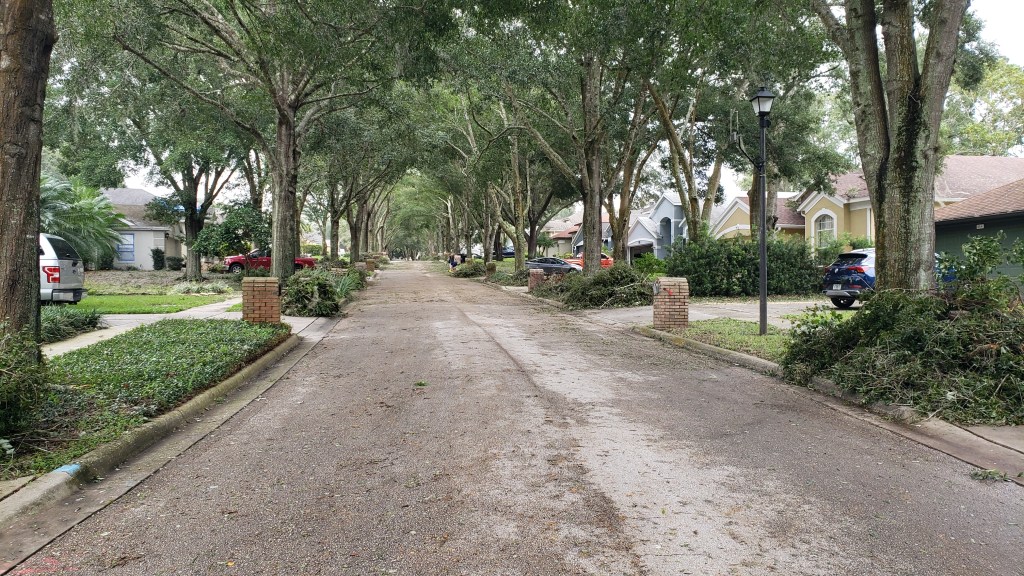
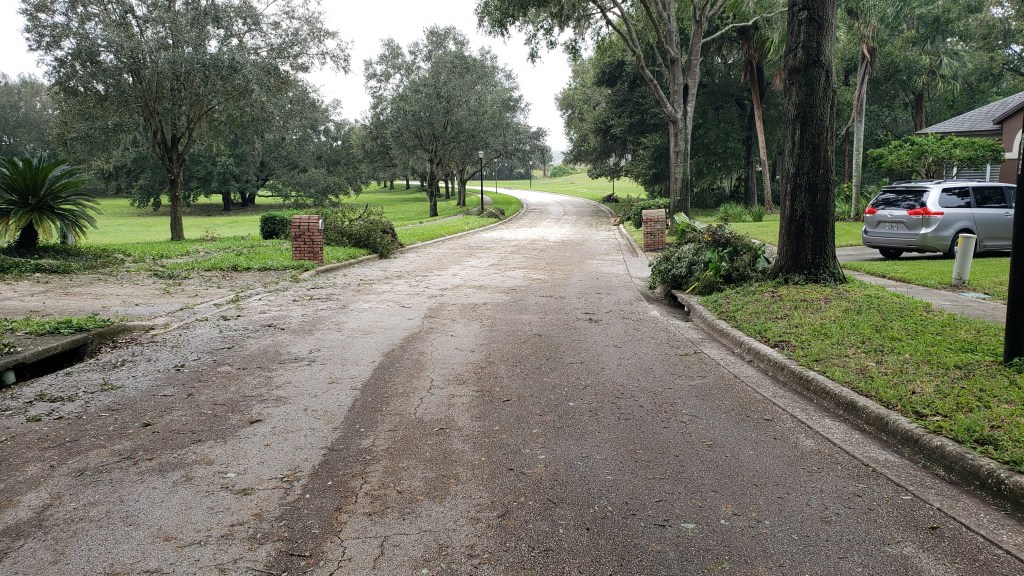
8:00am looking up our street8:00am looking down our street
Surprisingly, there were no further tornado warnings, although our radio kept informing us that “flash-flooding” was occurring in counties across the state. If there was one thing we didn’t need to worry about in our location, it was flooding, so we ended up unplugging the radio again and taking our chances on not needing any further “warnings.” We still had enough to be alarmed about with the way the house creaked and groaned under the constant pressure from the storm, which may have been losing some power but still felt distinctly scary. The occasional muffled thump was also unnerving in the dark, and we wondered what it might be like under a Category 4 storm (like the Great Miami Hurricane of 1926) or even a Cat 5 (like the Florida Keys Labor Day Hurricane of 1935). The thought was absolutely terrifying.
Daylight at 7:25am brought our first real calm since 5:00pm the previous evening. The winds had all but died down, the rain was a mere annoying drizzle, and we could see the malice of Milton. Our street was full of tree debris, mainly leaves and small branches, but with a few more substantial tree limbs mixed in. Our landscape was positively groaning under the weight of 14 inches of rain – which came down like craze-driven sheets at Milton’s height – and we would be able to see, when we ventured to the bottom of the road, that the occasional “thumps” in the dark were a pair of trees that had come down right across the main road out of our sub-division. Amazingly, someone had already been out with a chainsaw, and there was still room for cars to squeeze through.
Driving out of our road, with the two downed trees on the left
The full sub-division had been hit with more trees downed in a handful of places, and general tree debris pretty much lined every road, but there was nothing catastrophic to report, and traffic was able to navigate fairly easily, albeit slightly slower than usual.
More tree debris through the neighborhood
It felt like the whole world had been watching Milton with grim fascination, and there had certainly been plenty to be horrified by, with at least a dozen deaths and large-scale destruction in multiple points along the coast. Flash flooding had been a very real and ongoing concern. Tampa had been spared the full, cataclysmic forecast of doom, but the state’s record outbreak of tornados had added unexpected weight to the disaster-tinged side of the ledger. In short, Milton had lived up to its billing as a monstrous chaos creator, if not quite “the storm of the century” predicted by a few. Unlike Helene, this latest cyclone has not generated the same widespread devastation, but there are places – notably Sarasota, Fort Myers and St Petersburg – that are going to need a lot of help to bounce back.
LOTS of tree debris
In the final analysis, we got a crash course (no pun intended) in hurricane meteorology, a degree-level class for understanding the workings of these monster storms, and we will be even better prepared for the next one. Because we know there will be a Next One, and one after that, and even more besides. Because, despite the efforts of Governor Ron DeSantis and his GOP cronies, climate change will continue to be the biggest issue facing the world, and it cannot just be erased from public discourse and school curriculums. The weather WILL go on being increasingly extreme, and Florida WILL continue to bear the scars. At some point, the public will wise up and Reckless Ron and his ilk will be run out of the state on a rail. And it won’t be a moment too soon.
Looking up our street AFTER a few hours’ of neighborhood clean-upLooking down the street after clean-up
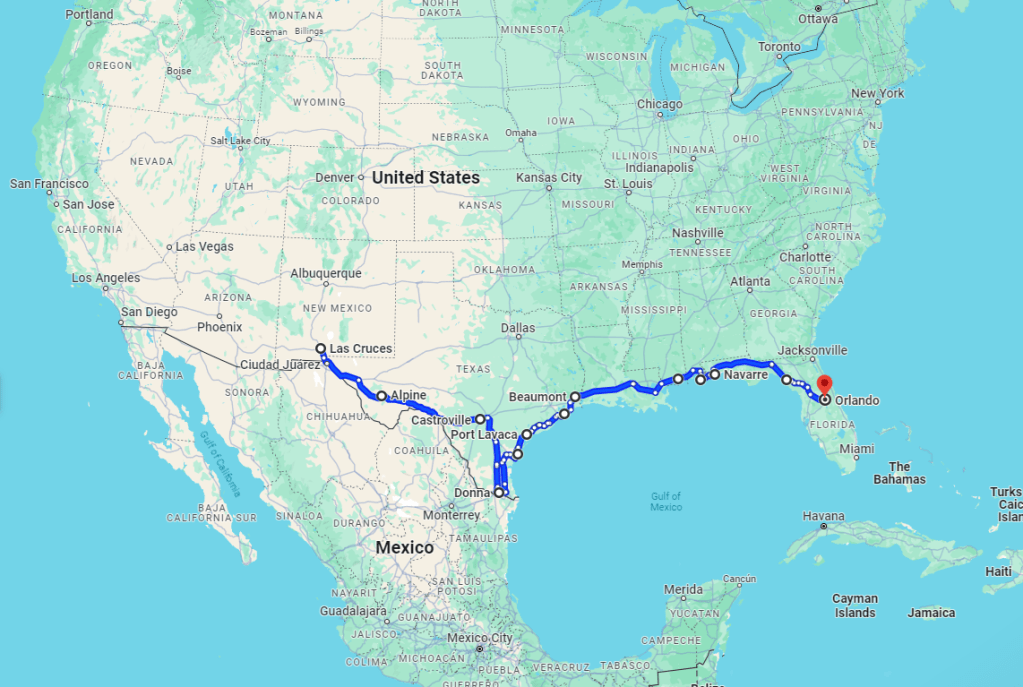
Back in Orlando again, it’s time to tot up the final mileage and trace our entire route (in 2 maps) around the US. We reached West Glacier, Montana, at our furthest distance from Orlando at almost 2,700 miles away, albeit we reached there via a distinctly circuitous route that involved fully 12 states!
The first 7 months saw us take in by far the biggest ‘chunk’ of our year-long route, including side-trips into Colorado and Southern California by car, as well as parts of Northern Arizonaand New Mexico
The “return journey” from there was also far from a straight line, taking in another 10 states before completing what was essentially a giant circle of the Midwest, the North, South West and Southern states. For much of the last 5 months we were close to the Gulf of Mexico before coming back into Florida via Pensacola and the Panhandle area, where we were definitely able to relax a bit (albeit keeping more than one eye on staying out of the way of some seriously stormy weather).
The final five months took us from the heart of New Mexico down to the far south-western corner of Texas, then right around the Gulf of Mexico via Galveston, New Orleans, Biloxi and Gulf Shores
So, with no further ado and a bit of a fanfare – “Ta RA!!!!!” – our final mileage comes to, wait for it…35,186 miles since we left home on May 14, 2023. In our RV, Fati, we traveled a total distance of 9,846 miles, while in our trusty little Ford Fiesta, Nippy, we added a whopping additional 25,840.
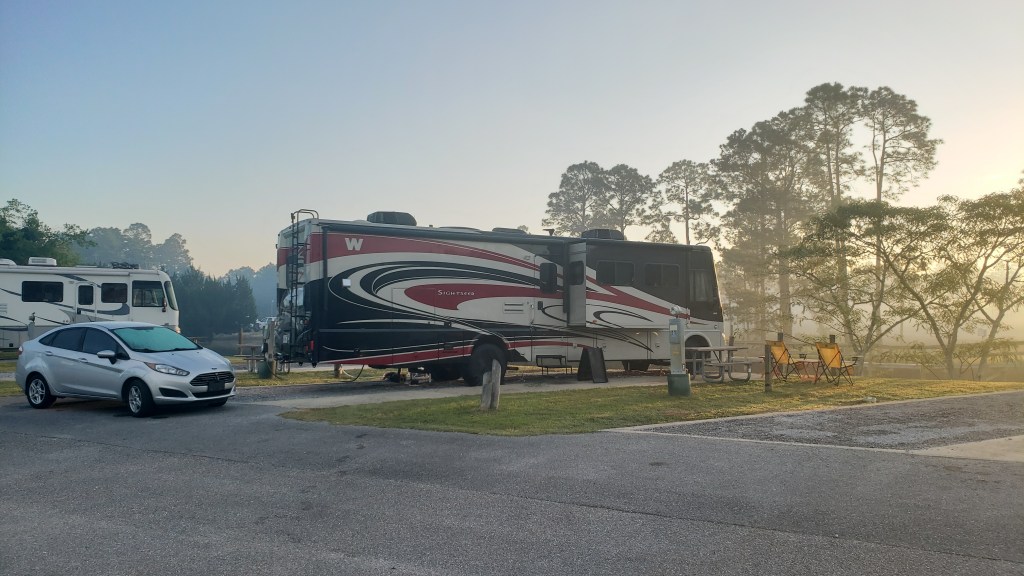
Somehow, we’re all still in one piece, albeit Fati has been in for several repairs and 2 full services, while Nippy is heading for a fourth service today and has needed new tires, windshield wipers and two air filters (!). Needless to say, we are immensely proud of our Ford-engined Winnebago RV, as well as our little Fiesta, and they both now deserve a good rest.
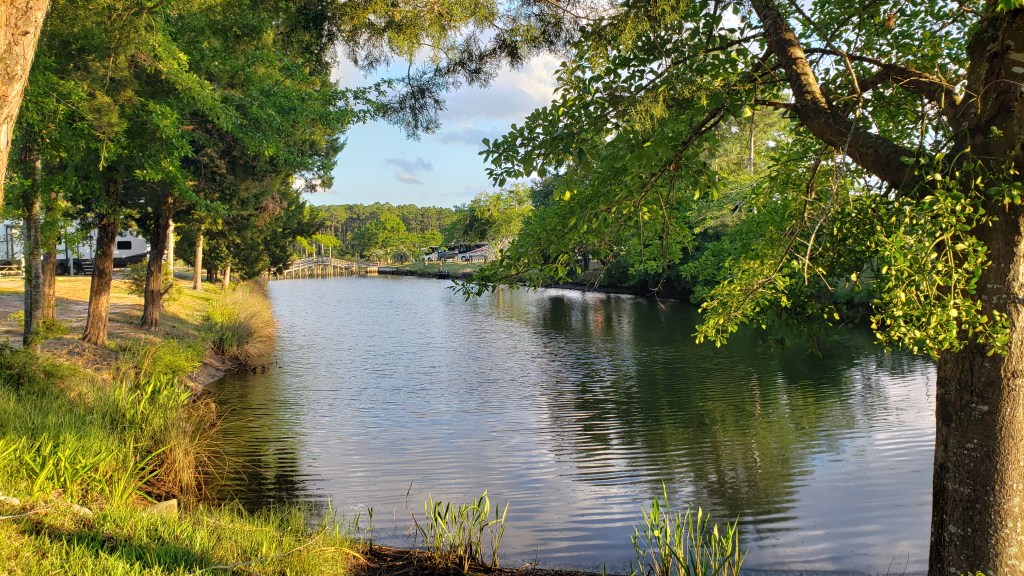
Finally back in Florida, we spent a quiet week in a beautiful little RV campground in Milton in the Panhandle before turning south for the last leg of the year-long trip
Will we have more travels to report anytime soon? The debate is now on at Chez Veness! We DO have a fair bit of work to catch up on first, but there is already talk of an East Coast RV tour, as well as a possible trip out West to the areas we missed this time, namely Washington, Oregon and Northern California, as well as more of Colorado.
So, stay tuned for further travel bulletins, and, if you have liked and enjoyed our blogs, please leave us a comment and be sure to check out our YouTube channel for a series of snapshot videos of the trip on this link: https://www.youtube.com/channel/UCP5dY0TcznDGkOY8BQUkpQg
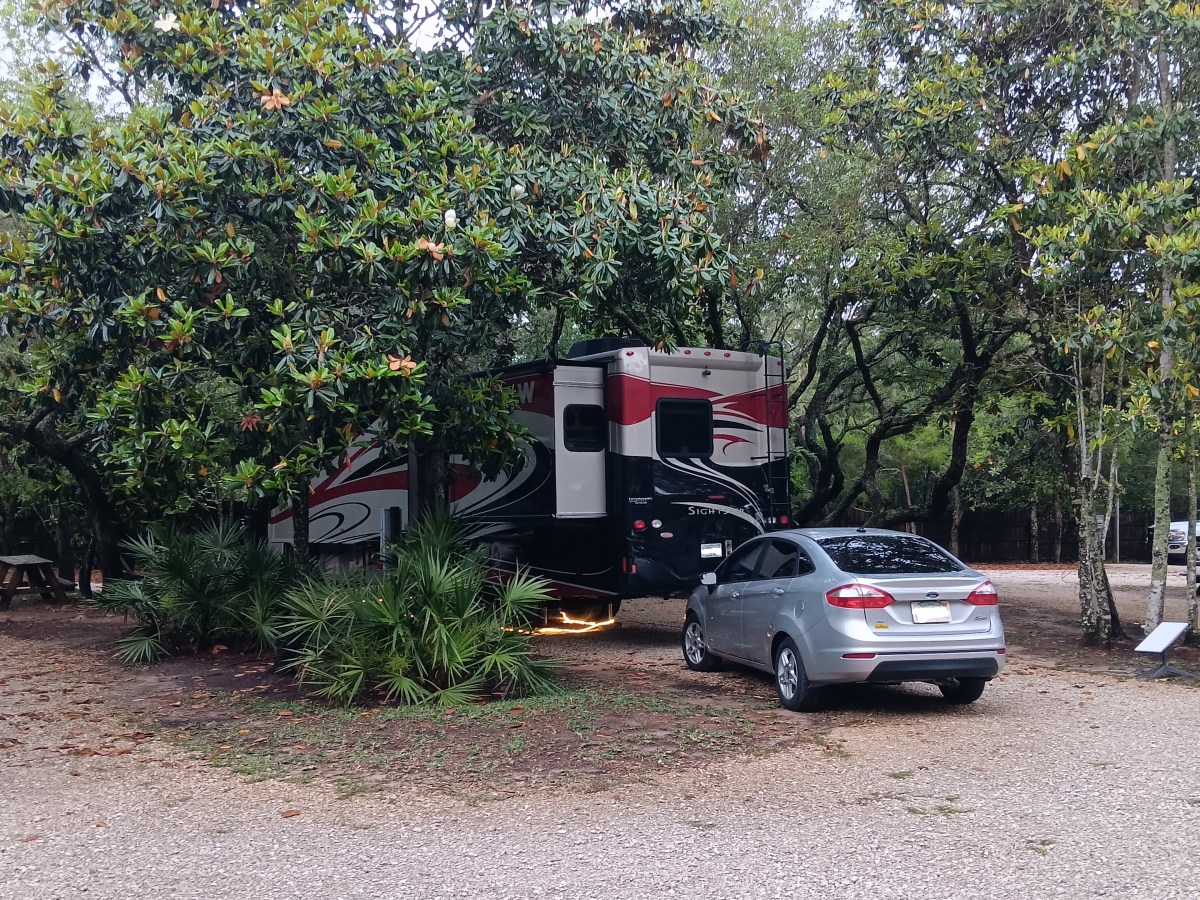
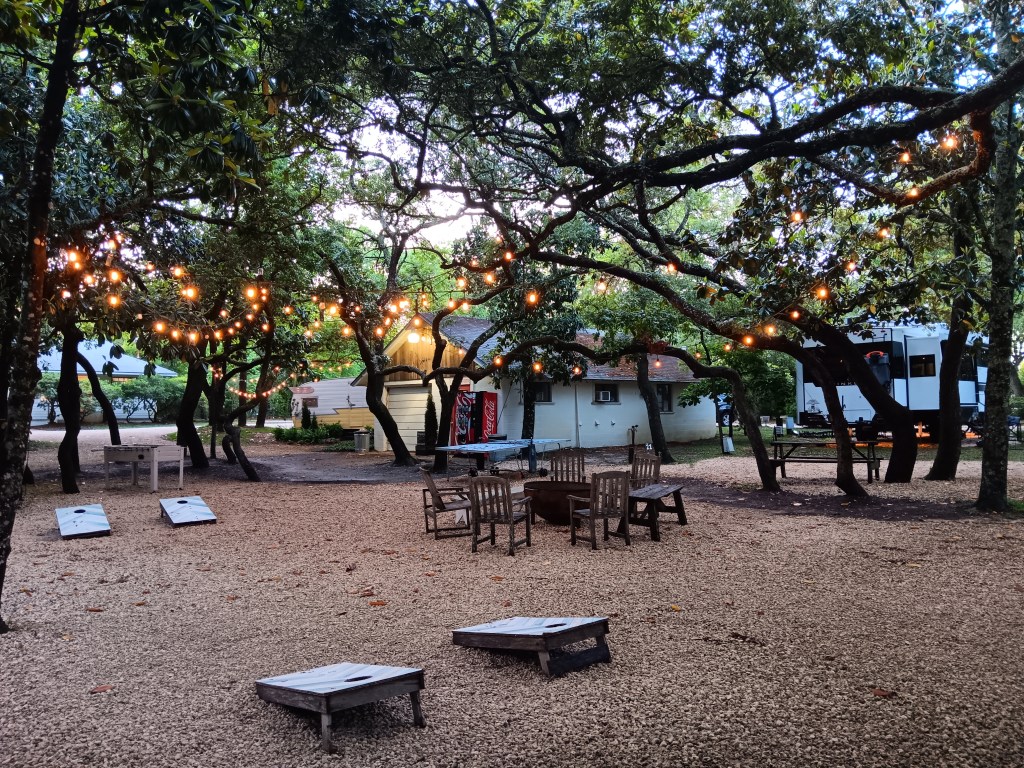
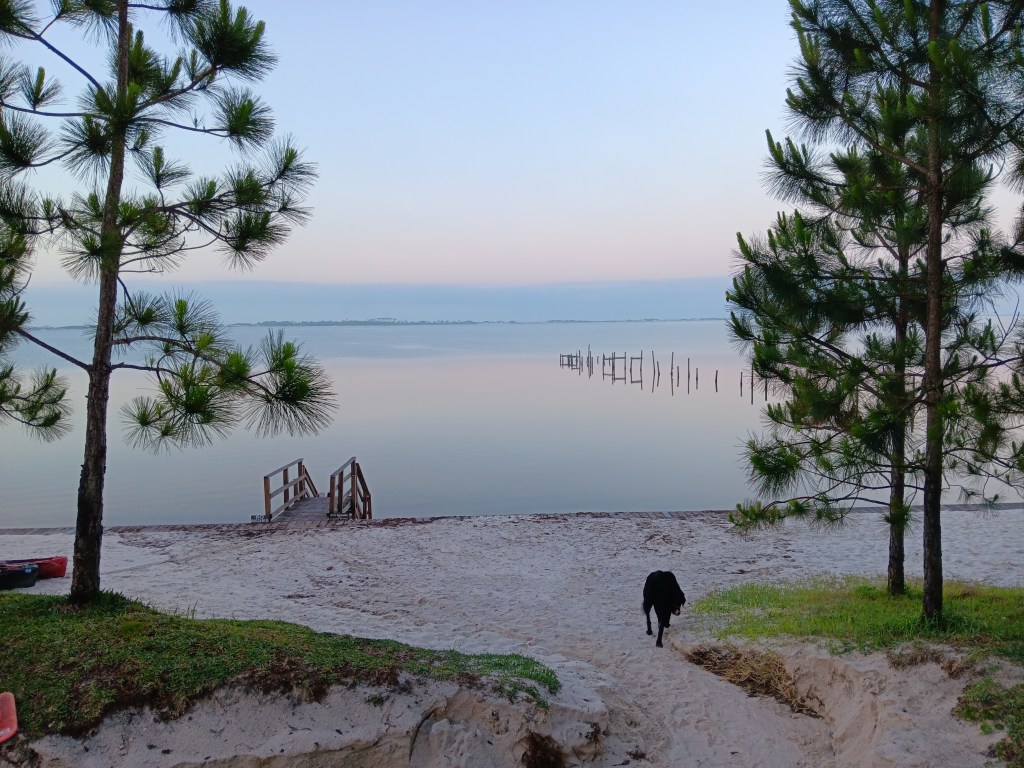
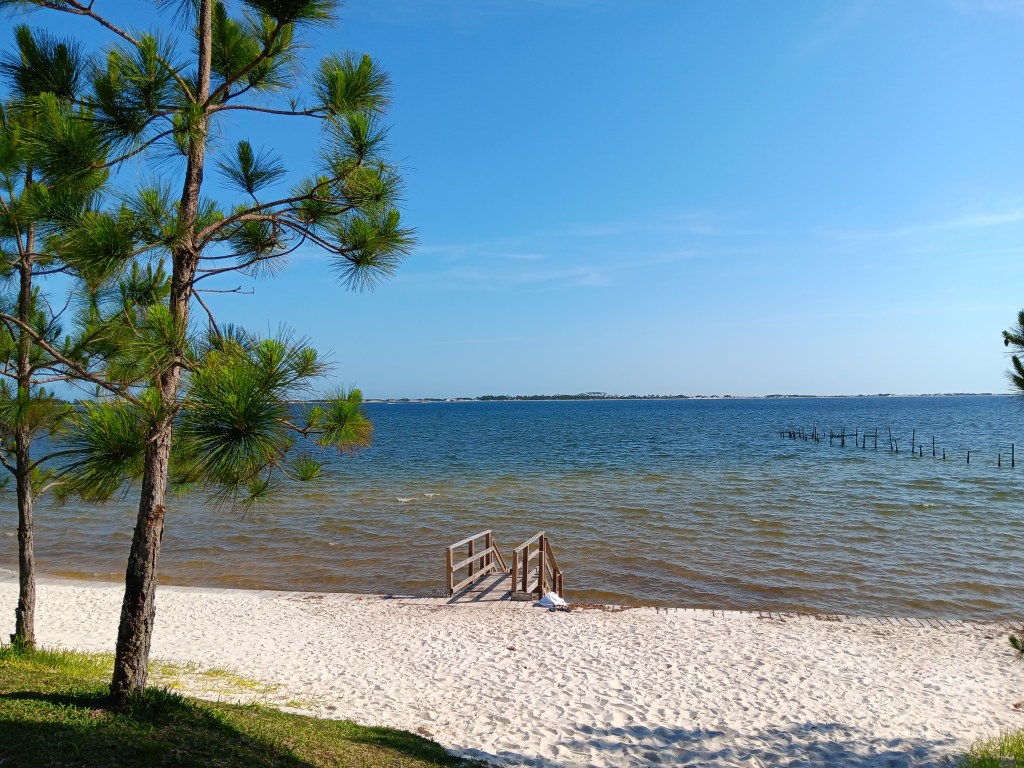
When is a campground only 29 miles away from your previous location but a million miles away from harsh reality? When it’s The Hideaway Retreat in Navarre, Florida, an oasis of magnolia trees, white sand beach, and the blue, blue, blue of the ocean.
Okay, so maybe it’s on the Santa Rosa Sound, not the ocean, but the effect is the same. A self-proclaimed “shabby chic” retreat that offers rare shade in the Sunshine State, the Hideaway scared us at first for its close-together trees, then proved to be far more straightforward than we imagined, and a gem of a place we’ll return to if we ever get the chance.
When you live in an RV, every noise matters. We know all of our noises, from the occasional hum of the fridge as it tries to freeze everything solid to the gentle click of the light switches and the metal “pop” as the slides or the jacks settle in during cold weather. But the muffled thumping we kept hearing eluded us. What the hell was it?
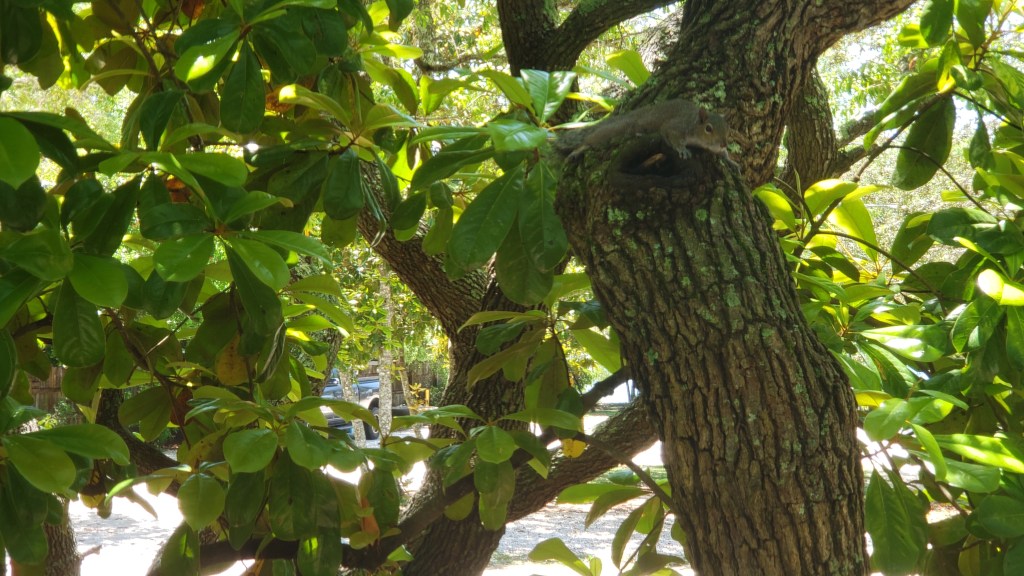
This isn’t the source of the thumping noise. It’s a squirrel (clinging to the sawed-off part of the trunk) that swore at us for a full five minutes because we were parked so close to its tree. We eventually came to an agreement, and he/she moved on.
It drove us to distraction until we asked one of the staff and they told us it was testing that takes place at the Hurlburt Air Force Base Special Operations Command’s training grounds, just across the Sound. They’re blowing things up, but don’t worry; after a while you won’t hear it anymore. Which was (partly) true. It was simply one of those background noises that makes RVers (okay, us) wonder if something on their rig is eager to meet a mobile mechanic and will cost many, many hard-earned dollars.
The strip of land at the far side of the Sound is the training grounds. It looks far in the photo, but it’s not, really.
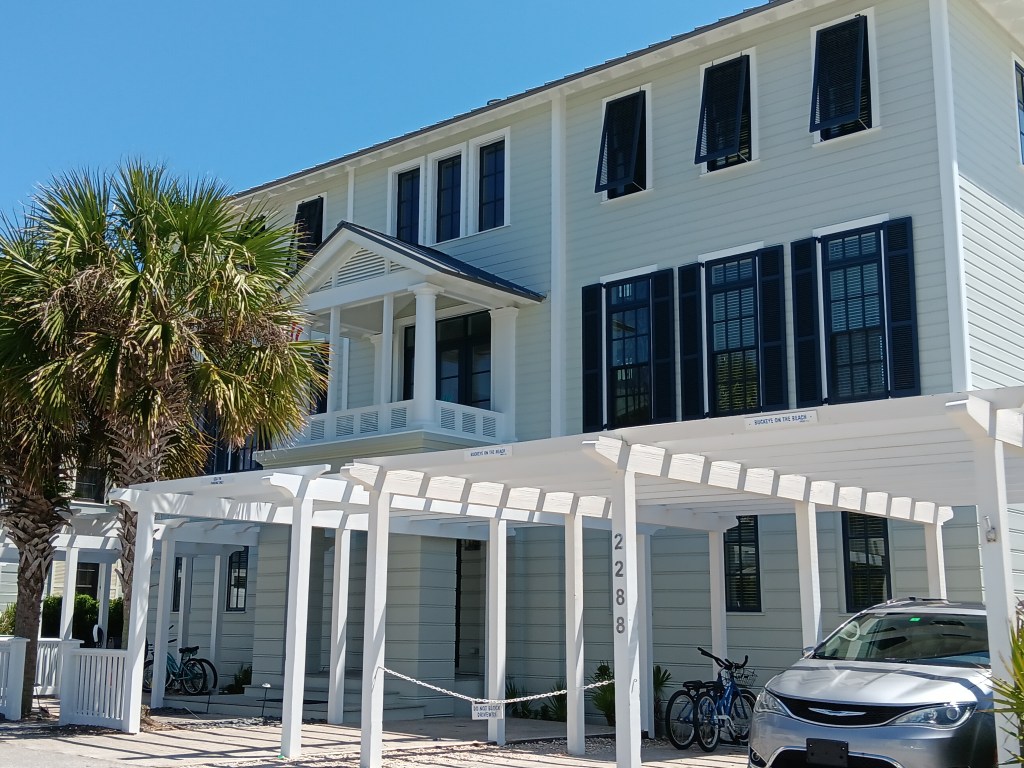
That problem solved, Simon had never seen the movie The Truman Show, but was aware Seaside, Florida, not far away, was the setting for the fictional town of Seahaven, so we had a drive along the coast the next day with that town as our goal. When we arrived, we couldn’t escape the feeling that it was very much like the formerly-Disney-owned town of Celebration, which some say looks like a Normal Rockwell painting and others say is more along the lines of The Stepford Wives.
Row after row of condos and single-family homes, and nearly all of them were painted white.
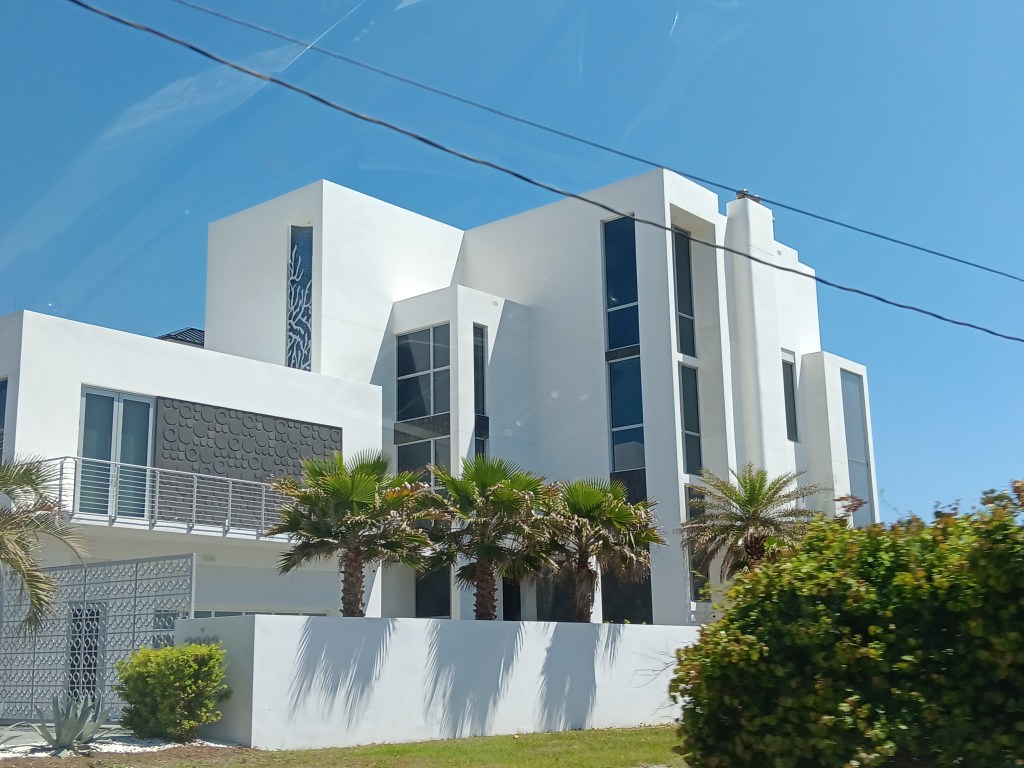
This is a single family home. And it isn’t even the biggest along the shoreline in this area.
Unfair movie comparisons aside, Seaside clearly has money. It also has a lot of community amenities, including an intriguing area featuring permanent kiosks and food trucks that would have been perfect for lunch.
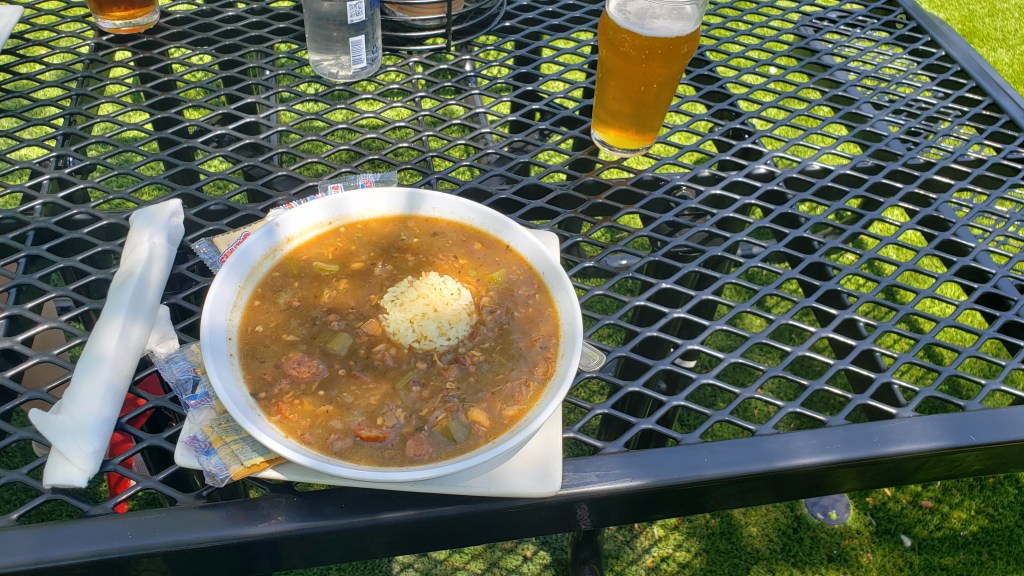
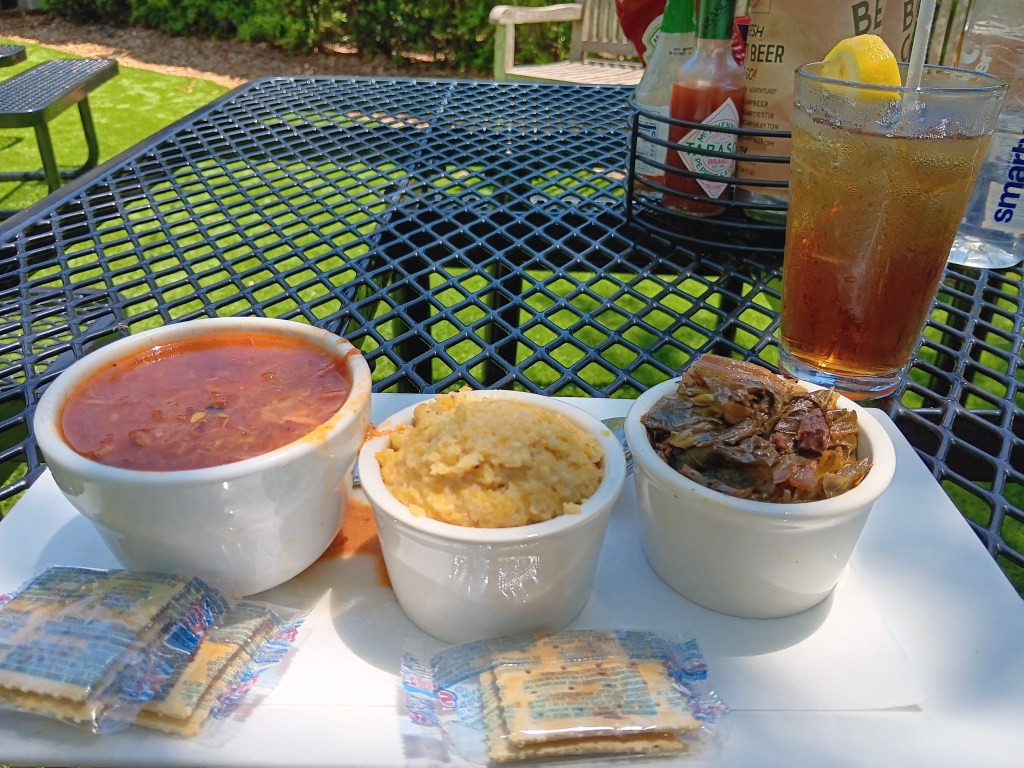
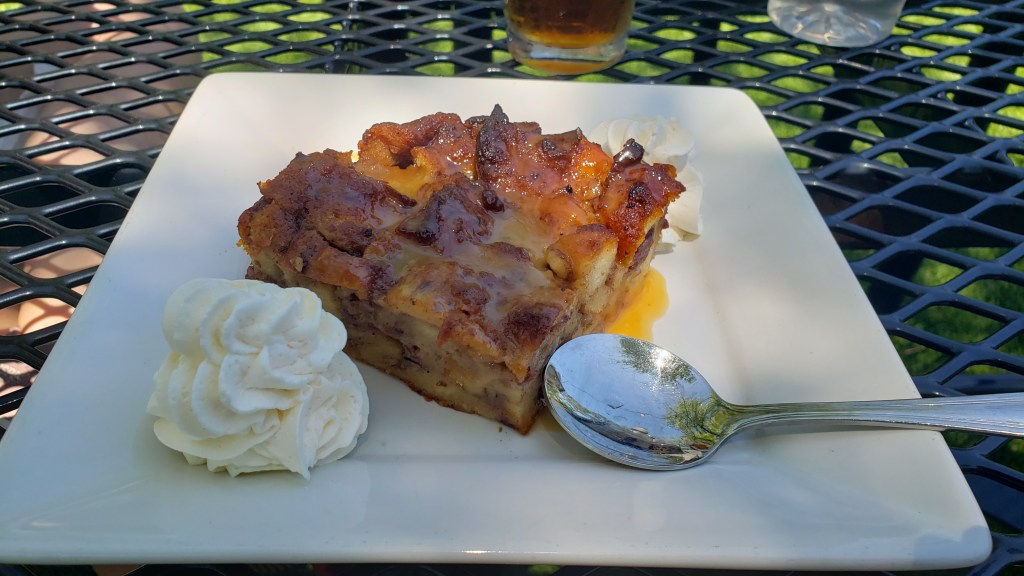
But we’d already eaten, having stopped at Beach Camp Brewpub, not realizing Seaside was so close. Still, Simon had a huge bowl of gumbo and a beer, Susan went for a cup of Brunswick Stew and iced tea, and we split sides of cheese grits and collard greens, all of which were delicious. Simon being Simon, Sticky Toffee Bread Pudding rounded off a fine meal.
Thick and rich and scarfable!
Trio of deliciousness!
Yes, yes, yes! But more caramel sauce, please.
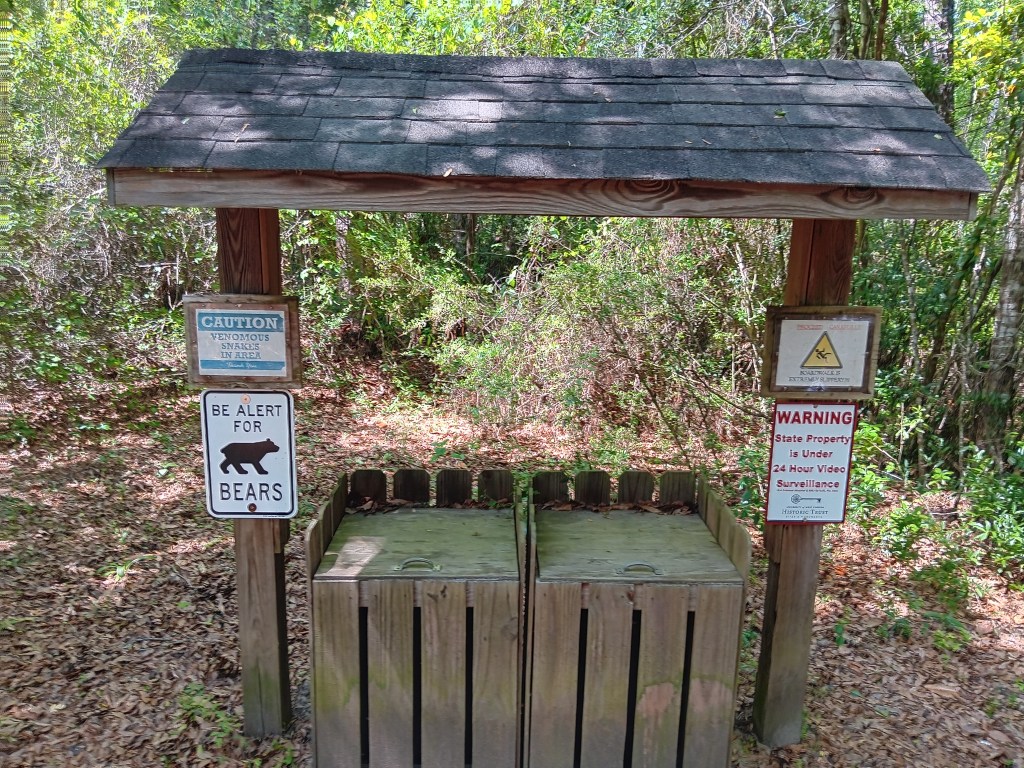
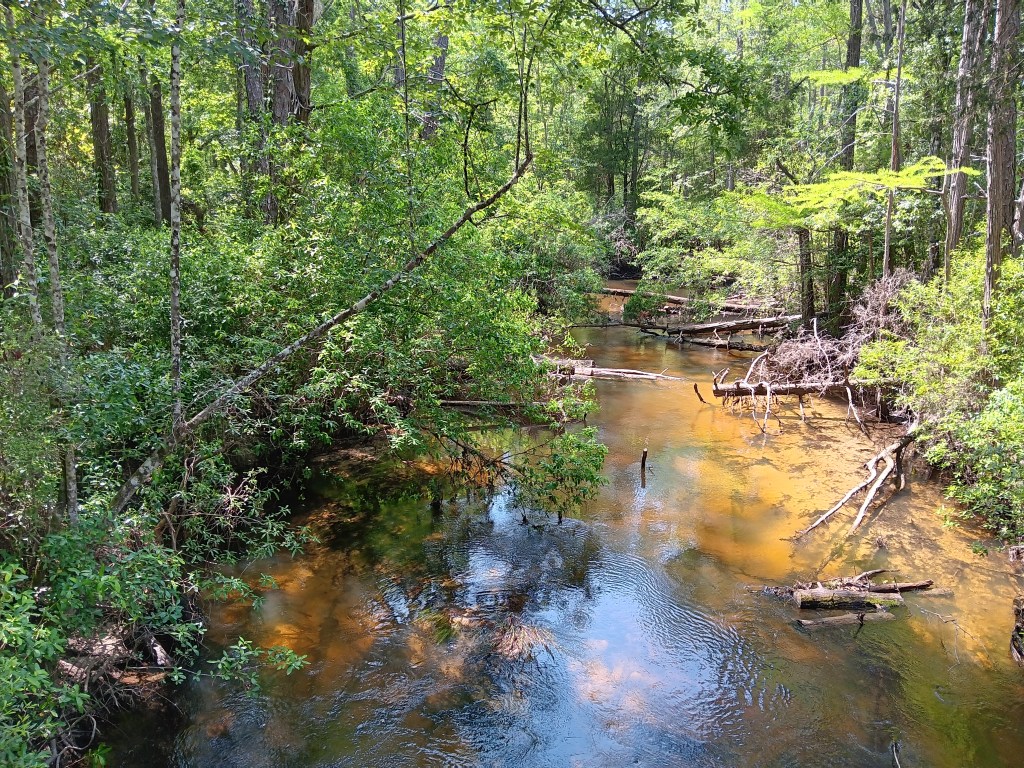
The next day we had hiking and a boat tour on our radar, for a bit of exercise and the chance to get out on the water. Arcadia Mill has a three-quarter-mile-long, dog-friendly boardwalk through what was once antebellum Florida’s first water-powered industrial complex. Very little remains of that logging endeavor, other than a few ruins of retaining walls, but it’s a gorgeous walk through the forest, with peaceful streams running languidly across our path. True balm for the soul.
Venomous snakes, bears, slippery boardwalks, and 24-hour surveillance. This should be fun!
Why do we love views like this one so much? Perfection!
We started the adventure with a little picnic of sandwiches, carrots, and fruit, then did the full loop, with Ruthie making the trek in her wagon.
After consulting her vet about the more advanced laryngeal paralysis our pup is experiencing, walks are now out of the question for her, but she seems to appreciate getting around comfortably when the path isn’t too bumpy.
Who’s a beautiful girl? YOU ARE!
The boat tour? Well, that didn’t really work out. Simon wanted to “drop by” and find out more about it, but when we arrived it was someone’s house. No one came out when we pulled into the driveway. It all got very awkward, with shades of our horrible coffee debacle in Leiter, Wyoming, so we backed out and agreed we’d better call first.
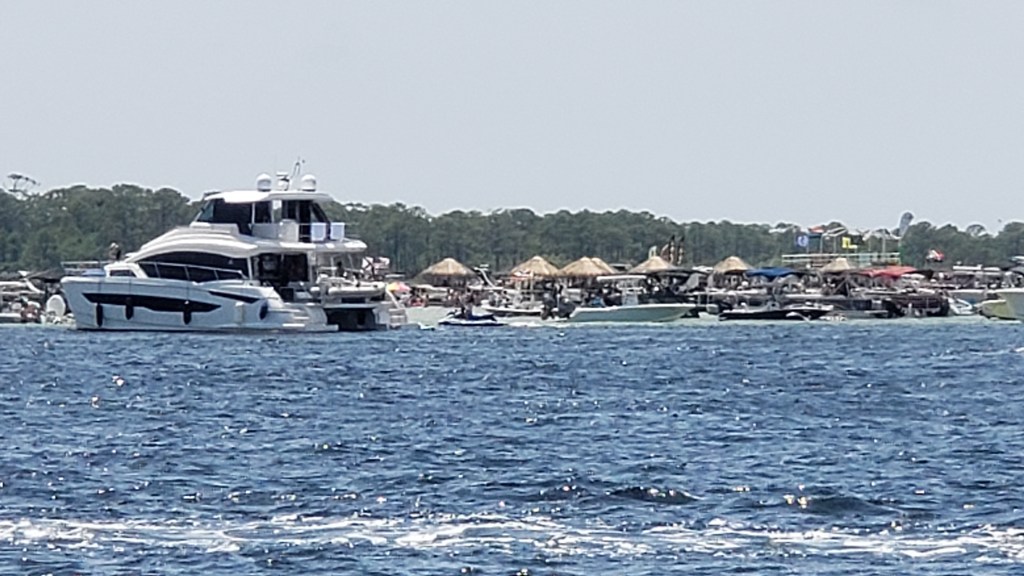
While we couldn’t go boating (renting is cost-prohibitive here), we did take time to head down to the Destin marina for a view of the famous Crab Island. It was once a real “island” in the North Channel, but much of it washed away, and now it’s a massive sand bar with four-foot-deep water, making it an ideal spot for boaters who want to chill out or party.
A tiny, tiny portion of the “island.”
We could see it well from the marina, but had an even better view as we crossed over the William T. Marler Bridge (Highway 98). It was jam-packed on that sunny Friday afternoon, with weather in the high 80s, and we imagine it’s shoulder-to-shoulder and boat-to-boat in high summer.
Those with a keen eye will have noticed the floating tiki huts. During busy times, mobile food and drink boats (not you, alcohol) putter out to the island and offer their wares. This little shaved ice and ice cream boat was just coming back to the mainland for refills.
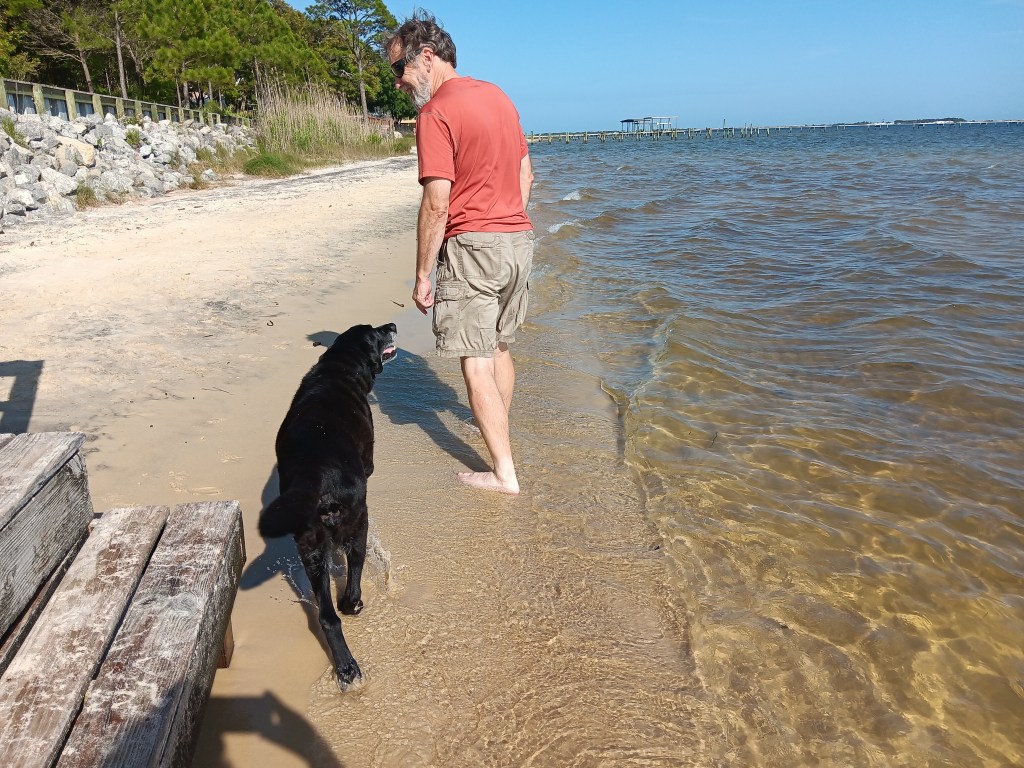
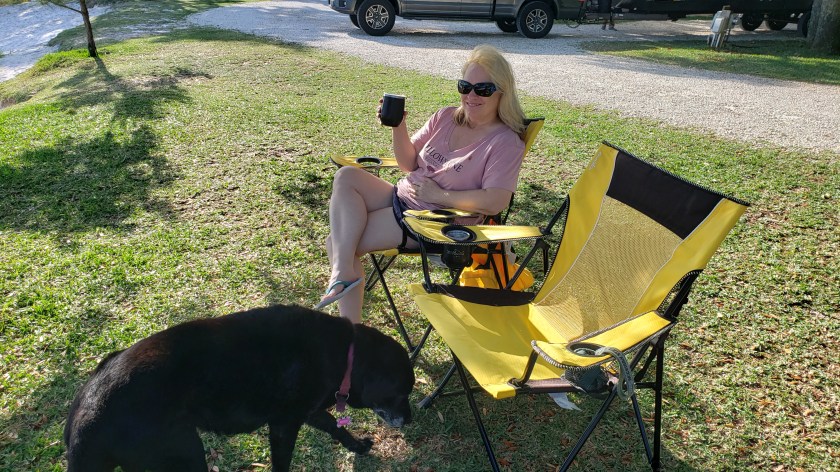
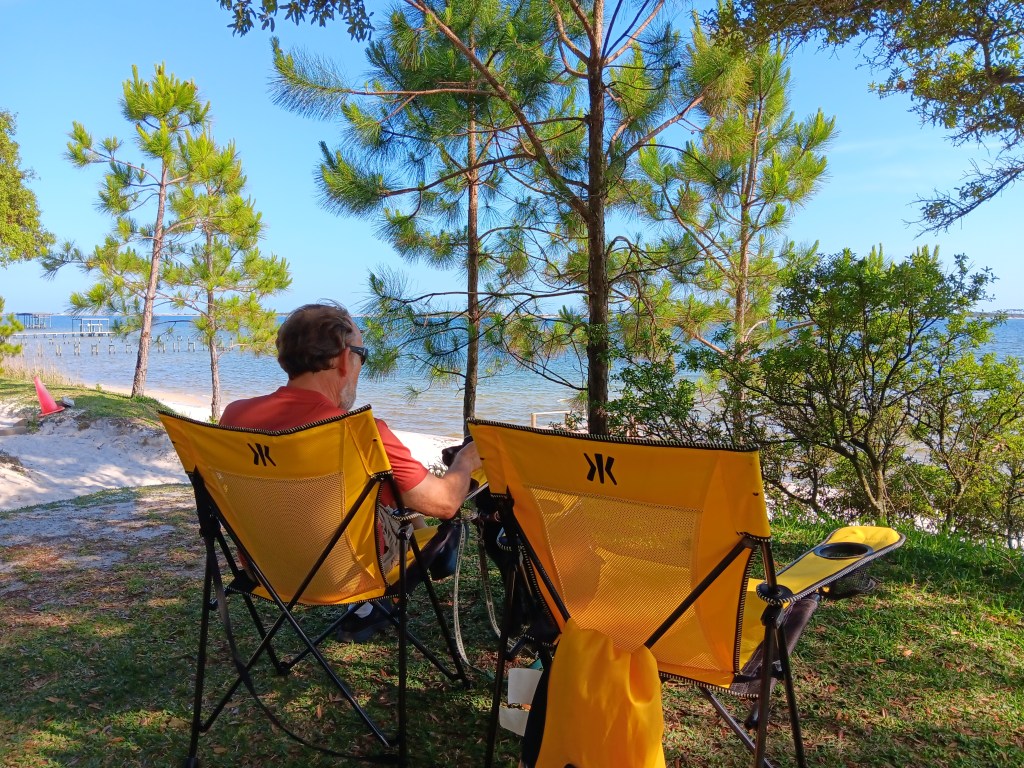
But possibly the best thing we did in Navarre was hang out near the beach at our campground, eating ice cream, having a drink, and watching through our binoculars as boats went by. Only a few times during this trip have we just kicked back and acted like real campers. We could get used to it.
Simon: Let’s go to Milton as our first week in Florida. There’s nothing nearby to tempt us away from the campground, and we can push through the work we need to get done so we can enjoy our final stops. Susan: Perfect. If I can count on that, I’ll fill up the fridge and plan for all our meals at home. Simon: You can count on it. Also Simon (first full day at campground): Let’s do a loop around East Bay and down to the coast today and visit Pensacola tomorrow! YAY! GO, GO, GO!!!
The man just can’t. But our thoughts are starting to focus on our return home and the major decisions we’ll be facing once we’re back, so we agreed to two days exploring, and the rest of the time in the rig getting a jump on preparations for summer’s onslaught.
With a view like this, why leave?
If you have other things to do, here’s the short version: We pretty much did nothing, other than two short excursions. For the longer version, read on.
Resting scowl-face!
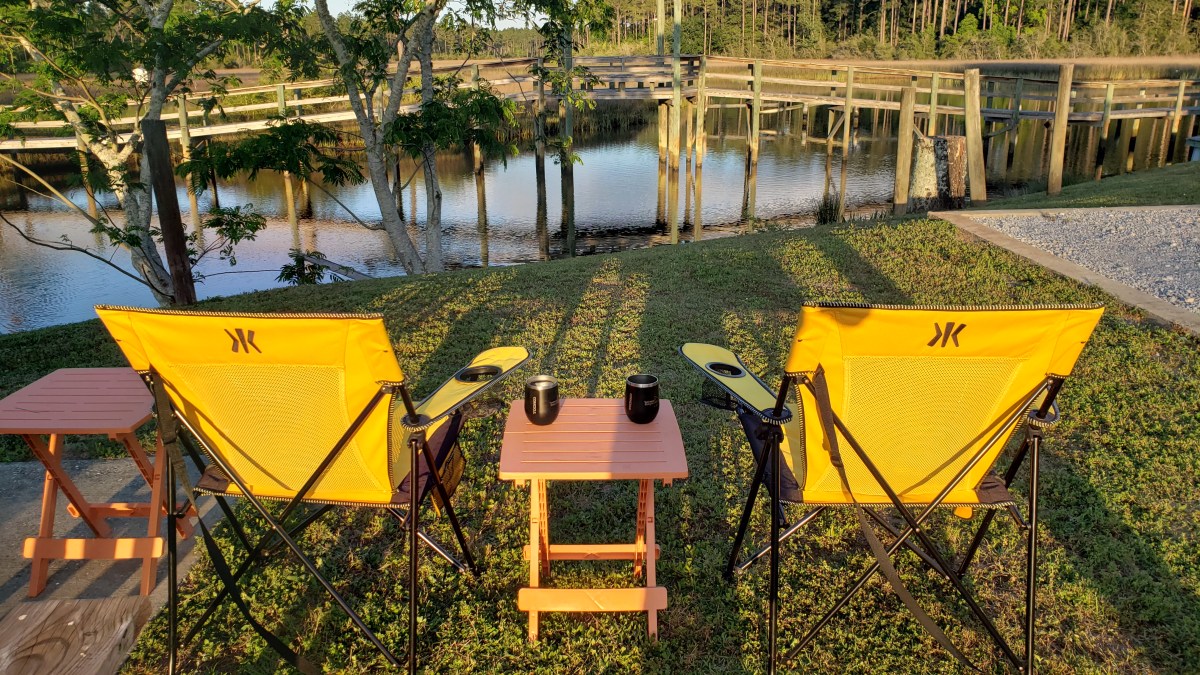
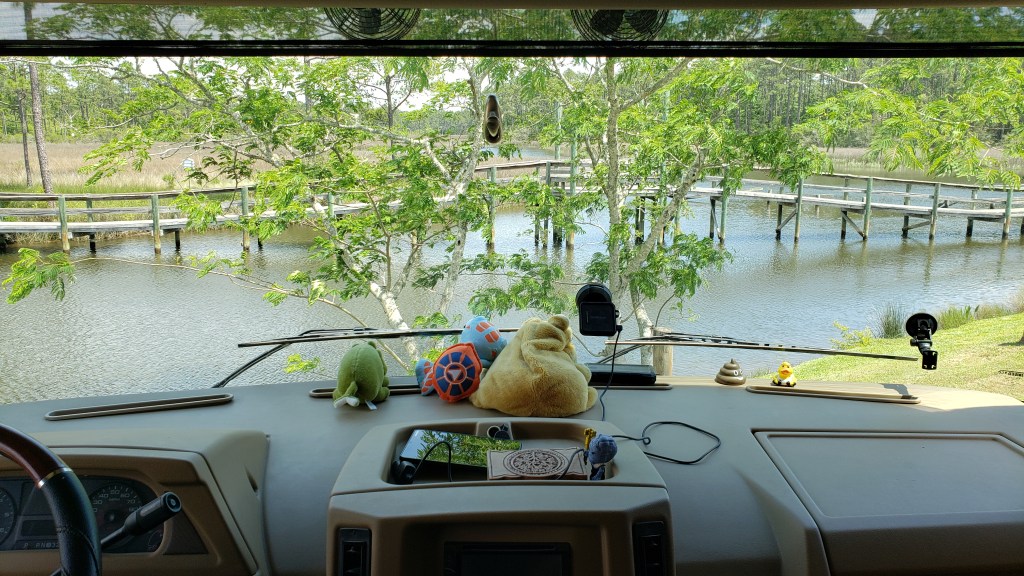
When we checked in at Avalon Landing RV Park, we were offered an upgrade to a water site for $30 ($4.28 a night), and while we weren’t quite sure we wanted the extra fee, we agreed, and it was a decision that really paid off. Birds swooping and diving, mullet jumping, people fishing from the bridge; absolute viewing perfection from inside the rig while we worked, and from outside with our pre-dinner drinks.
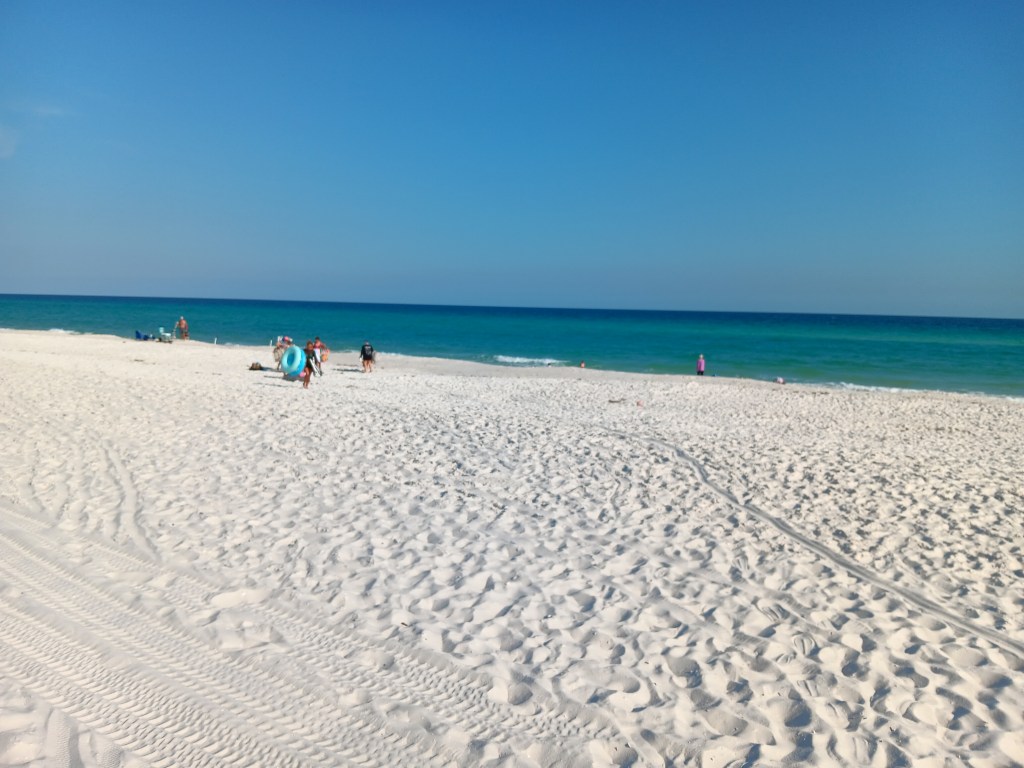
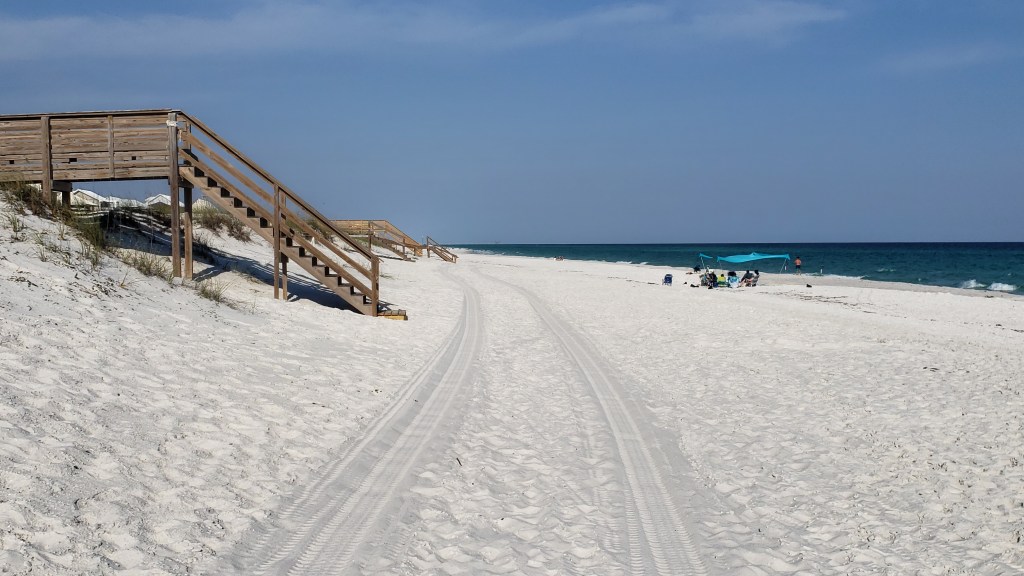
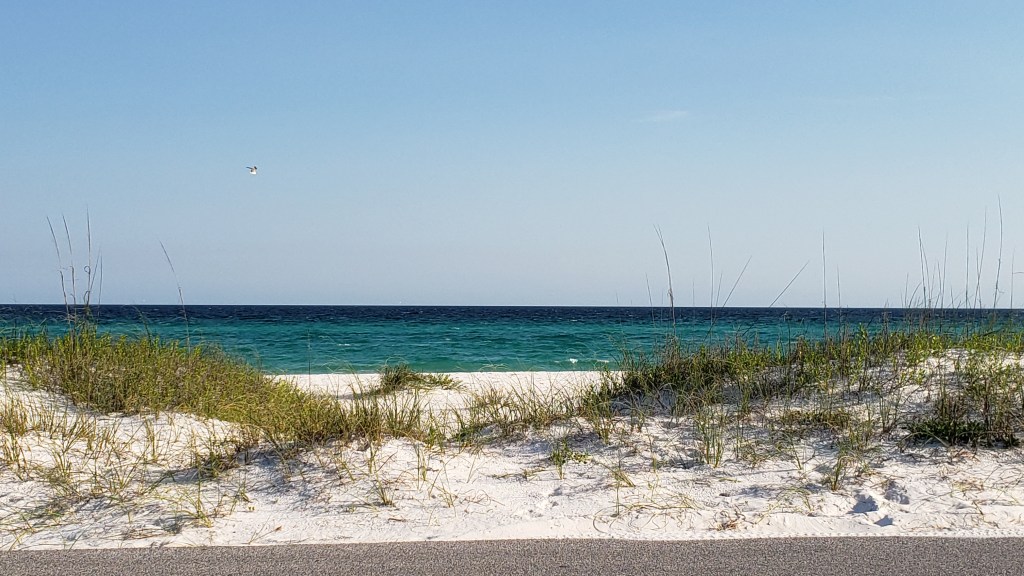
We spent the first day “at home” getting laundry, shopping, and a little bit of work done, then set out for a loop around the bay the next day. When we reached the Gulf, we both had a little catch in our breath, seeing the wonderfully familiar blue of the water. Florida, in our opinion, has the most beautiful ocean water in the country (well, around the country, really), with its deep blues and bright blues that are even more radiant against the Panhandle’s superb white-sand beaches.
The next day we drove south, then turned west along the single road through Gulf Islands National Seashore, which we had first encountered ‘way back in Mississippi. Little dune-ettes – tiny by Lake Michigan standards – stretched the full length, with the occasional peek at the sea on one side, and the East Bay on the other. A gentle day, yes, but we felt the full impact of being so close to the end of our adventure.
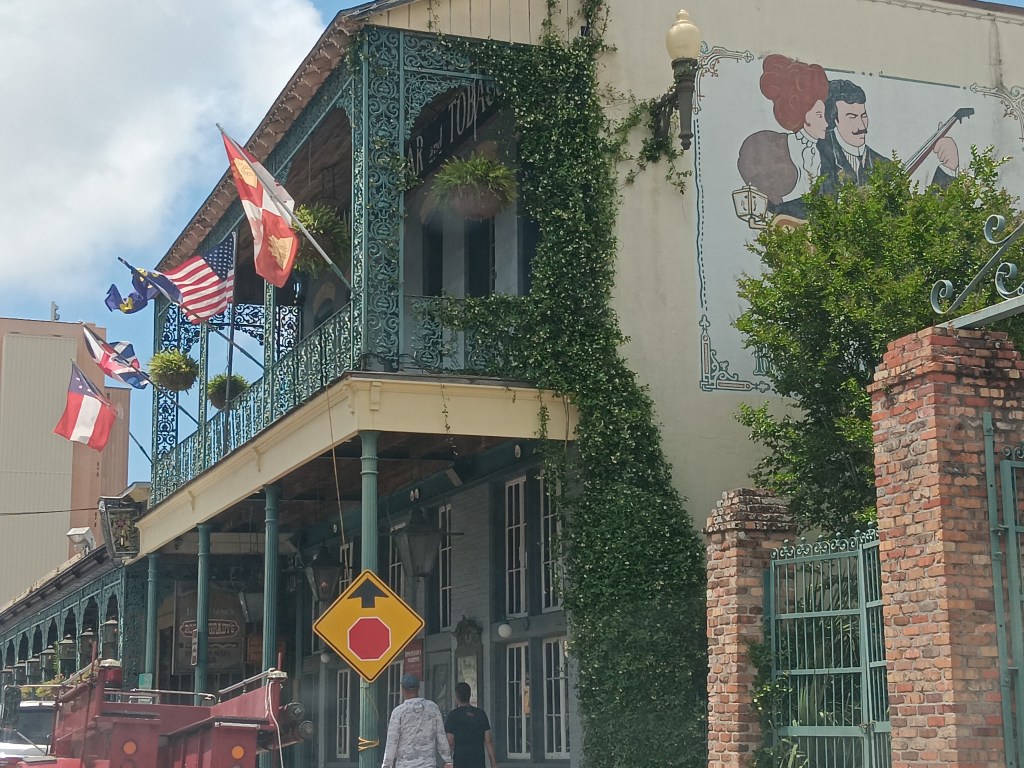
Next up was Pensacola, with its pretty downtown balconies reminiscent of New Orleans, and an up-close (-ish) view of Captain America, an off-shore support vessel that helps install and decommission things like drilling rigs and wind farms. The ship was just paying a visit, and its home port is Pascagoula, Mississippi.
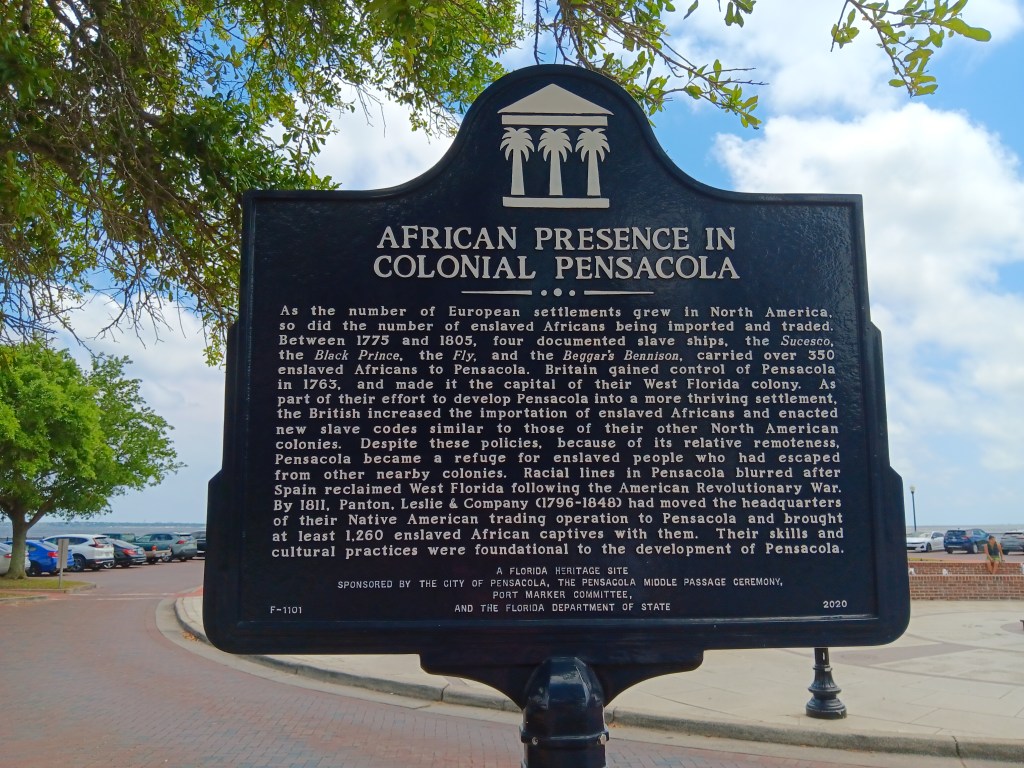
A historical marker at Palafox Pier, where the ship is anchored, recalls a darker time. Pensacola’s history of importing enslaved Africans is long, dating back to the mid-1500s. First the Spanish, then the English, shipped human “cargo” to the area, presumably landing at or near what is now the pier. It also recalls the people who escaped enslavement and hid out in Pensacola’s relative remoteness. Their ancestors, the sign indicates, helped shape the character of the city.
Why is this marker important? Because it (and others like it, specifically in St. Augustine, Florida) counters the history we were taught in school, that slavery began in Virginia in the mid-1600s. St. Augustine saw its first slaves in the early 1500s. These markers are so easy to overlook, but we’ve been surprised at how much they’ve inspired us to learn more about things we didn’t know, or thought we knew.
The rest of our time was spent working, putting “decisions” in motion, and enjoying our gorgeous view. We’ll have one more beach destination, two more short moves, and then a very special finale to what has been a mind-expanding trip.












 Veness Travel Media