Native Americans and Four Dead Presidents

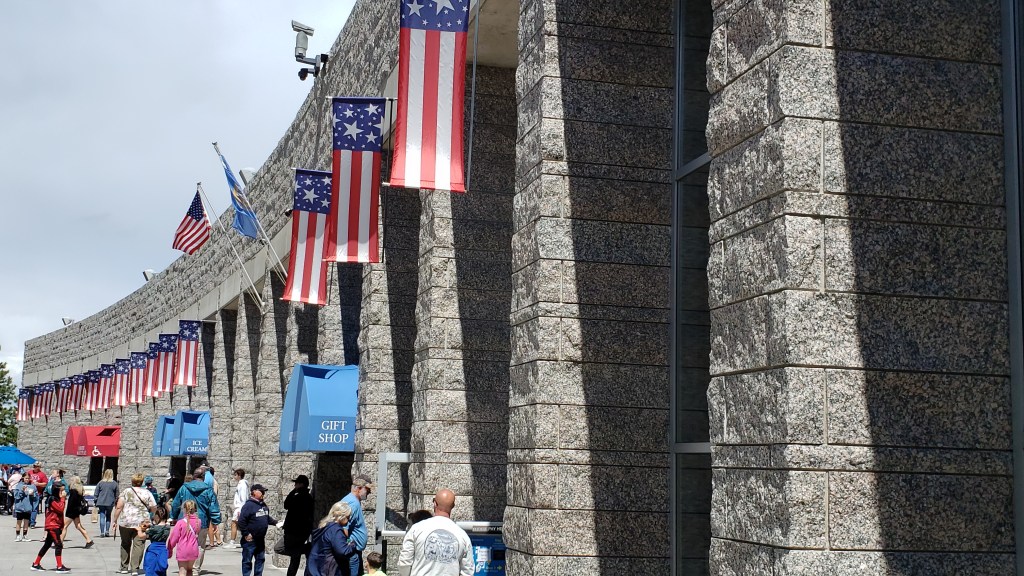
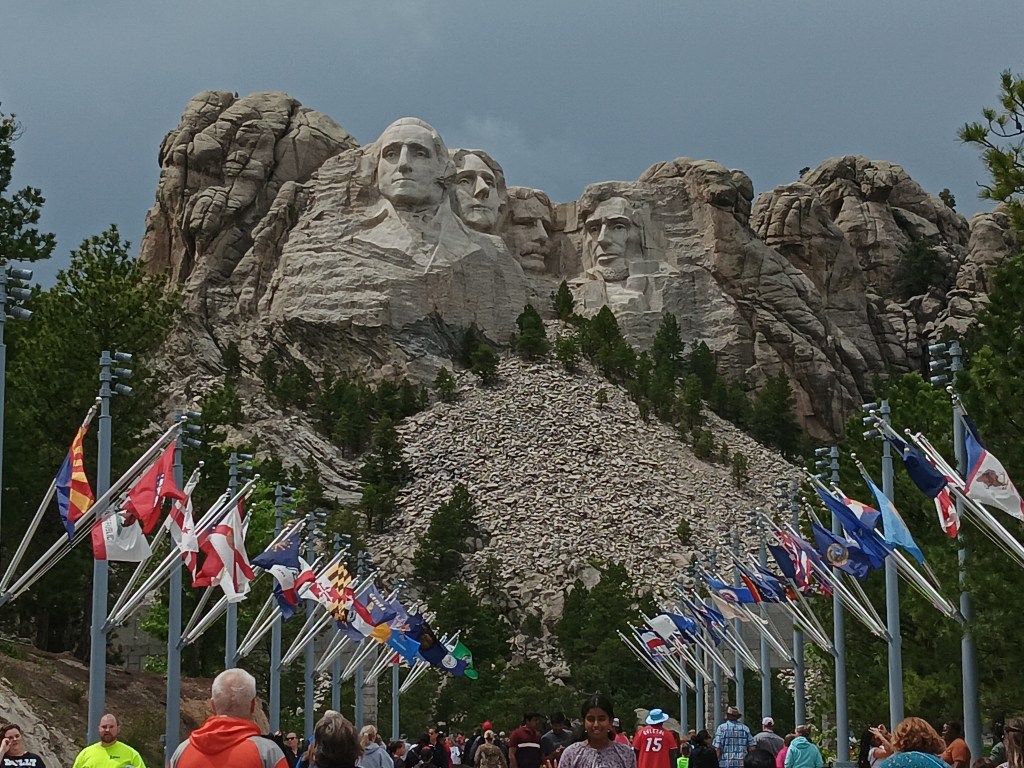
Mount Rushmore with entry plaza
Mount Rushmore

The more we’ve toured, the more questions we’ve had, but that’s part of the point of travel, isn’t it? The boring stuff you learned in school was the hook on which you hung little bits of information that, hopefully, act as a starting point when you’re out in the world exploring.

Susan had constant flickers of those schooltime factoids when it came to places like South Dakota’s Wounded Knee and the events that happened all across this part of the country, but it was all told through the side that “won.” Simon’s point of reference was Westerns from television and movies. Neither of us felt we had a well-rounded story, and we were eager to learn more.

theater road sign
At times, things as simple as a sign had us scratching our heads. What the heck IS this? A roller coaster? A prisoner bus? What?!*

Our next-door neighbors from back home in Florida have a place in Rapid City, and they were there while we were in town and invited us over for dinner. They do a great deal of work with the tribes, teaching them how to play and appreciate music, and we spent several happy hours in their company, learning more about the local tribes and their history. They recommended a visit to The Journey Museum, and that was our next day’s morning stop.

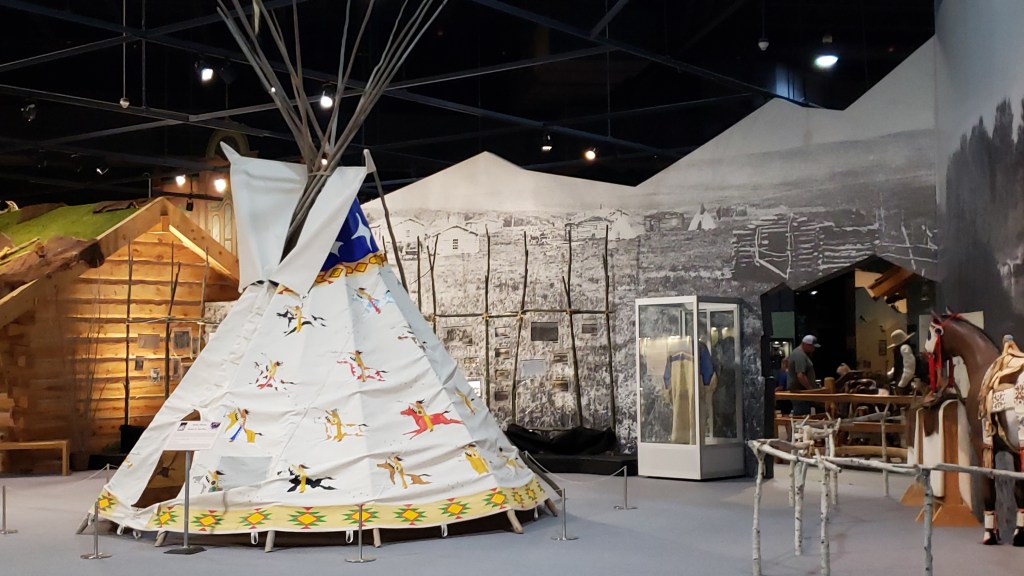
The museum is thoughtfully presented, and while it includes sections on paleontology, geology, and archeology, we were there primarily for the Native American exhibits.

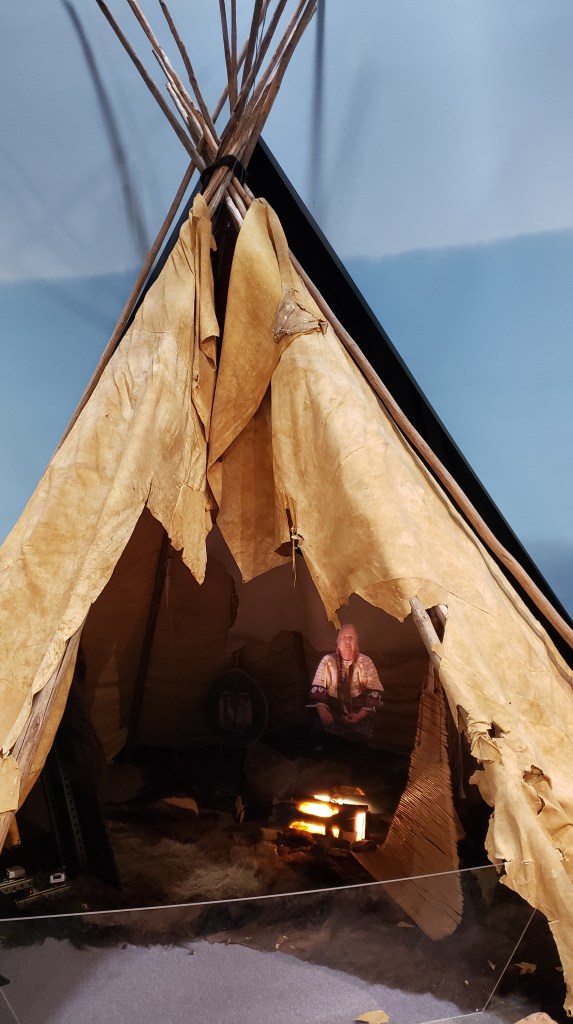
the journey museum tipi exhibit

We’d been told it was difficult to get any kind of reliable history, as the tribes tended not to keep written records in the past, and nobody seemed to agree on what really happened versus what is perceived or idealized to have happened.

Like much of the area’s history, the museum’s Native American and Pioneer sections intersect. It was difficult in most cases to get a well-rounded understanding of the two culture’s realities when they came together or clashed, when the focus is inevitably more on their separate experiences than on a realistic view of “how we got to now.”

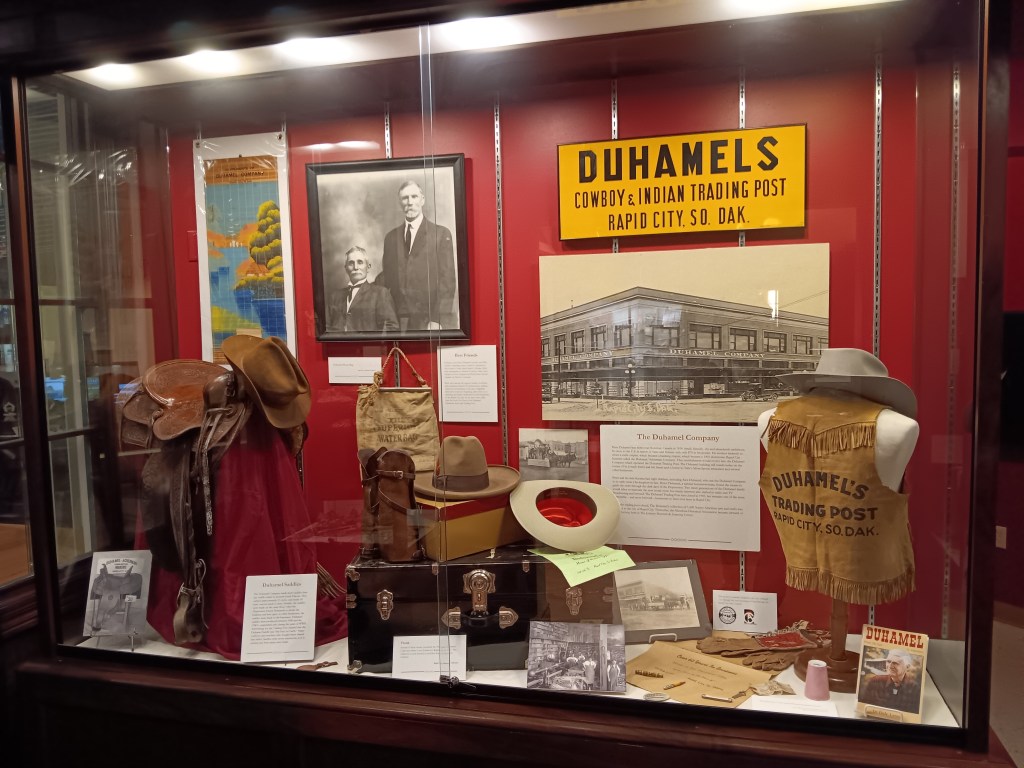
the journey museum exhibit

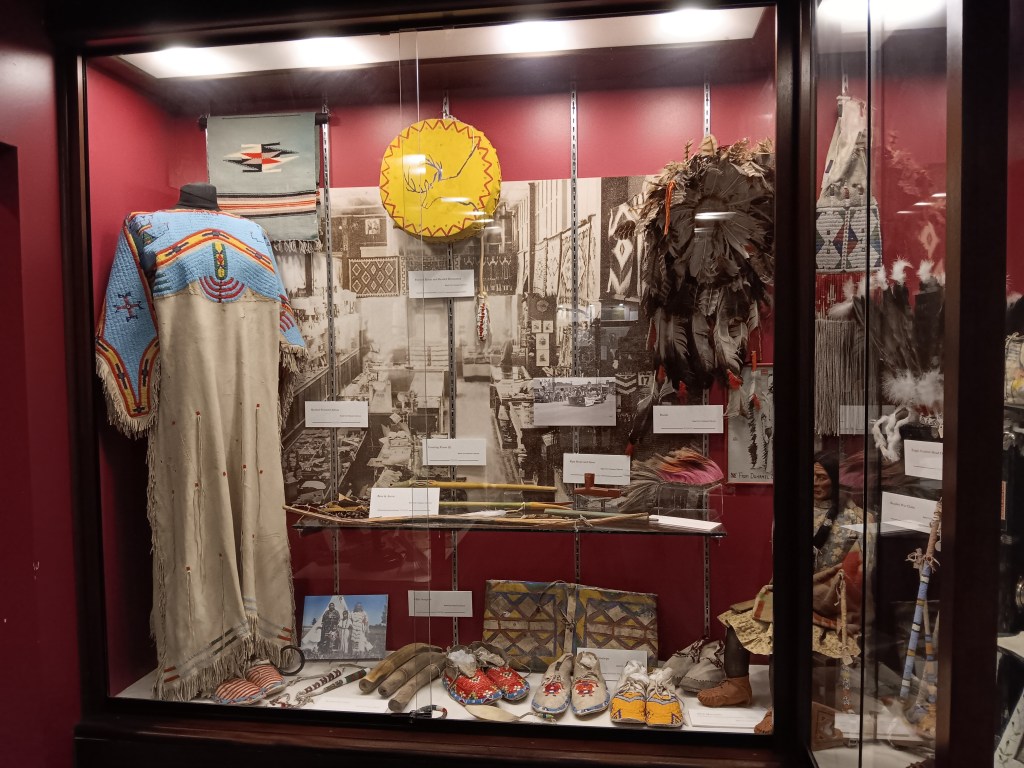
the journey museum native american exhibit

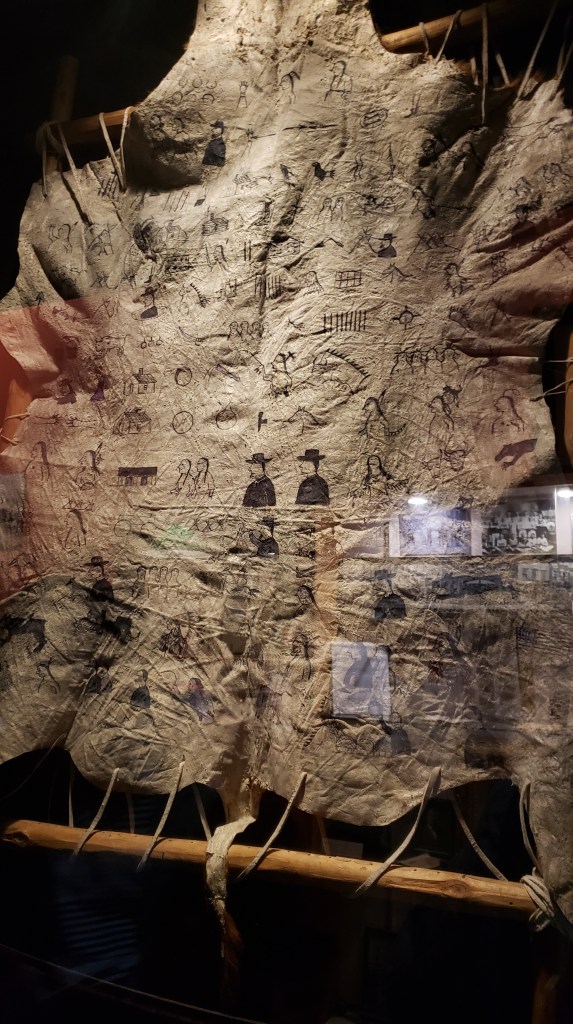
winter count buffalo hide journey museum
This is an example of a Native American “Winter Count,” which is a series of pictographs on buffalo hide that records important events that commemorate each year.

Even so, we really enjoyed the museum’s displays, and Susan was especially happy to see women represented as much as men (almost), with a heart-tugging exhibit that featured (in video style) an older woman talking about how girls were welcomed into womanhood within the tribe. She even sang a lullaby. So beautiful.

journey museum tipi with old womam

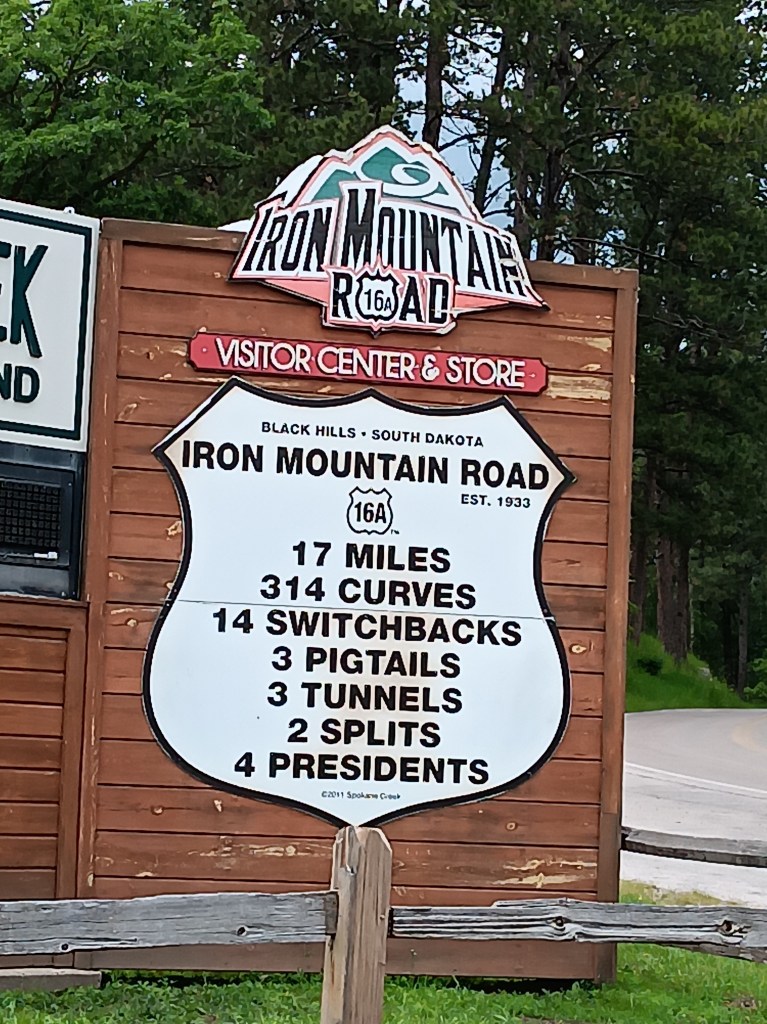
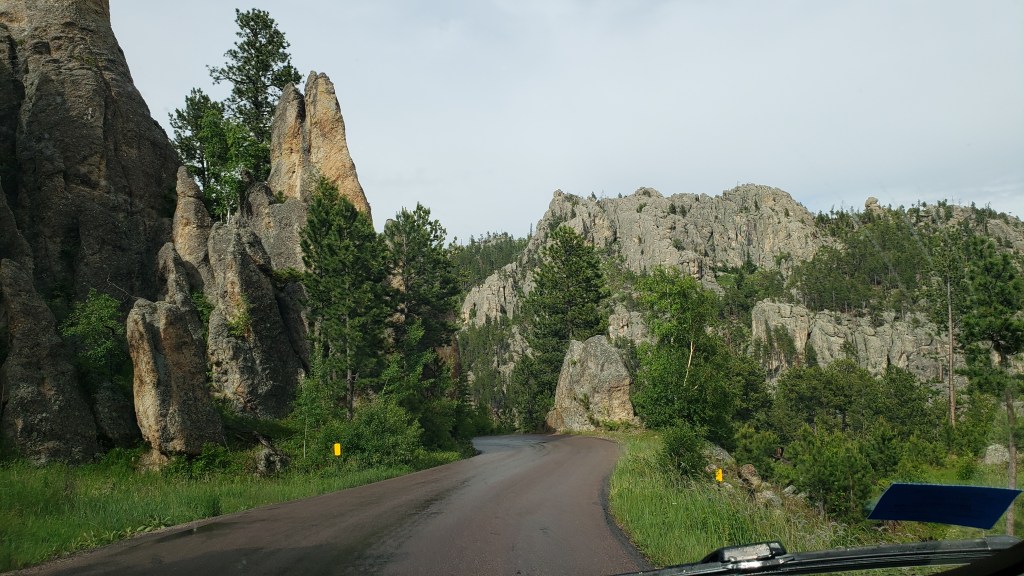
Today’s scenic drive was Iron Mountain Highway on our way to one of the country’s most iconic sites.

iron mountain highway statistics

We won’t bore you with the outrageous “shortcut” our GPS took us on to get to Iron Mountain Highway, which was so long we began to wonder if we were already on that highway. Instead, we’ll show you a couple of examples of the grand views we had once we were on the right path again.

iron mountain highway landscape

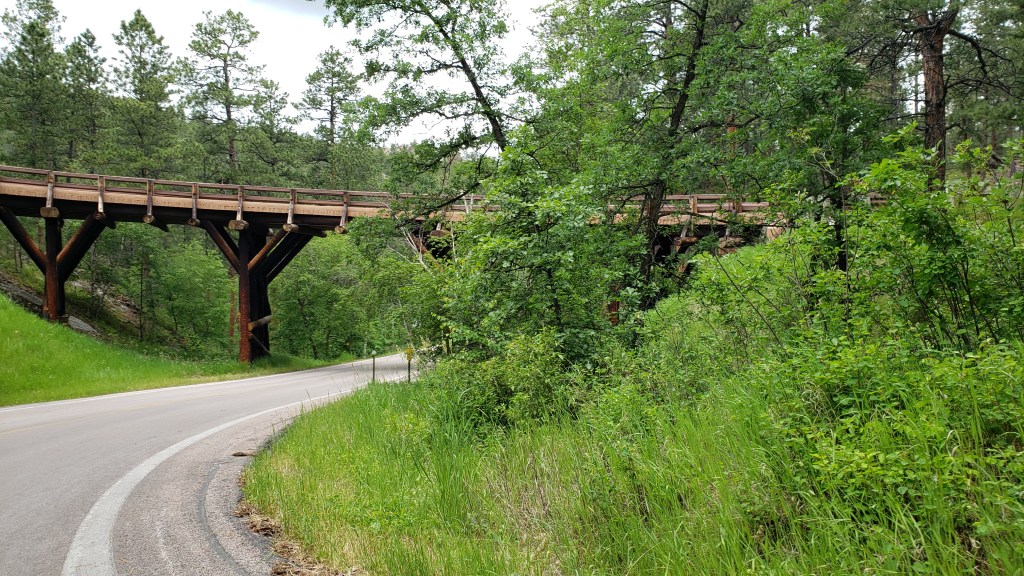
iron mountain highway pigtail
This is a small part of one of the “pigtail” bridges that wind you down the hillside. They’re shaped like…well…a curly pig tail.

iron mountain highway rock formations

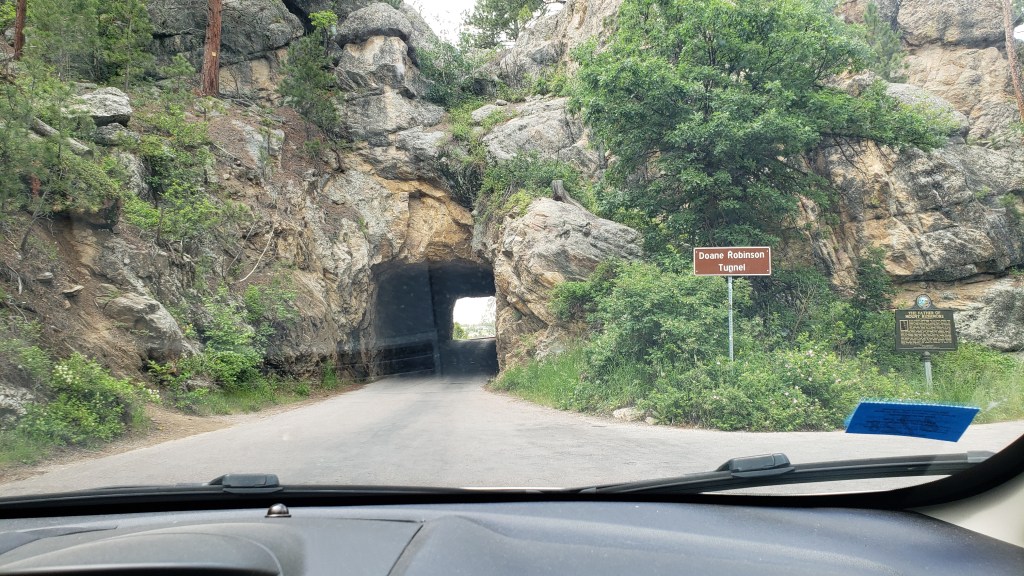
Iron Mountain Highway doesn’t end with the view you’re about to see, but WOW! What a spectacular “reveal” for our next destination!

iron mountain highway tunnel
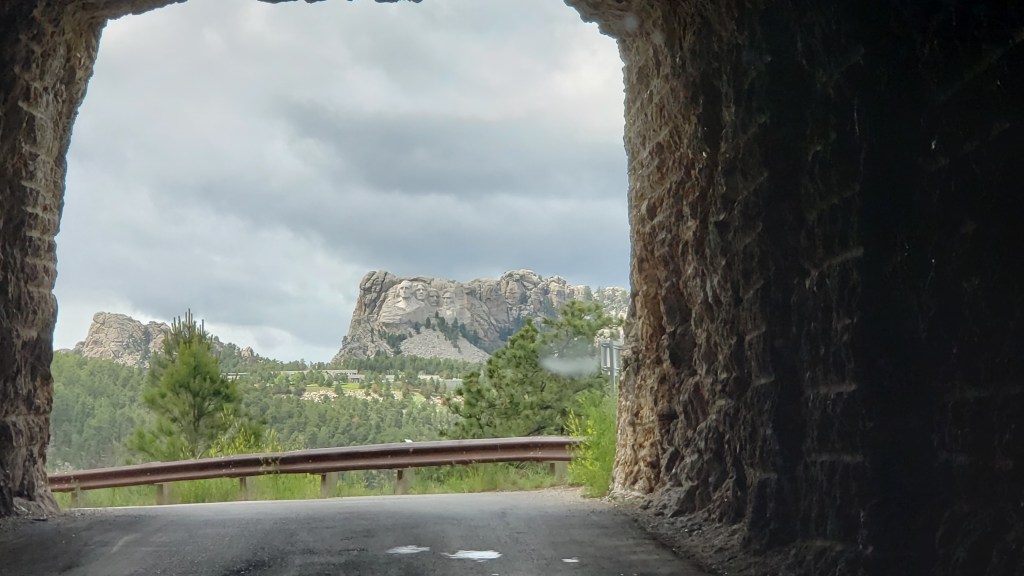
Can’t see it yet…

iron mountain highway tunnel mount rushmore reveal
Aaaannnndddd…NOW!

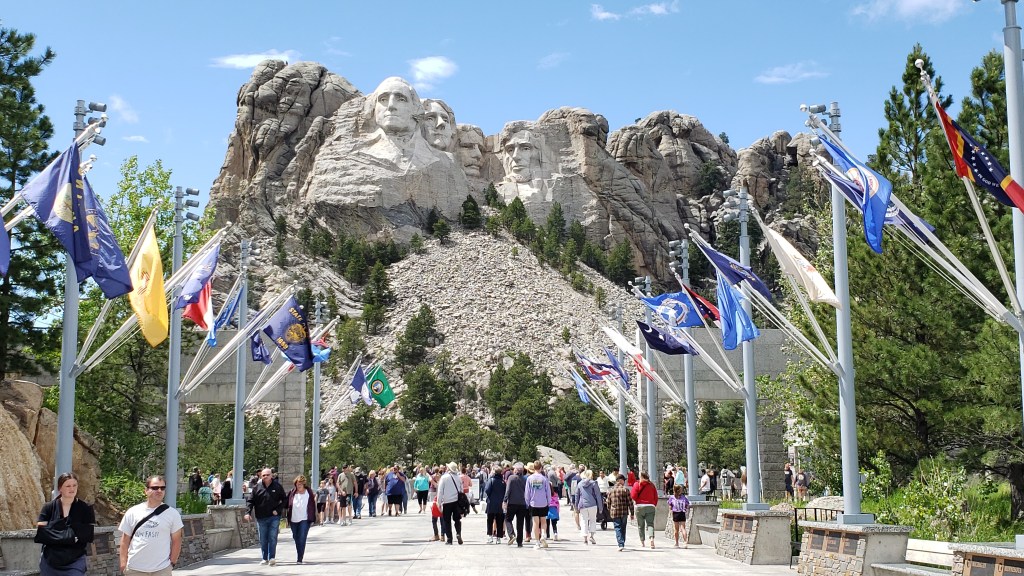
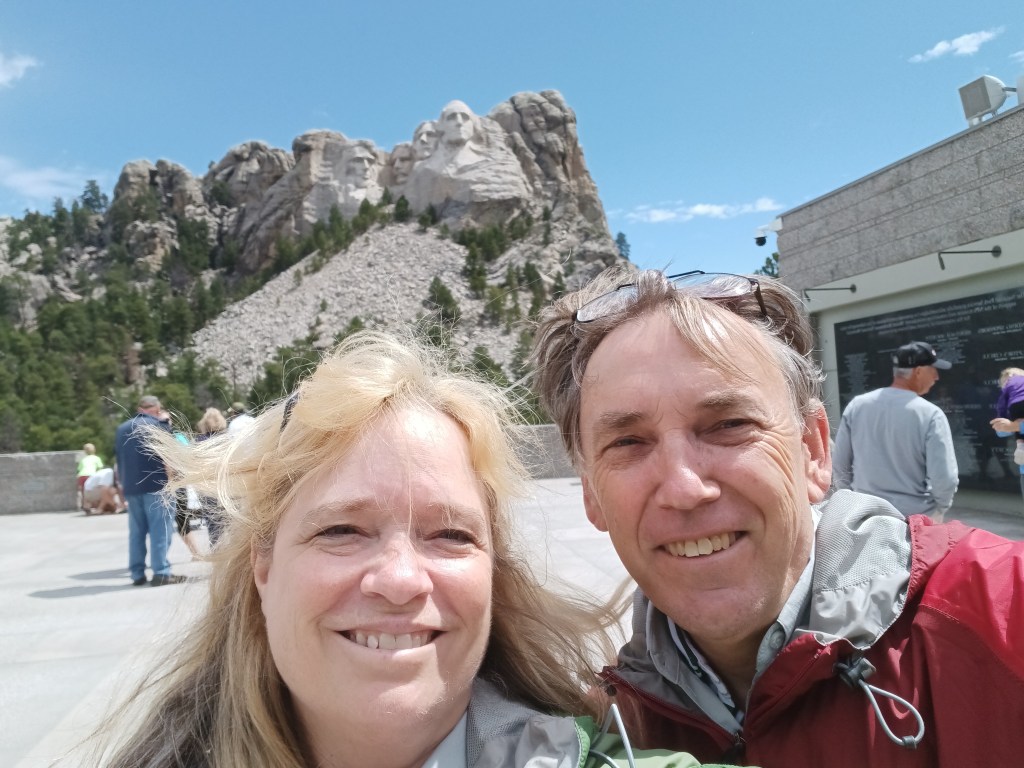
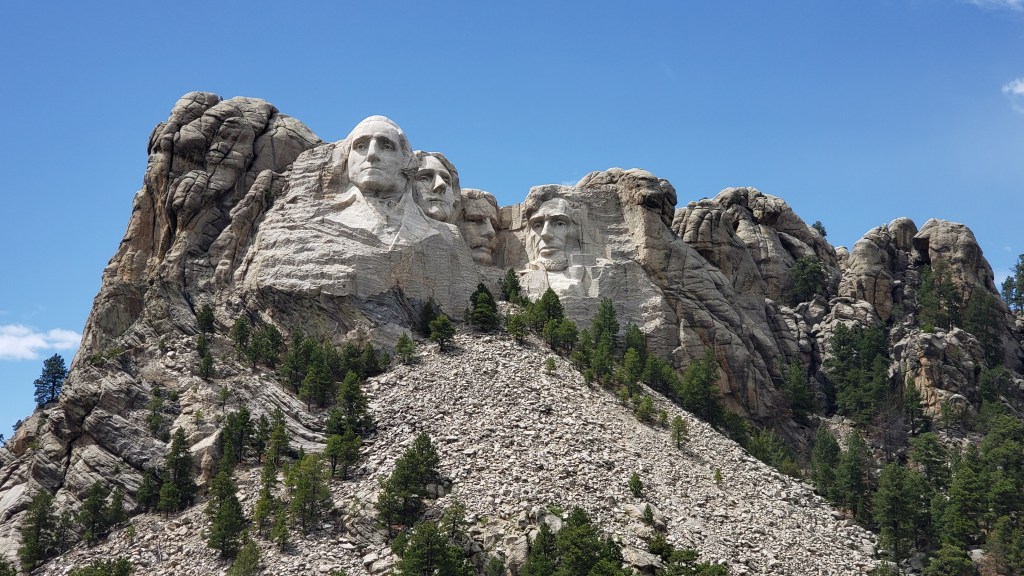
Neither of us ever thought we’d ever be in a position to see Mount Rushmore, and standing there in front of George, Tom, Teddy, and Abe felt just a bit surreal. Considering their human rights records (not you, Abe), we had some mixed feelings before we got there. Once there, we felt a surge of pride and patriotism (in the best sense of that word).

mount rushmore selfie

We probably took 40 or 50 photos of the monument itself, but we’ll just share a few here, including a side view of our first President taken from a cut-out along the road once we left the park.

mount rushmore plaza

mount rushmore 1

mount rushmore 2
The weather was, shall we say, changeable.

mount rushmore side view
That’s George, in the middle of the photo

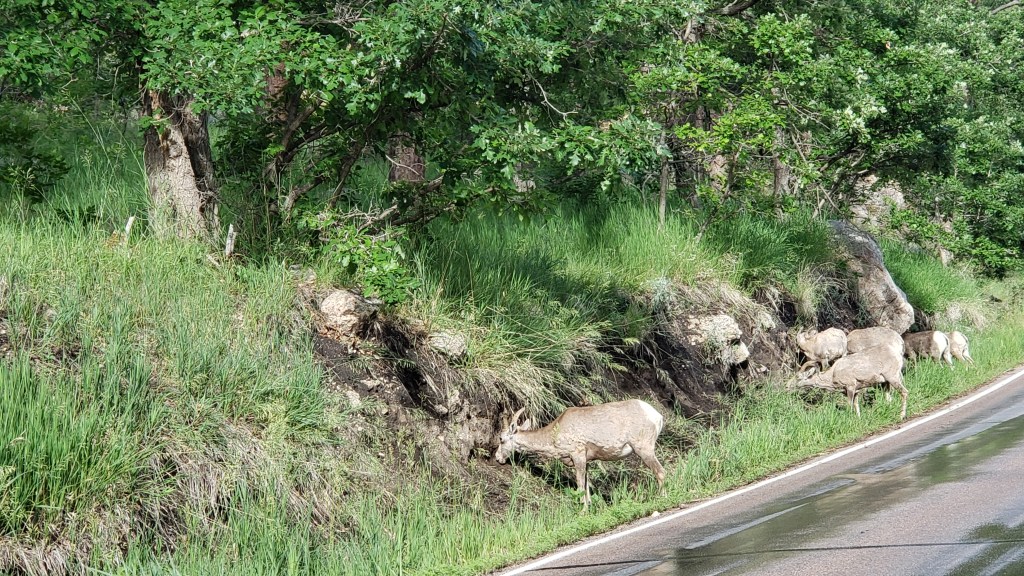
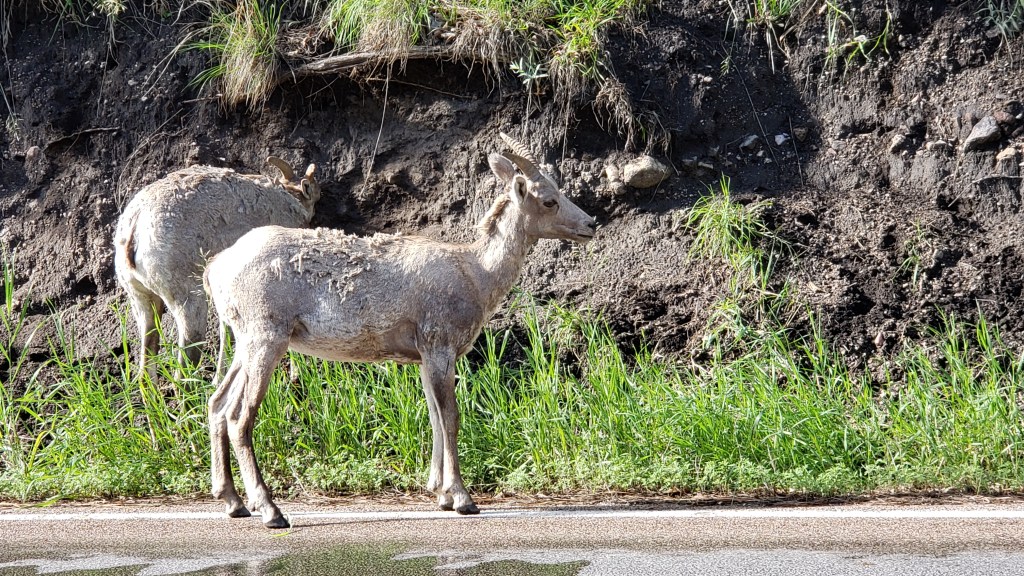
A second drive along Needles Highway was a welcome journey as we made our way down into Custer National Park again, with a stop at one of its visitor centers to get a steer on where to see Bighhorn Sheep (we’d nearly given up on the elk, who, we were told, were spooked by the last few evenings’ thunderstorms and were in hiding), and the docent was right on target with her suggestion.

custer state park bighorn sheep roadside

custer state park bighorn sheep

custer state park bighorn sheep closeup

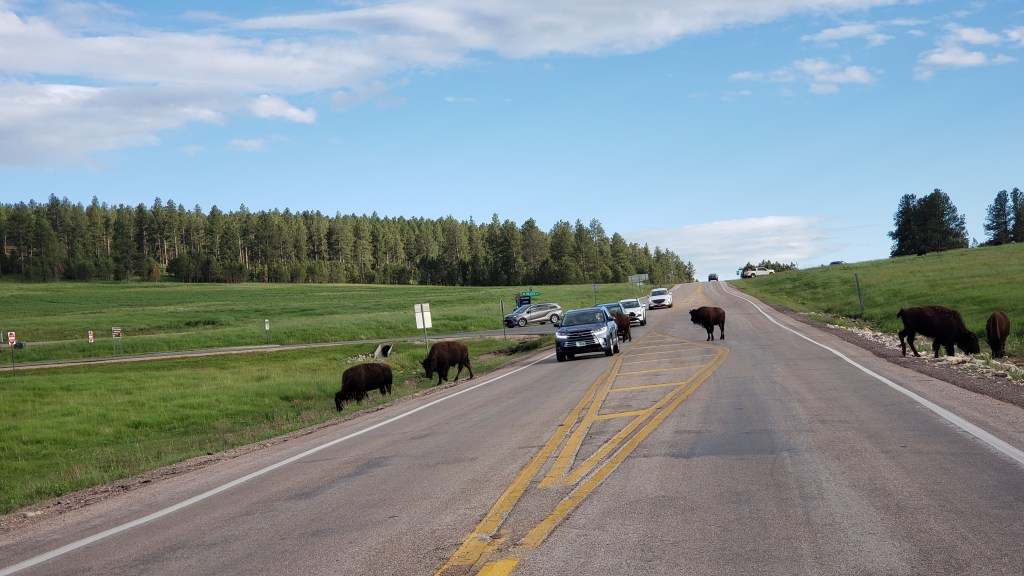
Squeezing the last drops out of Custer State Park, we drove one side of the Wildlife Loop again on our way back to Hermosa, and buffalo and pronghorn herds’ reliability held up.

custer state park bison in evening

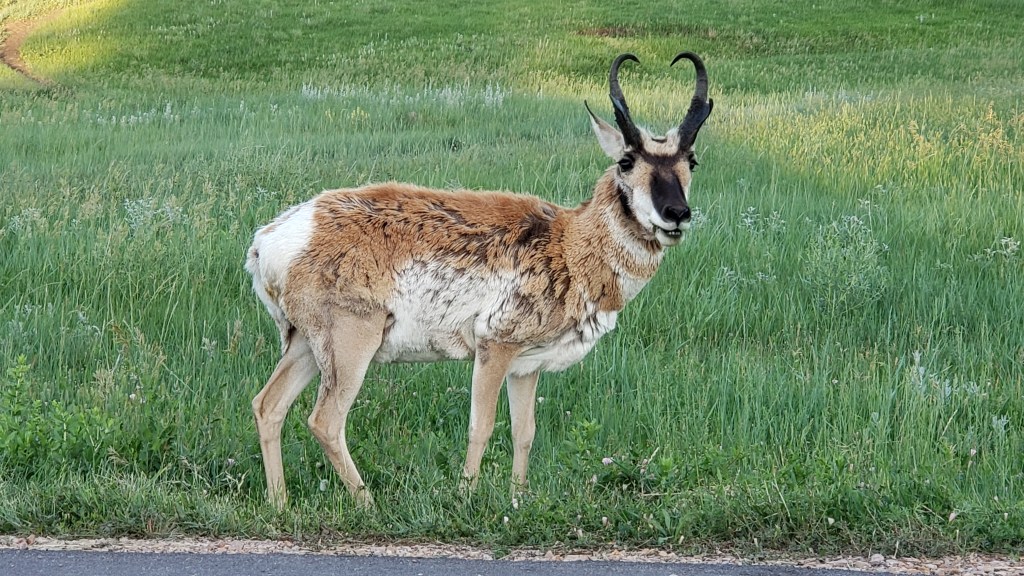
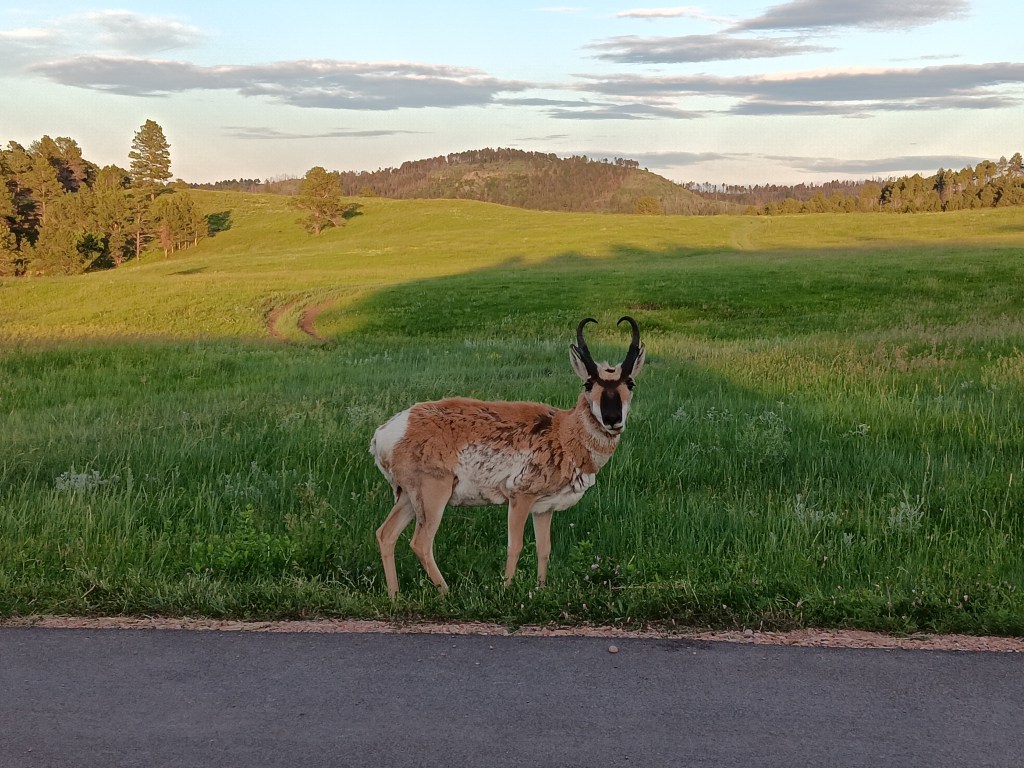
custer state park pronghorn male closeup

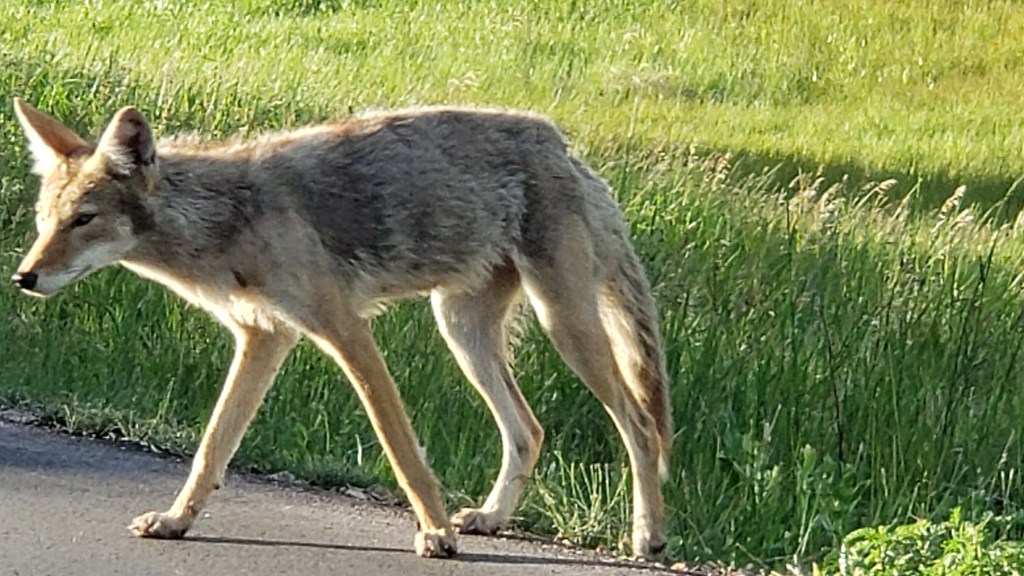
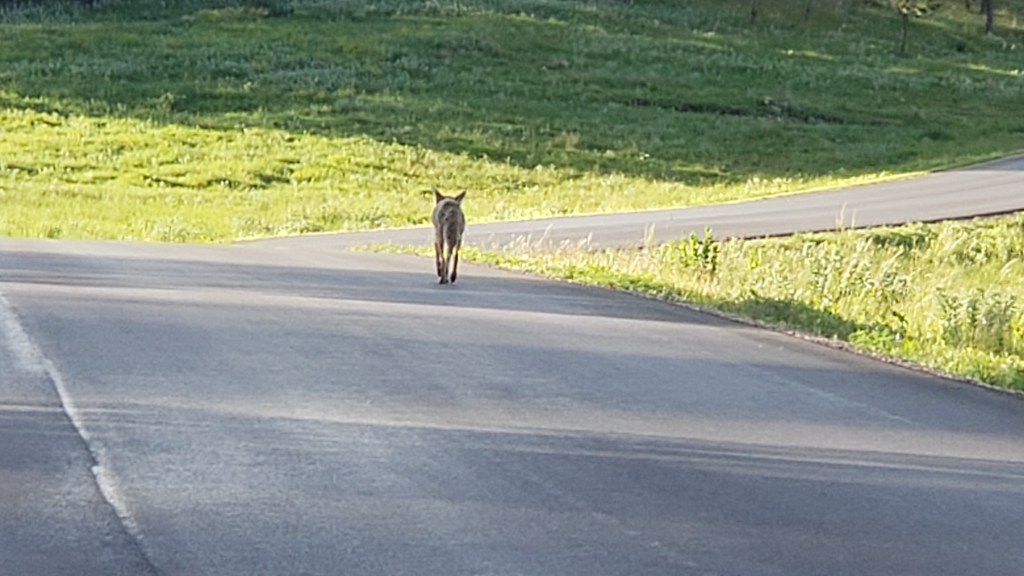
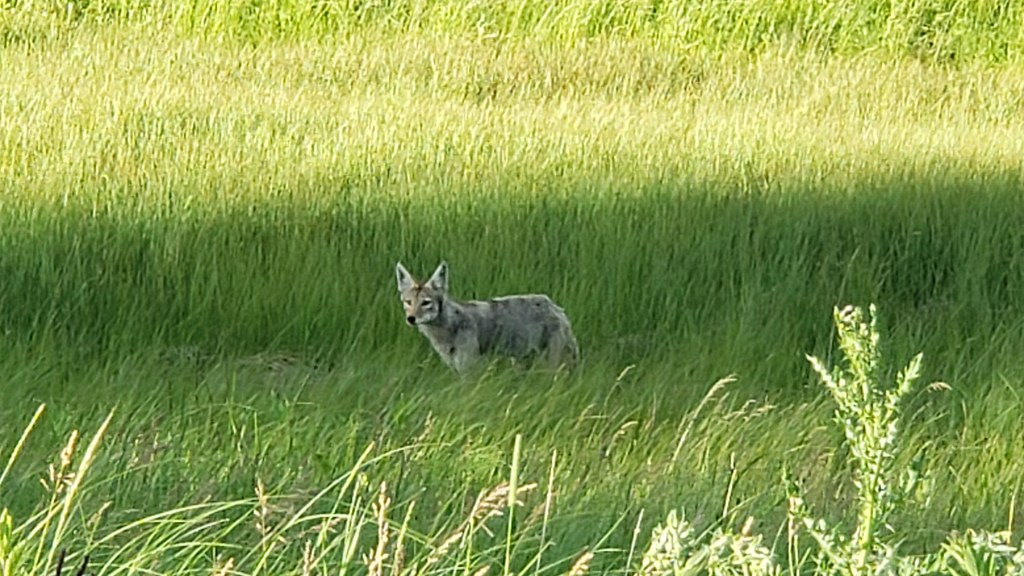
But tonight we were treated to a spotting we didn’t expect at all. We watched this coyote for about fifteen minutes as he/she/they hunted, and our patience was rewarded with an up-close view as the coyote came up to the road, gave us a good look, then trotted away.

custer state park coyote closeup
No zoom lens needed

It wasn’t an elk, but we felt, yet again, we’d been treated to something rare and special. What a great way to cap off a great day!

custer state park coyote walking away

*That sign that had us wondering what it was trying to communicate is for a little tiny theater in the middle of absolutely nowhere. Cute!
The Awesome Ruggedness of Custer State Park

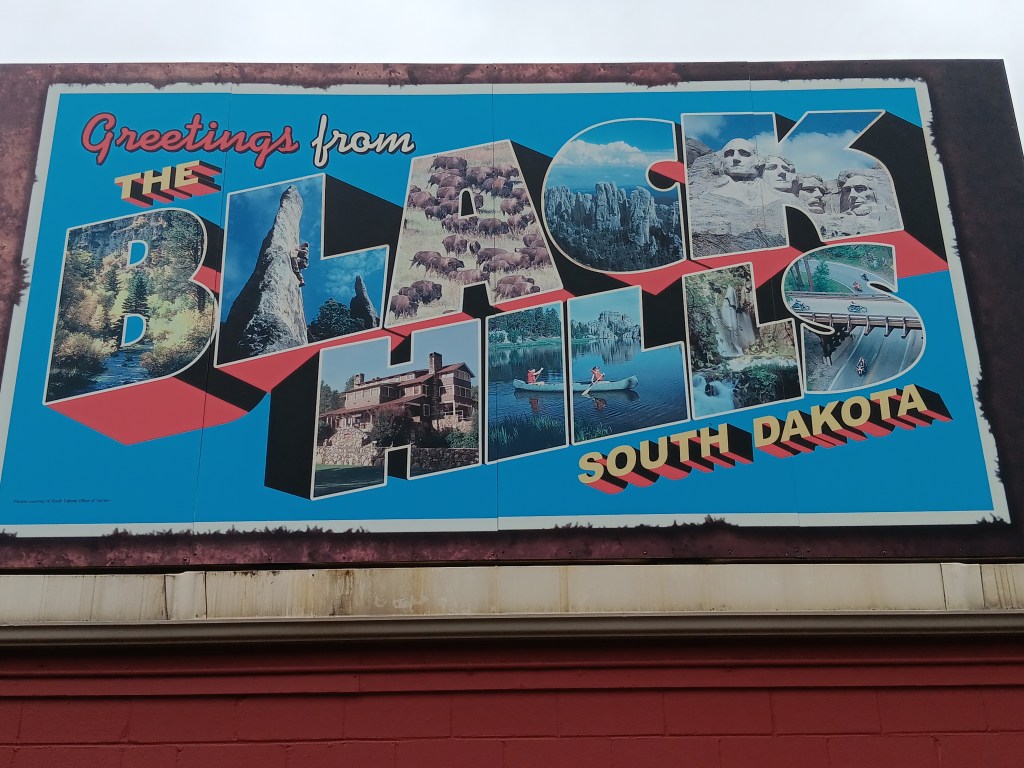
welcome to the black hills

Why were so many places across the country named after a man who lost one of history’s most infamous battles, a battle aimed at genocide of the native peoples? We don’t know, and we’re not in a position to right the historical wrong or re-frame the story, but we will say the State Park named for Lieutenant Colonel George A. Custer, better known as General Custer, is one hellofa fabulous park.

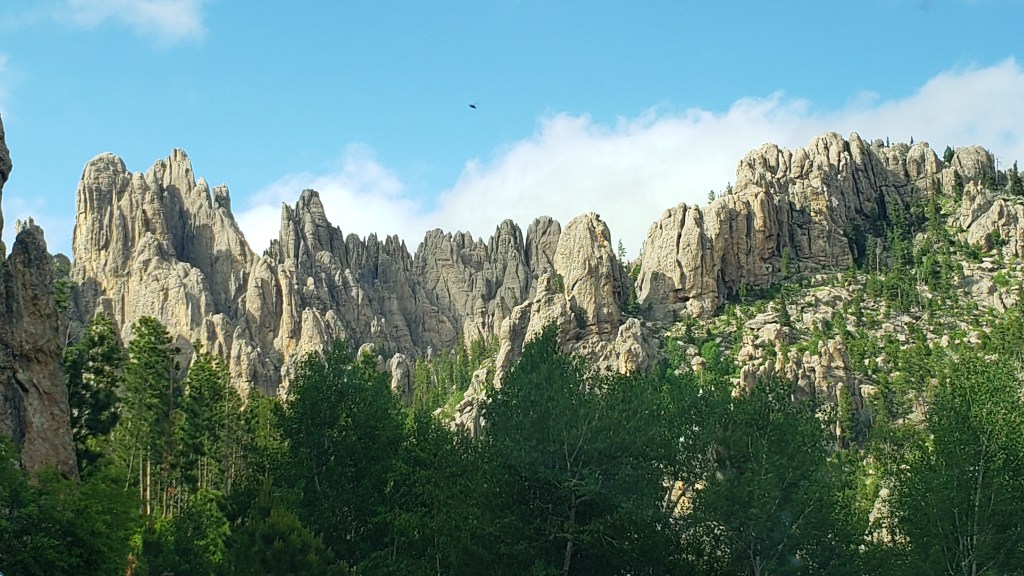
needles highway spires

We could yammer on about the rolling hills and the lush greens that splash across the landscape, as if some insane artist with a passion for the verdant is forever in the process of painting and repainting according to the whims of sunlight and clouds.

rolling hills in south dakota black hills

We could wax poetic about the Black Hills specifically, and we could throw in the fact that “hills that are black” is the English translation of “Pahá Sápa,” from the Lakota language of the Sioux people, and that the Black Hills rightful return to the Sioux Nation is a long-standing, contested issue the Sioux are currently losing.

If we really wanted to get all up in ourselves, we’d casually toss in the utterly self-promoting comment that the book, Paha Sapa: Land of the Gods, mysteriously made it into the queue for The Jungle Cruise at Walt Disney World’s Magic Kingdom park, and therefore into Susan’s third edition of The Hidden Magic of Walt Disney World.

But we won’t spend time on those topics, because on our second full day in Hermosa we were all about animal tracking from the comfort and convenience of our car.

We had been lucky enough to see bighorn sheep in the Badlands, and you’ve already read about our encounters with bison in Theodore Roosevelt National Park, so today we were on a mission to track down a herd of majestic elk.

pronghorn in badlands national park
This isn’t an elk

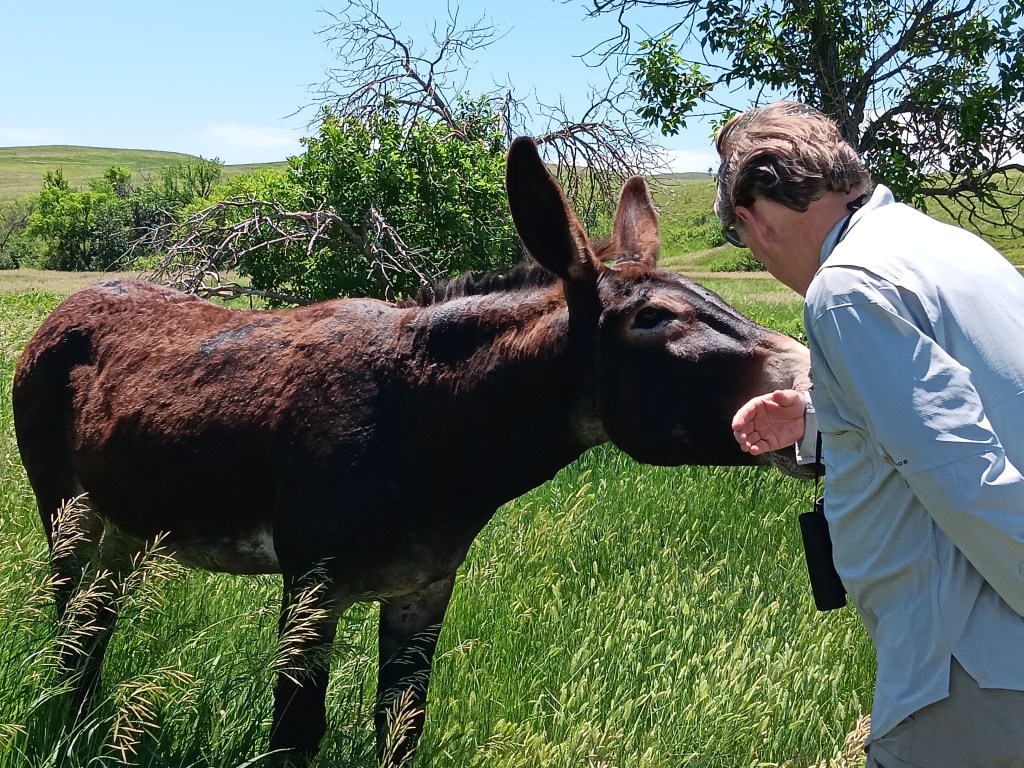
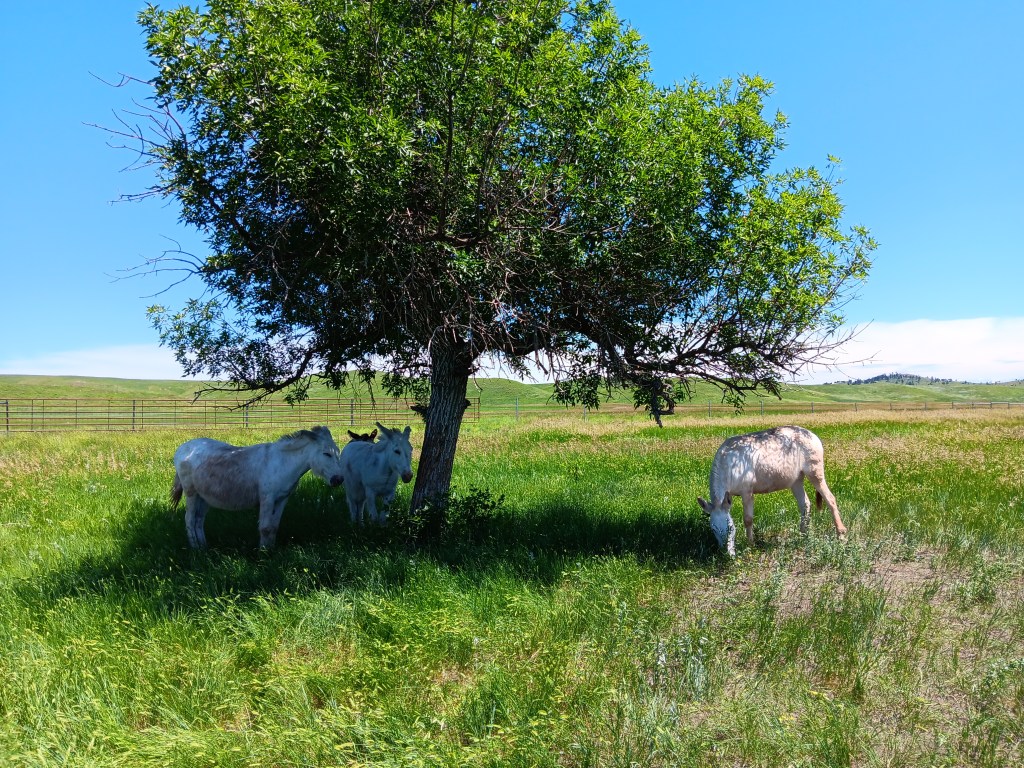
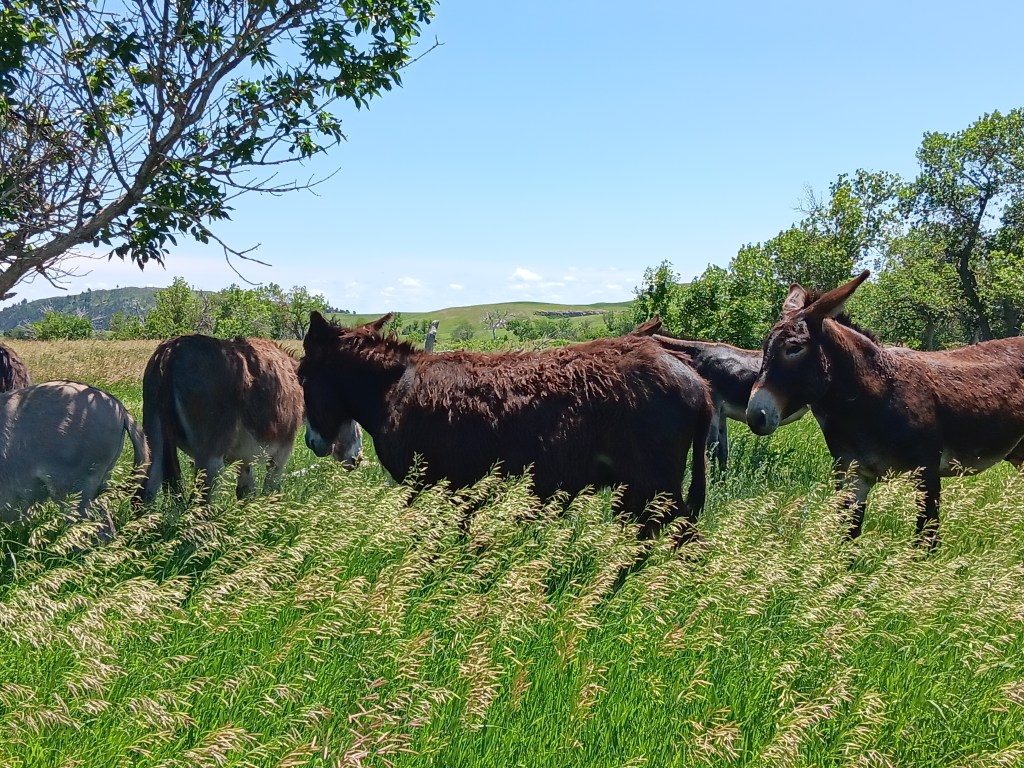
We entered the park’s Wildlife Loop not far from our campground, and first up on our sightings checklist were the burros, fondly nicknamed the “begging burros” for their willingness to eat whatever you’ve brought them (more accurate than “willingness” is “insistence”). Hence, they’re super friendly, and come right up to you rather than waiting for you to approach them.

simon and burro

burro herd custer state park

burros custer state park

Their hearty ancestors were pressed into service nearly a century ago, toting tourists and their paraphernalia up Black Elk Peak from the Sylvan Lake Lodge. Only a small herd is left, but they’ve been roaming wild ever since their forebearers’ tourism-based employment end. Most of them are descendants of the originals, but a few of the burros are donated newcomers.

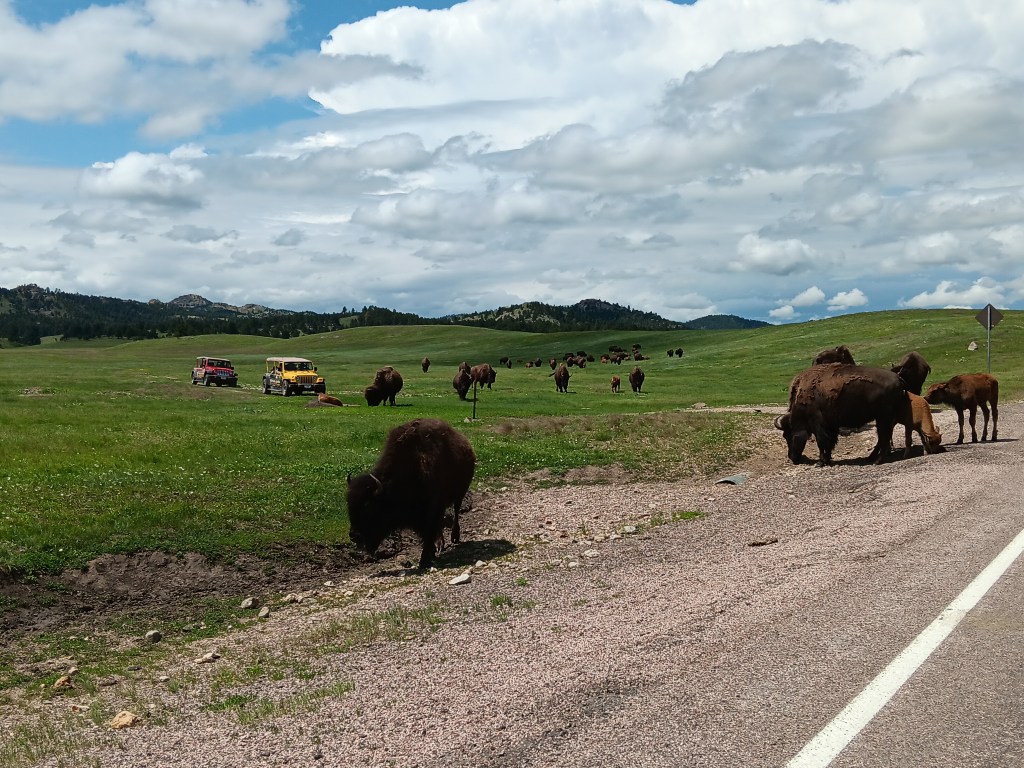
Having frittered away the morning working, it was well past lunchtime when we found ourselves caught up in another bison jam, so we got out our sandwiches and spent nearly an hour enjoying their wanderings, their playful calves, and one truly peevish specimen who wanted to pick a fight with everyone.

bison fighting custer state park

bison herd custer state park

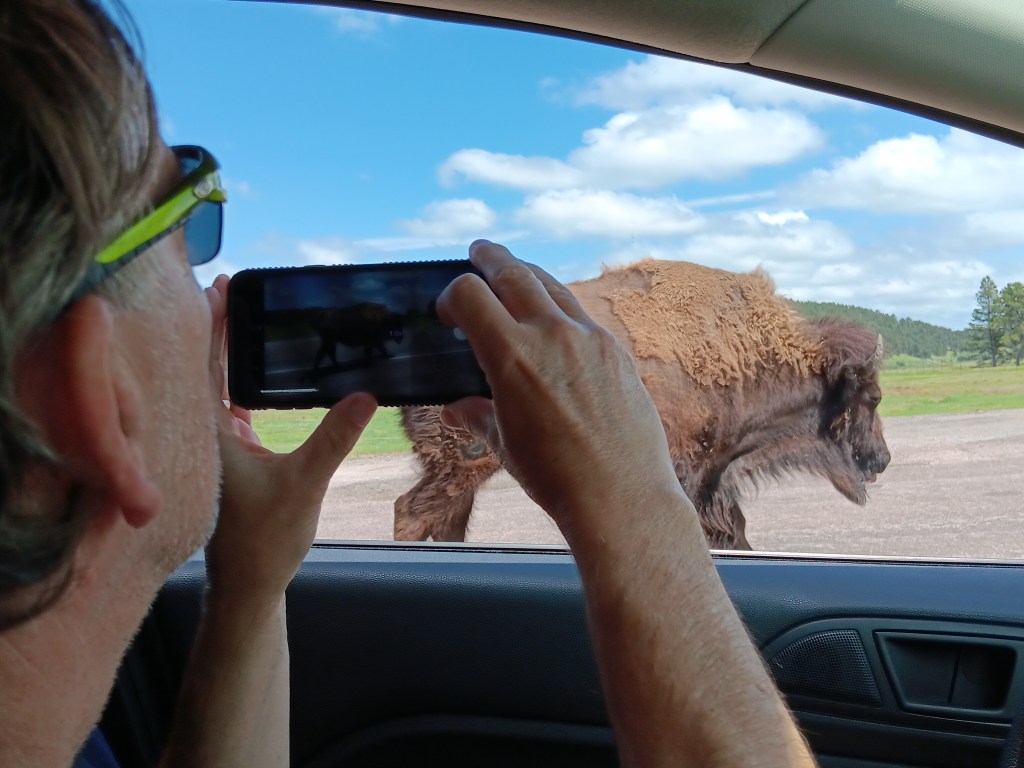
We don’t know what the deal is (probably salt from the roads?), but this herd also had a liking for licking cars, starting with the one parked in front of us. And again, one of the bison gave us the stink-eye through the front window, then spent about five long, long, long minutes alongside Nippy, deciding if it wanted to ram us or just move on.

simon viewing bison custer state park
Scary bison makes a decision

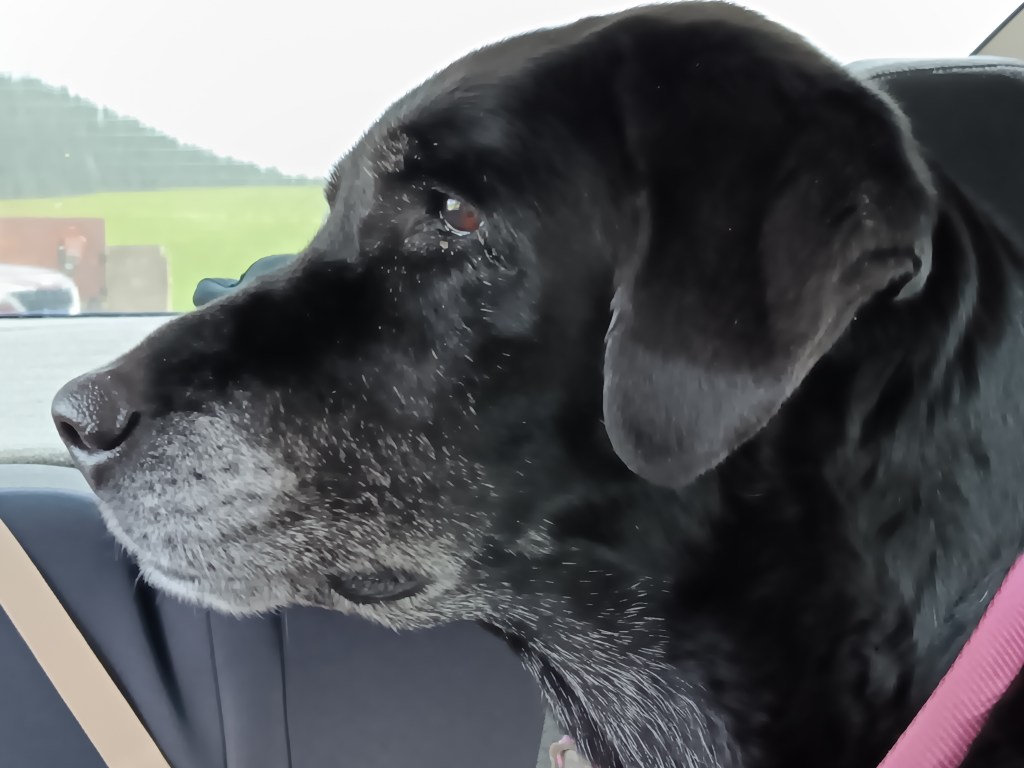
A certain dog in the back seat was riveted, but this time she didn’t bark. She just sat there making little huffing sounds, clearly aware now that the beasts surrounding us were much bigger than she is.

ruthie viewing bison custer state park
Must. Not. Bark!
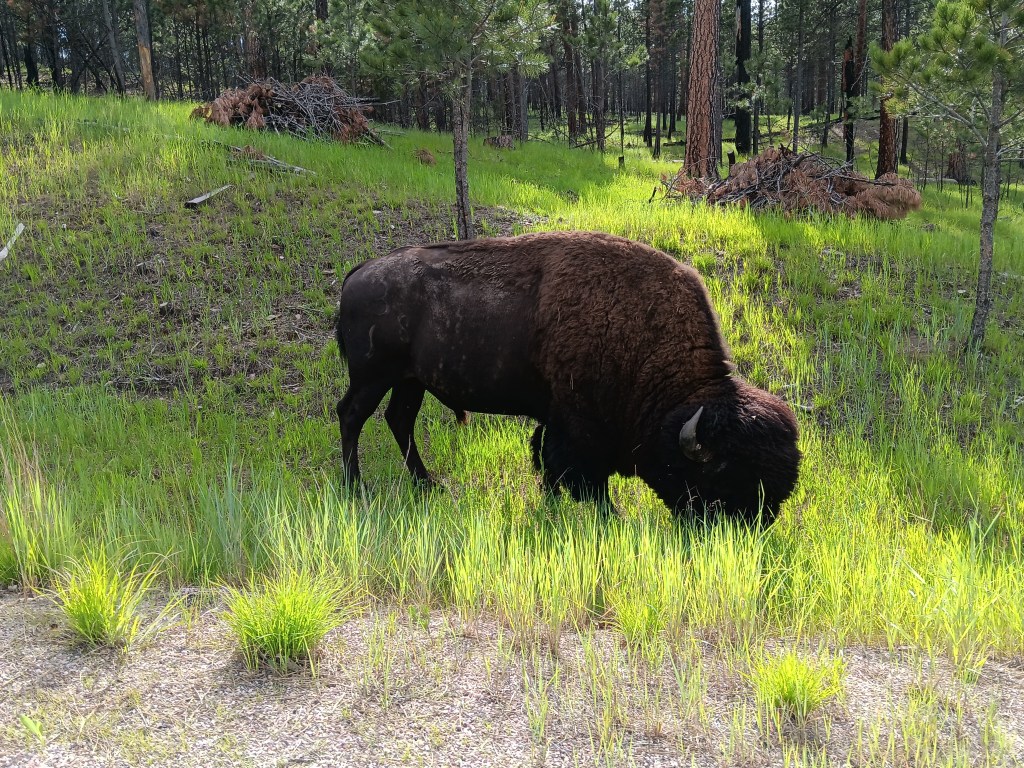
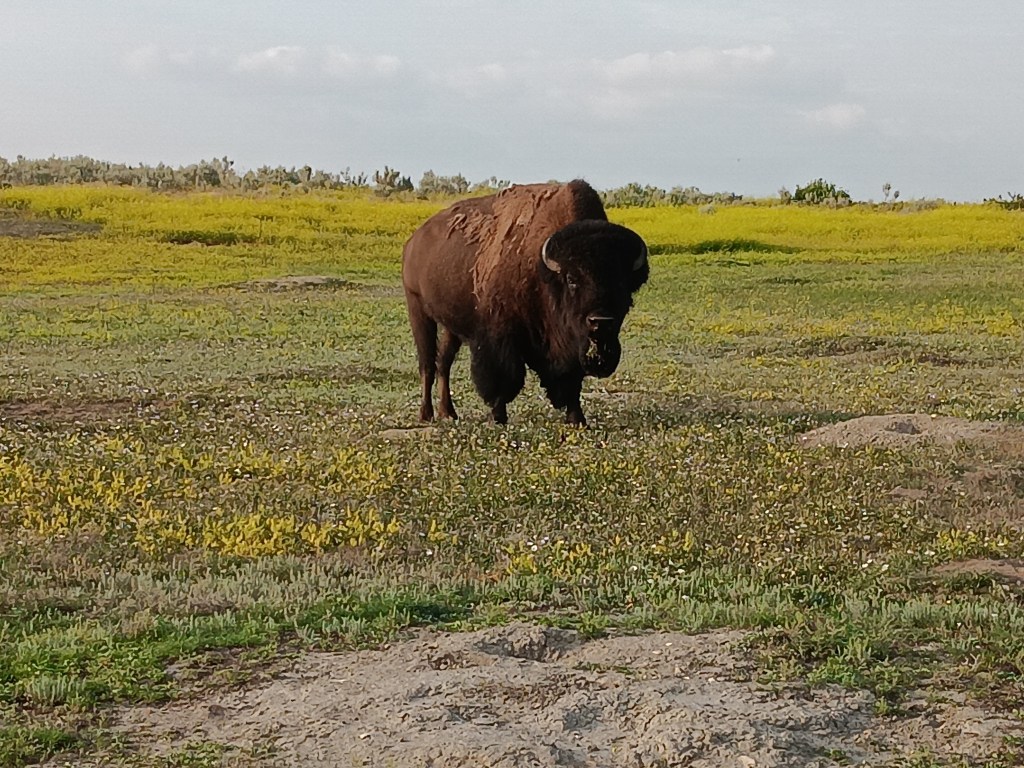
We moved on when they moved on, and had a lone male on a side road nearly to ourselves as we made our way to Custer, with Needles Highway as our next major adventure.

male bison custer state park

We did stop at Calamity Jane Coffee Shop in the cute town of Custer to help Simon deal with his lack of caffeine, and while I’m not usually a coffee drinker, I got one anyway and it was honestly the best cup of mocha and Joe I’ve ever had. Sadly, Jane wasn’t on hand that day, but her employee was friendly and the bathroom was clean. Score!
custer south dakota

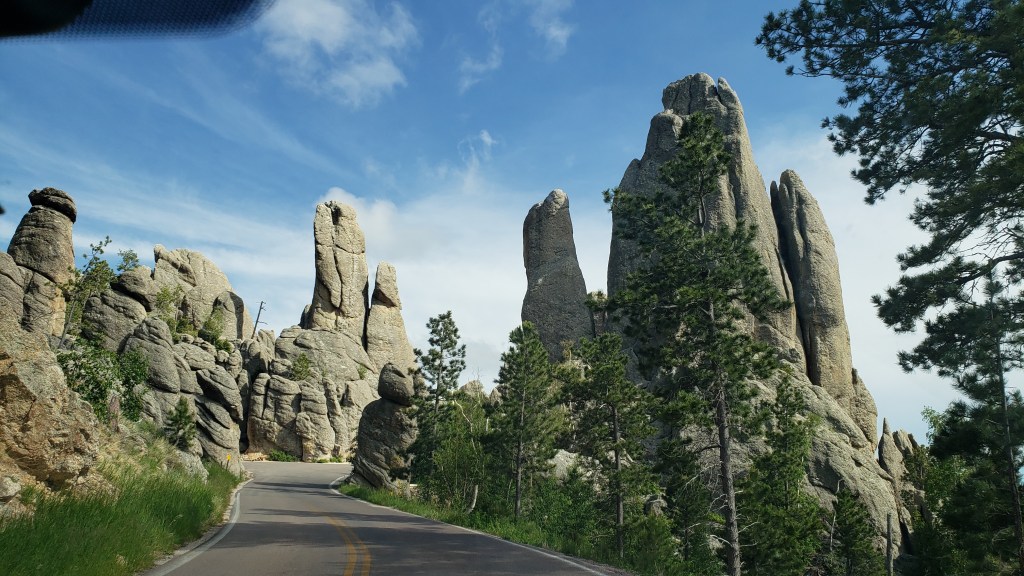
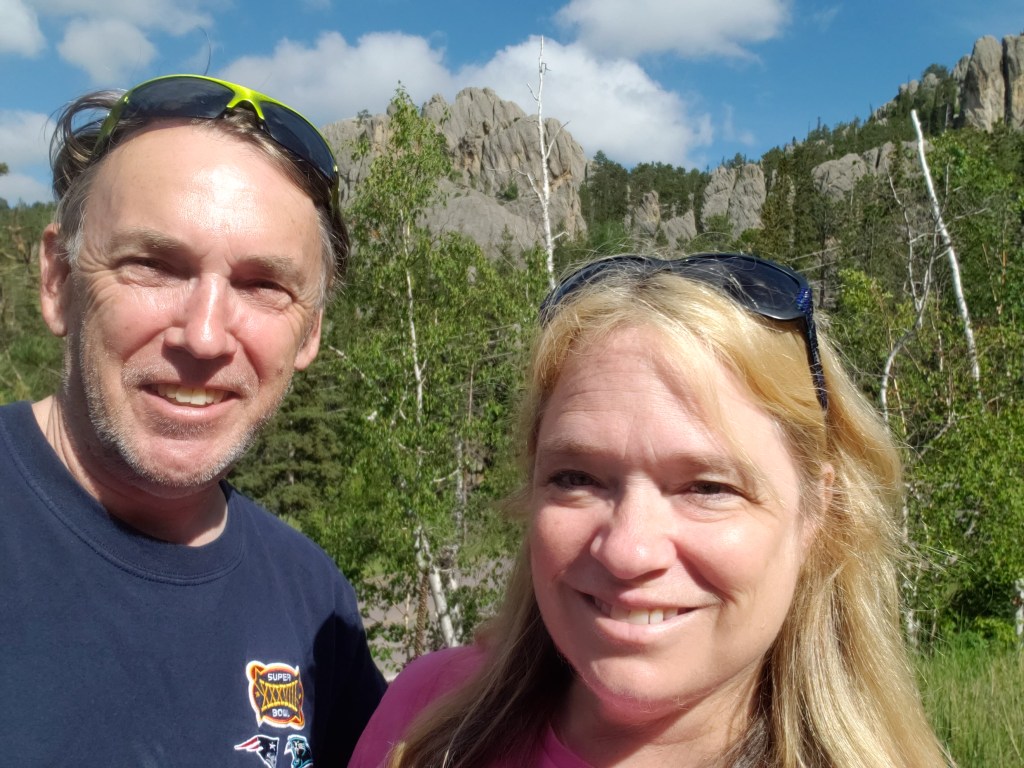
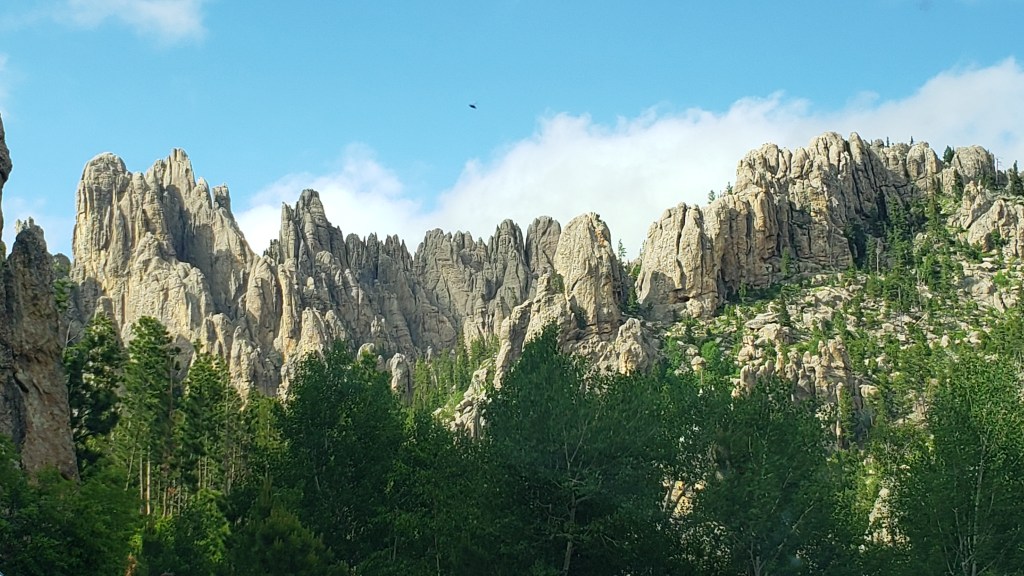
Needles Highway is a 14-mile scenic drive punctuated by the most outrageous granite spires that were pushed up sideways by the forces of nature. Every turn reveals a thrilling aspect, and we goggled at the magnificence and took selfies like the tourists we are.  

needles highway landscape

needles highway selfie

needles highway spires 2

South Dakota’s governor, Peter Norbeck, mapped out the entire trail that would become Needles Highway on foot and on horseback. It’s so winding, and has so many tight turns, it takes nearly an hour to drive just 14 miles, even longer with stops for panoramic photos. But you want to go slow, because this is prime elk territory, and we’re out for elk sightings today. Right?

There are three tunnels along the highway, carved through the rock by wind, rain, and the area’s harsh winter weather. Each tunnel is impressive, but we’ve never seen a tunnel more impressive than the Needle’s Eye. Nippy is small, but Simon could touch the side of the Eye as we drove through.

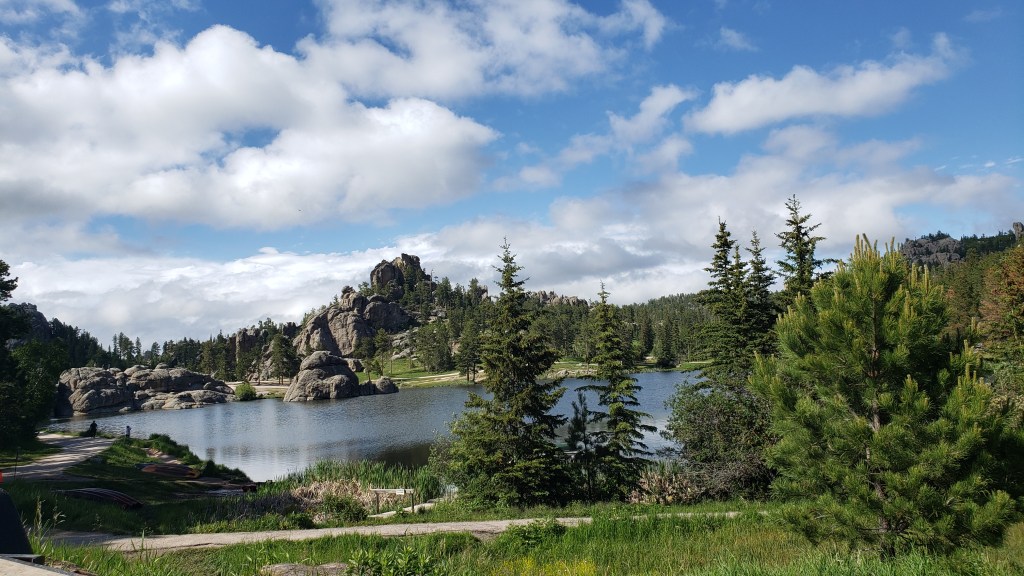
We agreed we’d have to come back and do Needles again, next time stopping at the lovely Sylvan Lake for a stroll and a picnic lunch. When we finally did that a couple of days later, the weather suddenly turned freezing cold, and was hammering down with rain and pounding with thunder and lightning, so we sat in the car and had lunch while feeling very, very sorry for a bridal party running through the storm to get to the lake’s reception hall, with all the girls in sheer, sleeveless formalwear and the bride’s veil whipping in the wind.

sylvan lake custer state park
This is what Sylvan Lake looked like three minutes before a massive thunderstorm hit

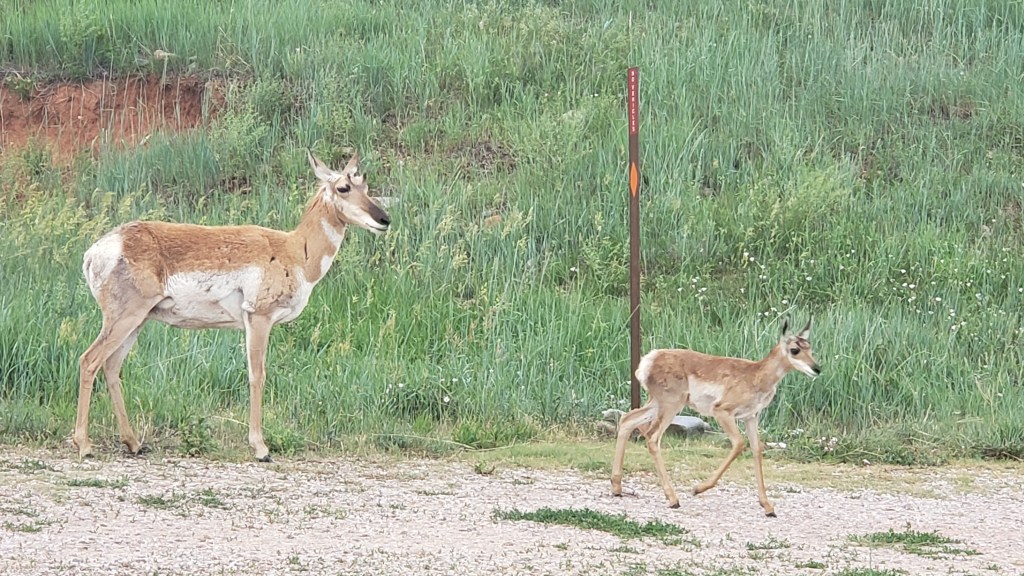
After Needles we went back to the Wildlife Loop, where the Visitor Center assured us we’d have a chance at spotting elk as dusk came on. Instead, we saw deer and lots of pronghorn, including the wonderful treat of a mama pronghorn and her baby, with daddy not far behind.

pronghorn mother and baby custer state park

pronghorn mother dad and baby custer state park

We made two more trips into Custer State Park after that, determined we’d see elk, but to no avail. To add insult to injury, a couple we got to chatting with at the campground said they’d seen a herd of elk right on the road the previous evening, at around 6:30 p.m., which was about 15 minutes before we arrived at the same spot that same evening.

Would it take until Yellowstone before we’d see elk, or would South Dakota be kinder to us than that? Either way, what a grand and exciting place for wildlife and for absolutely magnificent scenery. But Custer wasn’t done surprising us yet.

coyote custer state park

South Dakota’s Badlands And The Results Of Effective Billboard Marketing

Badlands National Park selfie
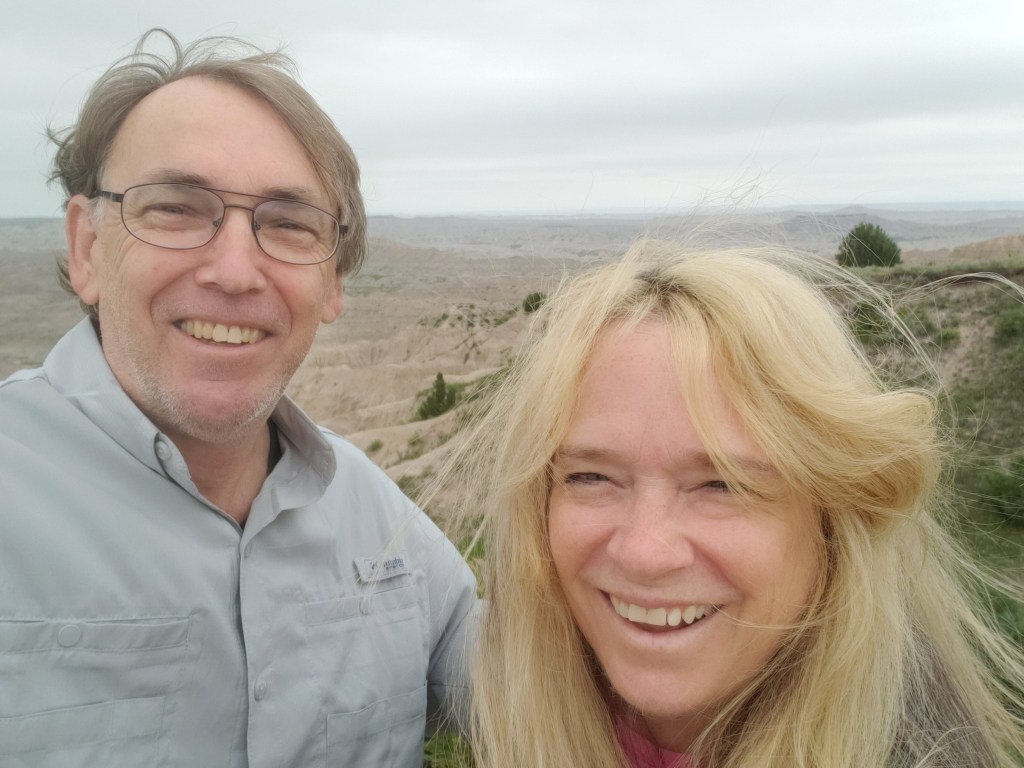
South Dakota’s windy Badlands

We entered the new-to-us state of South Dakota on June 19, eager to see more of the Dakotas after a fantastic stay in the northernmost state in the Midwest. We’ve got a week in Hermosa, then 3 full days in Sturgis, to see Custer State Park, Crazy Horse, the town of Custer, Deadwood, Badlands National Park, Needles Highway, and Six Grandfathers, now known as Mount Rushmore.

To break up the long trip from Medora to Hermosa, we had an overnight stop at Harvest Host location, Belle Valley Ancient Grains in Newell, SD, which felt incredibly rural but was just minutes off the highway heading south.

Belle Valley Ancient Grains

We learned about the ancient grains owner Brian is farming, and came away with whole Spelt and White Sonora Wheat that we’ll make into grain bowls and hot cereal.

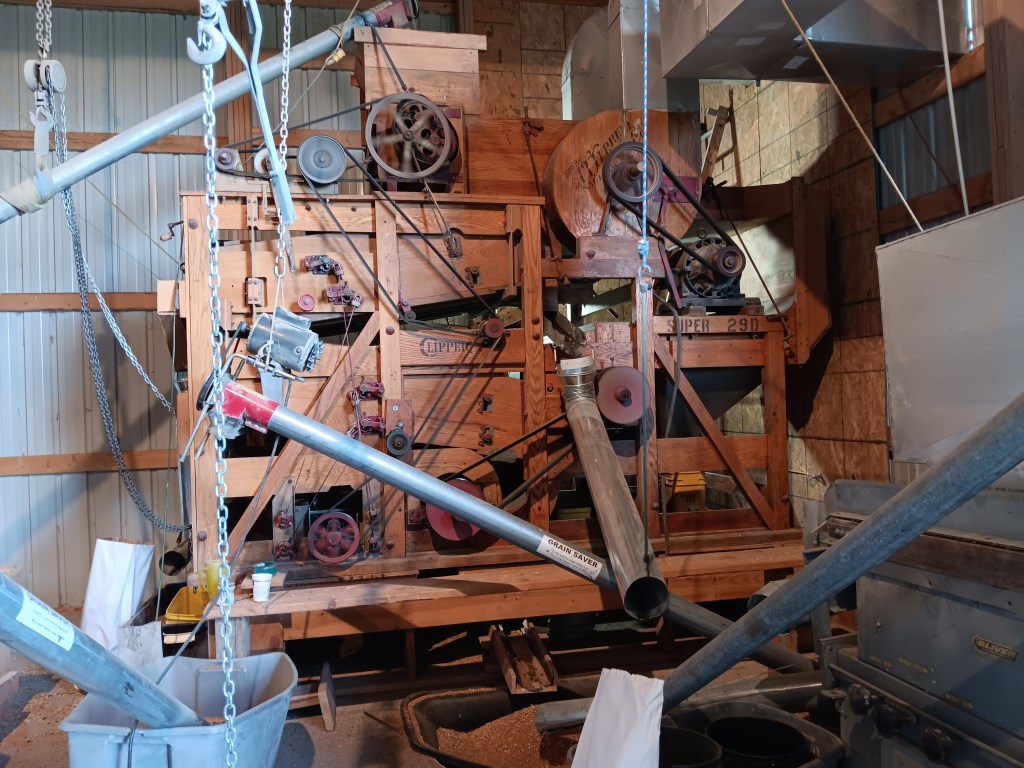
Belle Valley Ancient Grains grain machine
The 1950s machine Brian uses to separate the grain from the waste, before putting it through high-tech machines that finish the job.

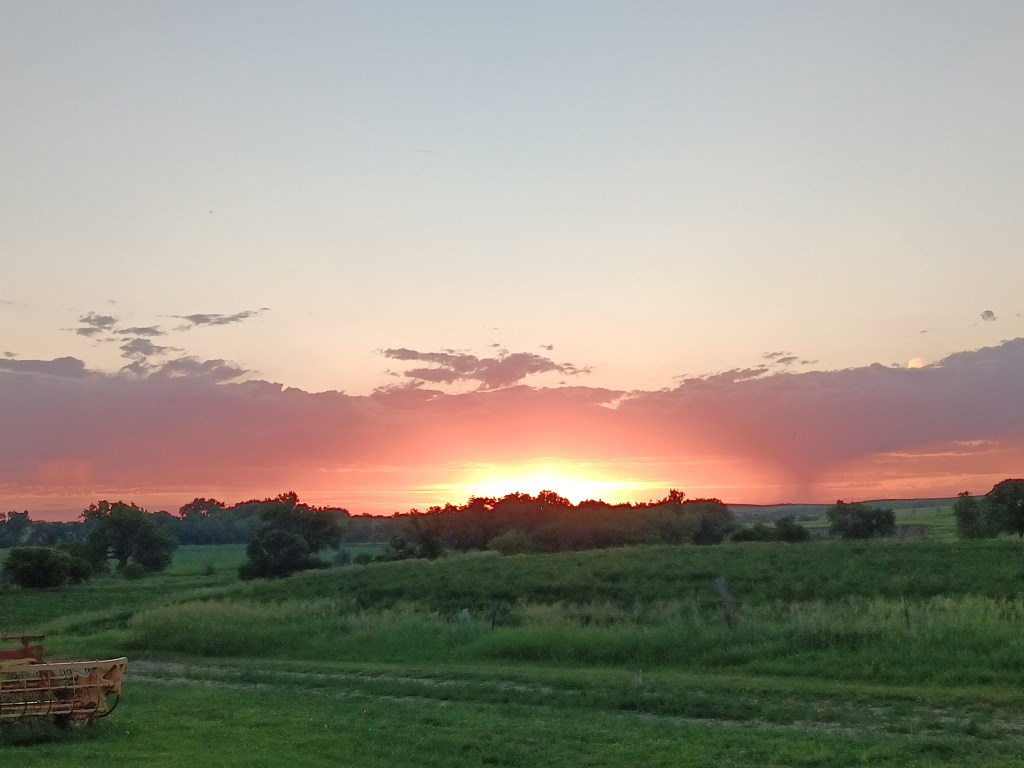
Belle Valley Ancient Grains sunset
It’s hard to beat a stunning sunset over pastoral land

Then it was on to Hermosa, with a butt-clenching 11 miles through construction cones on a highway with a speed limit of 75mph. You can imagine the number of cars that passed us after the construction zone ended. We’ve decided their honking and single-finger salutes are congratulatory celebrations of how well we navigated a tight lane with harrowing twists and turns, and we felt very special indeed.

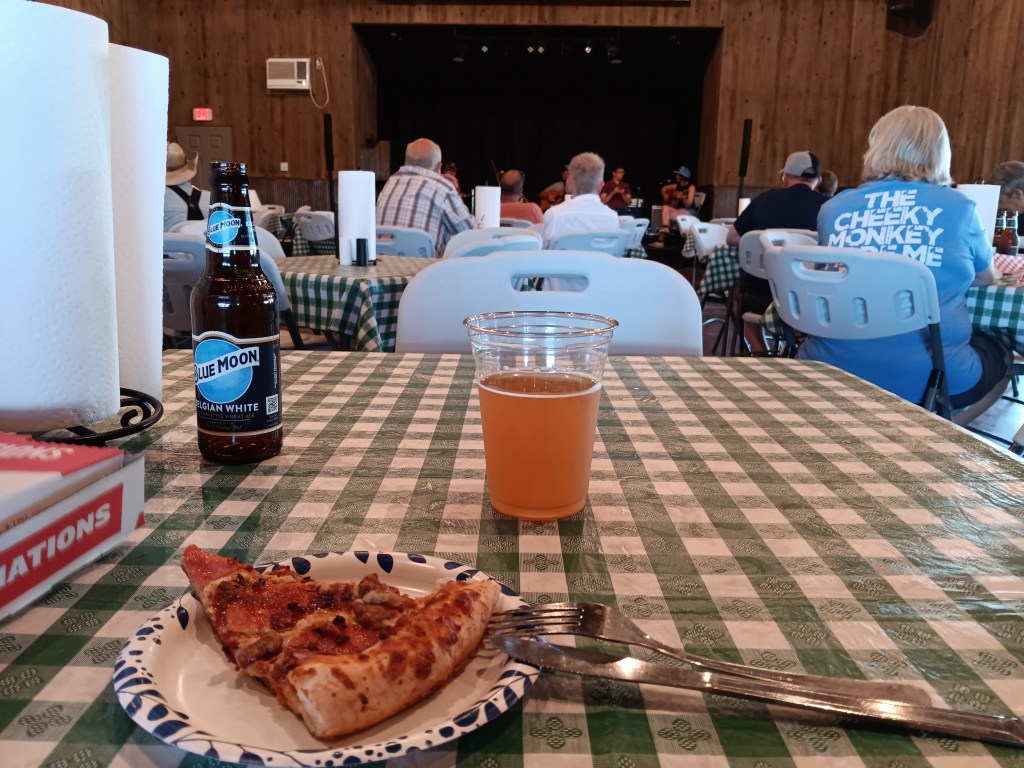
But enough of that, and on to the touring. We settled in at Heartland RV Park, enjoyed a pizza and live music at the campground’s event center, and had a relatively quiet night (rain is loud when you’re in a metal can), then made our way to Badlands National Park the next morning.


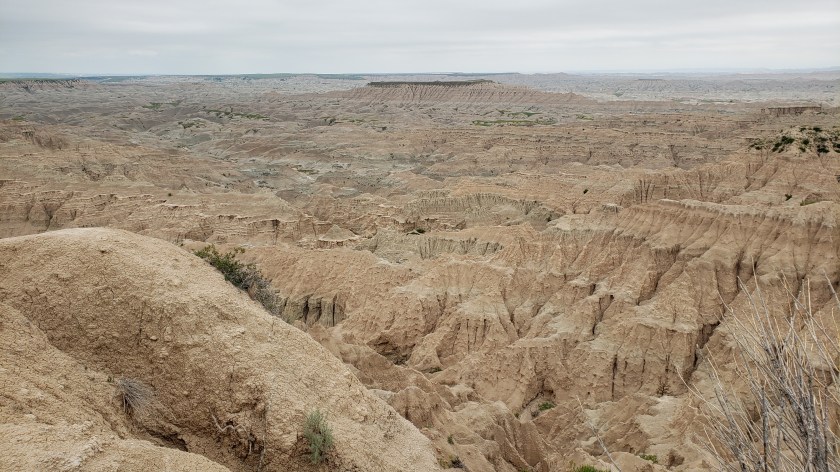
It was quite cloudy and windy all day, but that didn’t deter us.  We were on a mission to see something other than the rolling hills we’ve been driving over, and even before we reached the park, the landscaped changed. Immediately off the highway, the hillsides on either side of us opened to two massive valleys, with structures completely different to the ones we saw in Theodore Roosevelt.

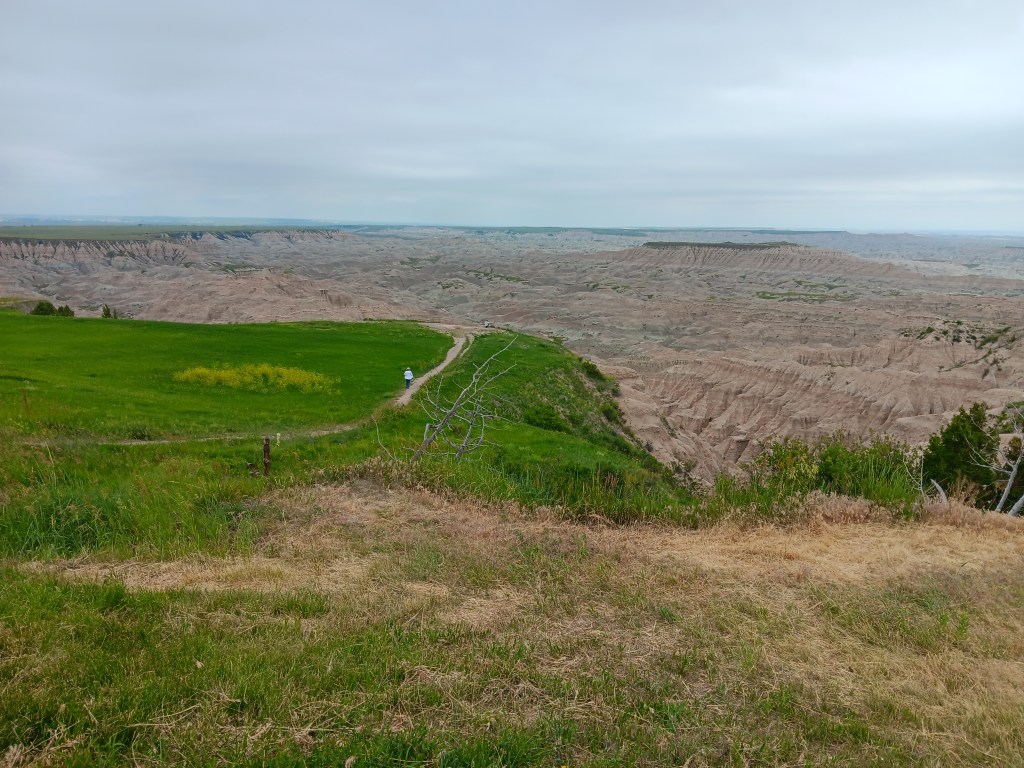
Badlands National Park valley
For scale, that teeny tiny white dot you can barely see at the end of the dirt pathway on the far edge of the plateau is Simon, and a lady who had just come from the Black Hills is in the foreground.

Badlands National Park valley up close

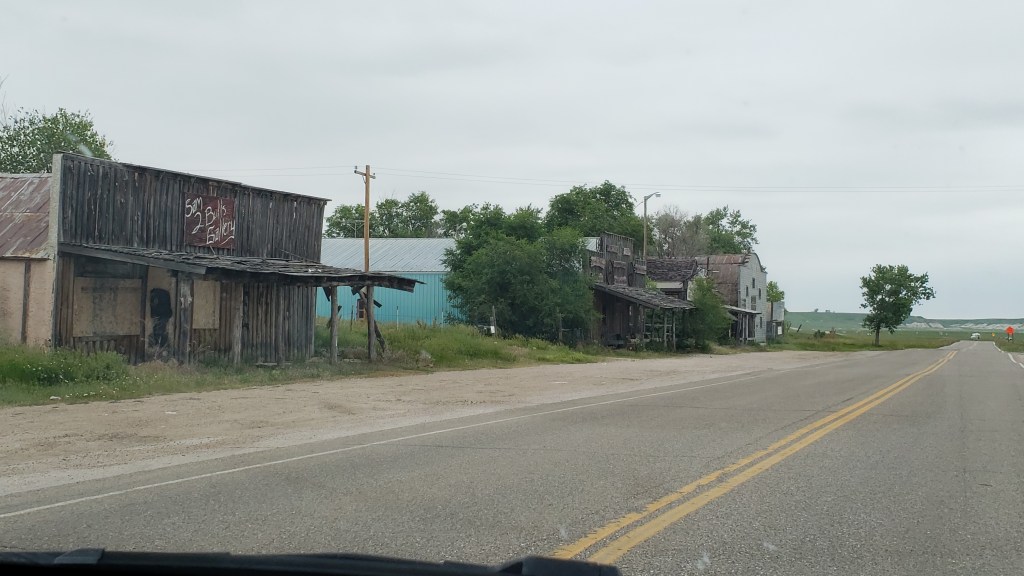
We made a quick stop at the Visitor Center, where they told us we could find gas in the appealingly-named town of Scenic if we needed any, but when we found it, it had obviously been a dead town for years. Decades maybe. The gas station had a price of $5.55 per gallon, so we’re guessing the place drew its last breath back when Jimmy Carter was President. Luckily, Nippy is very sippy, so we didn’t need to fill up until evening.

Scenic South Dakota
Is Scenic scenic? You decide!
Scenic South Dakota 2

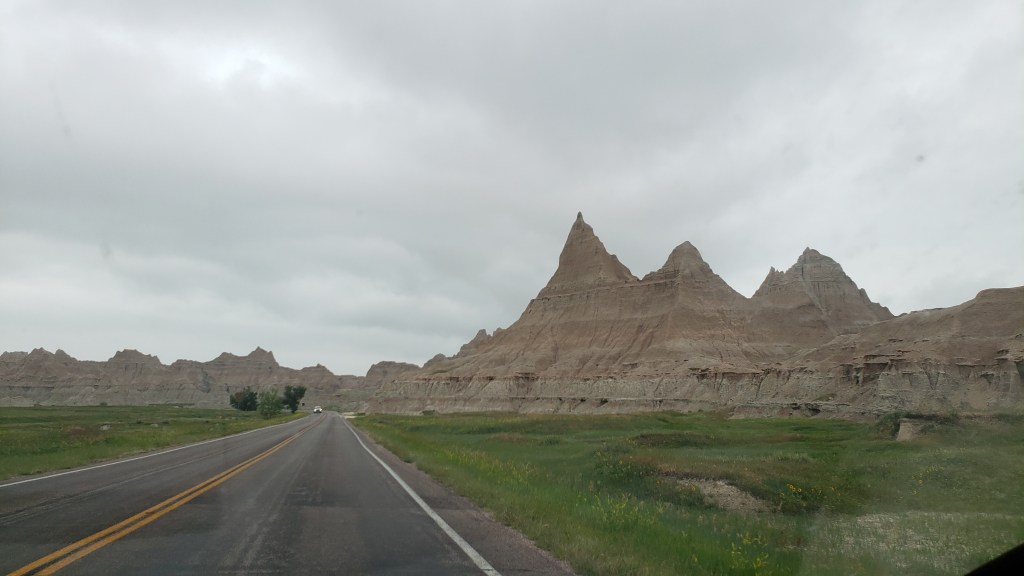
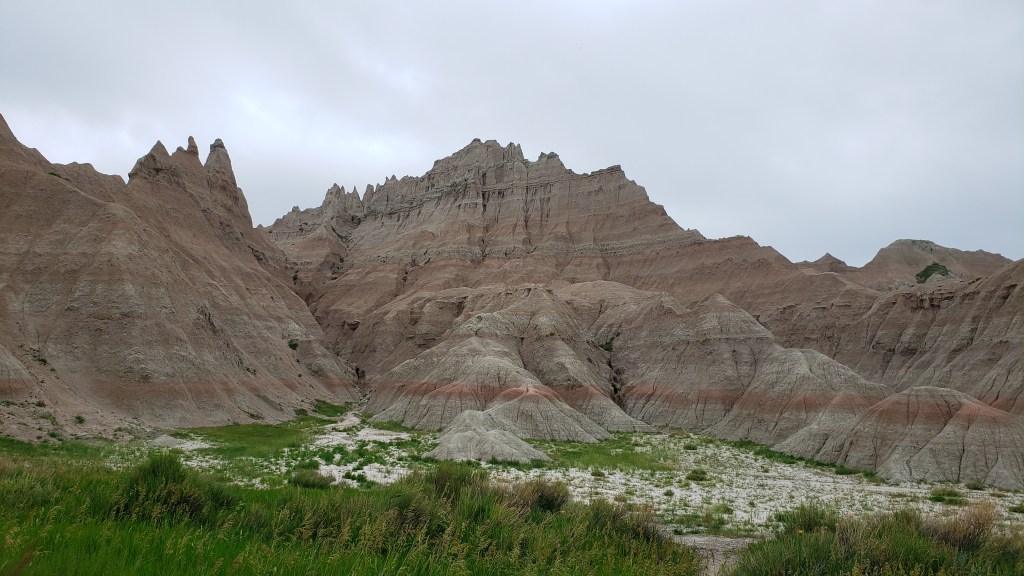
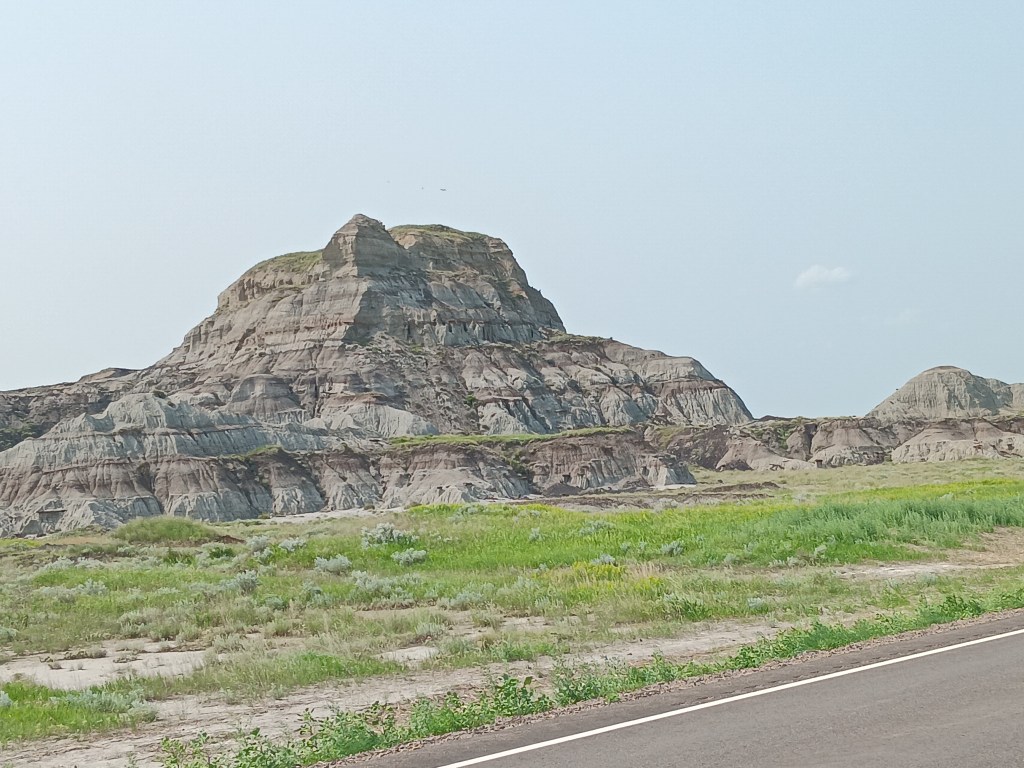
Once we reached the first outcroppings, it was obvious we were in an entirely new landscape. The peaks were sharper at the top and more angular as they descended, with a softer, more “melted” look when we got up close.

Badlands National Park peaks

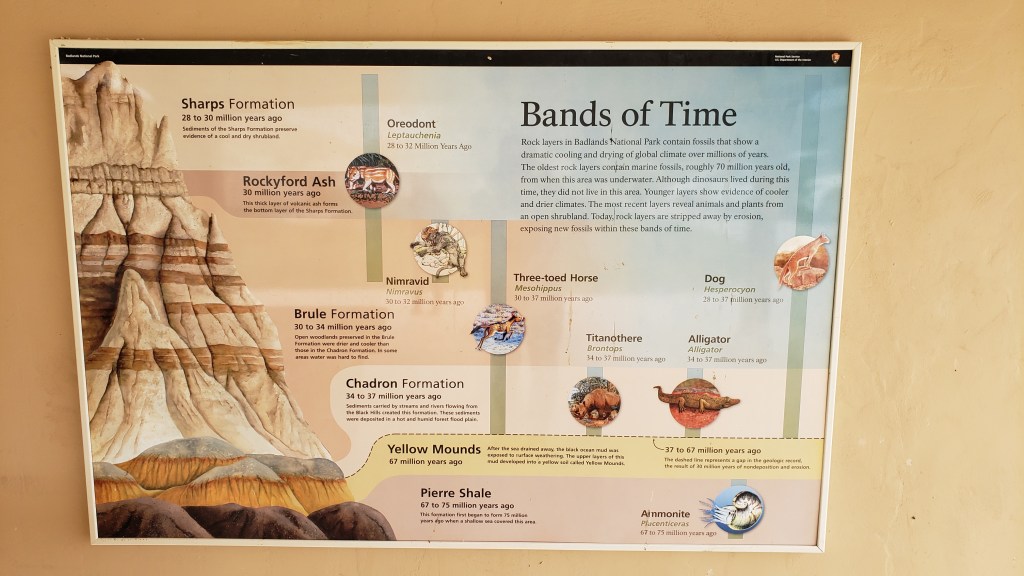
Badlands National Park Bands of Time
We were given a guide that showed what each later represented, moving from the oldest layers at the bottom to the youngest at the top.

Badlands National Park range

The badlands here were created by runoff that washed into an inland sea as Colorado’s Rocky Mountains rose into existence. We could see the layers when we took a short hike into a wide canyon, and the ground we were walking on was primarily the finest silt imaginable. Just like walking on talcum powder.

Badlands National Park simon and ruthie
The white pathway feels exactly like talcum powder

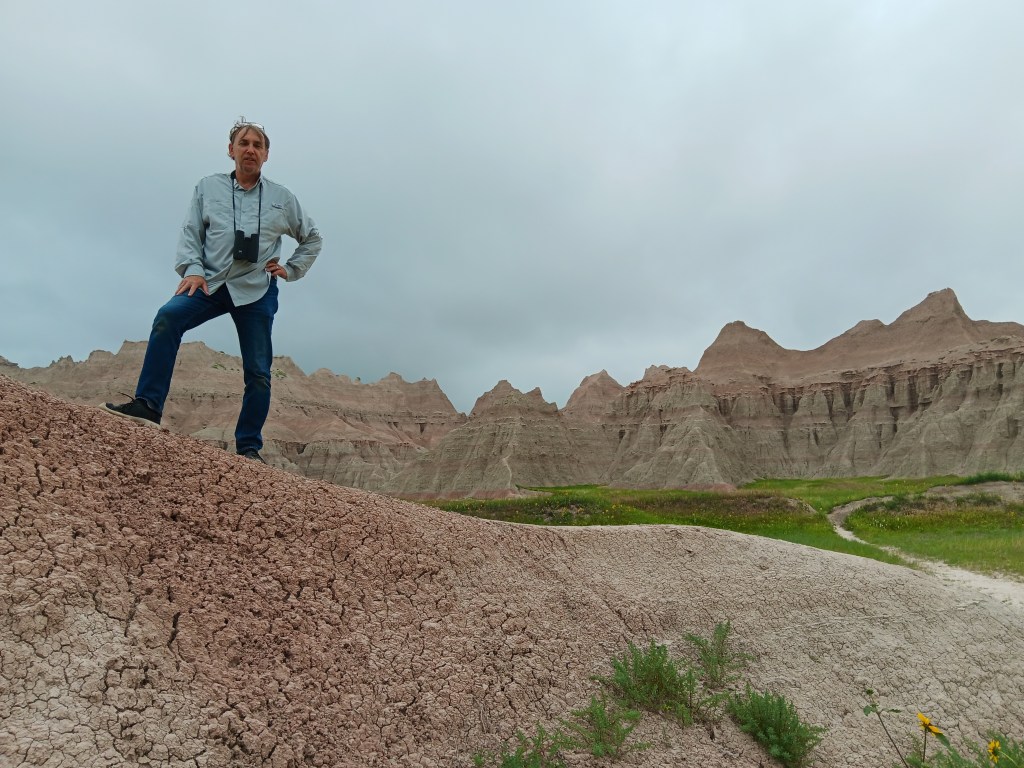
Other areas in the same canyon were like petrified mud, hard enough to create hills you could stand on but also dry and cracked on some surfaces.

Badlands National Park simon mud mound
This ancient sediment is described as “popcorn” rock

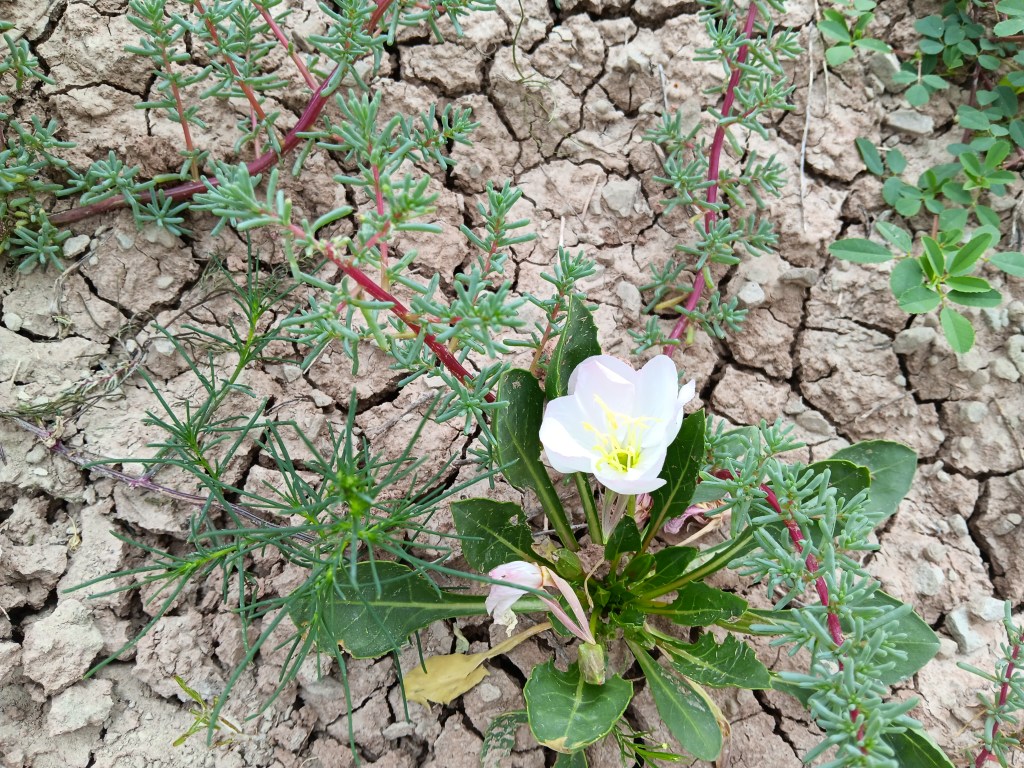
Badlands National Park flower
Even on that barren surface, the most delicate flowers have taken hold.

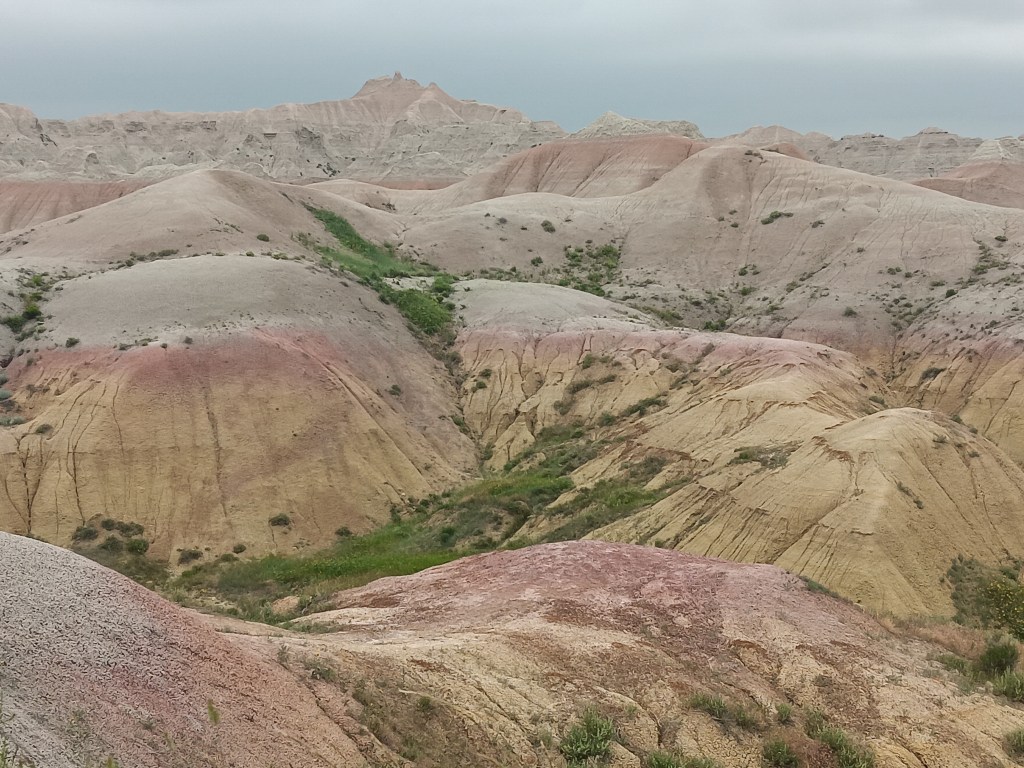
Another surprise were the “yellow mounds” (called paleosols) that were left when the inland sea drained away and chemicals from its plants left staining of yellow, red, purple, and gray. Against the cloudy sky, they’re less striking, but when sunlight hits them they positively shine.

Badlands National Park yellow mounds
Some yellow mounds we saw were only yellow, while most were multi-colored. We missed the sunlight photos, but you can imagine.

We could post a few hundred photos from the park, but we’ll spare you that and instead share a few from the absolutely bizarre town of Wall, our exit point from the park as we headed north to Hermosa.

Normally, commercials on TV and billboards along highways have zero impact on us. But Wall Drug Store is too smart for that, and the sheer number of billboards they’ve installed made it inevitable Simon would have to see what all the fuss was about.

Wall South Dakota
Our introduction to Wall

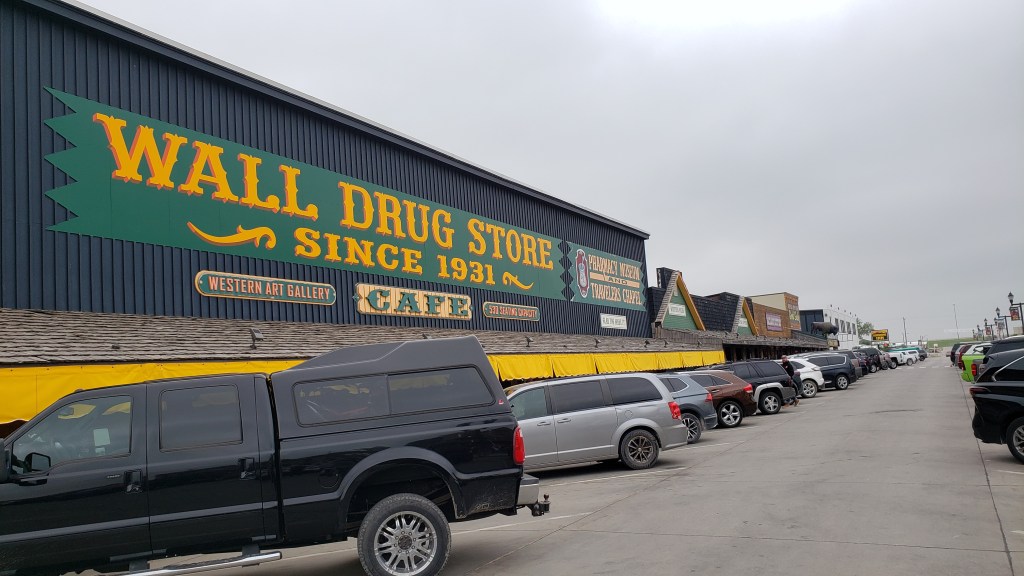
Like Buc-ee’s, if you’ve been there, you know. Wall Drug Store is just…massive. Like, a full city block massive.

Wall Drug Store facade
Not all of these storefronts are Wall Drug Store, but most of them are

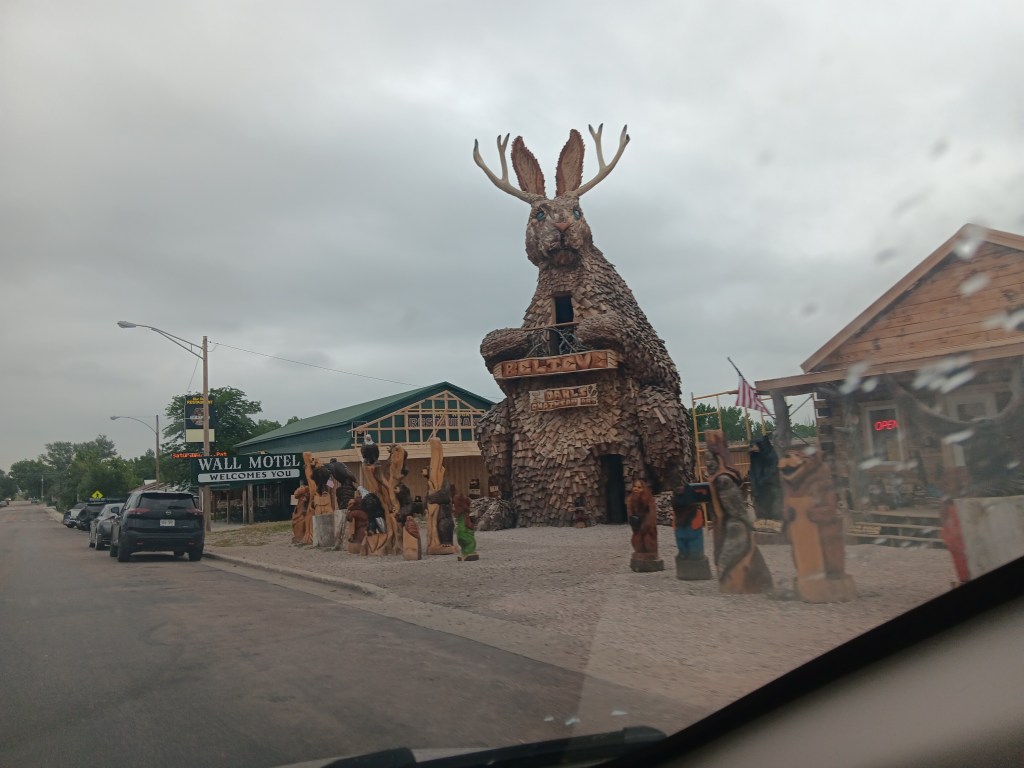
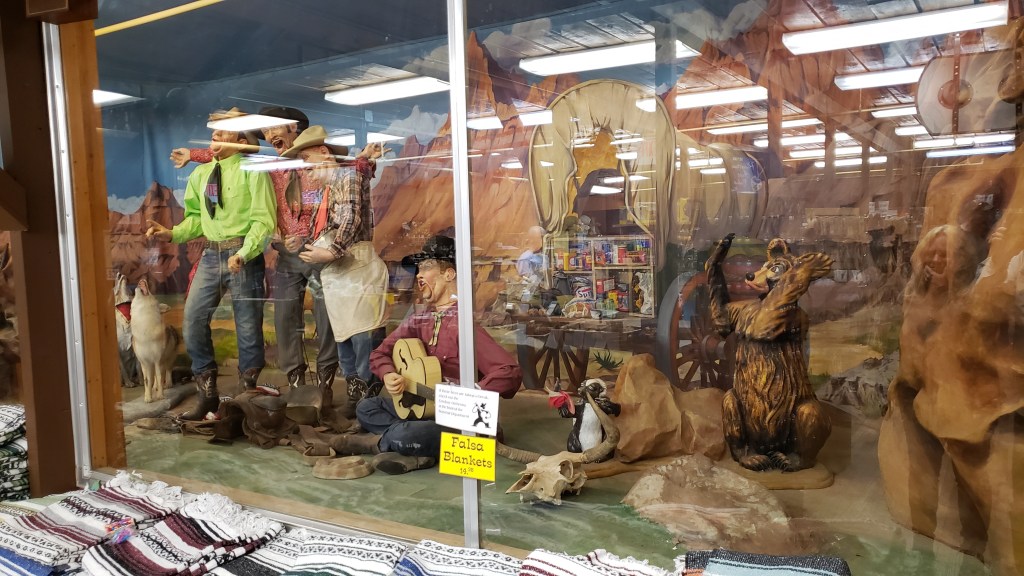
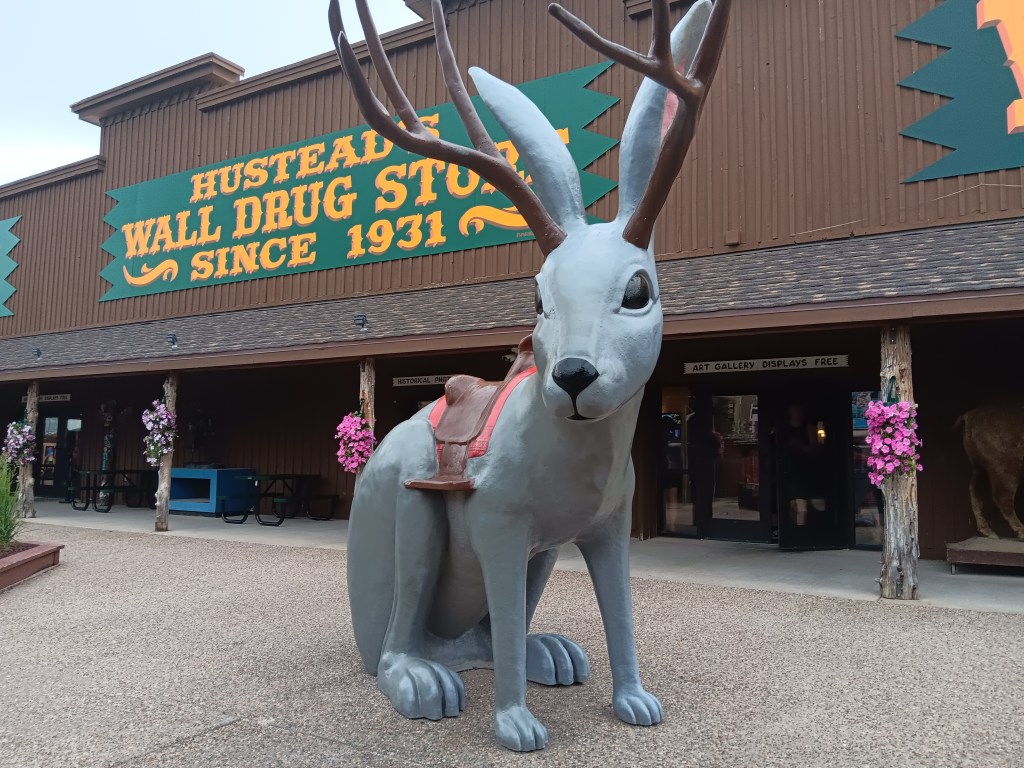
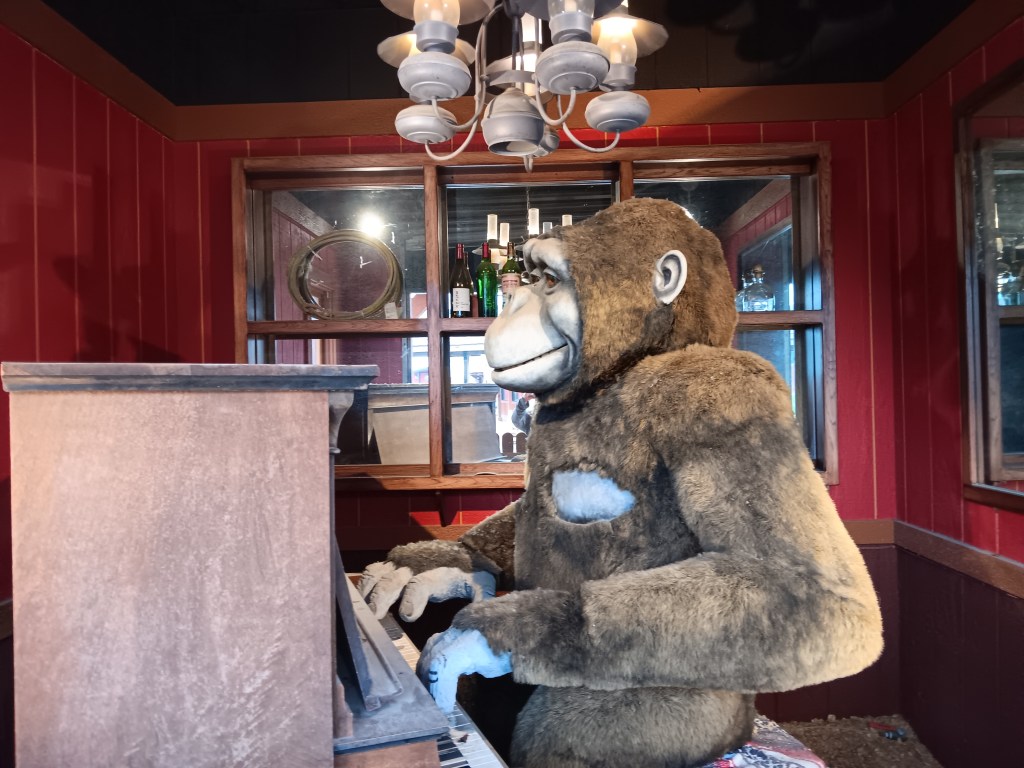
Want a billion shot glasses, T-shirts, cups, mugs, magnets, and every other form of tourist crap you can imagine, all wrapped up in interactive stuff that includes a jackalope the kiddies can sit on, a gorilla animatronic playing a piano, and an insane trio-plus-one of mechanical cowboys singing in a wild-west setting of howling coyotes and an upset bear? Wall Drug Store has all of it and much, much more.

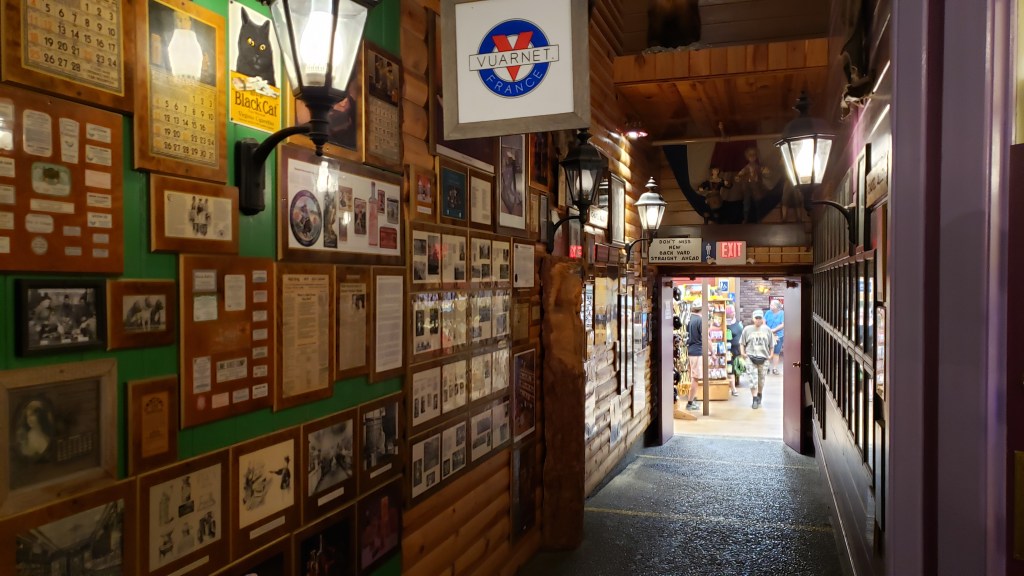
wall drug store interior

wall drug store mechanical band
This is a terrible photo, but there was no way to avoid the glare. Still, it softens the full horror.

wall drug store jackalope

wall drug store gorilla
Why?

We didn’t buy anything. We didn’t even try the “free water” the store so proudly advertises on the front façade. But we’ll remember Wall Drugs with the same fondness we remember that wacky gas station with a beaver as its mascot.

wall drug store front

Tomorrow (subject of our next blog) would see us making the first of many trips into Custer State Park, and we’ll just say that at $20 for a seven-day pass, we absolutely got our money’s worth.

Custer National Park male pronghorn
Hello, handsome!

What Theodore Roosevelt Did Best

Theodore Roosevelt National Park South Unit buffalo

Where do we even begin? With the epic wildlife, the rugged buttes and valleys that make up the landscape, or the absolute vastness of this national park that has launched itself into our top favorite places in the U.S.? It’s the easiest blog to write due to our enthusiasm, and the hardest due to the immensity of its impact on our minds and our hearts.

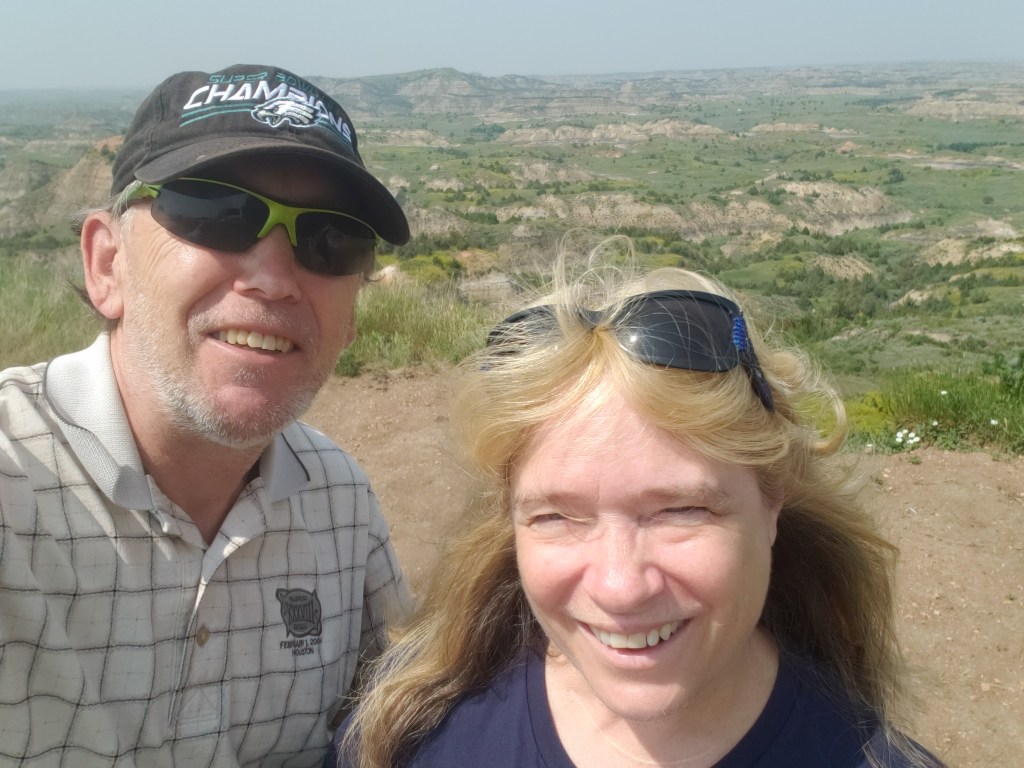
Theodore Roosevelt National Park South Unit selfie
As with all photos, you can’t get the scale of the landscape behind us. It’s just…huge!

We won’t bore you with the facts around President Roosevelt’s hand in protecting 230 million acres of land and establishing the National Parks system, or the history of the mounds, buttes, ridges, and points that make North Dakota one of the most distinctive landscapes we’ve seen so far, save to say each layer that now makes up the area’s badlands was formed, evolved, and, in some cases, was laid bare over the course of 65 million years. It’s a big number, but as we drove the Scenic Loop in the park’s South Unit, and later, the North Unit, “big” was a word that took on new meaning.

Theodore Roosevelt National Park South Unit  long view
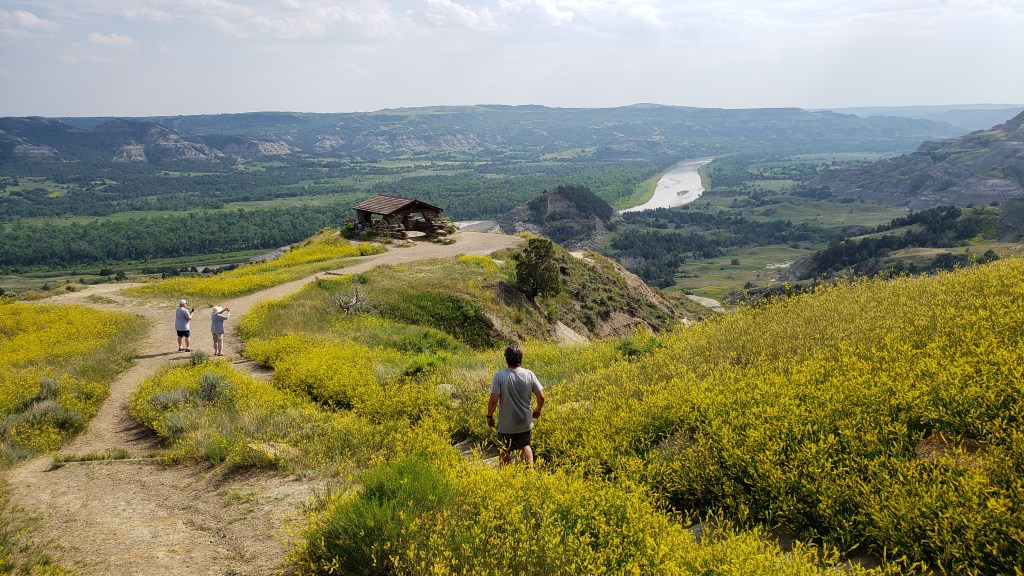
Everywhere you look there’s a gorgeous view to enjoy

Still in awe of the seemingly endless farmlands and prairie lands as we drove from Bismarck to Medora, the small (and very touristy) “cowboy” town where we had a reservation the Red Trail Campground, the landscape changed, and almost without warning we were looking at colossal sandstone, siltstone, and mudstone “mountains” towering over deep valleys with rolling green hills and meandering rivers.

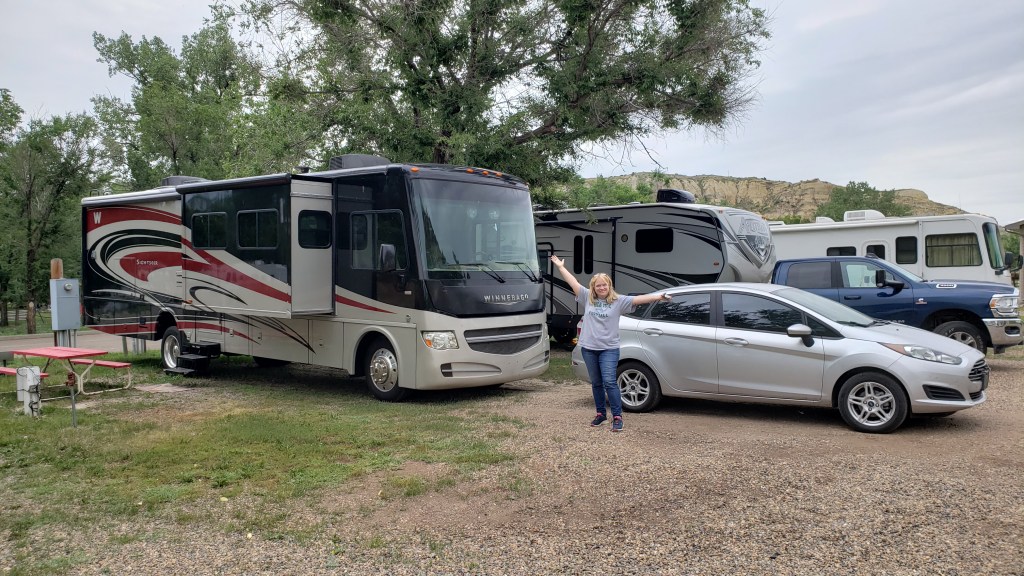
Red Trail Campground Medora SD
Fati resting after her exertion, and Nippy getting ready for a scenic drive

That morning, as we headed to Medora, we agreed we’d spend the evening and the next day catching up with work, then visit the South Unit on our second full day and the North Unit on our third full day. Obviously, that was a stupid and unrealistic plan, and our first trip into the South Unit saw us chomping at the bit as we entered the park around 7pm on the evening of our first day, lured by the promise of prairie dog towns and a greater chance at seeing wildlife around dusk.

Just minutes after entering the park we came upon our first prairie dog town, where hundreds of the adorable little rodents with almond-shaped eyes and sticky-uppy tails were going about their evening grass munching, while “sentinels” kept watch, throwing their whole upper bodies backwards and their arms upwards while emitting the cutest bark imaginable as part of their warning system.


It was straight out of a David Attenborough documentary, and Simon could have stayed there watching them until dark, but after about 20 minutes and a bit of prompting, he pointed Nippy up the hillside to see what else was in store.

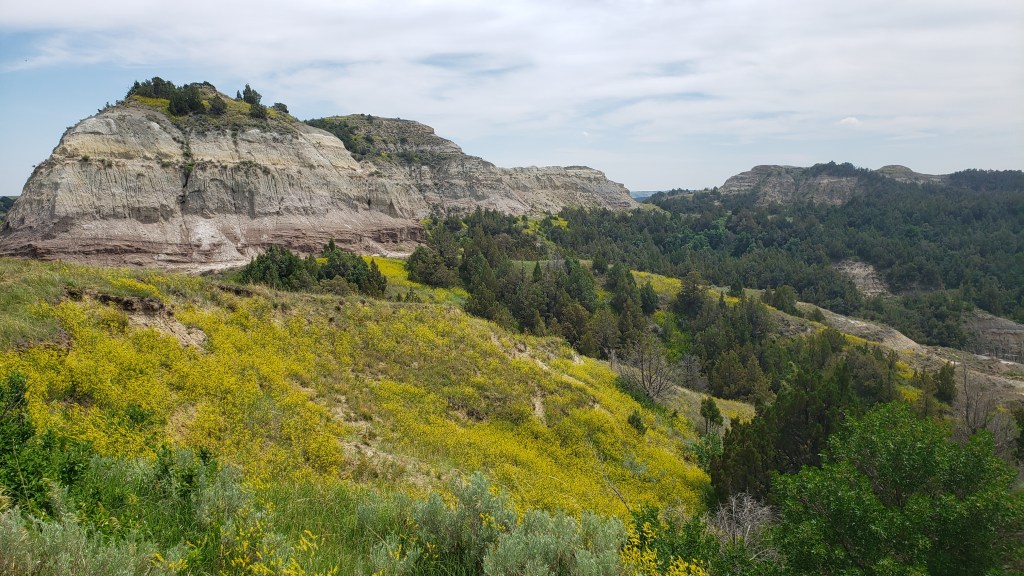
The landscape had us utterly captivated, and over the course of three days we never grew tired of seeing the majestic hills and valleys.

Theodore Roosevelt National Park South Unit landscape
We’re not sure what the flowering yellow plant is, but it smells great!

But we had buffalo to find, and again, it wasn’t long before we spotted one, then drove alongside three more, so we congratulated ourselves on our incredible luck.

Theodore Roosevelt National Park South Unit lone buffalo
The lone straggler

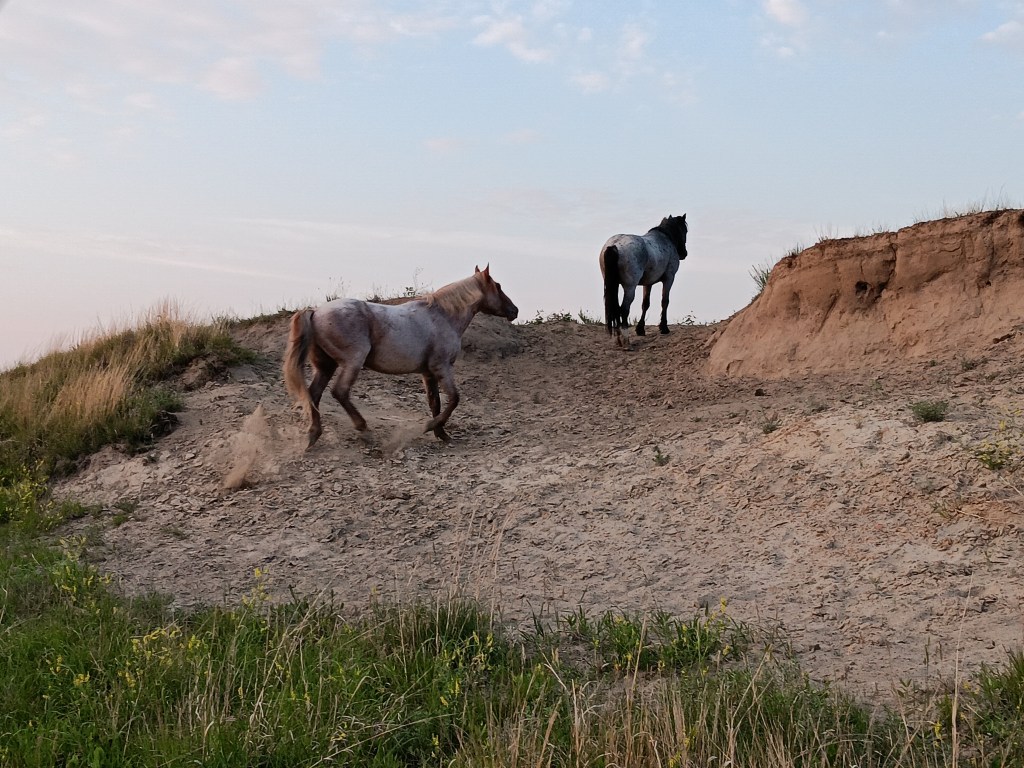
We weren’t going to do the entire drive that first evening (made longer due to the south part of the loop being closed, so it was an out-and-back journey), and just before we turned around we were treated to a small group of wild horses, which capped off an excellent evening of wildlife viewing.

Theodore Roosevelt National Park South Unit wild horses

Theodore Roosevelt National Park South Unit wild horses sunset

The next day we went up to the North Unit, fueled by the bacon and pancakes I made because I’m no quitter and was determined I’d be up to the challenge. The drive was a bit more difficult due to a stretch of Highway 28 being closed, so we had to detour about 66 miles, round trip, out of our way. Along the way, Simon saw a sign for Killdeer Mountain Battlefield, and being the sort of person who cannot pass anything by if it has even the slighted hint of interest for him (and despite the fact that he’d been wondering about finding a restroom for quite some time), he made the decision to find the battlefield, and he was unanimous in that.

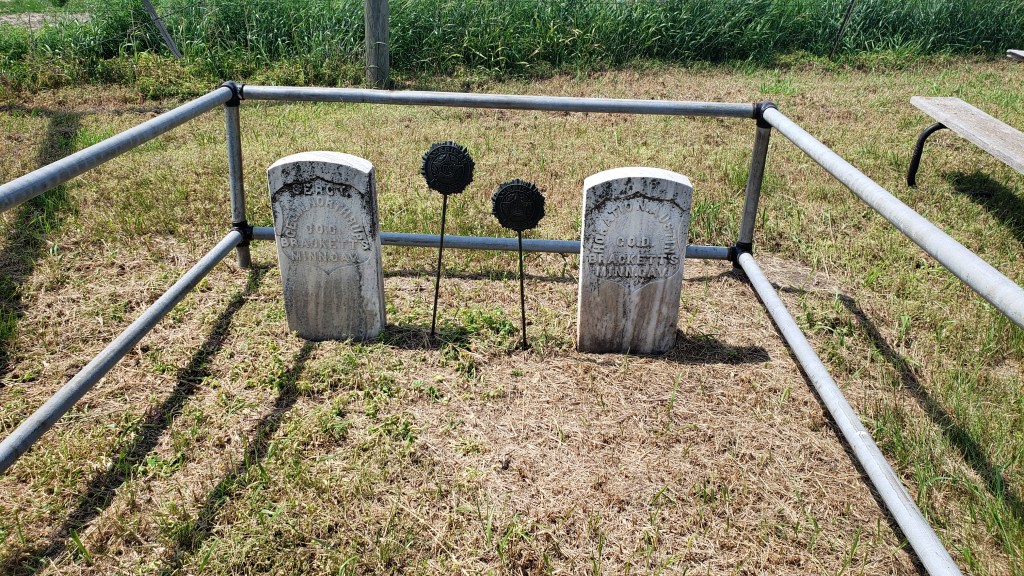
Killdeer battlefield graves
Obviously the fiercest battle in the west

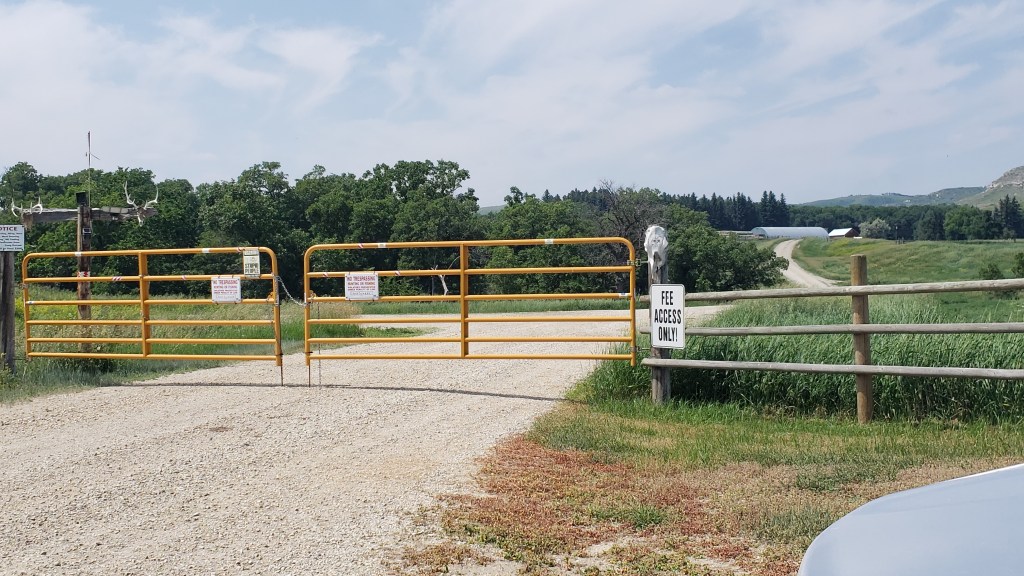
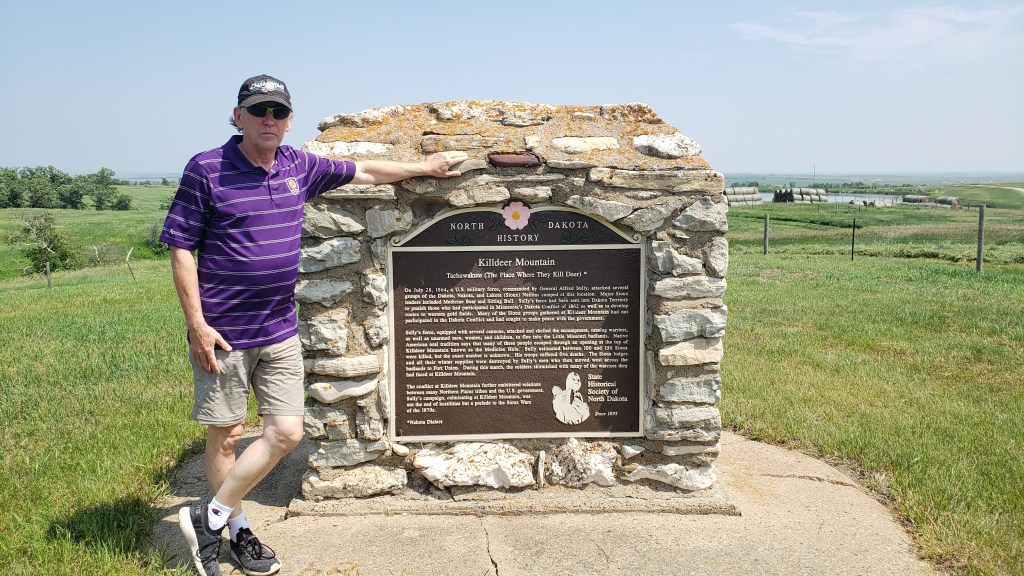
Long, unpleasant story short, it involved 16 miles round-trip on a dirt road (which he hates but thought there might be a restroom at the end of), a farmer and his son who angrily confined us on their property by locking the gate along the road so we couldn’t get out (stupid people that we are, as indicated by the sign on his gate that made some unfathomable reference to Stupid People, and the fact that the obscure battlefield monument was just a foot or two outside his gate and nearly impossible to see), and what can only be called an extremely disappointing monument to a grand total of two people who died on the “battlefield.”

kildeer battlefield farmer's gate
The Stupid People sign, meaning us. This was our view after we unlocked the gate and made our escape when the farmer drove away

Simon’s face says it all.

killdeer battlefield memorial
The opposite of impressed

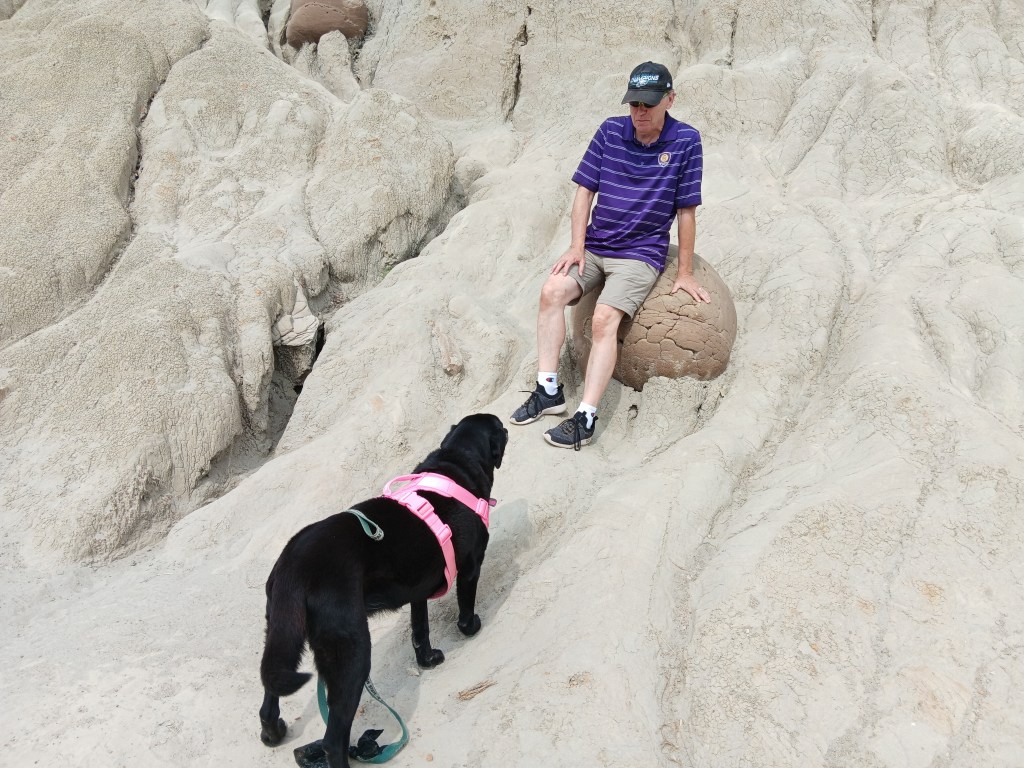
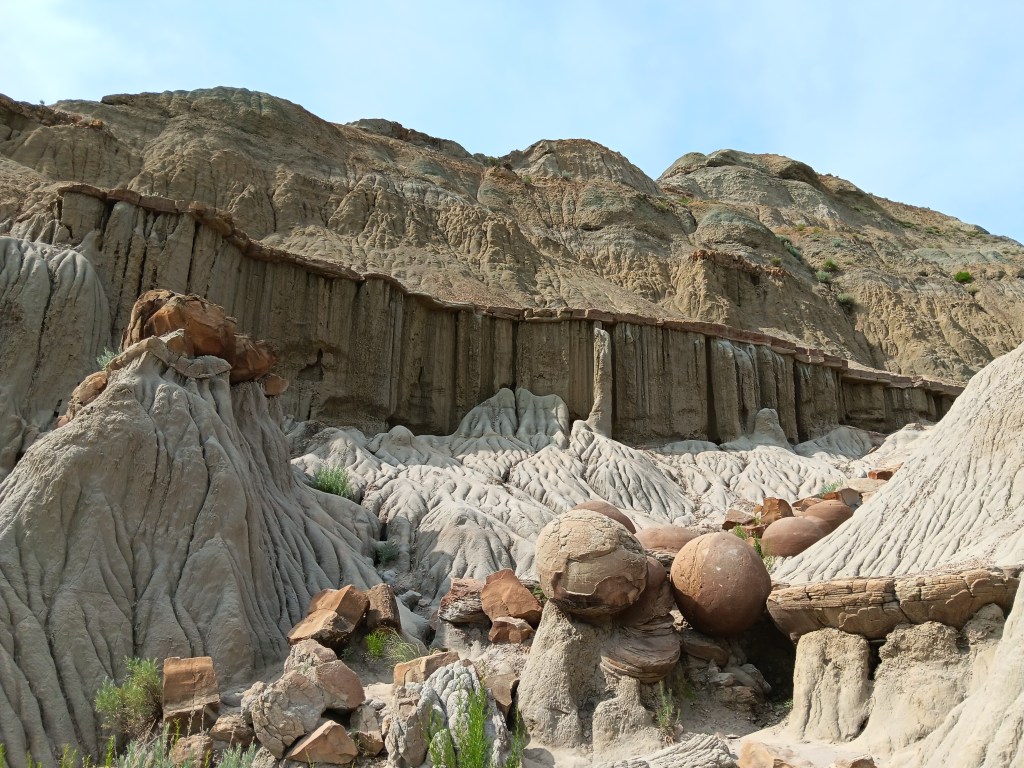
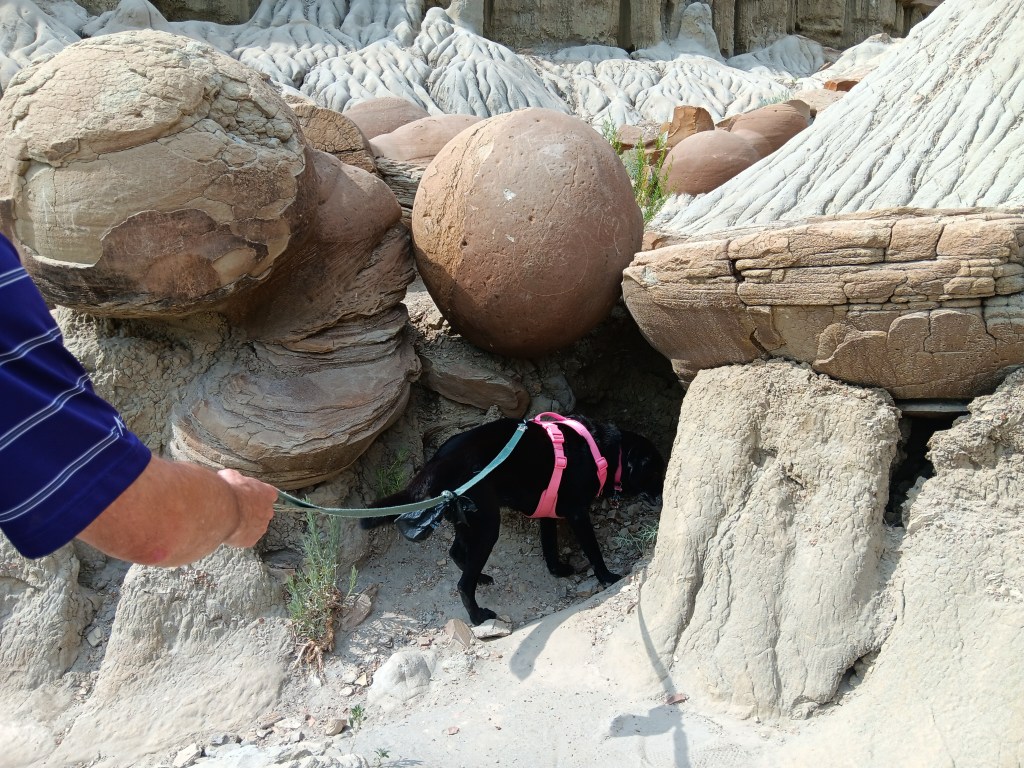
The North Unit is supposed to be the part of the park where wildlife is at a maximum, but we only saw a couple of small herds of buffalo, both at a distance. We did see remarkable “cannonball” rock formations, created by minerals pouring through sediment layers, which Ruthie found as fascinating as we did.

Theodore Roosevelt National Park North Unit simon on cannonball rock

Theodore Roosevelt National Park North Unit cannonball rock landscape

Theodore Roosevelt National Park North Unit cannonball rocks ruthie

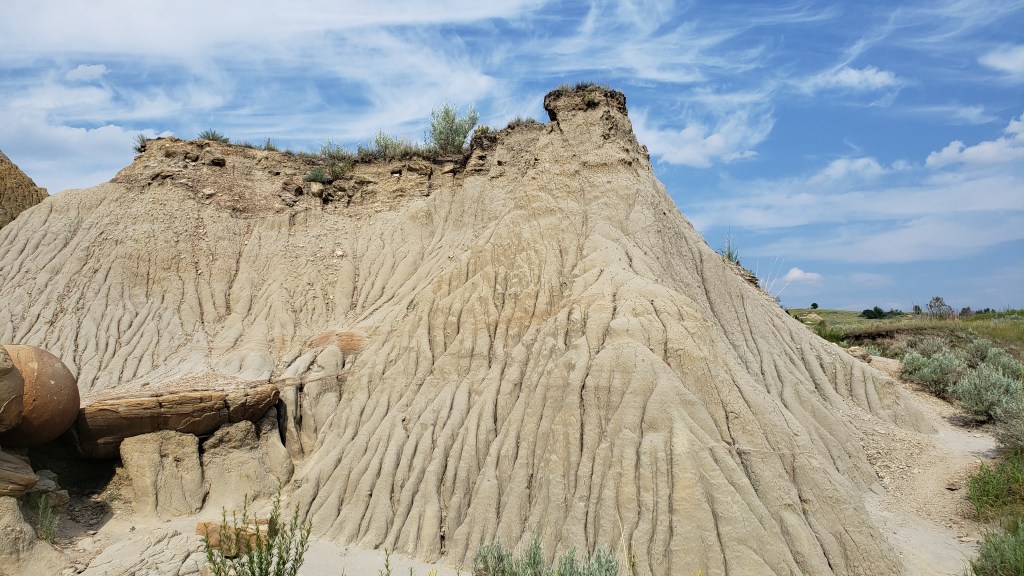
It was back to the South Unit the next day, and as magnificent as the park’s big picture is, the smaller details are equally compelling, and often we felt we were looking at structures created by the hand of Antoni Gaudi, architect and designer of Barcelona’s grand basilica, La Sagrada Familia. In the same way Gaudi’s Nativity Façade seems to be “melting,” so too do some of the water-and-wind-weathered rock formations.

Theodore Roosevelt National Park North Unit melting rocks
Melty rock

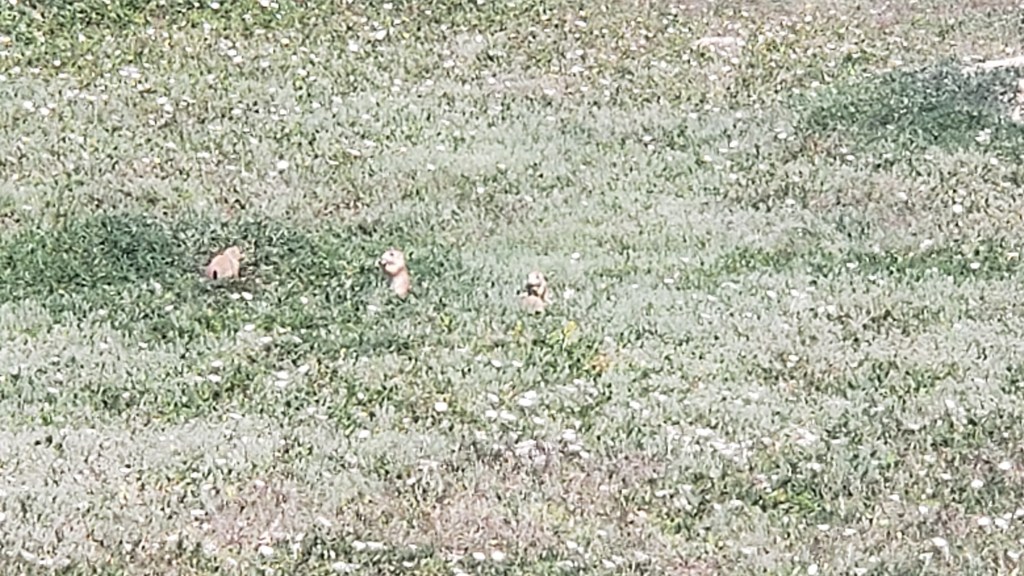
But today nature had three very special gifts in store for us. The prairie dog town, seemingly in just 48 hours, had sprouted dozens and dozens of babies! Tiny and hilarious and full of the joys of spring, they wrestled and barked and made sure their cuteness captivated hearts, and we spent a long time watching their antics.

Theodore Roosevelt National Park South Unit prarie dog babies
Terrible zoom photo, but you can see how tiny they are

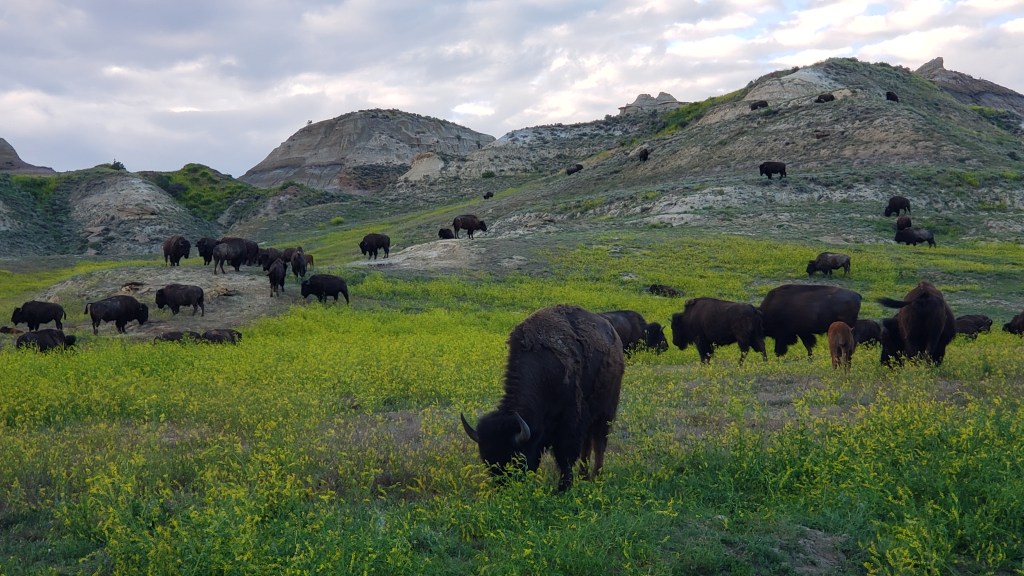
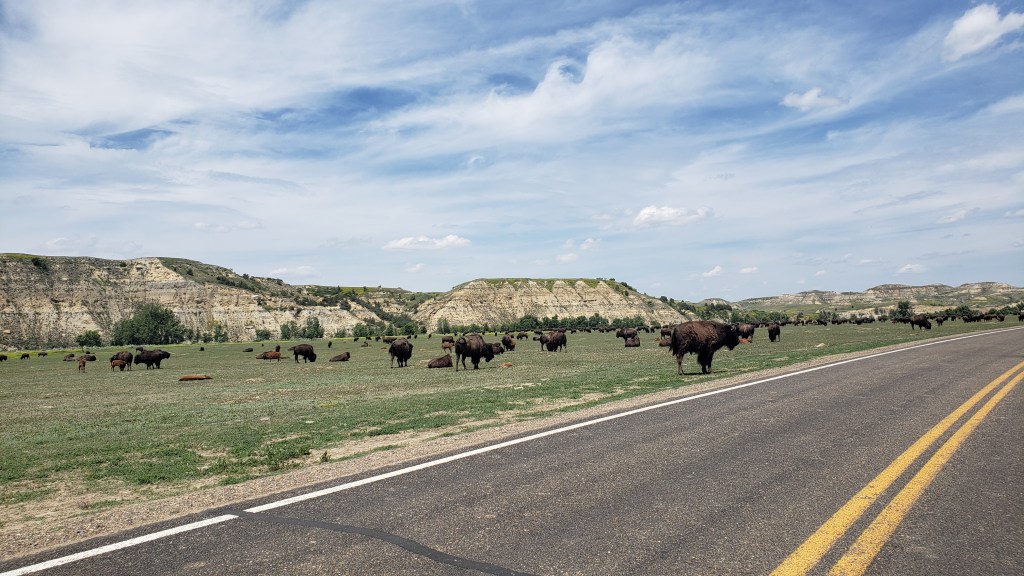
The buffalo took things a step further. As we came down a hillside into a deep valley, there they were, in their hundreds.

Theodore Roosevelt National Park North Unit large buffalo herd
One side of the road, with more on the other side, and they just go on and on

Theodore Roosevelt National Park North Unit buffalo herd

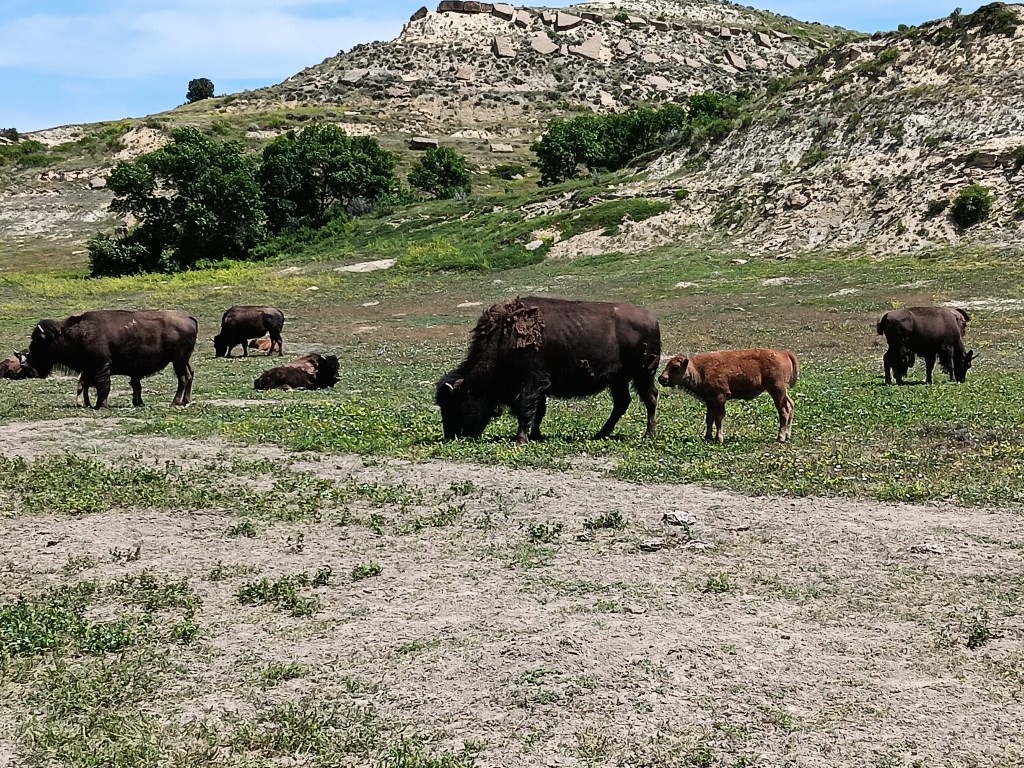
Theodore Roosevelt National Park North Unit buffalo with baby
We saw so many babies!

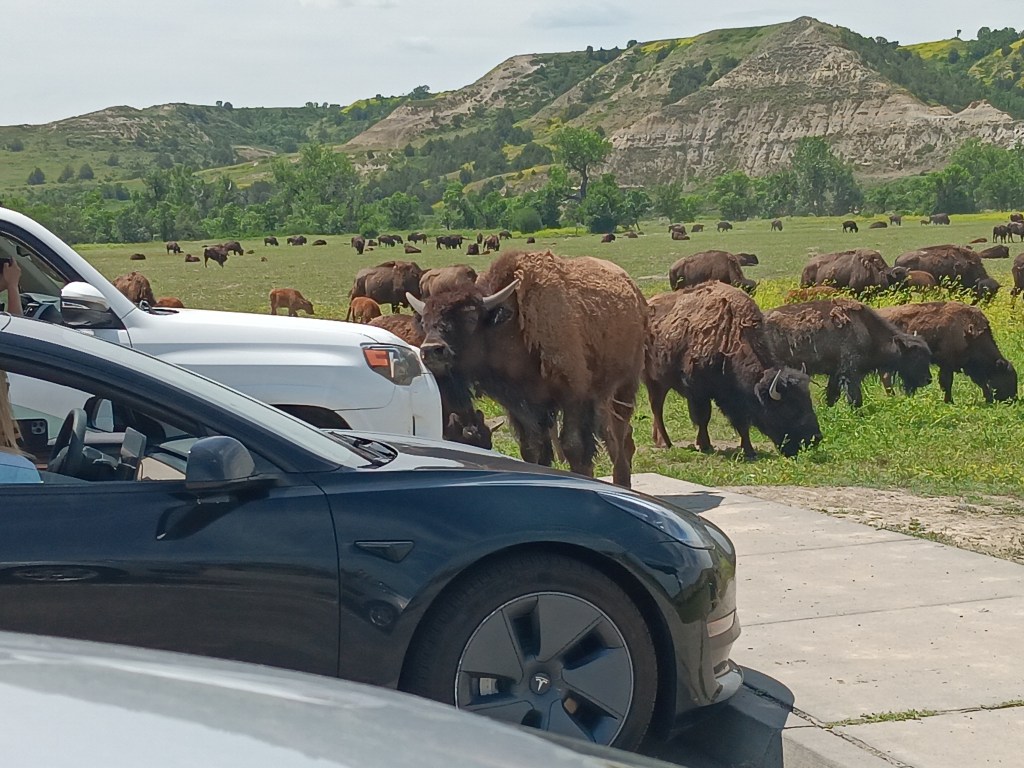
One massive herd took up both sides of the road, and the road itself. We inched our way forward, hoping the people behind us were happy to go slow too, until we found a parking space in the cutout, and that’s when things took an unexpected turn.

Theodore Roosevelt National Park North Unit buffalo scratching on car

This buffalo loves cars. It licked the pickup truck two cars down from us, it rubbed its head against their grate, then it moved on to the car next to us, and finally, as dessert, it began licking our car, chewing on the hookups for our tow bar, and looking us dead in the eye when Ruthie started barking.

Theodore Roosevelt National Park North Unit buffalo looking in front window

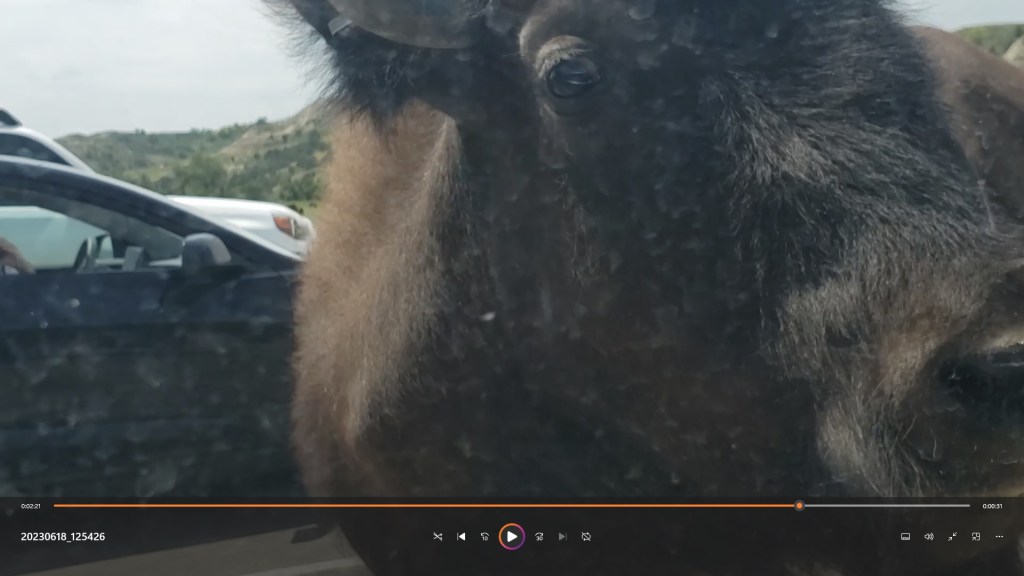
Now, let’s just say buffaloes have huge heads, and those heads have pointy bits. We’ve seen videos of cars the size of Nippy being turned into metal hamburger by enraged buffalo. So when this one came up to Simon’s window and stood there looking at him, we, and everyone around us, wondered what might happen next.

What happened next was, it felt it had made its point without using its points, and it was right. It moved on, leaving us with a thrilling if slightly terrifying memory we’ll treasure forever: The day Nippy got licked by a buffalo.

Theodore Roosevelt National Park North Unit buffalo looking in side window
Eye to eye with a buffalo

If you’ve read this far, you’ve done well. We did have one more special encounter waiting, when we came across not one but two coyotes prowling a prairie dog town. We thought we might witness the circle of life, but they decided to lay down for a nap instead, which was probably just as well. We weren’t sure we could watch prairie dogs being eaten.

Of course, we have no photos of this encounter. They were just out of reach of our zoom lenses. Instead, imagine two scraggly gray coyotes laying in a field, and you’ve pretty much got the picture.

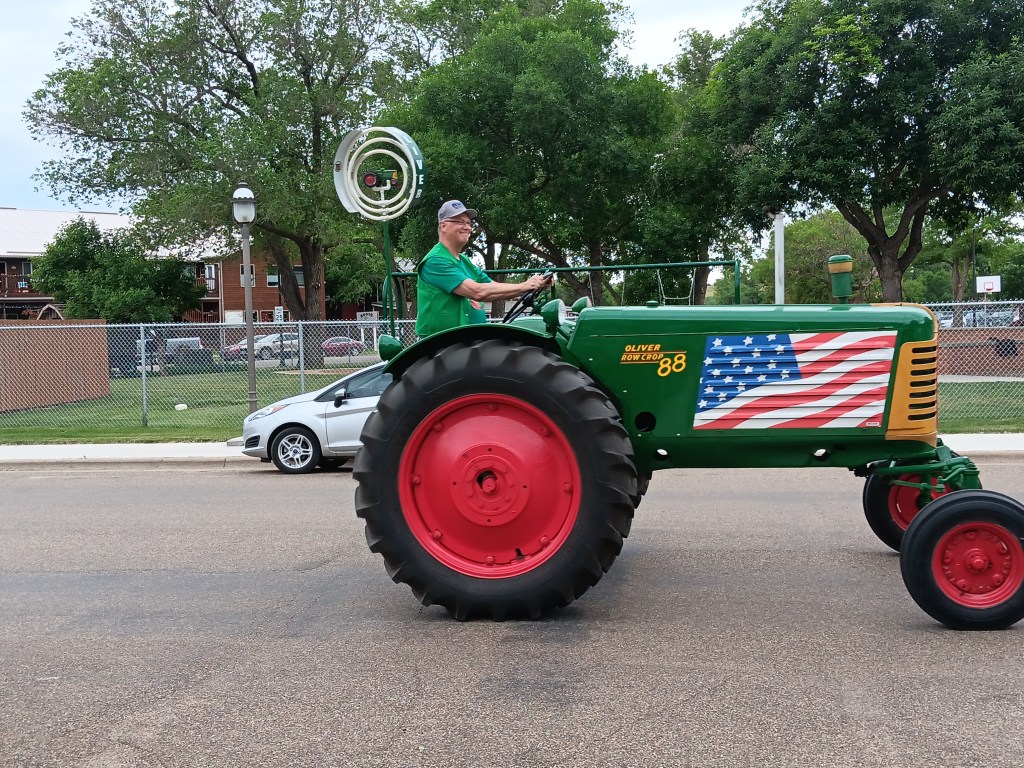
We returned to Medora that evening, a funny little town that was quite touristy, but not obnoxiously so, and while we skipped the $50 per person Medora Music show everyone we’ve talked to since has asked if we saw (we live in Orlando, where shows are second to none but buffalo are non-existent), we did see the tractor parade, and that was enough for us.

Medora SD tractor parade tractor

medora sd tractor parade

Fargo: It’s So Much More Than A Wood Chipper

Fargo wood chipper
Nobody should be smiling when encountering a sight like this

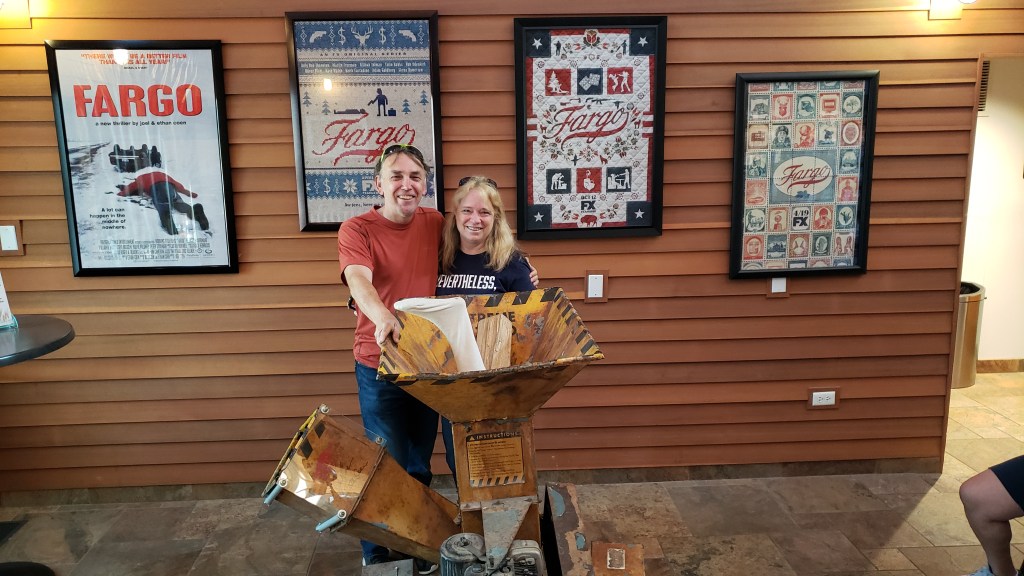
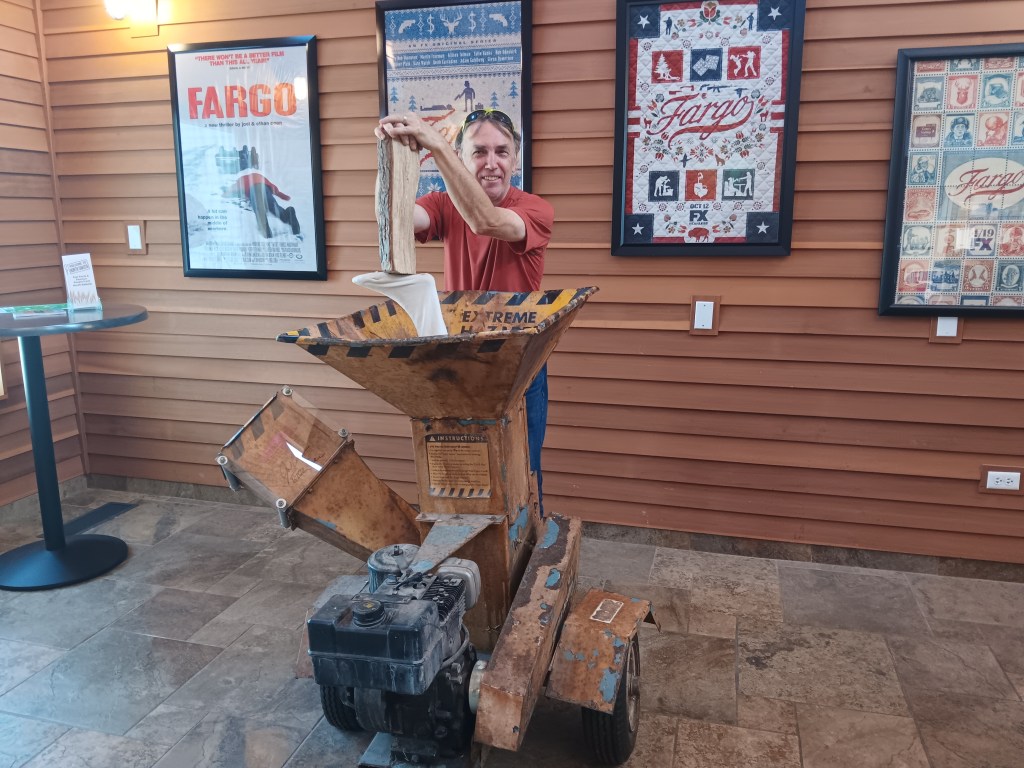
Simon loves the dark comedy movie, Fargo, with its relentlessly evil villains, the dogged heroine Marge, and that chipper no one who has ever seen the movie can forget. The Chipper prop now lives at the Fargo-Moorehead Visitor Center, and it was the reason we put Fargo on our Grand Adventure route.

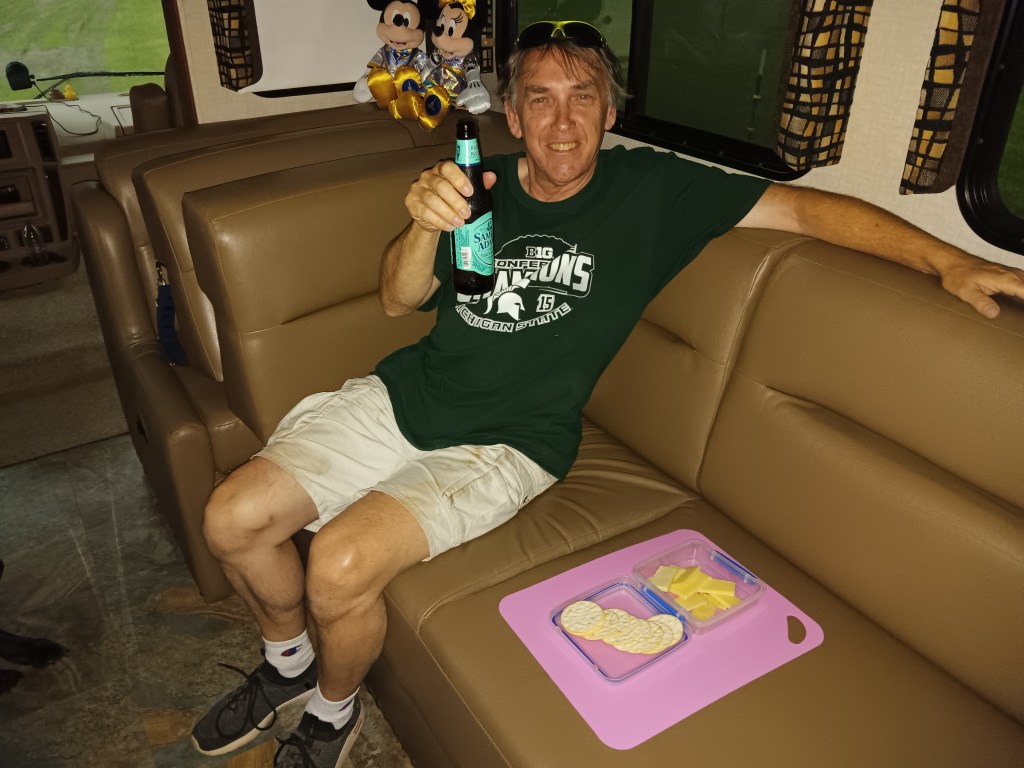
We stayed at a Harvest Host in Minnesota the night before, celebrating Simon’s birthday in high style with cheese and bikkies (crackers for us U.S. folks) and a beer, since we had no access to electricity and didn’t want to use up our batteries (generators aren’t usually allowed at Harvest Hosts), plus we’d had a celebratory lunch and were too full for much more.

Birthday beer
Birthday beer out there on the edge of the prairie (okay, right ON the prairie)

The host location was a farm with horses, goats, chickens, cats with newborn kittens, and a gangly, year-old dog named Pooh Bear.

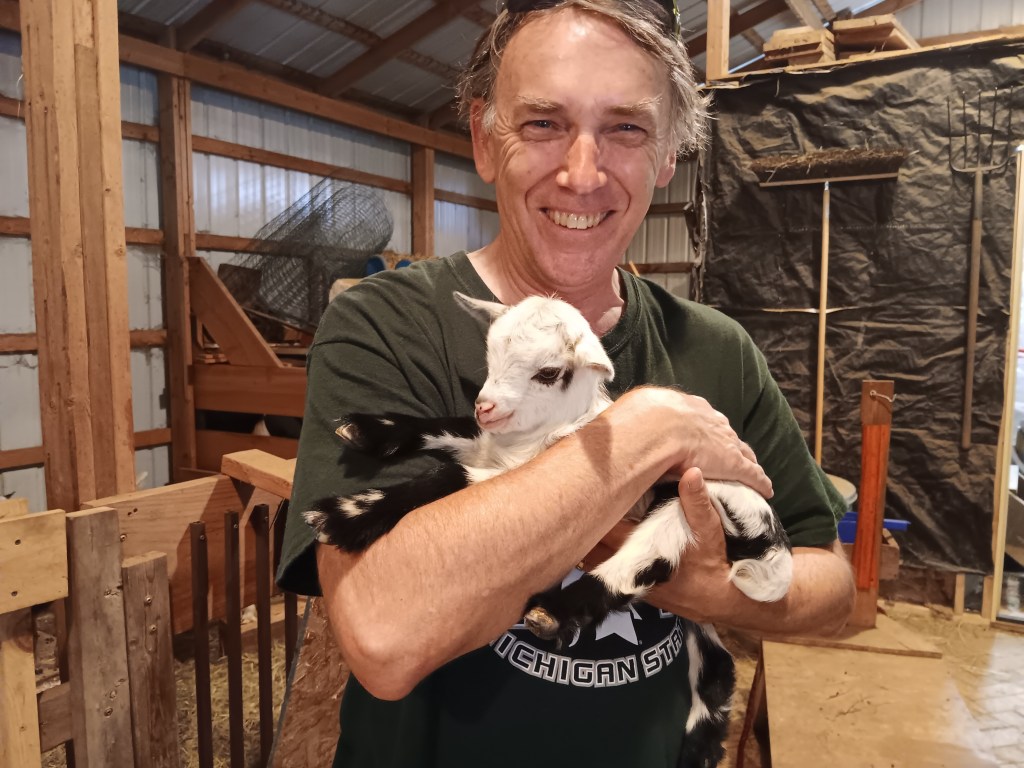
Harvest Host baby goat
It’s so soft!

We got to hold a three-day-old baby goat, meet the newborn kittens, and Simon, always ready to try his hand at something new, milked a mama goat.


We then spent the evening sitting on the front porch chatting with the owners, and felt it was exactly the kind of experience we were hoping to have during this journey.

The next morning we made the short trip into North Dakota, where we had another Harvest Host stay, this time at a winery, and while the sweet wines weren’t to our taste (neither was the eyelid tick), the food was good and we met another RVing couple who had come in from Oregon, which passed a happy couple of hours before heading back to the rig for the night, with a strong wind whipping through the prairie grasses as a small storm rolled past, which we loved.

Harvest Host 4e winery
Moody sky, but we only had a little bit of rain as the storm went past

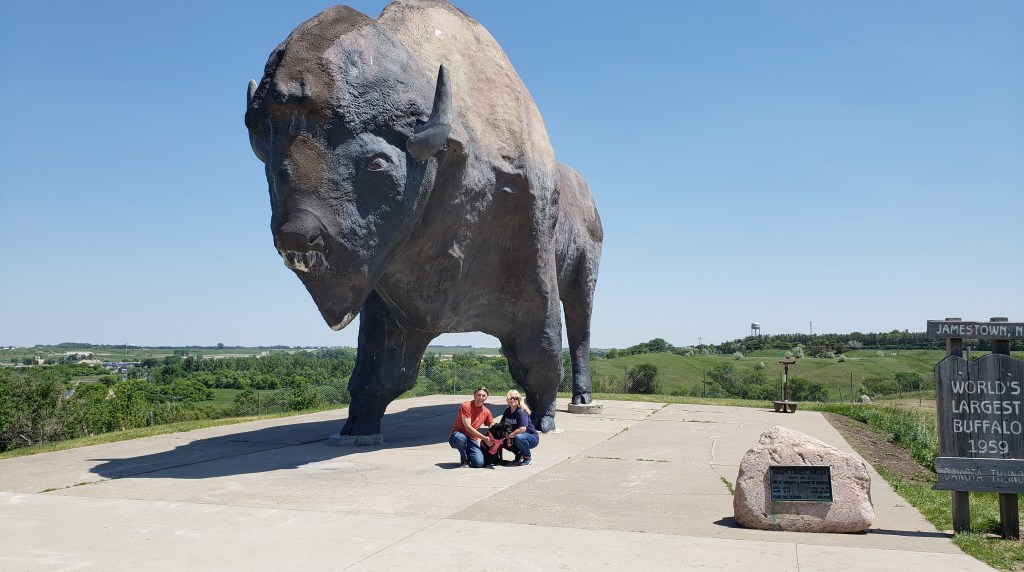
Bismarck was our next destination, with a detour off the highway into Jamestown to see the World’s Largest Buffalo.

Largest buffalo in the world
Imagine the droppings….

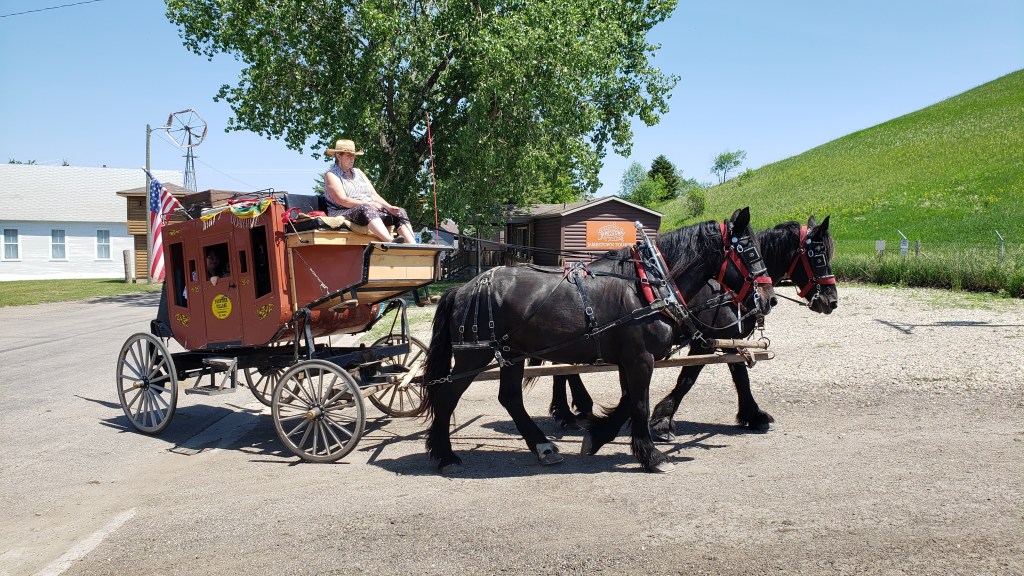
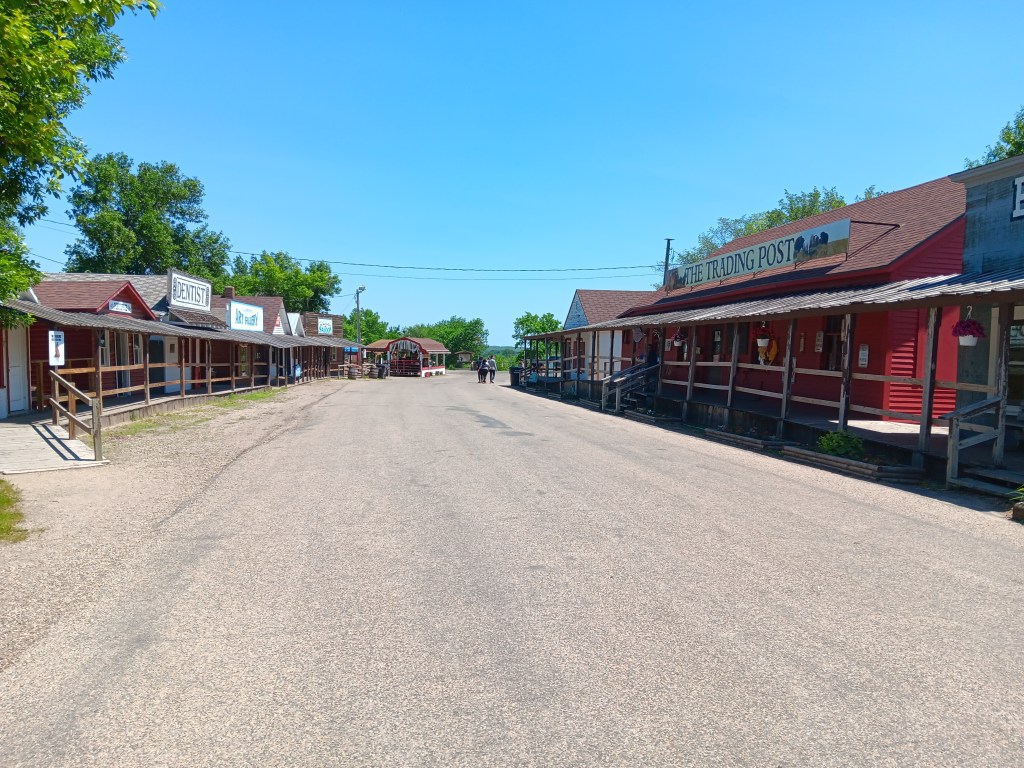
The roadside attraction included a touristy town with stagecoach rides, and it made for a nice diversion on our way to Bismarck.


We woke up early and headed back to Fargo for a photo op with the infamous Chipper. If you don’t know the movie Fargo, it’s the means through which the hapless main character gets turned into the human equivalent of ground beef, thanks to a crazy man with a passion for gruesome murders [Note: Leg in Chipper = hint].

simon with wood chipper
Non-gory recreation of a very gory scene

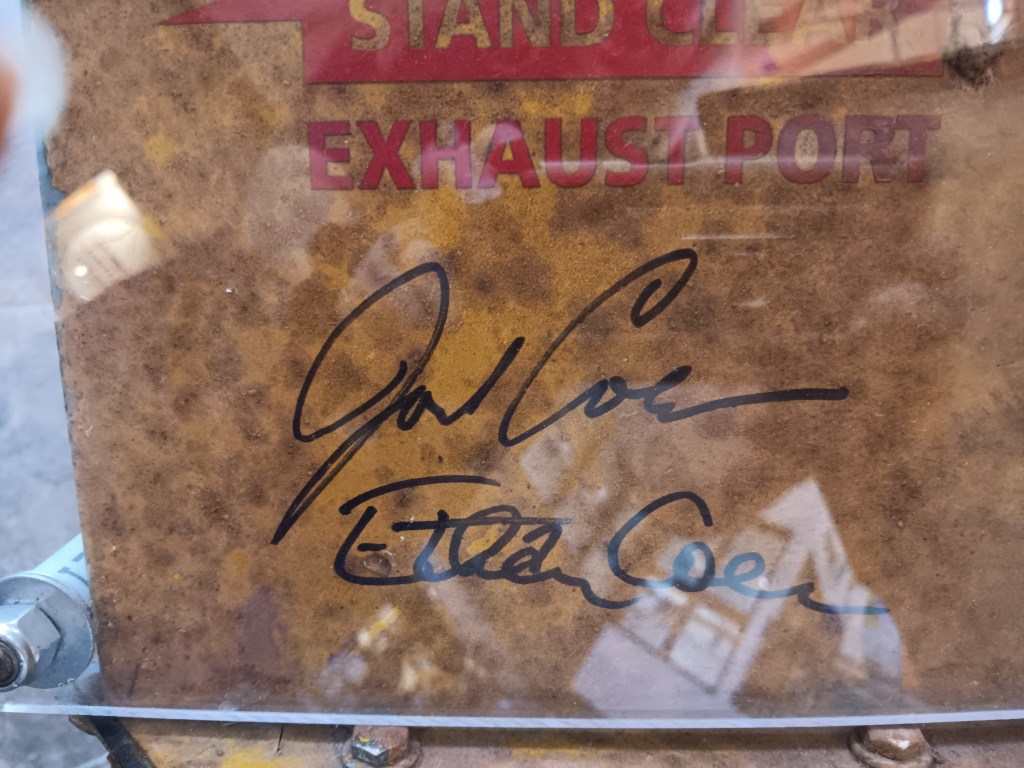
The Coen brothers (Fargo’s producers and directors) signed the Chipper, but there was no way to get a photo of their signatures without glare, so here they are, just as obscure and unfathomable as the movie the brothers created.

wood chipper signatures
Appropriately scrawled across the “exit”” end of the chipper, where whatever you shove into it blows out. Across the snow. All bloody.

Our next campground (with full hookups!) was Hillcrest Acres in Bismarck, a small, pretty place appropriately located on a hill, a forerunner to the scenery we’d see as we drove around the area for the next few days.

Hillcrest acres campground
Fati getting comfortable

Countless times, we wondered how those hills (variously called “buttes,” “hills,” “points,” and “ridges”) formed, why most were grassy but some were bare, and why glacial movement made North Dakota so undulating, but Michigan so flat. Wind and water played their part, but we’d like to talk with a geologist to find out more. That’s one of the beauties of travel; it inspires curiosity.

north dakota butte
These odd outcroppings are everywhere

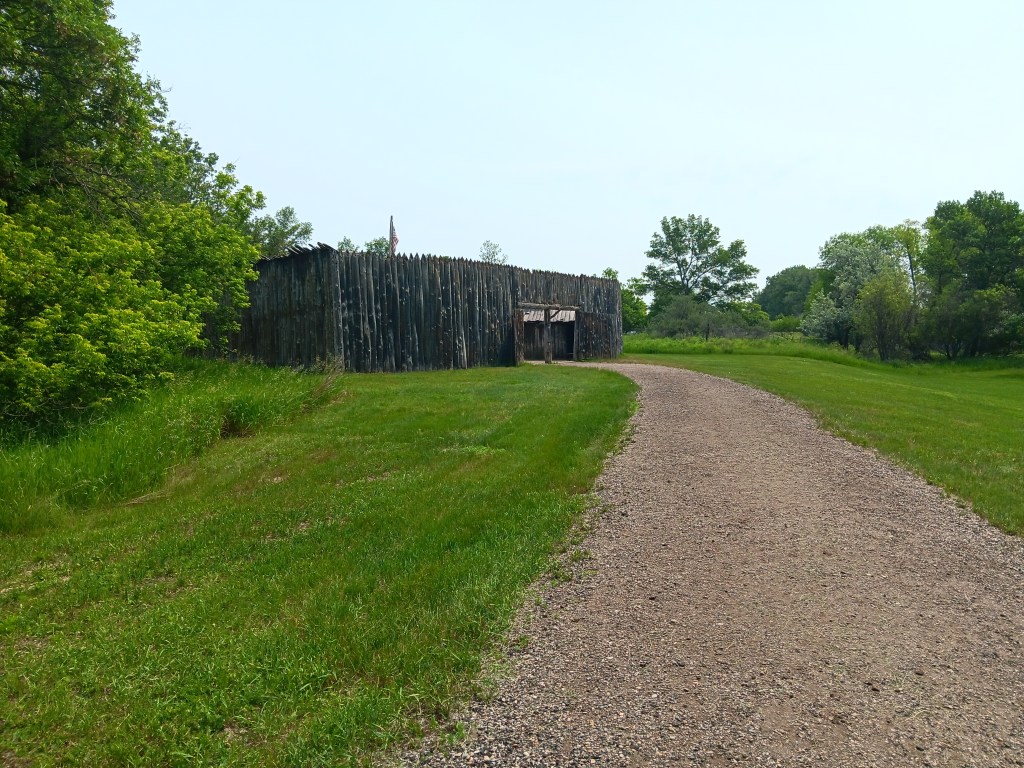
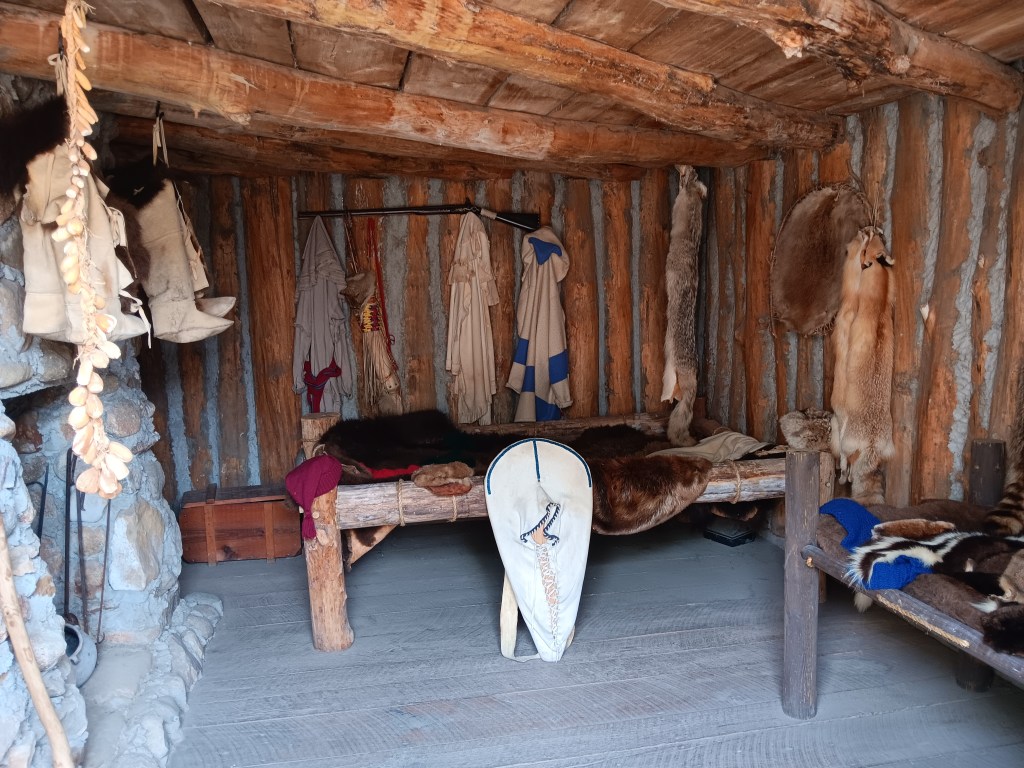
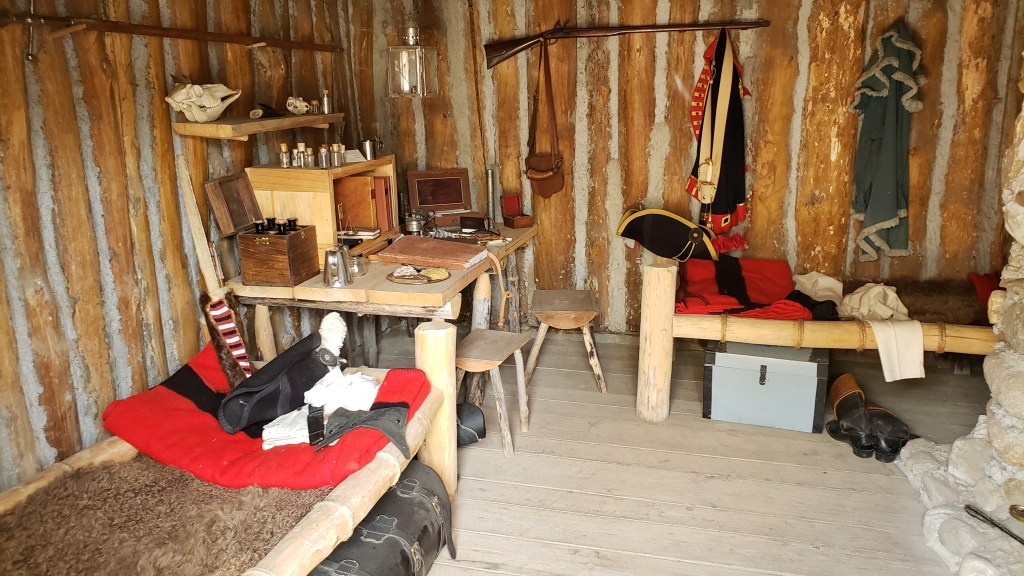
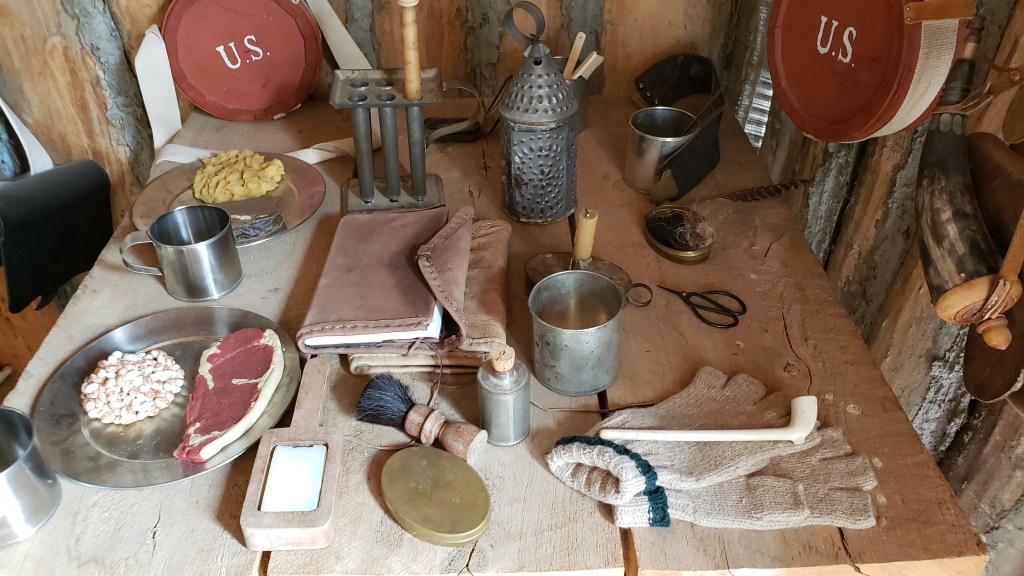
Our first full day took us to Washburn, where we discovered the restored Fort Mandan, in an area the Lewis and Clark expedition spent the winter of 1804. The fort had various tiny rooms, such as quarters for soldiers, interpreters, and the captain, plus a smokehouse, blacksmith, and storage room.

Fort Mandan

Fort mandan interpreter room

fort mandan room

fort mandan room details

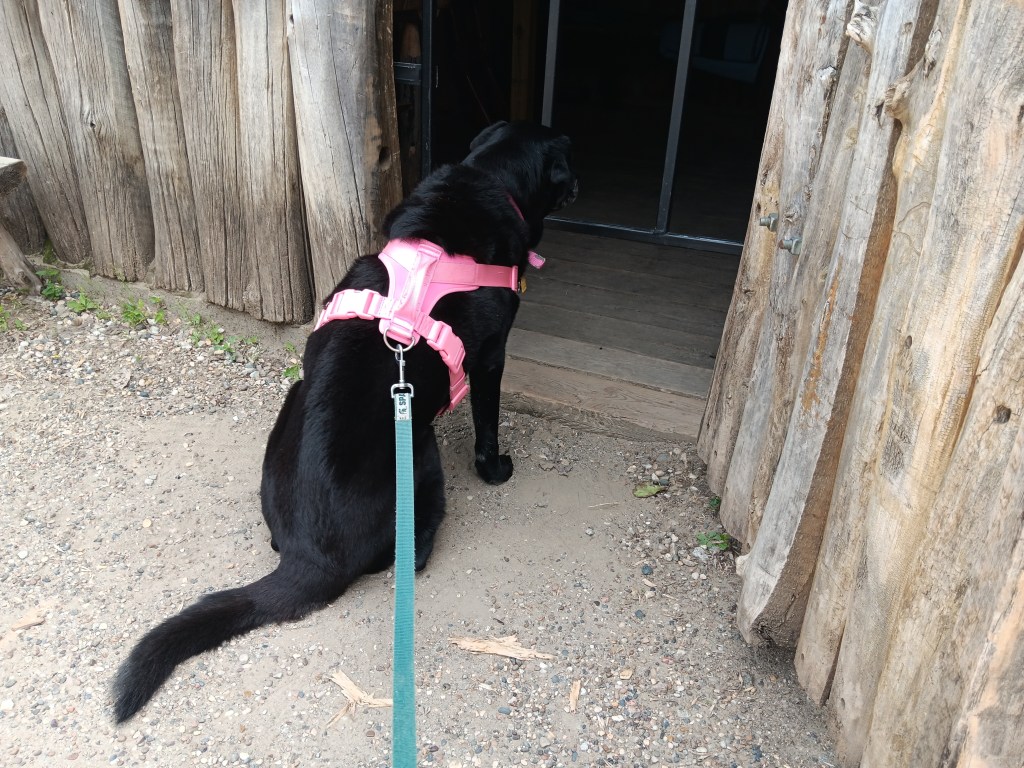
Ruthie was absolutely captivated by the Sargent of the Guard’s quarters and didn’t want to leave. We don’t know why, but she was very clear about wanting to stay.

ruthie fort mandan
We tried not to read too much into it, but “past lives” certainly came to mind

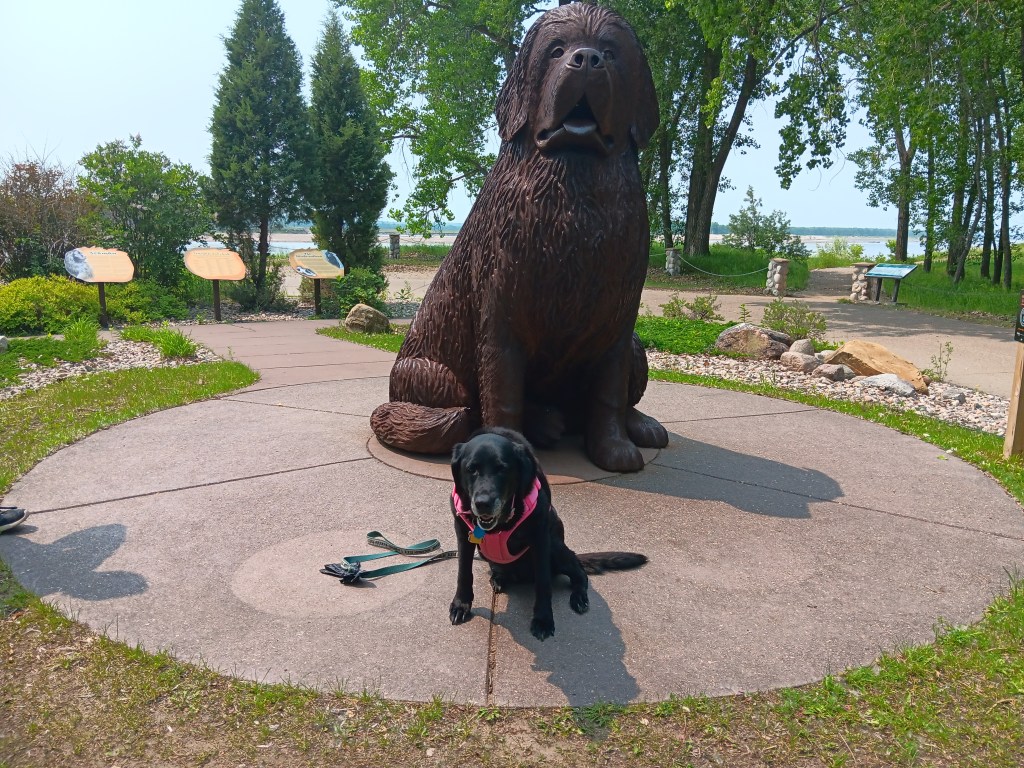
She was less captivated by the statue remembering Seaman, the faithful Newfoundland dog who traveled with the expedition, but she dutifully sat for a quick picture.

seaman statue

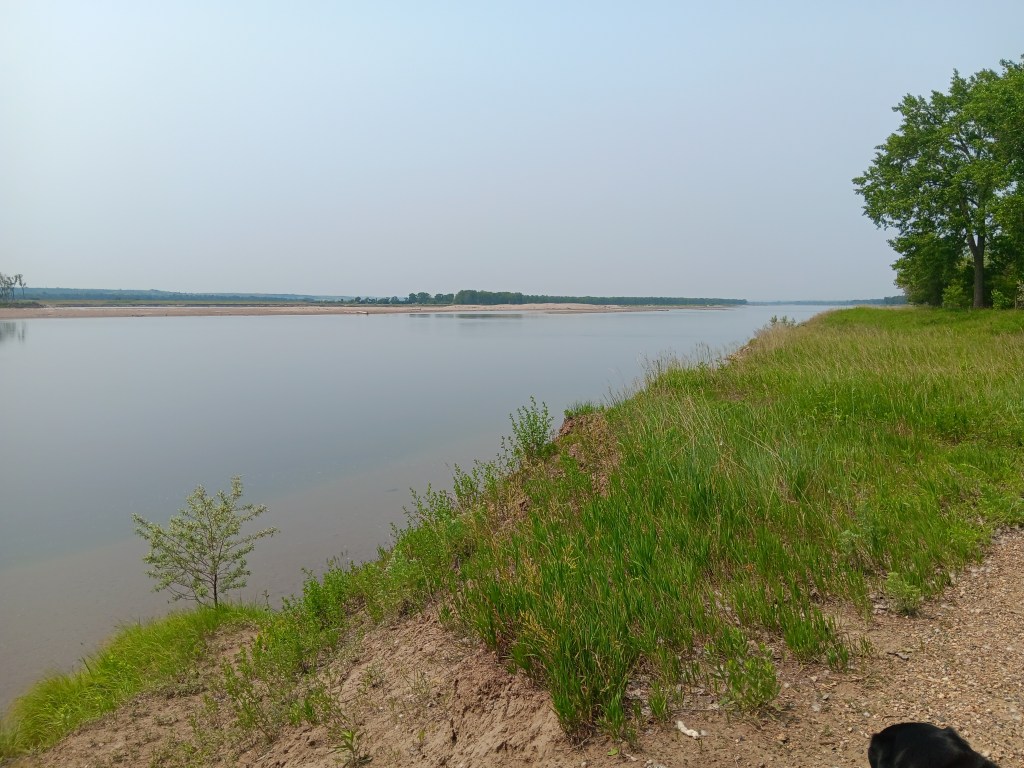
A short stroll beyond the statue rewarded us with our first up-close view of the Missouri River, whose waters were low and many big sandbars could be seen. We would cross over the Missouri several times in the following days.

missouri river

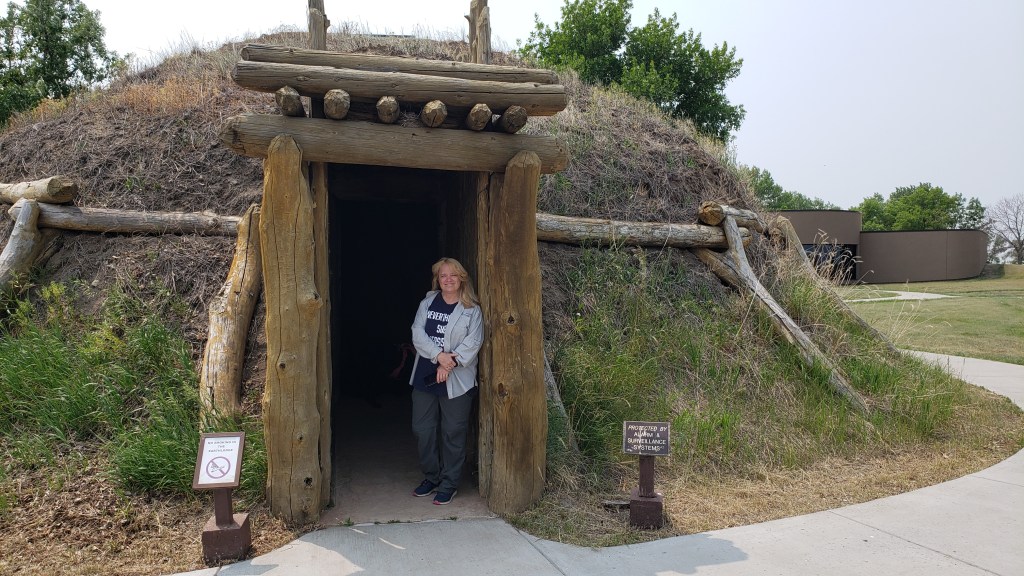
Just a short drive away from the fort was the Knife River Indian Villages National Historic Site (using their cultural terminology, not the terminology we might have chosen), with a recreation of a Native American earthlodge that marks the area many tribes used as a trading center.

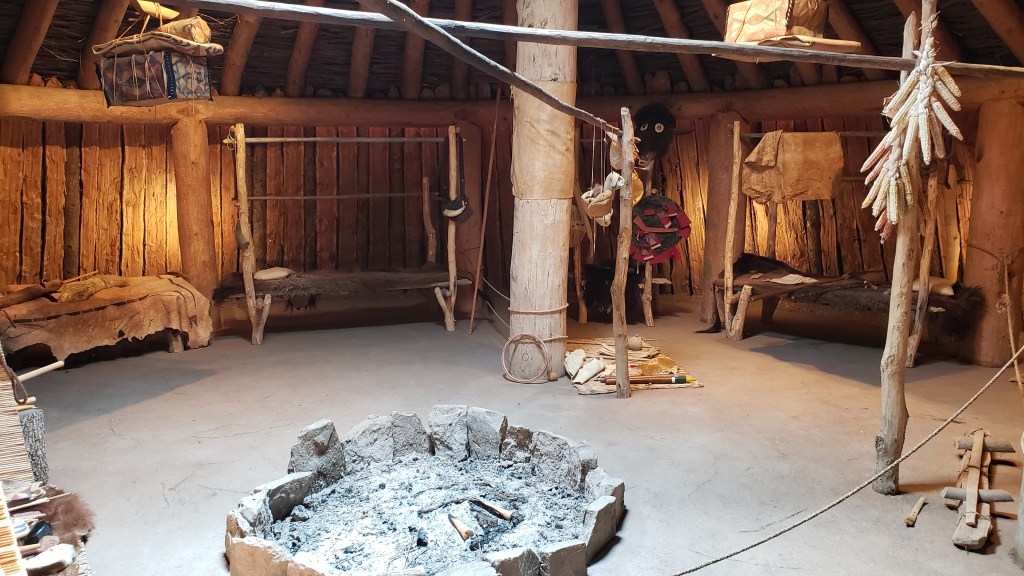
A buffalo hide acts as the doorway into the lodge, and inside the temperature is about 10 degrees cooler. A deep, smokey smell permeates, which gave us a small sense of what living inside it would have been like. Ruthie lost her mind in there, loving all the new sniffs.


The visitor center here was superb, giving an excellent overview of two tribes and their lifestyles. Although the day was cool and we could safely leave Ruthie in the car for a short time, we had to turn down the host’s offer to watch a movie, as our Floridian sensibilities made us uncomfortable leaving her for very long. But the exhibits were terrific, and we felt we learned more about the people who once lived there.

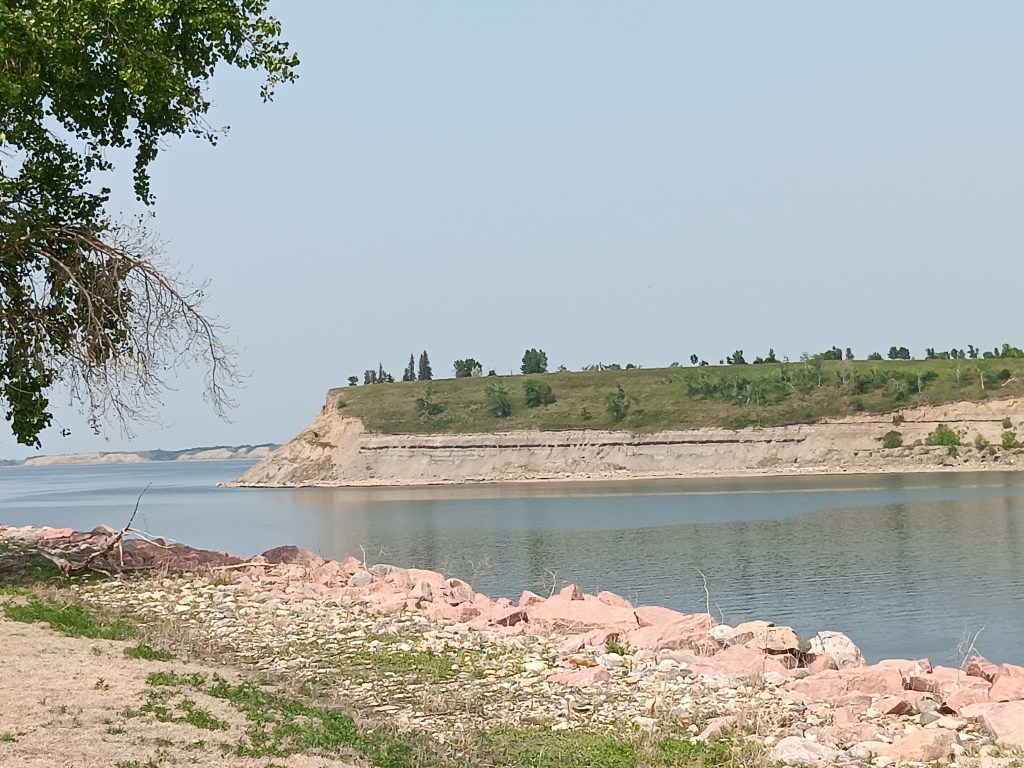
We drove further west for Lake Sakakawea (pronounced here as Sah-KAH-kuh-WEE-uh, not Sack-a-juh-WAY-uh), a huge lake set below stark cliffsides, which must be ideal for boating on summer weekends. The history of the lake is, predictably, one of eminent domain, force, and the subsequent throwing-of-a-bone in naming it after a famous figure who (it is my opinion) probably had as little say in her destiny as the land that now holds the lake named for her did.

lake sakakawea
A small slice of Lake Sakakawea

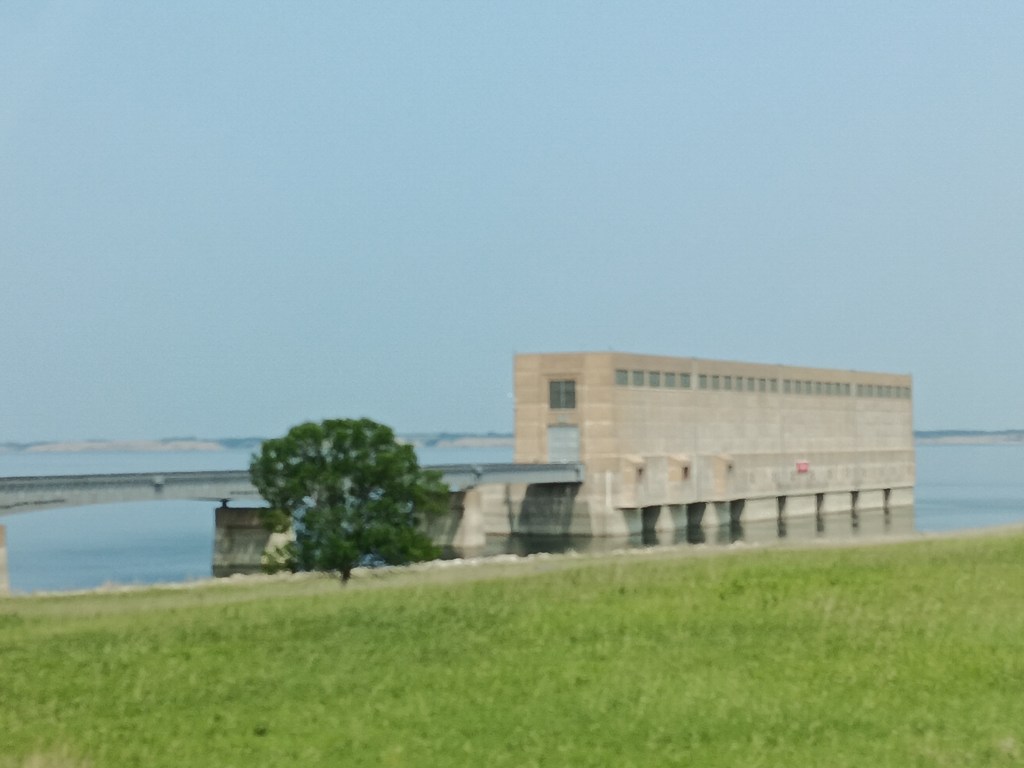
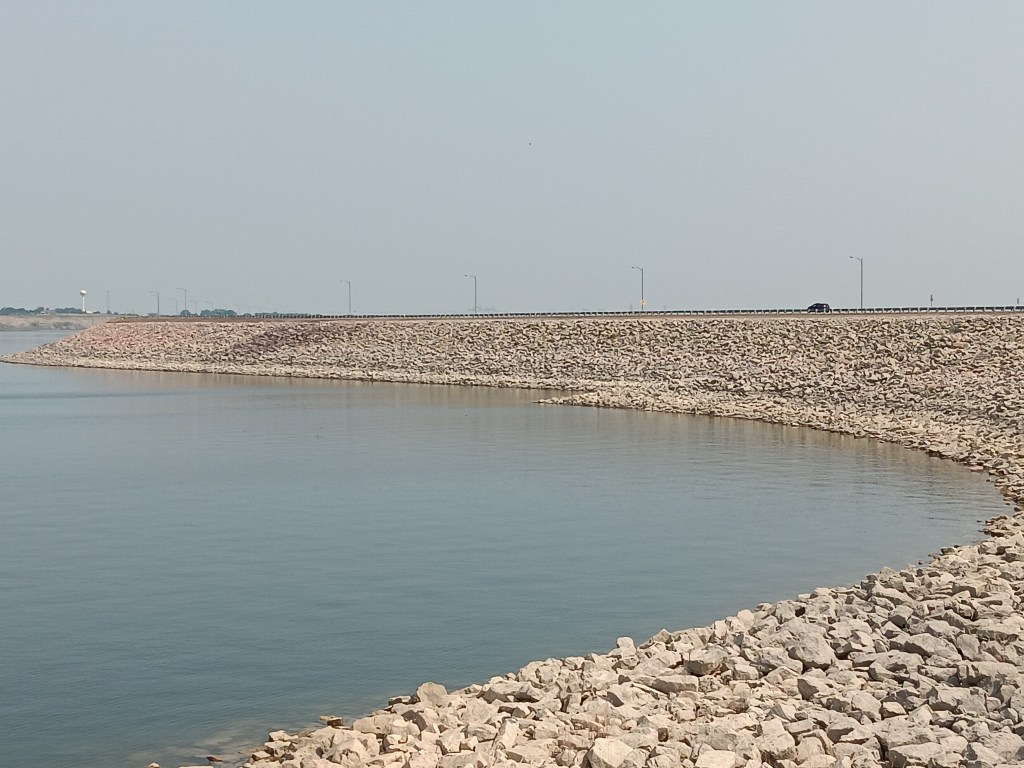
This is the site of two-mile-long Garrison Dam, a three-part set of structures built by the U.S. Corp of Engineering in 1953, that includes a pump station…

garrison dam pump house

…the dam itself…

garrison dam

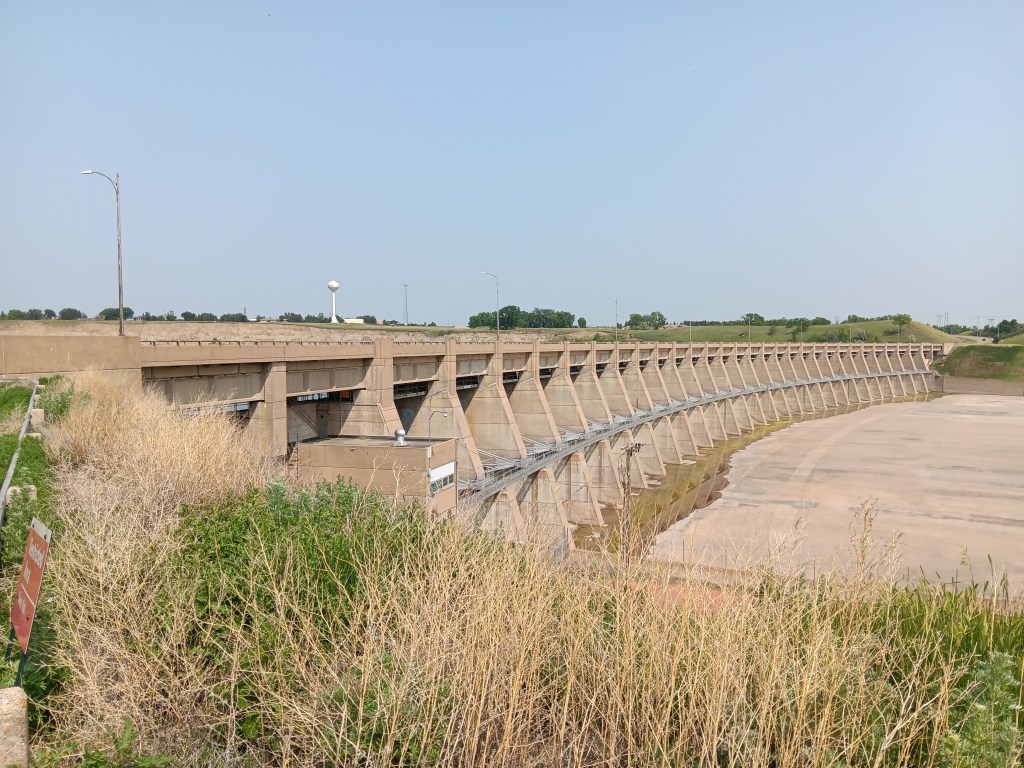
…and a spillway that helps route water back into the Missouri when levels get too high. Neither of us are geeky in that way, but it was truly fascinating, and we spent a fair bit of time pointing and saying, “I wonder what that’s for….”

garrison dam spillway

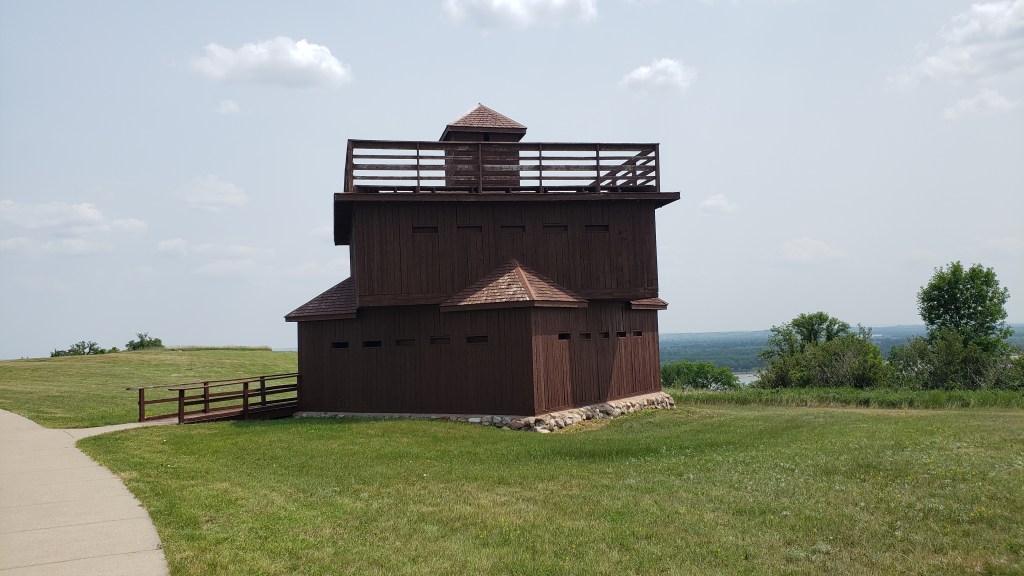
North Dakota’s oldest state park, Fort Abraham Lincoln State Park ($7 to enter), was our next stop, with three re-created blockhouses overlooking the Missouri River. On breezy summer days, the many narrow lookout windows must have afforded an excellent breeze. In winter, it must have been cold enough to freeze the brass whatsits off a monkey.

Fort Abraham Lincoln blockhouse
One of the three blockhouses

fort abraham lincoln window
There are several of these narrow windows all around the blockhouse, some with fabulous views

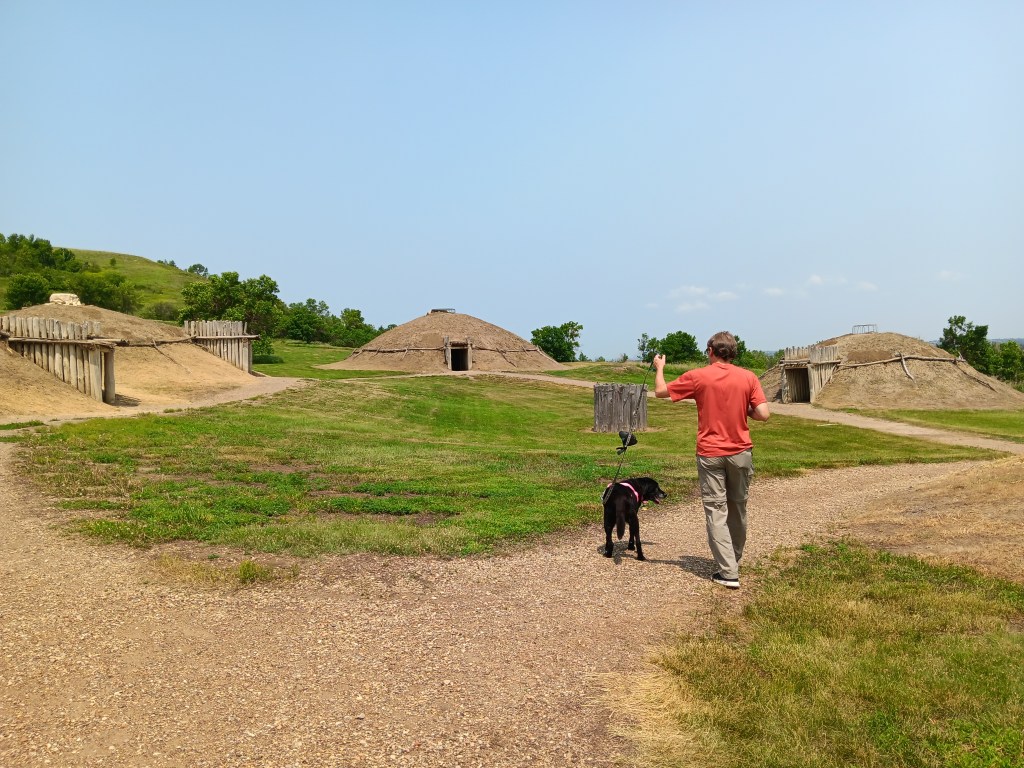
On-A-Slant Indian Village was within the park’s boundaries, too, and the earthlodges here were beautifully displayed, along with panels that described life in the Mandan tribe village from 1575-1781.

On-A-Slant Village

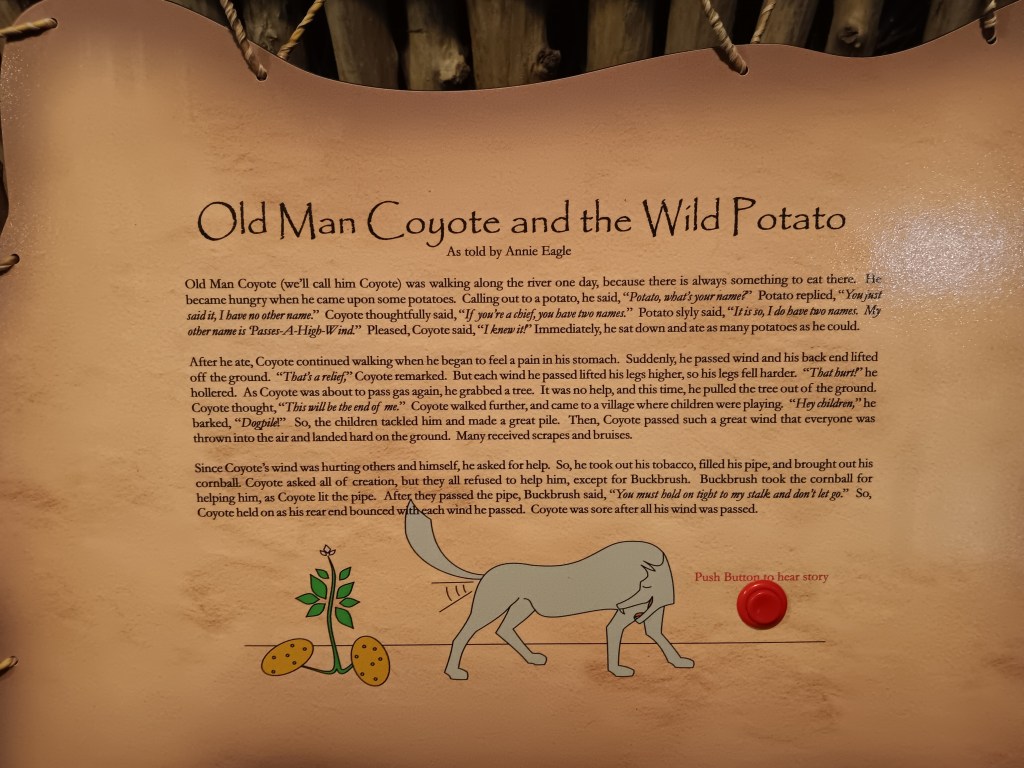
We were captivated by the idea that boys in the Mandan culture learned to shoot with accuracy by playing a game that involved throwing a hoop into the river and shooting an arrow into its moving center. According to an exhibit we saw, it was their belief that the dead buffalo they found floating in the river with each spring thaw were a result of these games. All of the children would have been treated to funny stories that told important tales.

Old Man Coyote and the Wild Potota legend

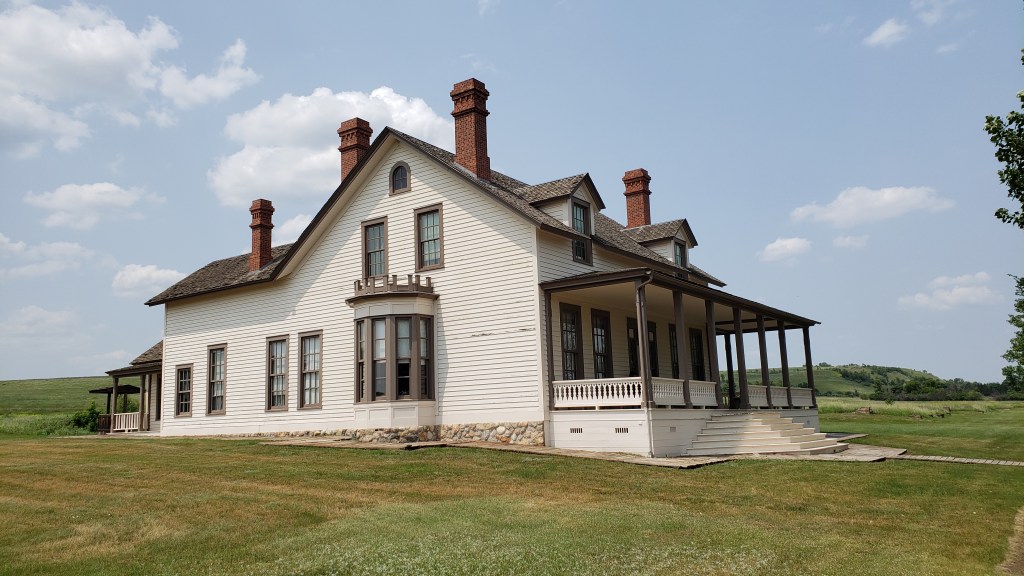
On the way out of the park, Simon made a quick right turn when he saw a sign for Custer’s House. We couldn’t take Ruthie in it, so we agreed Simon would check out the house while Ruthie and I waited in the car with the air conditioner on.

Custer's house
Spot the docent? No, you don’t, and neither did Susan

Twenty minutes later he was still standing on the house’s porch, so the following phone call ensued:

Susan: Hey. What’s going on?
Simon: Oh. Yes. It’s nice to hear from you. Uh-huh. I’ll let you know when I’m there.
Susan: What the hell are you talking about? I can see you standing on the porch, so I’ll certainly see you when you get back.
Simon: Okay, thanks! All the best. Bye for now.

When he got back to the car, he detailed the conversation a docent sitting on the porch (whom I couldn’t see) had at him. Not with him, at him. Simon asked what rank Custer was during the war, and 20 minutes later he knew everything from Custer’s blood type to his favorite dessert and whether he preferred tighty-whities or boxer-briefs. (Okay, not really, but the docent talked for a full 20 minutes, and Simon had to pretend I was someone important so as to break off the dissertation gently and with respect).

For those who cannot bear not knowing, it turns out Custer was a Lieutenant Colonel during the battle at Little Bighorn, but was a General during the Civil War and was allowed to keep that designation as an honorary title when that bloody war ended.

We finished the day at Standing Rock, an important stop along the Native American Scenic Byway. Our goal was to visit Sitting Bull’s burial site, which we found after many wrong turns, having blown past it on the way into town. Most people probably do that, too. There is only a small sign on the side of the road that indicates where this great man’s resting place is (or rather, was; he’s since been moved at the request of his grandchildren).

Sitting Bull burial site

The grand brochure we were given at the Fargo visitor center did not prepare us for what we found at Standing Rock. Perhaps we missed the highlights, though we’re not quite sure how we could have. Instead – and we’re assuming a LOT, all of which may be wrong – we found a town completely void of energy, as if a total lack of opportunity and a heaping helping of injustice held the place and its people in a state of downcast limbo. We’ll end our sweeping assumptions there, and, with heavy hearts filled with compassion, put our energy into hoping all good things come to the people who, by choice or by historical force, make it their home.

How Northerners Spend Their Time

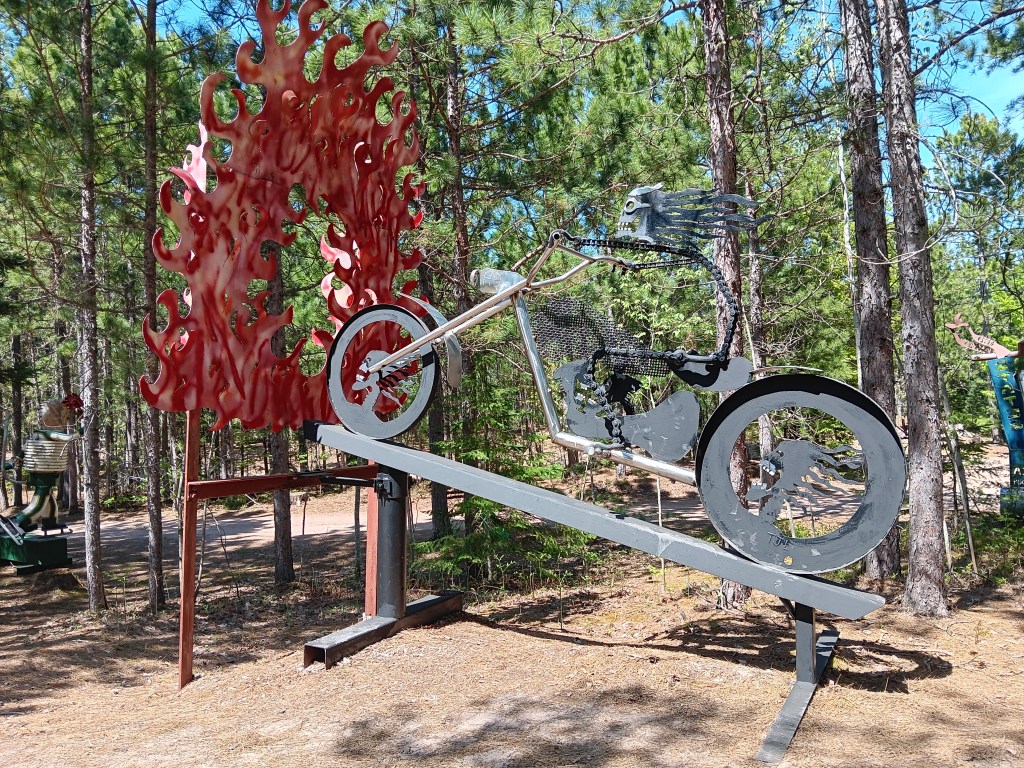
Lakenenland motorcycle skeleton
The winters here are long and dark

A trip back to Marquette to pick up a prescription was necessary, but a bizarre roadside attraction recommended by our dear friend Julie helped break up the trip, and, ultimately, made the whole journey worthwhile.

Lakenenland sign

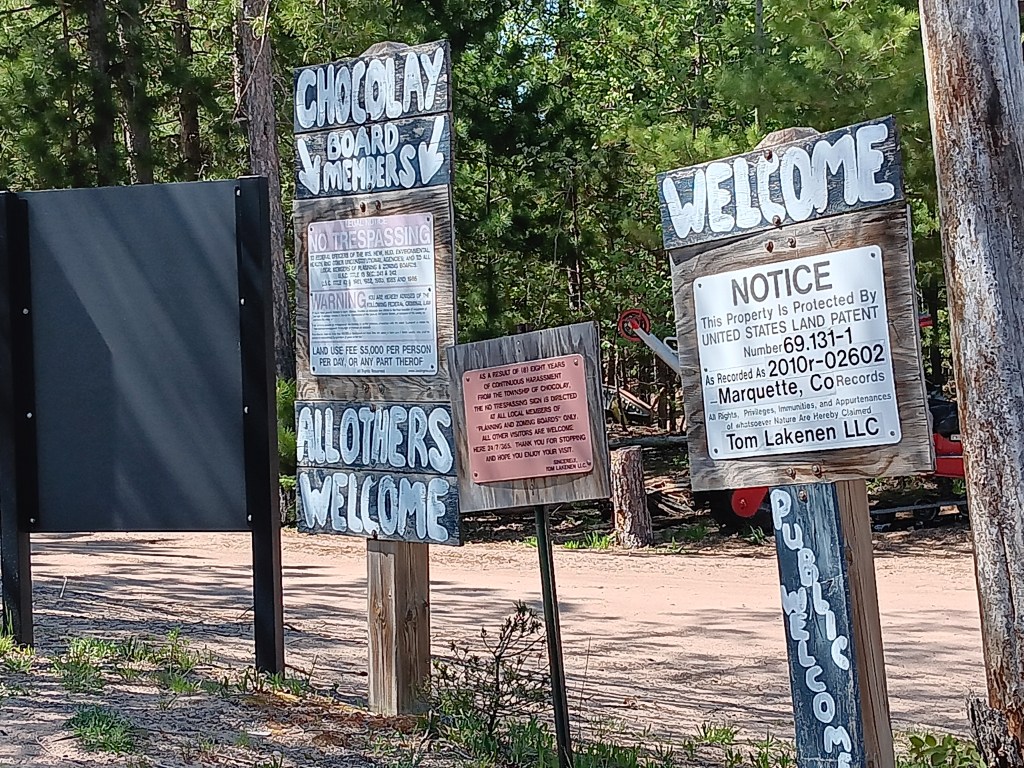
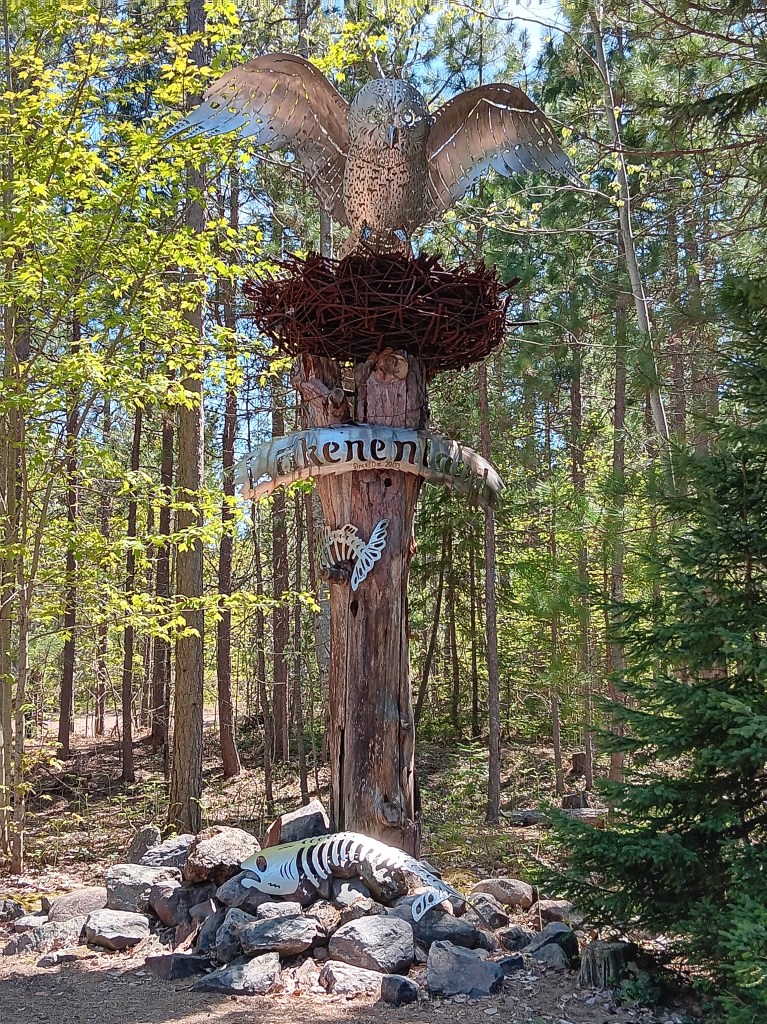
Lakenenland’s tongue-twister of a name hints at the quirky nature of the place, and the deliberately placed warning signs before entering the always-open always-free drive leaves no doubt there is a story behind its current location. The smaller sign reads:

“As a result of (8) eight years of continuous harassment from the township of Chocolay, the No Trespassing sign is directed at all local members of planning and zoning boards only. All other members are welcome here 24/7/365. Thank you for stopping and hope you enjoy your visit. Sincerely, Tom Lakenen”

Lakenenland welcome sign
Clearly, there has been some animosity

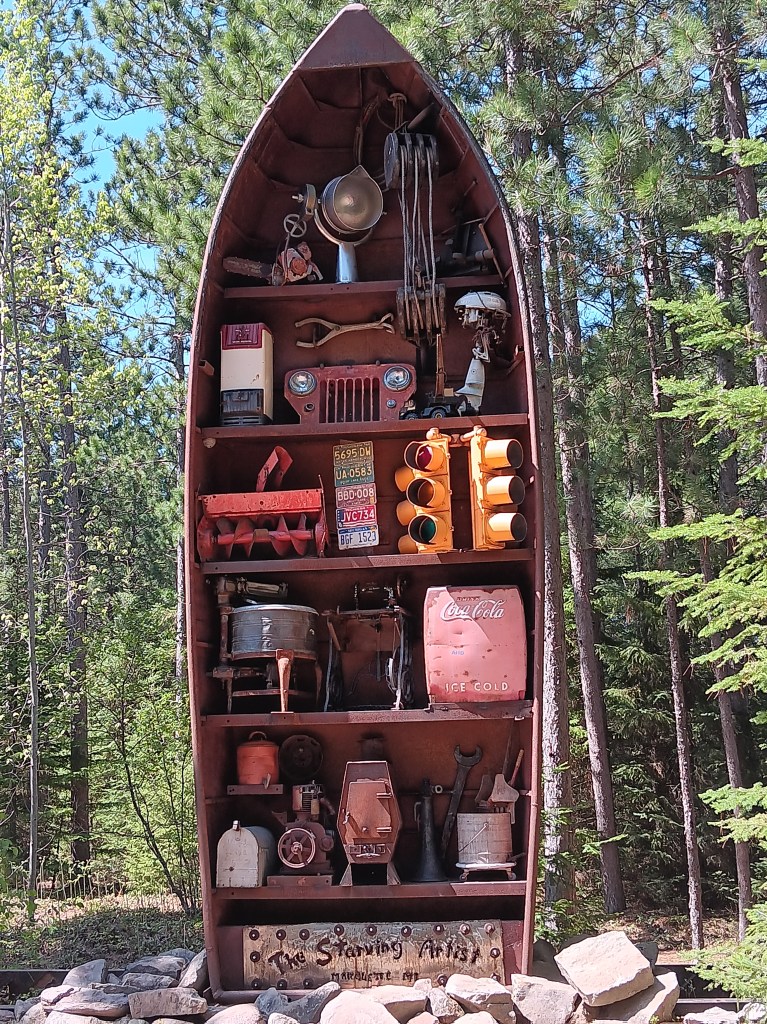
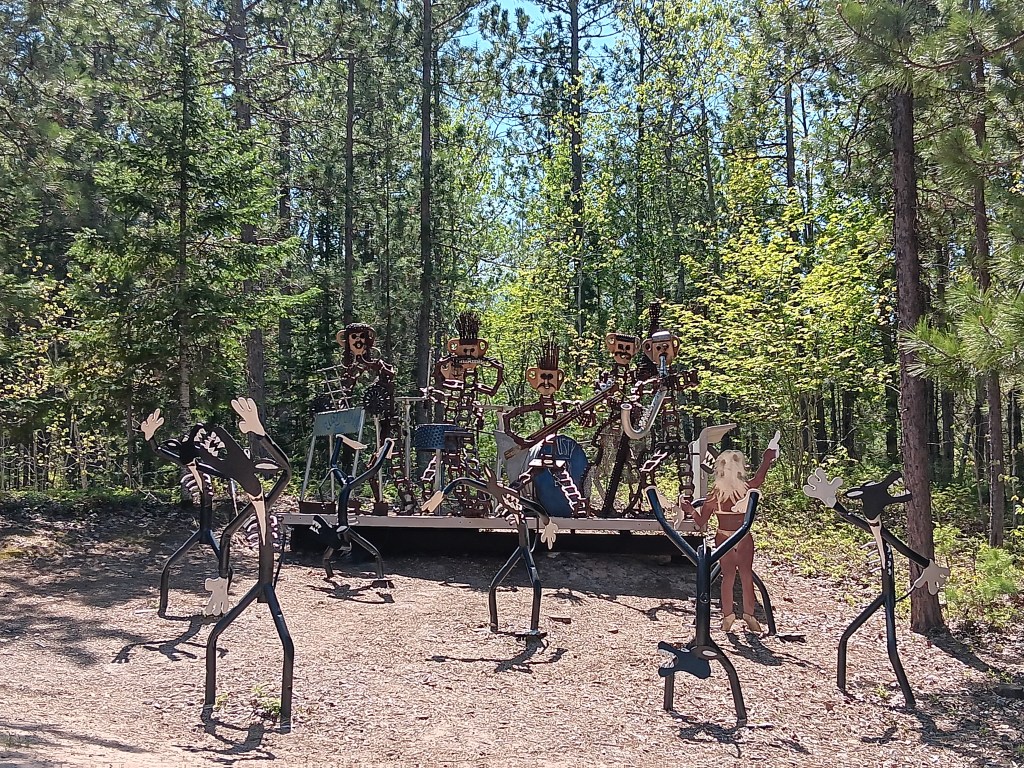
We’ve never been on those boards, so we spent a happy half-hour driving past various objects the intrepid Mr. Lakenen assembled into works of unusual art.

Tom has opinions, too, and (luckily for our mental health) we agreed with his support of front-line workers, nurses, and people who are currently being maligned by the likes of Florida’s dictator-wannabe. But most of the art is just fun, even when it’s a bit head-scratching.

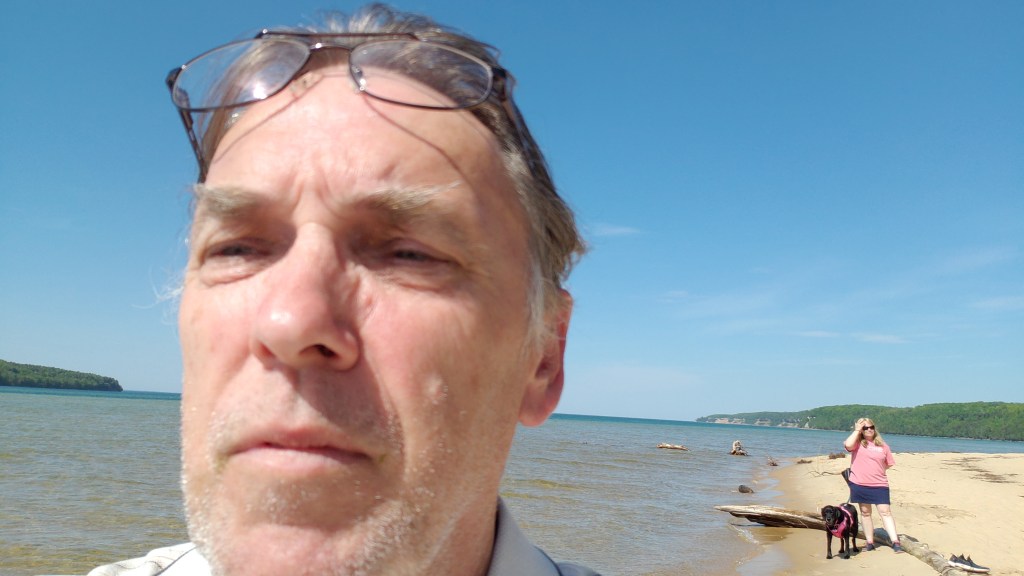
We returned to Pictured Rocks National Lakeshore’s Sand Point for a final walk along the beach and were treated to two water rescue planes (Coastguard, maybe) doing training sessions. This is a photo of them landing in the bay. At least, it would have been if Simon had realized he had the camera’s lens turned to “unintentional selfie.”

Simon unintentional selfie pictured rocks national lakeshore

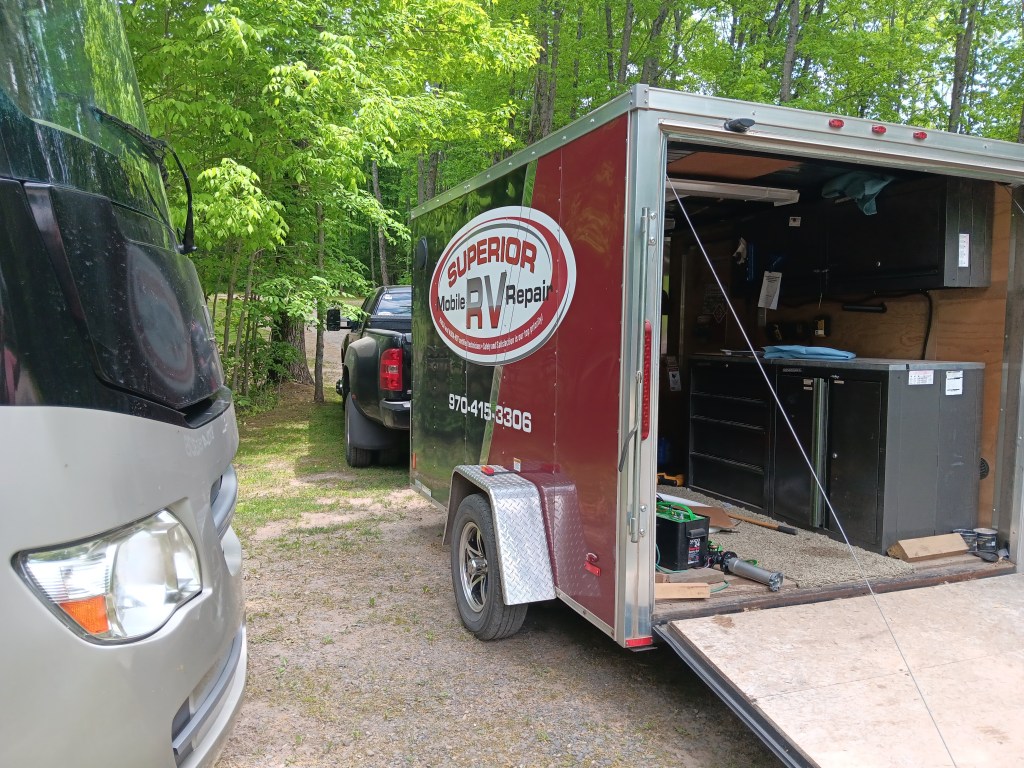
Even so, the magnificence of the beach and the lake was an ideal “goodbye” to the area, as we prepared for our speedy trip to the pretty Pentoga Park Campground in Crystal Falls, Michigan, where, we were assured, our hot water heater and water pump problems would be solved by mobile RV mechanic, Scott, who we found through our now-familiar go-to company, MyRVResource..

Superior Mobile RV Repair

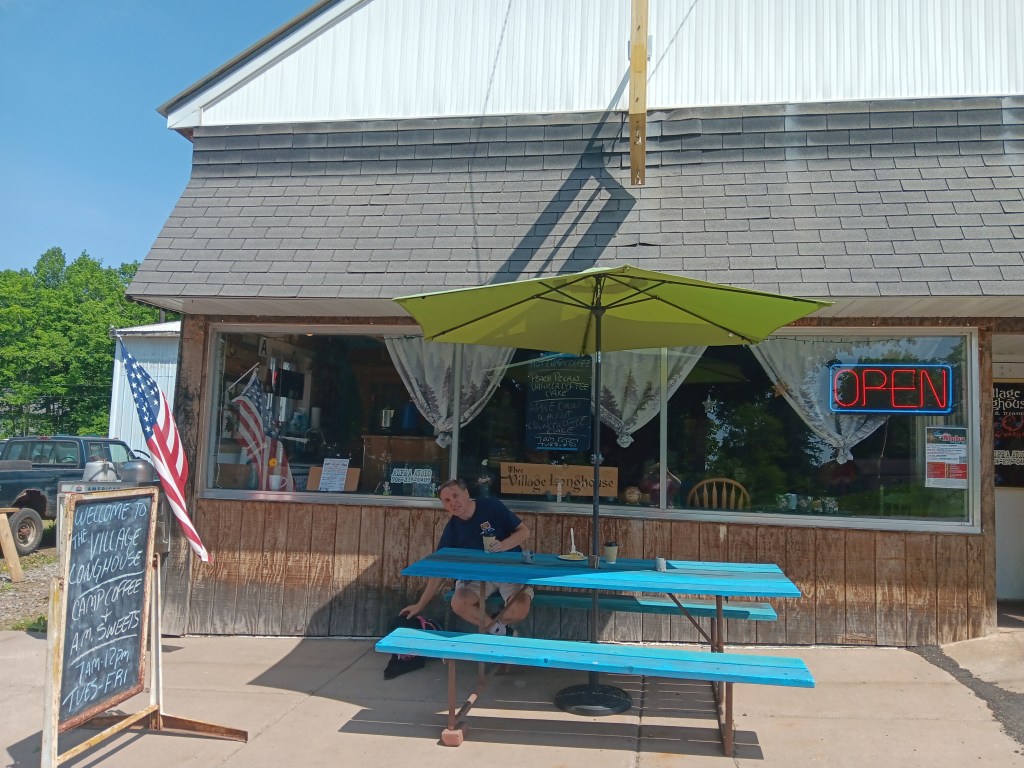
With such a short distance to drive to the campground, we stopped in the impossibly tiny town of Alpha, where we found The Village Longhouse, a cash-only coffee-and-cake stop that would waste an hour or so, allowing us to arrive at the campground right at check-in time.

The Village Longhouse Alpha Michigan

While we were sitting in the shade with coffees and a piece of cake to split, one of the locals came out and asked if he could join us, saying, “I’m used to the people inside. I like it when there’s new blood I can talk to.”

In the U.S.’s current political division, we had some concerns about how this was going to go, but it seems we met a somewhat rare liberal in Upper Michigan, and the next hour passed quickly as we shared stories of travel and politics. Finally, it was time to leave, and in a short time we were pulling into the campsite, where the friendly camp host shared photos of her dog and let us scope out a site that was as level as possible.

Pantoga Park campground Crystal Falls Michigan
Pantoga Park campground

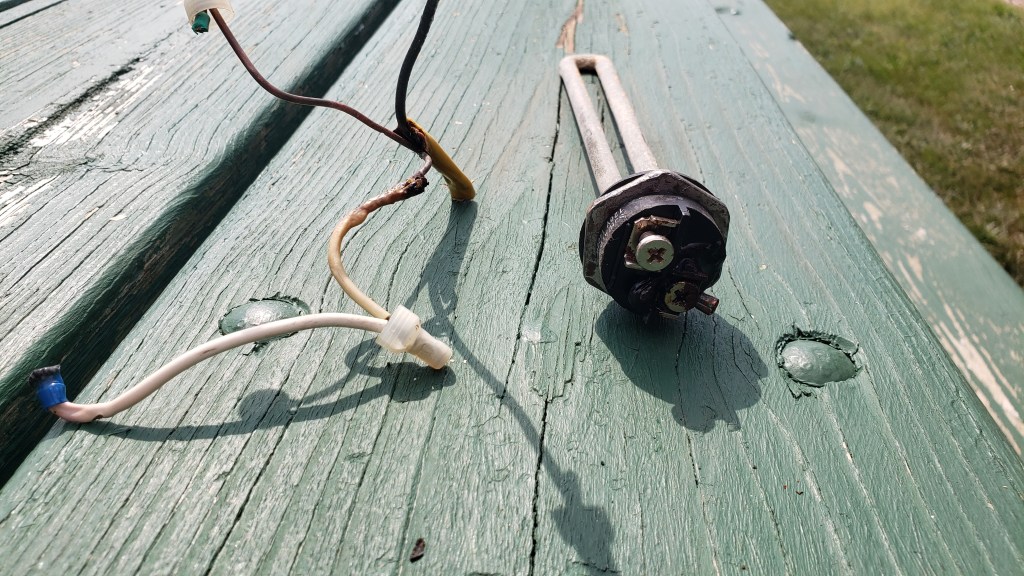
If you’ve been following us on Facebook, you already know the outcome of our hot water heater issue. The heights of joy, and the crushing next-day disappointment. Susan’s much-needed hot shower, and Simon’s agonizing path to cleanliness. We laugh about it now, as we hope you will, and we accept the hard-earned titles of “total twonks.”

Calm restored, we left Michigan the next morning and drove through America’s Dairyland on our way to our Minnesota campground. It had become our habit to do a wildlife count as we drove, and so far the tally was meager, with only one deer, several wild turkeys, and the hugely surprising sight of a gray wolf crossing the road just outside Marquette.

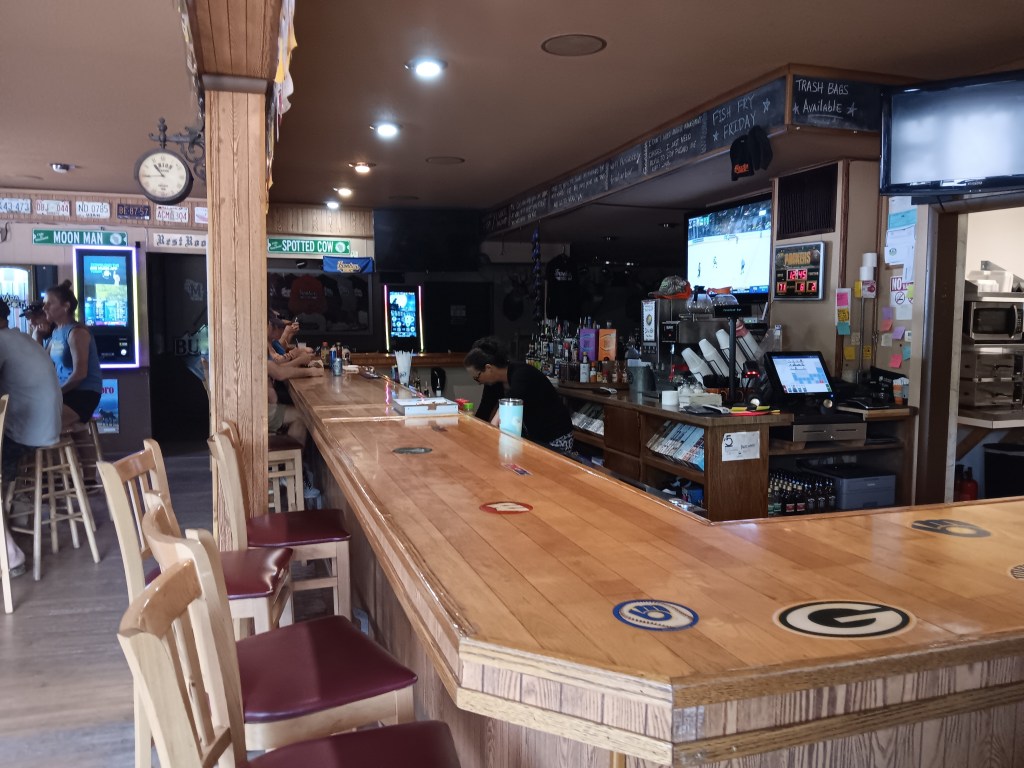
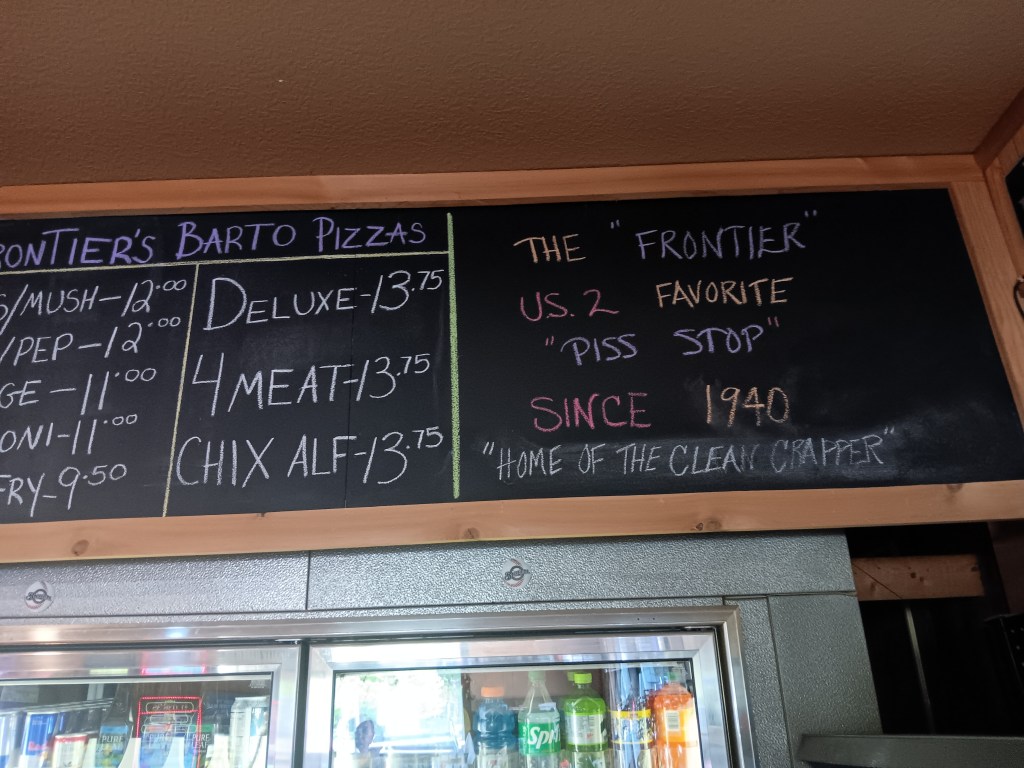
Perhaps the most surprising sight of all came when we stopped at a gas station in the middle of god-knows-where, only to discover what we thought was a convenience store was really a bar filled with ATV-ers swilling back Michelob and cocktails before “hitting the dust” again. The massive Frontier Bar sign on the front of the building was a hint, but, as we’ve so often done, we didn’t take it.

We did take a chicken strips basket to-go and split it in the rig, then made the rest of the journey into Minnesota while our GPS flashed the warning signs for a 6-degree Steep Grade going downhill and a second Steep Grade of 6-9 degrees going up.

Next up: Whoa!!! That’s one hellofa Steep Grade!

A Year On The Road – The First Week; 1,289 miles, and counting

The first week of our grand “Year On The Road” adventure – and a LOT of miles!

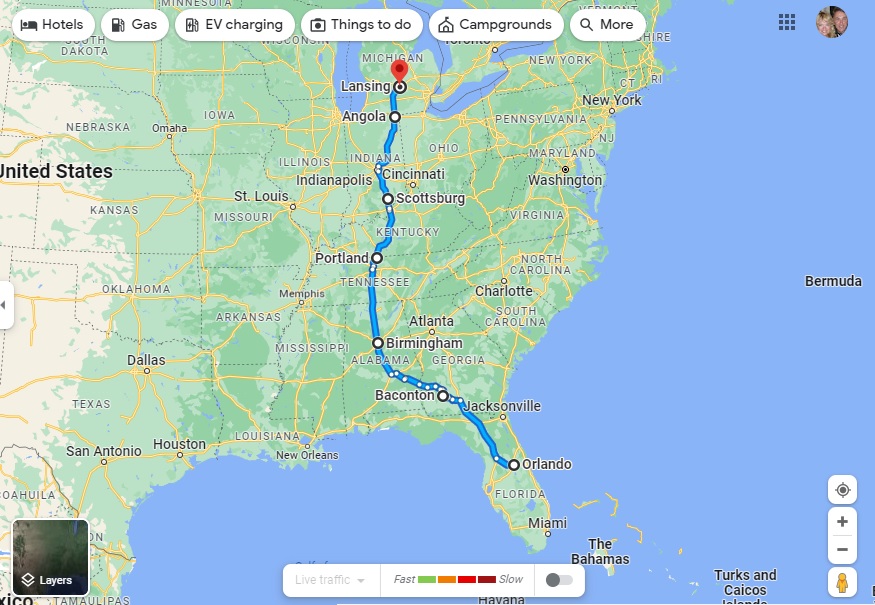
Considering how far we’ve come in the initial phase of our great American road trip by RV, we thought it was worth highlighting our route, and how much ground we covered.

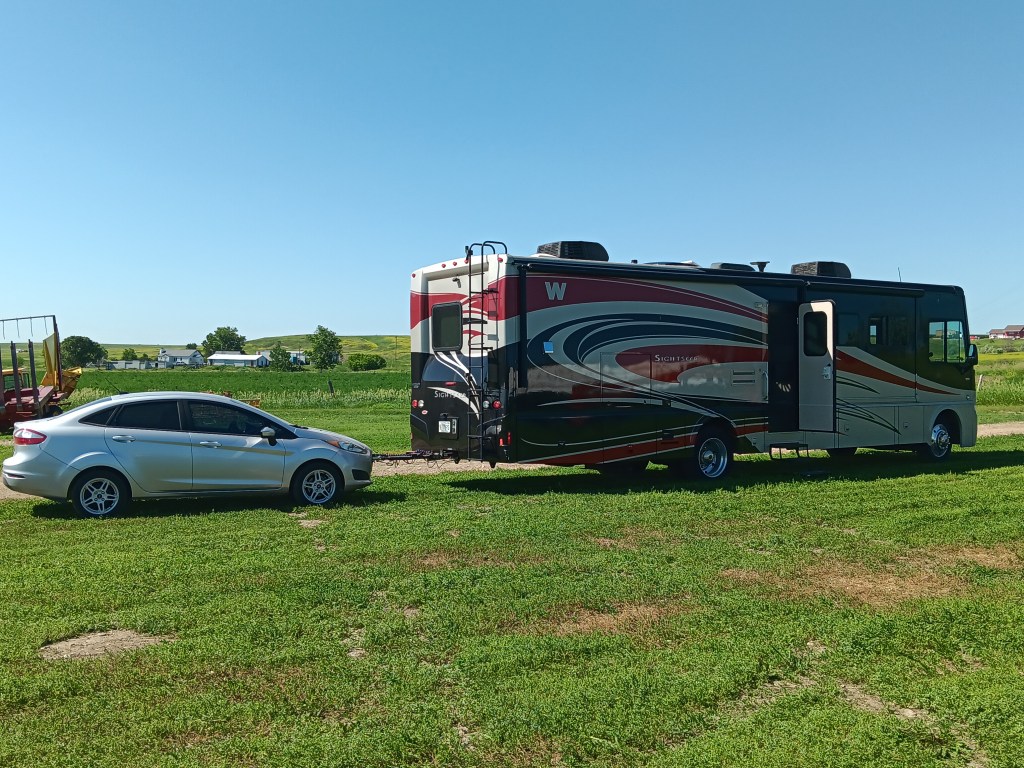
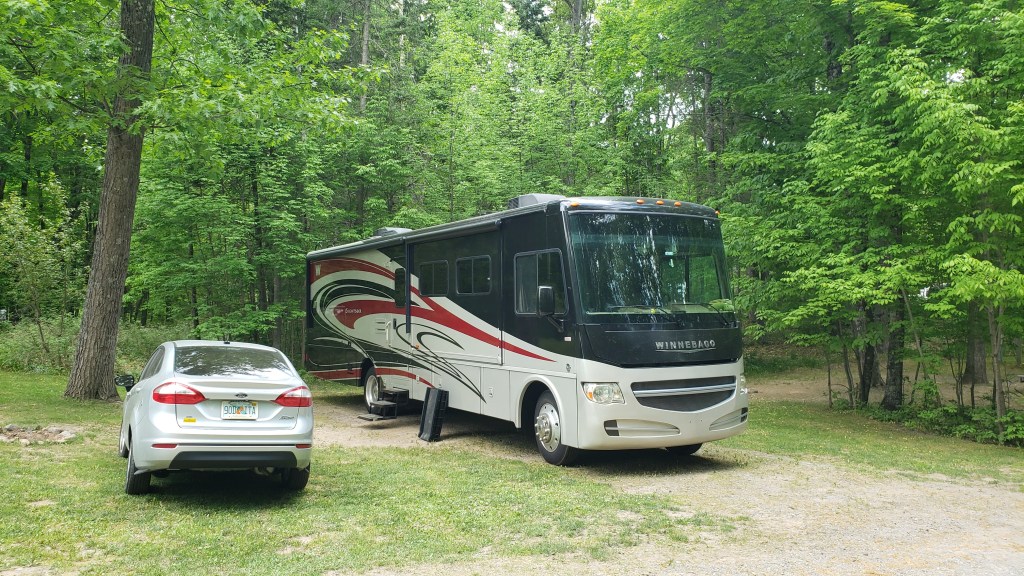
In reality, the first week of our ‘Year On The Road’ was effectively the “shakedown cruise,” the testing ground for our ability to actually drive this remarkable vehicle (that’s Indefatigable, or Fati for short, plus our tow vehicle or ‘toad’, Nippy).

Our initial route, through Georgia, Alabama, Tennessee, Kentucky and Indiana, before arriving in Michigan

In all we covered 1,289 miles through the first seven days, traveling from our home base in Orlando to Lansing, Michigan. That’s a LOT of miles for an RV in such a short time, and we had some challenges along the way but, in general terms, Fati handled it with aplomb.

Our first target was to reach Michigan, to set up the second phase of our route, which will take us into the Northwest of the country, via Minnesota and the Dakotas. Realistically, we achieved our main target and have got the hang of the driving and setting up camp at each location.

Normally, regular RVers wouldn’t travel and set up camp every day, but we wanted to see if we could manage a tough schedule before moving on to Phase 2. We certainly have a few issues to deal with (including the lack of hot water!), and we’ve had to consult various RV authorities, including the excellent MyRVResource.com, but we’re happy that we’ve grasped some of the essential principles of RV travel, and we’re ready for more adventures in the weeks and months ahead!

Indefatigable

Mission: Marquette

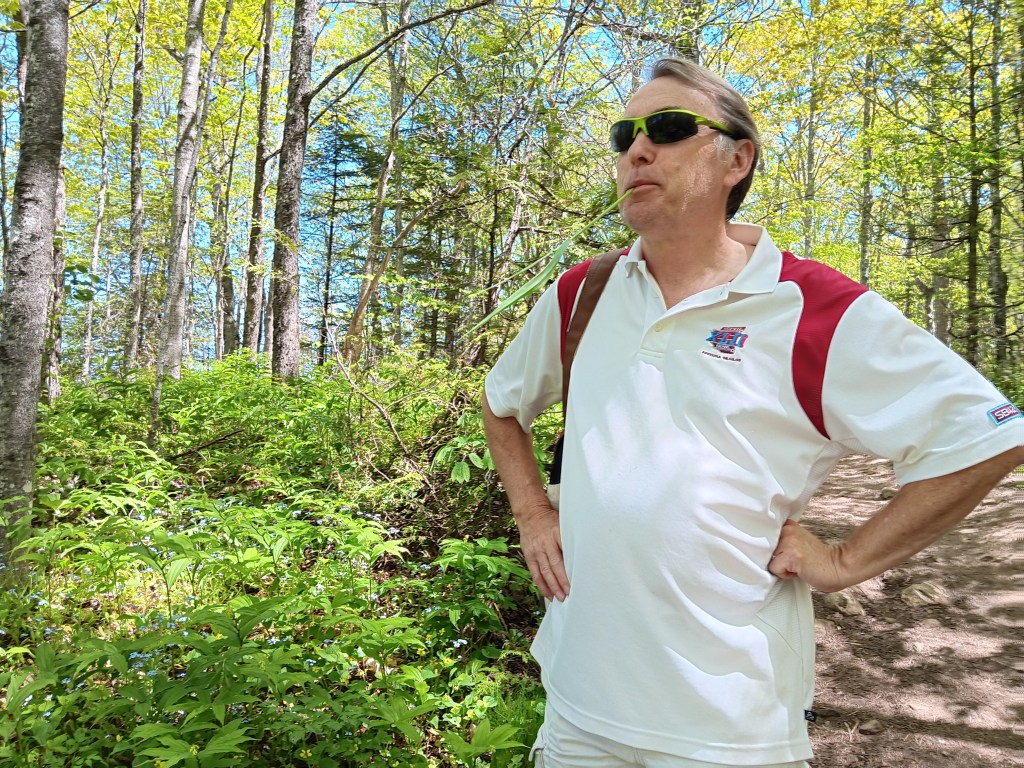
Simon in Pictured Rocks forest
Discover the forest, discover yourself

Armed with actual information we actually bothered to look up, we headed out on Saturday for a day in Marquette, Michigan, nestled on the shore of Lake Superior just 38 miles west of our campground. Highway 28 afforded a tantalizing view of the great lake nearly all the way.

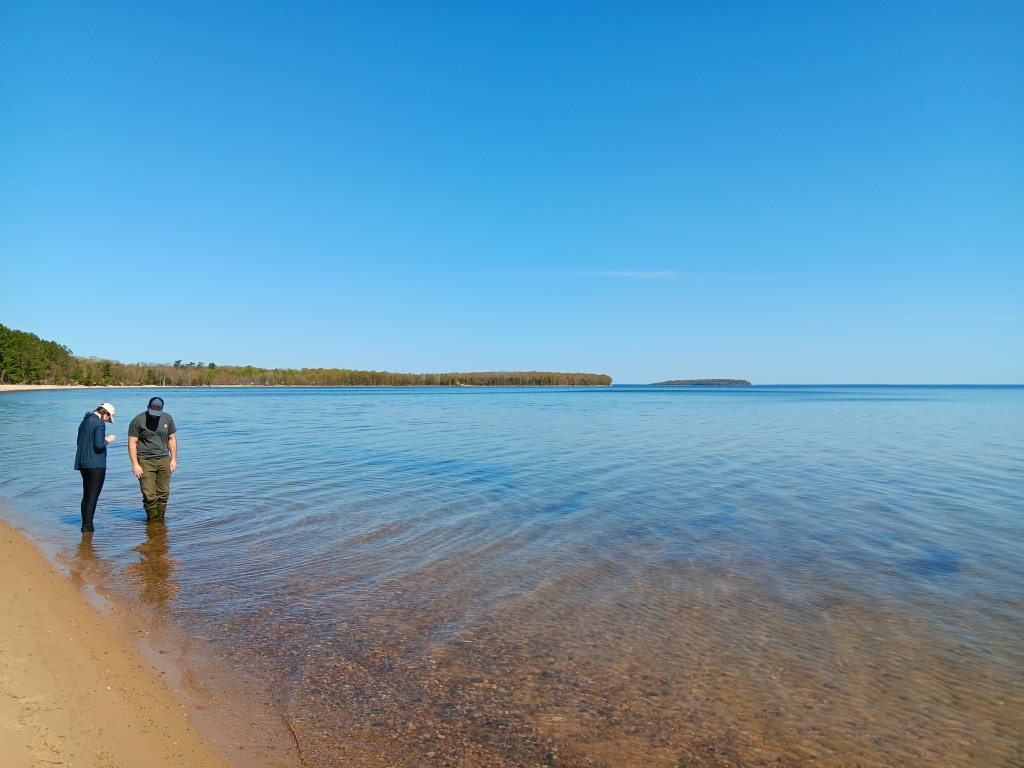
We stopped at several overlooks along the way, one of which led down to a beach, where we met a couple from Wisconsin who were knee-deep in the calm, freezing-cold water searching for agates, those pretty, banded rocks that, when shined up, make lovely jewelry. We didn’t know at that time that it’s (say it quietly) illegal to collect rocks along the lakeshore, so after a pleasant chat we wished them good luck in their endeavor.

Rock hunting at Lake Superior beach
We marveled at how still the water was, and could only imagine it at its most wintertime angry.

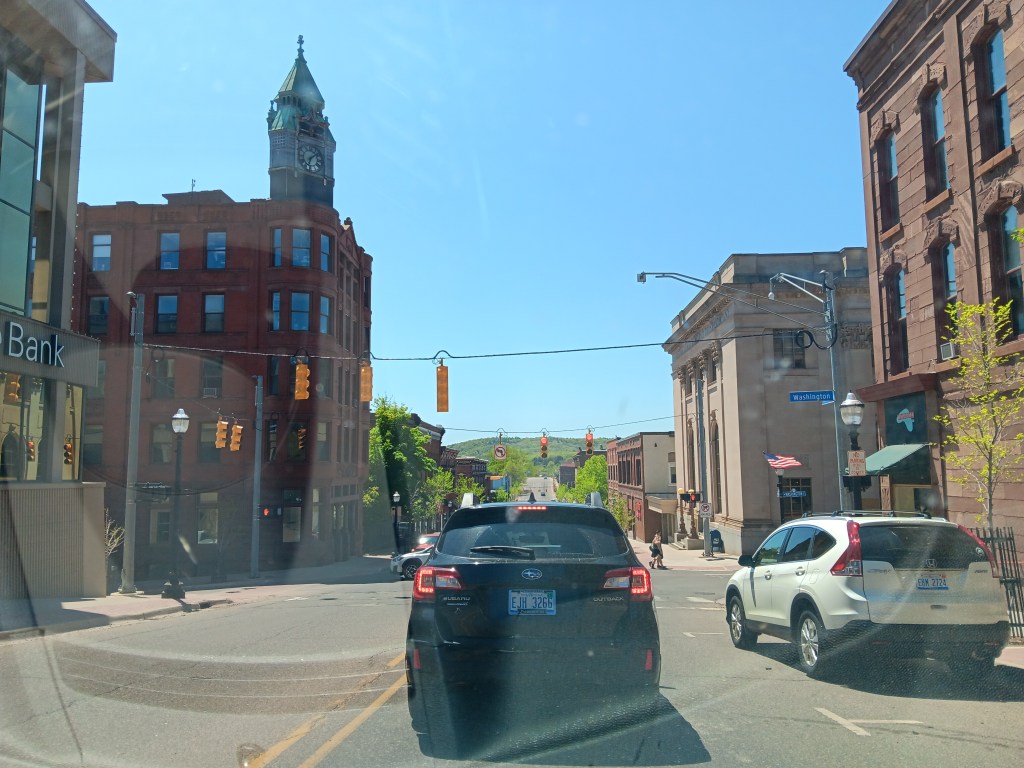
Marquette itself is a city, but also not a city; bigger than a town, but still entirely approachable, with a few streets that make up the downtown area. It can call itself a city because it has a cathedral, but we were here for its fabled dog-friendly nature, with Presque Isle Park as our goal.

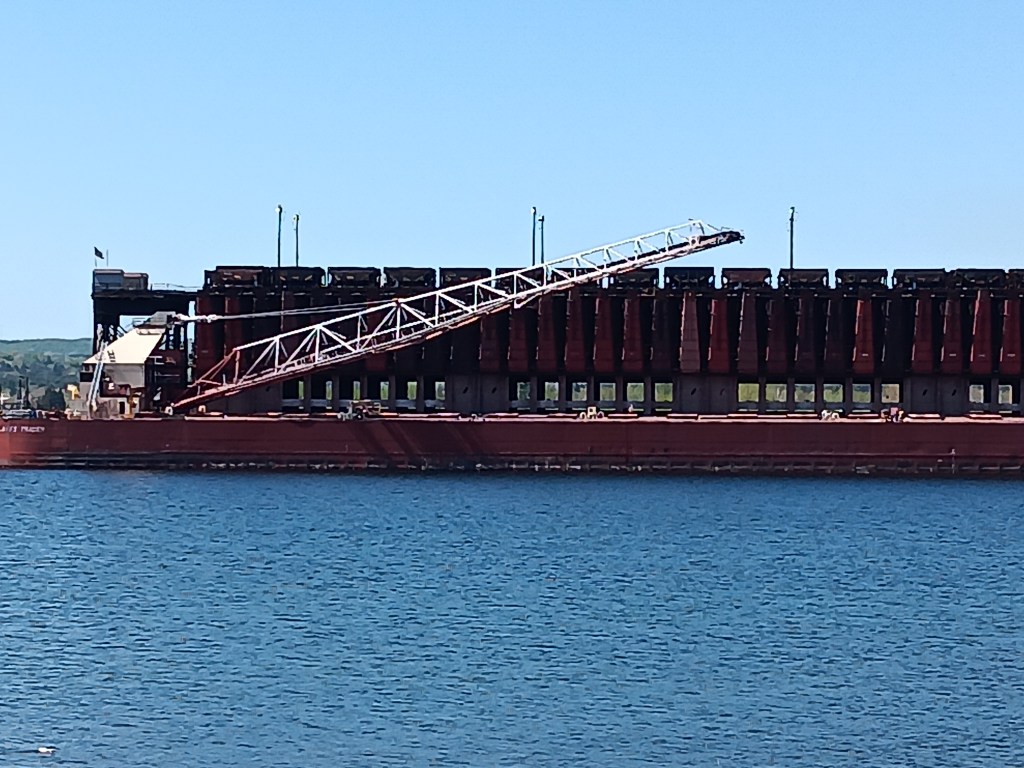
Iron ore was the main economic driver in the area, starting in 1911, and the massive ore dock in the harbor is still in use today. We stopped for a quick photo of this impressive piece of engineering, and that’s when we saw the first of many, many NO DOGS signs.

Marquette ore dock
The ore dock loads freighters up for moving taconite (iron ore pellets) from Marquette to distant places

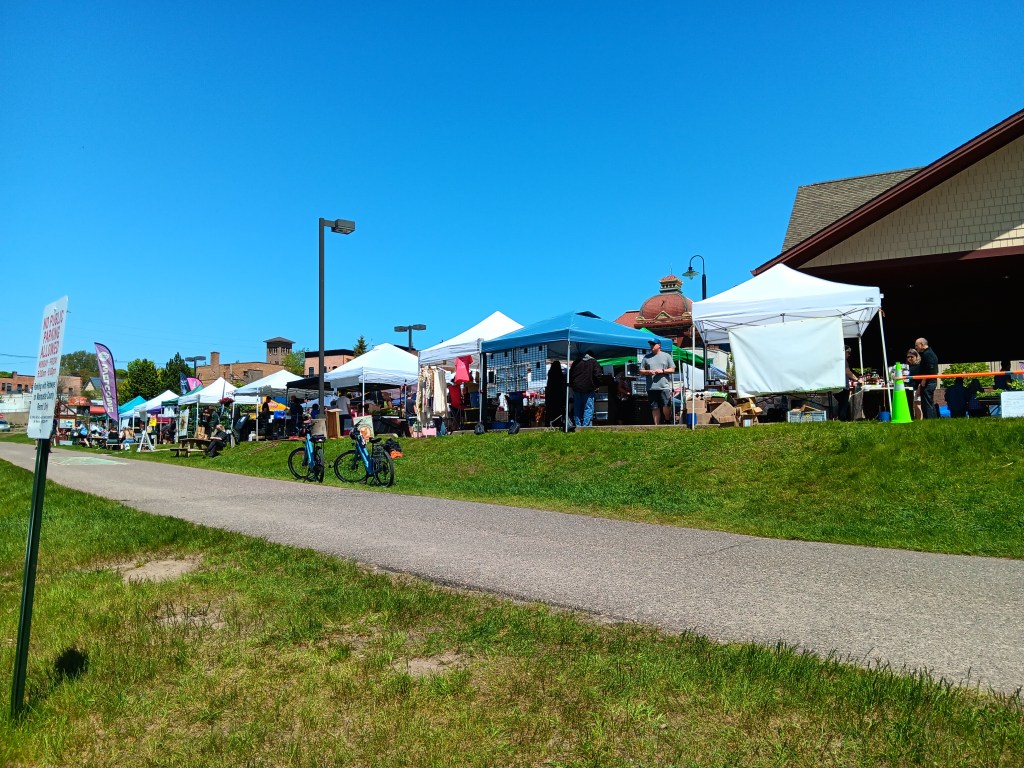
You can’t fight city hall, especially when you’re a tourist, so we drove around the park, then searched for any lakeside parking area that didn’t forbid our sweet Ruthie. None found, we decided to pick up some fresh produce at the Saturday Farmers Market, which also had the glaring red circle with a slash through it, superimposed over the image of a dog.

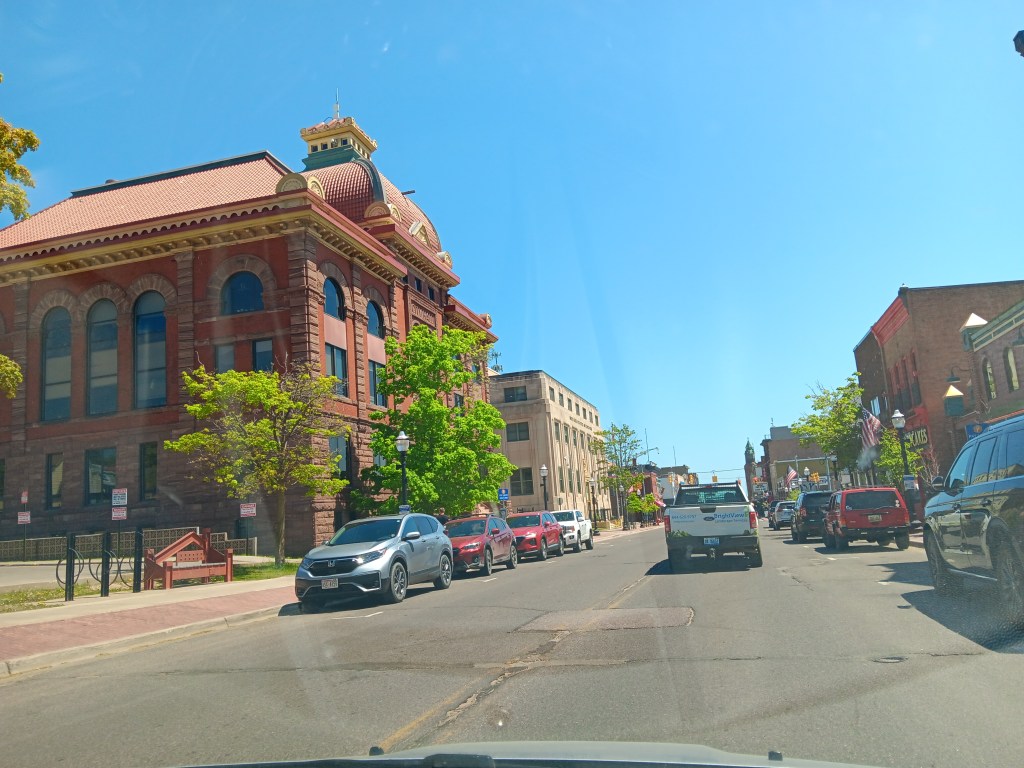
In the end, we simply enjoyed the downtown architecture, which was impressive, and started our search for a dog-friendly lunch stop.

Of the five options outlined by the Visitor Center’s leaflet, one was closed, one had no outdoor seating, two had just a couple of tables outdoors, all of which were filled, and the fifth we never found. But none of that mattered when we found the Co-Op Grocery, Marquette’s answer to Whole Foods.

Marquette Co-Op Grocery

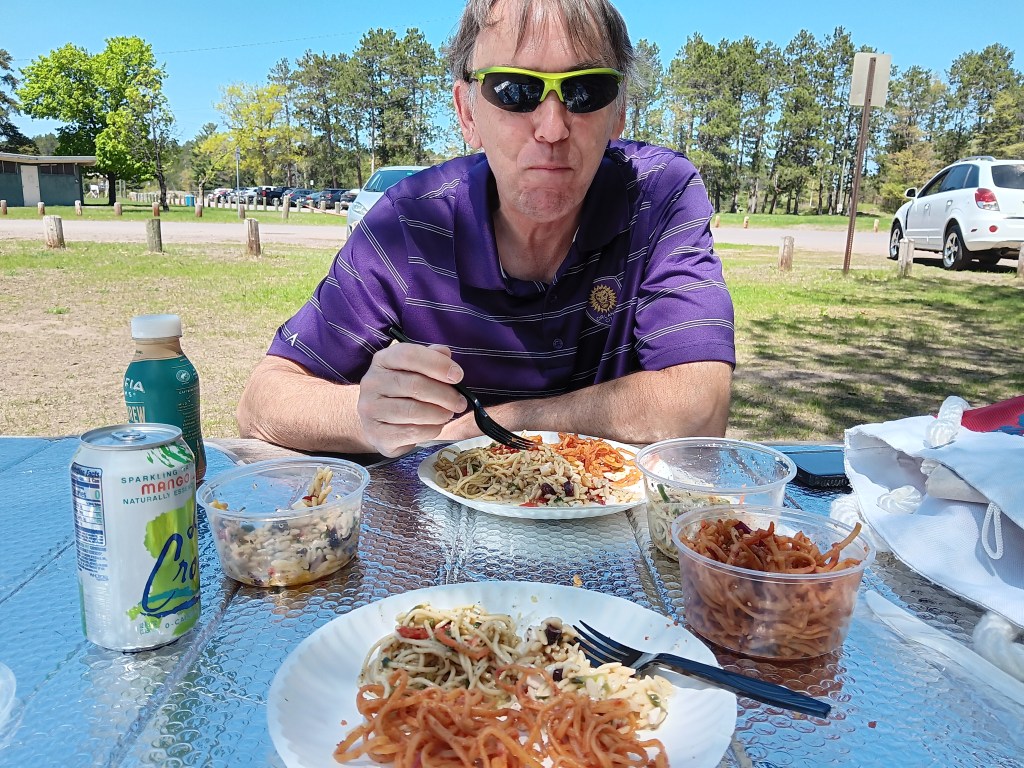
Three little pasta-based salads, an iced coffee, and a sparkling water later (with a scone thrown in for good luck) we ventured over to the sadly-named Dead Lake (so called not because it’s dead, or people who use it get dead, but because the Native people here recognized it as a place where their ancestors dwell), and after a small false start we came upon Tourist Park, a cozy picnic table in the sun, and a little girl named Amelia who fell in love with Ruthie. Lunchtime perfection!

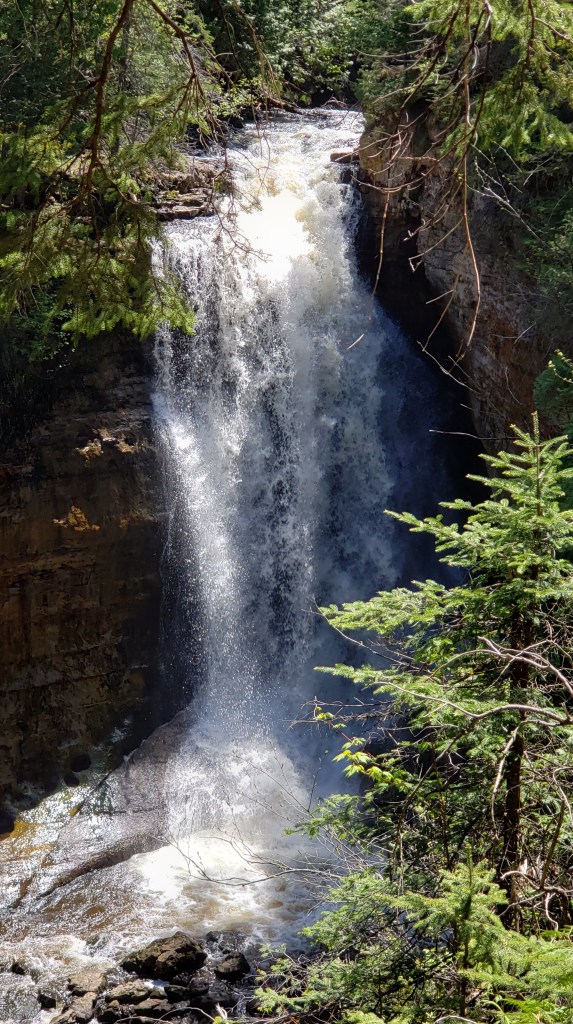
With so much success in the wake of failure, we agreed another trip out to Pictured Rocks State Park was in order the next day, this time with actual knowledge of its location as our guide. And what a pay-off! We took short hikes, we walked on beaches, and we saw magnificent waterfalls, the final one being the majestic Miners Falls.

Minors Falls Pictured Rocks National Lakeshore
You can’t really get the size of this majestic falls, so check out the video Simon posted on our Veness Travel Media Facebook page

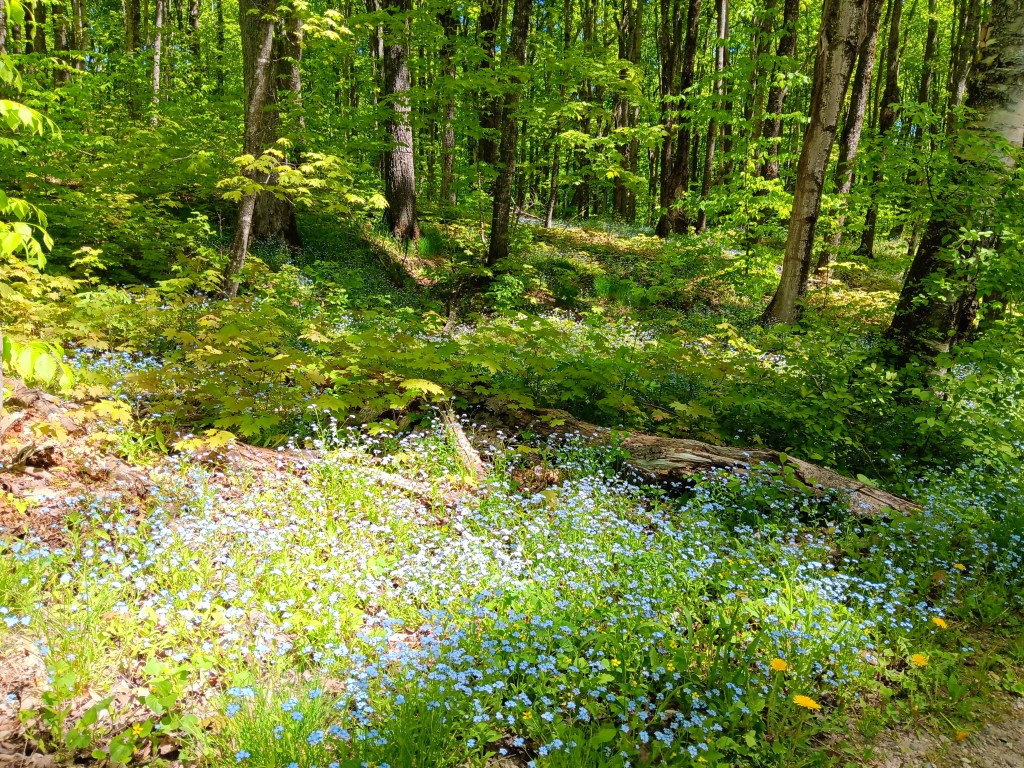
It was during this hike that we realized most of our photos were of the forests, and it really hit home how starved we’d been for nature. Florida has plenty of fascinating natural features, some of which hold a deep desire to kill you, but there’s something about a forest – deep and dappled and filled with the promise of frolicking deer and racoons – that touches a heartstring and plays a soul-stirring tune.

Lunch this day – the 18th anniversary of the day we married – was in the remarkable Grand Marais on the far eastern edge of Pictured Rocks National Lakeshore. The Midwestern version of a wild west town, it had a single street that made up the downtown area, with just a handful of shops and dining outlets.

Grand Marais
Grand Marais downtown

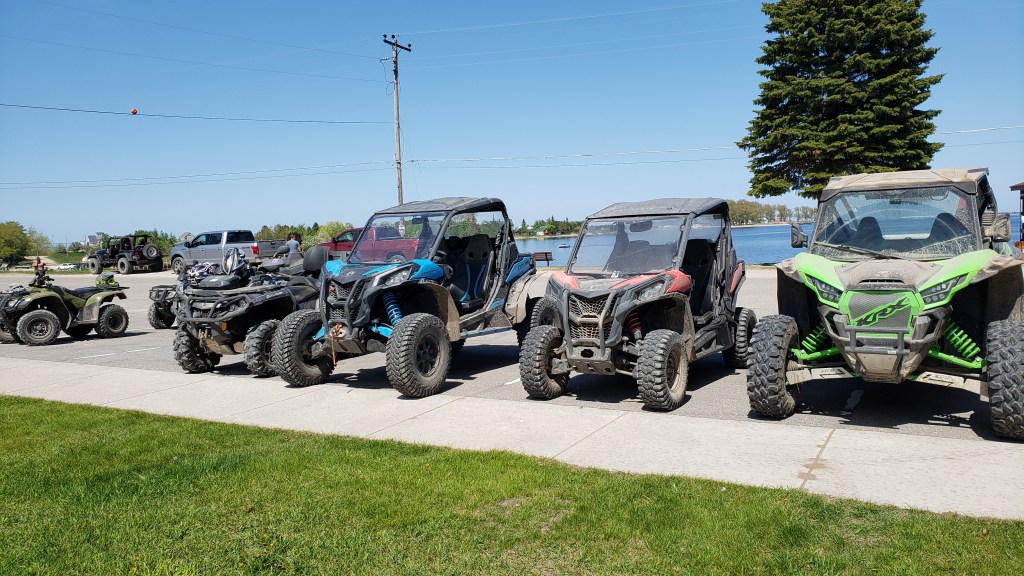
Dog-friendly patio? Check! Stunning view of Lake Superior? Check! Lots of Midwesterners and their amusing accents? Double check, with a heaping helping of off-road vehicles and a pint or two of beer for all of the over-21s. Chilly temperatures that required a run back to the car for our sweatshirts? That happened, too.

ATVs Grand Marais
How the cool kids get around

But none of the inconvenience mattered when we found Lake Perch on the menu. It’s Susan’s childhood in a basket, along with sides of coleslaw and French fries, and, with a pint each of local beer to toast our massive good fortune, we celebrated our anniversary to the strains of country music with lyrics that mentioned sex on a pontoon boat (“a slow-motion party”), sexy girls on tractors, and something about one man’s distain for another man’s testicles, complete with that word actually sung for all to hear.

Grand Marais lake perch
Cold, but happily splitting an Anniversary basket of Lake Perch with her beloved

Tomorrow: What in the name of all that is holy is that banging sound?

Pictured Rocks National where the hell is the Lakeshore

Pictured Rocks National Lakeshore

Michigan’s Upper Peninsula takes everything that makes the lower peninsula gorgeous, then doubles down, straight into spectacular. Blue skies, green pine trees, and the sparkling, silvery waters of Lake Superior.

Continue reading “Pictured Rocks National where the hell is the Lakeshore”

Pure Michigan

Michigan is cold. It’s cold for about five months of the year, it’s cold at night and in the morning for longer than that, and it gets cold snaps in May, like it has for the last three days. Michigan is also one of the most beautiful states you’ll ever visit.

The mighty Mackinaw Bridge
Mackinaw Bridge, the “Mighty Mac”

“Pure Michigan” is one of the slogans for this nature-lover’s paradise, where four distinct seasons allow for everything from river tubing – affectionately called “rump bumping” – to skiing, snow shoeing, ice fishing, and snowmobiling. The state is crisscrossed by hiking trails through landscapes as varied as pine forests, sand dunes, and urban centers.

And it’s those heady, scented pine forests that take Susan straight back to her childhood (Michigan is her home state) and feel exotic to Simon, who marvels in the natural diversity of this massive country. When we hit the pine tree-lined stretches of Highway 127 and Interstate 75, the REAL adventure we’ve embarked upon began.

Michigan hike
Michigan has fabulous rest stops all the way up to the Bridge, this one with a hike to a scenic overlook.

Yes, we’ve had some setbacks and hurdles along the way, and we’ve booked a mobile RV repair service for a week from now (showers and shampoos with boiled water are our new friend!). With help on the way, eventually, we spent yesterday and today exploring Mackinaw City at the upper tip of the “Mitten” (referring to Michigan’s hand shape) and St. Ignace, just across the mighty Mackinaw Bridge.

We had planned to “boondock” for a day or two, finding parking places without any hookups, according to our whim, but a serious cold snap with threats of temperatures that could reach freezing forced us into a campground with 50amp power so we could run our heater and keep the plumbing from freezing.

With that in mind, we found the beautiful Mackinaw Mill Creek Campground and a cozy spot with pine trees on three sides, just a short stroll from Lake Michigan.

Mackinaw Mill Creek Campground
Our home for two nights.

The downside was, it’s midge season. Those pesky, swarming, non-biting, gawd-awful bugs that absolutely invade every breath of air, especially along the shoreline. That cold snap and its gusty wind became our bug-busting friends, keeping these demons of the breezes to a low roar.

Midges and Mackinaw Bridge
Those things that look like helicopters are midges. They’re tiny, but they’re hellish in swarms!

Mackinaw City is touristy, but in a charming, midwestern way. Lots of little gift shops, fudge shops, and, in the past, mom-and-pop places serving up the area’s iconic pasties (pastry-enclosed individual meat and potato pies the miner’s took with them into the mines for meals). But we’d have to go into St. Ignace to find those delicious treats – a must-do on Susan’s long must-do list – as only one pasty shop remains in Mackinaw City, and it was closed.


We spent yesterday watching the ferries go back and forth to Mackinaw Island (a place we know well, and decided not to visit this trip), taking a stroll along the main drag, and walking along a rocky beach with a view of the bridge.

View of Mackinaw Bridge from St. Ignace
This is actually looking back at the lower peninsula from St. Ignace, but it’s better than our rocky beach pics.

Today we crossed the bridge in our car, Nippy, with Susan doing a serious butt-clench the whole way, thinking about the comment our friend made (Hi, Janet!) about how the bridge was recently hit by a crane.

Crossing the Mackinaw Bridge
The butt-clench gets tighter when you have to drive over those grates.

Once safely on land again, we headed to Lehto’s Pasties to pick up lunch (beef, potato, and rutabaga ((swede in the UK)) for purist Susan, chicken and vegetables for sacrilegious Simon), then headed to the waterside for a view of Mackinaw Island and the ferries. A&W Root Beer and Michigan’s own Vernor’s Ginger Ale were our drinks of choice, and it was a truly picture-perfect experience. Just what we’d been hoping for.

After lunch we poodled around, looking for roadside stops where we could walk down to the water. At every turn, we found more and more gorgeous vistas. If not for the winters, we could move here.

View of Mackinaw Straits from St. Ignace
Beauty, everywhere.

The toilet seal was still leaking when we got back to Fati, and there’s no hot water unless we boil it, but we do love this life when we’re out exploring, and Michigan’s natural and human-made wonders lifted our spirits immensely.

Veness Travel Media selfie

Next…Pictured Rocks National Lakeshore in Michigan’s Upper Peninsula!