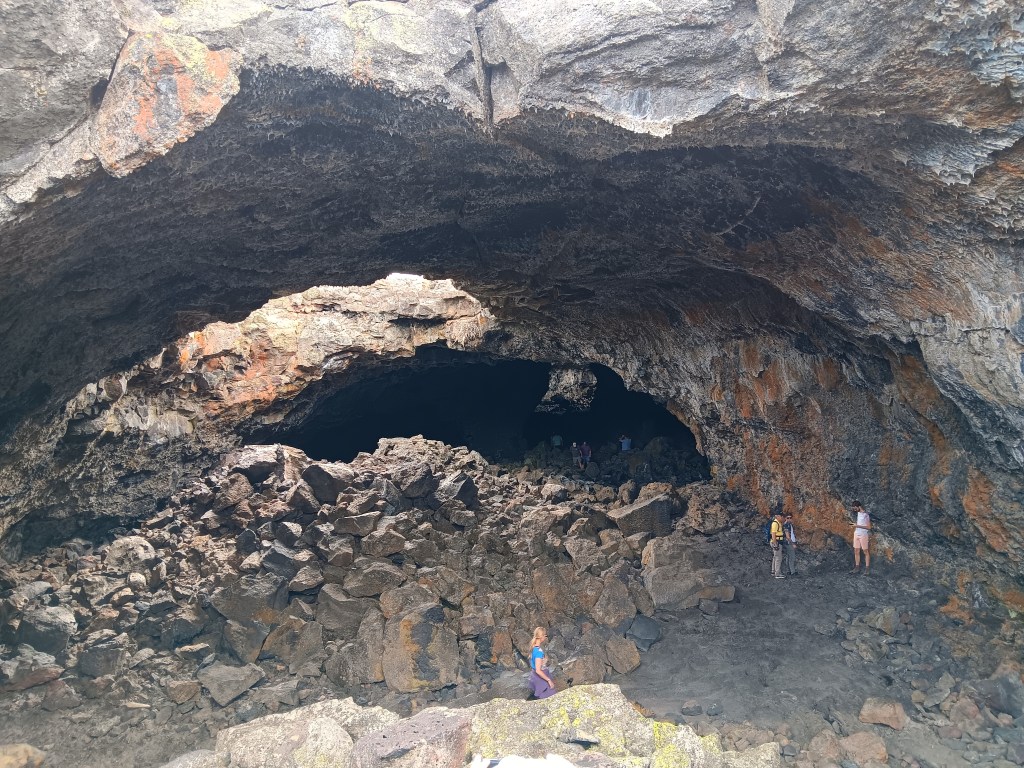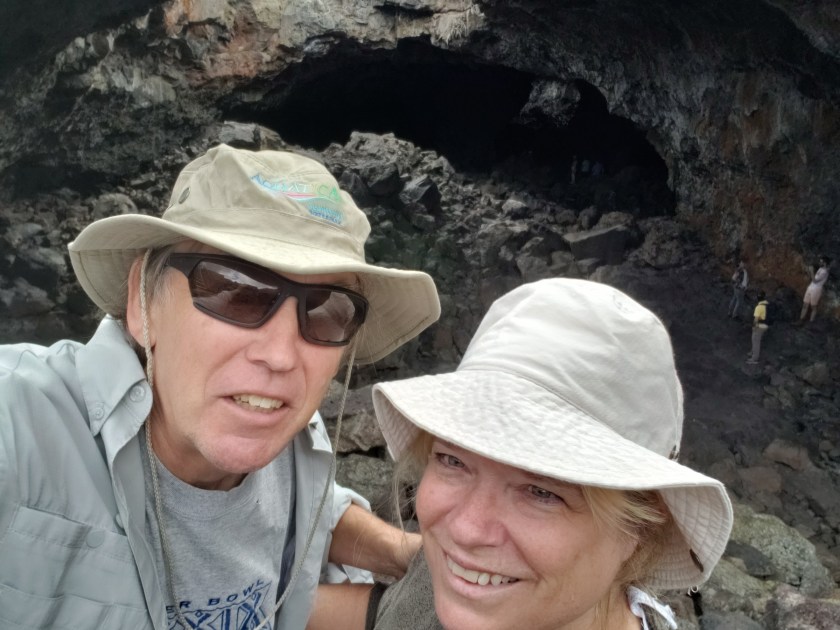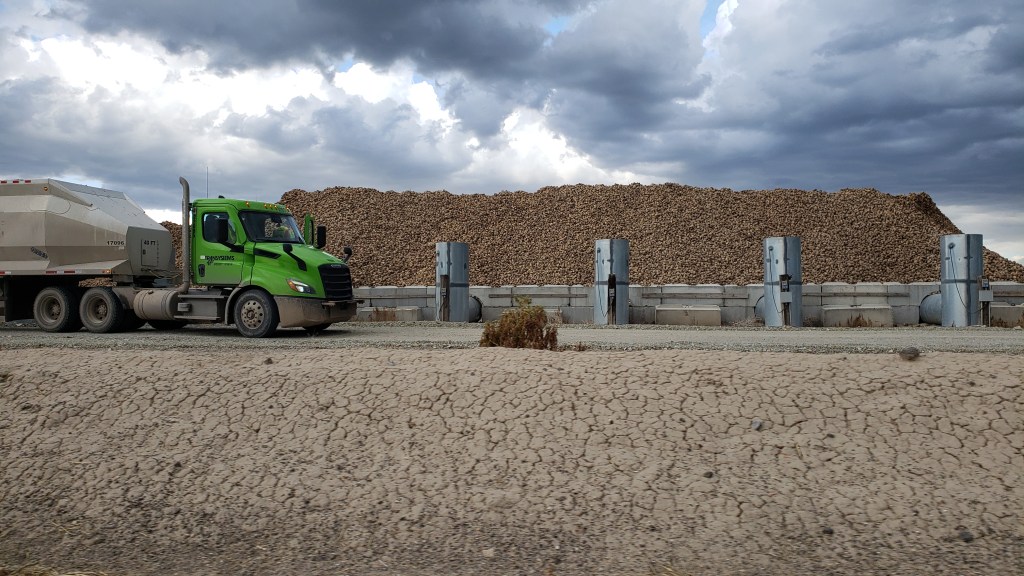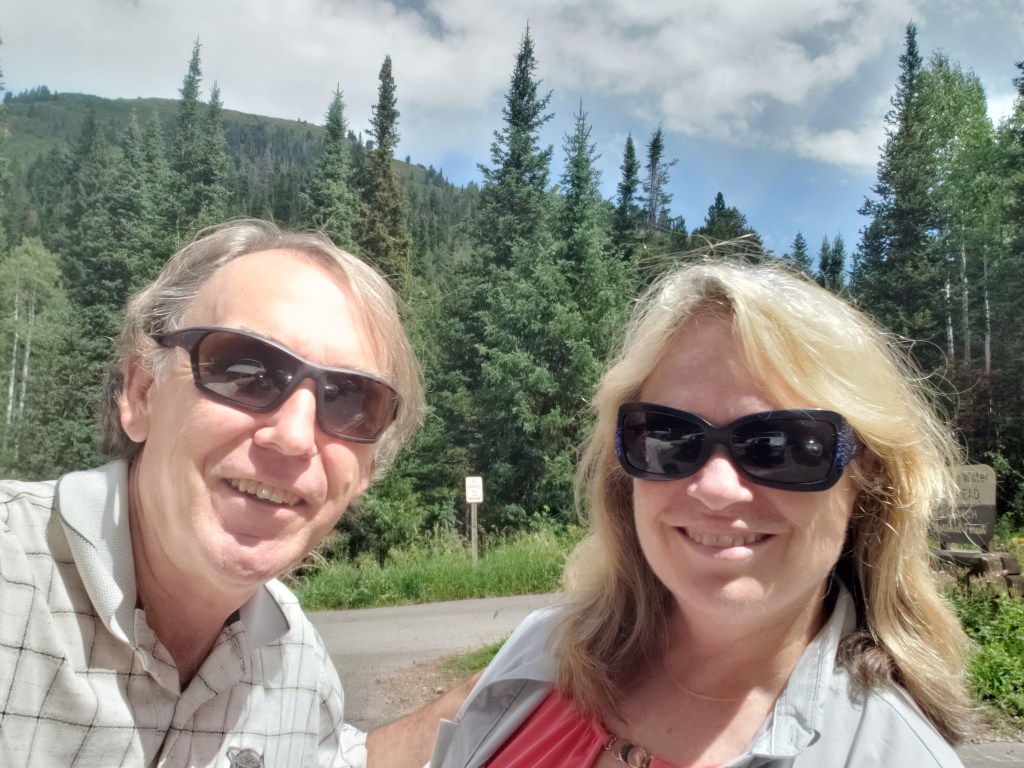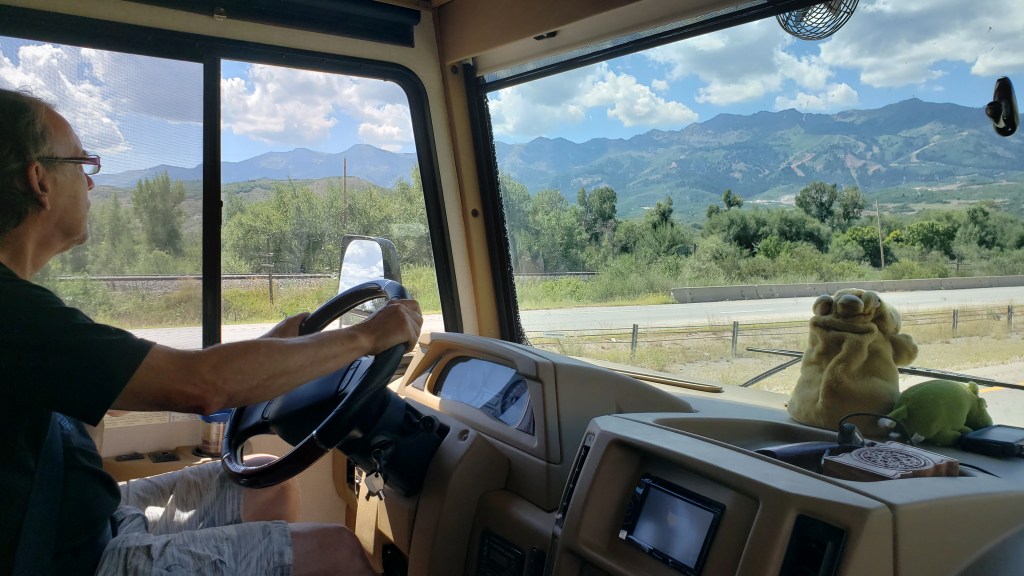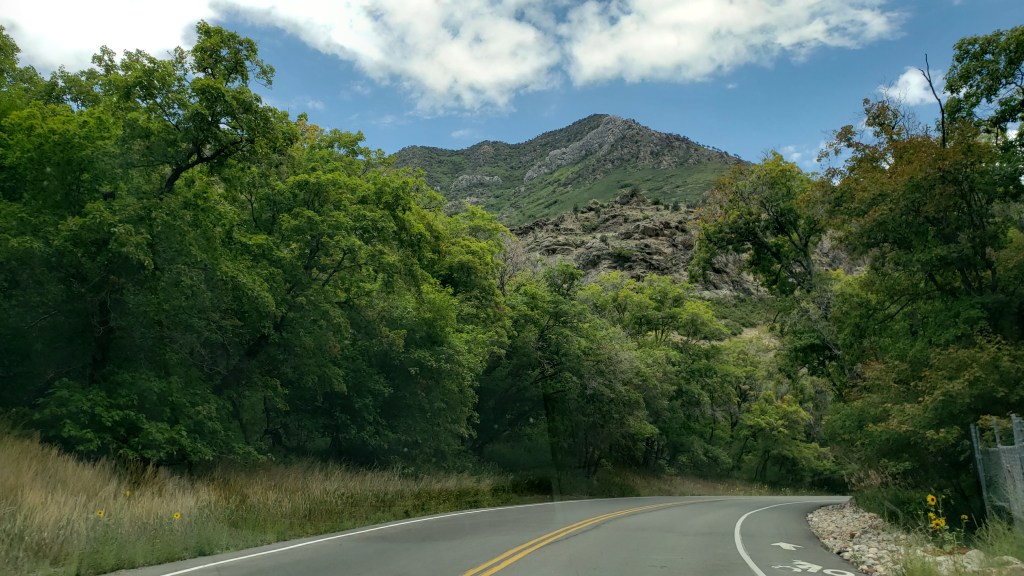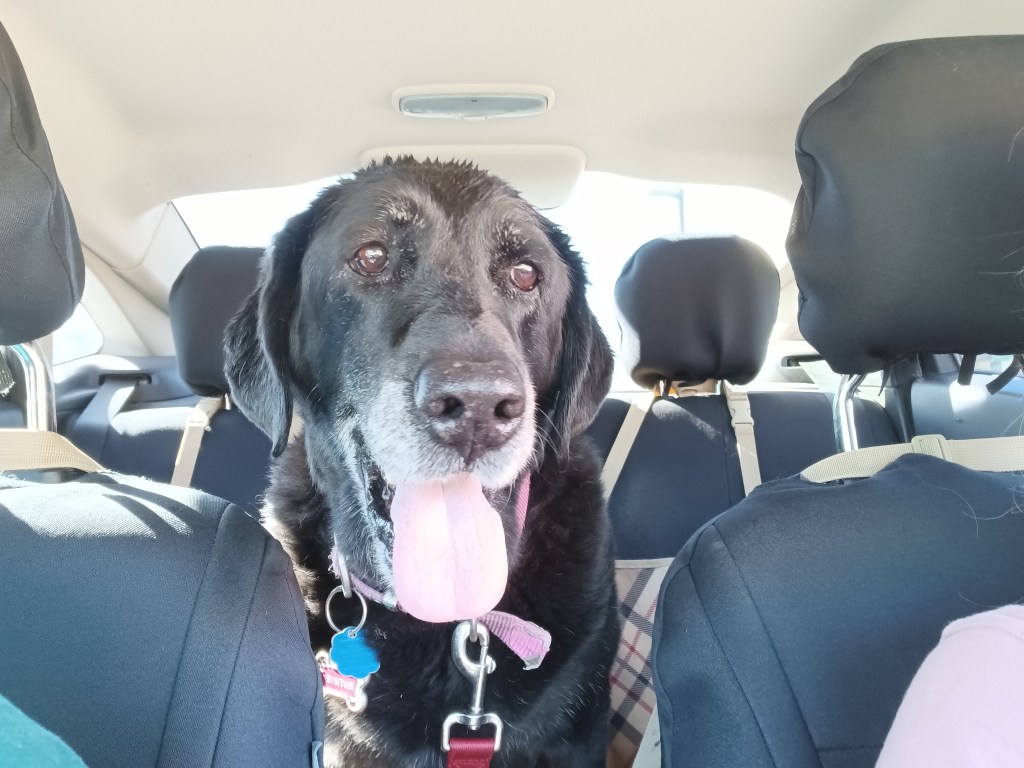
Into The Rockies!

In the last six weeks we have dipped in and out of the Rocky Mountains in each of Montana, Wyoming, and Colorado, but we hadn’t driven through them. Until reaching Utah.

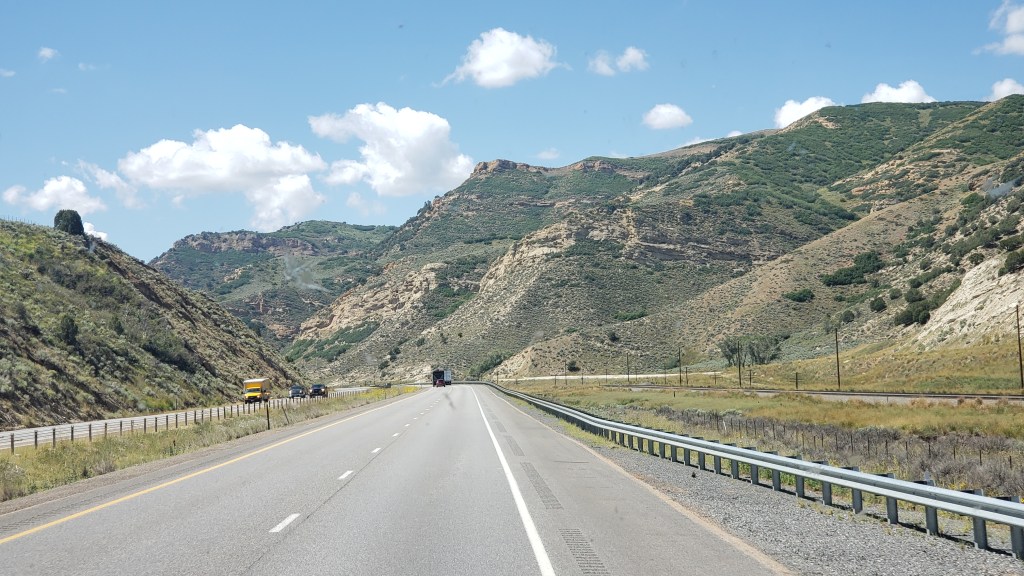
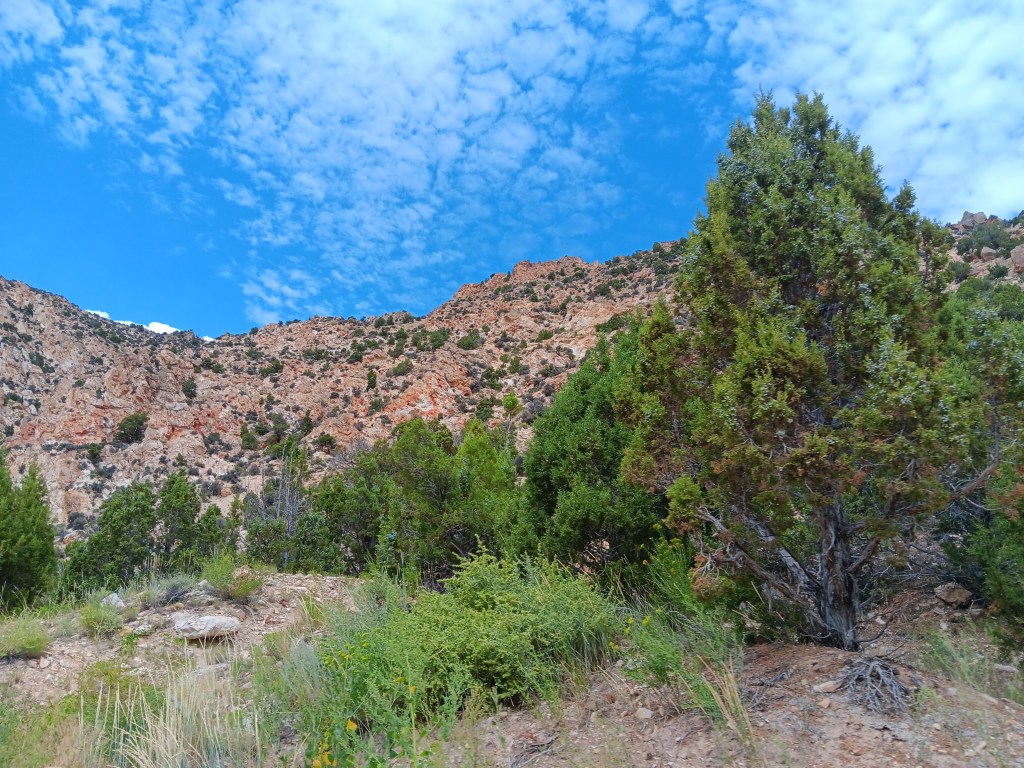
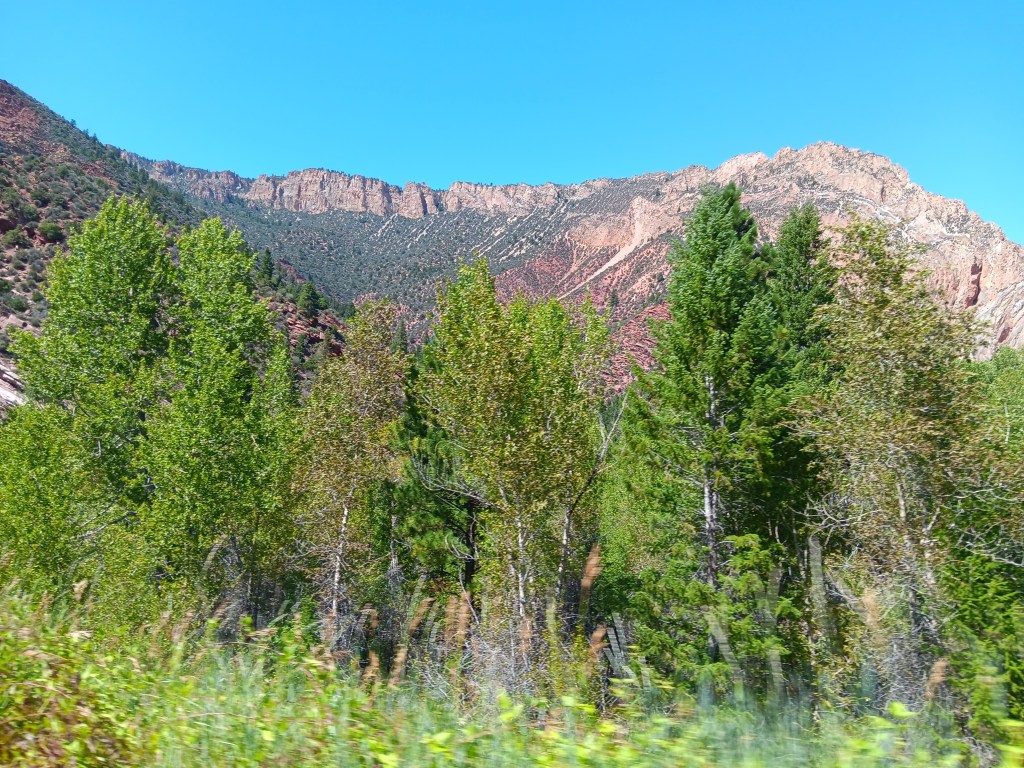
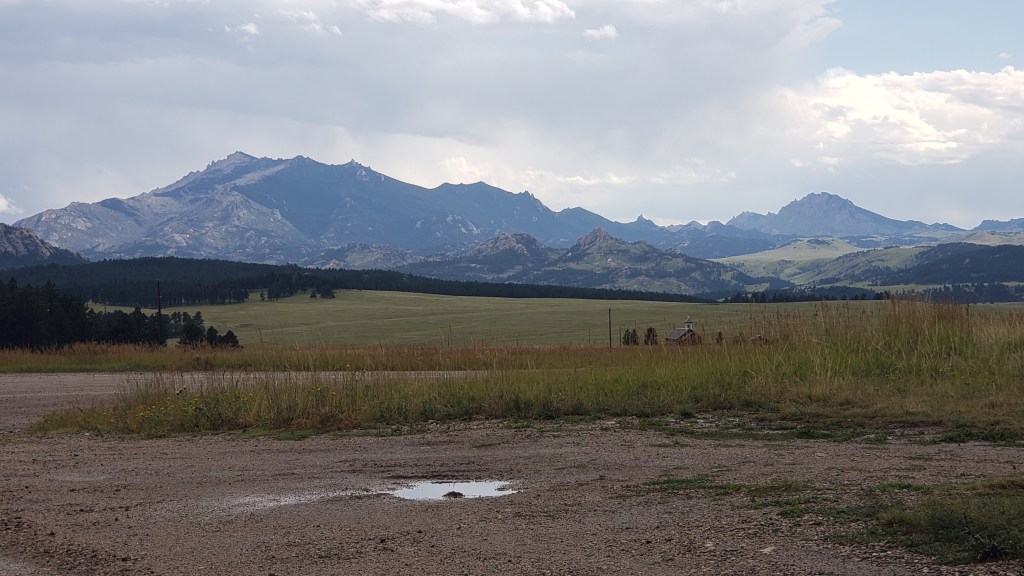
Driving west along I-80, what was initially a dark smudge on the horizon rapidly transformed into a formidable vertical barrier as the Uinta Range loomed into imposing view.

From the relatively flat southwest plain of Wyoming, the Rockies suddenly provide a formidable barrier to the west

The highest peaks of the Uintas reach 13,534ft above sea level, which is only 42nd in terms of the overall peaks in the Rockies, but Colorado has fully 39 of those, and Wyoming two, so Utah actually comes in third of all the states that feature the Rockies. More significantly, it is ninth when it comes to the prominence, or highest vertical rise, at 6,358ft.

Looking up at that 6,000-plus feet of mountain ahead of us was a sobering prospect. We were supposed to drive through there?

Thankfully, the highway into Utah was simpler than it looked and our Fati coped admirably with the winding mountain pass route from Wahsatch to Emory, where we branched northwest on the lower elevation of I-84. Still, surrounded by the massive bulk of peaks reaching almost 10,000 feet put our WPMs (Wows Per Minute) back into high gear.

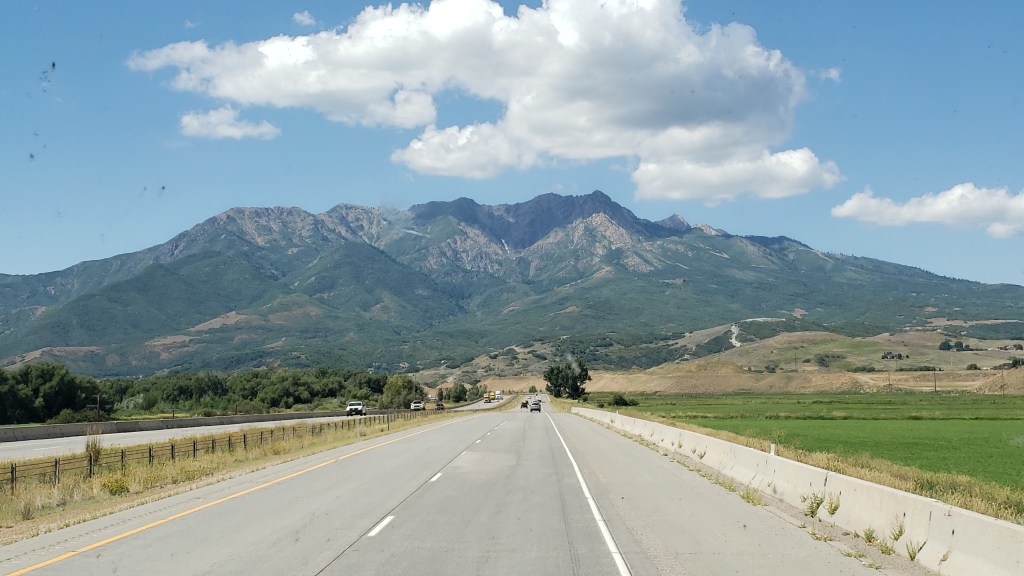
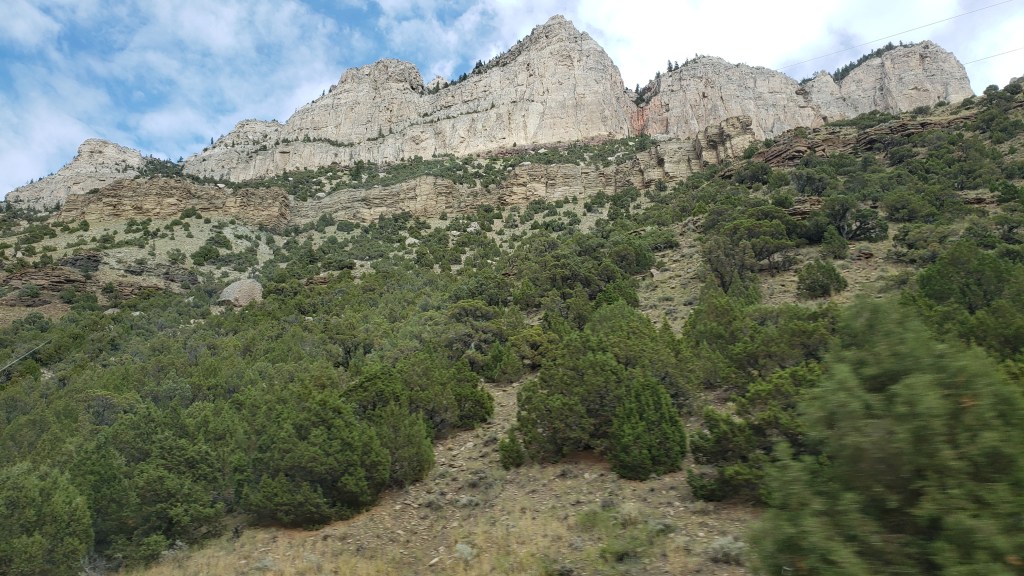
This is the bulk of Thurston Peak, which reaches 9,705 feet above sea level, with a vertical rise of almost 5,000 feet. Small, it isn’t

Amazingly, I-84 dropped our overall elevation to just below 5,000 feet, meaning Thurston Peak on our immediate left towered almost 5,000 feet above us. It made us feel incredibly small.

We were heading for Layton, Utah, just north of Salt Lake City, where the spectacular Valley View RV Resort awaited us. However, it had to wait a bit longer than expected as our GPS systems (two of them) decided to play silly buggers with us, not for the first time.

Our Garmin wanted us to turn off the highway onto a road that did not exist, while our Samsung phone’s system couldn’t locate us at all. A quick call to the RV resort revealed that we needed to turn off at Antelope Drive, but we then found ourselves in a quiet residential area with our Garmin telling us the road had a six-ton limit. At fully 11 tons, Fati was potentially just a teeny bit over that limit, so we pulled over.

Someone who’s name begins with Simon tends not to handle GPS malfunctions terribly well. It usually includes lots of words beginning with F in a tirade of angry invective. For once, this didn’t reach DEFCON 1 thanks to Susan volunteering to unhitch Nippy and scope out the road ahead, which appeared to drop off the edge of a cliff.
Sure enough, she found the way in, which didn’t involve any cliff-hanging, and, communicating by phone, guided the RV safely to its intended port.

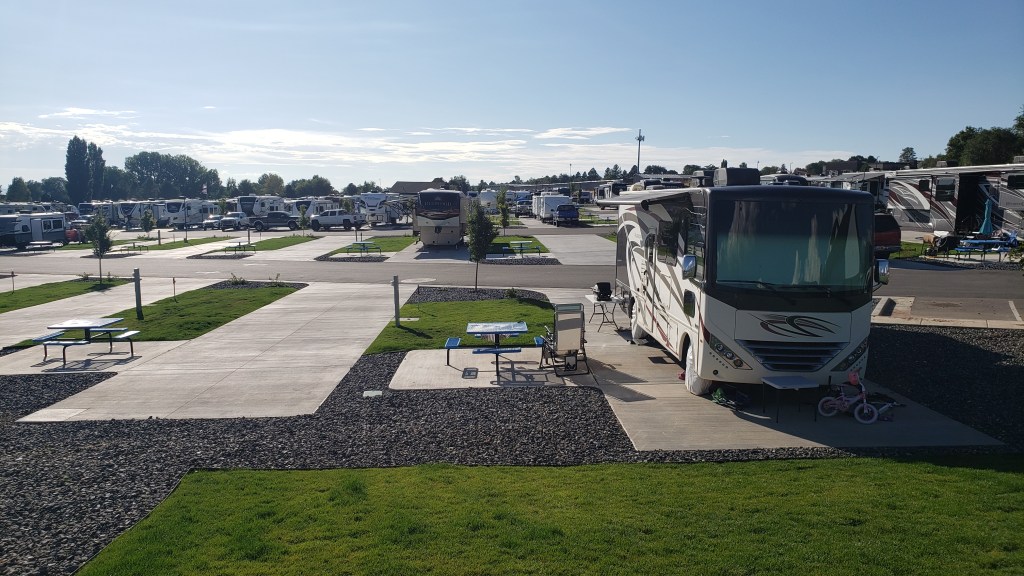
Valley View RV campground is a genuine high-caliber resort, with lots of facilities and a wonderfully modern, clean look

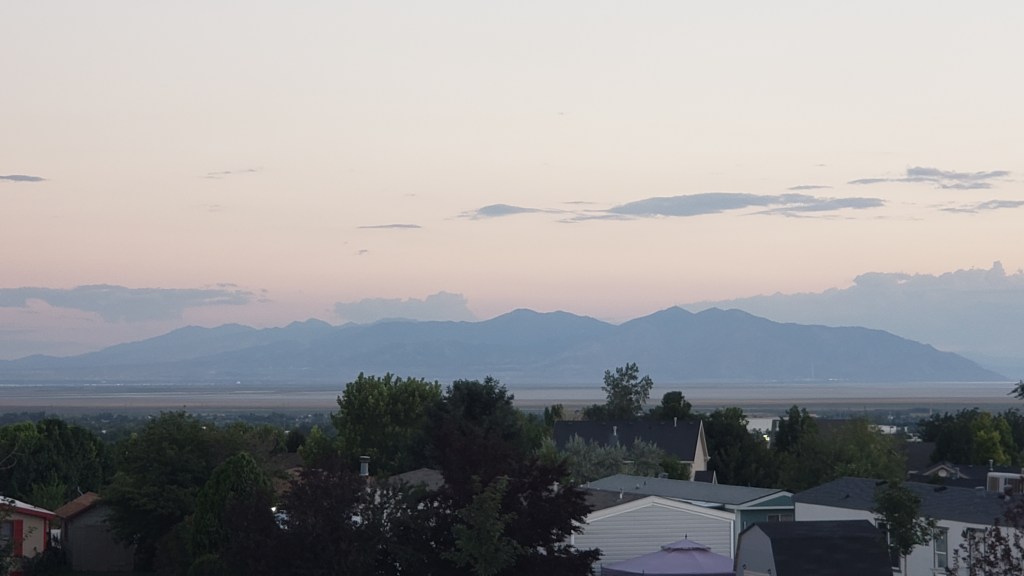
Our new home for the next 8 days is a slick, modern and feature-packed RV resort, with 121 berths for RVs of all types, plus facilities like a swimming pool, clubhouse with fitness center, pickleball courts, and a dog park. Food trucks visit periodically to provide a handy dinner option while the clubhouse also offers complimentary coffee, just like a hotel (much to Simon’s liking). To one side, we have a view of the Uintas; to another it is the Great Salt Lake and Antelope Island.

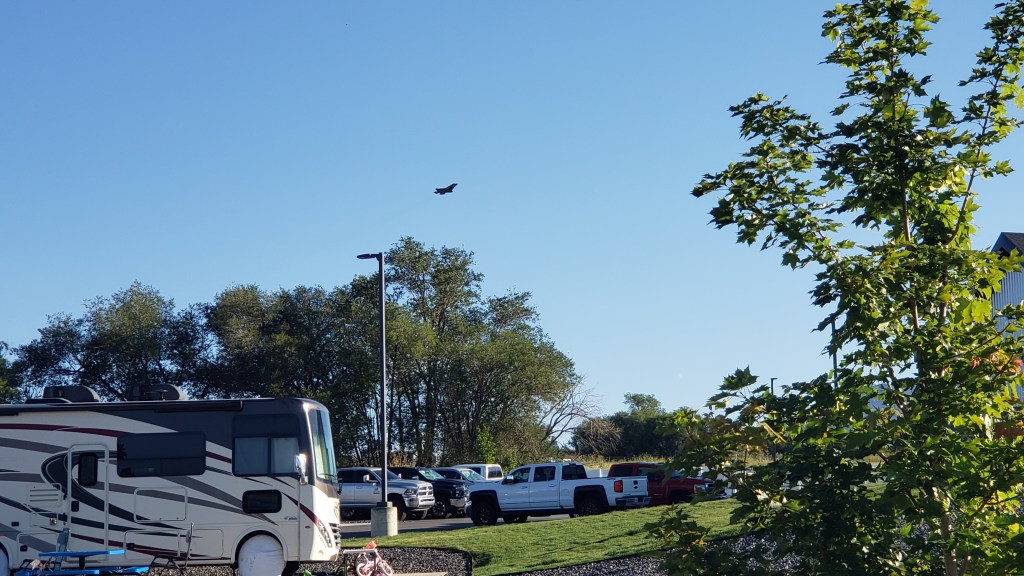
Oh, and we are half a mile from Hill Air Force Base. Who fly F-18s. Every weekday. From 8 a.m. So, there’s that….

Our 8 a.m. alarm call, courtesy of the US Air Force

Next, we’re off to see Salt Lake City, more of the Uintas, and Antelope Island. We have a truly excellent base to explore from and the views of the mountains are truly spectacular. This is yet another scenic wonder in what has been a string of them since we hit Upper Michigan back in June, and we are eager for more.

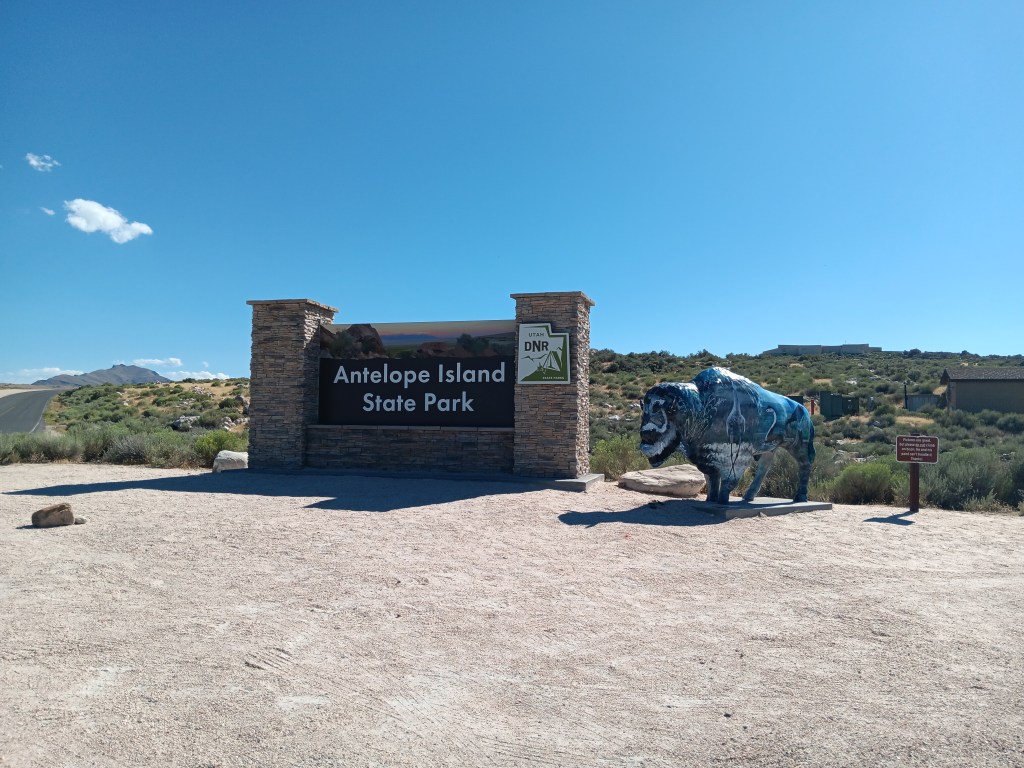
Antelope Island lies to our west, full of intrigue and scenic promise. This is another epic location…and we’ll take you there soon!

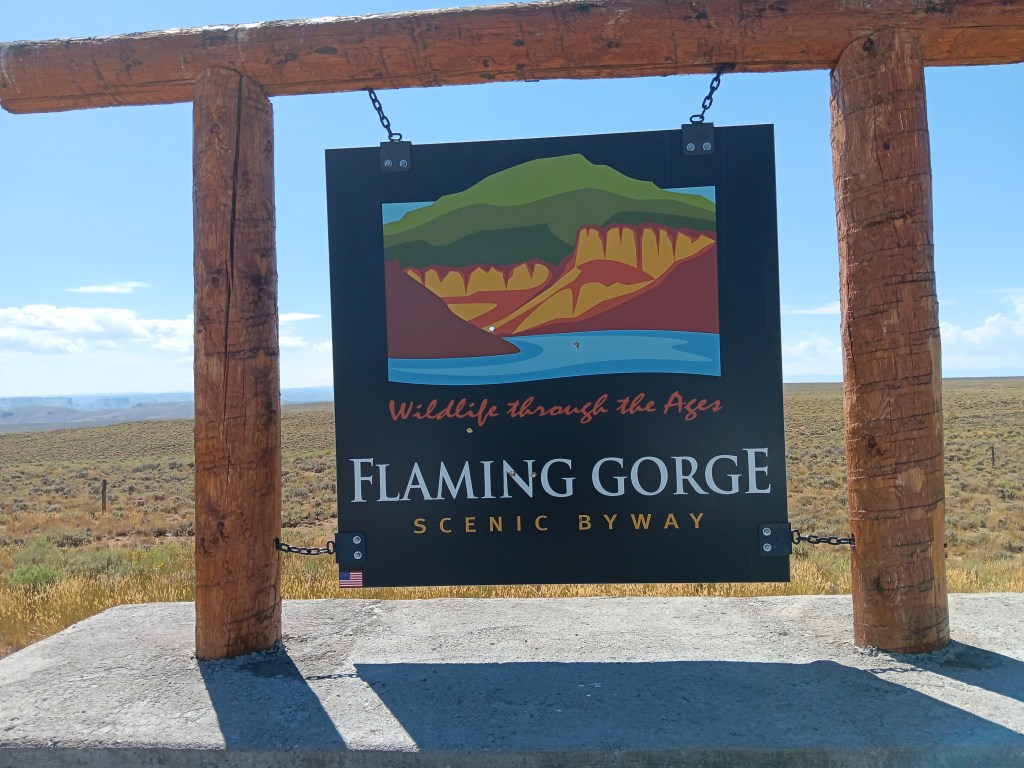
The Flamin’ Gorgeous Flaming Gorge


We had two days left in Wyoming before heading into a brand-new state for Simon, and we were determined to end our time in the state of never-ending surprises on a high note. Little did we know how high we’d get!

Not THAT kind of high; this isn’t Colorado. But our final day’s trip did end with a long, long, drive at nearly 10,000 feet, with plenty of steep drop-offs, long ascents and descents, roads slick from the rain, and not a guardrail in sight.

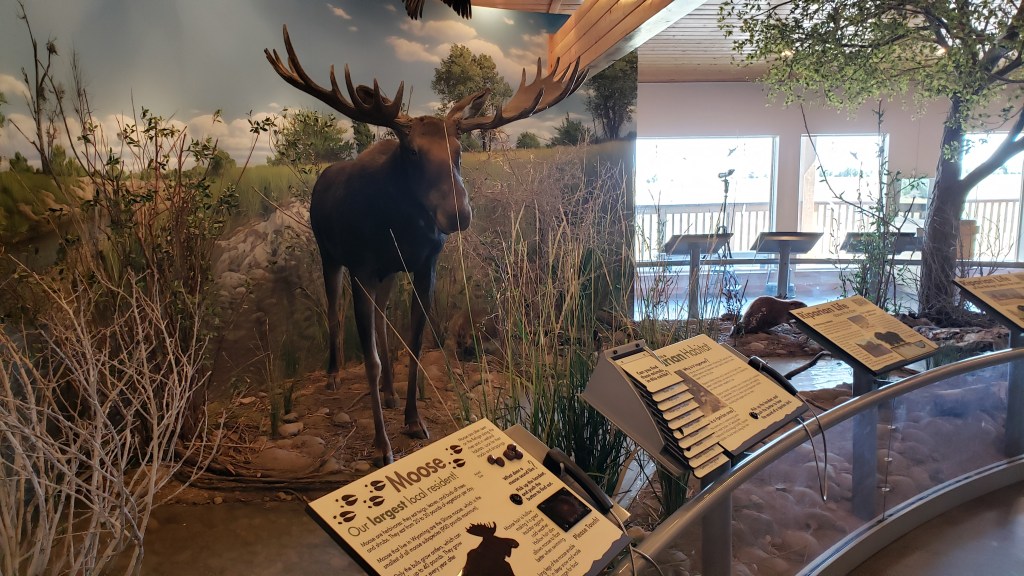
Let’s forget about that part and start with the drive we took out to the Seedskadee National Wildlife Refuge, with its tongue-twister of a name and its wonderful visitor center. The refuge claims to have more than 300 species of birds, mammals, and fish, some of which are taxidermized and on display so you get excited about what awaits.


We saw exactly two eagles, a couple of trumpeter swans, one grouse, and a small handful of kangaroo rats (more appealingly called “gerbils” when you buy them at a pet shop). No moose, no coyote, no rabbits, no badgers, over the course of three passes along the main wildlife road (two during the day, one near dusk).

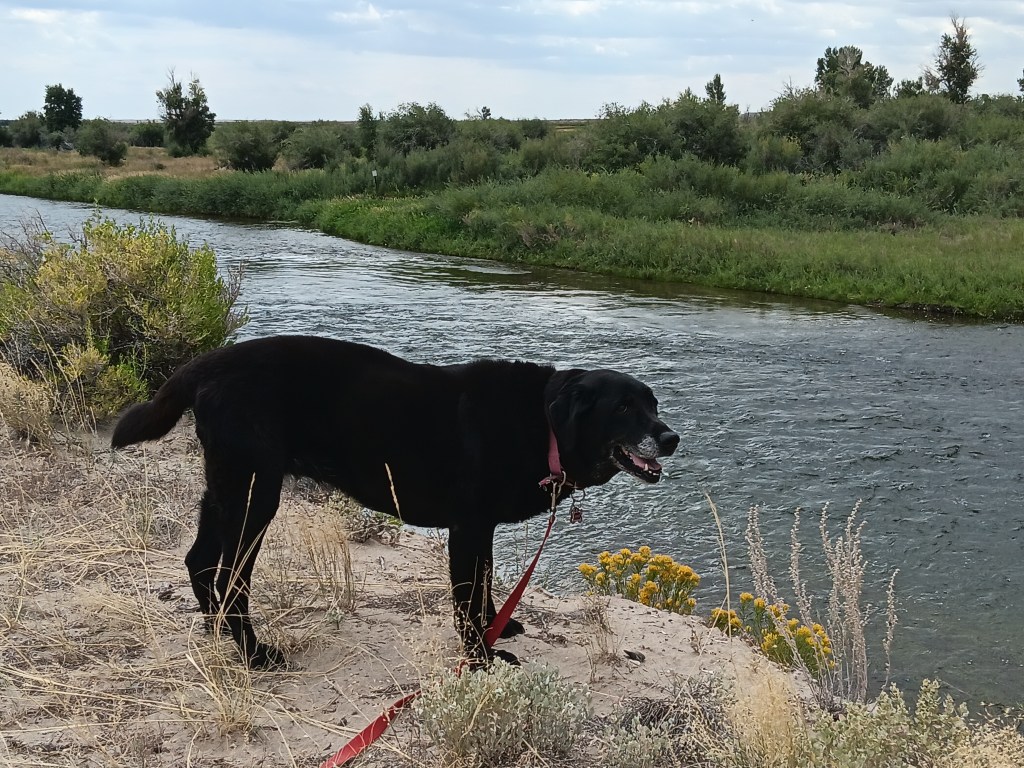
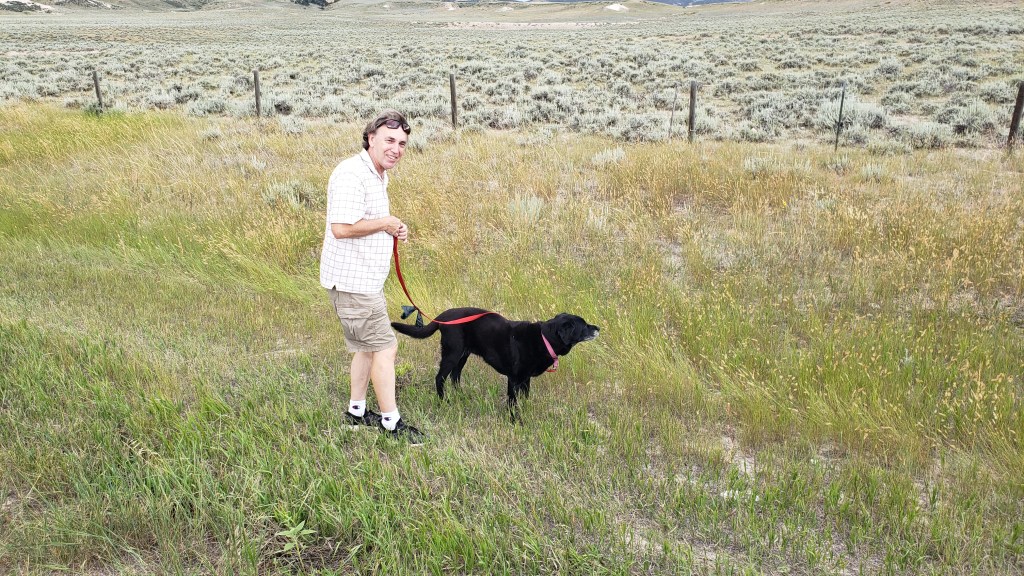
Ruthie found plenty to sniff, so she was happy.

It may have been just a bit windy.

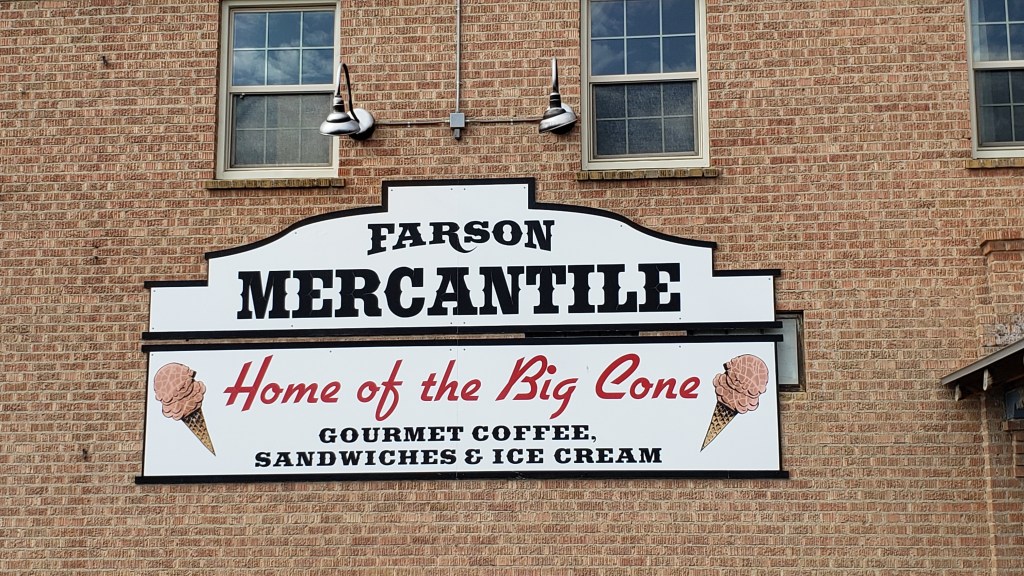
After getting skunked (not by a skunk) during our first pass in mid-afternoon, we decided to head into Farson, where the visitor center guy told us we’d find the “best ice cream,” and a single-serving would be “enormous.”

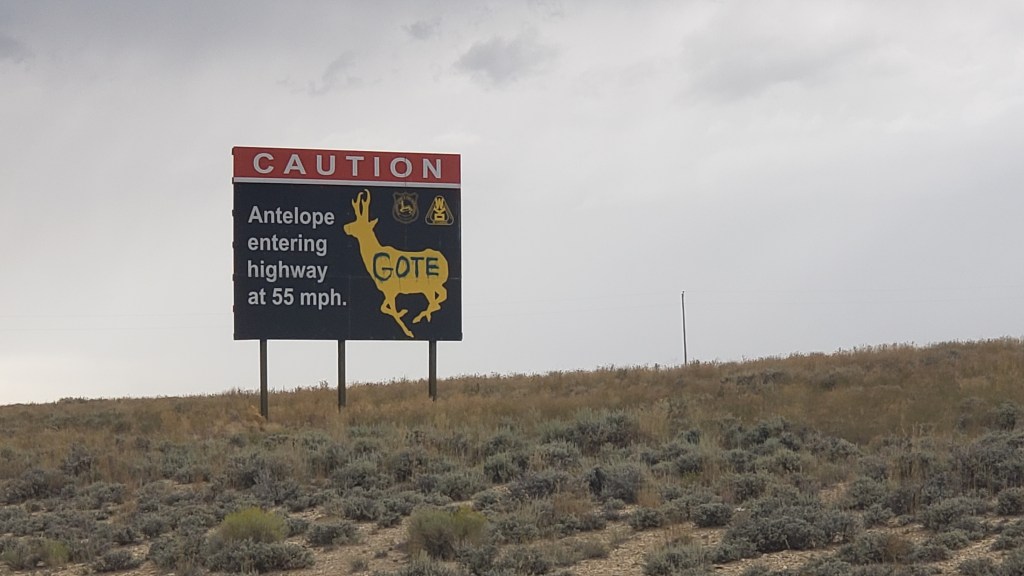
We saw lots of wacky signs warning of local dangers, such as cows and speedy “antelope,” (which aren’t antelope at all, they’re pronghorn, but that’s an argument for another day).

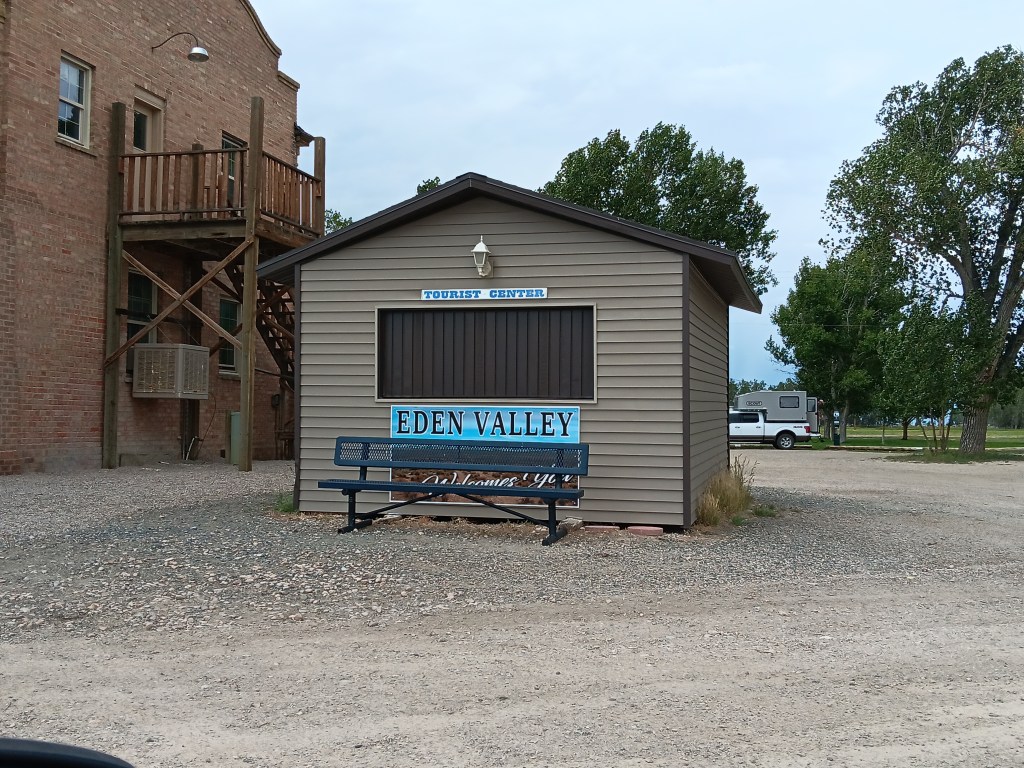
Farson’s Visitor Center, right next to the only other thing in town, the Mercantile, with its big ice cream cones.


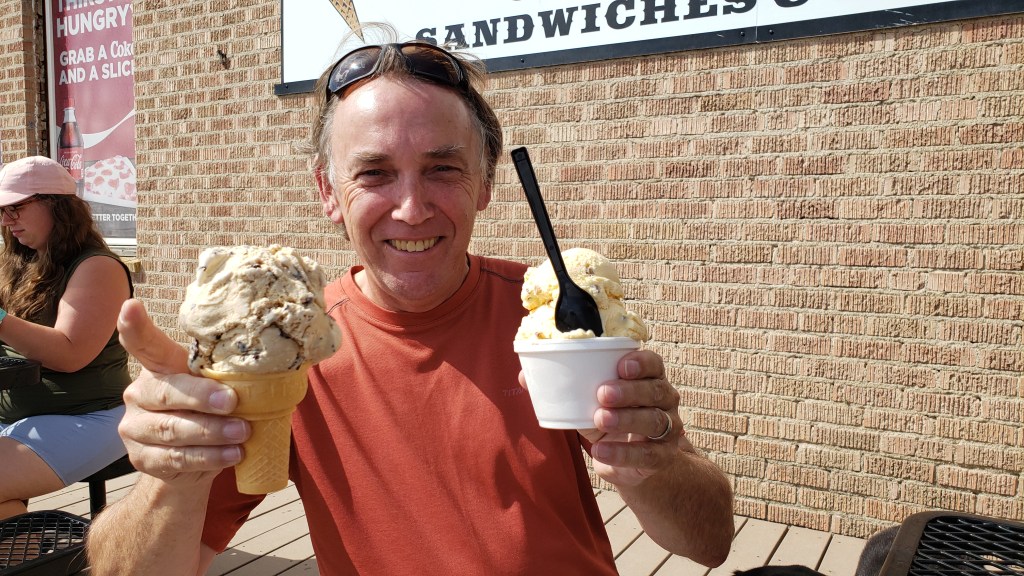
He wasn’t wrong. The place was hopping, and everyone was buying ice cream. We split a sandwich first, having skipped breakfast, and judging by the outrageous size of the ice creams we saw coming out of the building, we both opted for the Baby Scoop.

Turns out, that’s what nearly everyone else had, too.

Simon originally asked for a Single, but when the girl scooping it up started to mound a second massive scoop on top of the first massive scoop, he balked, and retreated to Baby Scoop.


Susan ate less than half of hers, Simon powered through his, and we spent a happy hour talking to the locals who joined us on the patio. One was a rancher having a treat with his grandson, and he told us all about his farm, and how he’d never been to Florida because he had no desire to “go to the other side of the world.” All the people we met were just passing through the tiny town, but insisted you “have to stop for an ice cream” when you’re here.

Our return trip to the wildlife refuge had the disadvantage of being right after a big rainstorm, and we were right in thinking we’d see less wildlife (meaning, none) because of it.

Lots and lots of looking, but not a lot of seeing.

Somewhere along the wildlife road we also missed our turn-off to the highway, and as darkness began to threaten, we had a choice to make. There had been no obvious roads turning off the wildlife road, so should we push on? Or should we go with a sure thing and make the many-miles trip back along the road we already knew would lead out of the refuge?

This is pretty much what we saw most of the way.

In this instance, we chose to backtrack, mainly because we’d passed a wreck of an RV that was camped on the side of the road, its owners were probably packing heat, and we’d be held captive if we didn’t get out before dark, since we’d been told the DNR closes the gates shortly after dusk.

The next day made up for any small disappointment we’d had, as we pointed Nippy south out of Wyoming and into the Flaming Gorge in northern Utah.


I’m a bit tired as I type this, both of us having been awake most of the night with a big thunderstorm and an antsy dog, so we’re going photo-heavy here, with captions that will do most of the work for me.

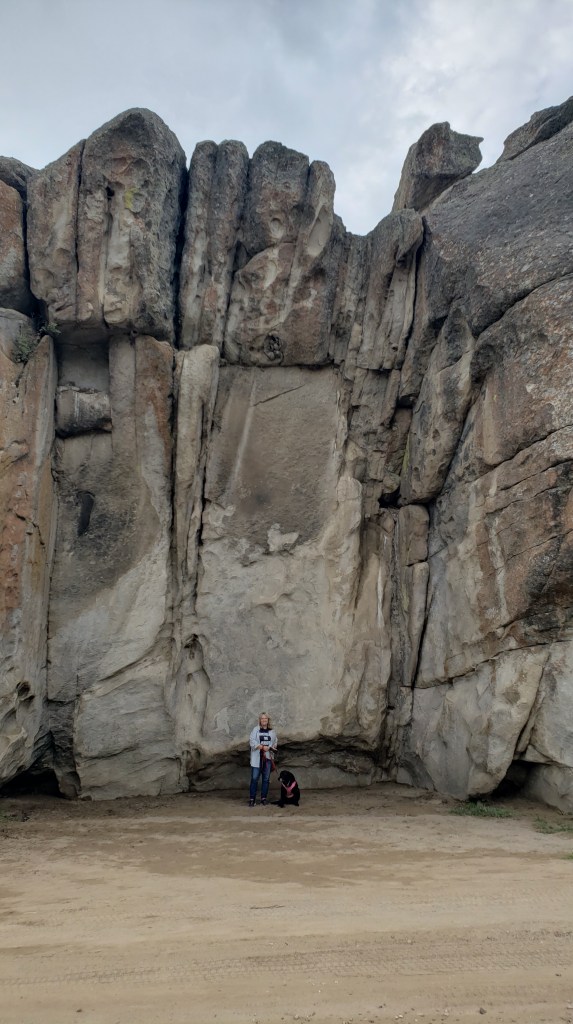
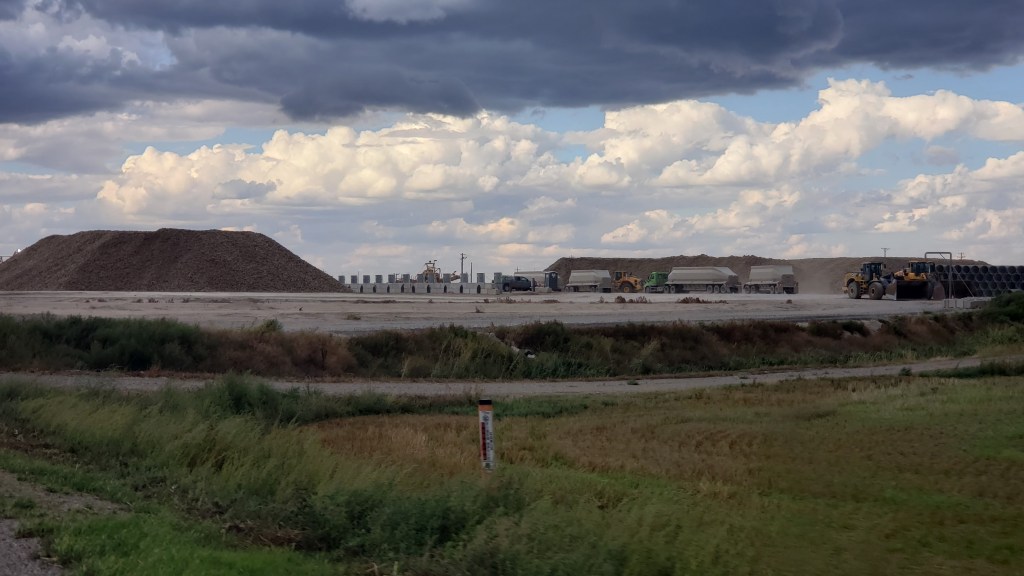
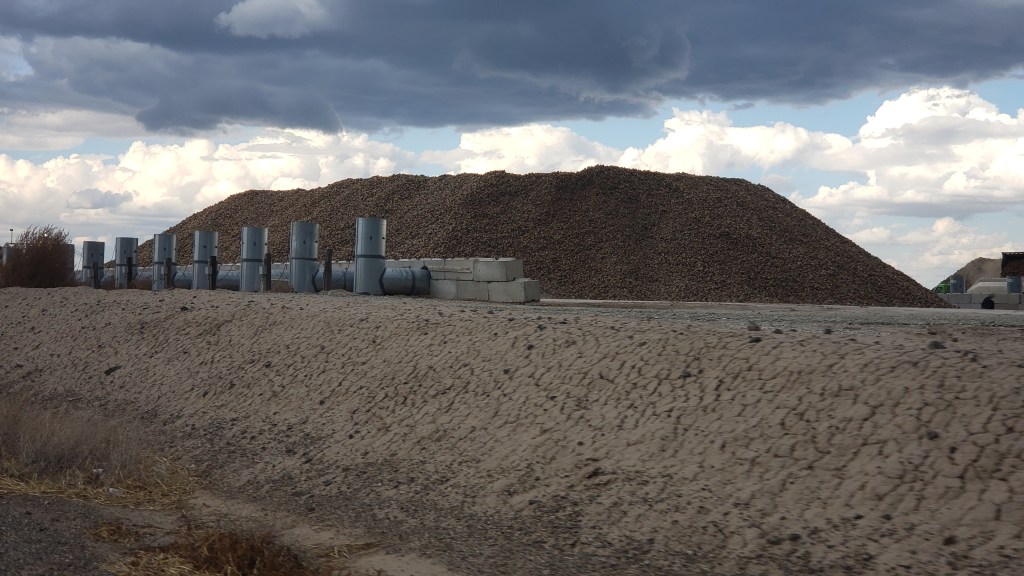
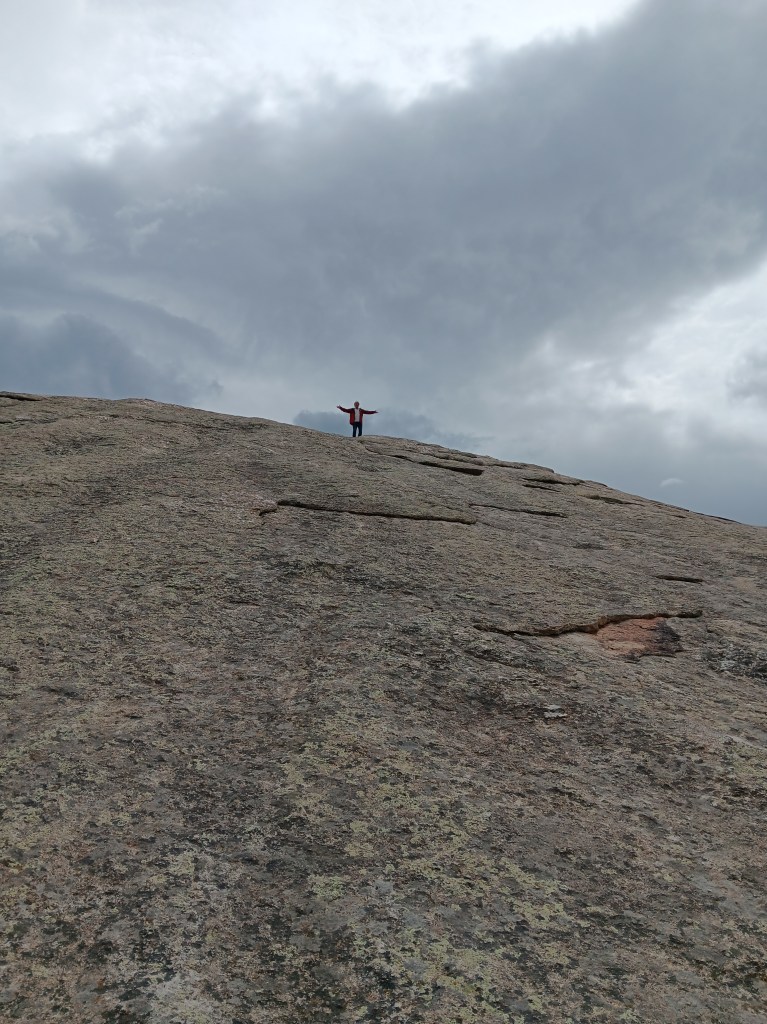
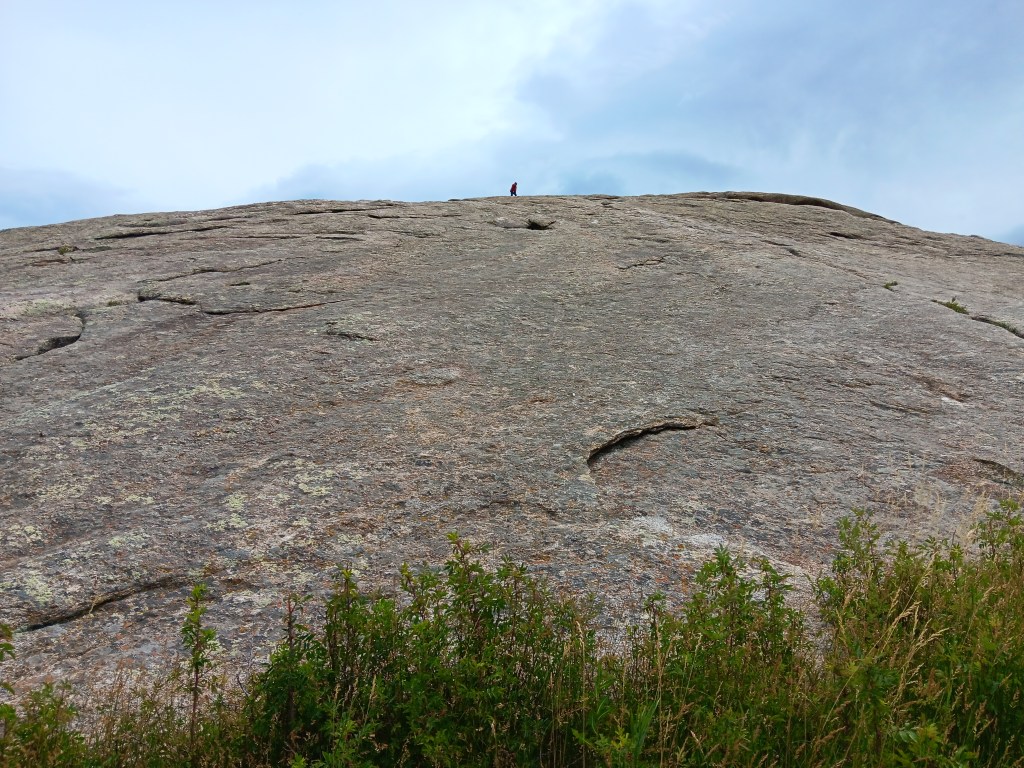
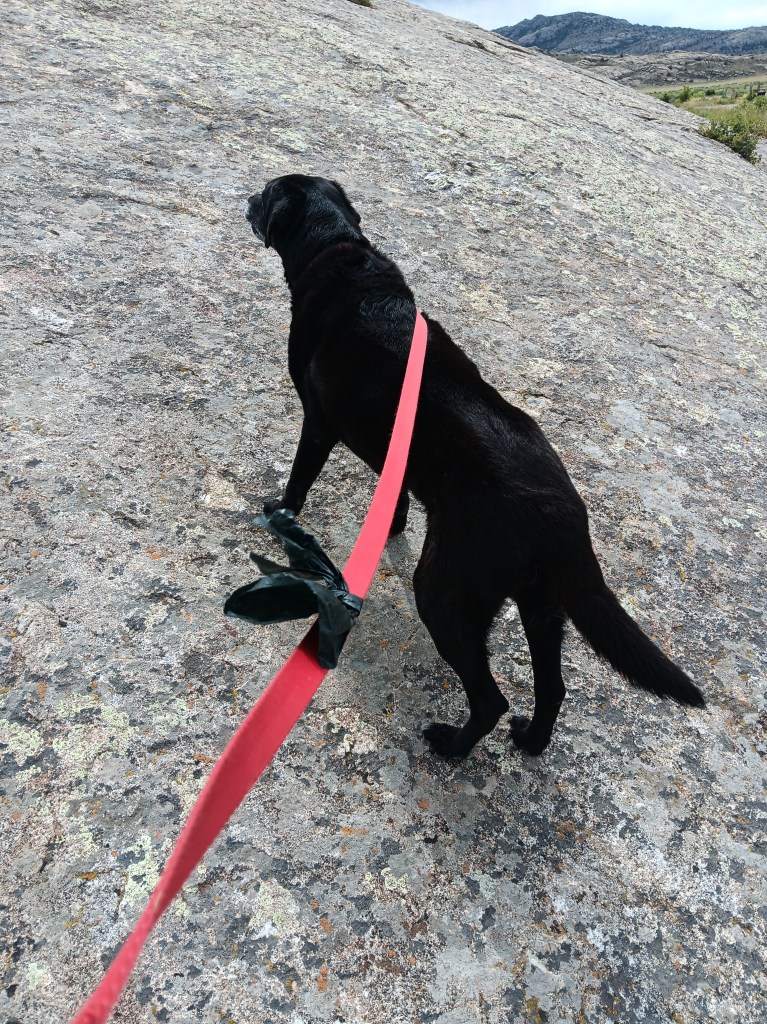
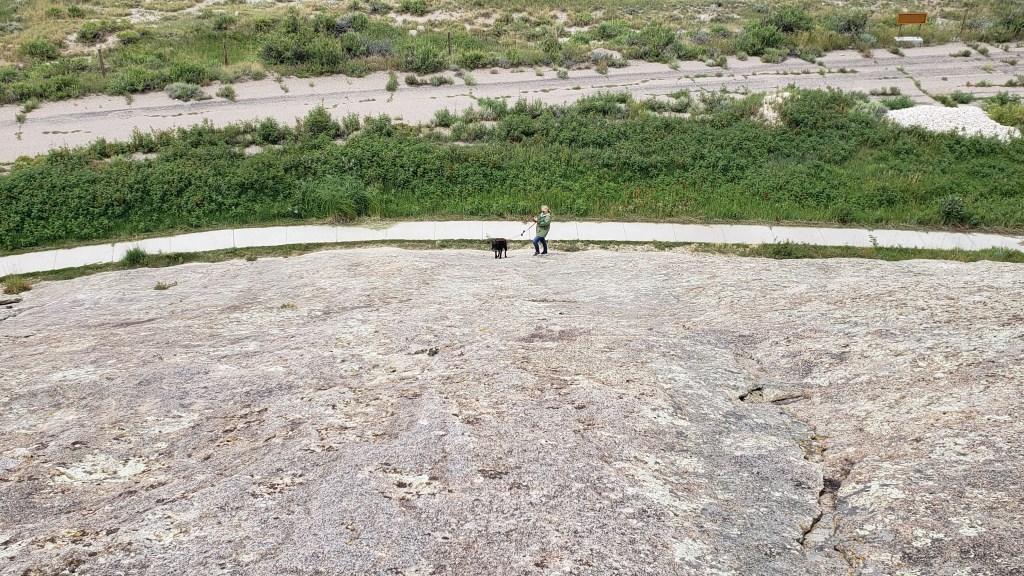
I’m putting this photo here first, and I’ll use it as a reference for how BIG the mountains we passed were, and how high the canyons walls were. This is nothing more than a large mound of rock, hardly worth noticing, but it gives you an idea of size.

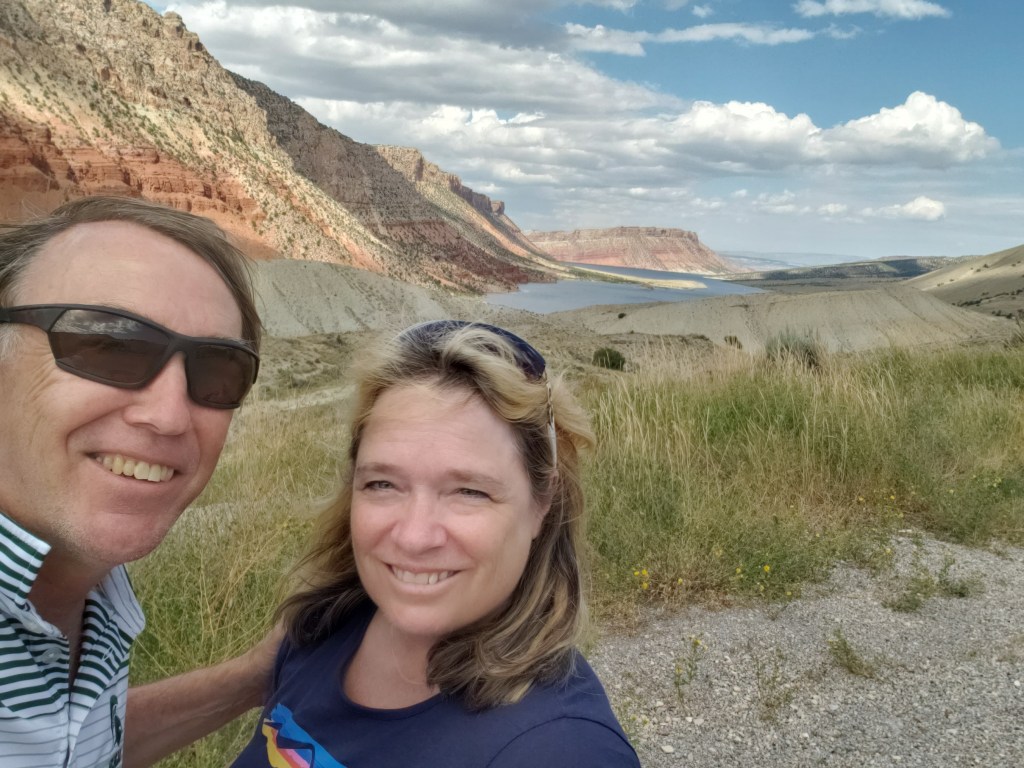
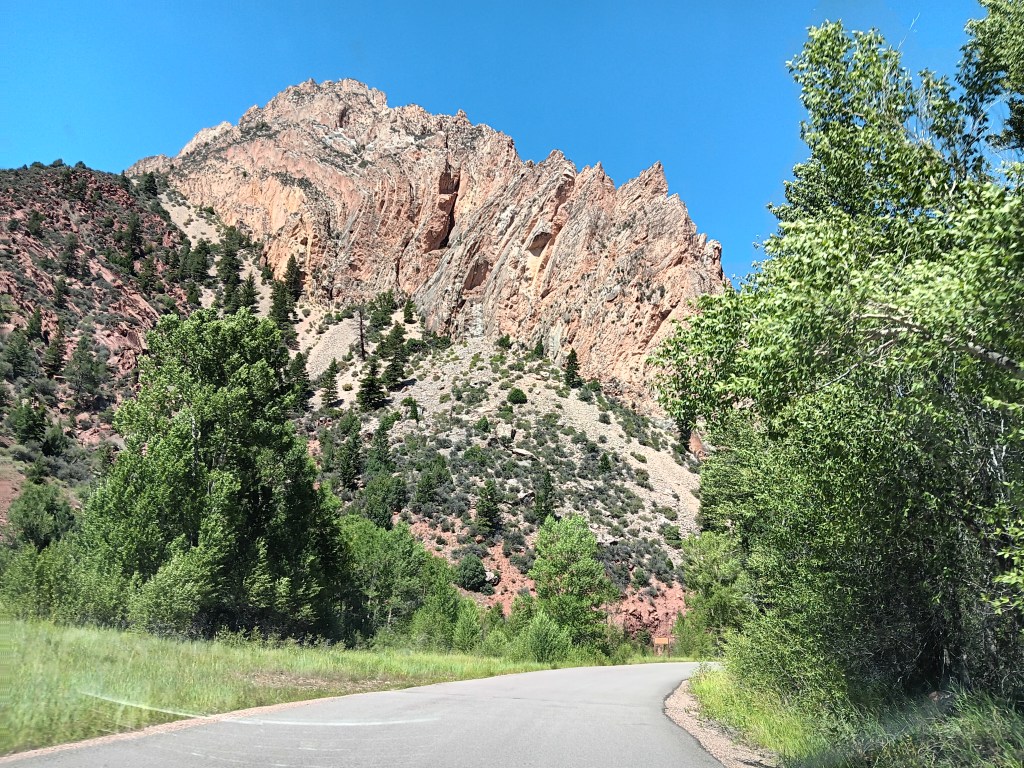
On our way through Flaming Gorge National Recreation Area, we detoured down a road that led to the Sheep Creek Canyon Geological Area, a name that intrigued us, and we’re so glad it did. It turned out to be in our Top Two of astounding canyons.

It started slowly, but even so, that boulder with Nippy in front of it is about the size of a single rock at the top of this mountain.

You wouldn’t be able to see the boulder without binoculars if it were at the top of this mountain. It would just be too small.

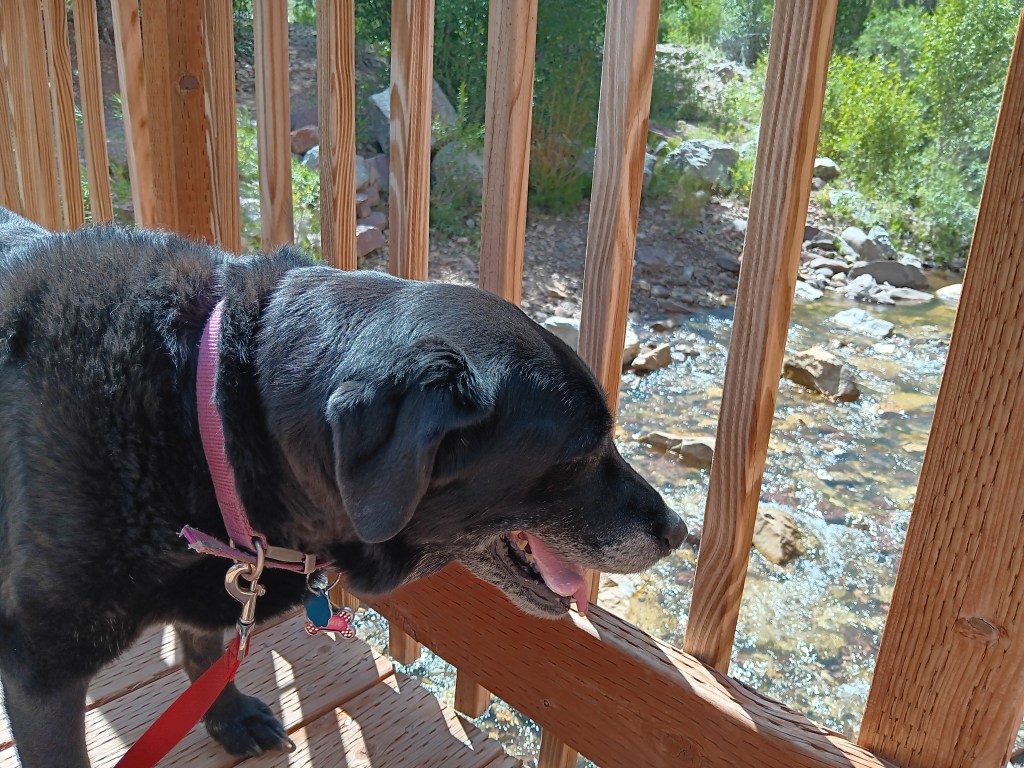
A creek ran alongside the geological loop throughout our entire drive.

“How cool and babbling and refreshing on this hot summer’s day! Too bad I hate water so much.”

The tiny points at the top of this massive, massive mountain are enormous pine trees.

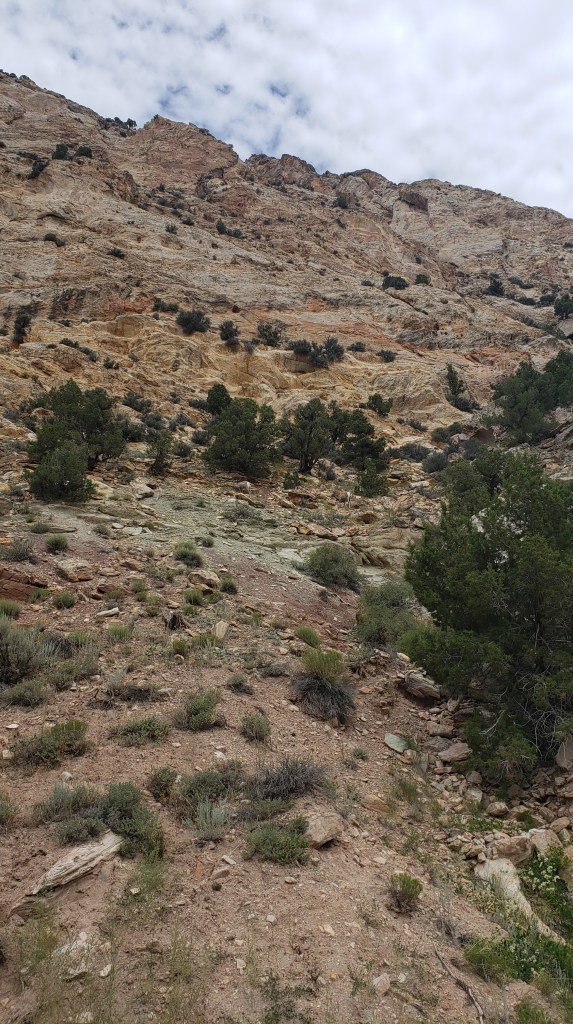
The smallest rocks sticking up at the top of this mountain – whose structure looks like it was bent in on itself – are about the size of the boulder.

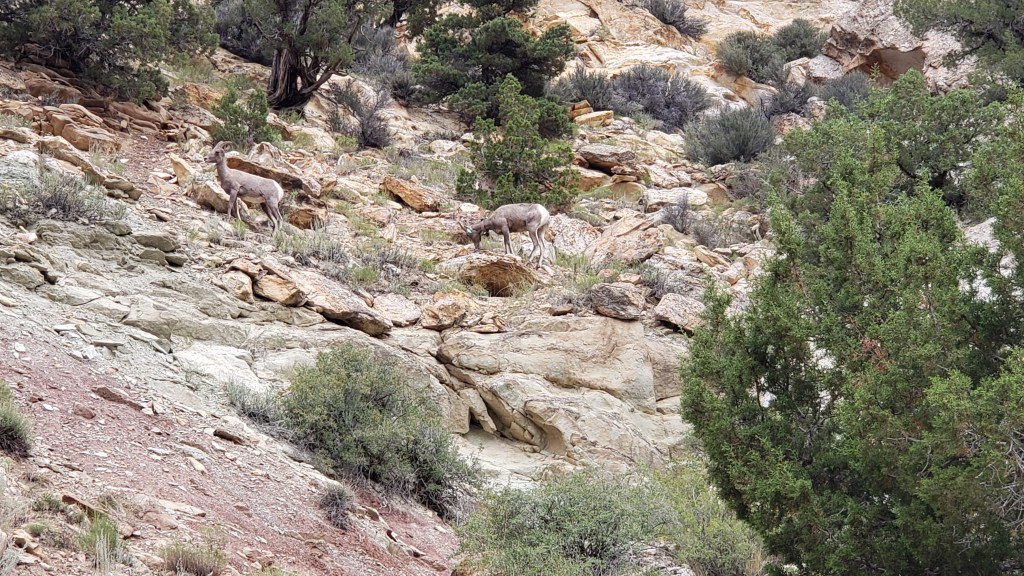
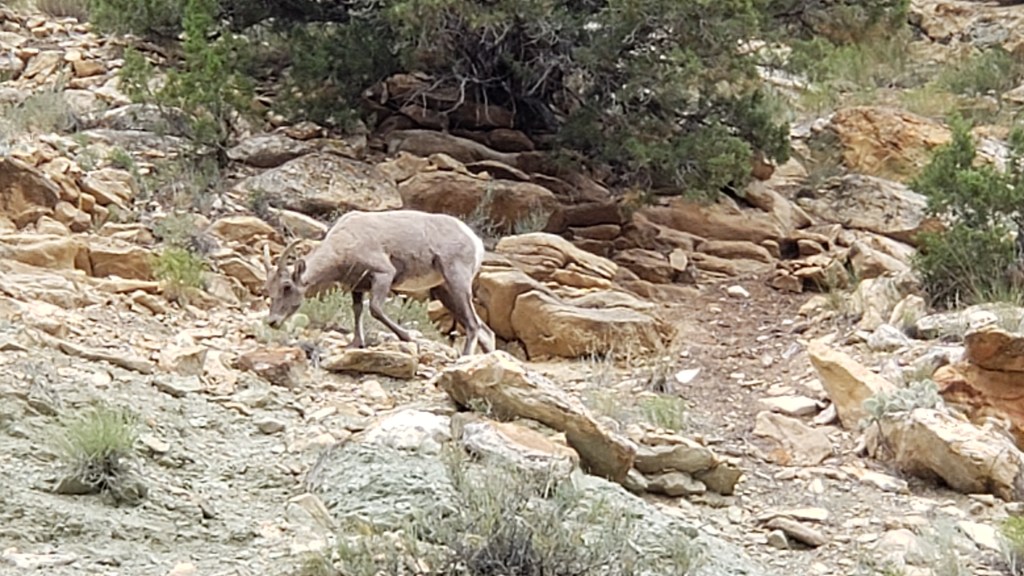
We took hundreds of mountain photos, as you can imagine, but we’ll stop there. Instead, enjoy these two Bighorn Sheep, who blend into the landscape so well it was surprising we saw them at all.


This is without zooming in. You can JUST make out their white butts below the trees in the middle of the photo. That’s how hard they are to see.

This is zoomed WAY in.

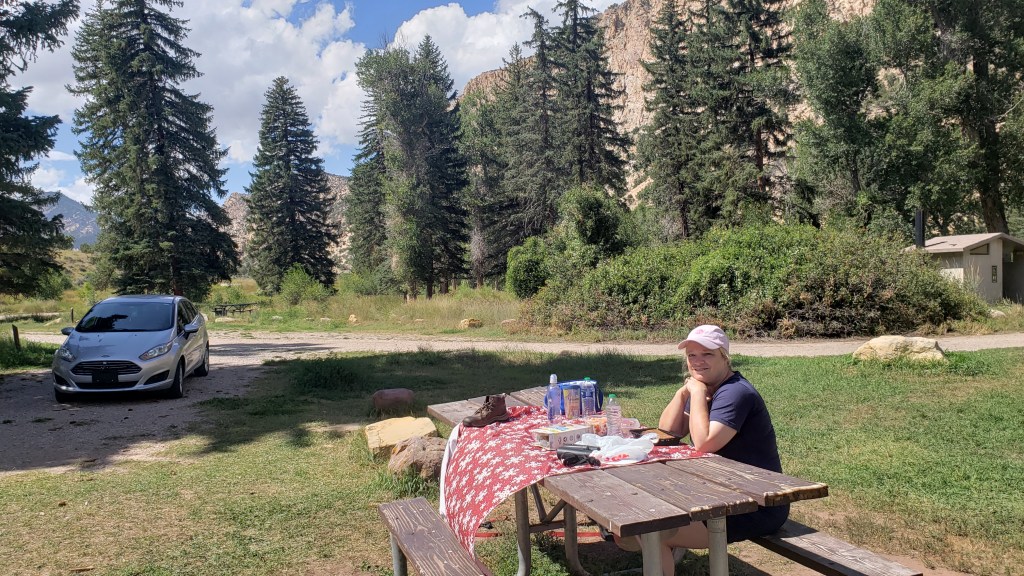
We pulled off into a tent-camping area before leaving the canyon, and had the kind of lunch we were growing used to (meaning, odd). This time it was frozen carrots, cherry tomatoes, Paul Newman Italian Dressing in a packet we picked up at the lodge in Yellowstone, Triscuits, bread, and sausages.

Why? Just, why?

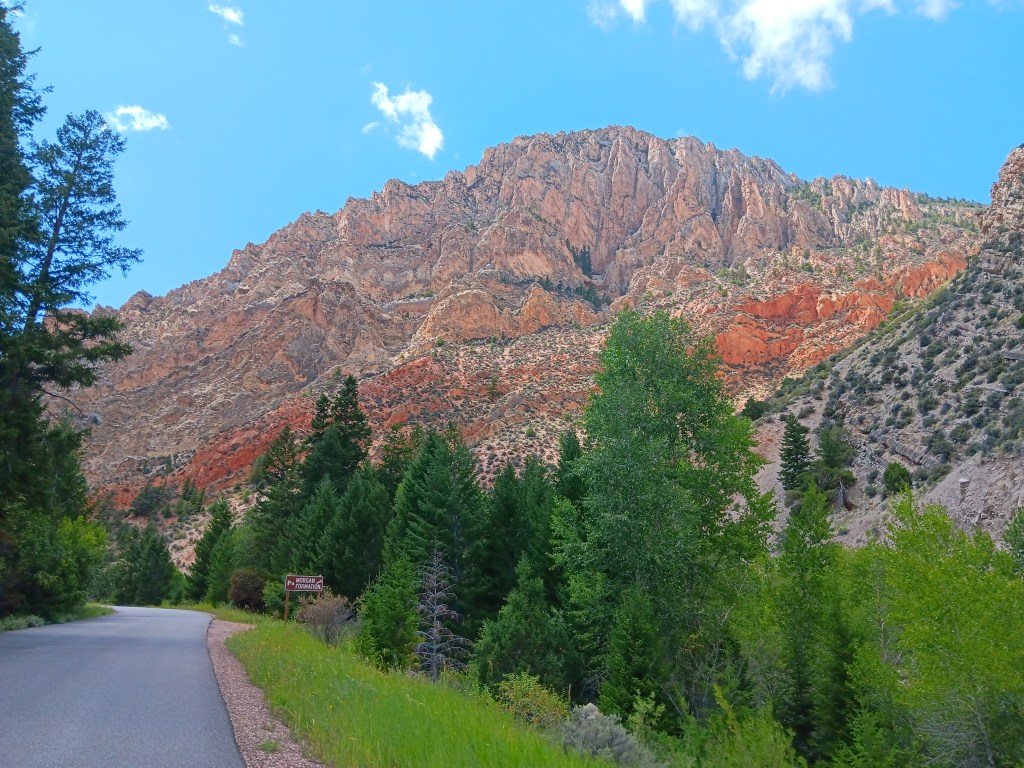
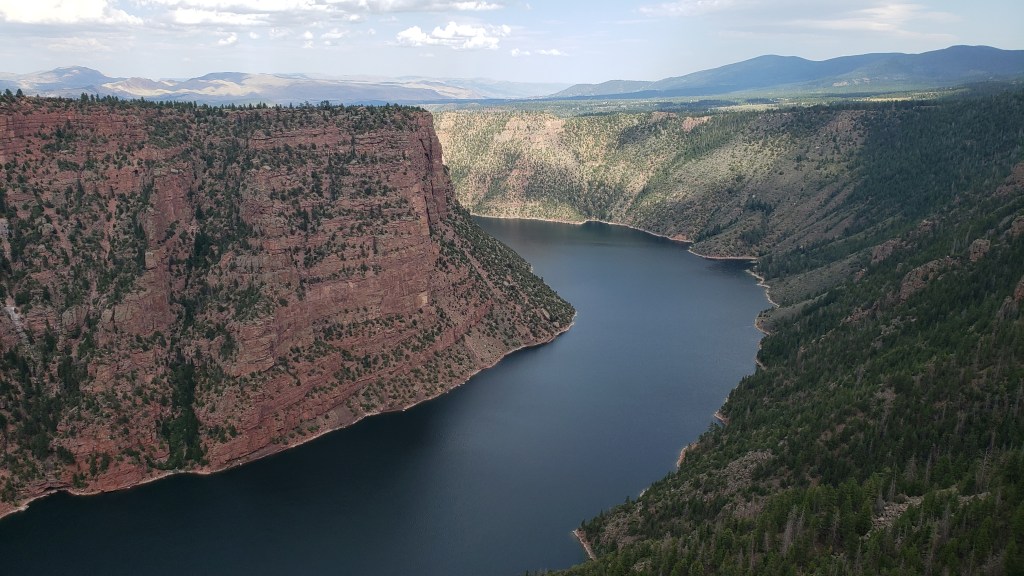
Finally, we reached the Red Canyon, and while we didn’t get the best light of the day, the deep red of the rock and the depth of the canyon were still incredibly impressive.

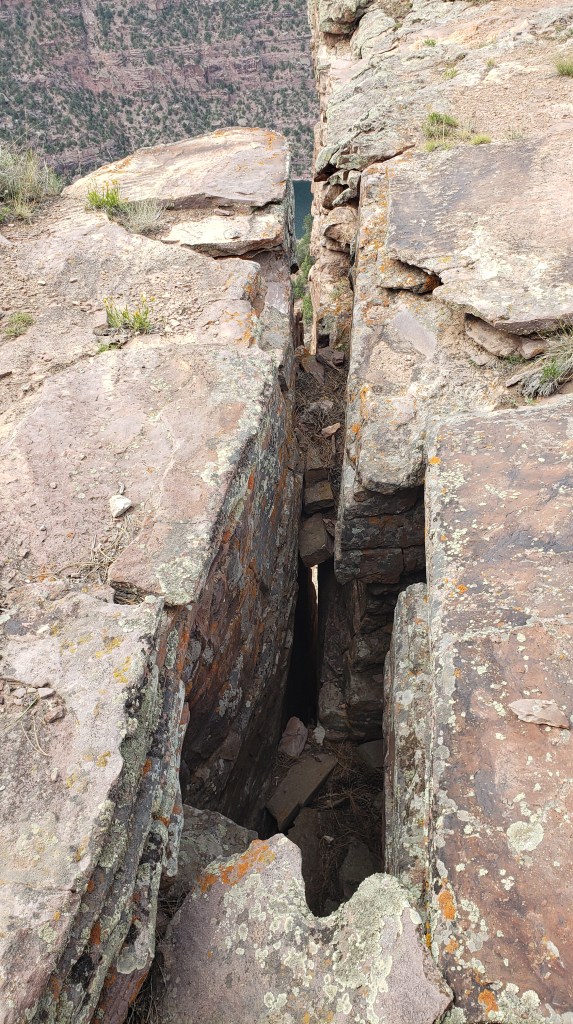
There are warnings to avoid the deep fissures all around the walkway that leads out to the overlooks.

You can just see two people on the ledge just past the small pine tree (the white dot is one person’s shirt), which gives you an idea of scale.


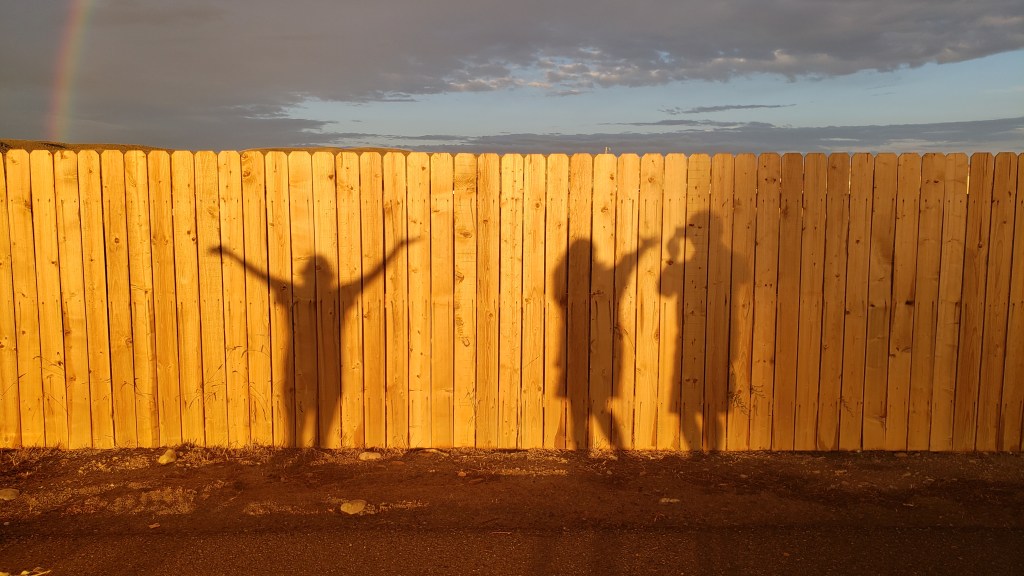
Our final evening in Wyoming was celebrated with a glorious, full rainbow, and some fun with a fellow camper when we noticed our shadows on the fence. Isn’t life great sometimes?

Click photo for video

That’s How People Die


Some of our adventures begin with “It all started out so well.” This is one of them.

With three hours to kill before we could check in at our new campground in Green River, Wyoming (just 15 miles from the Rock Springs Walmart, whose parking lot we spent the night in after we drove two hours longer than we’d planned to), we popped into the Rock Springs Visitor Center to get some local knowledge about what to do in the area.

Along with the famous Flaming Gorge, we were told to drive out to the White Mountain Petroglyphs, visit the Killpecker Sand Dunes, and take the scenic Wild Horse Loop as great ways to spend time and soak up some natural wonders.

Each time we talk to a Visitor Center person we tell them three things: We have an elderly dog who can’t hike more than a mile round trip; we want to avoid high places with sharp drop-offs; and we’d like to skip any dirt roads, to avoid damage to our little Nippy.

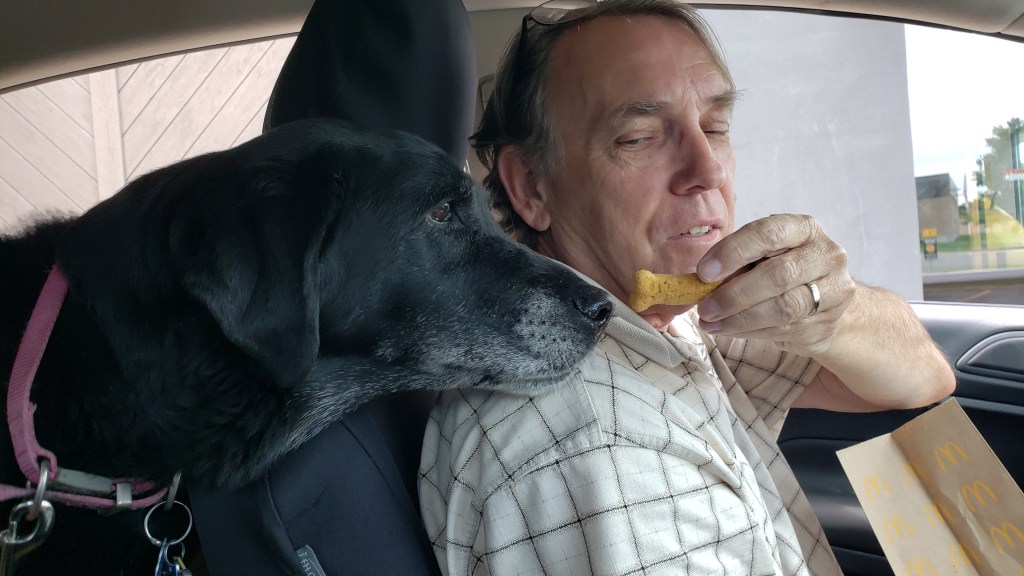
Our Ruthie. In Nippy. With Simon. And a treat.

In this instance, we pointed at Nippy and at our elderly dog, just outside the Visitor Center’s front window, to drive home the point, having been totally ignored by another Visitor Center representative who only told us about long hikes in his area, which were, apparently, his favorite thing to do.

No problem at all, we were assured. We should go to Flaming Gorge, of course (“Well, yes, there are sharp drop-offs, but they only last a few minutes,”), and we should also go out to the White Mountain Petroglyphs, which include what is now called Birthing Rock, a secluded spot where Native American women went to give birth. The highlight of the place was that you could see fingernail marks in the rock, where laboring women tried to cope with their pain.

Okay, odd, but count us in!

We should also drive the Wild Horse Loop in the evening, and see where thousands of wild horses live, our girl said. The loop would take an hour or two, depending on how often we’d stop. Then, on another day, the Killpecker Sand Dunes are “so much fun,” we should go there and do some dune surfing.

Perfect! We’d do the petroglyphs before checking in at the campground, the Wild Horse Loop the next day, then fit in the unfortunately-named sand dunes and Flaming Gorge, with a day in between to do some work. Plan made!

This isn’t us in Wyoming. It’s us at an Orlando City Soccer game, with our hair covered in beer from the people behind us. But this is how we feel when a plan comes together.

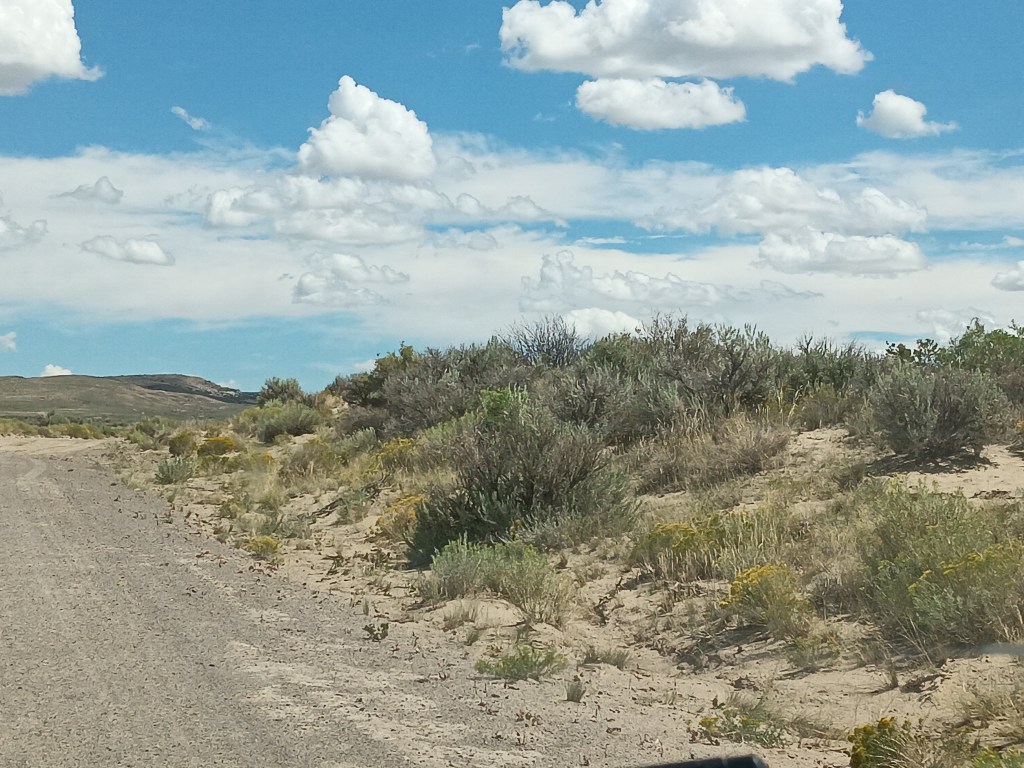
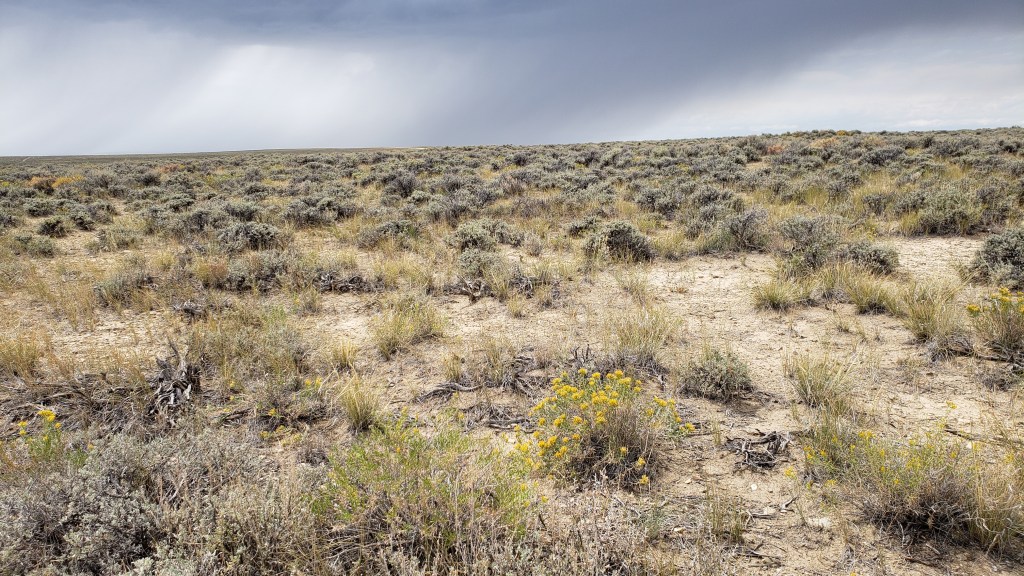
CR-191 heads north out of Rock Springs, and it’s a smooth, paved road into the “Red Desert.” We quickly left the city behind and were passing an increasingly dry, desolate landscape of low, gray-green sagebrush, tufted bunchgrass, some sort of spindly yellow flower, and sand, made even more godforsaken by the harsh summer sun hammering down on us and on the swirling dust-devils.

Foliage we are not familiar with

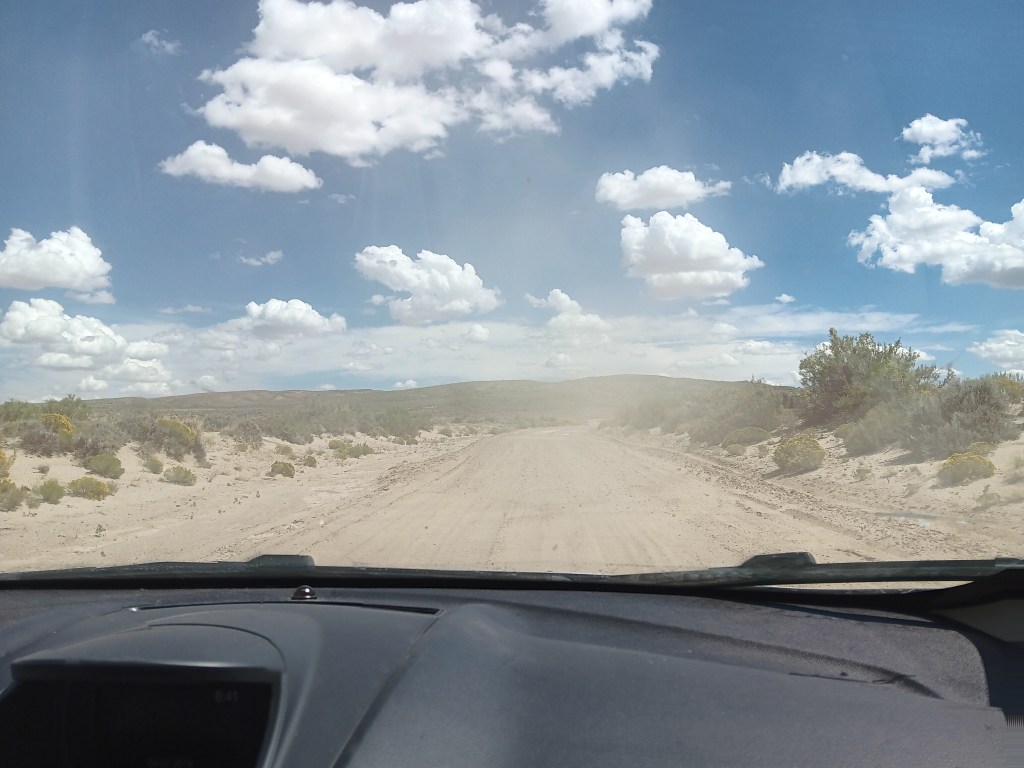
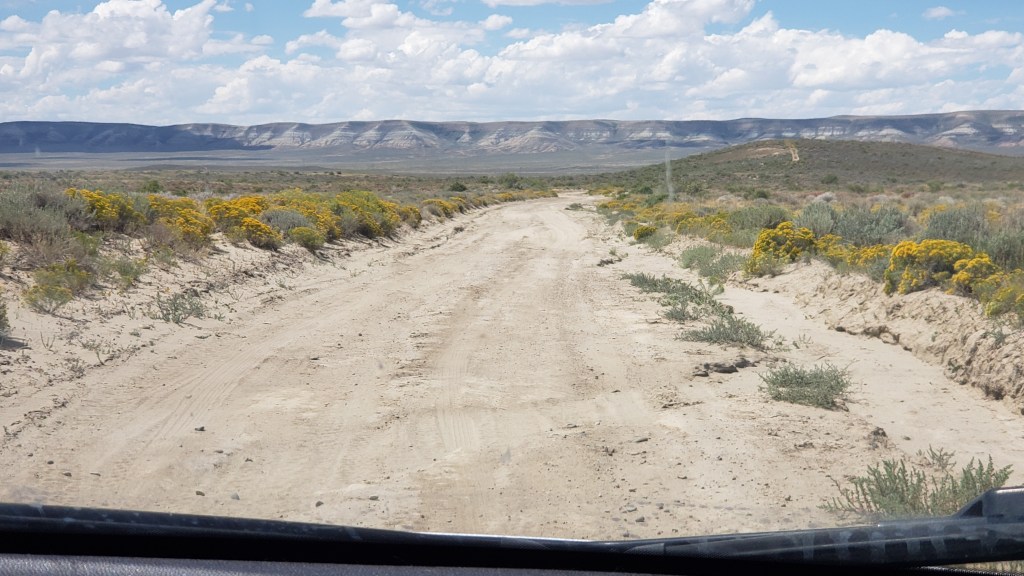
A sign pointed to the turnoff for the road leading to the petroglyphs, and we were mildly dismayed to discover it was, in fact, a gravel road. But it was an “improved gravel road,” meaning, it had recently been watered and graded. Okay. Not too bad. And it was only 17 miles to our destination.

Within minutes, we both agreed if that monstrosity was “improved” we’d hate to see what an unimproved gravel road was like. Unfortunately, after 10 rough, pitted miles, we found out. Some of the cracks created by winter’s run-off in the not-at-all-improved road were so deep we were reminded of the Guernsey Ruts, and extensive holes full of tire-sucking sand threatened to end our journey in the ditch, with a slipped Nippy.

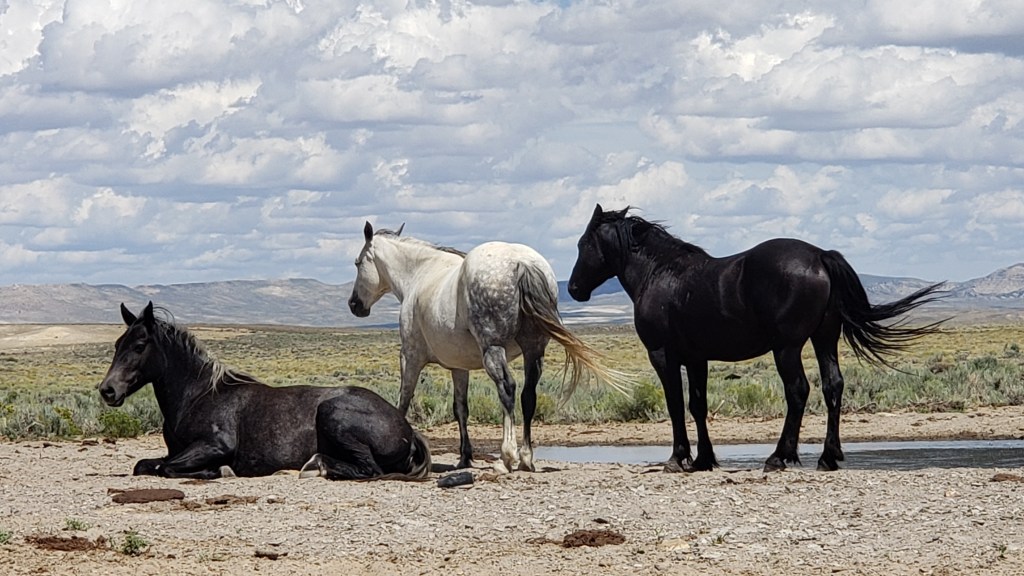
One lone pronghorn watched our progress, and we were certain it was thinking, “What idiots.” Three wild horses turned to observe us briefly, surely wondering if we had a death wish. A small herd of cattle paused mid-chew to give us looks that indicated we were the kind of people who should return to the comforts of the city. Now.

After they looked upon us with scorn, they turned their backs and shunned us altogether.

But we pushed on.

We’d gone more than 17 miles, but there wasn’t a petroglyph or birthing-worthy rock in sight. We’d been traveling parallel to a cliffside for many, many miles, but it was never closer than a mile or so away. We could see quite a way down the “road,” in front of us, but there were no signs indicating our destination was imminent. Where the actual hell were we?

Several miles back, it had begun to dawn on us we had one individual-serving-size bottle of water, no extra gas, no cell phone service, and a dog with very little hind-quarter muscle mass, who could never make it back to the main road. Not only that, but we were totally alone. Some pissed-off rancher could come out and shoot us between the eyes, hide our bodies in the shrubbery, and never spend a moment in prison for the murder of two tourists who didn’t have the sense God gave a goat.

We absolutely are not going to compare ourselves to the brave pioneers who faced immense hardship while founding this great country, but really, sort of, we are.

If the car broke down or we got a flat we could probably make it back to the main road, but there was no way our Ruthie would survive the desert of the damned.

It was time to call it.

So near, yet so far, and with the Grim Reaper’s hot breath on our necks, we turned Nippy around and prayed we’d make it back to pavement.

You’re reading this, so it’s obvious we did. But only just.

It was windy, too. No one can be expected to bear this with grace.

We’ll spare you the next day, when we ventured out for the Killpecker Sand Dunes, which turned out to be much, much further down that same horror of a dirt road.  We won’t mention our dismay when we switched gears and decided to do the Wild Horse Loop instead, which (say it with us) was also down an ass-end-of-nowhere road.

This isn’t the Wild Horse Loop. This is the super-easy, get-there-on-a-paved-road Horse Corral we found the next day, where the Bureau of Land Management rounds up wild horses and auctions them for adoption. Wild herds can double every 3-4 years, and, if left in those numbers, most would starve to death.

Later, when we read the multi-page booklet we were given by the Visitor Center, we discovered additional information we hadn’t been told. The fine print for these locations insisted:

“Grab your camera and binoculars, pack plenty of food and water, and make sure to travel in a fueled-up AWD (all wheel drive) vehicle and always let someone know where you will be going and when you will be back.”

Oh, and by the way, it’s a steep, nearly two-mile round-trip hike to the petroglyphs from the road, through sand and shrub and probably loads and loads of infuriated rattlesnakes.

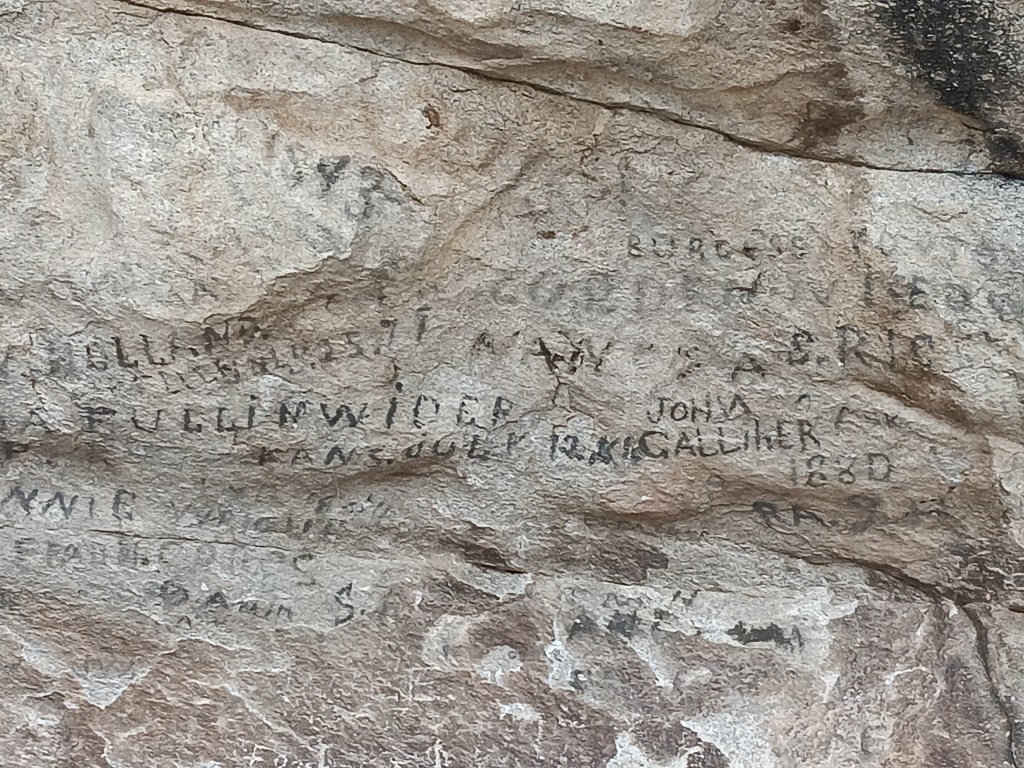
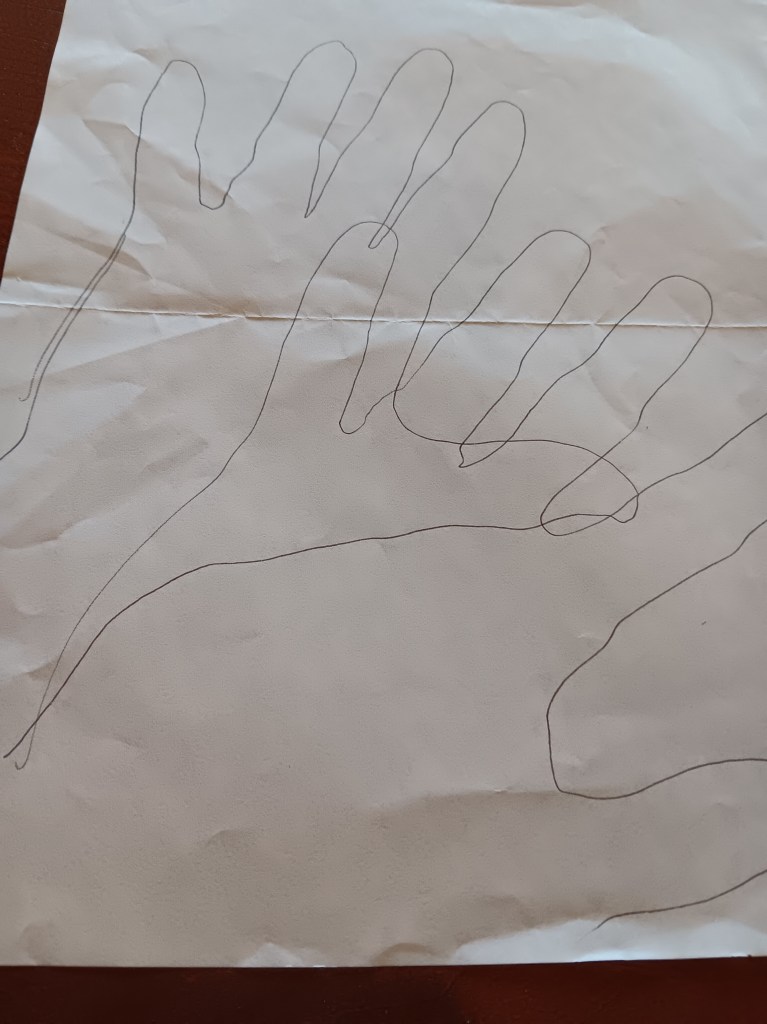
Since we didn’t get to see the petroglyphs, we made our own.

That is the kind of information you give to people who don’t own trucks or cowboy boots. The kind of people who carry designer purses or wear Ray Ban sunglasses. In short, us. We’re the people who need to be told.

Us in our natural state

But we won’t be the people who need to be told next time, because we learned the lesson and survived to tell the tale. So, in the end, it’s a story of triumph. Right?

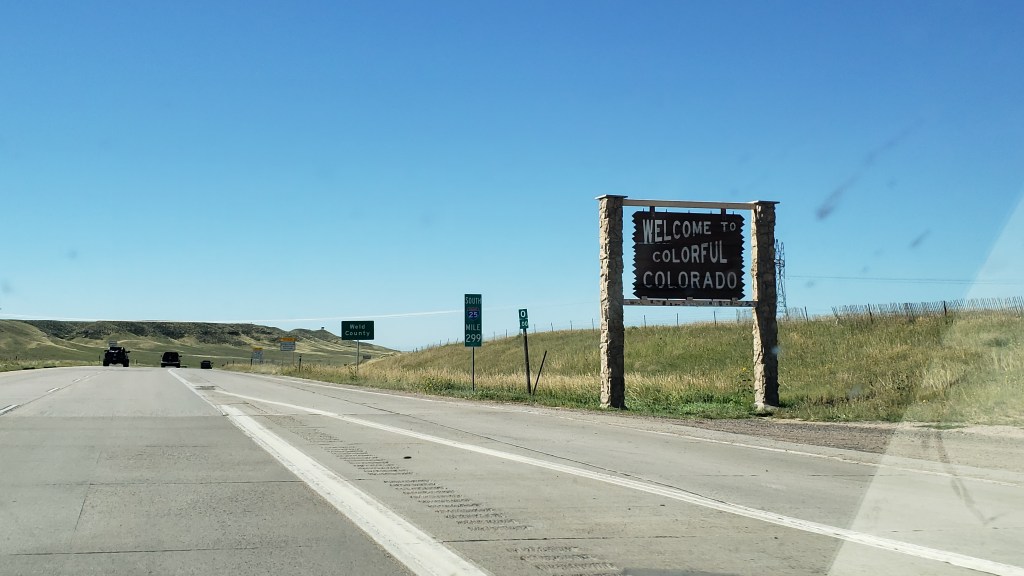
An Unexpected Detour Into Colorful Colorado


Colorado wasn’t on our original itinerary. We just couldn’t fit it in before winter hit, but with the changes we made – skipping Oregon and Washington – we took advantage of the extra time we have, and our proximity to the Rocky Mountain state.


With Fati tucked up at the campground in Wheatland, WY, we headed south into Colorado, having booked a hotel room in Loveland for one night. If we could get a timed entry reservation, we’d visit Rocky Mountain National Park on our second day.

But it was a big “If.” From experience, we knew timed entries go quickly, so we were ready to sniper the 5 p.m. online reservation release and hope for the best.

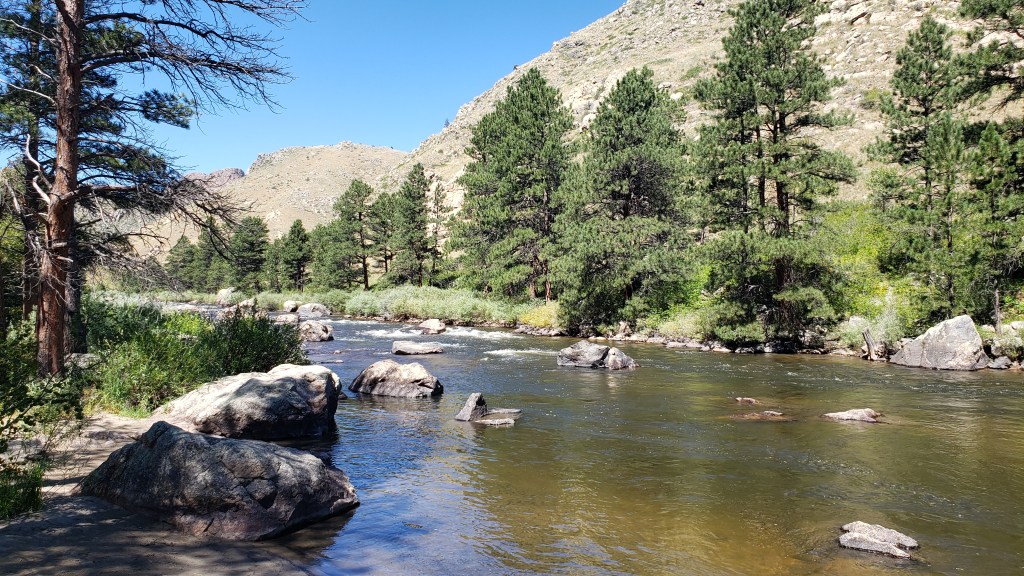
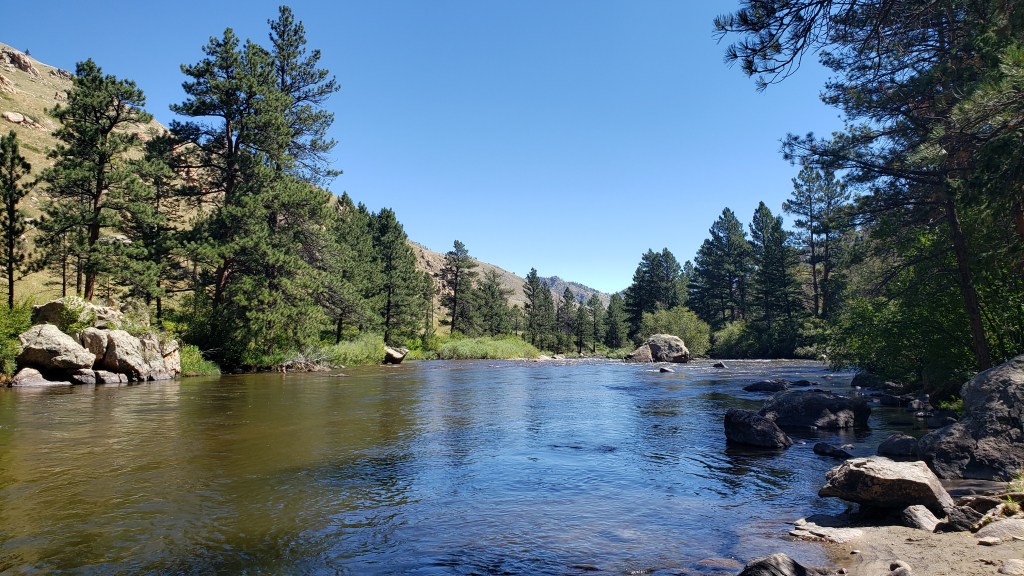
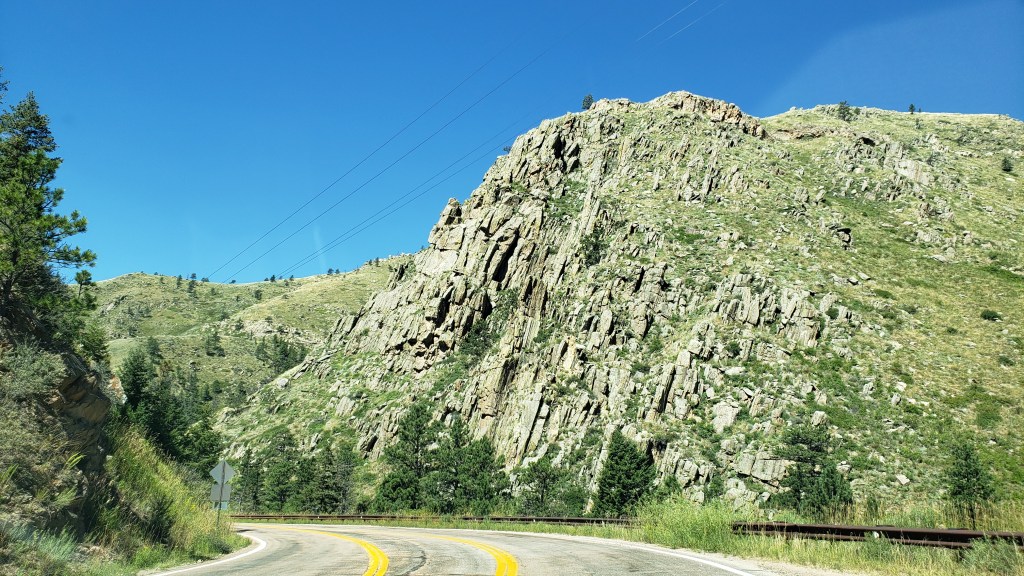
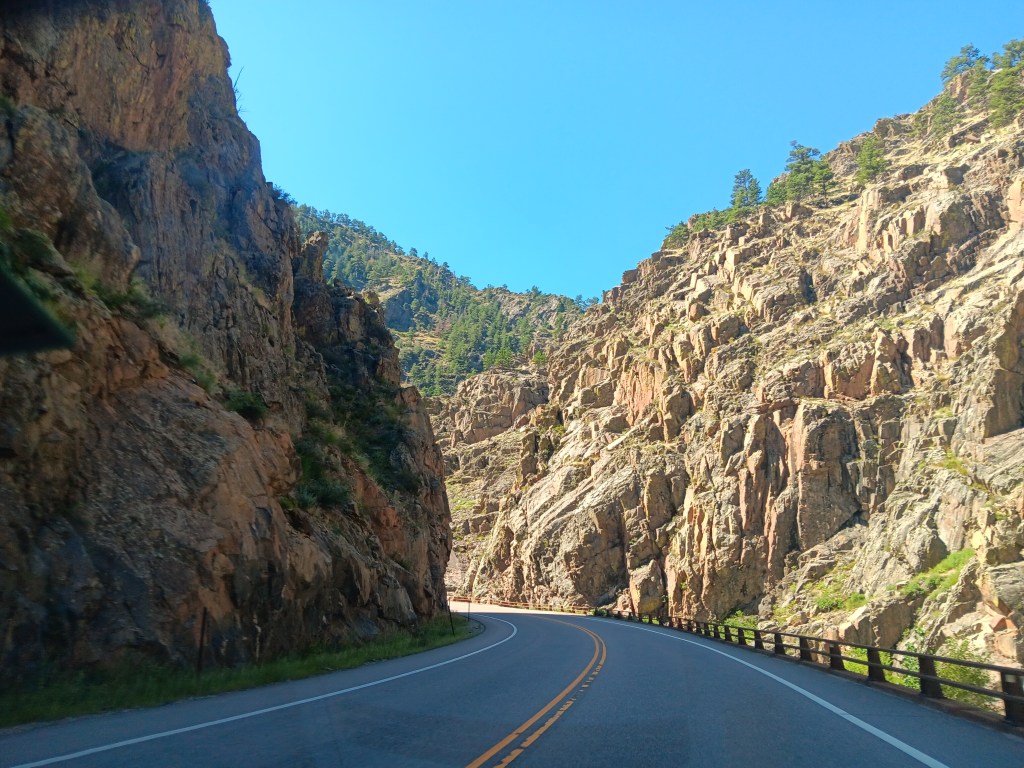
We had perfect weather for our first adventure, which saw us leaving I-25 at Wellington, Colorado, aiming for Cache la Poudre Canyon (oddly pronounced “cache la pooh-der,” and named for French-Canadian trappers who hid their gunpowder there during a blizzard in the early 1800s).


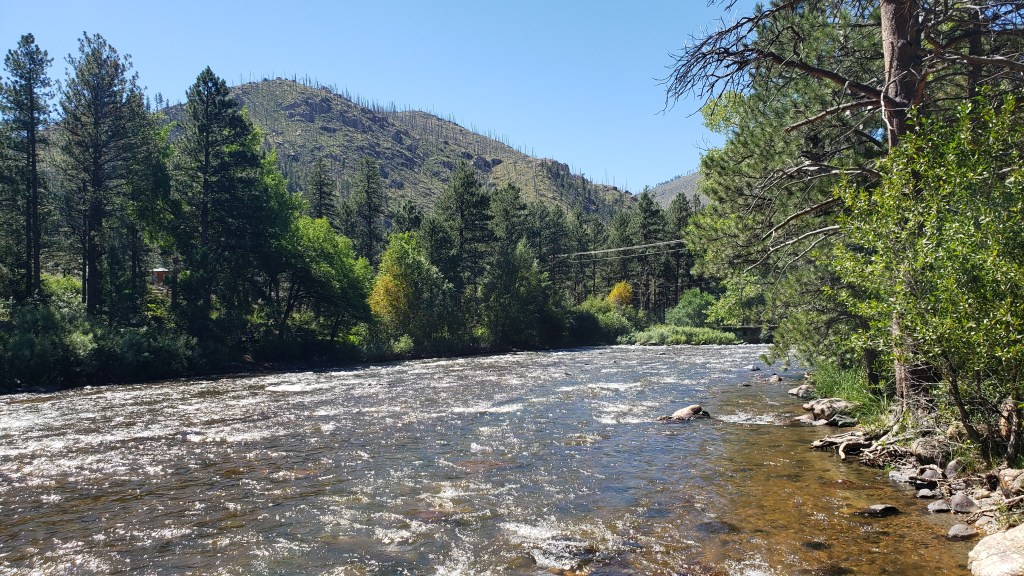
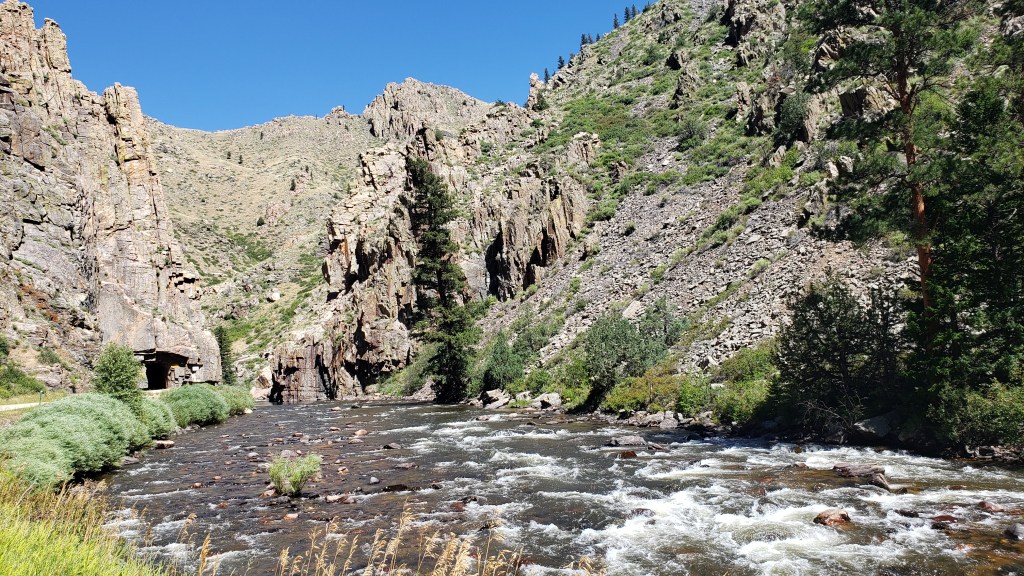
The landscape started gently, but quickly morphed into high, craggy spires lifted vertically by whatever natural forces were at work back when dinosaurs roamed the land, and a mighty Poudre River now wends its way along the bottom of the canyon it carved out.


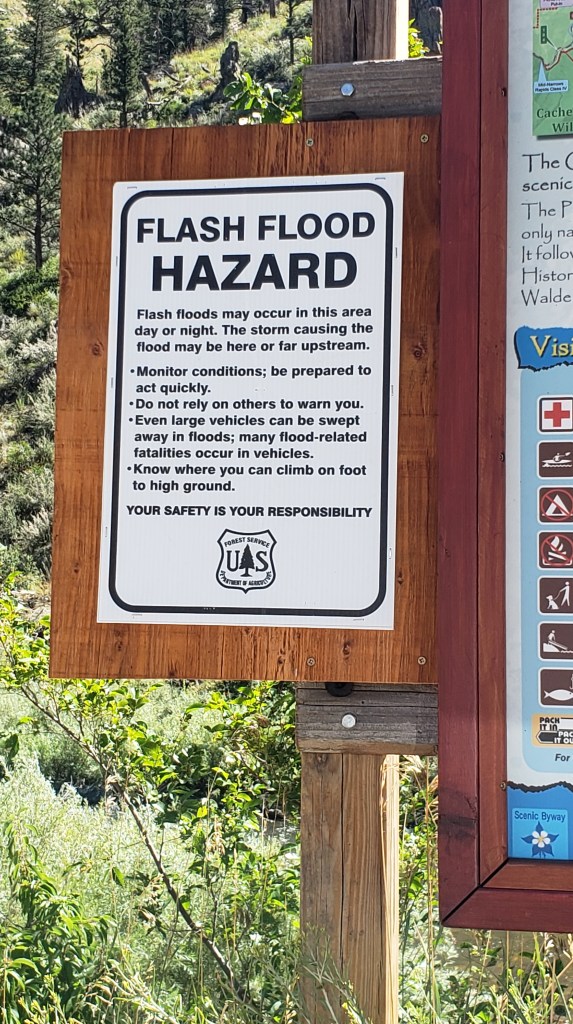
We all have our “things” that unnerve us slightly, and Simon paused for just a moment when we stopped along the river and saw this sign. We were astonished by how many houses were built in the canyon, and often wondered how they would survive a flash flood.


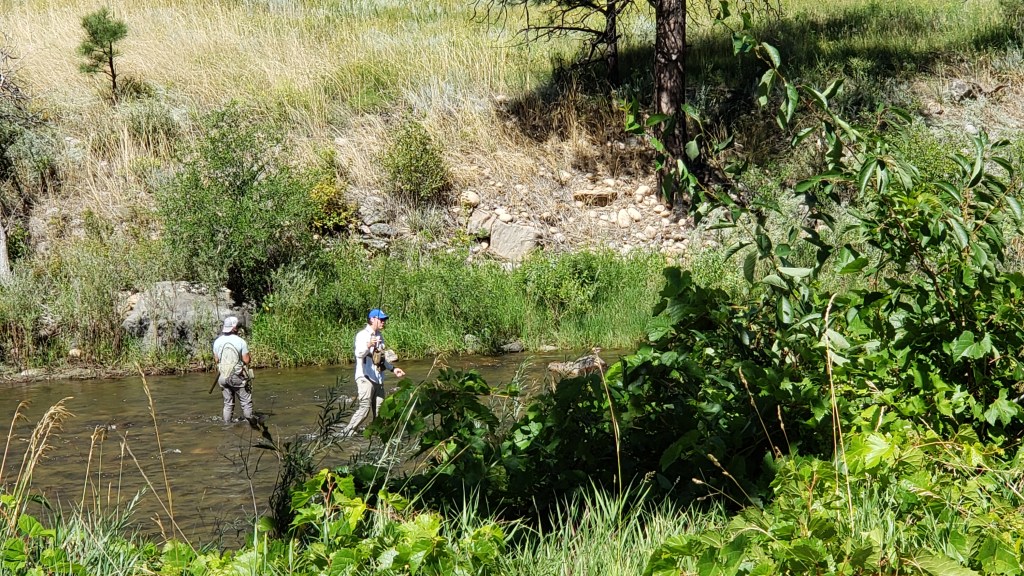
Similar to the Galatin River on our way to Yellowstone, Poudre River is heavily used for fishing and white water rafting. We love seeing rivers as-is, but it’s even more thrilling each time a raft filled with happy (but dogless) adventurers comes bounding down the gentle (and not so gentle) rapids.


We know you’re probably growing tired of scenery photos, but this beautiful country astounds us at nearly every turn, so here’s a video of the canyon’s prettiest turn.

Click on photo for video

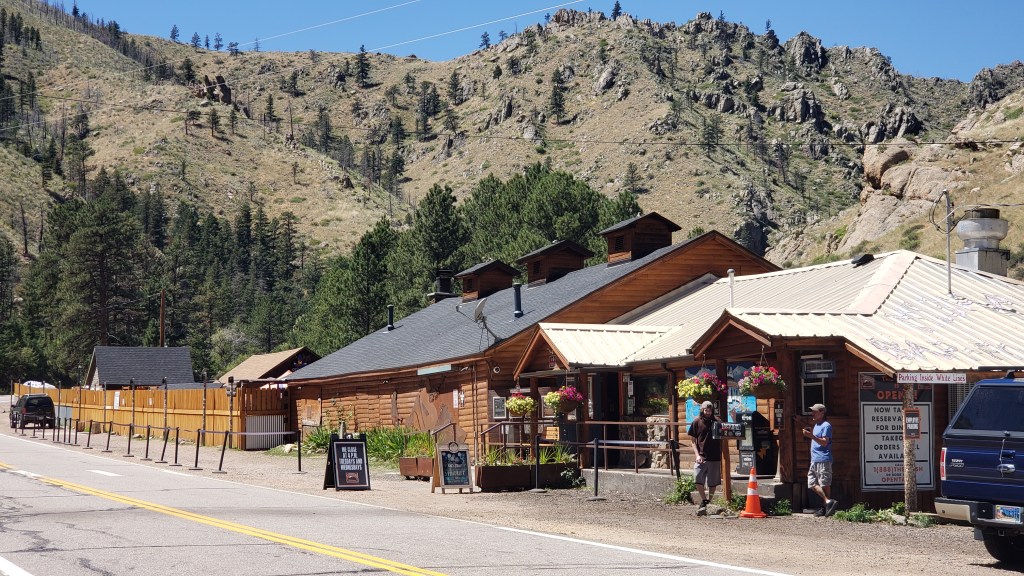
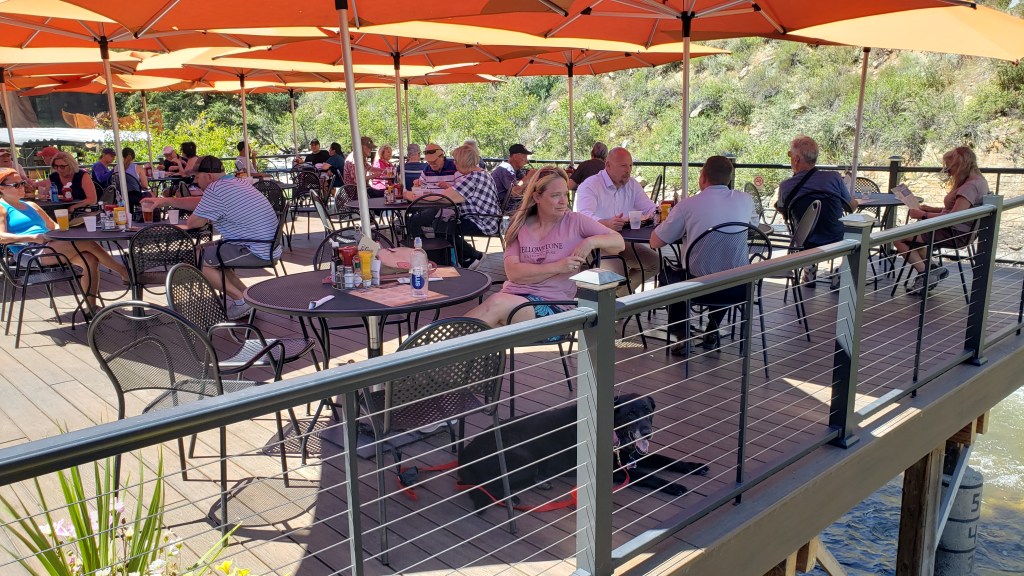
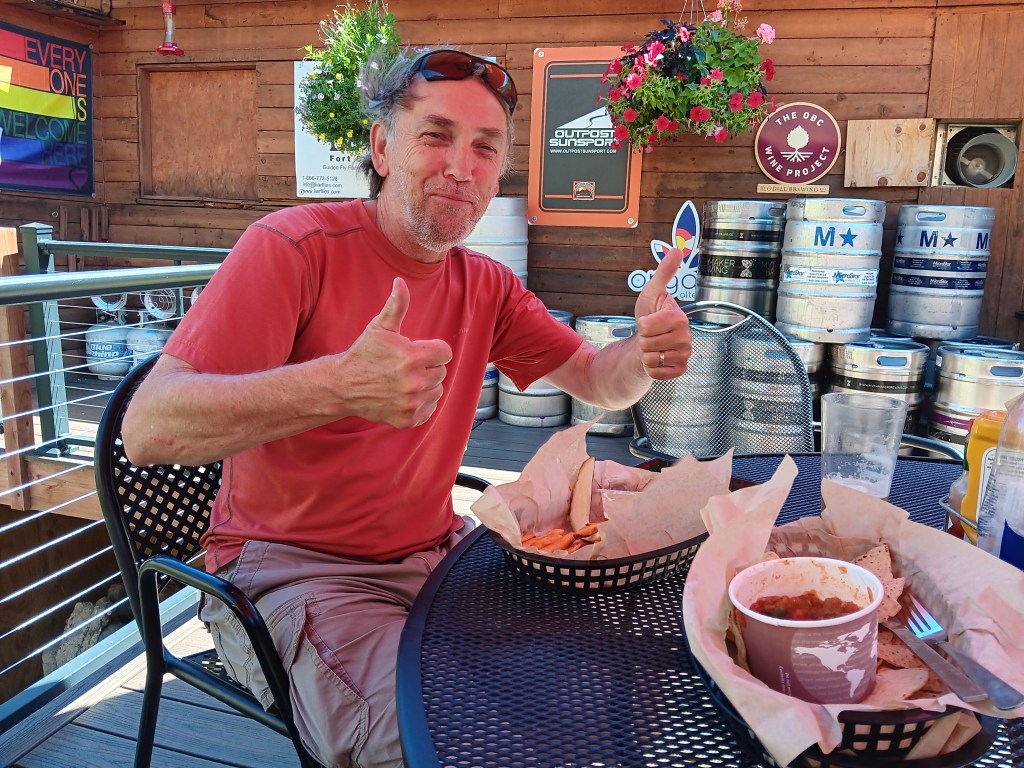
Lunch that day was at the Mishawaka, partly because it’s a long-time institution in these parts, and also because it’s the only restaurant (and a hot-spot music venue) for about a hundred miles. It’s busy…like, REALLY busy…but after driving as far as we could, we backtracked, scored a table on the patio overhanging the river, and life was good.

Surrounded by mountains, with the river behind it

Susan, happy as a clam who didn’t have to cook

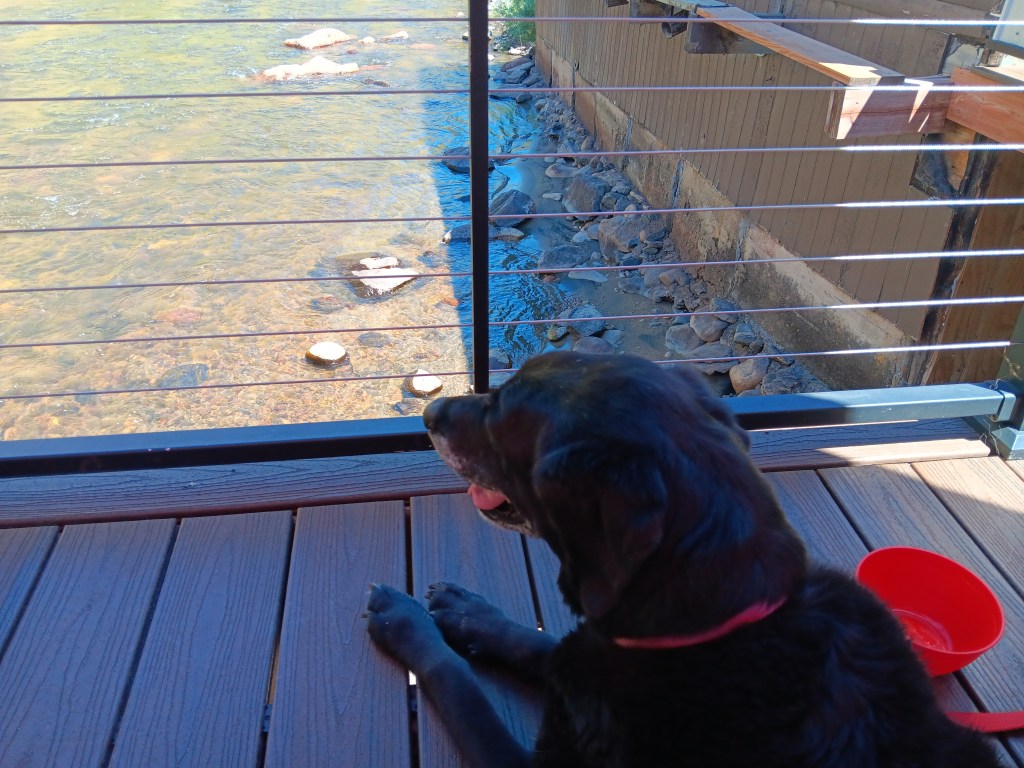
Ruthie, happy as a Labrador who has just been given four french fries

Simon, happy as a well-fed boy who’s finally had a real meal. We split an order of fish & chips, but scarfed it down so fast we forgot to take a photo. Still, it’s not hard to imagine what fish & chips looks like.

We made our way out of the canyon after lunch, marveling at how different the view is, depending on which way you’re going.


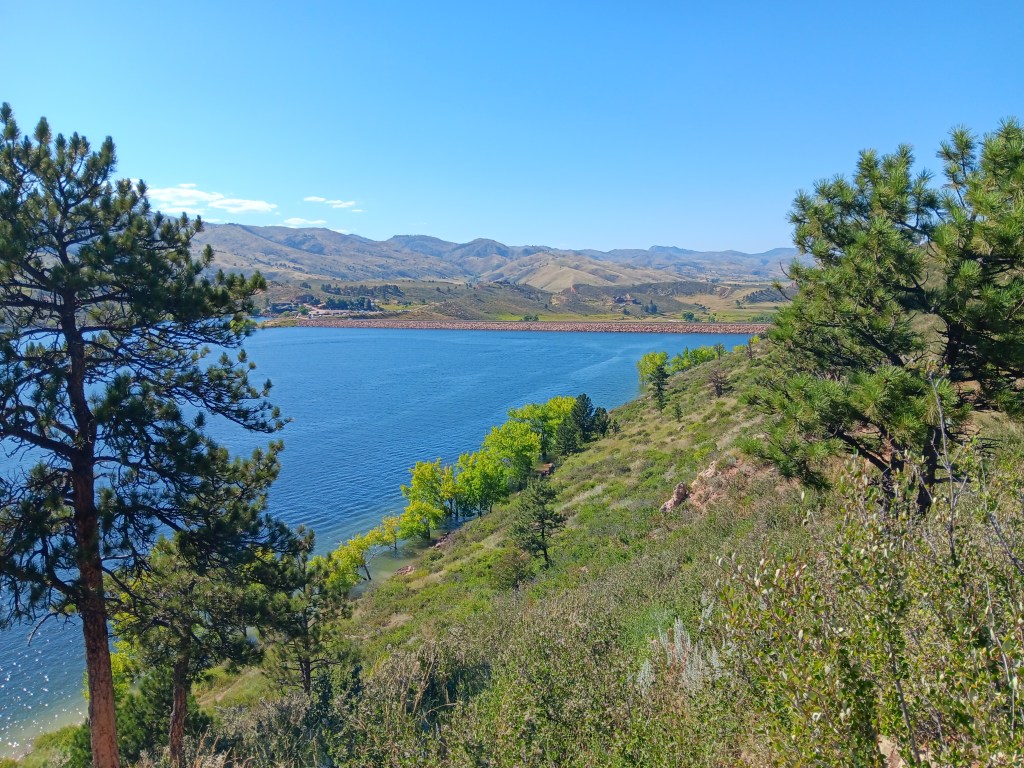
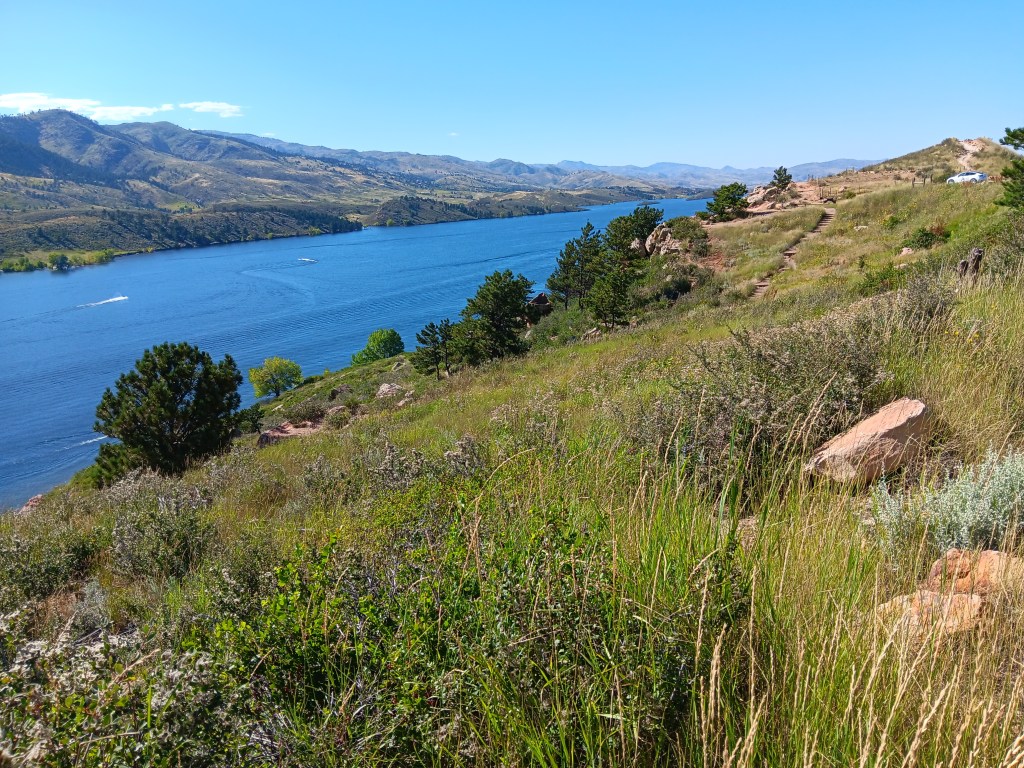
The day was still young enough for us to detour to Horsetooth Reservoir before heading to our hotel for long, hot showers and a good night’s sleep. The reservoir was created to divert water from the Poudre River to ensure a steady, accessible supply, and now it’s used for all sorts of recreational activities.


At exactly 5 p.m., Susan was on nps.gov, for the release of coveted timed-entry reservations for Rocky Mountain National Park. Forty seconds later we had confirmation for entry between 9 a.m. and 11 a.m. and were good to go!

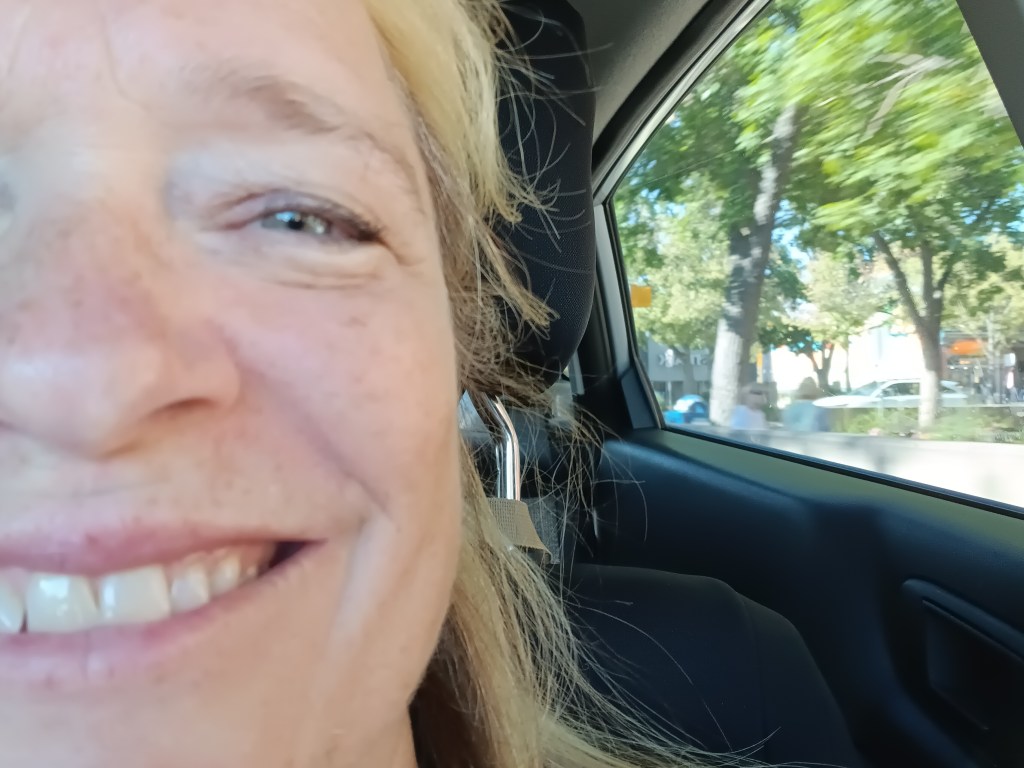
The face I make when it’s all going right! PS: Those spots are freckles, not dirt, though with this lifestyle they could easily be dirt.

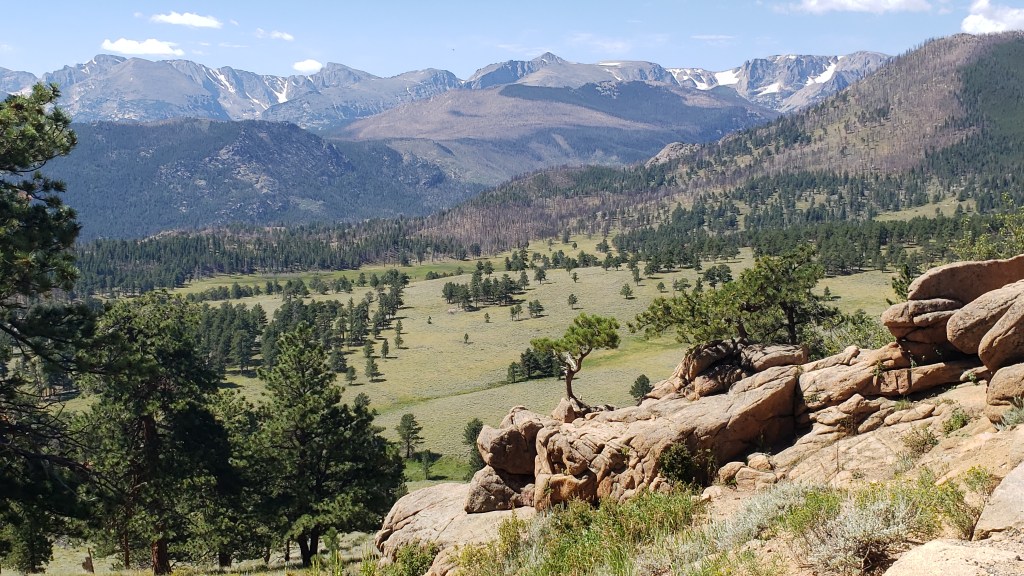
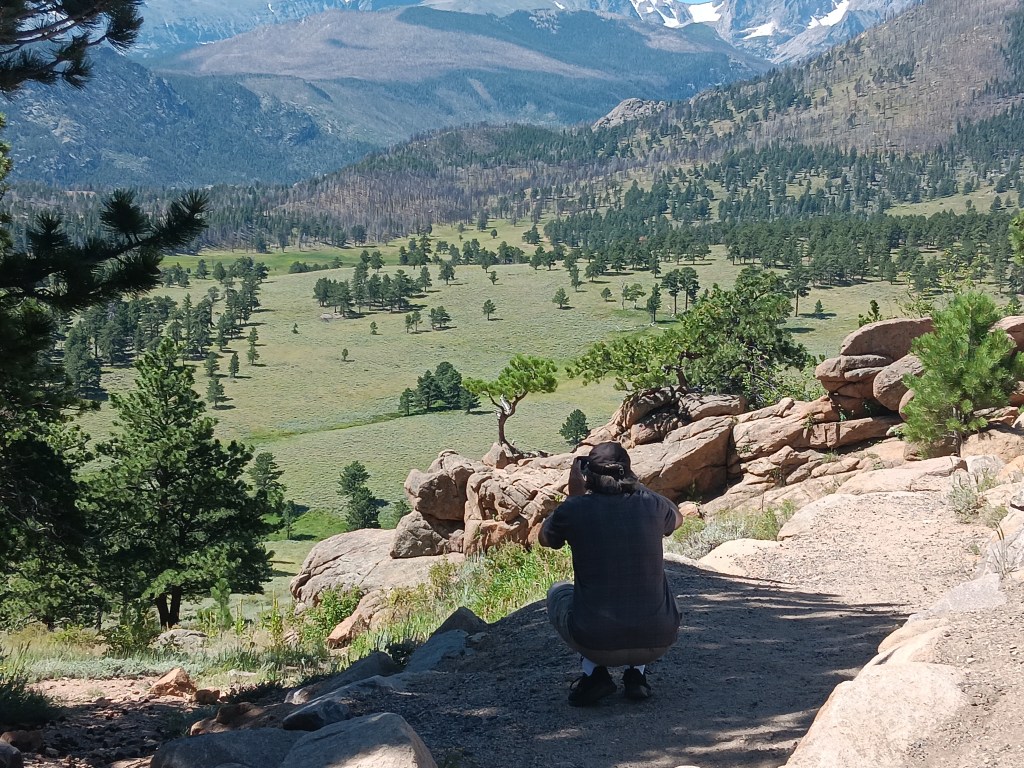
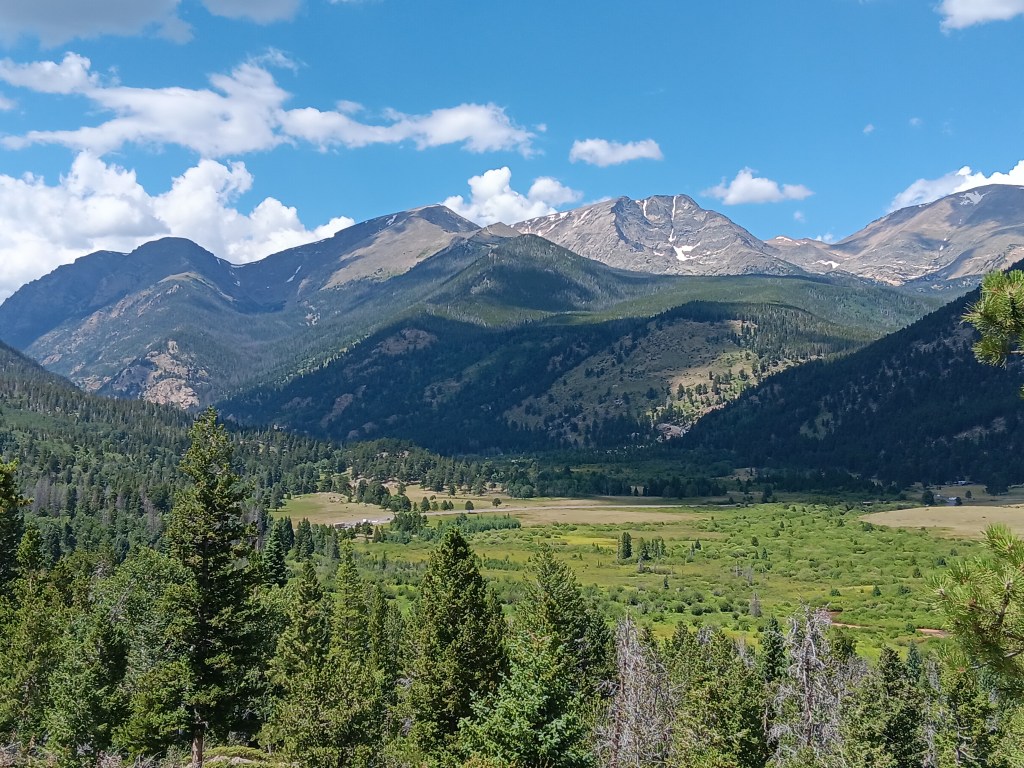
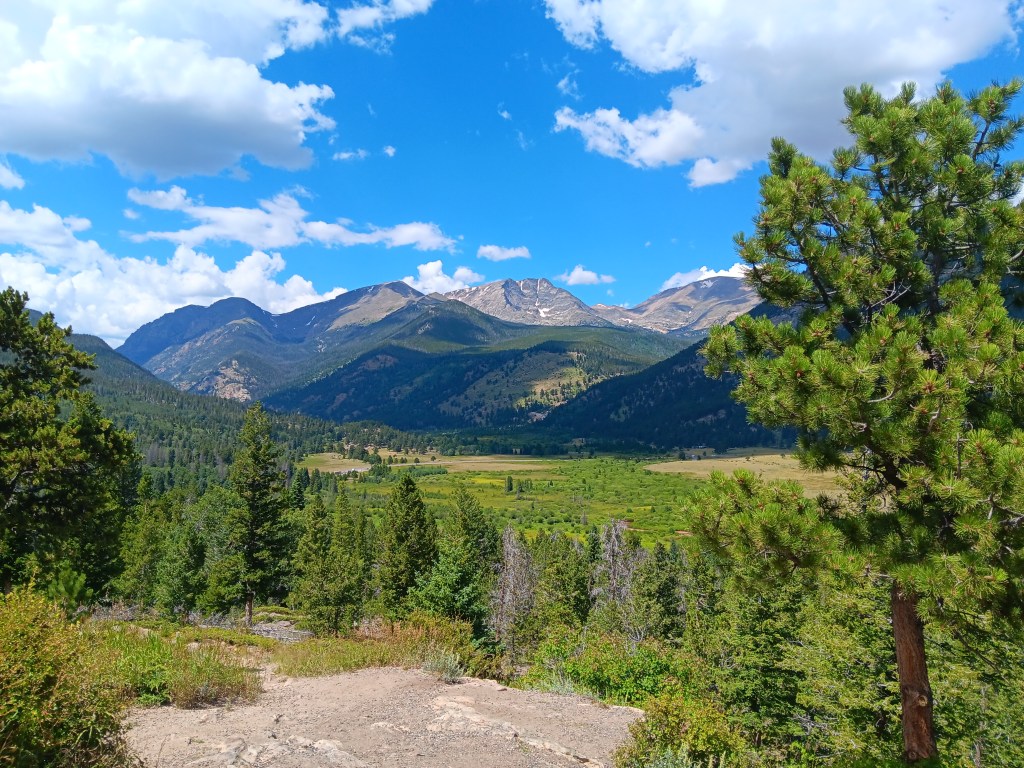
Simon’s word for the day even, before we reached the park, was “Stupendous,” but it barely scratches the surface of what this place is all about. We couldn’t do any of its fabulous hikes (Ruthie just isn’t able, and dogs aren’t allowed on the trails anyway), but Oh! What glorious vistas!


The ranger we spoke to at the Beaver Meadows Visitor Center just outside the park’s entry told us we must do the Trail Ridge Road (“No, we don’t have any big drop-offs here, we have ‘rolling drop offs,’ which means they’re just long slopes next to the road,”), then visit the hidden gem of Sheep Lake Valley.

We agreed we’d go as far as Beaver Pond, part-way up the mountain, then see if it was still comfortable. During our ascent, the term “rolling drop-off” revealed its true meaning: You won’t die immediately upon impact after falling off the cliff, you’ll just bounce your way down to the valley and die a long, slow, horrible death.

Okay, so it’s not a “sheer” drop-off, but damn, son…the only thing “rolling” about it is you and your car if you’re not careful

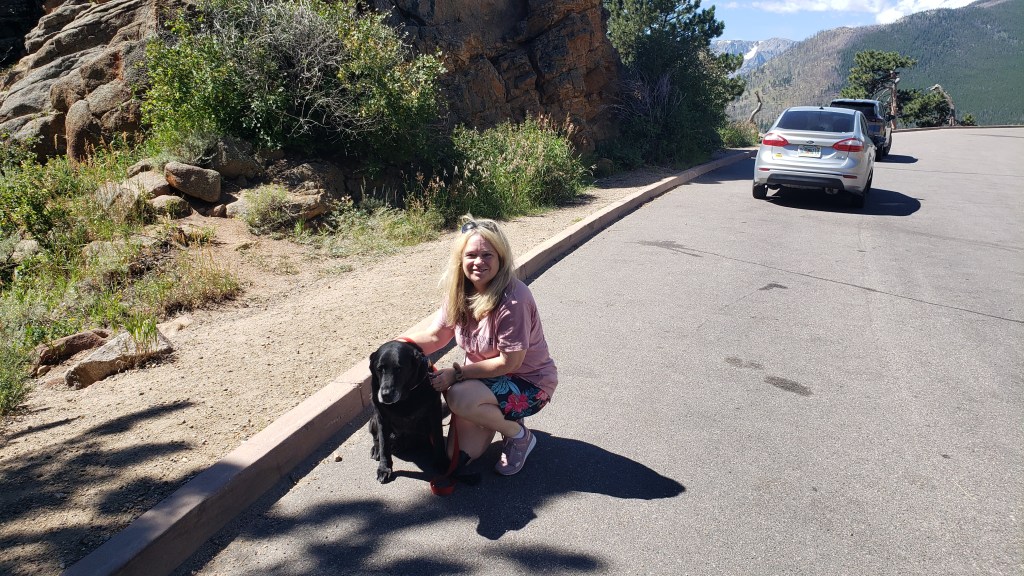
Happier times, just before we hit those “rolling drop-offs.”

Still, Beaver Pond was located before the big switchbacks, so it would all be fine. Right?

We blew past Bever Pond without realizing it, and were well into the switchbacks when Susan said, “Get me the hell down from here.” Loving husband that he is, Simon pulled into the next big turnout, just on the uphill side of the hideously named Many Parks Curve Overlook (elevation 12,183 feet). He pulled right up to the edge of the parking area, got out, and said, “I’ll just get a couple of photos and be right back.”

Click on the photo for video

As always, Simon had to go right out to the edge of the cliff while Ruthie and I stayed in the car watching him lean way, way over the guardrail. The following conversation took place:

Ruthie: Where’s he going?

Susan: Twelve thousand feet straight down, if he’s not careful.

Ruthie: Who will feed me?

Susan: Me. I always feed you. You know that.

Ruthie: Who will pick up after me when I’m a Good Girl in the garden?

Susan: Now we have a problem.

He was back ten long minutes later, and we were on the descent to Sheep Lake Valley (elevation 8,524), named for the Bighorn Sheep that are prevalent there, so much so that, during summer months, rangers have to be stationed along the road to act as crossing guards.

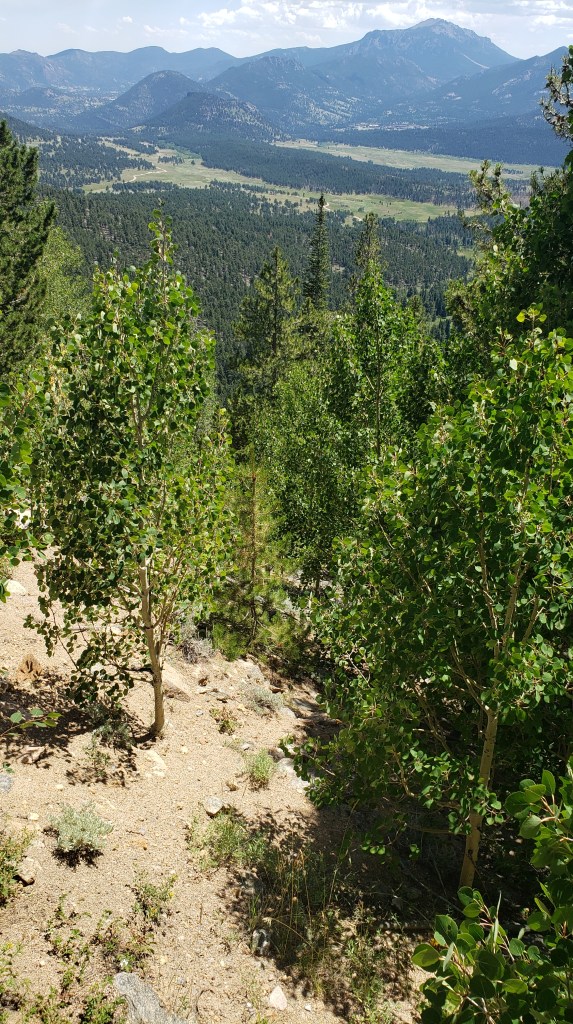
That green patch is the valley, still quite a way down


We hadn’t seen Bighorn Sheep since Custer National Park in South Dakota, so we were hopeful of finding another herd or two.

It was not to be. But something even better was waiting for us when we reached the valley. A bull moose was browsing in a pond just off the road, giving us the thrill of a wildlife sighting we had not yet had.

That dark thing with antlers to the left of the reeds is our moose. It isn’t wise to get too close.

Enjoying swamp salad for lunch

We shared our binoculars with another couple, who hadn’t seen a moose during their travels, either. There are few things better than having someone say you made their day by doing something so simple.

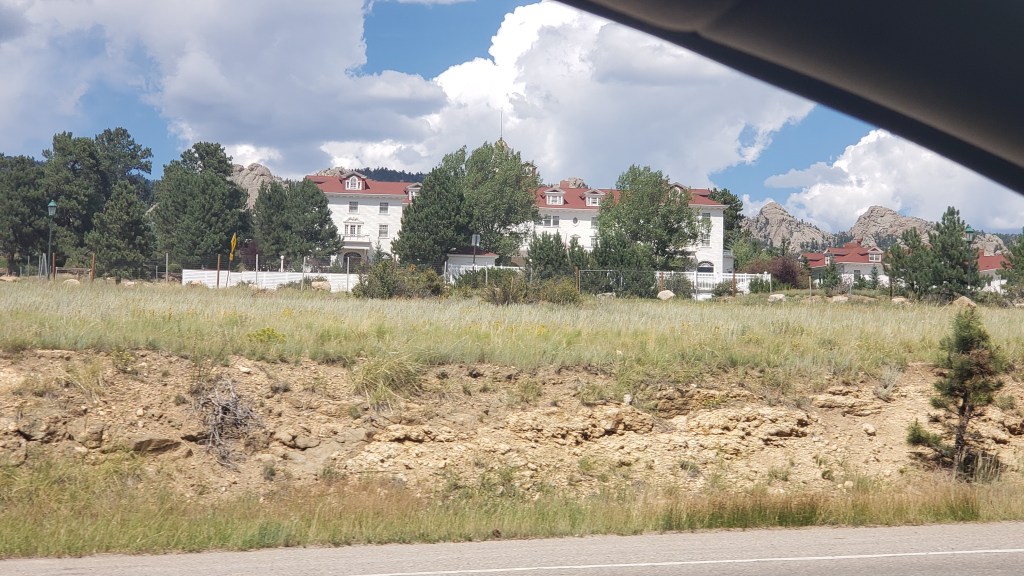
What a wonderful finale to a day of WPM (Simon’s new term, meaning “Wows per minute”). But we had two more Wows to enjoy when we stopped at Estes Park for dinner. First was the horror-movie Wow of passing the Stanley Hotel, architectural star of the movie, The Shining.

Even driving past it felt a little bit creepy

The second was the Wild Game Sampler at Molly B’s restaurant, an enormous platter of smoked buffalo, jalapeno elk, apricot boar, and smoked caribou sausages, with cheese, crackers, and mixed-berry jam, meant to be a sharing appetizer, but the right size for a full entrée, if you’re Simon.

He had no idea which meat was which, but he enjoyed it all

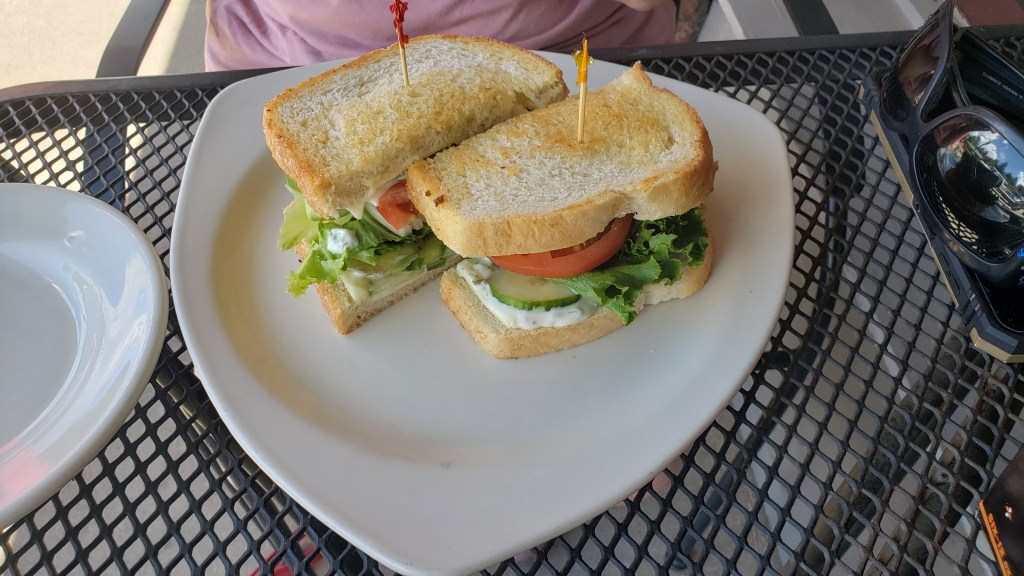
Susan had a vegetable sandwich.

Too big to eat, so it became “deconstructed”

Ruthie had to settle for water, and refused to look at us.

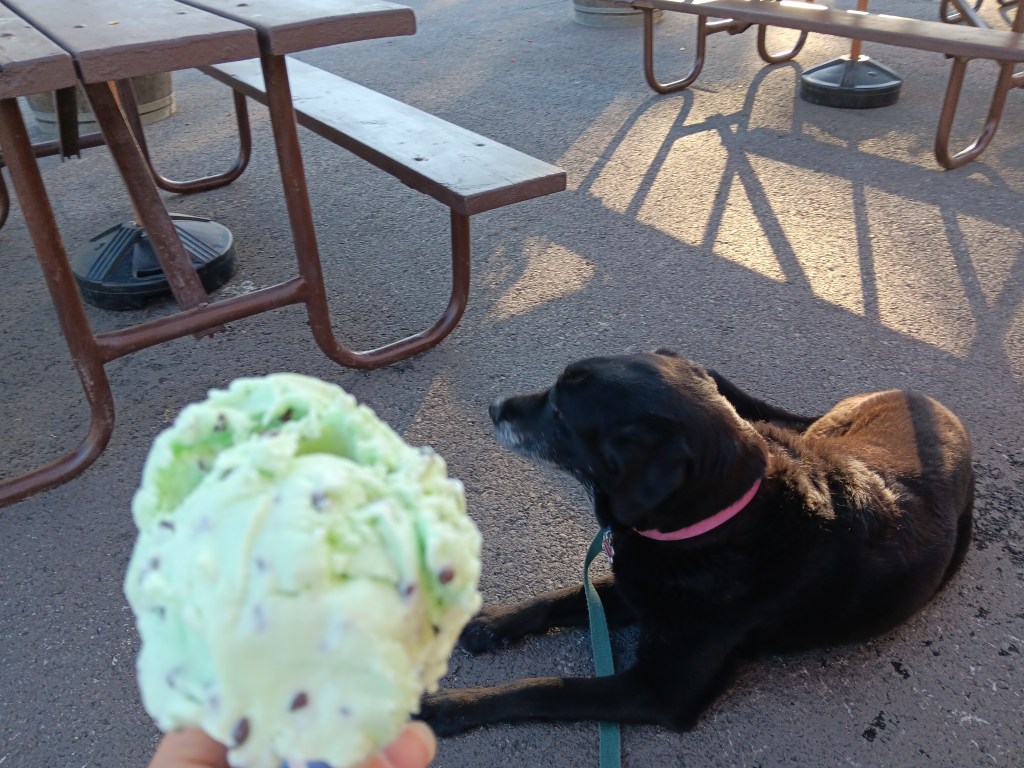
This isn’t at Molly B’s, but it’s exactly what she always does when there’s food around and she hasn’t had any. PS: She did get a spoonful of ice cream.

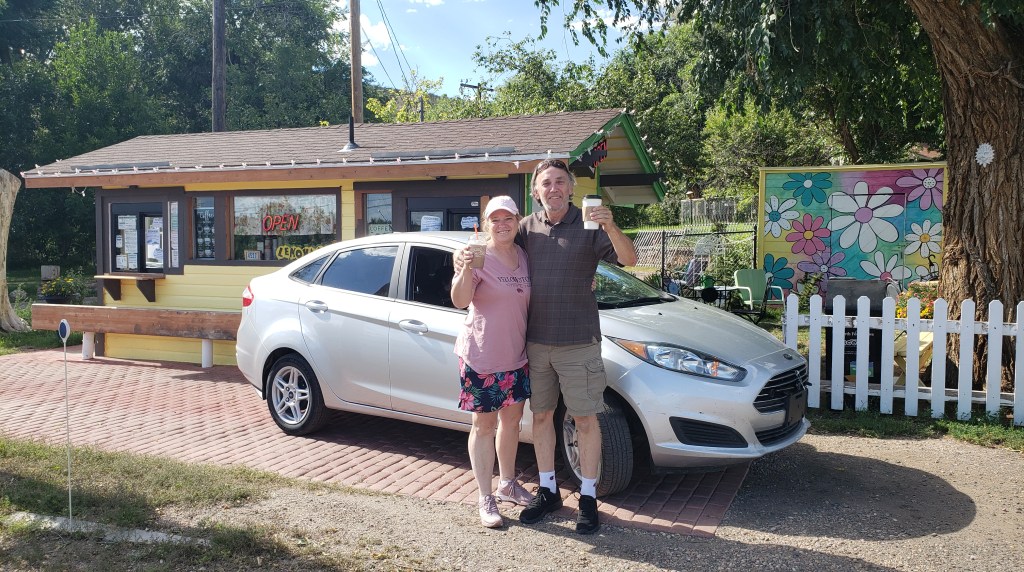
So much fresh air cleared most of the caffeine out of Simon’s bloodstream, so we stopped at the most adorable coffee shop we’ve ever seen. It was a drive through, or a walk-up, or whatever you wanted it to be, and we both ordered a Cherry Garcia coffee and chatted for quite some time with the shop’s owner, who offered to take our photo when we told her we’re travel writers. Isn’t life grand when you slow down and appreciate the quirky?


It was a three-hour drive back to Fati, and several times during the return trip we mentioned how happy we were to have checked Moose off our Bingo card, in a place so stupendous we struggle to find the words.

On The Trail Of The Oregon Trail


Whenever we see a daunting mountain or endless rolling hills we think of the pioneers who made their way west with no smooth pavement to ease their rattling teeth and overworked horses or oxen. The Laramie Range at the southern edge of Casper, Wyoming was one such obstacle that proved the people who pushed westward let nothing stand in their way.

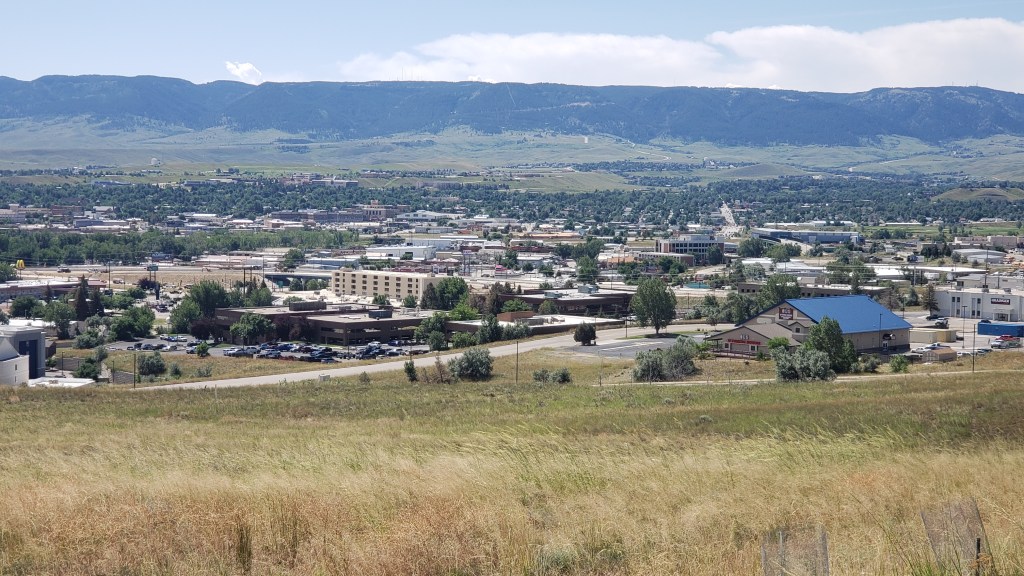
Present-day Casper, Wyoming, with the Laramie Range in the background

Two trails are famous in the U.S.: The Pony Express (Kansas City, Missouri to San Francisco, California) and the Oregon Trail (Independence, Missouri to the far reaches of Oregon). There were actually two more major trails, we came to find out, that cut their way through Wyoming: The Mormon Trail, which started in Illinois and ended in Salt Lake Valley, Utah, and the California Trail, from Kansas City, Missouri to many places in California). All of them passed through Casper.

The Pony Express isn’t on this map, but it ran roughly along the same route.

For some, it was a 2,000-mile journey from beginning to end, and it’s quite incredible that specific points along the way were used by all or nearly all of them. Independence Rock was one of the landmarks they looked for, and many left carvings on the hill that marked their passing.

Independence Rock was an importation milestone. Reach the huge granite mound by July 4 (hence, its name) and you’ve got a chance of surviving the rest of the trip. Arrive late, as part of the ill-fated Martin Company Morman handcart expedition did, and disaster is the likely result.

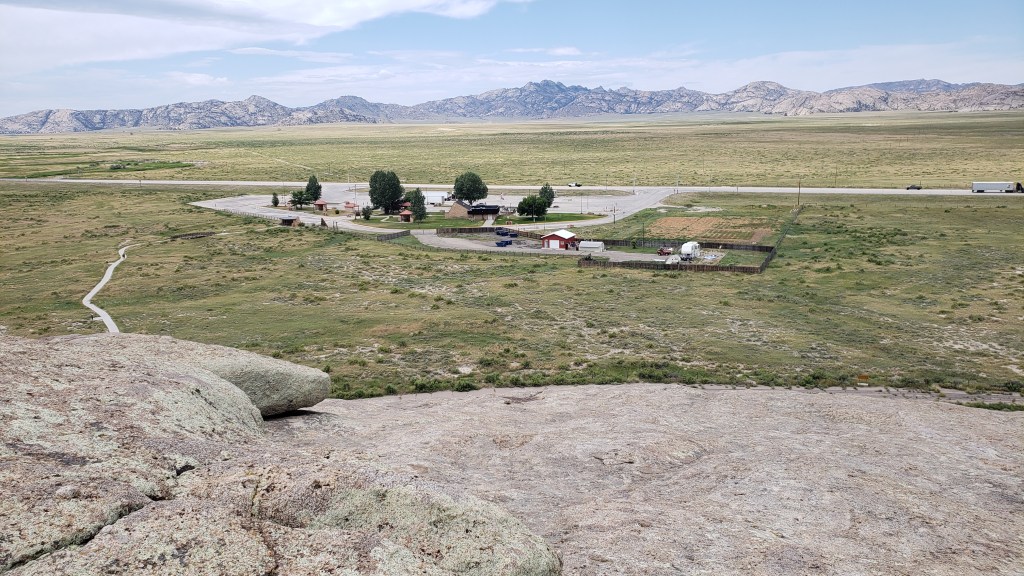
Simon, of course, had to climb to the top, as other visitors were doing.


Ruthie, of course, wanted to follow him. Her toenails insisted otherwise.


View from the top

Martin’s Cove, ten miles to the east, tells the 1856 Morman Handcart Disaster story. Under the guidance of the Edward Martin Handcart Company, the season’s final two (of five) English emigrant groups departed Iowa City, Iowa in late July. By mid-October, having been delayed by snowstorms and suffering from illness, fatigue, and malnourishment, 50 of them were dead. It became the greatest single-event loss of life of the country’s entire western migration.

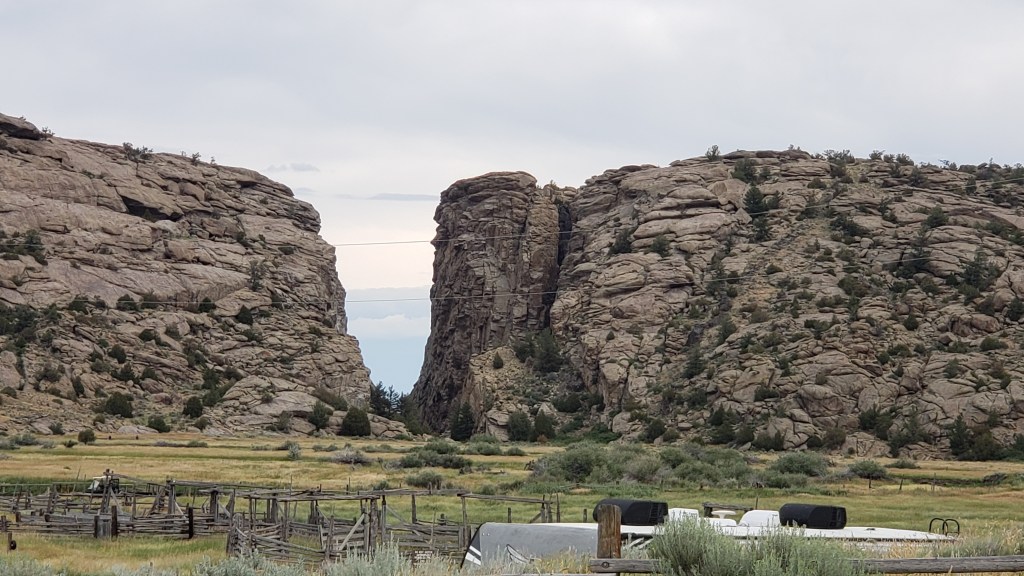
Another geological landmark the westward expeditions looked for was Devil’s Gate, near Martin’s Cove, a gap that allowed them to travel south of the area’s impassable river gorge. All four “trails” passed through this gap, and their wagon and handcart ruts are still visible. We couldn’t see them, nor the former Martin’s Cove camping site the travelers used, because (say it with me…) NO DOGS are allowed on the trails.


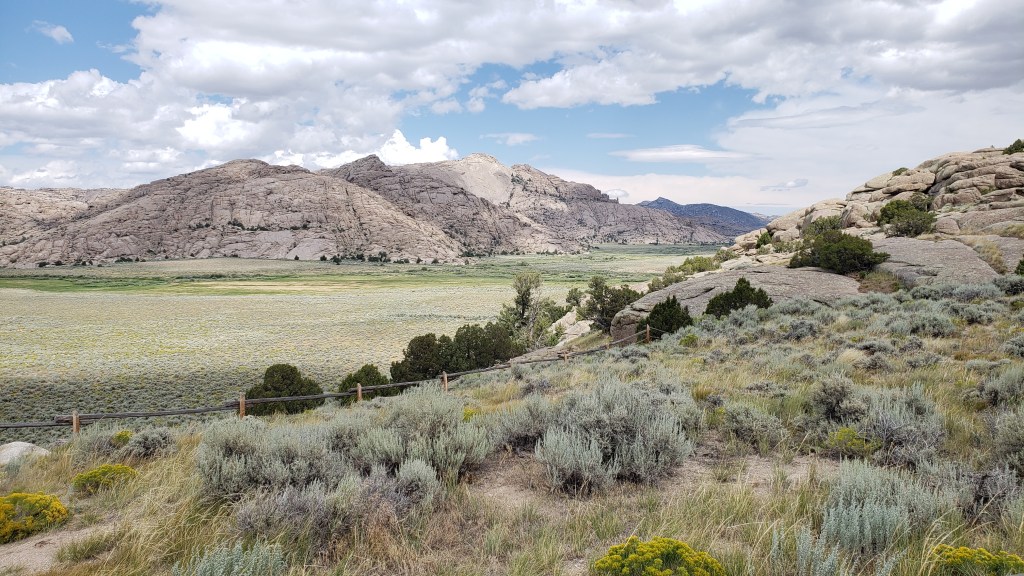
A third landmark was Split Rock, a camping and grazing site one-day’s travel (12 miles) from Devil’s Gate, distinctive for the enormous V-shaped “split” (more like a natural cut-out) at the top of the mountain. You’ll see it slightly to the left of the middle mountain’s center in this photo:

When we moved Fati to a new campground in Wheatland, Wyoming, north of Cheyenne, we made a day trip out to the Guernsey Ruts, Register Cliff, and Fort Laramie, also milestone locations on the trails.


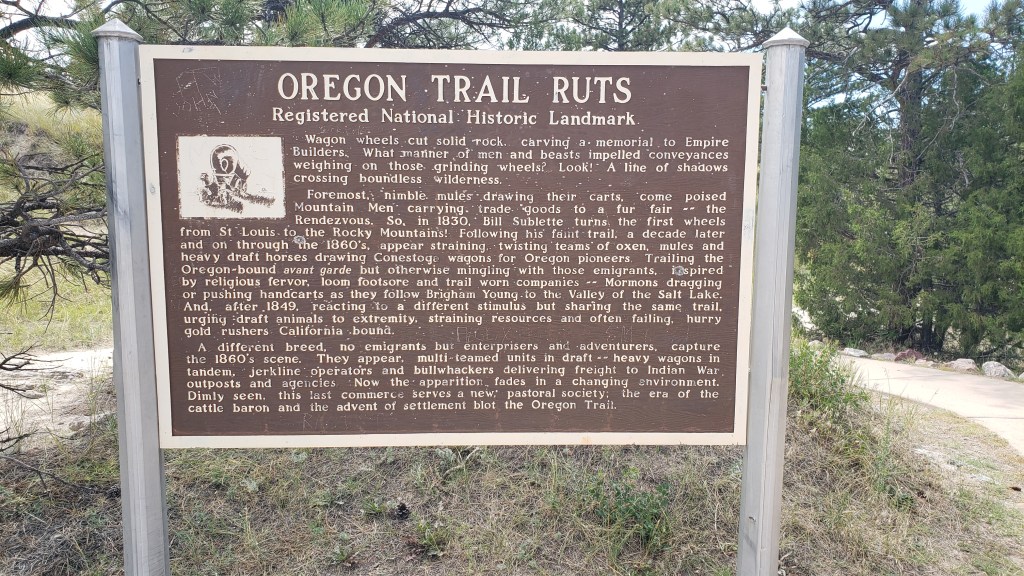
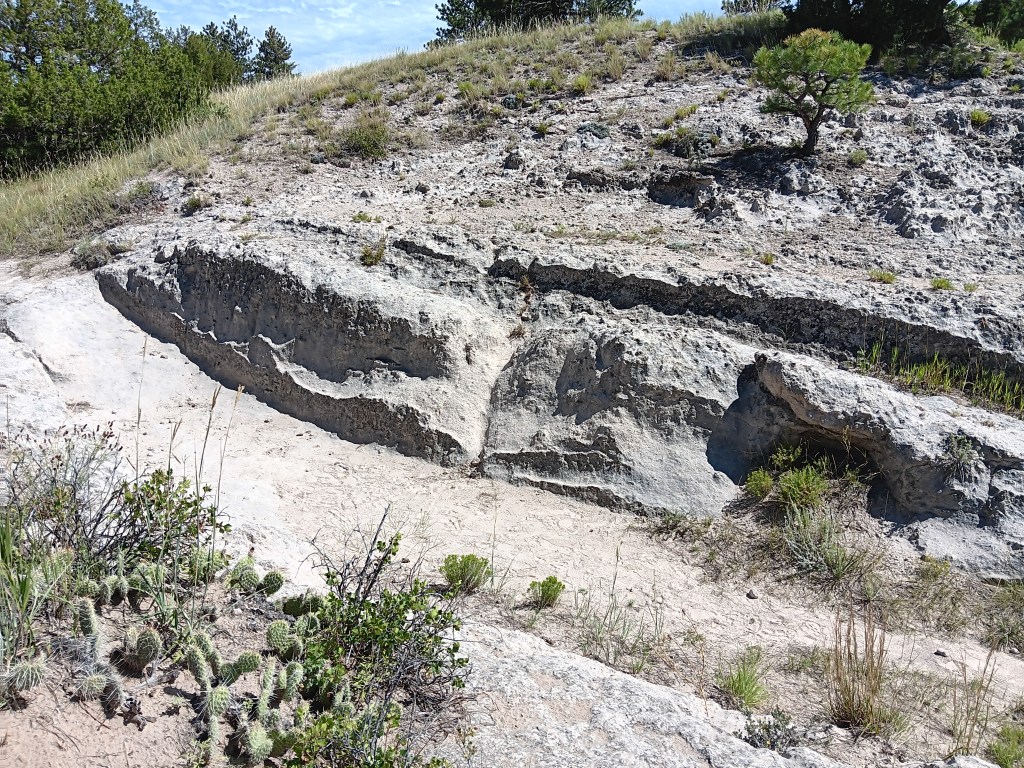
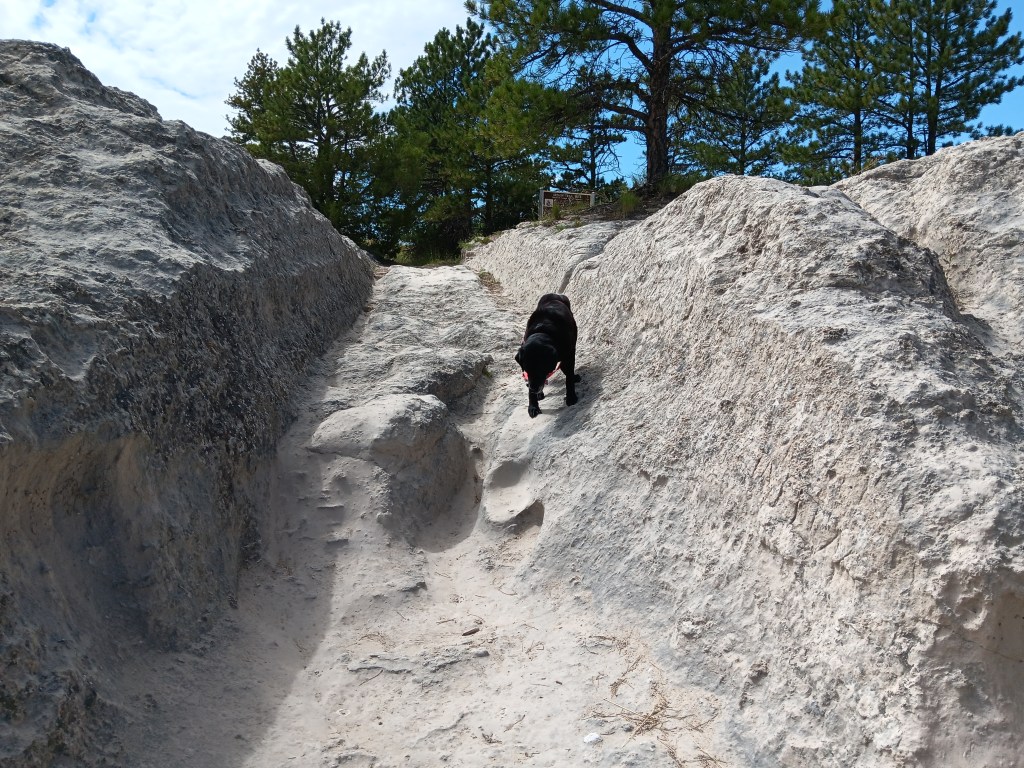
The Guernsey Ruts are located at Oregon Trail Ruts State Historic Site, where wheel tracks made by covered wagons and handcarts left deep gashes in the soft sandstone, which are now on protected land. Some are five feet deep, and it’s easy to see the wheels’ furrows and the deep pathway where people walked next to their wagon.

The ruts are at the bottom of the rocky side, and the walking trail is the deep gash just above it

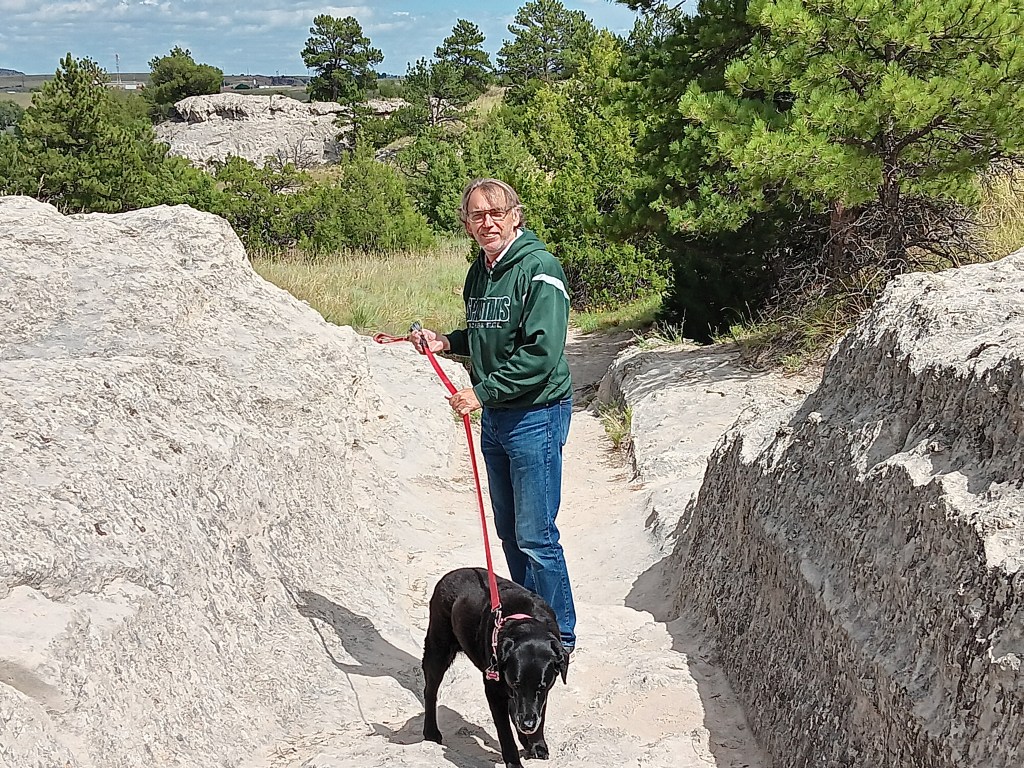
Standing in one of the wheel-track ruts

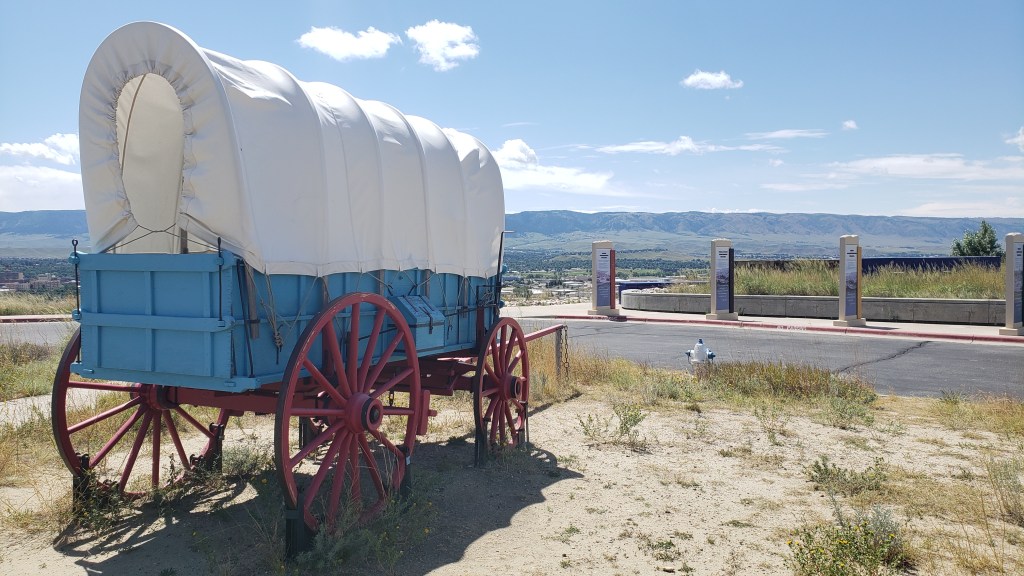
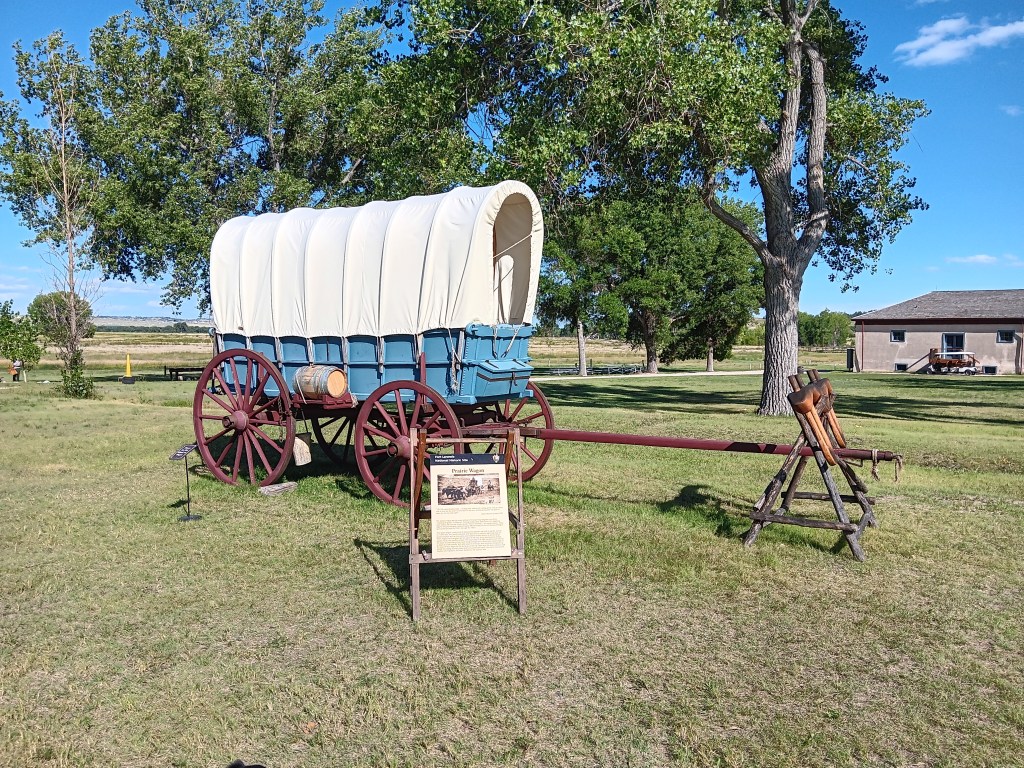
For reference, this is an example of a “prairie wagon.” This reproduction is located at Fort Laramie.

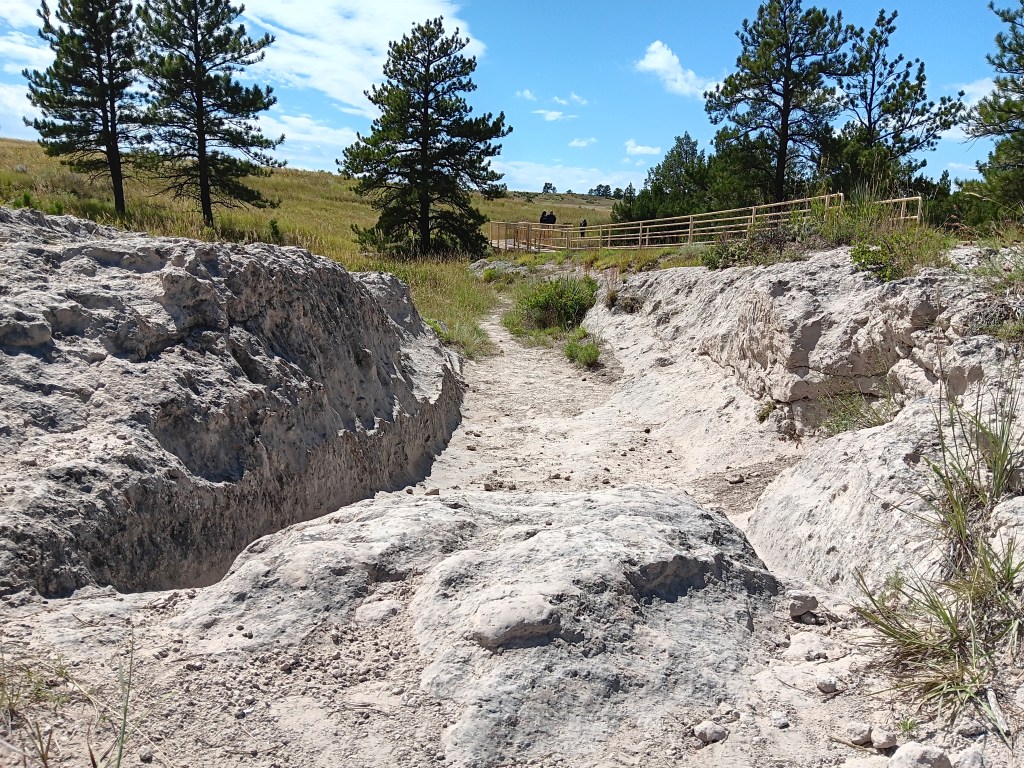
Visitors to the site are allowed to walk in the hard tracks, and we really felt a human connection to the slow, difficult climbs and drops the pioneers experienced as they plodded their way west. More than 500,000 pioneers crossed here due to the topography of the land, which is why the ruts are so deep.


Imagine having to get your wagon or handcart over this rock and into the established tracks

Even four-legged Ruthie needed a helping hand getting down the steep path

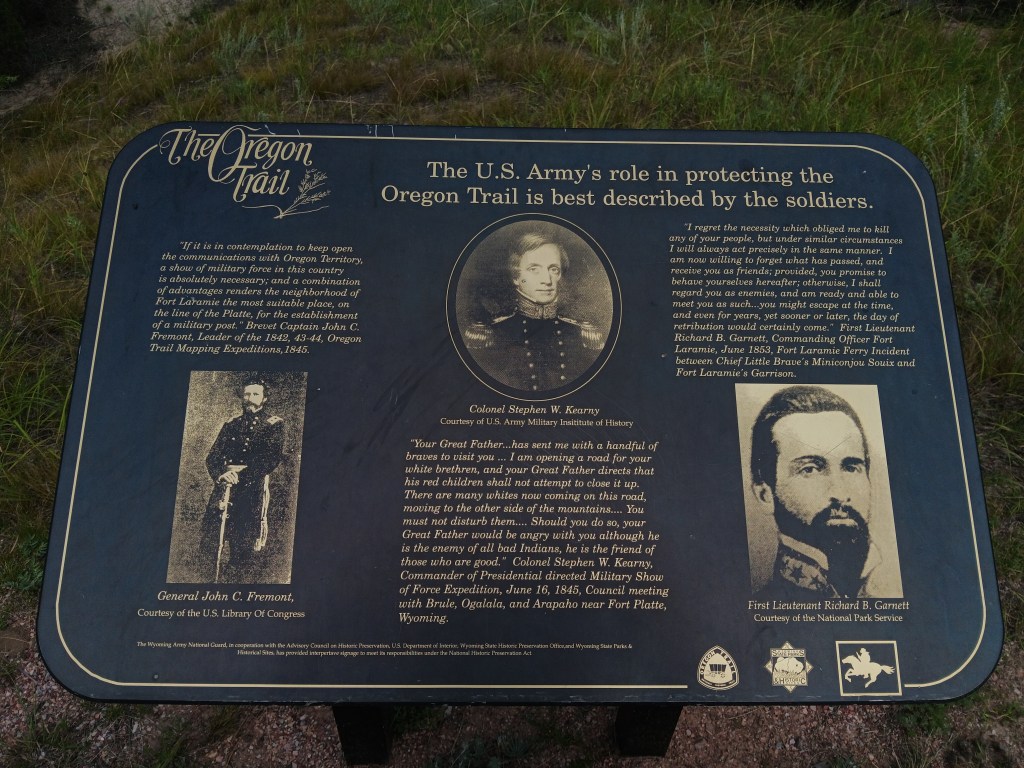
The one blot on this otherwise evocative site is the panels that tell the story of the trail only from the perspective of the soldiers tasked with “protecting” the emigrants’ passing through land that was home to native tribes. In a nutshell, the sentiment was that the tribes were hostile and it was perfectly fine to kill them “as needed.”


There are a few sites we’ve seen that give a nod to the people who actually lived on the land before white people came through, and their desire to continue living peaceful lives, but so far they’re certainly the exception. It’s impossible not to see these plaques’ quotes as a conscious choice.

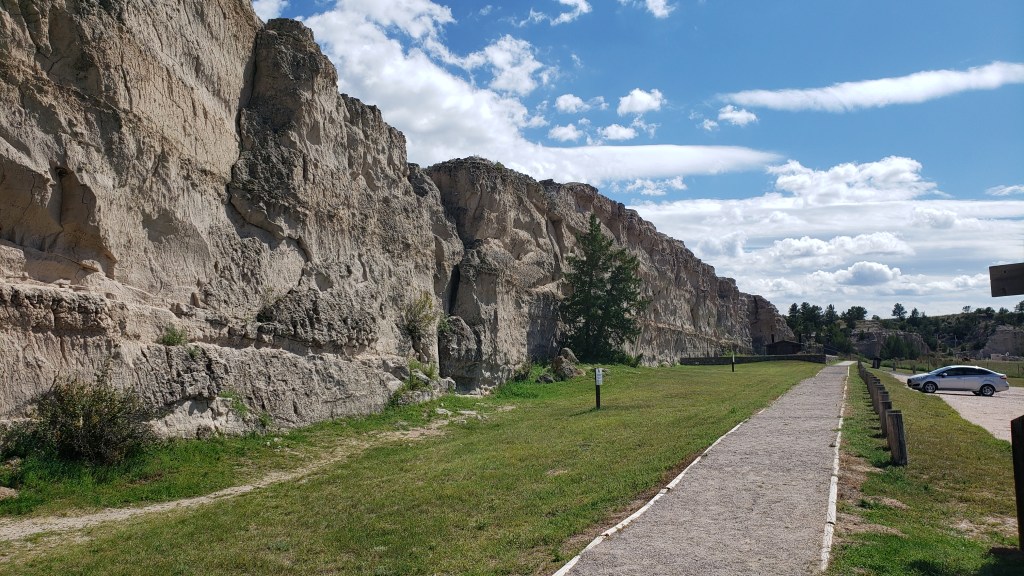
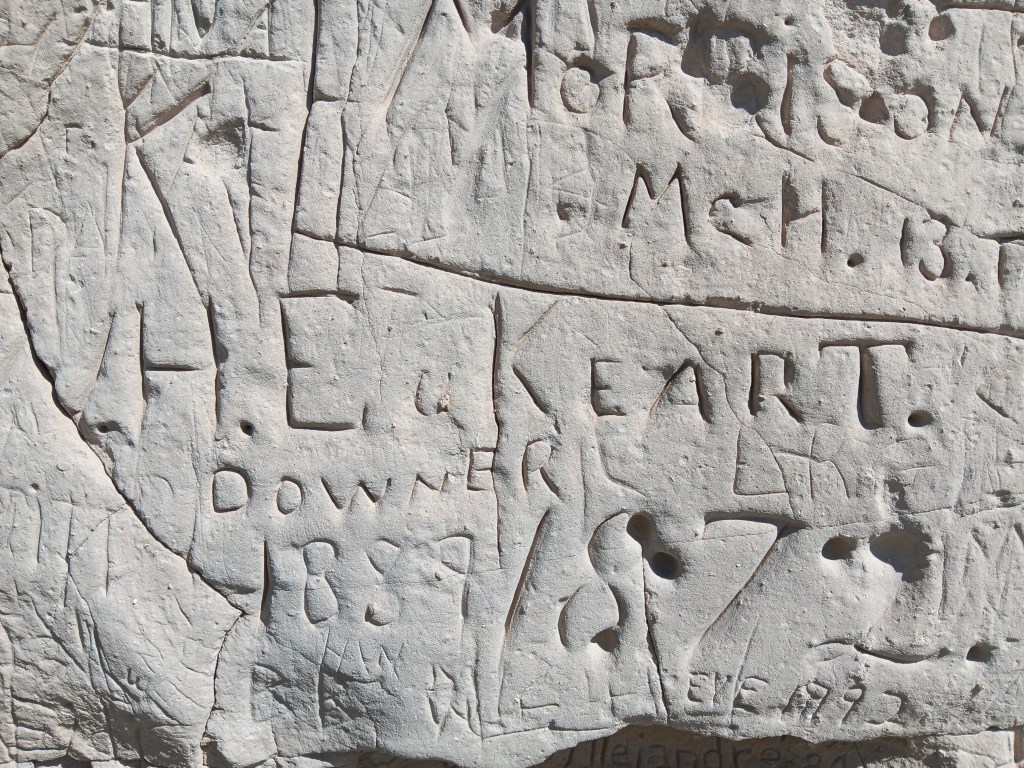
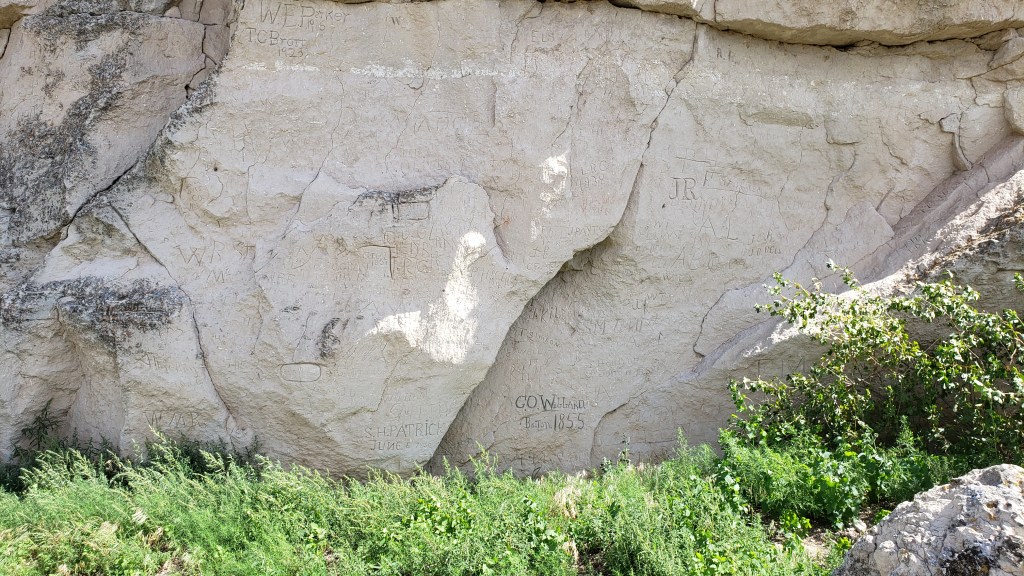
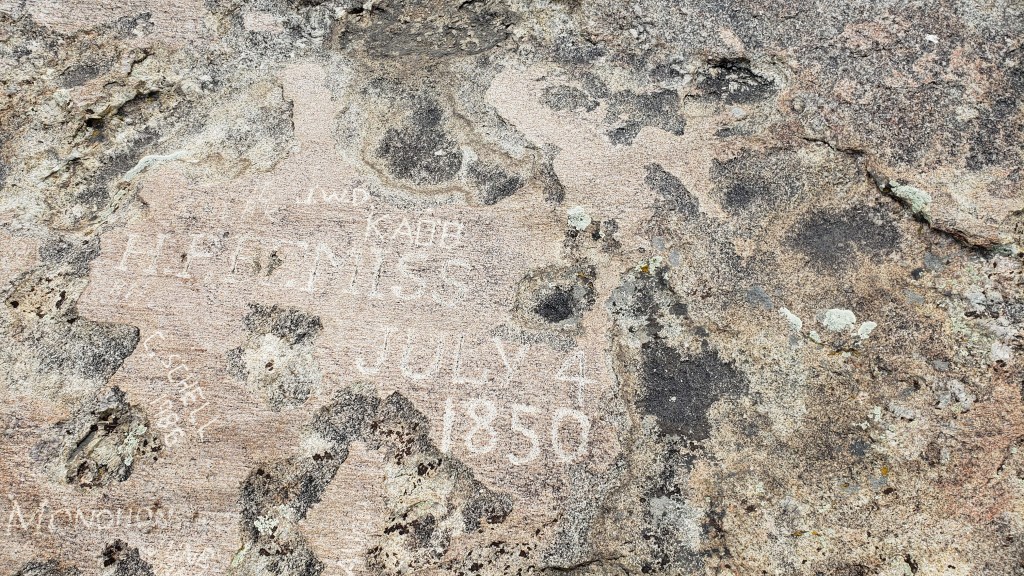
Register Cliff is about 12 miles east of the Guernsey Ruts, and it also holds the title of a State Historic Site. Here, trappers, fur traders, and emigrants rested during their journey west, and some carved their names and the date into the 100-foot-high limestone cliff.

We didn’t see the earliest dates that have been identified on the cliff (1797 and 1829), nor did we see petroglyphs and pictographs made by the native people long before white people arrived, but we did see some carvings from the mid- to late-1800s, and many carvings behind a fenced area are from the time the Oregon trail was heavily used.


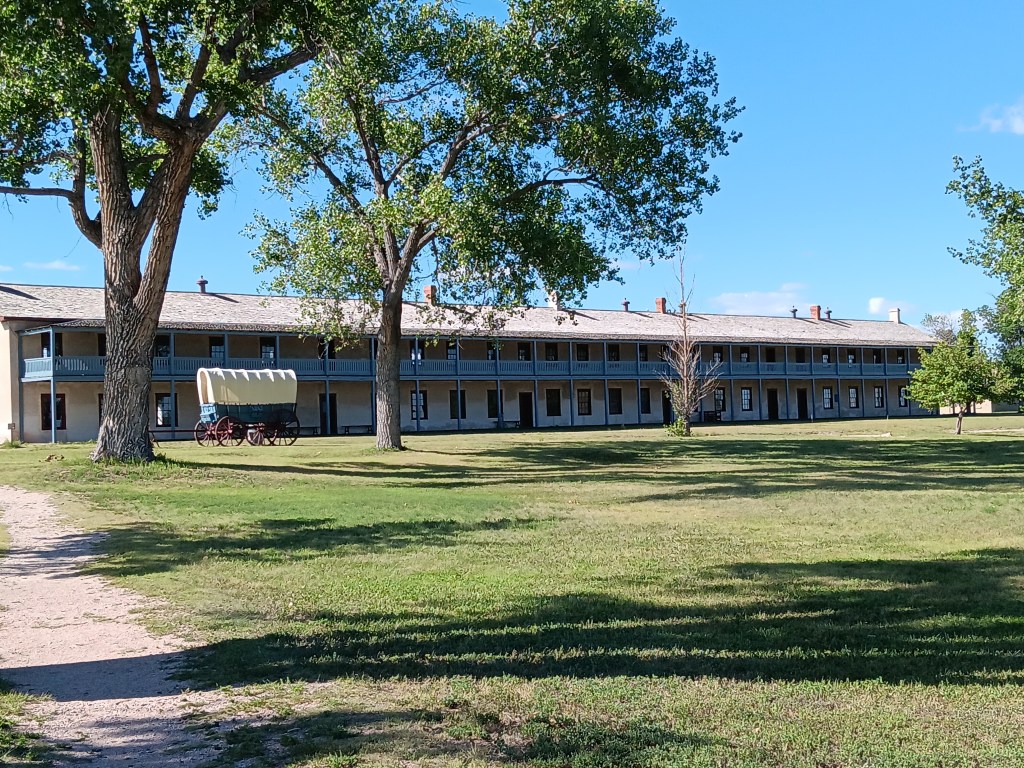
Fort Laramie – founded in 1834 as a trading post before evolving into a military post in 1849 – wasn’t the stockade-style fort we expected. Instead, it was more like a mini town, with necessities of daily living such as a bakery, a jail, a schoolhouse, barracks, and officer homes. It felt a lot like a military-specific version of Dearborn, Michigan’s wonderful Greenfield Village.
Barracks upstairs, living areas downstairs

Store

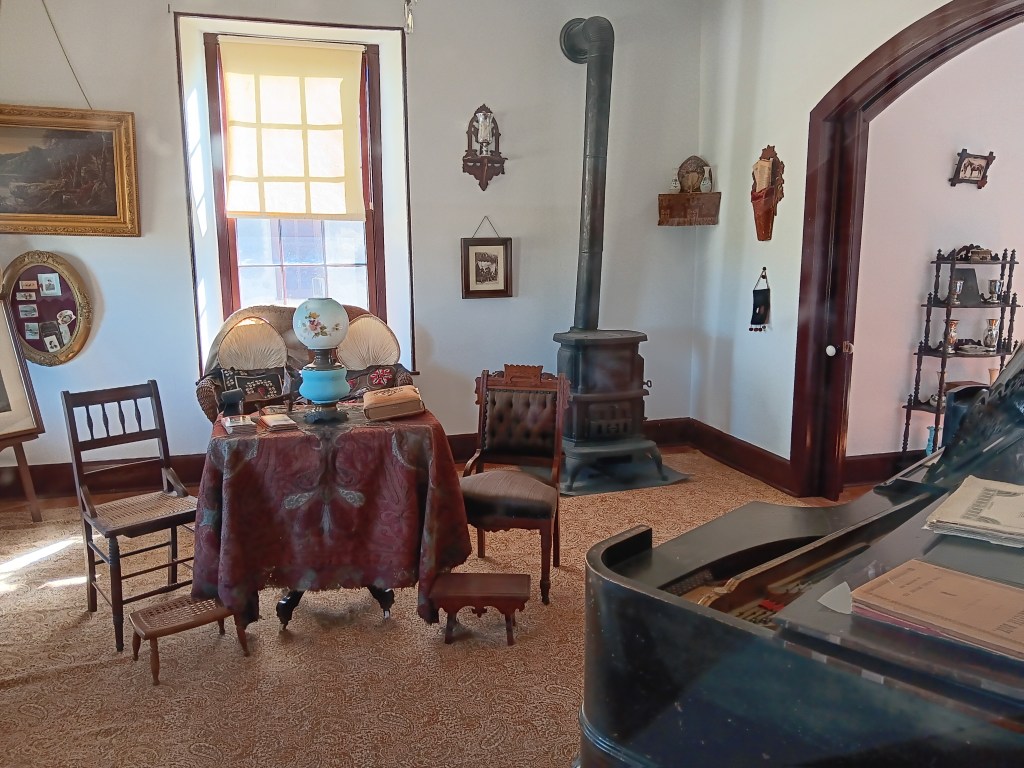
The officers’ homes were surprisingly luxurious

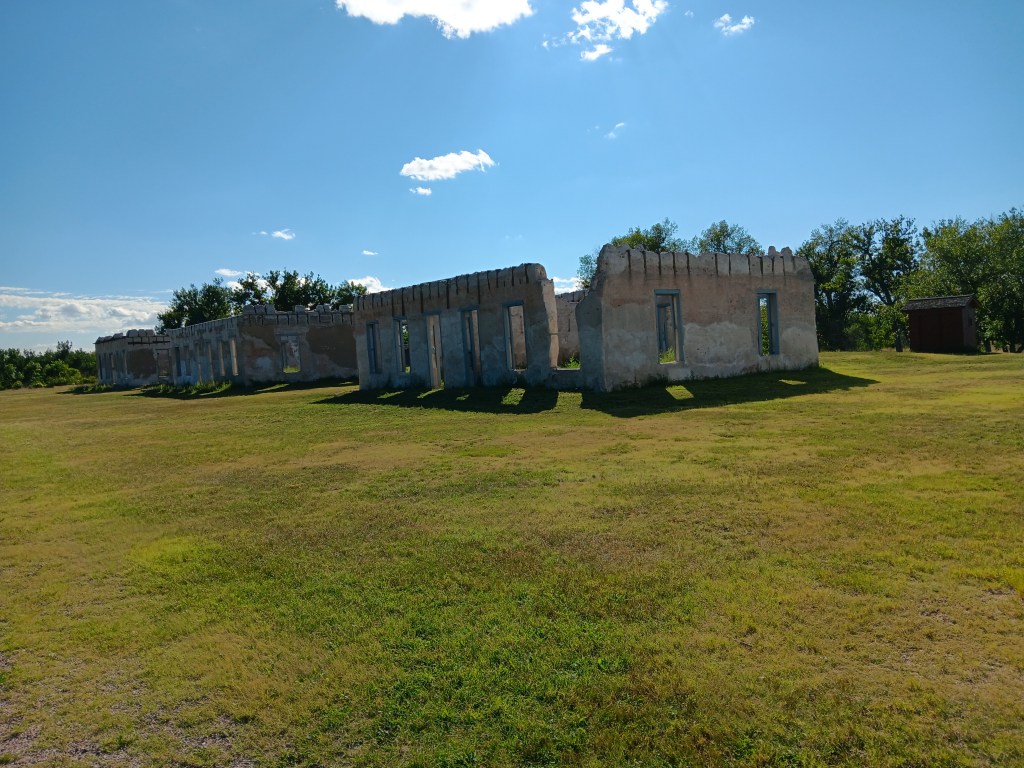
Some buildings are now just ruins

It was a place where emigrants stopped on their way to Oregon, Utah and California, as did some local tribes, to trade furs and hides for other goods. It was also a stop for the Pony Express from 1860-1861.

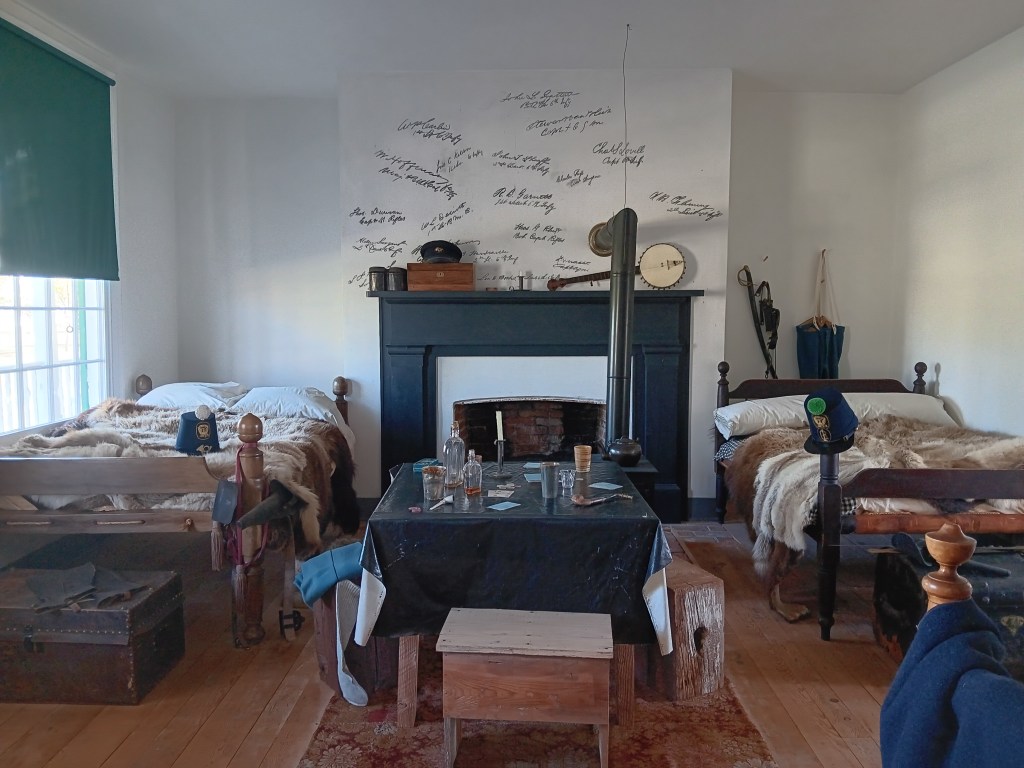
We don’t know what these signatures above the fireplace are all about, but they looked really cool and historical. A plaque wiht some context would have been nice.


We’re certain we’ll see a lot more sites having to do with the settling of this great, vast country, and when we do, we’ll be happy to share them with you.

A Year On The Road – The First Three Months

On August 14 we celebrated the third month of our grand ‘A Year On The Road’ RV adventure, with a chance to tot up our mileage and chart the latest course of the scenic route we are forging across the US.

Having ended Month Two at Fishing Bridge RV Park in the heart of Yellowstone National Park, we have basically undergone a bit of an about-face on our original planned route and gone “freelance” for a few weeks. Our third month covered a total of 1,318 miles, giving us a whopping 5,061 for the trip to date.

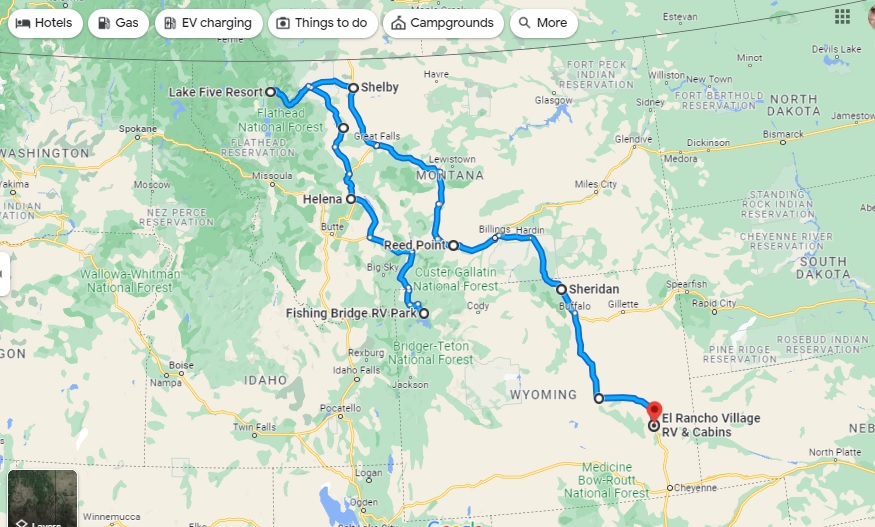
Month Three – 1,318 miles, starting in Yellowstone and reaching El Rancho Village RV & Cabins in Wheatland, Wyoming, via Glacier National Park in Northwest Montana

As you’ll see from the map, we continued north from Yellowstone to Glacier National Park, but then broke away from the proposed westward trek to Washington and Oregon via a bit of Idaho in favor of seeing more of Montana and Wyoming, two states which we have found utterly enchanting.

We have tried not to cover any of the previous route, apart from a few miles along I-90 in Montana, and have dived much deeper into Wyoming in particular, including side trips to Cheyenne and Laramie – very much the heart of the Old West – in Nippy to avoid putting too many miles on Fati. From here, we’re looking to turn West again, with each of Colorado, Idaho and Utah on our radar – and more of the magnificent Rocky Mountains.

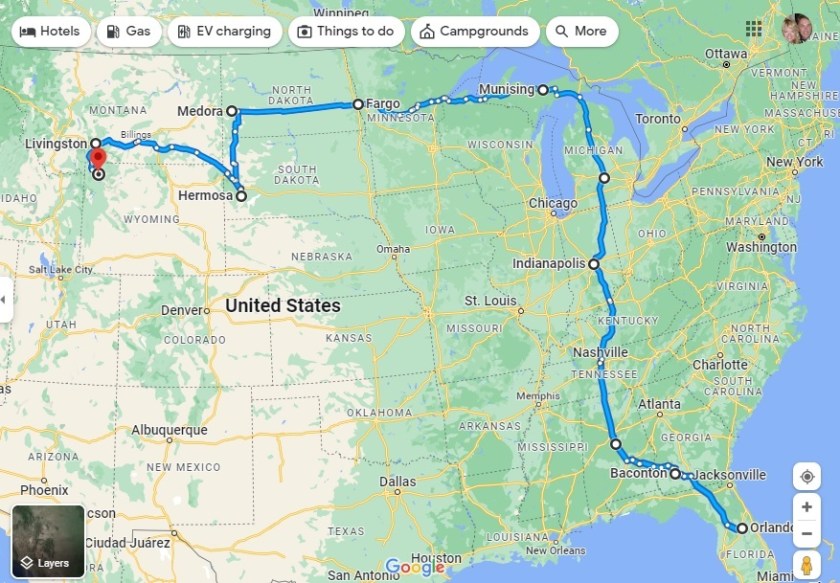
The first two months – and 3,743 miles

When Nature Says “No.”


With four days in Evansville, Wyoming, on the eastern edge of Casper, we had plenty of time to seek out some of the pioneer migration hot-spots along with our scenic touring.

We’re going to split our Casper area stay into two separate blogs, one of general touring and a second taking in landmarks and locations having to do with the famous Oregon Trail and its three “sister” trails.

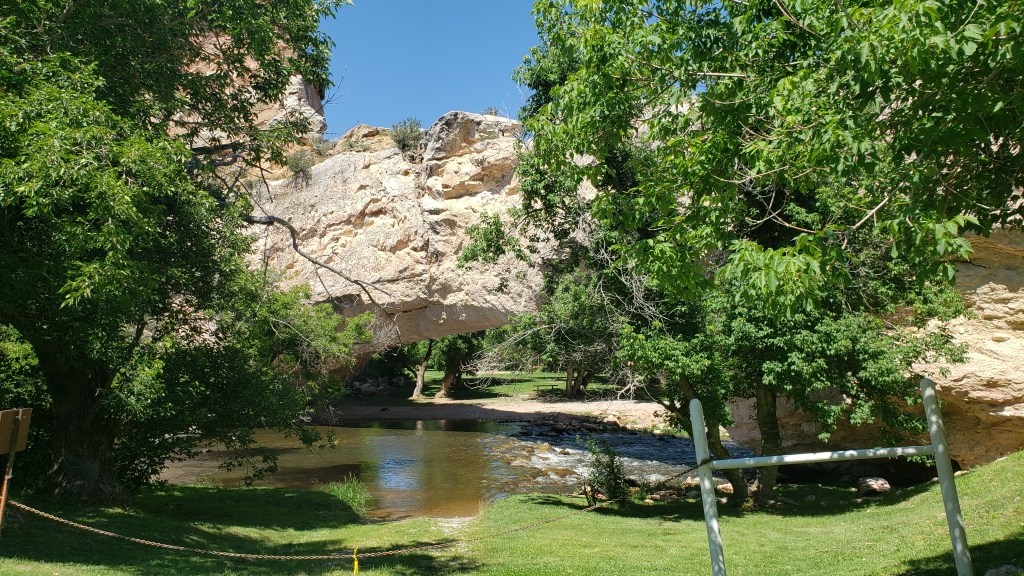
On our first day, we headed east to Ayers Natural Bridge at the recommendation of the Casper Visitor Center. If you follow us on FaceBook you already know the outcome. No Dogs Allowed under threat of a $100 fine, so we took some photos of the most perfect picnic spot in the country, and kept going.

Natural Bridge on a glorious day, perfect for a picnic. But not for us and our dog.

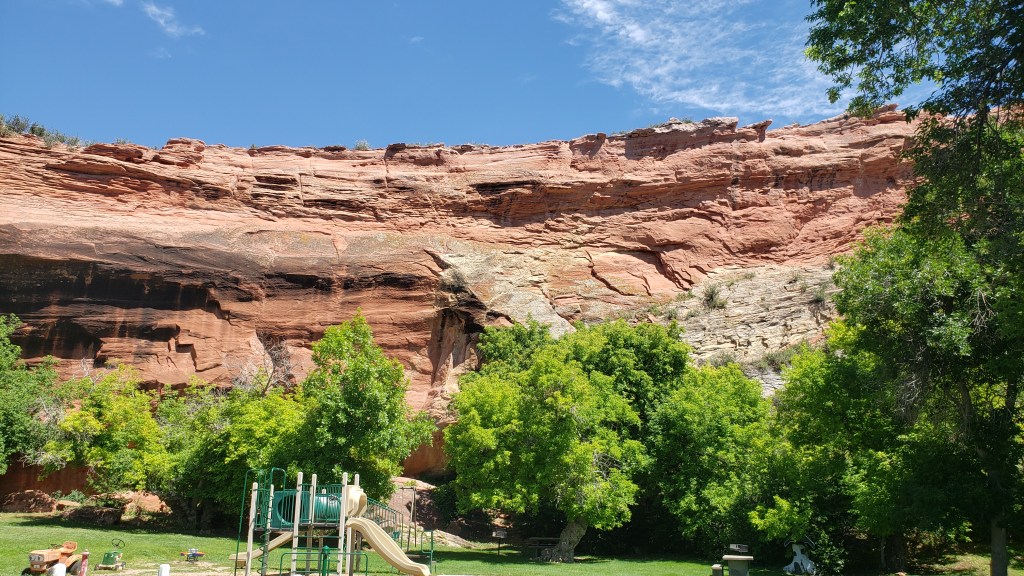
Eye candy everywhere you look. But not for us and the dog.

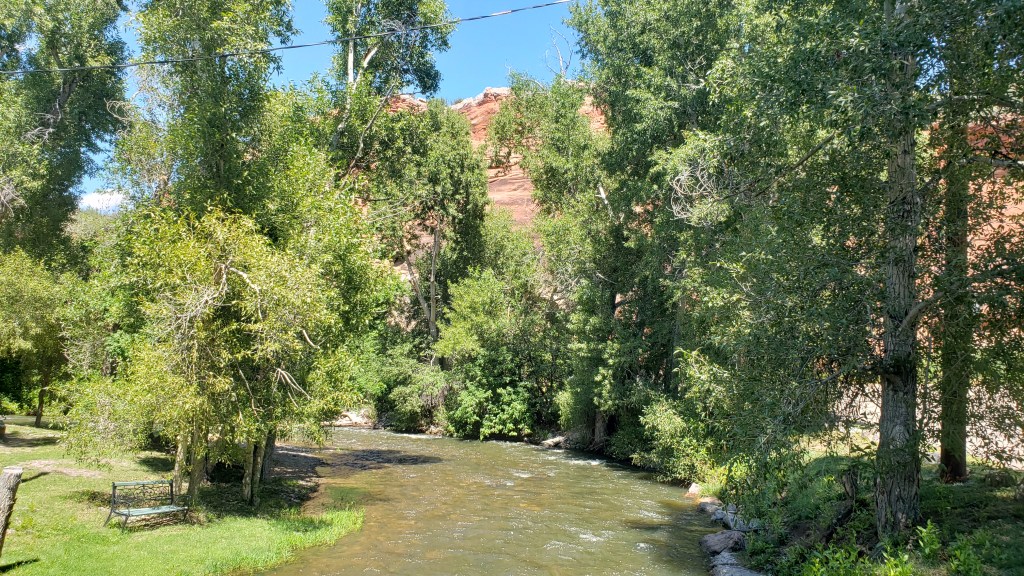
Babbling river is calling out, begging people to dine along its banks (not us).

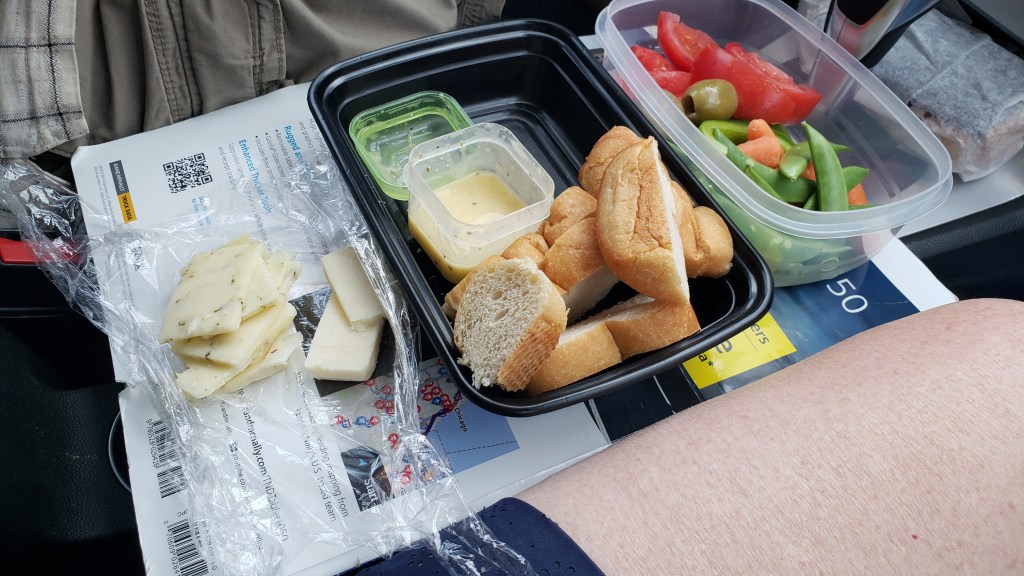
Ayers was supposed to be our lunch stop, and having driven an unexpected 40 miles to reach it, we needed a detour off busy I-25 and found it along WY-94, which dead-ended at Esterbrook. At the top of a rise, we pulled over and enjoyed lunch with a view.


This is becoming a habit.

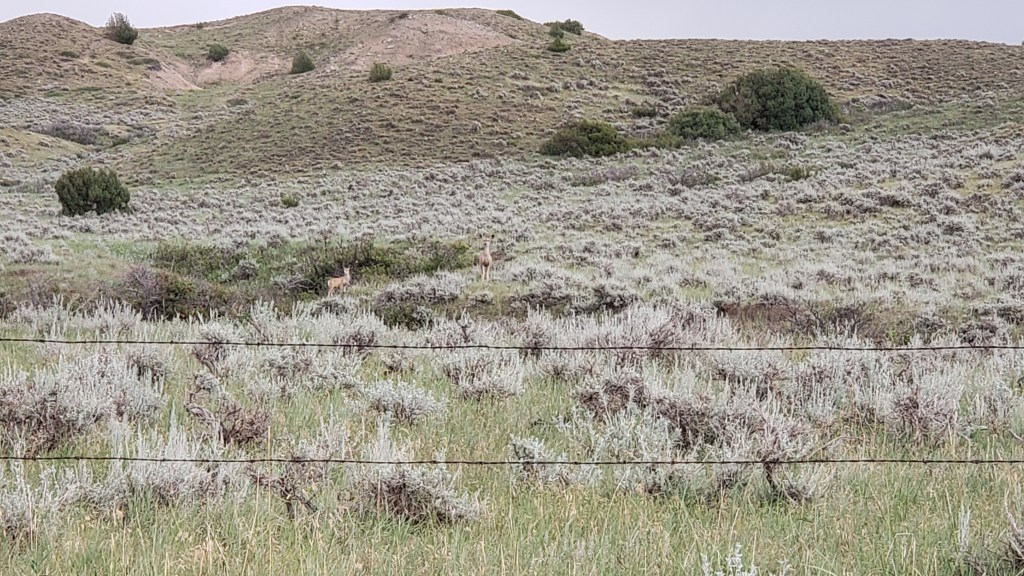
This turned out to be seriously remote driving, with the wonderful bonus of lots of wildlife.

Pronghorn are the most reliable animals in Wyoming. We see them everywhere.

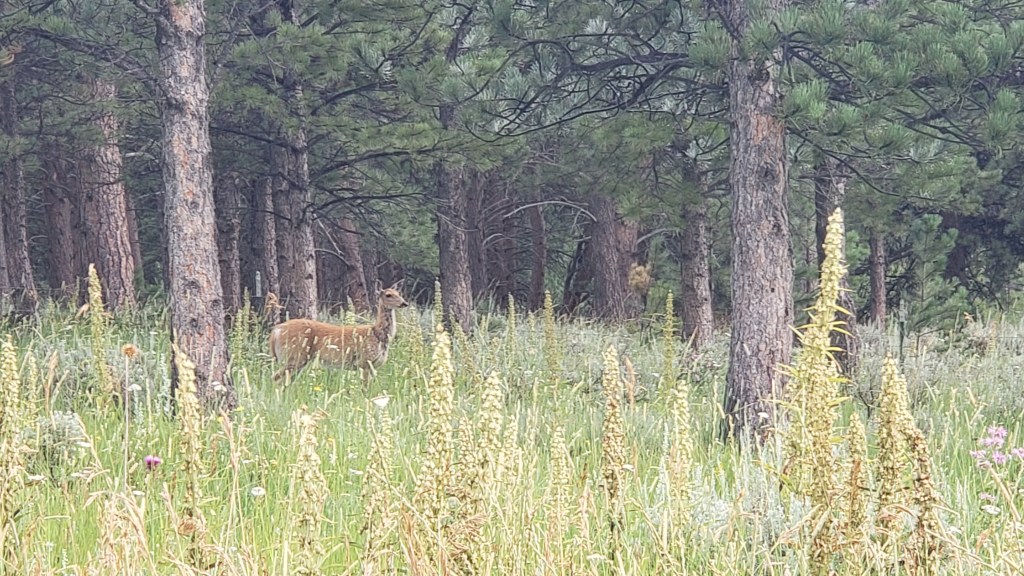
We’ve seen fewer deer than we thought we’d see, but they do pose nicely when they show up.

We spotted Mama, then her fawn came galloping up. Just as we pulled away, a second fawn appeared.

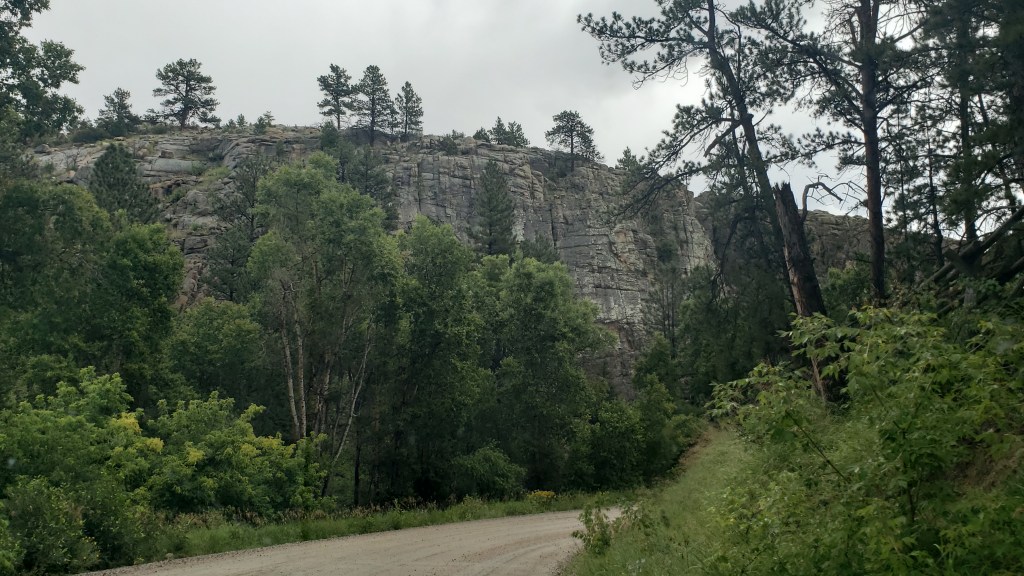
The terrain did what Wyoming does, and changed from rolling hills to prairie to rocky outcroppings to the heady scent of pine forests. We are constantly amazed by what unfolds with each rise and dip in the road. All of this happened within a 10-mile span:


Esterbrook itself had probably seen better days. Most of it looked deserted, though there were a few homes that were clearly inhabited. Where they get their groceries, we do not know. The nearest towns were nearly an hour away.

Deserted.

Also deserted.

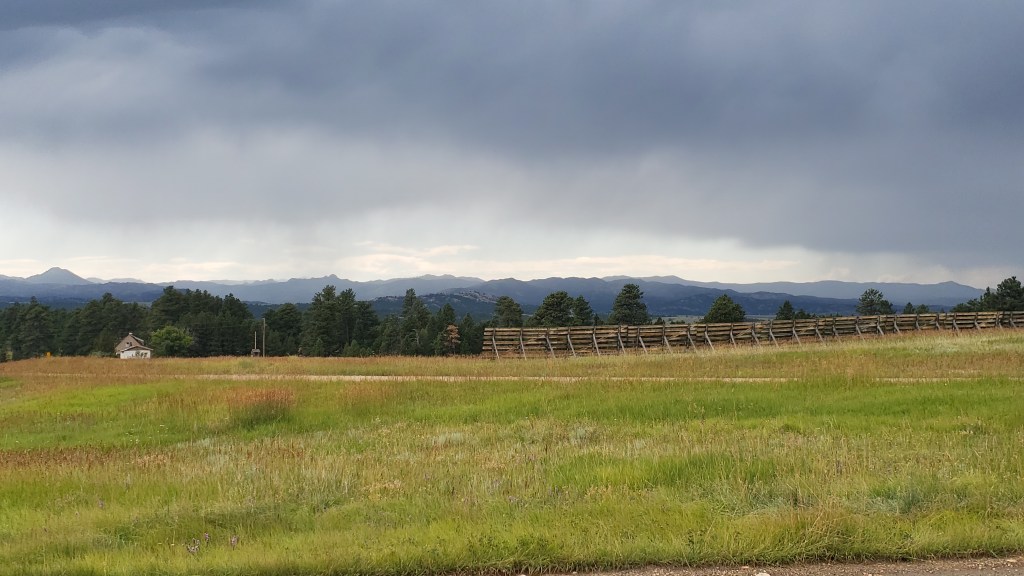
We did get our first view of what we thought was the Rocky Mountains, but, no, it turned out to be another view of the Laramie Mountains.


Simon had hoped to find a nice iced cappuccino in Esterbrook, having not yet learned coffee can only be found every 200 miles or so in places like Montana and Wyoming, and it had become our mantra to say, “Knock on someone’s door and ask them to brew you a pot” after our mortifying visit to tiny Leiter.

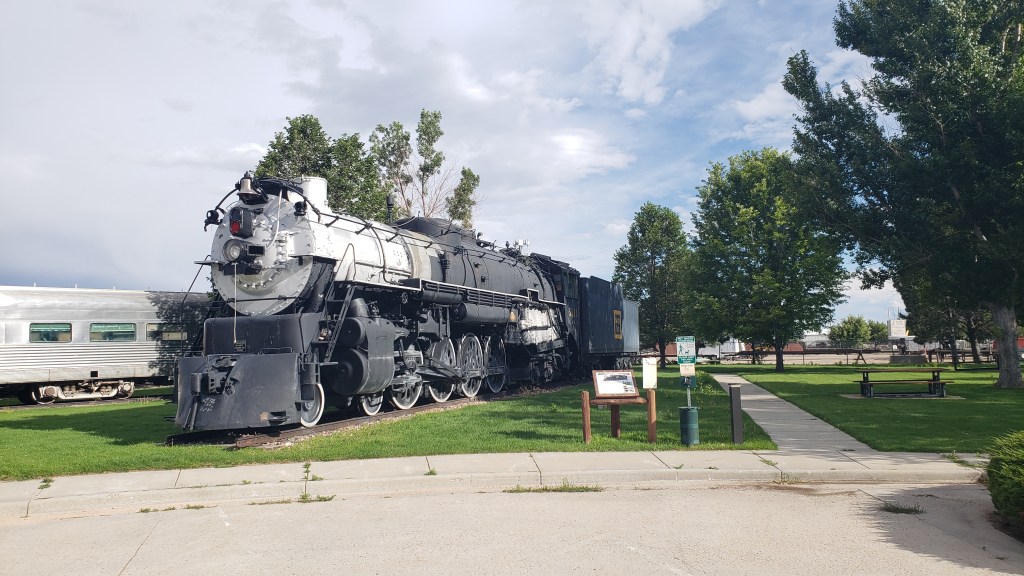
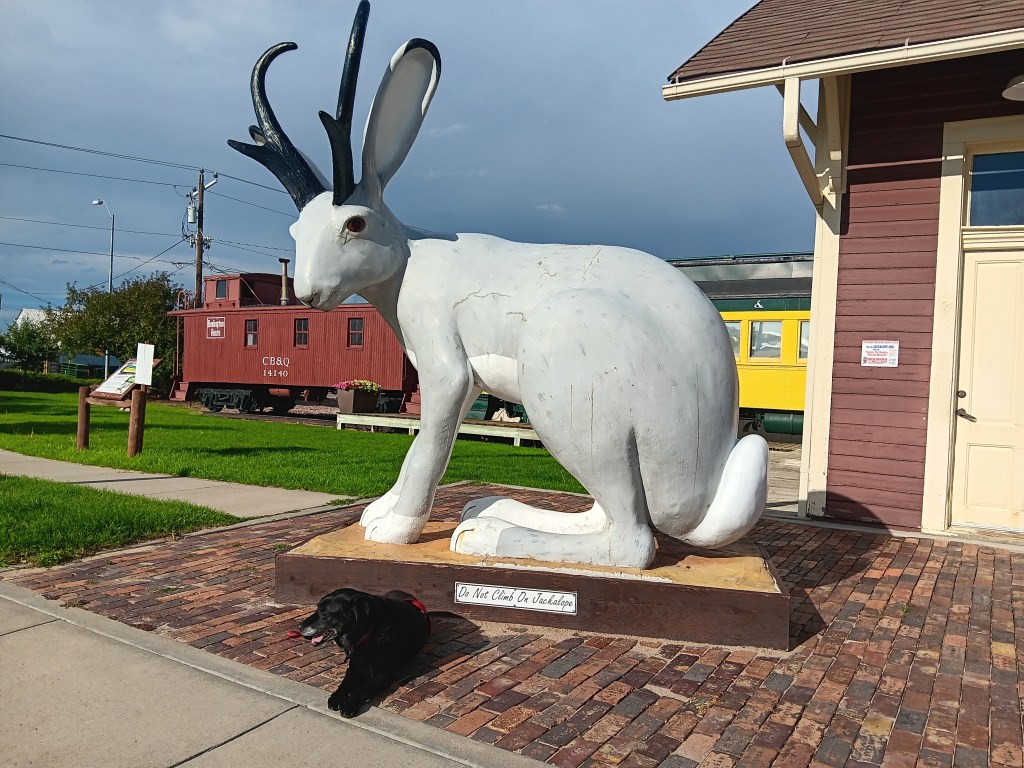
We returned to I-25 at Douglas, “Home of the Jackalope,” and found a train museum and, of course, lots of jackalope statues and cut-outs, along with some quirky little storefronts. The only coffee to be found was at McDonalds, but by the time we realized it we were well out of town.


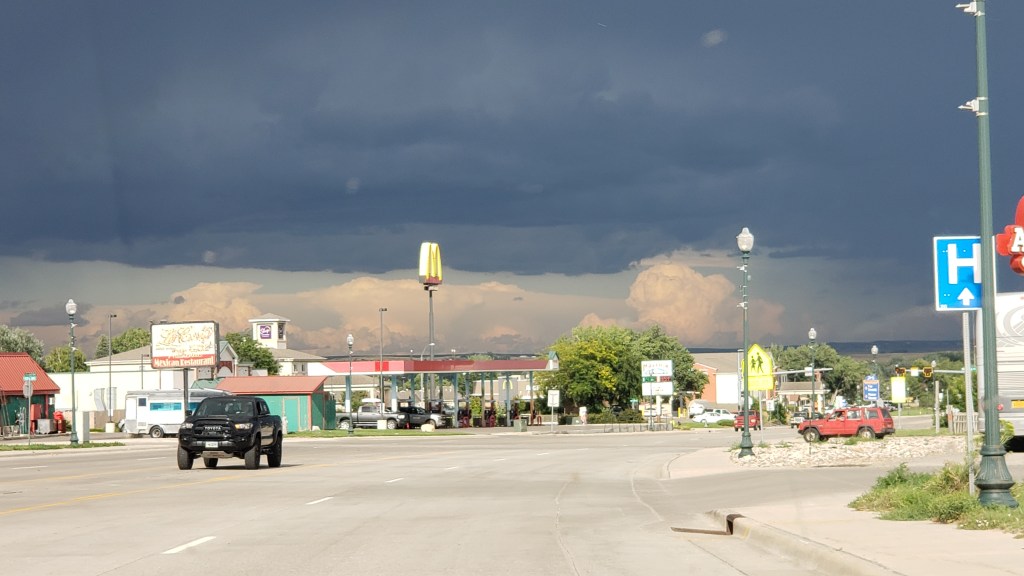
The weather had been around us for more than a week, but we rarely had any.

Our next day’s touring in Nippy would be the longest we’ve taken on this trip, covering 374 miles. Most of them passed rolling hills, prairies, and ranches, so we’ll only cover the highlights, including one heck of a majestic canyon and one heck of a smelly park.


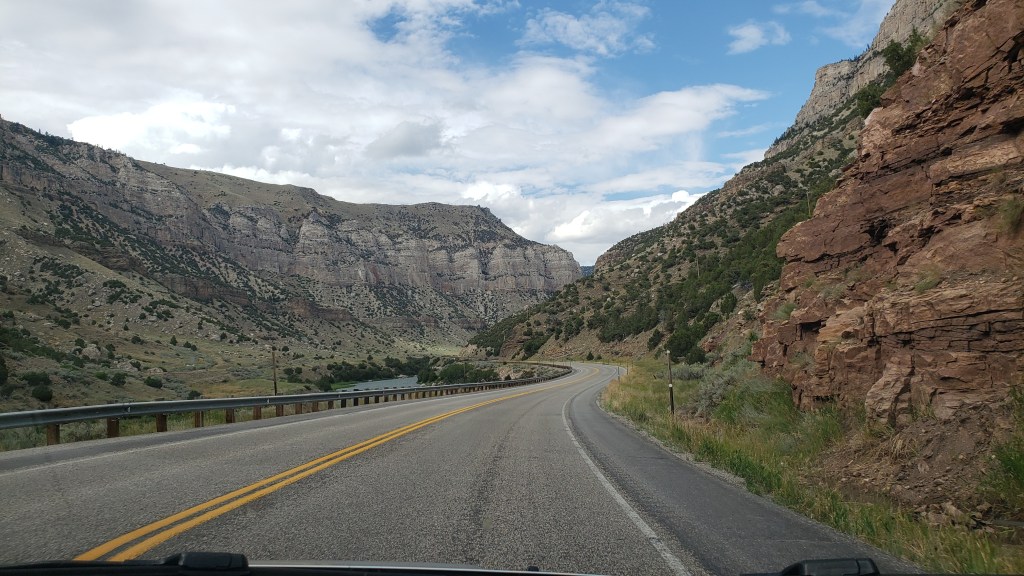
Having stopped at three major Oregon/Mormon/Pony Express sites, which we’ll cover in our next blog, we circled north along our route and detoured up highway 20 toward Thermopolis, named for the world’s largest thermal springs, which bubble up there. Highway 20 passes through the Wind River Canyon, honoring the river that runs through it.

Shoshone lived in the area for thousands of years, and other tribes including Crow, Arapaho, Cheyenne, Blackfeet, and Lakota, made seasonal migrations to the canyon. The Wind River Indian Reservation is still located here, and it holds great spiritual meaning.

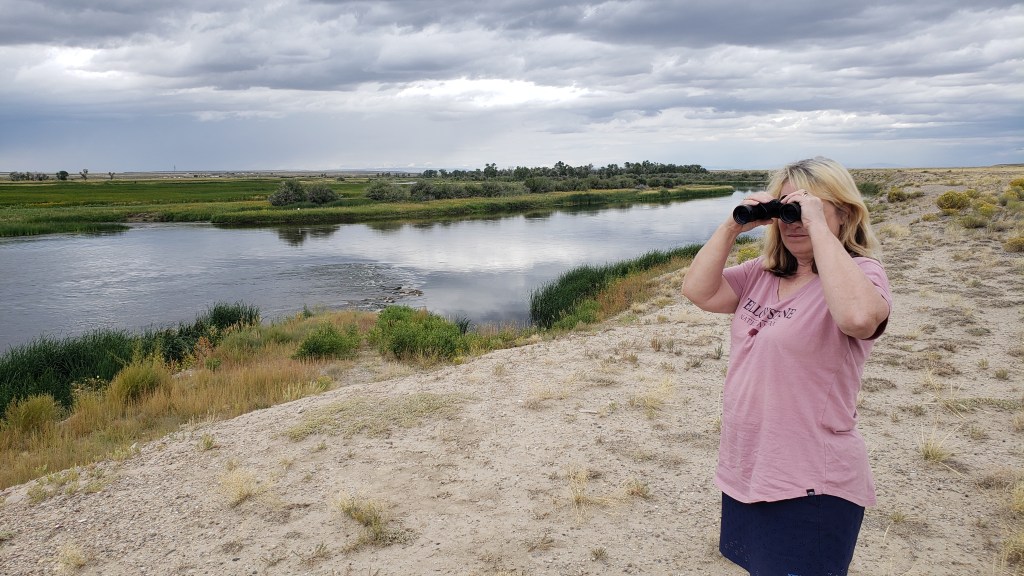
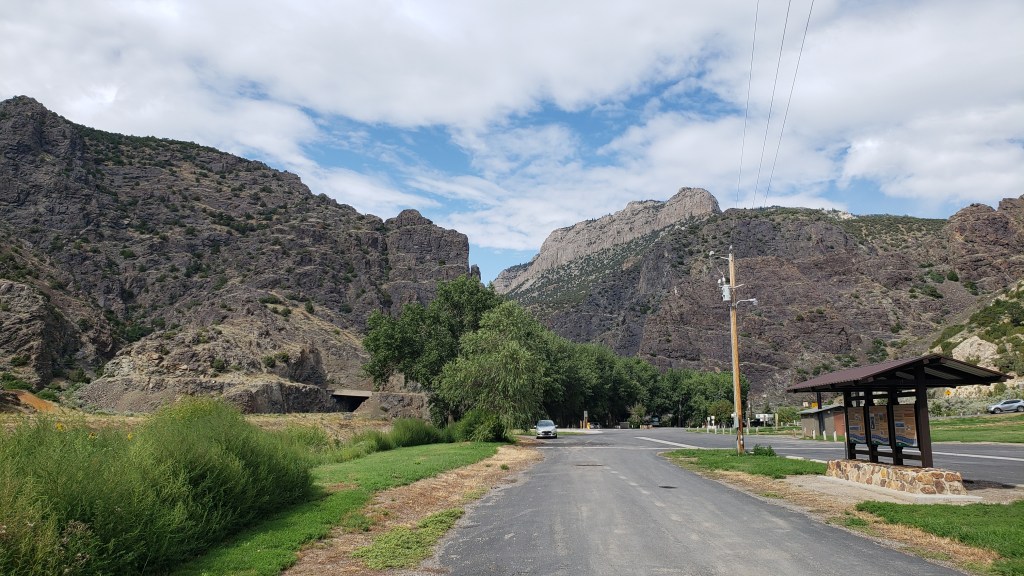
We stopped at a park at the entrance to the canyon, and spent time looking through our binoculars for the Bighorn Sheep that live on the mountains. We didn’t see any, but it’s impossible to imagine they aren’t there, hiding behind the rocks.


Three tunnels punctuate the entrance to the canyon, and while they weren’t as tight as Needles Eye, they made for a grand transition.

Click Image for Video

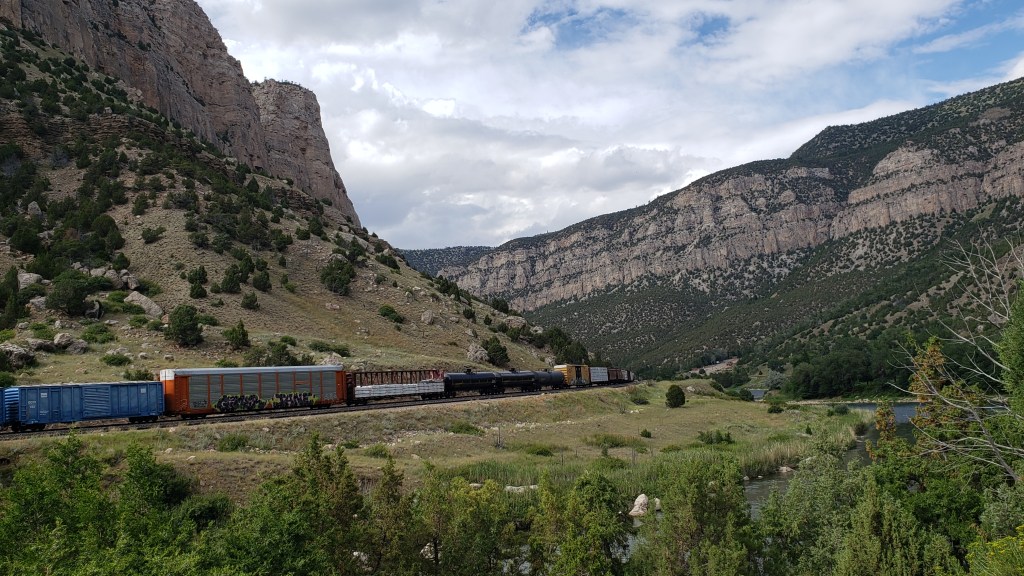
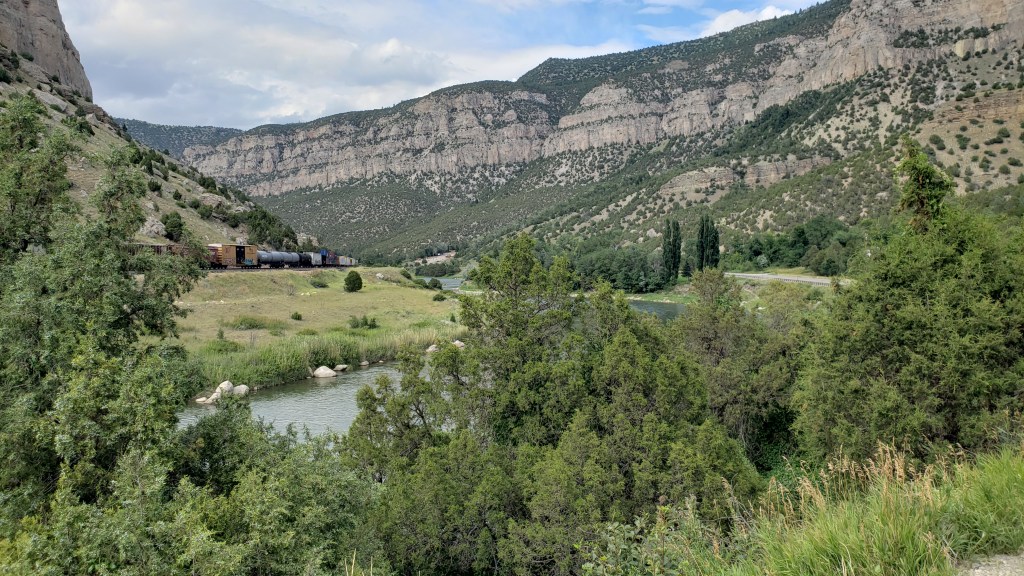
It only takes about 30 minutes to get through the canyon itself, but along the way we were treated to varied mountainsides and towering peaks that rise to 2,500 feet on either side. Its oldest rocks date back to the pre-Cambrian period, more than 2.9 billion years ago.


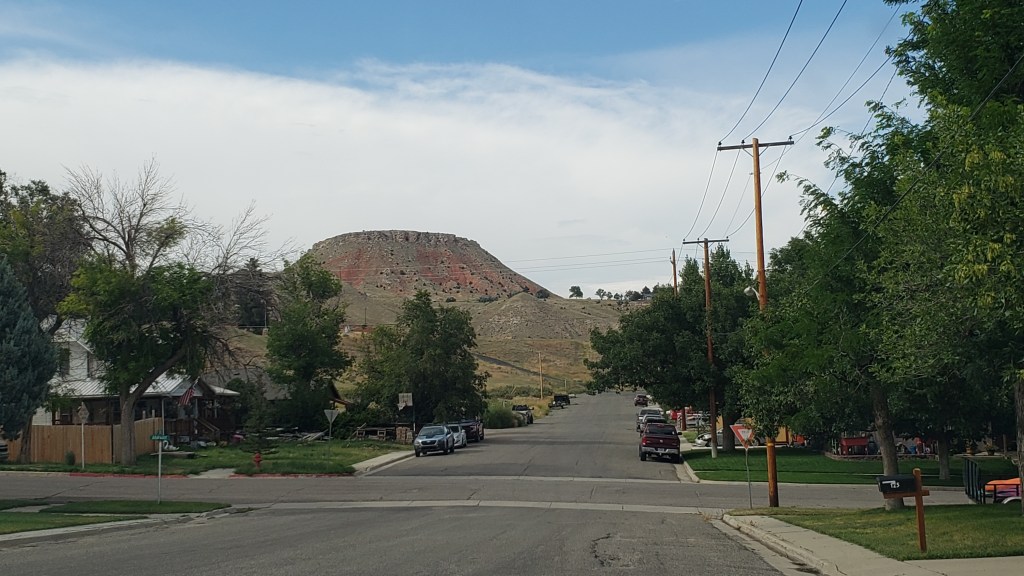
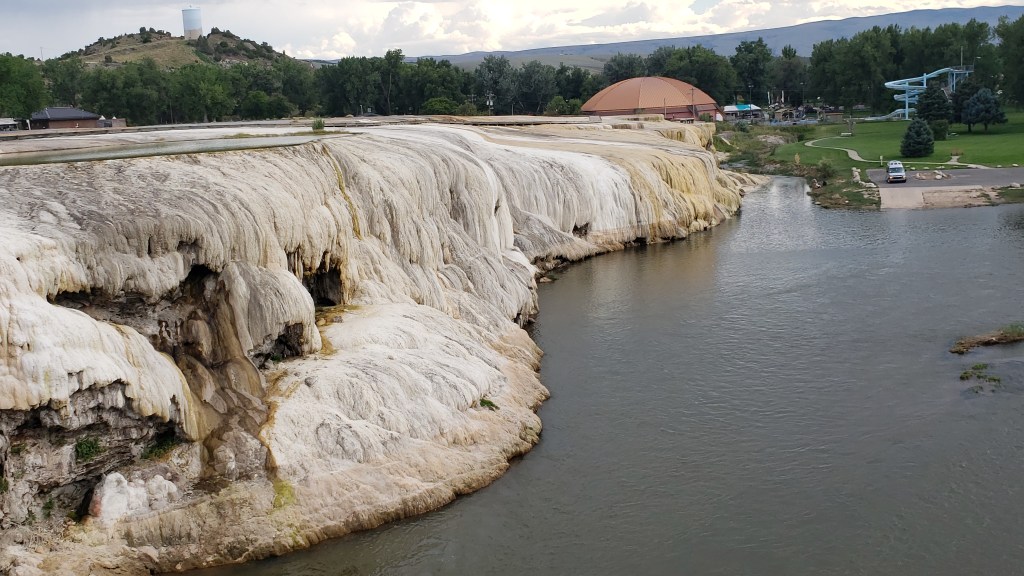
Thermopolis was no slouch, either. The town features a mini Devil’s Tower as its backdrop…


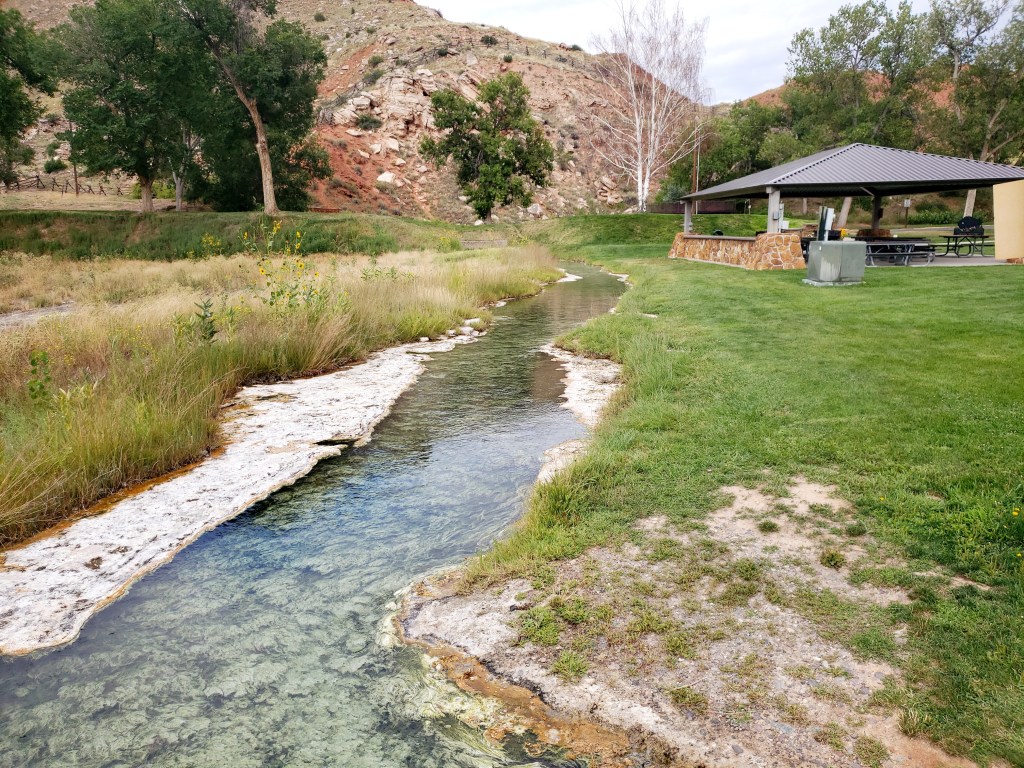
… but it’s the smell of Sulphur that permeates the thermal area that really catches your attention, especially when you’re up close to a spring. As Simon would say, “Whew! What a pong!”

White Sulphur Spring
Click Image for Video

Can’t. Stand. The stink!

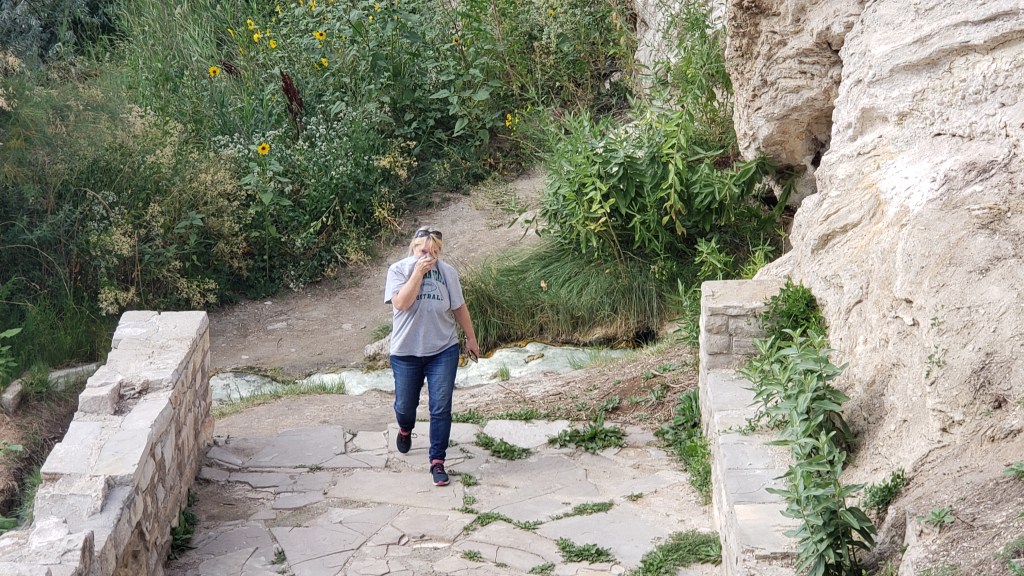
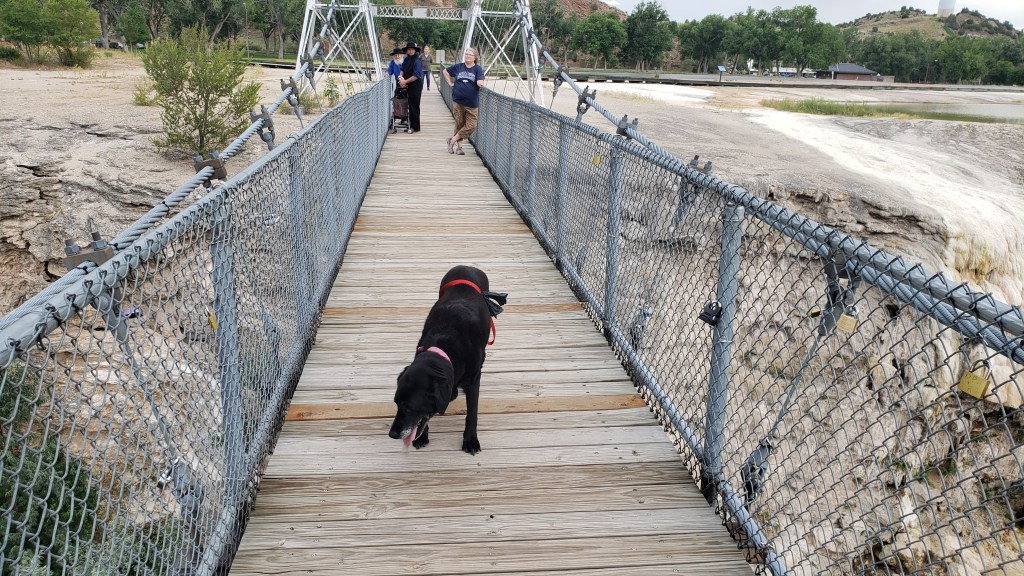
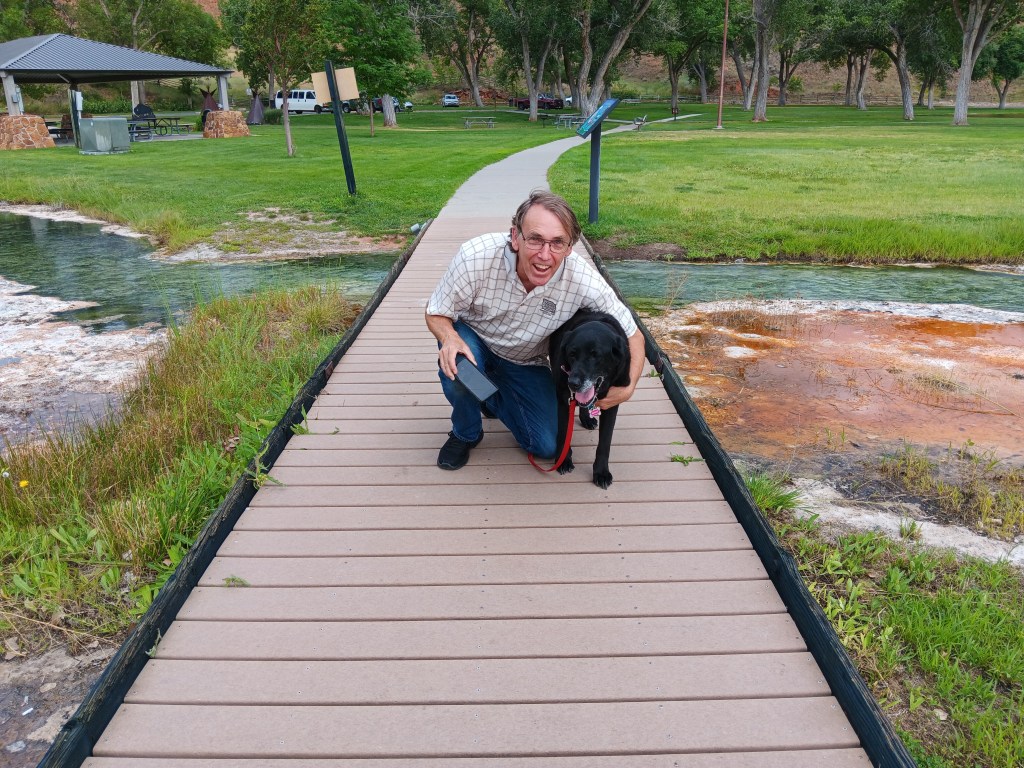
The park is very pretty, and very well used. Along with the springs, we found travertine formations and a swinging bridge (delightful to some, terrifying to others; we’ll let you guess which one of us has an overactive survival instinct).


Ruthie didn’t mind being on the bridge.


We spent quite a bit of time there, in spite of the stink, but there was one more surprise in store for us as we made our way east back to Evansville.


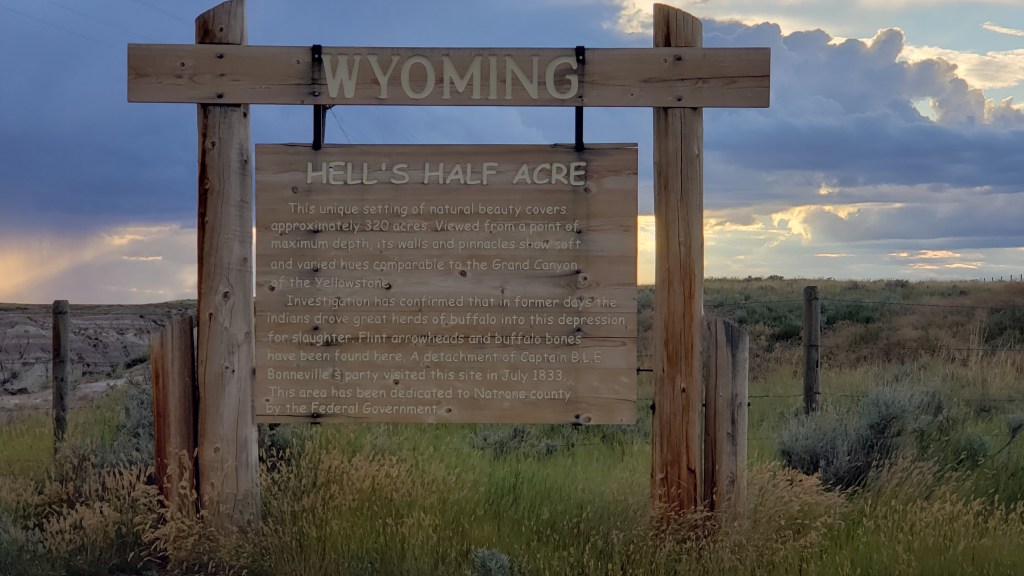
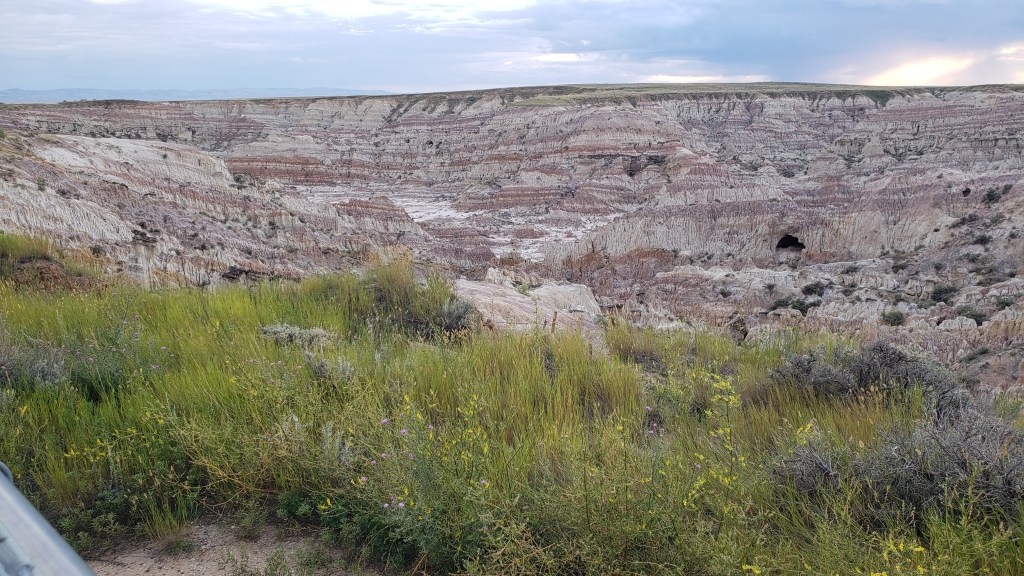
Smack in the middle of nowhere is Hell’s Half Acre, a mini badland of sorts that seems to just drop away from the surrounding plains. You can’t get the size of it from a photo, but it’s 150-feet deep. That cave near the right-hand side is massive.


Once again, there was weather all around us, but we only got a few drops and a lovely rainbow to cap off a long but very satisfying day.

Oh, Give Me A Home Where The North American Bison Roam


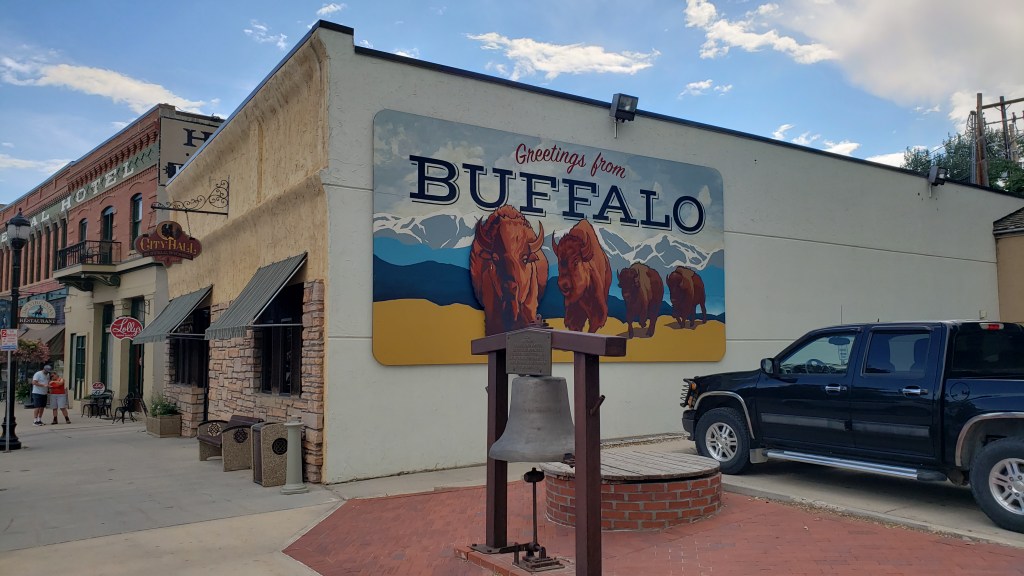
Many a hearty laugh has been had by us over names like Pony Espresso, Jesusland, Jan’s Cut & Yak Hair Salon, The Lucky Chucker, and Born In A Barn, but one name has baffled us. Why, oh why is anything having to do with the U.S. named “Buffalo” when there are no buffalo in North America and there never have been?

“Bison Bill Cody” doesn’t have the same ring, we’ll give you that, but it, and the name of the town in Wyoming, would be more correct as “Bison,” not the name mistakenly given to the animal those of us of a certain age incorrectly grew up calling “buffalo.”

“Call me a buffalo. I dare you.”

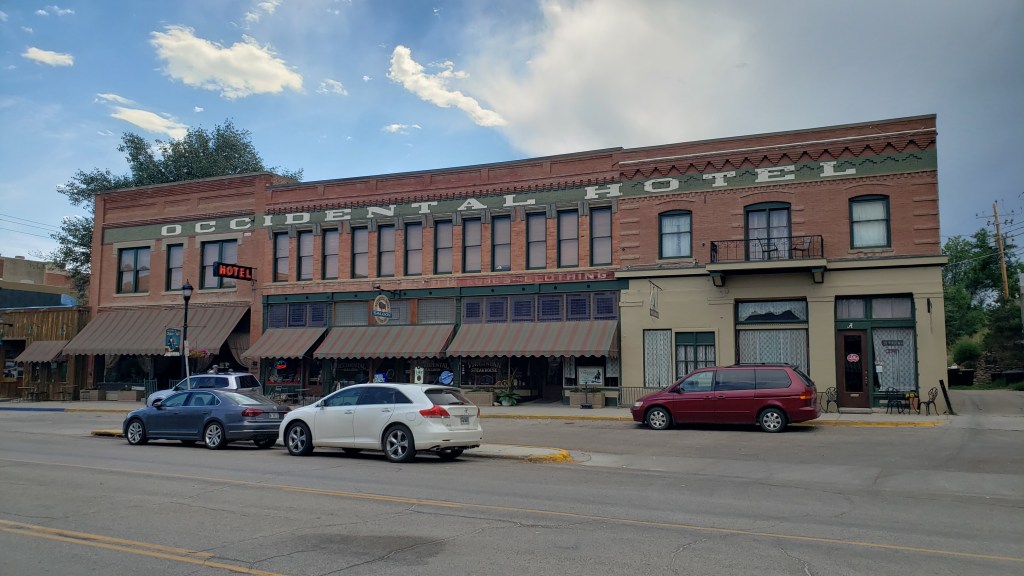
None of that mattered too much when we paid a visit to Buffalo, partly on the suggestion of our RV driving instructor Geoff, who told us the Occidental Hotel there had a really cool saloon.


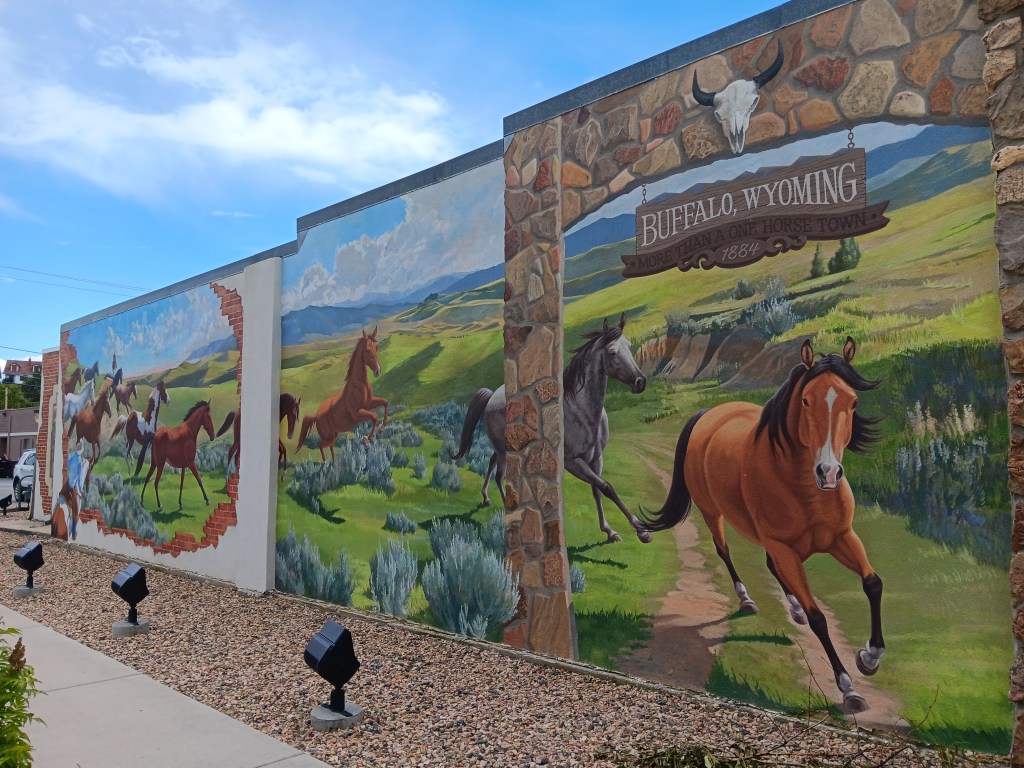
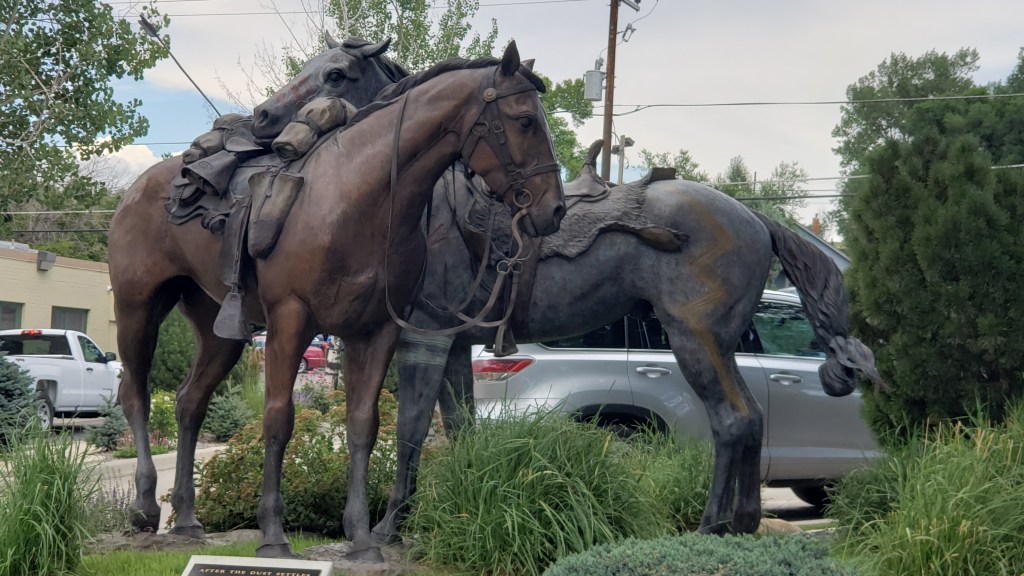
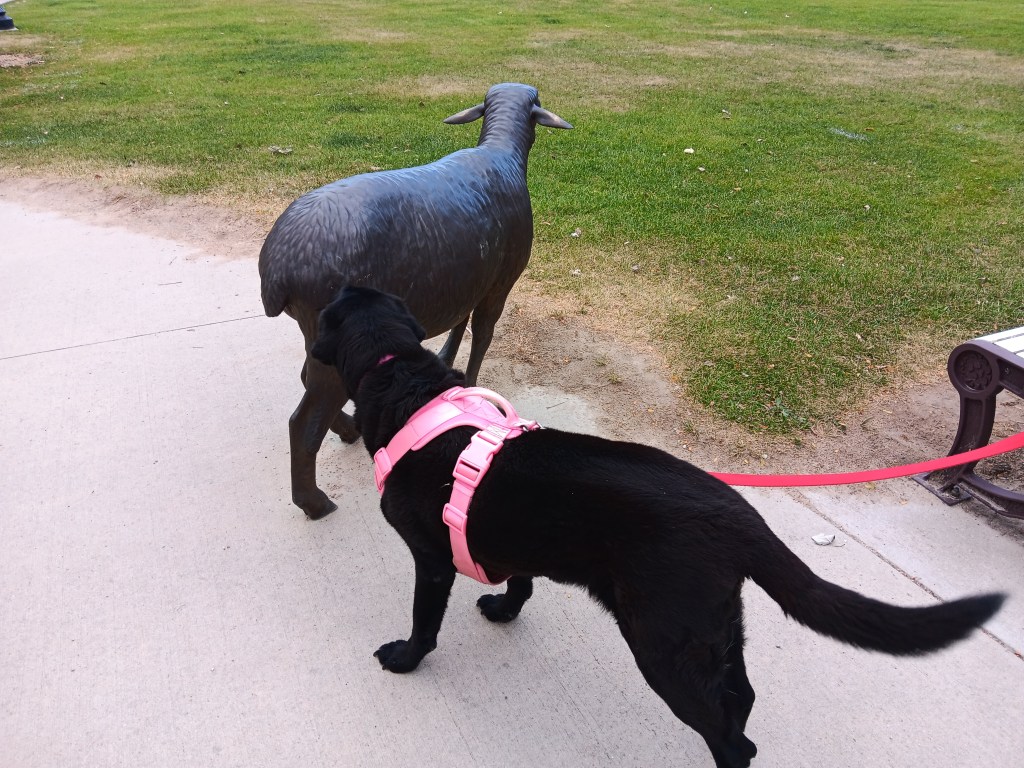
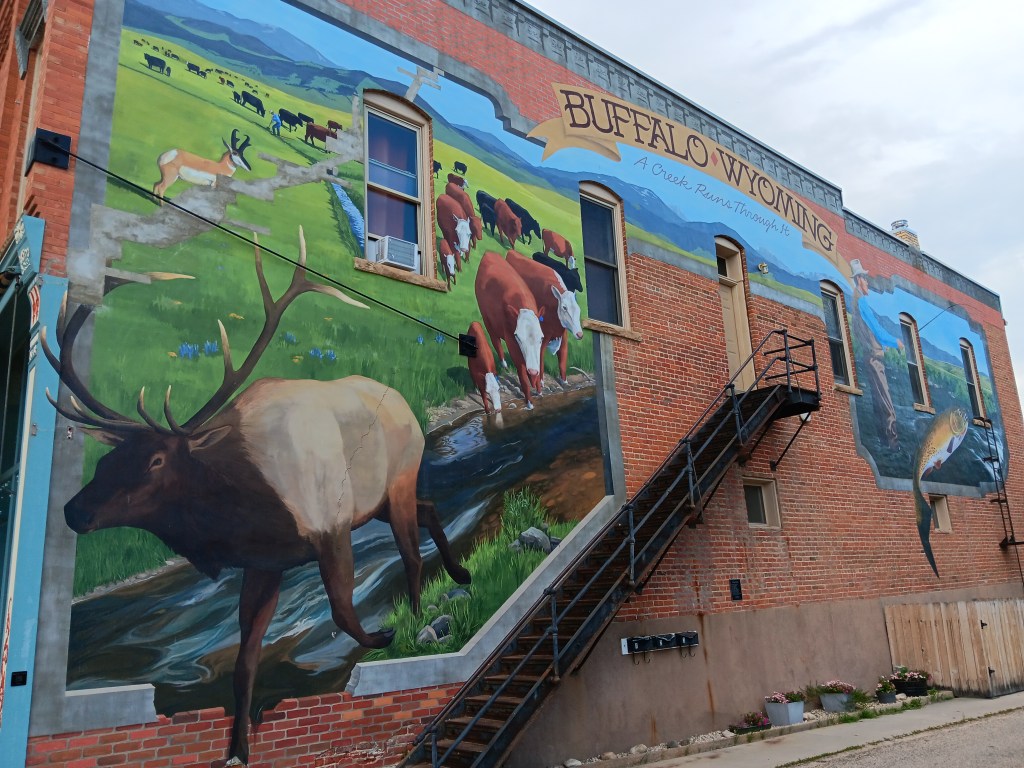
We’d make it our lunch stop, but first we took a little wander around town. Wyoming loves its metal sculptures and cut-outs, and Buffalo was no exception.


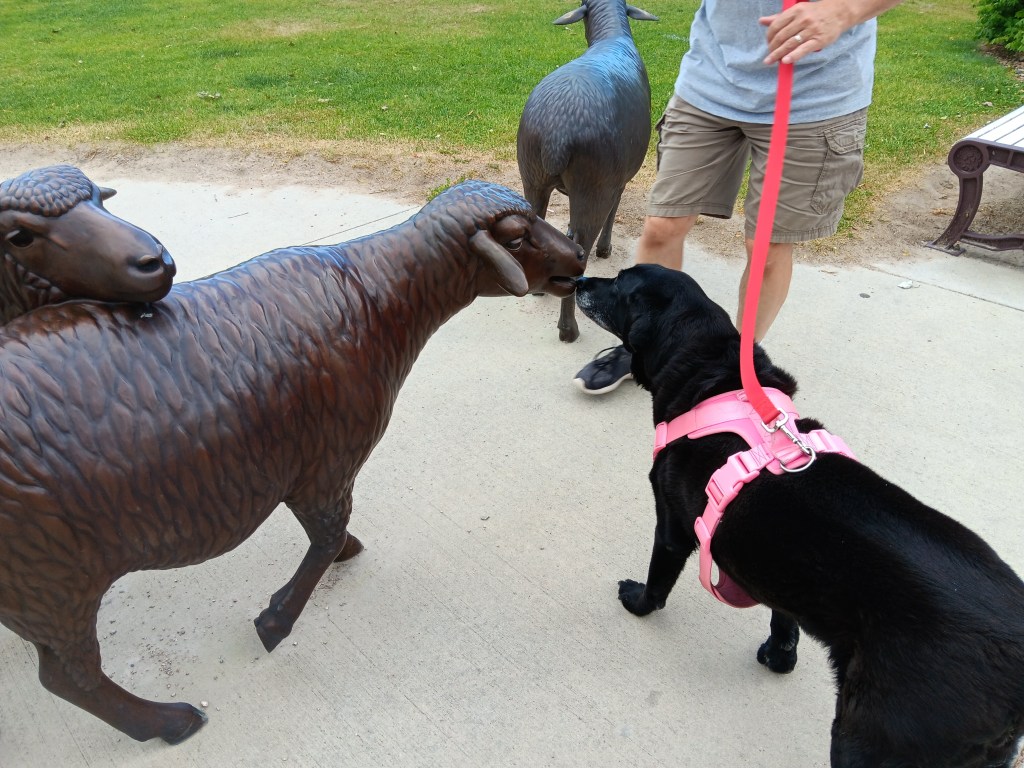
Ruthie wasn’t so sure about some of them.

“Ewe don’t smell right.”


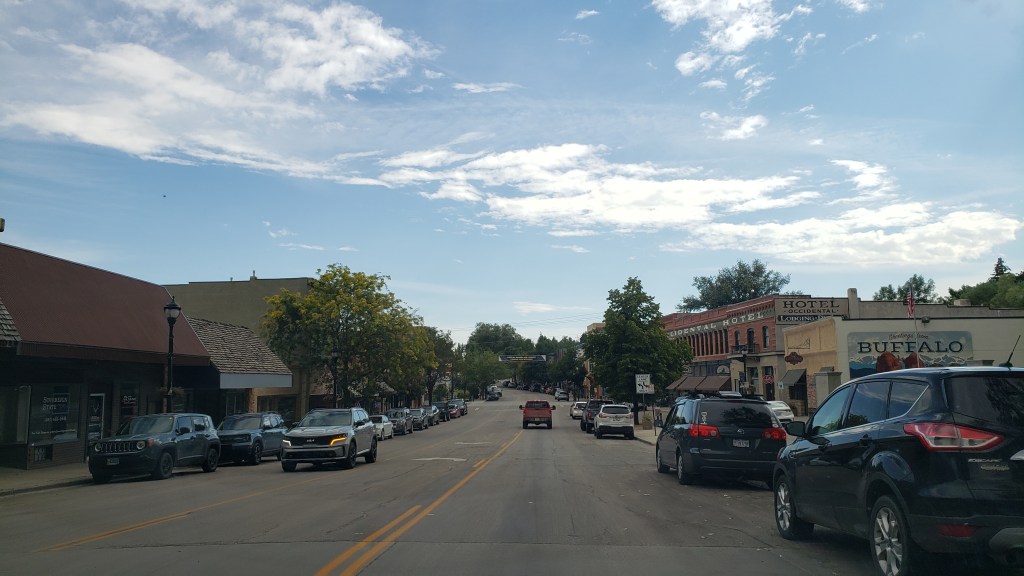
The downtown area was pleasant, and while it wasn’t as jam-packed as Deadwood, it felt far more original, and we like that.

Not a Starbucks in sight


Known to the locals as “The Ox,” the Occidental Hotel was founded in 1880, and its saloon replaced a raggedy old bar in 1908. With its location at the foot of the Bighorn Mountains and central to the heavily-used Bozeman Trail, the hotel once played host to the likes of Buffalo Bill Cody, Calamity Jane, Butch Cassidy and the Sundance Kid, and, later, Teddy Roosevelt. It is now on the National Historical Register.

Open the door and this is your view

The saloon is chock-full of Wyoming stuff – animal heads and skulls (of course), antiques, period stained glass, and even bullet holes from some long-ago booze-fueled gunfight. The saloon is original, and we could almost imagine cowboys, rustlers, gamblers, and the lawful and lawless bellying up to the 25-foot bar, some for a shot of “liquid courage” as poker games sometimes went on for days.


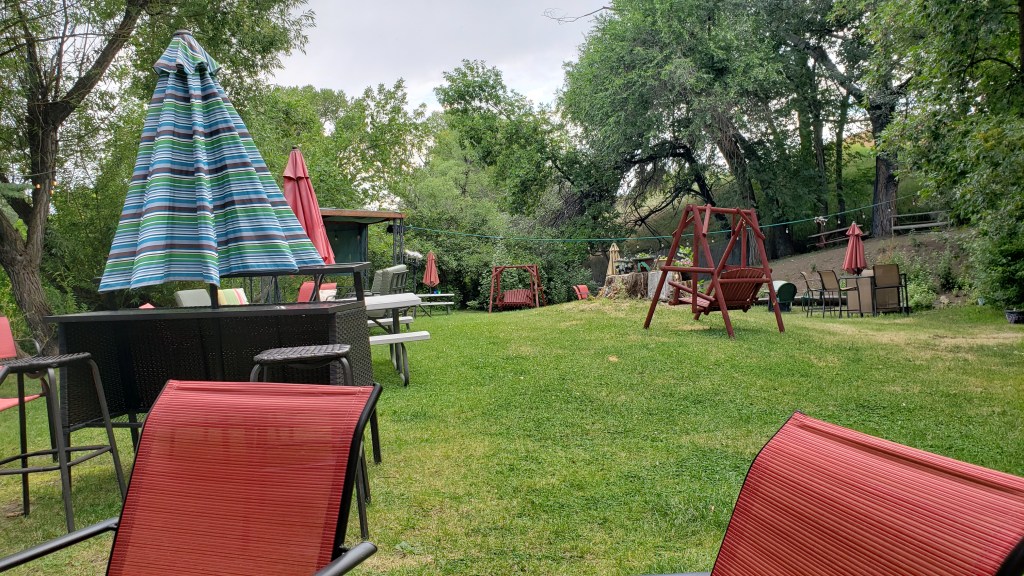
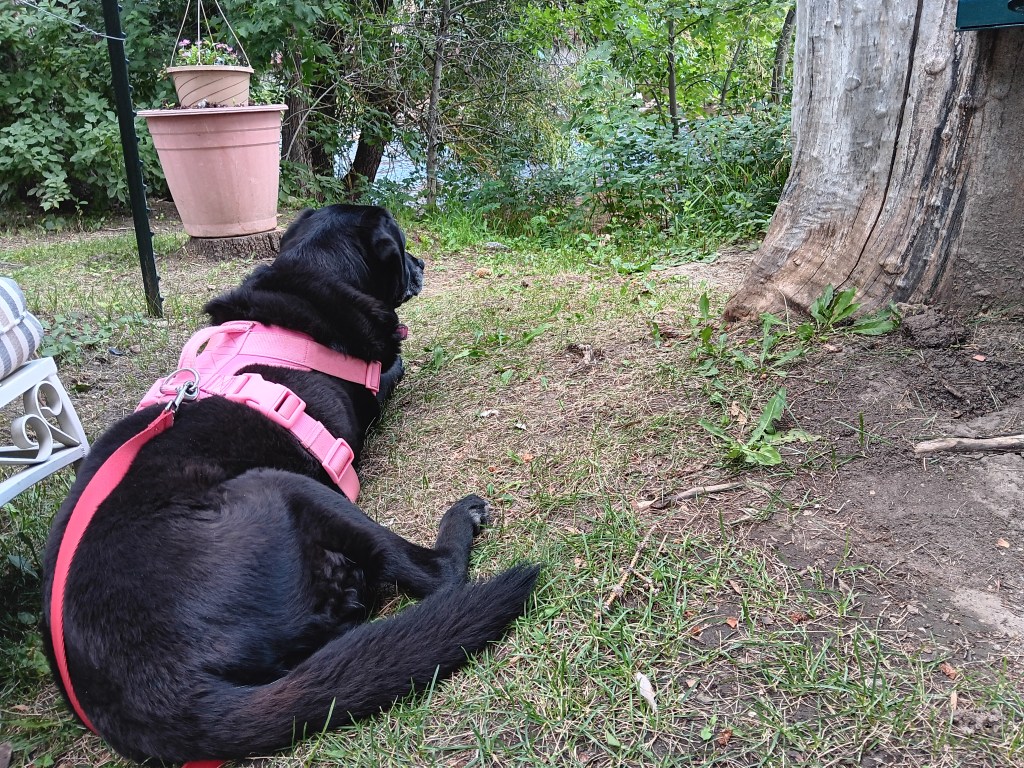
We just wanted lunch, but with No Dogs Allowed, our dining took place in the back garden that sits along a river, where the hotel has live music every Thursday night.


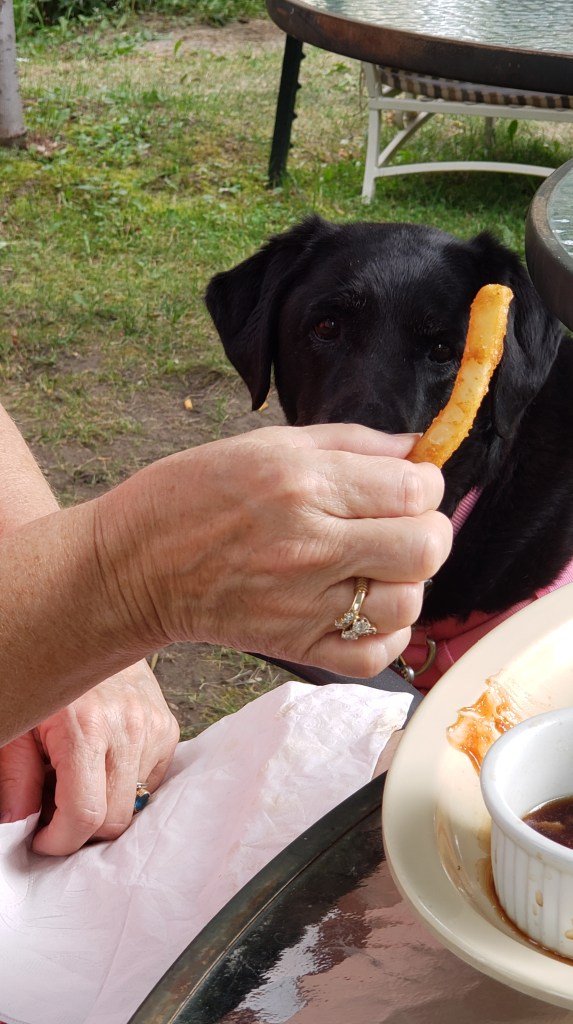
We only had ourselves as entertainment that afternoon, along with Ruthie, who loved us when we gave her a fry, then ignored us when that was all she got.

“YES! YES, I WANT THAT!”

“I thought you people loved me.”

Luckily, we adore each other and are happy with our own company. Even luckier, two young children, their mother, and their grandparents showed up for an al fresco lunch, and we were treated to several rounds of Hide and Seek, during which the youngest cheated like crazy.

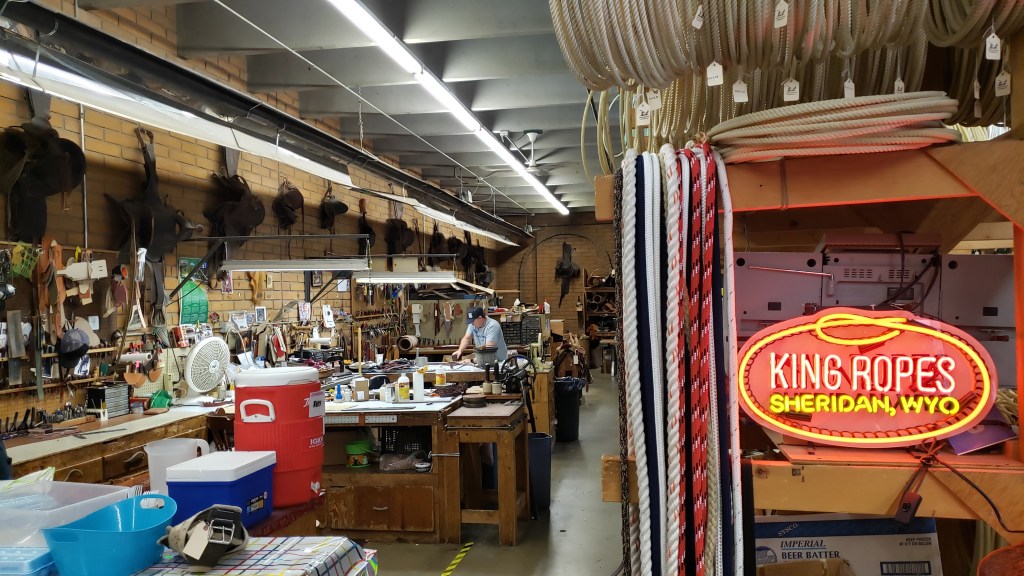
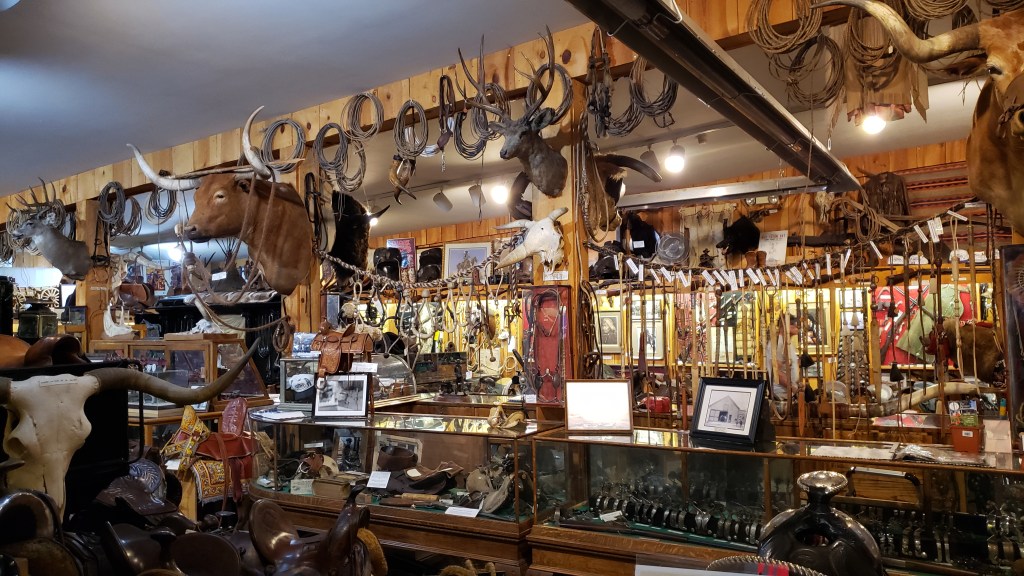
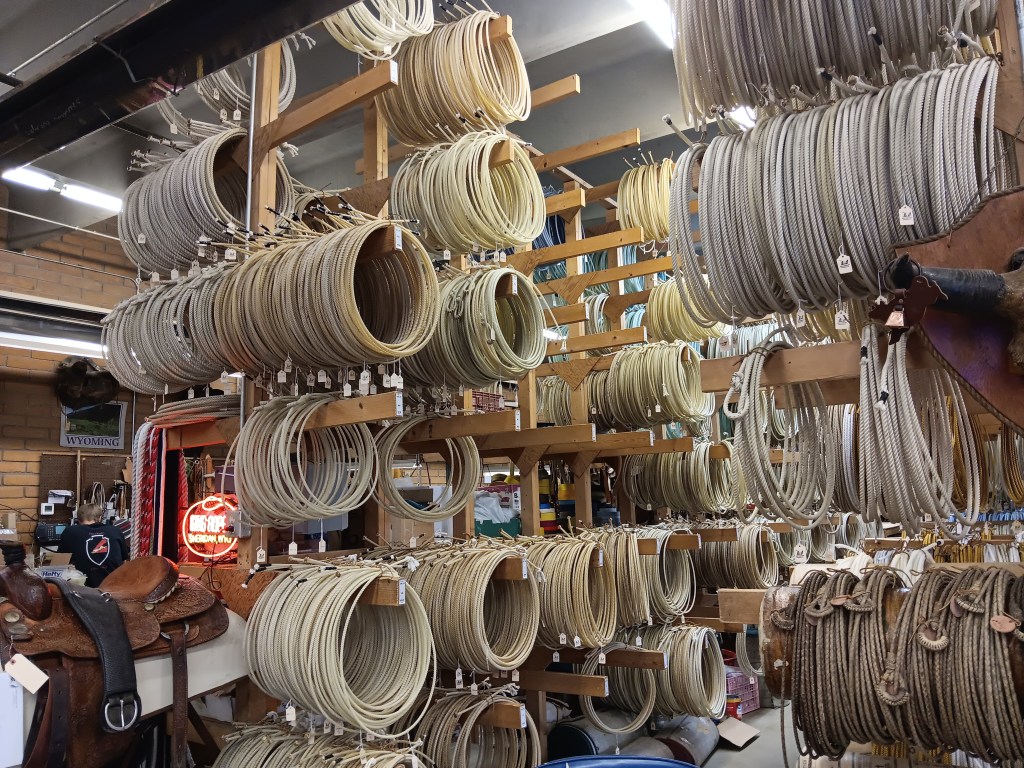
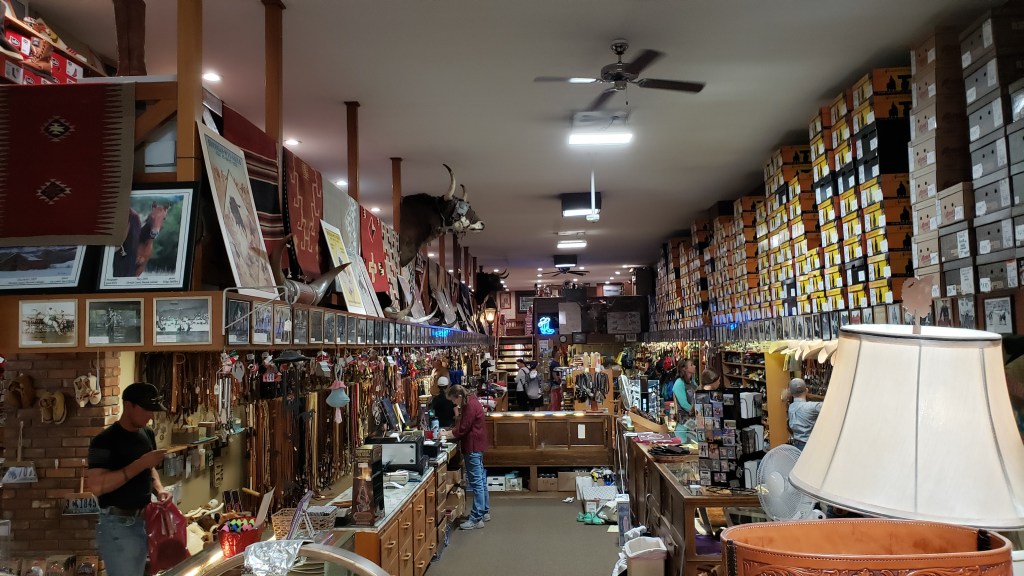
After Buffalo, we returned to Sheridan to see the famous King’s Saddlery & King’s Ropes, an institution in a town where even the kids are decked out in cowboy hats and boots. We stuck out like the boring-clothed tourists we are.


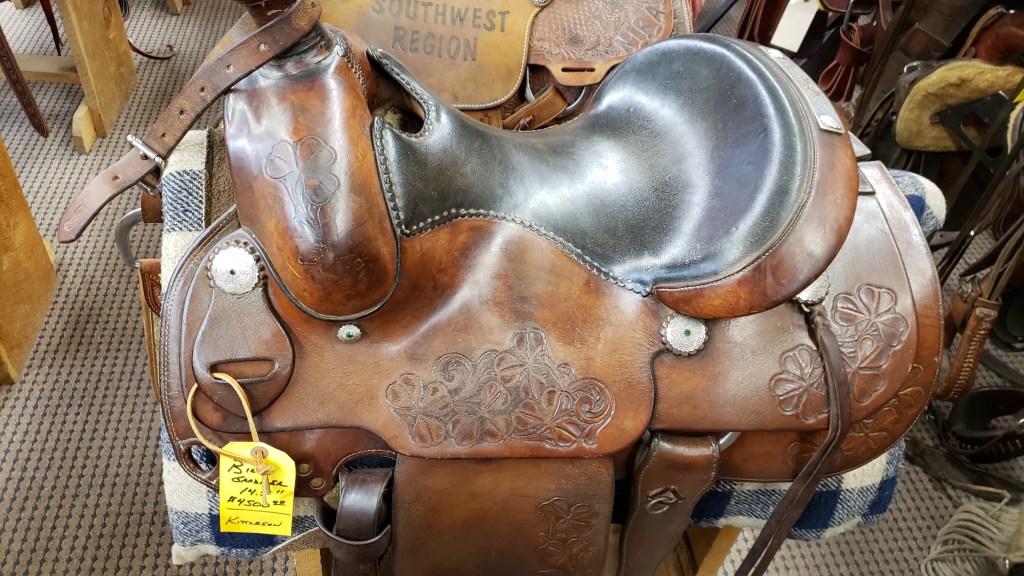
King’s is part Western-wear and tack shop, part saddle makers, part rope makers, and while we wouldn’t know a good saddle or rope from a bad one, they certainly had some superb examples of the craft.


It was nearly time to say “goodbye” to Sheridan, but we’d be doing it having made some new friends. There is nothing quite like adversity to help bring people together, and this time we were able to be on the giving end of “a friend in need.”

A massive storm rolled through a night or two ago, and our newest neighbor sprung a little leak. A couple three sites down had a tarp they could lend her, and we had Ruthie’s long leash, which would help tie the tarp down, plus a Disney Cruise Line towel to sop up some of the leakage. In the end, we had great conversations about each of our travels, where all of us were headed next, and which locations were in our Top Five.

You can just see Simon’s red rain jacket hood on the far rear side of the trailer

Our intrepid neighbor is heading to Alaska for work, and we wish her great success and safe travels. As luck would have it, the other couple showed up at our next campground a few nights after us, and we promised to get together and chat over a drink. But Simon bashed his noggin on one of the slide-outs before that could happen, with a little blood, a very sore neck, and an early bedtime being the unhappy result. We’re traveling roughly in the same direction, though, and we sincerely hope our paths cross again, next time with wine.

Making Choices In Montana

This was the easiest decision we had to make. And yes, that’s a long line ahead of Simon. A locals’ favorite!

Sometimes you have to make hard choices. While there are times when you have to take a leap of faith, our decisions over the next few days would be based on both local knowledge and hard-earned first-hand reconnaissance.

Billings, Montana was supposed to be our next stop, but since we were running a day late we pushed on to Columbus, which we planned to use as a base from which to see the Pryor Mountain wild horses, Devil’s Canyon Overlook, Cody, Beartooth Pass, and Chief Joseph Scenic Byway.

We ruled out Pryor Mountain, a 204 mile round-trip in Nippy that sounded long but oh-so-scenic from the comfort of our house when we were making plans, but sounded truly awful when reality hit, then ruled out Beartooth Pass when it became obvious the sharp drop-offs, cliffside driving without barriers, and the sheer terror of it all were going to do Susan’s head in. Instead, we opted for the still-very-high-up Chief Joseph Scenic Byway, which gave us plenty of spectacular views without the threat of death.

A quick stop in Absarokee’s little downtown market for a bite of take-away lunch (two pizza sticks for Simon, one chicken strip for Susan, and a pot of potato salad to split) gave us the fuel needed to start ascending the mountain to Red Lodge, Montana, which bills itself as “The Gateway to Yellowstone Park.”

Feasting in the car . Rainstorms make everything taste better!

And it is a gateway…if you’re willing to brave the Beartooth Highway, a 69-mile twisting, turning, sharp-drop-off road that tops out at 10,947 feet (that’s 3,337 meters for our UK friends).

The trip to Red Lodge offered yet more rolling landscape dotted with green hills that led to sharp, craggy rock, and while the weather over the Beartooth mountains threatened a bit of rain, we only had a few spotty showers.


We stopped at the Visitor Center, which included a one-room cabin once owned by Liver Eating Johnston. There were people then and are people now who can live and thrive in a dirt-floor cabin, but we aren’t among them.


Photo taken through a glass door. Ignore the reflection on the right.

The Visitor Center host suggested we take a drive to Wild Bill Lake for a one-mile hike, then head up the Chief Joseph Scenic Byway, an alternative to the Beartooth Highway. The hike was a terrific suggestion, and we thoroughly enjoyed our walk, as did Ruthie, who got lots of love and attention from kids fishing along the lake.


Now, we’d been assured the Chief Joesph was tame, but over the course of the next week or so we’d learn that “tame” in Montana and Wyoming is not the same as “tame” in Michigan, Florida, or the UK. We would also learn that “rolling hills” mean something entirely different, too (steep grades both up and down, in quick succession).


None of that mattered as we wound up the mountainside, stopping at markers for the likes of Bear Creek Hill and Dead Indian Pass (elevation 8,000 feet). Naturally, Simon had to find the most precarious place on the whole mountain to lean out and peek over the edge, while Susan very sensibly waited in the car.

See that little strip of pavement way, way down, in the middle of the photo? That’s the road.

A marker at the summit tells the story of 600 members of the Nez Perce tribe, led by Lean Elk and Chief Joseph, who used the pass to escape the U.S. Army in 1877. At this point in their retreat, they were forced to leave an injured warrior, who was subsequently killed by U.S. scouts.


The byway eventually hooks up with the Beartooth Highway, so we retraced our route for the return trip and veered off at WY-120 heading to Cody, just 18 miles away.

Cody was busy, as we’d expected, and, inexplicably, with thoughts of a big, juicy Wyoming steak on our minds, we ended up at a German restaurant eating a kid’s portion of schnitzel and some sort of noodle dish with eggs and cheese. They were out of nearly all of their interesting beers, so we ended up with brews neither of us can remember. Life is funny sometimes.


What is this noodle, egg, and cheese food? We don’t know.

Can you really go wrong with half a schnitzel?

Fati took us to Livingston the next day, which served the dual purpose of getting us closer to Yellowstone National Park while also giving us the opportunity to decide on our best route to the West Yellowstone entrance through real-life experience. We could take Highway 191 from Bozeman, or, as had been suggested by the campground host, take the longer route down the 287 through Ennis. Our trusty Mountain Directory West showed 191 as the better route, but was local knowledge the real story?

The next morning we took advantage of the opportunity to do some sightseeing south of the city, heading to Chico Hot Springs. It was probably just an excuse to get so close to the Gardiner entry into Yellowstone that we couldn’t pass it up and would have to pop in for a look.

Cute little bar in Chico Hot Springs, but, of course, NO DOGS ALLOWED.

We’d been to Yellowstone before, and remembered the road from Gardiner into the park as being steep but nothing to bat an eye at in a car. In fact, it had been the only place we’d seen mountain goats the last time we were there, and we hoped to repeat that experience. What we hadn’t realized was, the road has been rebuilt in a new location since the flooding last year that washed out several roads in Yellowstone. Now it has such steep grades and such tight turns, even some of the park rangers would later tell us they preferred not to use it. We have no photos of this part of the journey, since Simon was gripping the steering wheel and Susan was white-knuckling Nippy’s armrests.

We were blissfully unaware of what lay ahead as we played around taking photos in front of the famous Arch, and when we did make the arduous climb up to Mammoth Hot Springs – punctuated by a few straggler elk – we were hugely relieved to reach the top, and not at all eager to make the trip back down.


It may have been a bit windy.

Why? Why do you people do this to me?

Still, there was no other choice, so down we went when we’d finished our nice little drive to view Mammoth’s glimmering travertine formations.

This isn’t travertine. This is elk.

This is elk and travertine.

This is us and travertine but no elk.

The next day, the 191 wound us through a valley in Gallatin National Forest and along the Gallatin River in Nippy, giving us the lay of the land. Simon was just slightly apprehensive about the drive when we’d have to make it with Fati, because of its sharp curves and very few passing lanes long enough for us to pull over and let other vehicles go by. Big benefit? No major grades. And what a road it turned out to be!

Every curve offered a view more superb than the next, and often we had river rafting tours and people out fly fishing alongside us.


We stopped for a peaceful picnic lunch along the riverside, where four fishermen were grilling whatever it was they’d caught. The scent of pine trees made it an idyllic setting, and we spent a fair bit of time enjoying the serenity.

Our picnic lunch didn’t include fresh-caught fish, but it did include a hiking boot used to hold down one side of our Christmas tablecloth.

We then returned to Livingston via Highway 287, and were hugely surprised to see one of the mountainsides along the road had come down due to a 7.5 magnitude earthquake, leaving a massive scar and an even bigger pile of rubble.


Lucky for us, this all happened in 1959, and whoever takes care of these sorts of catastrophes had created a charming visitor center for Earthquake Lake on top of the rubble, and on top of 14 people whose bodies were never recovered.

Dead trees still stand in the lake, and the hosts at the visitor center told us the concussion from the landslide was heard all the way into Yellowstone.


The visitor center monitors tremors, and we were told the seismograph is so sensitive it often records the footfalls of elk walking in the vicinity. The employees feel tremors several times a day, but they seemed happy with their jobs and their location, so nothing major appears to be on the horizon.


It was reassuring to hear, since we’d soon be spending a few days exploring Yellowstone.

In the end, we were glad we drove both highways to help our decision-making, and it turned out local knowledge didn’t stand up to the test. Highway 287 was gorgeous, but had so many long, steep grades that poor Simon was tuckered out by the time we returned to Fati that night.


Our decision had been made. Next stop, Fishing Bridge Campground in Yellowstone!

Reaching Back in Time: Mammoths and the Wild, Wild West

South Dakota is considered the Midwest, along with states like Michigan, Ohio, and Minnesota, but its relationship to those states ends at the invisible division. It’s not really the West, either, though larger-than-life historical characters spent an awful lot of time there. We were eager to get to know some of them, and to see their stomping grounds.

But first, we were off to discover the remains of the state’s long-gone wooly mammoths at the indoor museum and archeological dig, The Mammoth Site, home to the world’s largest collection of mammoth bones.

Originally, we weren’t going to bother, since Ruthie couldn’t go inside and the wild west was calling. But the day was plenty cool enough for her to spend a quick half-hour in the car with the windows rolled down, and the museum’s sign was very appealing.


We’d heard the curators had all been very excited about a recent find among the bones already uncovered at the indoor dig site, and who doesn’t want to see something that’s just been unearthed after spending time underground since the last Ice Age?


The bones are all in-situ, left in a sinkhole just as they were found so that they can tell the story of the animal just before and at the point of their death, along with how their bones rearranged as the earth moved and the ice retreated.

Mammoth skull and tusks

One such mammoth died with its head slumped against a hill, tusks up. When the wall collapsed, the mammoth’s bones disarticulated and moved backward, so that its head was now near its butt.

It’s hard to tell what’s going on here, but one tusk is on the left, the rest of the skull is near the rump

Another is Napoleon Bone-A-Part, the oldest mammoth in the sinkhole, as evidenced by his teeth and the depth at which he was found. He shuffled off this mortal coil at the age of 49, a relatively early demise for an animal that can live to age 60, but life was harsh then, so he may have been fairly lucky…until he fell into that sinkhole and his luck ran out.


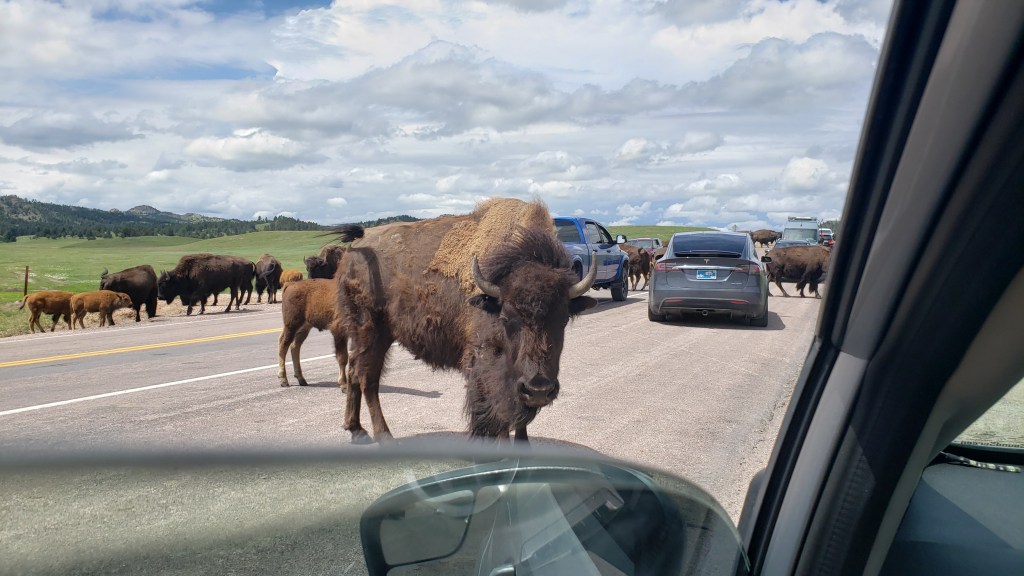
The museum deserved more than 30 minutes of our time, but we wouldn’t leave Ruthie any longer, so we gave her a good walk around the grounds, then made our way toward Wind Cave National Park, which we’d missed when we got distracted by the bison herd along Custer State Park’s wildlife loop.


A visit to Wind Cave itself was not to be. The Visitor Center was packed, and the dog-friendly route we were told to take down to the cave was nowhere to be found. Instead, we took a one-mile hike up a hill, just to get some exercise, and hoped Wind Cave was boring enough that we hadn’t really missed anything.

A brewery in Custer had our name on it for lunch, with a dog-friendly back porch and an interesting menu. Simon opted for the bratwurst made with rattlesnake, rabbit, and pork, and Susan chose the wedge salad. No one cares what a wedge salad tastes like, so I’ll get straight to the interesting part: the rattlesnake and bunny brat tasted “like chicken,” Simon joked, but admitted it really just tasted like a meaty sausage, with no odd flavors. “I’d have it again,” he insists.

Would you eat this?

The town of Keystone held some appeal on paper, but the reality didn’t strike us as overly interesting when we arrived, so we drove around a little bit, then got some nice frozen coffee drinks, which captured the full attention of the family dog, who happens to be a whipped cream fanatic.

“Give me that.”

We would make a move to Sturgis Campground and RV Park in Sturgis, South Dakota, the next morning, just an hour or so drive up the highway. But not before a mobile tech showed up to fix our electric hot water situation. His comment, “You’re pretty lucky,” when he pulled out the charred remains of some wiring and the fried electric coil started a downward trend in our thinking, which would ramp up to 11 in the coming days.

Fried

But before that, we still had some interesting exploring to do, on the trail of long-gone wild west heroes.

Deadwood is such an iconic name in U.S. history, and we were eager to see it. The modern version, however, is so filled with tourist shops and slot machines that we found no real reason to give it any more time than a quick walk around the main street before heading up a rather steep hill to the town’s cemetery.

Deadwood. The first thing you see when you arrive is a Starbucks

Now, it’s probably not normal, but Susan loves cemeteries. Each headstone tells a story in miniature, like the gargoyles on European churches, and they set off a spark in her brain that is both enjoyable and convoluted. The story of the two people whose gravesites we came to see needs no imagination. Wild Bill Hickock and Mrs. M. E. Burke, also known as Martha Jane Canary but best known as Calamity Jane, have gone down in U.S. history as well-known and beloved figures.

After paying a whopping Senior rate of $2 each to get into the Mount Moriah Cemetery, we hiked up the hill to find their grave sites.

Even without any real interpretation, it was fascinating to see the place in which they found final rest. The gunslinger Wild Bill was shot while gambling in Saloon #10, which is still in Deadwood (sort of), though the name of the bar has been transferred to another bar across the street from the original. The pairs of aces and eights he was holding in his hand when he was shot in the back of the head is now known as the “Deadman’s Hand.”


Frontierswoman and sharpshooter Calamity Jane died of pneumonia and bowel inflammation after a hard-living, hard-drinking life. Finding any two sources that agree on the facts of her life is a daunting task indeed.


A bit further along in the hilltop cemetery, we found the overview of Deadwood Gulch, and several headstones for babies who departed life far too soon, some at or just before birth.

Deadwood Gulch

Sad as these tiny headstones’ stories were, another story of woe was about to play out back in town, and we grabbed a couple of curbside seats to watch it. I’m going to be very honest here and say I (Susan) have no idea at all what the story was about, beyond a little gunfight during which neither of the principles were hit, but the bartender took it in the leg. Still, the kids enjoyed it, and that’s what counts.


The real highlight of Deadwood, for us, was a visit to Chubby Chipmunk, recommended to us by our dear neighbors from back home. We did buy a six-pack, with Susan having reigned Simon in after his eye-wateringly expensive truffle debacle in Minnesota.


We devoured two of them right away, but doled out the rest over the course of a week. Truffles have never been a habit we want to get into, but so far, we appear to be failing miserably.


An enormous storm was rolling in as we departed Deadwood, but we’d gotten used to the changeable weather, and slept through the drama to awaken to the prospect of a fresh new day, and a whole new state.