The latest instalment of our exclusive series for The Independent newspaper in the UK is now online, highlighting our travels through Nevada and Southern California, including the Mojave National Preserve, Valley of Fire State Park, and Greater Palm Springs.
This section of our Year On The road adventure took us deep into desert territory – both the Mojave Desert of much of Nevada and the Sonoran Desert that runs from Mexico up into Arizona, including part of SoCal.
Our view of the Hoover Dam from our travels around Las vegas
There were scenic wonders aplenty, and a chance to see why both one of the Star Trek movies and Arnold Schwarzenegger’s Total Recall were filmed here and, for as bright as it shines, we honestly felt the scenery around Las Vegas actually glittered brighter than the city itself.
We also want to offer our sincere thanks to both Travel Nevada and Greater Palm Springs for their help in ensuring we saw the best of their areas, as there was a LOT to see!
Today marks ten months since we locked the door to our house in Florida and set off for a year-long adventure in an RV. Here’s what we learned during the past month:
When someone is trolling along the beach using a metal detector, all the RVers camping beachside lose their ever-lovin’ minds trying to figure out which alarm is going off in their rig, and shout, “What’s that beeping? I’ve never heard that beeping before!”
Oh, wait. No. Maybe that was only us.
“All hat and no cattle.” It’s a saying in Texas, and if it’s directed at you, it’s not a compliment. We don’t have the hats and would be gored to death in the first ten minutes if we tried to have the cattle, and when that became obvious, Texas stepped up. We continue to be amazed by the incredible kindness we’ve been shown, and we think we now understand what “Don’t Mess With Texas” is all about. Mess with one, you’re messin’ with ‘em all, and if one of them takes you into their fold, they’ve all got your back.
We now know how to diaper a dog in under 10 seconds. She now knows how to stand still for 10 seconds. And we shout and cheer about how beautiful she looks when she plays “dress up.” So far, she’s buyin’ it and is happy to wear her “fancy nappy.”
When you smash a mosquito on the inside of your windshield, don’t use hand sanitizer to wipe away its bloody carcass. You’ll only make it worse.
If you do use hand sanitizer and make it worse, tell yourself and everyone else you meant to create that big, nasty smear so you can revel continuously in the glory of your victory.
Louisiana! Home of the best crawfish, shrimp, and gumbo in the world! Big, steaming pots filled with boiling goodness all over the place! Happy families gathered on the front lawn around a table covered in a mountain of orangey-pink “mud bugs,” enjoying a gorgeous Sunday feast! But not for you. Because all of the restaurants are closed on Sunday, so you’re having a McDonald’s Kids Meal. At least you get a prize.
Covid sucks. I (Susan) am tempted to say it sucks more when you’re in a 36-foot space, but really, it sucks no matter where you are. That big pack of N95 masks we brought with us? Thank God for foresight, because they’re keeping Simon safer, and we’re grateful for that.
The end of Month Ten means there are just two more months left of your trip, and you have now entered some sort of freakish time warp in which days only last, like, 45 minutes, because surely we just posted our What We Learned During Our Ninth Month On The Road blog a week or so ago. What the actual hell…?
We have never had to pay to enter a city before, so the $2 toll to get into Galveston was a first for us. Passing through the tollway looks straightforward when you’re in a car, but less so in Fati. Is the lane wide enough? Will we hit the top of the toll booth? Is that barrier curb on the right too close? Was taking the coastal road instead of the highway a bad idea? How much does RV paint cost if we get a massive scrape down one side? A million thoughts went through our brains, except for the one that did catch us out.
The issue we hadn’t factored in as we were approaching the tollbooth was that we had to put our two dollar bills under a rock in the booth’s sliding tray. There was no hand to reach up and meet Simon half-way, so this was my view while he tried to get the job done.
In the end, the toll booth attendant (who had done this before) came out of the booth to take our money. And yes, we did fit through that narrow lane without a scratch.
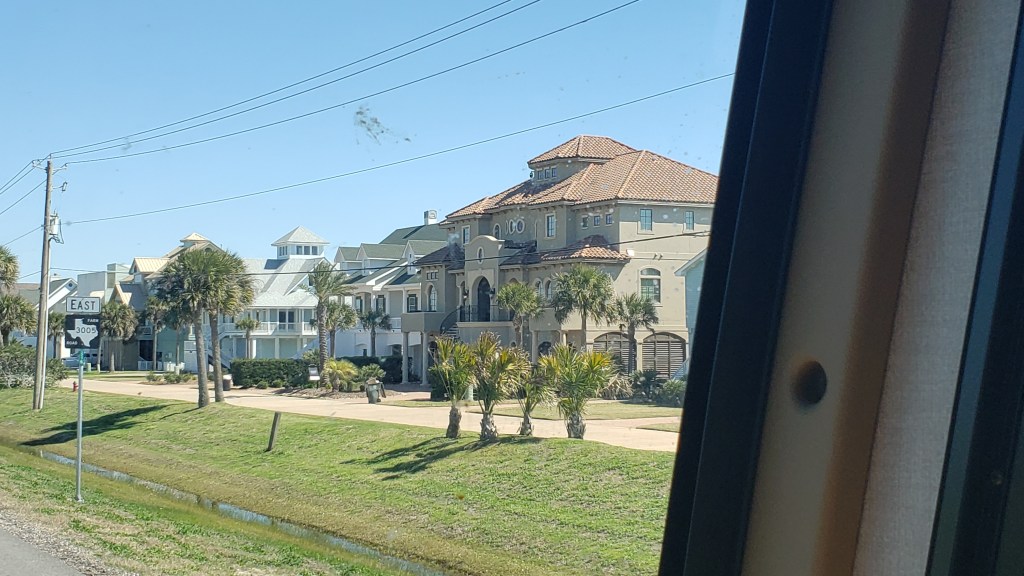
On our way to the campground, we passed massive homes along the Gulf side of the road, and it was obvious there was money in Galveston. Whether it was due to familiarity with the more city-like setting or just the glorious views of the Gulf of Mexico all along our right-hand side, we immediately felt comfortable, and took a real shine to our temporary island home.
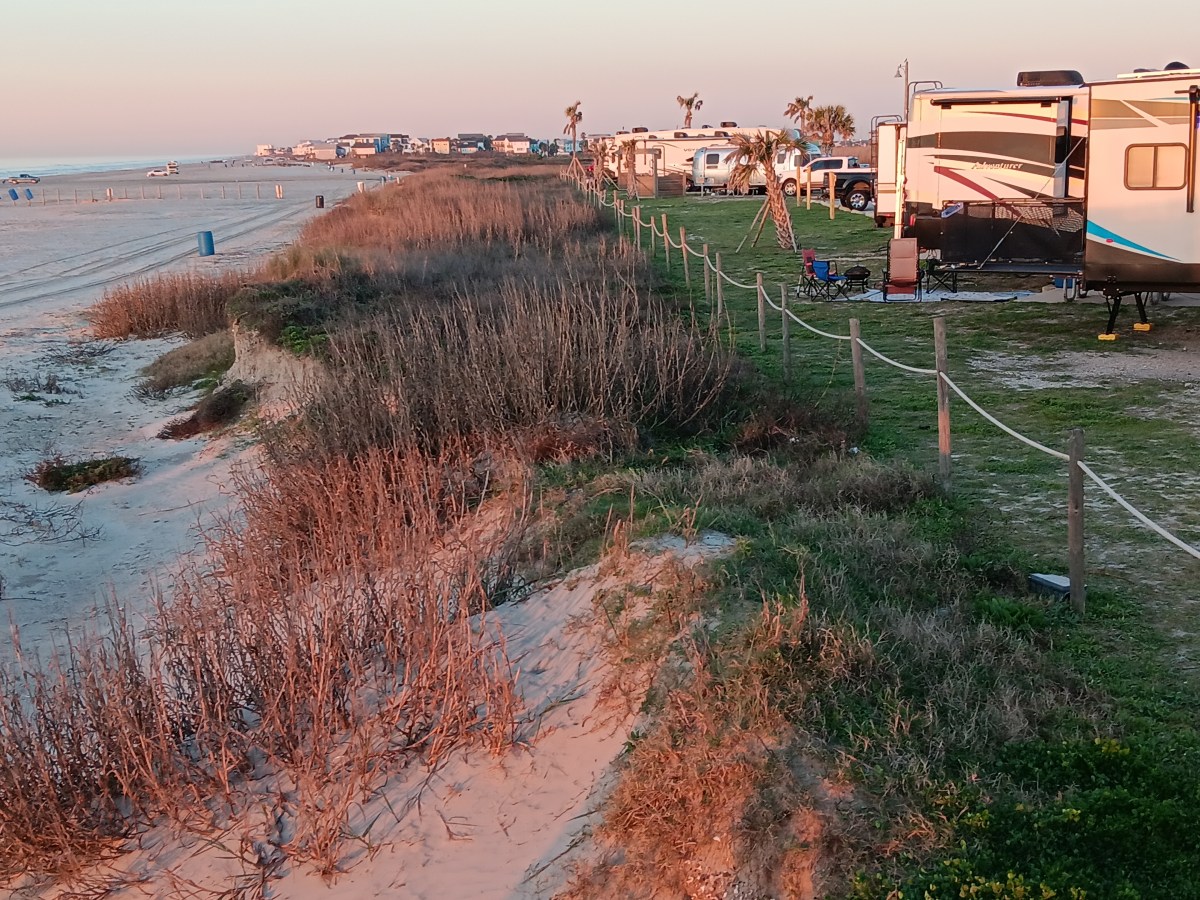
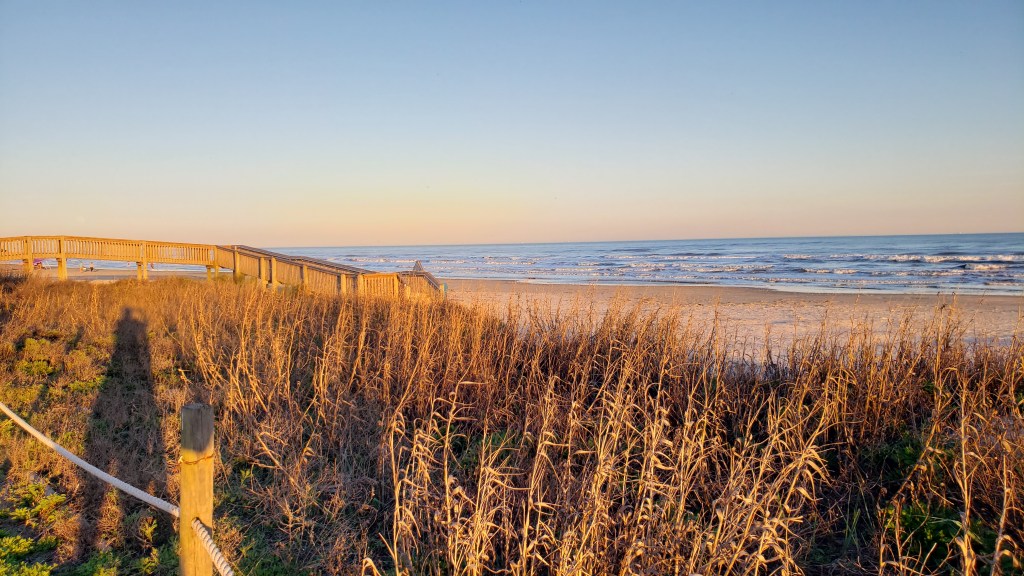
Once settled at the lovely Dellanera RV Resort, so close to the water we only had a 30-second walk to the beach, we took advantage of the nice weather and had a stroll. Like Galveston, the RV park felt comfortable right from the start, and we were delighted to have a full week to enjoy its seaside amenities. We could easily understand why “Winter Texans” made Dellanera their season-long stay.
The walkway in the distance connects our campground to the beach.
Galveston’s beaches go on for miles and miles and miles. We’re pretty sure you could walk around nearly the entire island using the beaches.
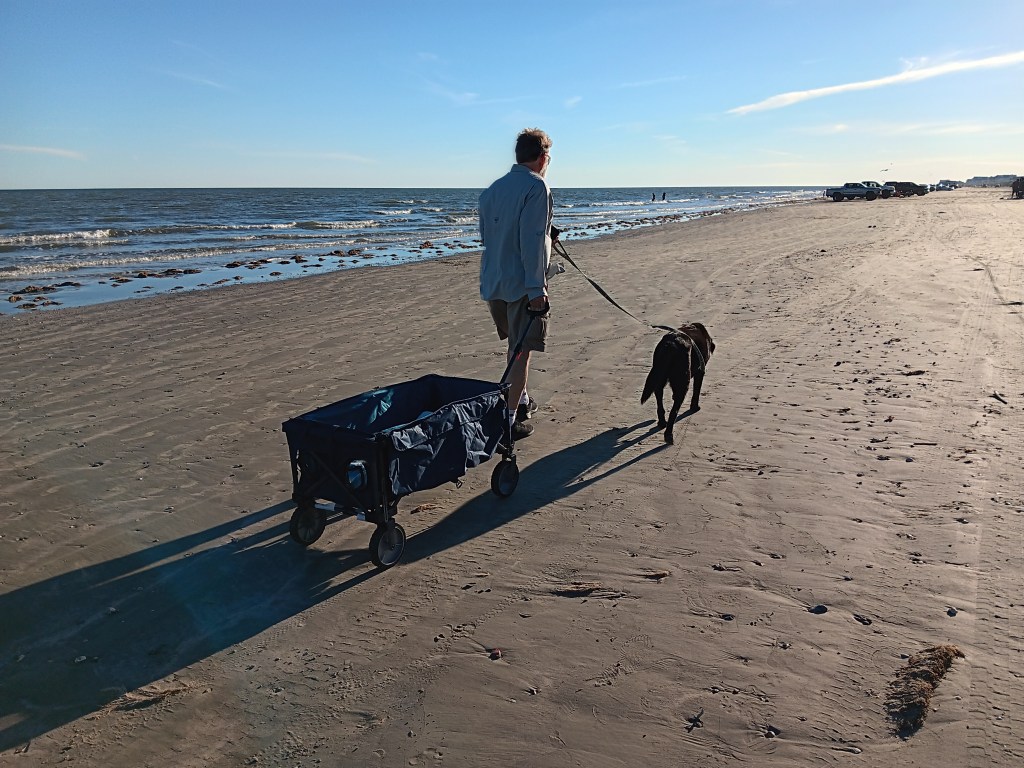
Ruthie now has her own vehicle. She can still take her walks for as long as she’s comfortable, then we drop the tailgate on her wagon and she can cozy down on a blanket and have a ride while we get more exercise. It’s been a boon for us – lots more walking! – and she’s getting used to it, though the movement feels a little bit odd at first.
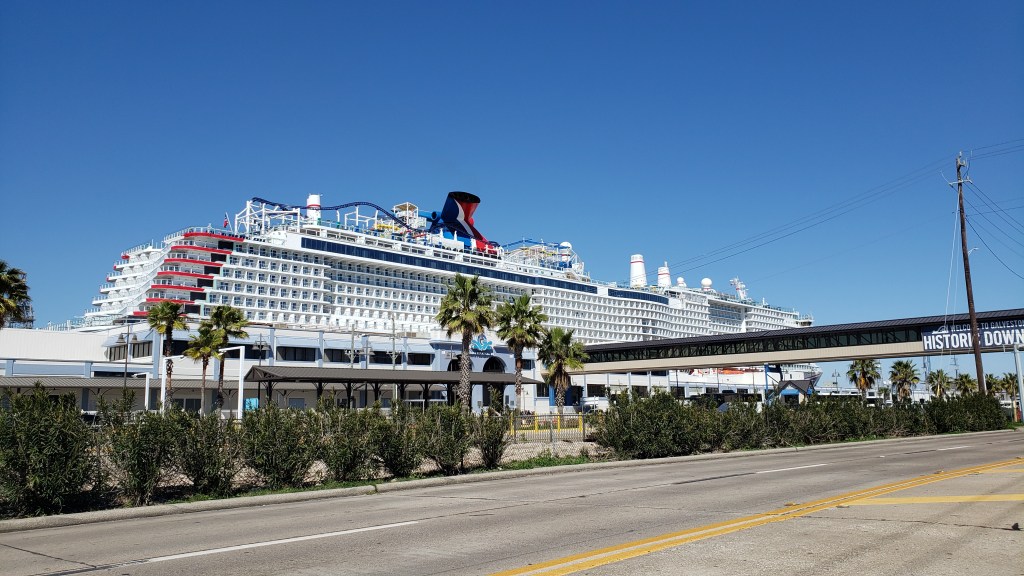
Galveston is the world’s ninth busiest cruise port, and there were two Carnival ships and one Royal Caribbean ship in port when we took a drive to the downtown area on our first full day.
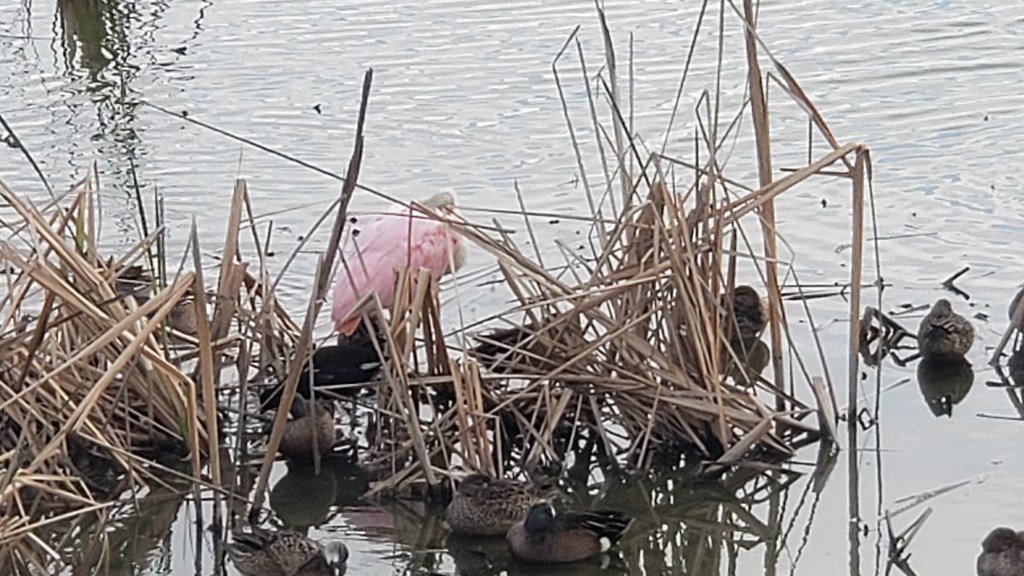
We also aimed to visit the area’s three wildlife reserves, but that term means something slightly different here to what we’ve come to expect. Here, it’s wetlands along the sides of some road, or, in one case, ponds in the middle of a brand new, upscale housing development, where we saw Roseate Spoonbills, lots of interesting ducks, some Snow Geese, and some sort of goose bird we’d never seen before, which turned out to be Black-bellied Whistling-Ducks. Who knew?
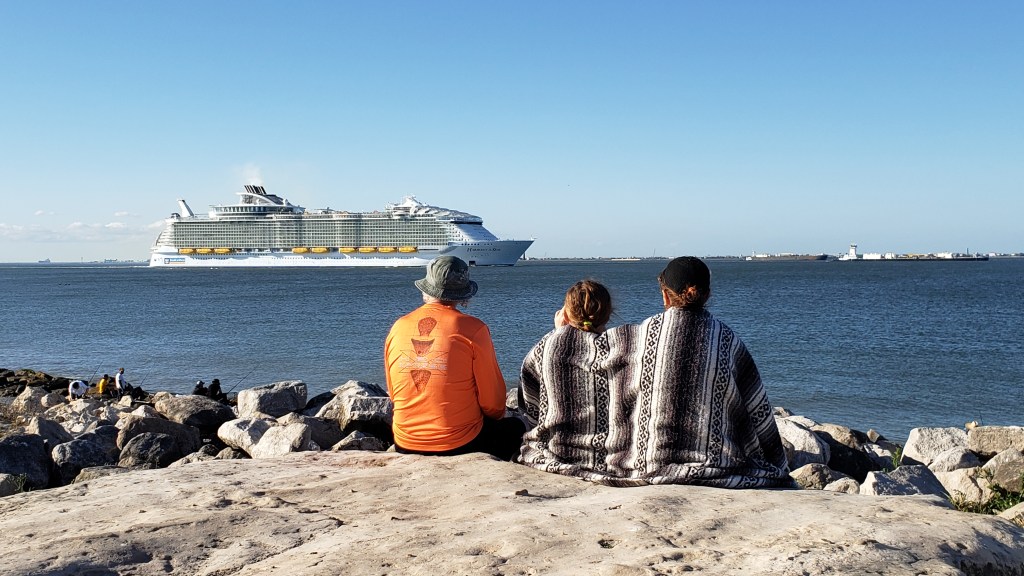
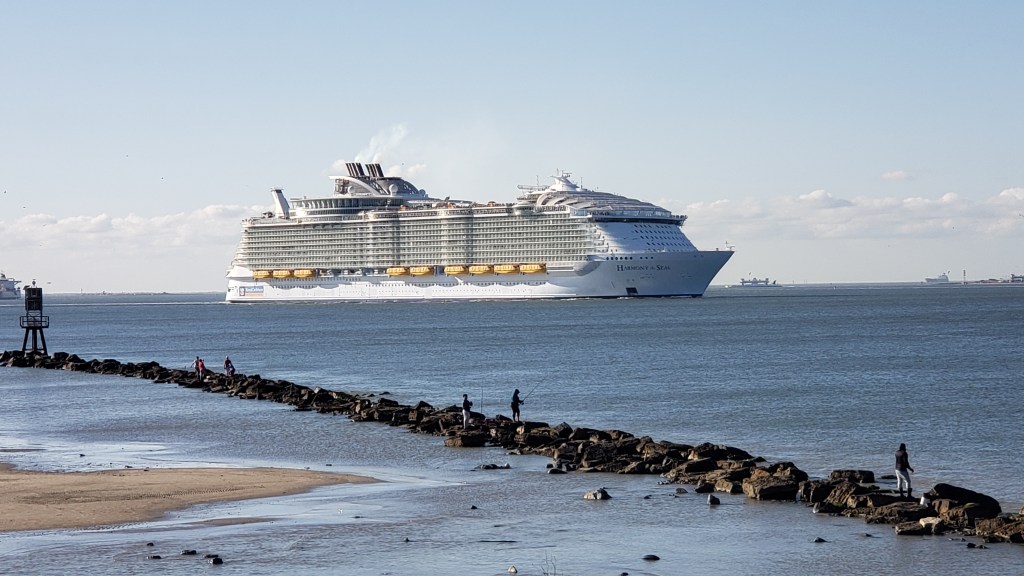
The next day, Royal Caribbean’s mega-ship, Harmony of the Seas, was just heading out of port as we were touring around, so we made a bee-line to Fort San Jacinto Point, where we joined lots of other spectators who were there to wave her off.
The people fishing in the foreground and the giant tankers in the channel in the following photo gives you some idea of how absolutely enormous Harmony is. We’ve sailed on her sister ships, Oasis of the Seas and Allure of the Seas, each during their media previews prior to their maiden voyages. They’re whompin’ great ships, so enormous it feels more like you’re in a shopping mall than on a cruise ship. Harmony is even bigger, with capacity for 7,084 guests and a crew of 2,369.
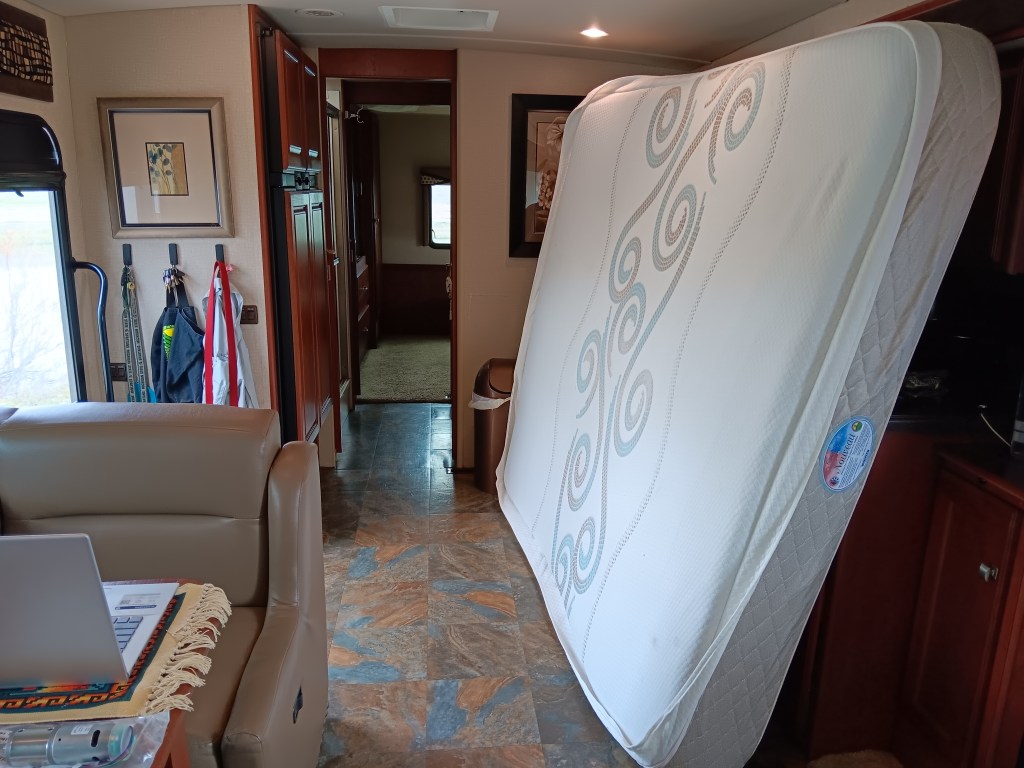
Our next two days were taken up with work while we waited for delivery of a new motor for our tilt bed. We’re not going to go into this story – at all – other than to say we’d been sleeping with the head of our bed semi-upright for nearly two weeks, and we both felt like we’d been thrown from a high building.
Mattress blocking the whole kitchen, but it’ll be back on the bed frame by lunchtime, right? Yeah…no.
This little high-torque motor is the replacement for the rotten bastard of a motor under our great huge heavy bed frame that decided to stop communicating with the controllers that move the bed up and down. We appreciated the service it had given us, but couldn’t it go for just another 2.5 months? I mean, really!
Cell phone shown here to give you an idea of size. How can something so small cause such a big problem?
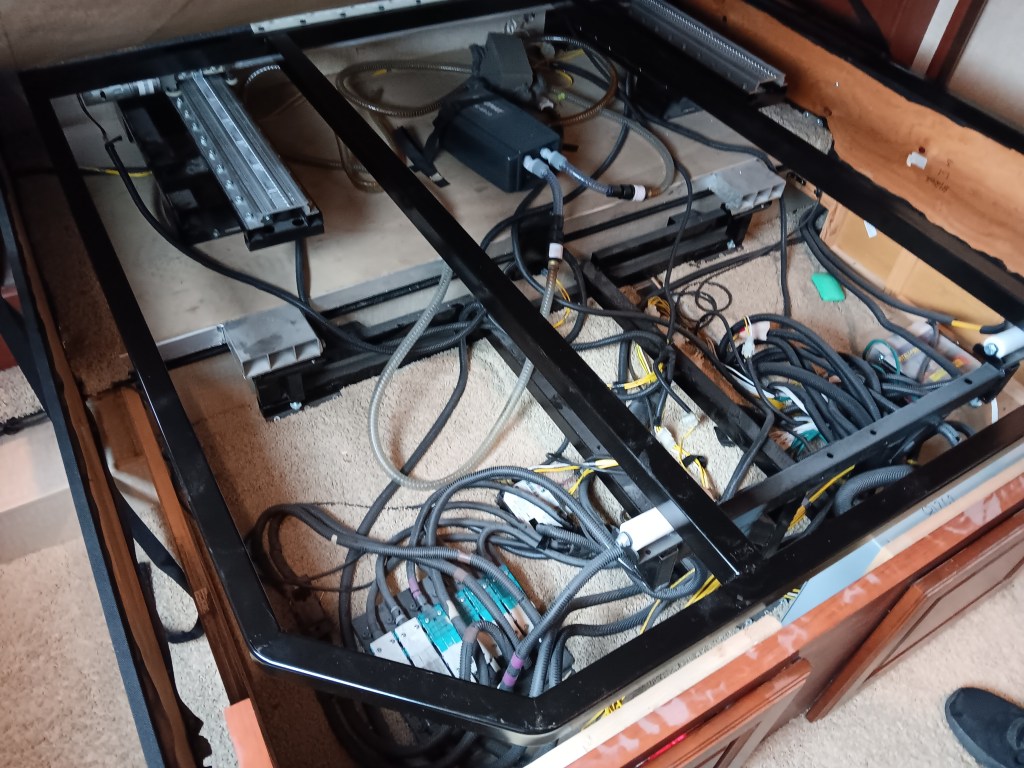
We expected the motor to take about half an hour to replace, and the mobile tech expected that, too. Again, we’ll say no more than the final result was, the entire bed foundation had to be removed, as did part of the frame. The single set screw that was supposed to be all that held the motor in, wasn’t. Some damned fool put another screw in while the rig was being build, under a metal box that can’t be reached without dismantling much of the frame. It took the poor technician nearly four hours to complete the job.
Some RVs have storage under the bed frame. Ours has a billion wires. And yes, that green thing on the floor on the right is soap. It’s supposed to help keep mice out, but probably only results in fragrant green mouse poop.
But we won’t talk about that. Because it’s awful and upsetting and we hated the world while it was going on. We hated the Lippert tech support people even more, when the first one said, “Yes, it’s just one set screw” and the second call resulted in, “I don’t know how you’ll reach the second screw. You’ll have to figure it out.”
But no more. It’s not something we’ll talk about. Because we’re not complainers.
Tonight, it’s “blowing a hooley,” (which is a British saying that sounds dirty but isn’t) and our rig is shaking with every massive gust of wind, but we’re going to be sleeping flat, so life is still worth living.
We don’t yet know what we’ll do with the last of our time in Galveston. We promised each other we’d get a really great steak while we’re here, which is a stupid idea after the expense of our repair but a great idea as a reward for all the heavy lifting we’d done and the massive amount of encouragement we gave our mobile tech when it all went to hell in a handbasket.
Our next port of call was Port Lavaca, nestled along the Gulf Coast’s Lavaca Bay. The area’s history picks up three threads we’ve been writing about: The Spanish holding of territory that later became Texas; Native Americans being driven from their lands (in this case, Comanche who survived a raid in what is now a town to the north, and came to the port area for refuge); and the names people use for bison, which, in Spanish, is La Vaca, even though la vaca actually means “the cow.” But we were mainly there for the scenery.
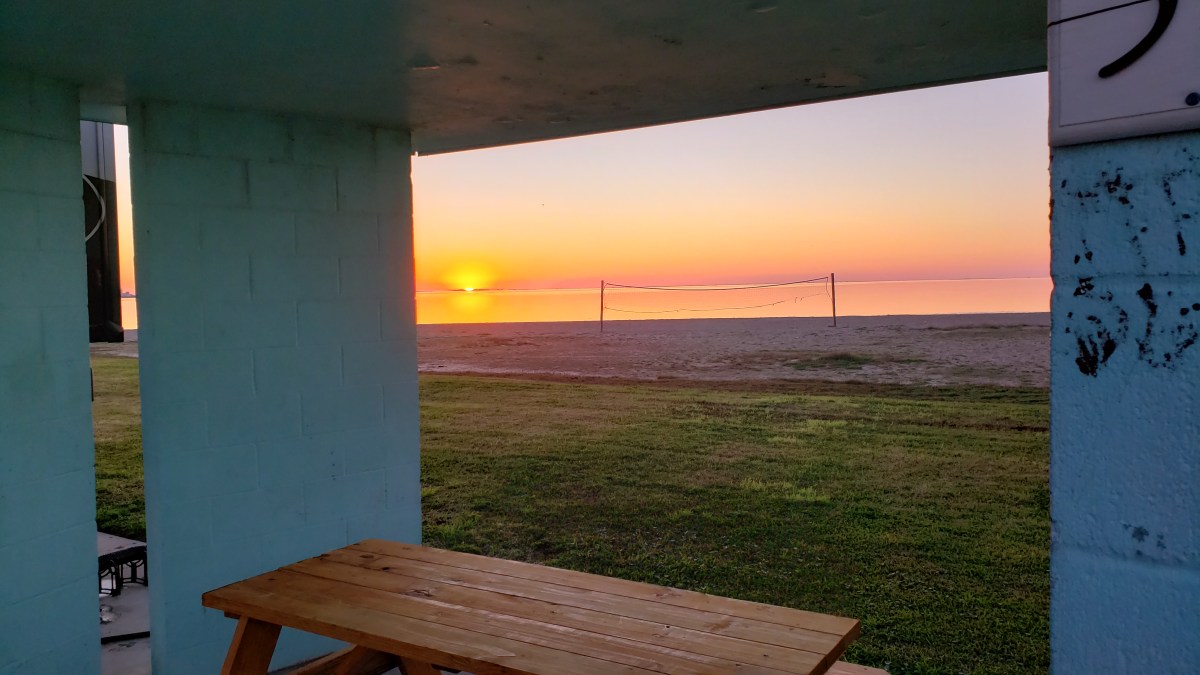
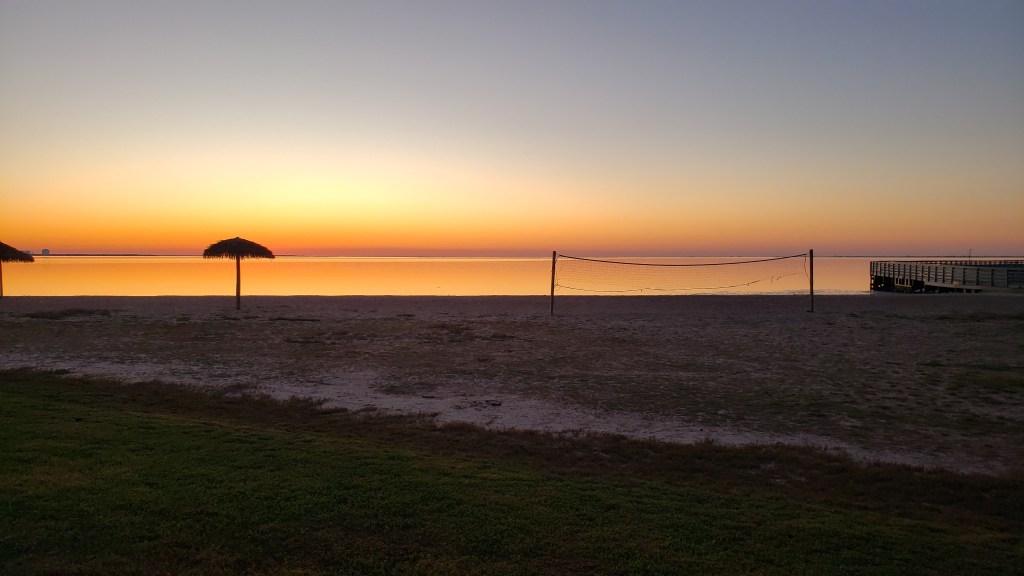
Most small county parks can’t accommodate big rigs, but Texas is no slouch, and the beautiful Lighthouse Beach RV Resort had no problem with 36-foot Fati. Our site looked out on the bay, and on a wonderful boardwalk over the water that was perfect for our evening strolls as the sun went down and the sky lit up like fire.
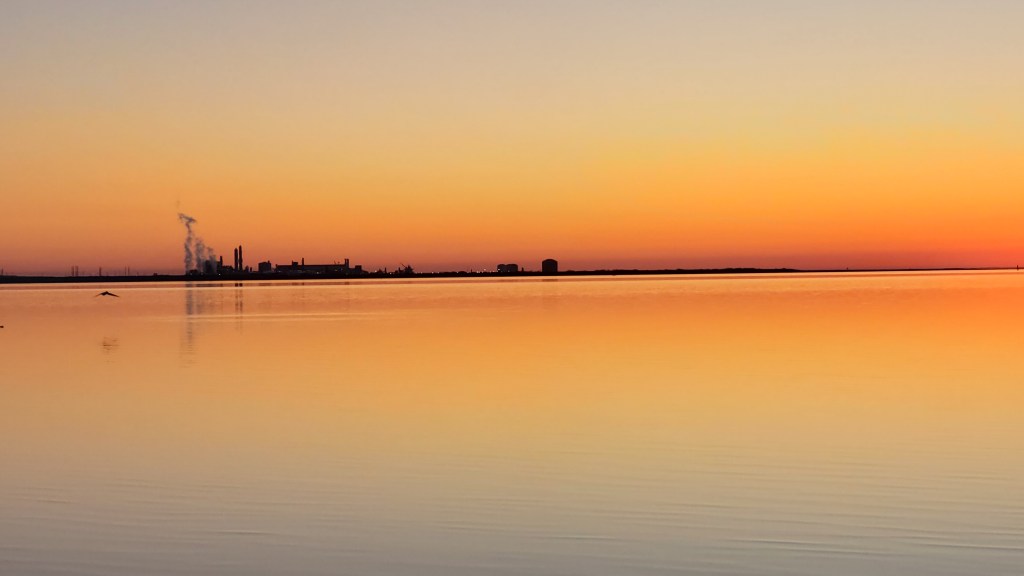
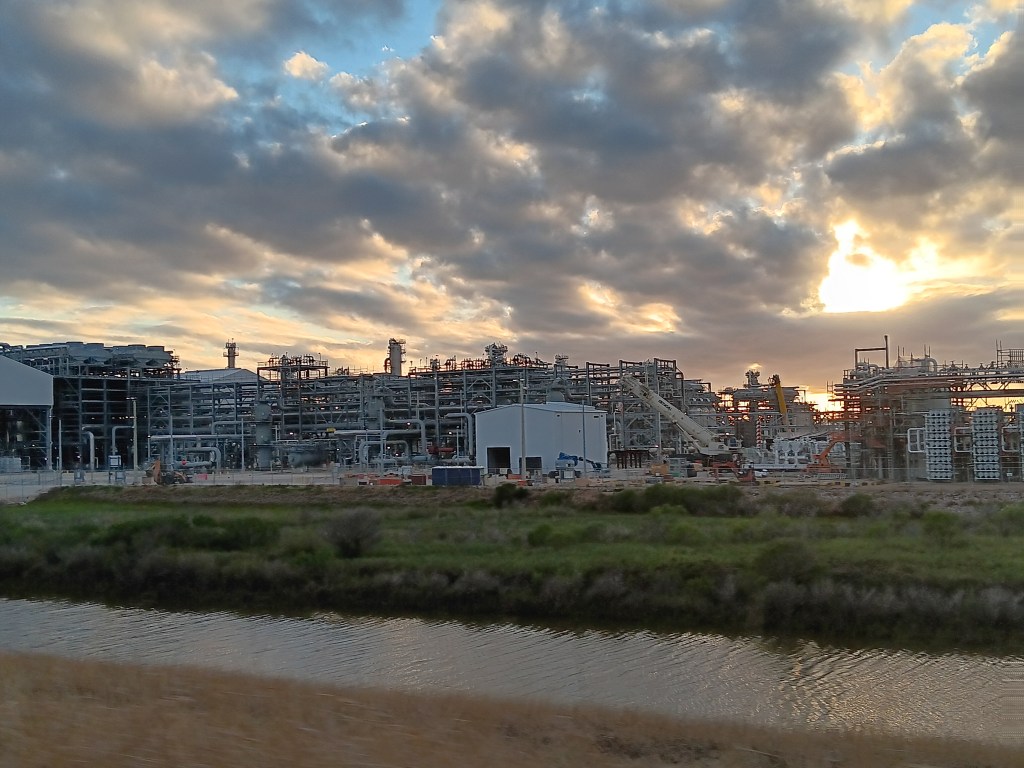
Fishing and birding are the big draws here, and it’s easy to slow right down to the point where a glass of wine and the view are all the excitement you need. Want more? Ramp it up with a walk along the pier and meet the fisherpersons, peer over the water through binoculars to see what’s flying and floating around, and marvel at the mad rush of the so-called “Formosa Five Hundred” that takes place along the State Highway 35 causeway during each shift change for Formosa Plastics Corporation, situated directly across Lavaca Bay from our campground, along with Alcoa and DuPont.
Formosa, as seen from our campground.
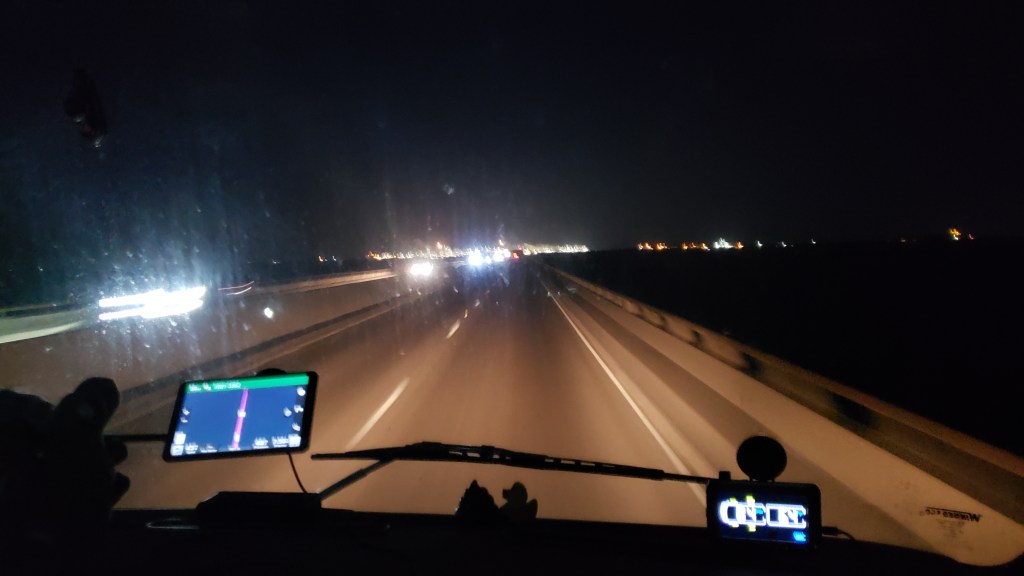
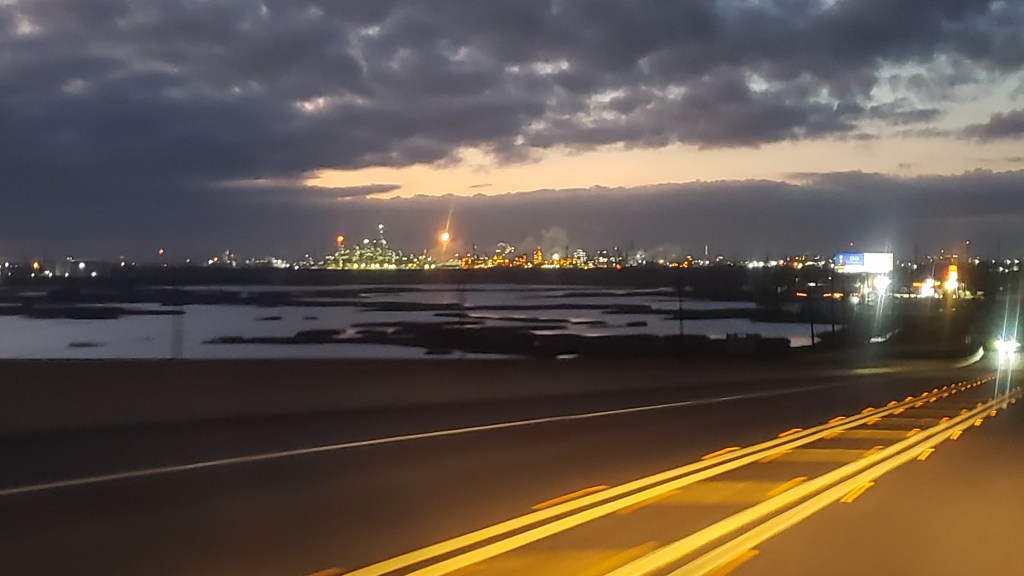
Now, those of you who’ve been following us from the beginning will likely have noticed we never drive Fati at night. Like, ever. It simply isn’t done. But circumstances dictated otherwise this time, and we found ourselves heading over the causeway as darkness fell.
This level of visibility is why we try never to drive at night.
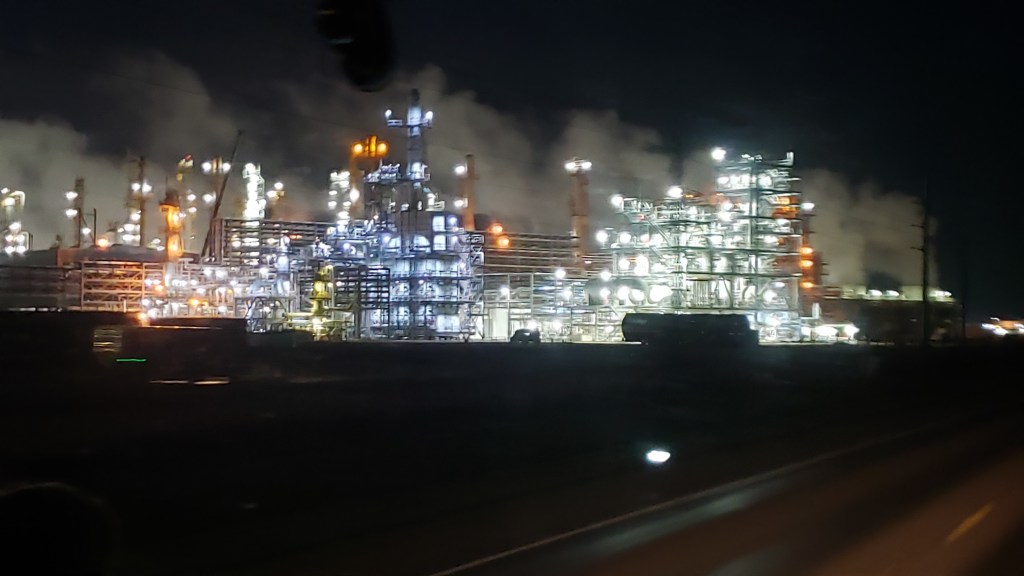
Approaching and then passing Formosa, producers of resins and other chemically things, was like driving into the unsettling opening scene of the movie Blade Runner. A true dystopian setting right there in ironically named Port Comfort, minus the flying spacecraft.
The rest of the journey east ambled along dark roads through empty countryside, and ended with an overnight stay at a Walmart right off a busy road, with trains and their blaring whistles barreling past every half hour, all night long.
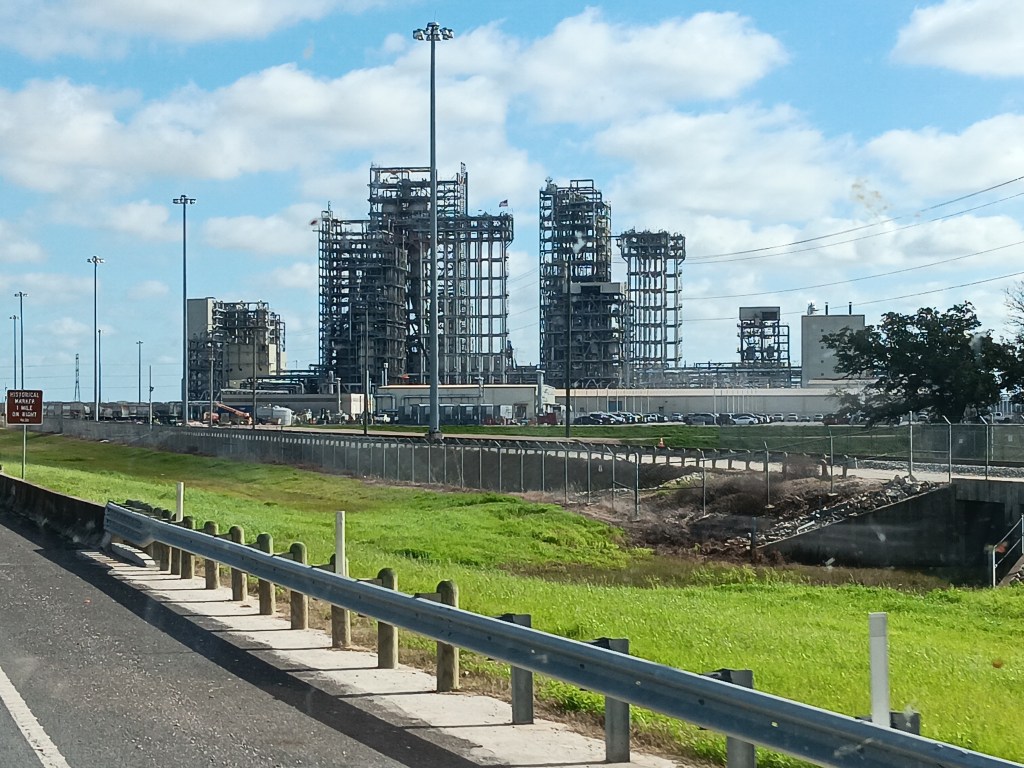
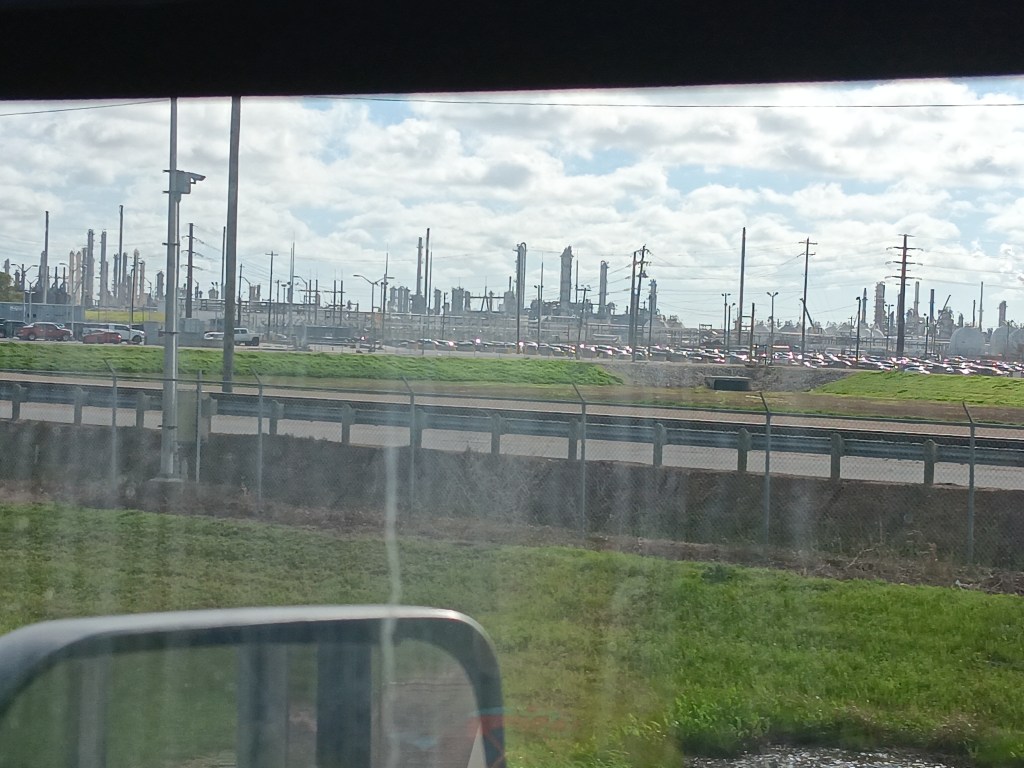
We were truly exhausted when we reached Oyster Creek the next day, and were somewhat dismayed to see our campground was just on the boundary of miles and miles of refineries.
But it was a peaceful little haven, mainly populated by refinery workers who put in such labor-intensive days that they were all asleep by 8 p.m. Silence reigned, even as the belching discharge from the refineries’ chimneys lit up the sky with fire, this time not of the natural variety.
Those super-bright orange spots are fire blasting out of the chimneys.
Everybody knows cars and machinery don’t run on daffodils and the laughter of unicorns. We all know there is a process of refinement. Seeing it in person when you haven’t grown up with it in your home town is both horrifying and fascinating. It’s like looking at a city comprised of the bare bones of enormous building complexes, but with no people, and we were filled with discomfort with the process and admiration for the people who work there.
Like so many things we’ve experienced during this trip, we were pulled in two directions, mentally. Years ago, seeing fish farming in Chilean Patagonia first-hand completely put us off from eating farm-raised fish, ever again. It was a simple decision. But not everything is that straightforward.
We had been told Surfside, a little town right on the water, was worth seeing, so at least that decision was straightforward. Surfside Beach was hit by Hurricane Nicholas in 2021, and many if not most of the homes there are new.
Heading down a massive bridge, with Surfside and the Bay at the end of the road. Some of the dots in the water are tankers, some are oil rigs.
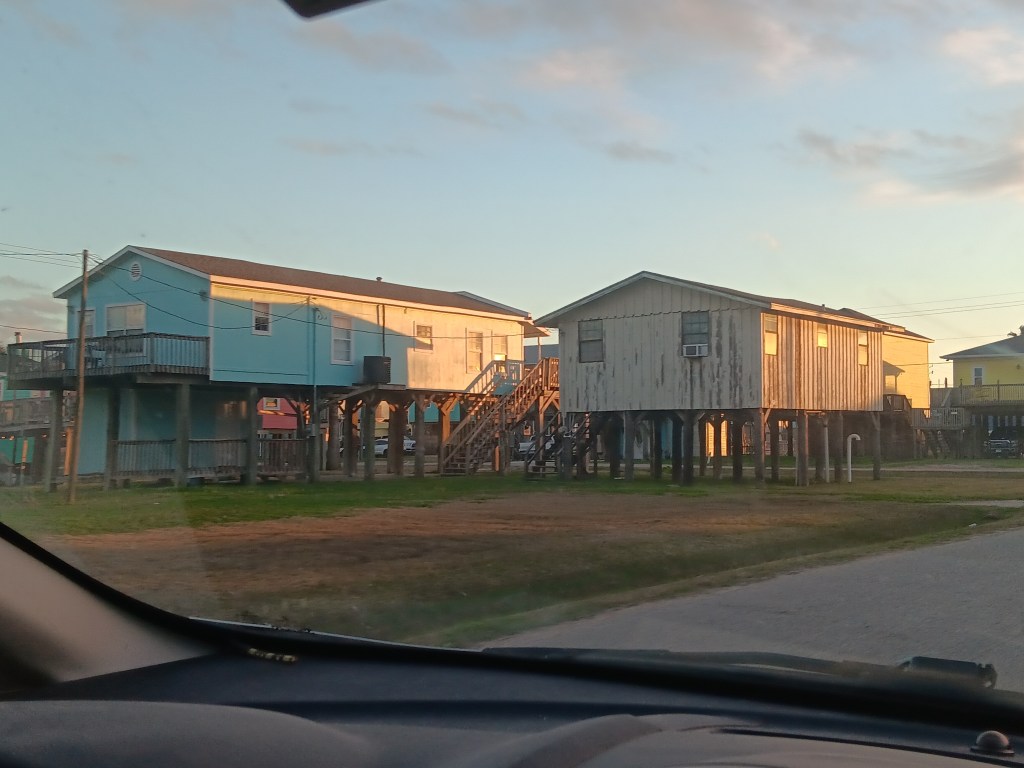
All of them are high up on stilts, creating a hodge-podge neighborhood of houses that look like they were brought in and propped up on stilts wherever the moving truck happened to stop. There is none of the formal layout – or similarity in architecture – of the neighborhoods we’re used to, and we drove around pointing and commenting and being fascinated by the whole thing.
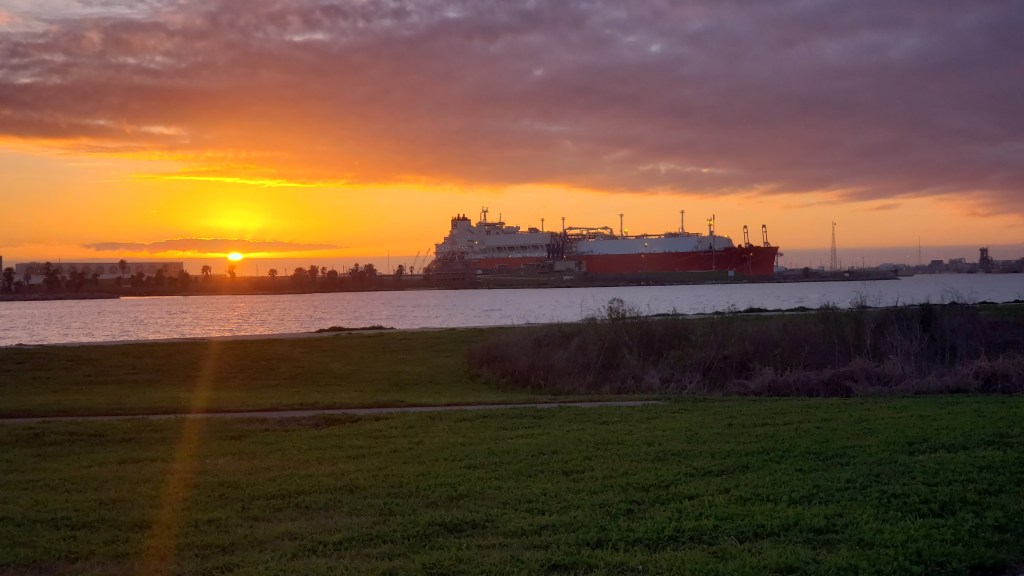
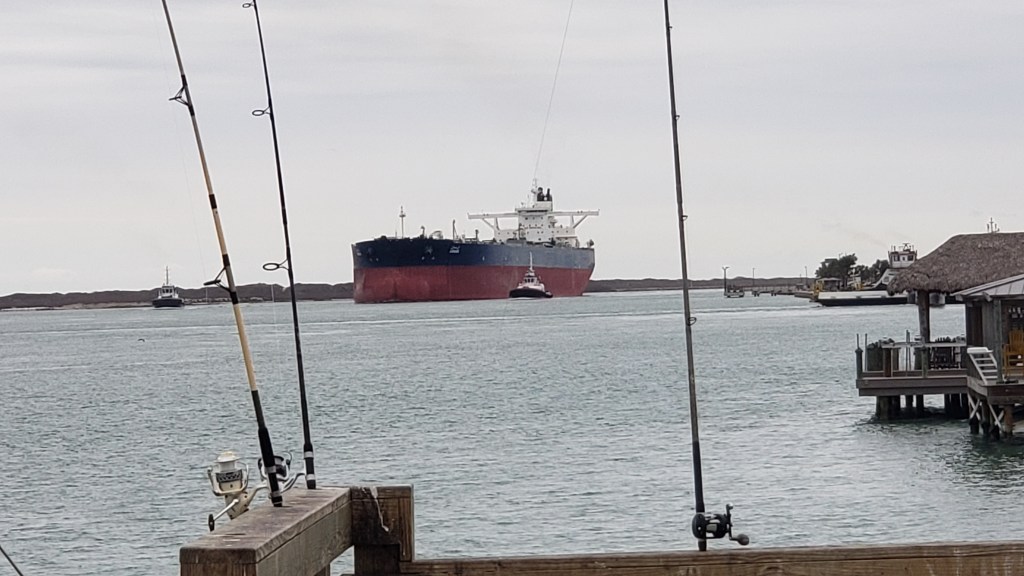
Freeport Channel seems to be the place where locals gather on balmy evenings to do some fishing and to watch the gigantic freighters that harbor there, presumably to fill up with whatever the refineries are pumping out.
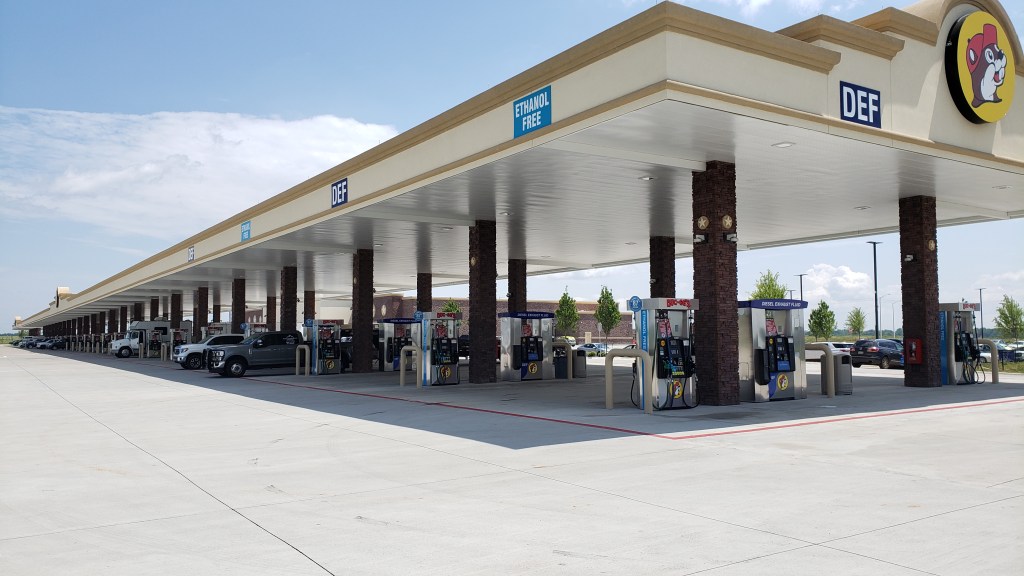
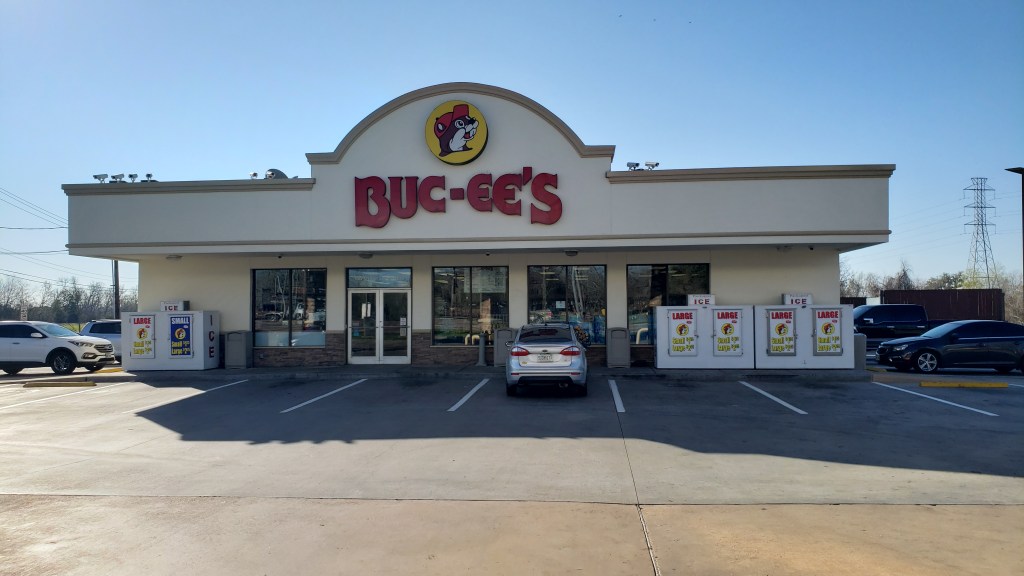
Unexpected as it was, Oyster Bay made a good two-day base to decompress before we headed to Galveston, and when we learned the original Buc-ee’s was less than 10 minutes away, we headed over and grabbed a couple of bags of Buc-ee’s Nugg-ees, just because we could. We felt the circle from the beginning of our journey to the not-so-distant end of our adventure starting to close.
If you’ve seen the movie, The Big Year, you know how passionate birders can be about their hobby. We’re casual birders at best, but we do enjoy seeing wildlife we can’t see in Florida. While much of Texas is known for its exceptional birding, it turns out our next destination, Port Aransas, offers some of the best in the state.
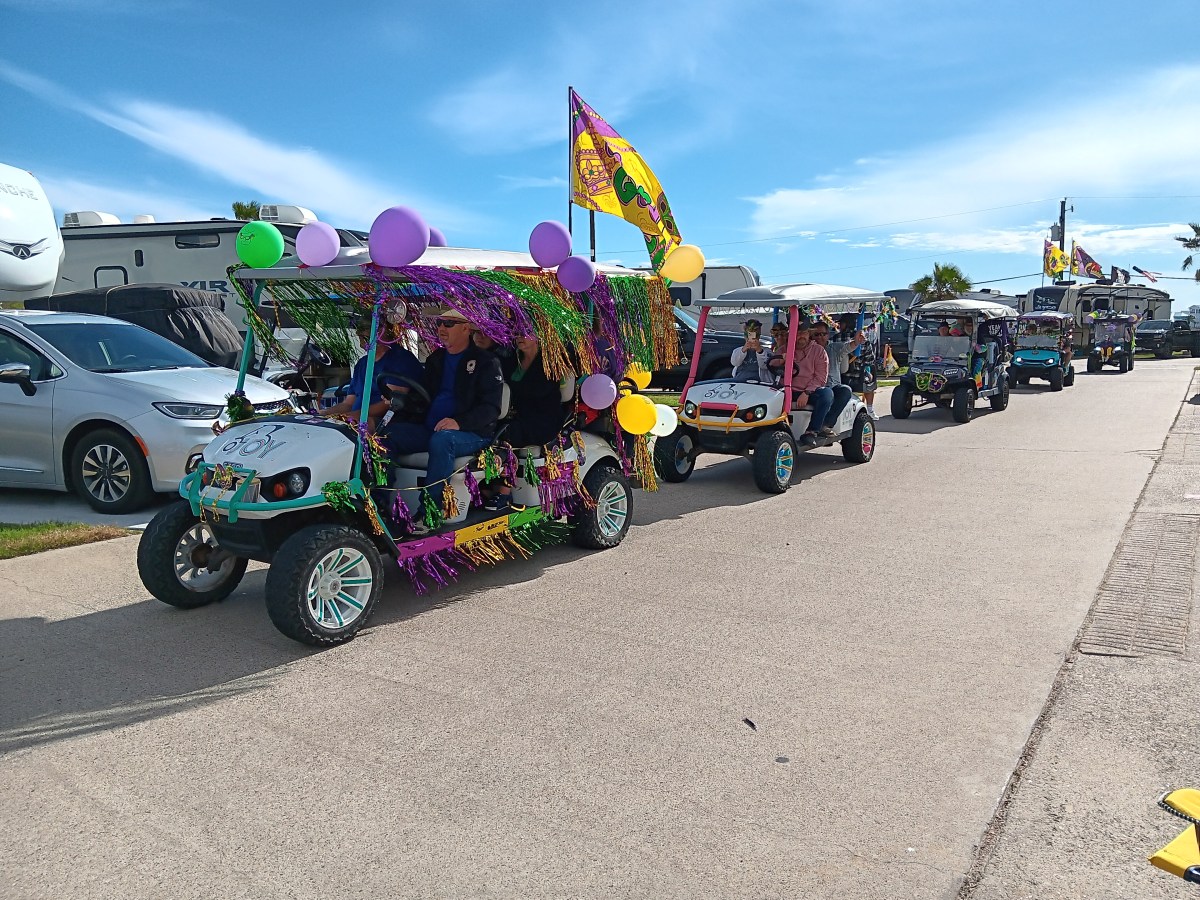
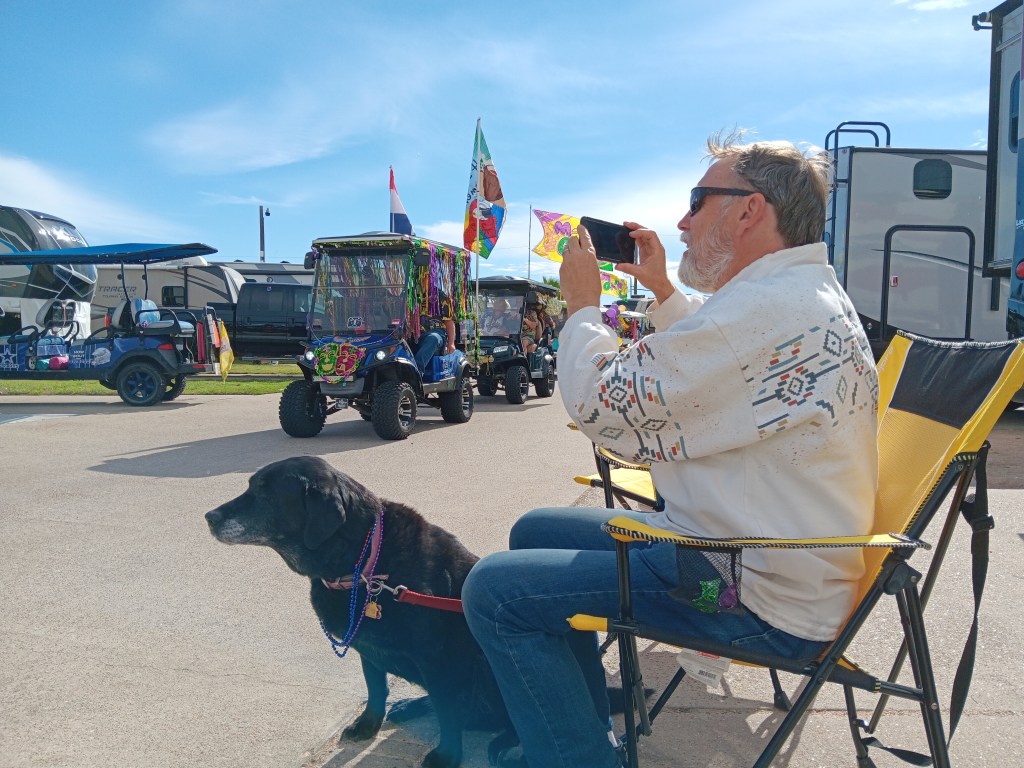
We arrived on Fat Tuesday and were delighted to hear there would be a Padre Gras golf cart parade that afternoon, the island’s answer to Mardi Gras. Campers were lining their chairs up along the campground’s main streets, and we joined them.
What a great way to start our stay!
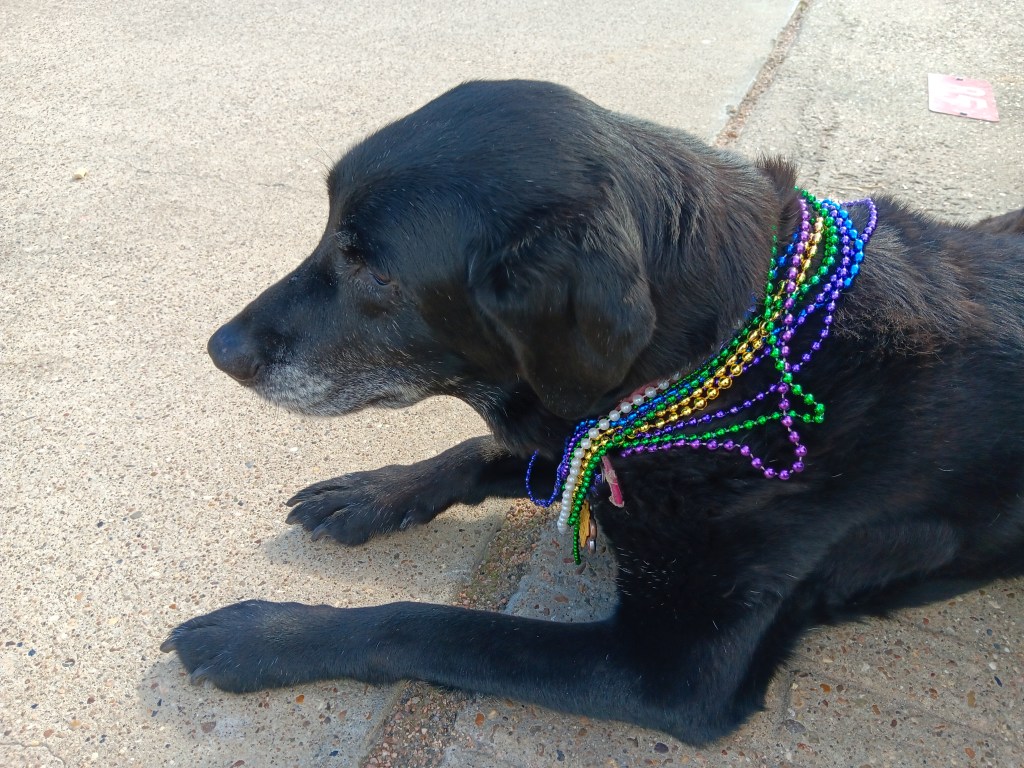
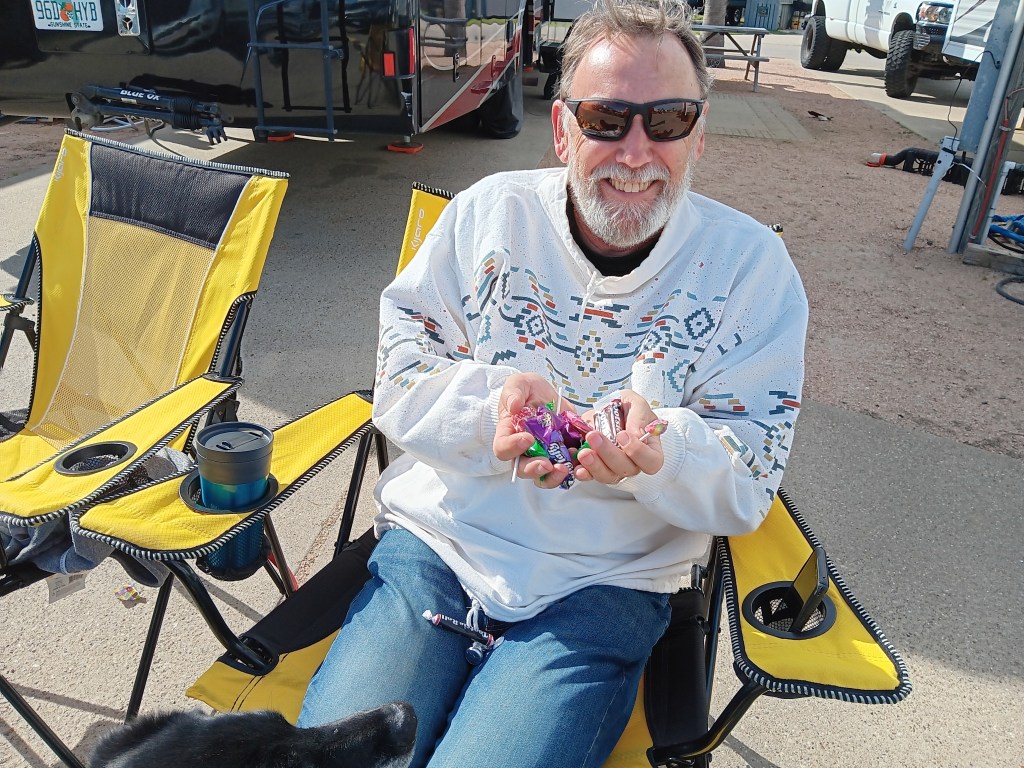
We were all set for the fun of clapping and cheering as each cart went by, but hadn’t thought about the paraders throwing beads and candy. Ruthie got to wear the beads for a while, then we gave them to our neighbor’s granddaughter. We doled out the six or eight pieces of candy over the following few evenings and called them “dessert.”
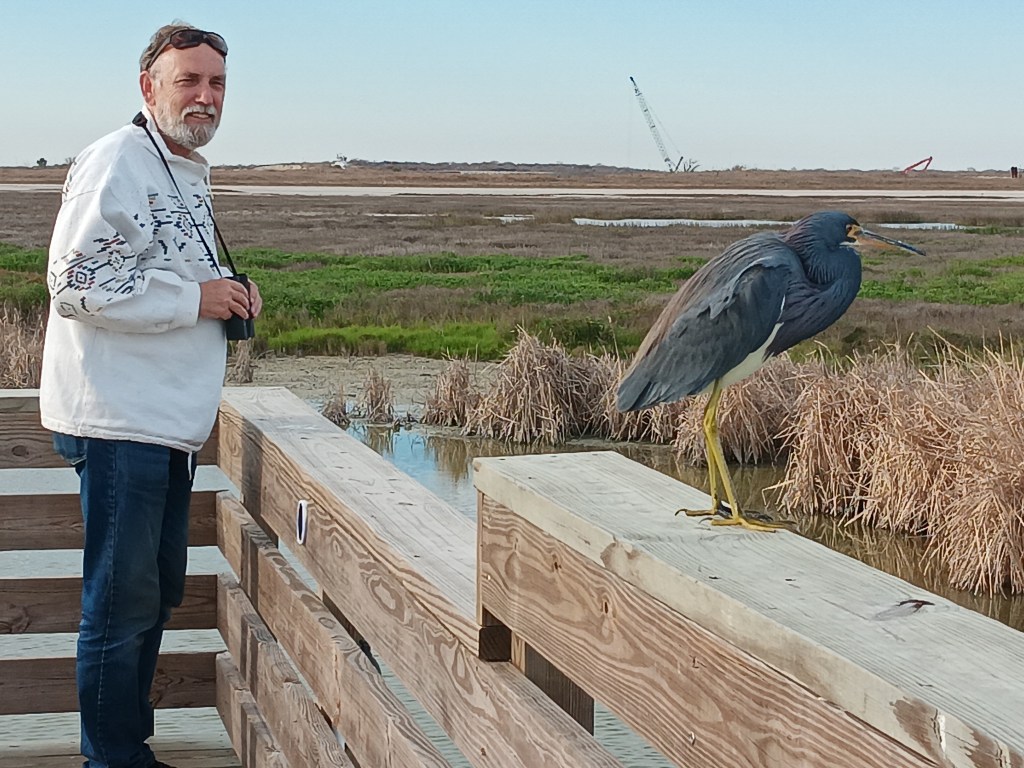
A fair bit of our five-day stay was spent wandering around wetlands and reserves with our binoculars. Many of the birds that live here or migrate here for winter are familiar to us; ibis, certain kinds of ducks, herons, egrets, and some cranes, but we were excited to see some new ones, including Roseate Spoonbills and the endangered Whooping Crane.
There was a big flock of Spoonbills here, too, but they were just too far for our camera to capture.
Three whole Whopping Cranes!
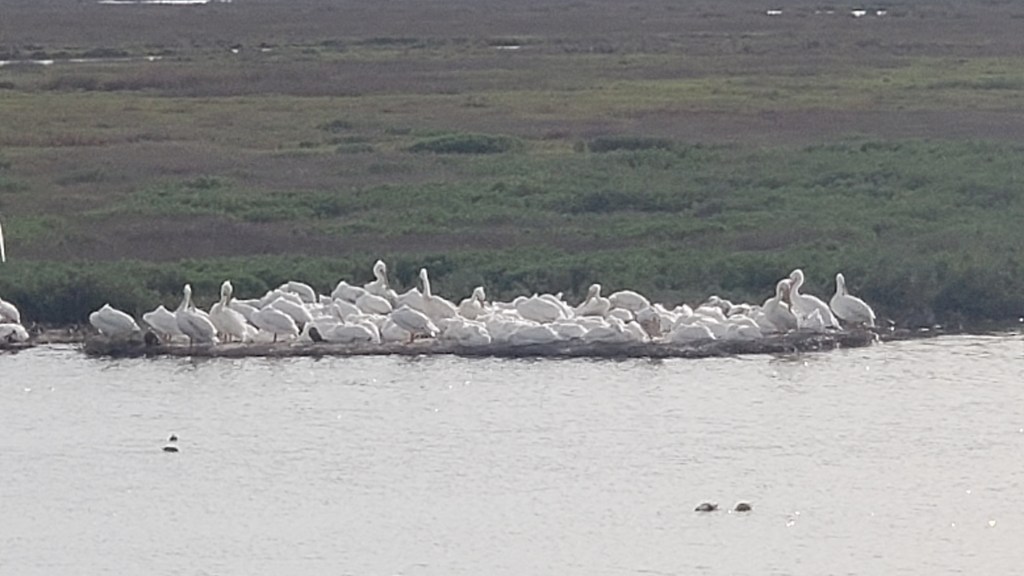
Florida has plenty of pelicans along its shores, but we don’t see them inland, so they’re still special to us. Here, they have both Brown and White Pelicans.
This little fellow wasn’t reacting to people passing by, and within a short time two women from a rescue center showed up and carefully took him away. We hope he’s feeling much better now!
Unwelican.
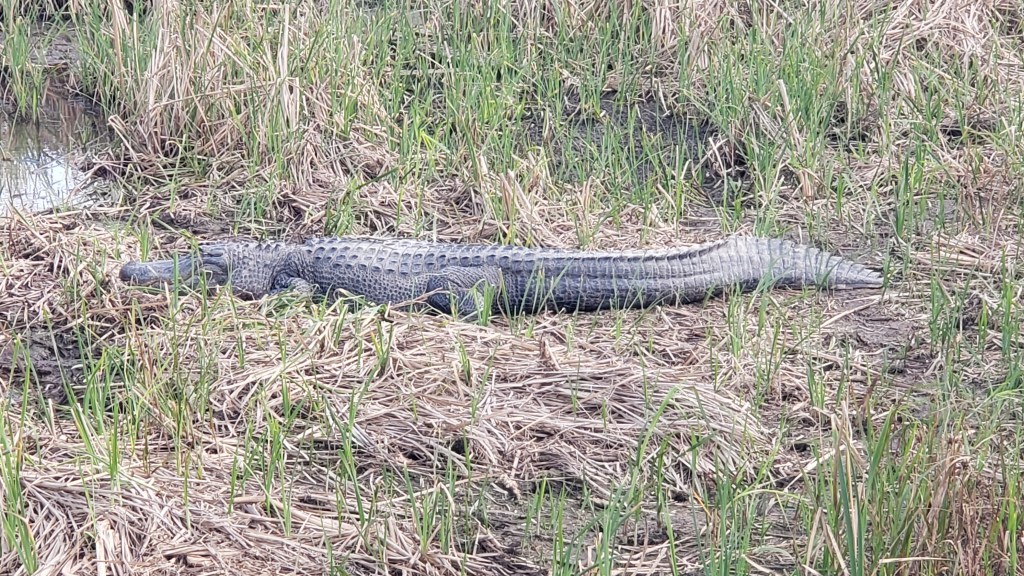
Gators are always a bit special, but we’re pretty used to seeing them. In this instance, the Leonabelle Turnbull Birding Center’s resident gator, called Boots by the locals, is a great huge whompin’ example of the species, measuring in at 14 feet. He’s a grumpy 50-year-old who chased away his only potential buddy, Stumpy, who was missing a leg. Stumpy got relocated, then relocated again, and is now living in Beaumont, our destination a few weeks from now.
You could make a lot of boots out of Boots…if he didn’t kill you first.
Ship-watching is practically a sport hereabouts, and we joined the locals at Roberts Point Park, where cargo ships enter the channel to pick up oil from the refineries and then head back out to sea to make their deliveries.
There is a pier not far from the park that gives you a view of the ships that’s so close you can almost see the faces of their crew members. It’s also a great spot for fishing, and we watched a man feeding the small fish he caught to a couple of pelicans. His wife told us the pelicans sometimes attack the man, but it never seemed to occur to them that it was the natural result of hand-feeding a wild animal. We sort of hoped some of the bites hurt.
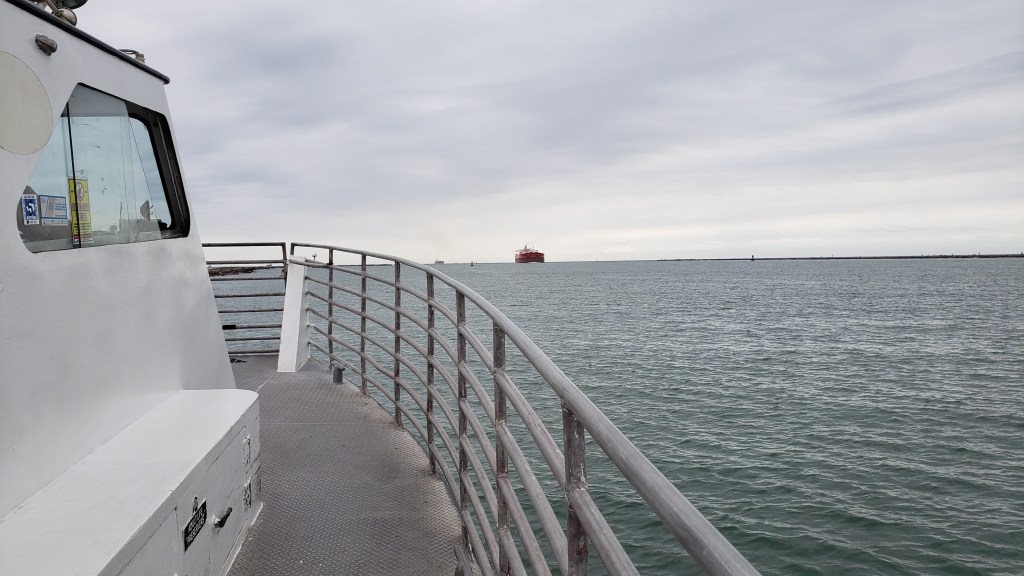
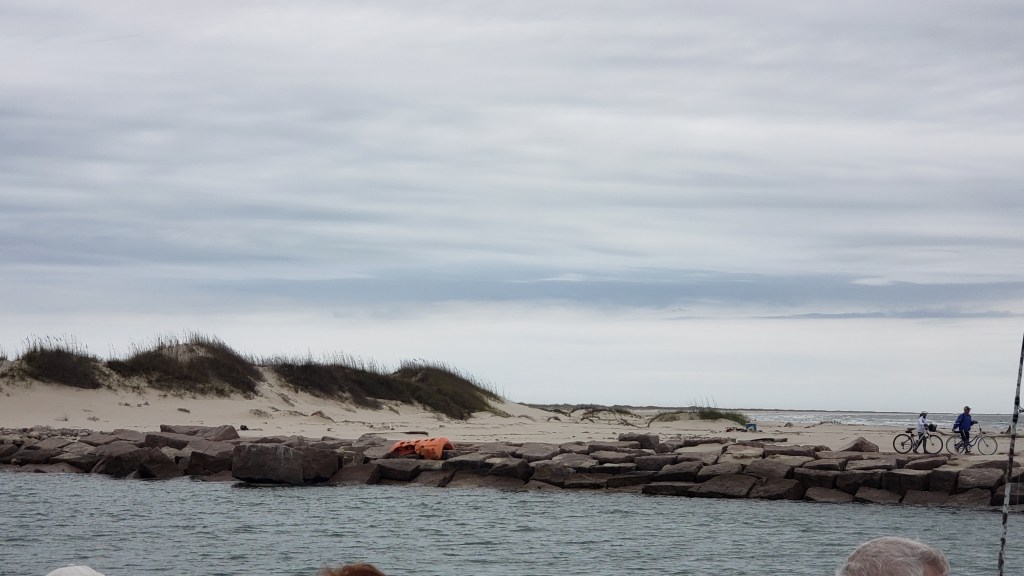
We had planned to take a trip out to San Jose Island (a.k.a. St. Jo’s), a private island whose owner lets people visit the beach, but the weather was turning and the primary draws are fishing and swimming, so we made the round-trip without getting off the little ferry.
Finally out on the water.
This is pretty much all there is to do on the island. Probably wonderful in summer, but not so much in winter when it’s cold and wet.
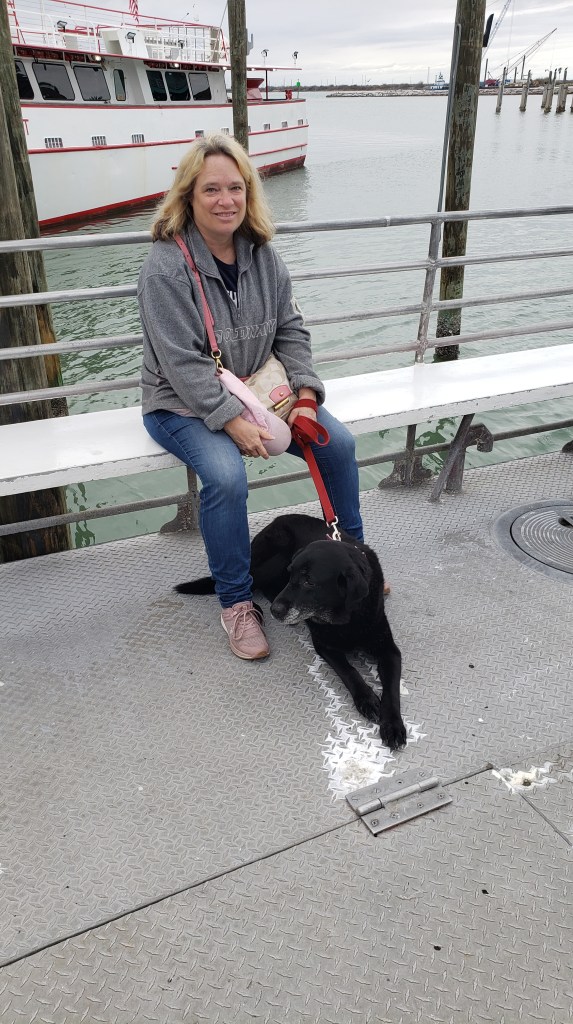
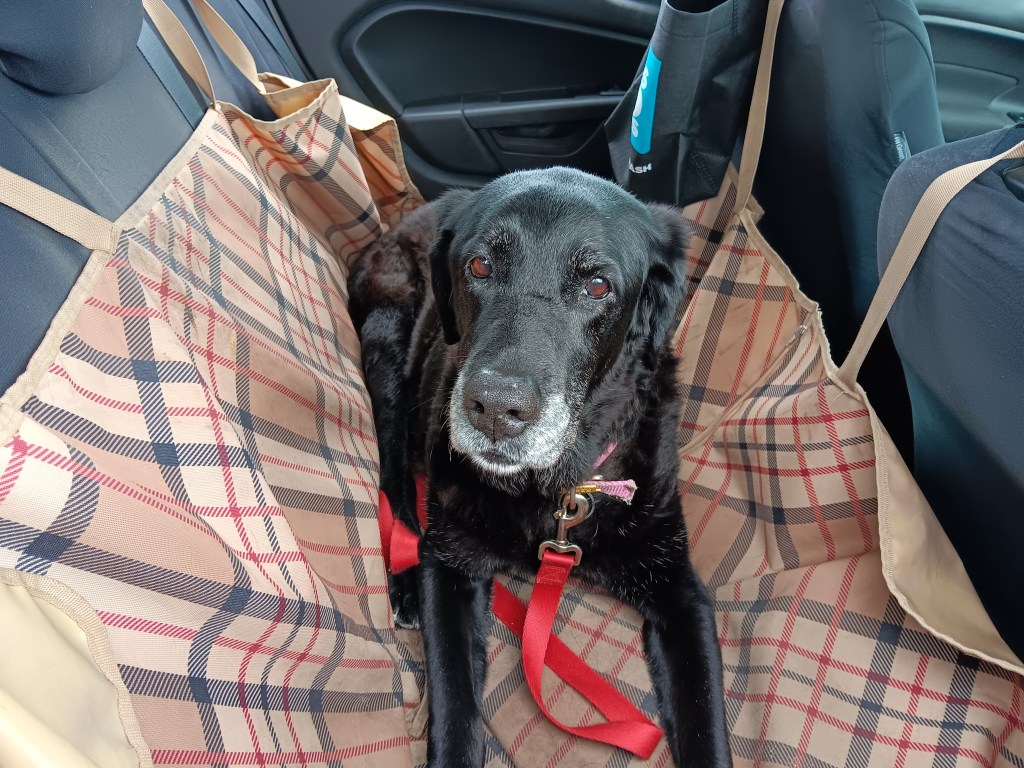
Ruthie was not impressed. At ALL. The vibration of the ferry totally unnerved her, and we could hear her thanking all the blessed angels in heaven when her feet were back on terra firma. That dog can pull – hard! – when she wants to go back to the car.
Ruthie looks calm here, but she was shaking and panting and having a real fit for herself. One of the passengers on our return trip helped by petting her head while I patted her rear.
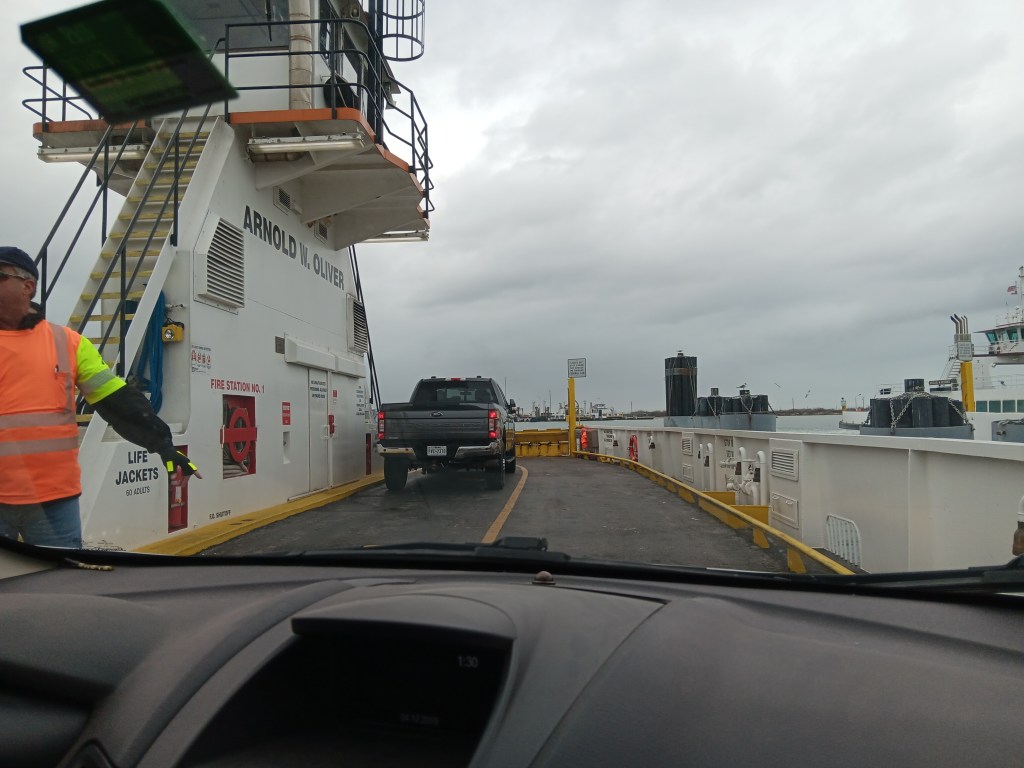
The island is all chopped up in this area, and while there are bridges, it sometimes requires less milage to take the free car ferry from Port Aransas to Aransas Pass, and that would be our route when it was time to move on to Port Lavaca. But first, we wanted to give it a try in Nippy to be sure we knew how to do it in Fati.
Loading and unloading area. The whole set-up was super efficient, and surprisingly quick.
We were directed into that spot to the right of the pickup truck. Score!
We got an up-front view for our crossing, and were astonished at how totally without movement the journey felt. It was only by being able to see the shore that we knew we were moving at all.
Our view.
Our final two days in the area were so rainy and windy we ended up staying home. Happily, Port Aransas is small, so we felt we got the best out of it that a wet winter could give.
We have encountered countless Spanish, Native American, French, and German business names and locations during our journey, and, after a while, our brains automatically translated them into English, sometimes with humorous results. We were looking forward to visiting Body of Christ – Corpus Christi – an iconic port city along Texas’s Gulf Coast, named for the Roman Catholic Feast Day that was going on when the place was “discovered” by the Spanish in 1519.
We had two major attractions in mind, along with more fabulous Mexican food, and a heaping helping of seafood, at least for Simon.
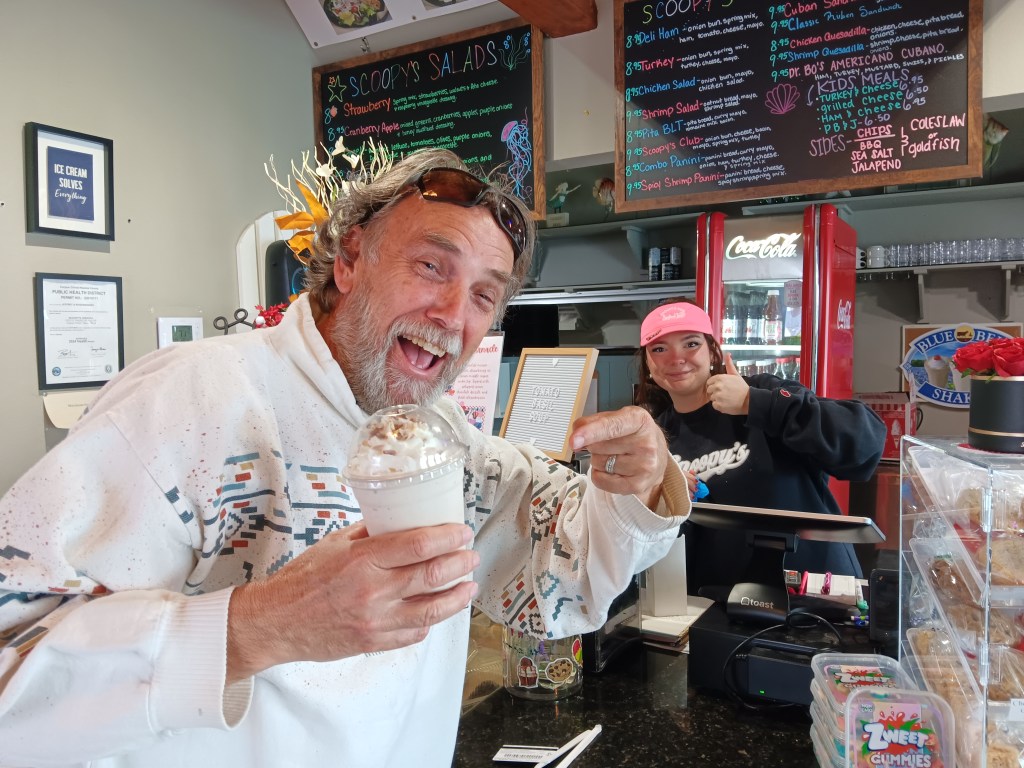
“You like dessert, Jennifer, not coffee.” My go-to line when Simon orders a sweet coffee drink. This time, though, it was a milkshake.
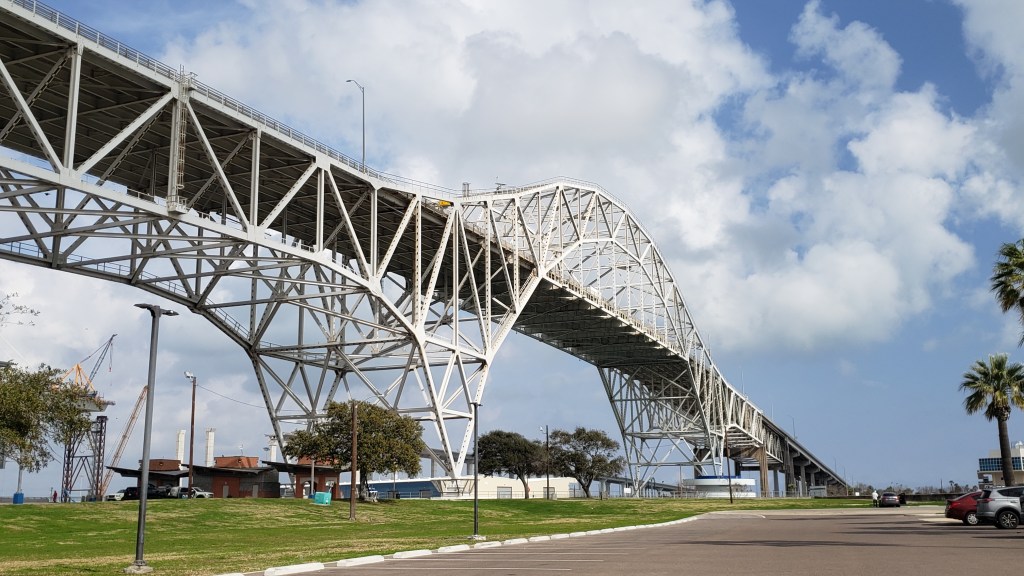
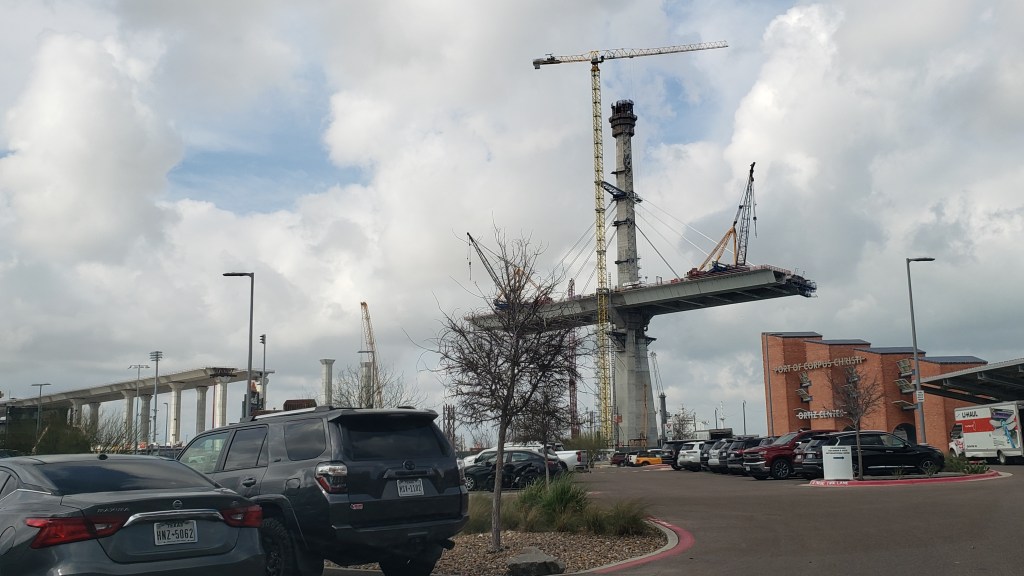
The city’s personality is defined by its beaches, its fishing, and its bridges, one of which can be seen for miles in every direction. As big as it is, though, an even bigger bridge is taking shape next to it, presumably to accommodate the ever-growing size of ocean-going vessels that make their way into and out of the port.
Existing bridge is too low.
New bridge will be gigantic.
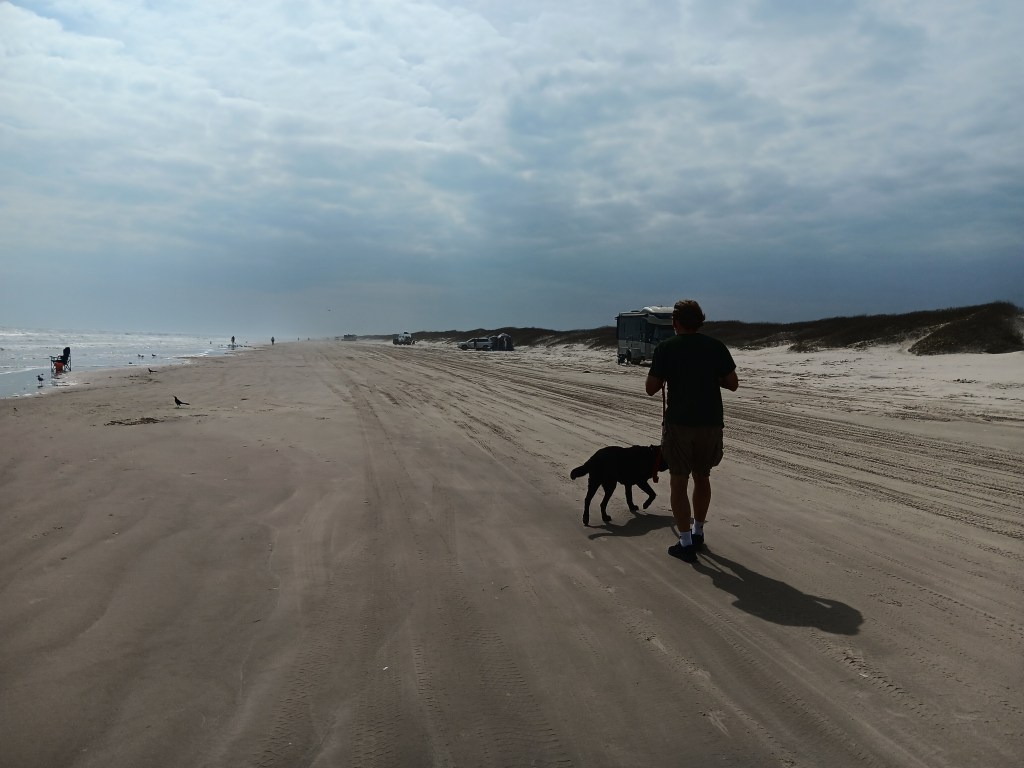
The skies were a bit grim to start with, but it was still pleasant enough for a walk (and a drive) along the beach. Ruthie was okay with the hard-packed sand, and happily trotted along when we made a trip out to Padre Island National Seashore.
Happy girl! She loves the hard-packed beaches.
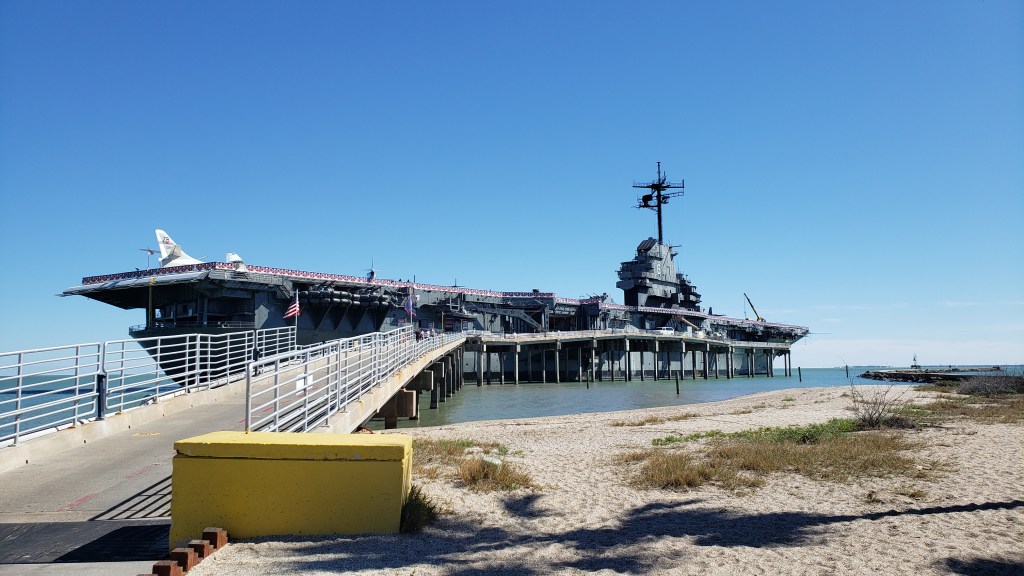
The first attraction we wanted to visit was the huge aircraft carrier parked in Corpus Christi Bay. Ruthie couldn’t be left alone for an hour or more, so Susan waited with her in the car while Simon toured the ship. He’ll take over the blog for this part:
Walking up the ramp to the main deck entrance of the mighty U.S.S. Lexington is like walking back in history, to the turmoil of World War II and the life-or-death struggle in the Pacific theater, where aircraft carriers were the big dogs of most battles and the USA’s fleet helped to carry the day in some of the bloodiest exchanges of the War.
You feel that heritage almost immediately as you enter the gaping Hangar Deck, where the aircraft were stored when not on a mission. Amazingly, up to 60 planes could be stored here, but the area – which covers 40,000 square feet – is now given over to a variety of exhibits, video presentations, a Pearl Harbor memorial, several flight simulators, and a few vintage aircraft.
The Lexington has a long and illustrious history, from her commissioning in 1943 to service with the Seventh Fleet out of San Diego, when it was on call to serve as a major deterrent in places such as Formosa, Laos, and Cuba, before taking up training operations from 1962-1991, when she was decommissioned and eventually moved to Corpus Christi as a permanent museum and tribute to the many men and women who served in the carrier fleet.
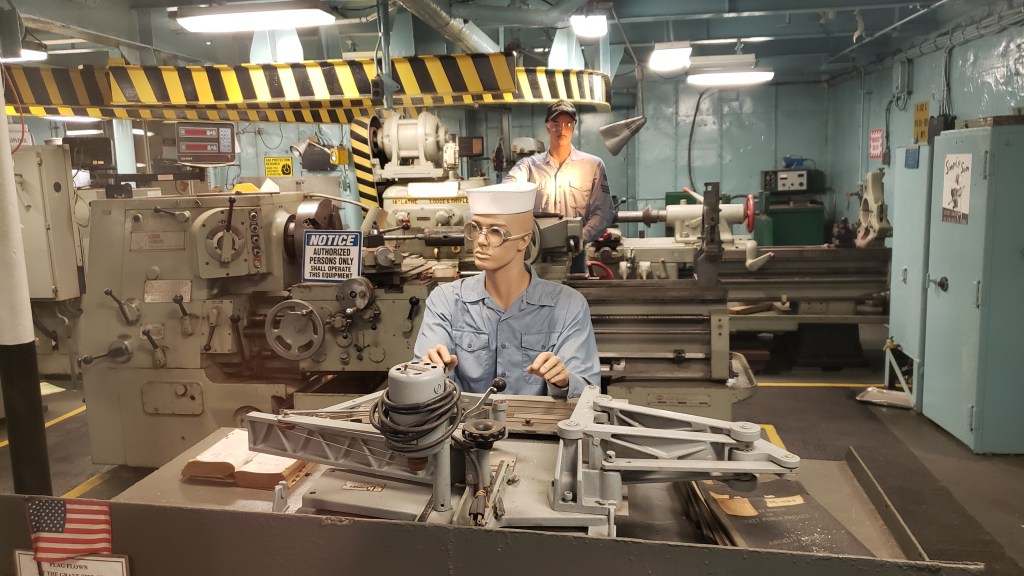
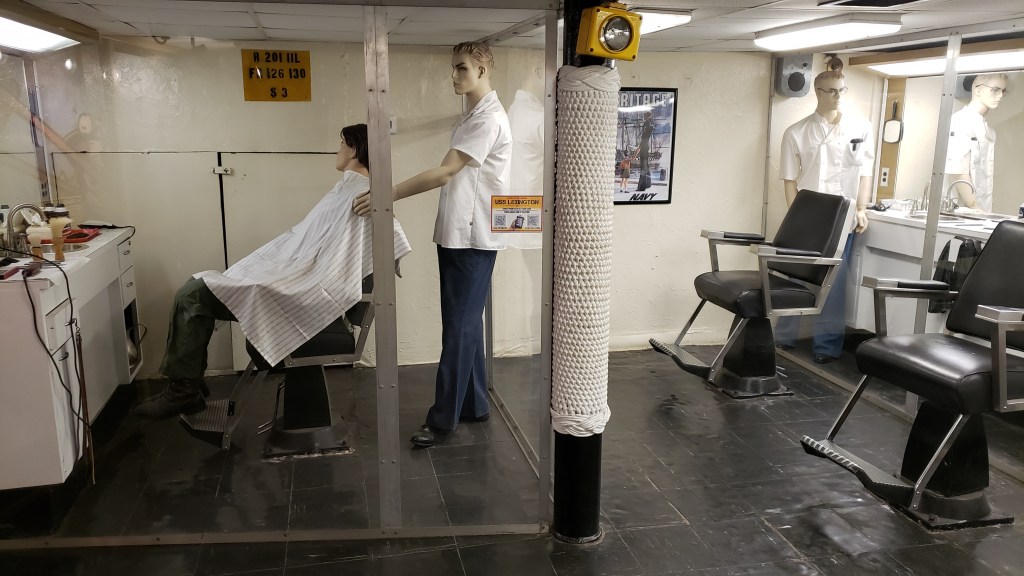
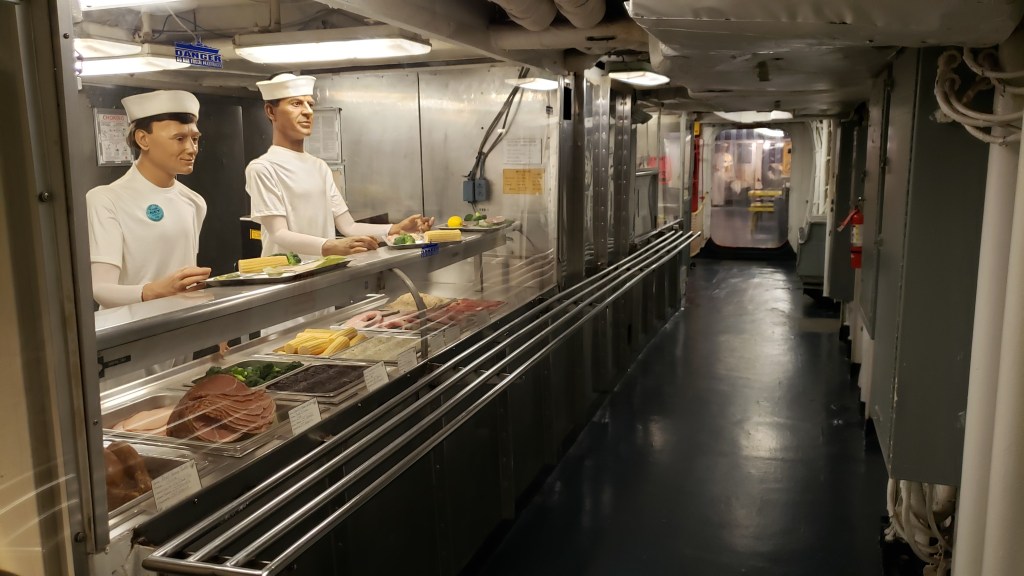
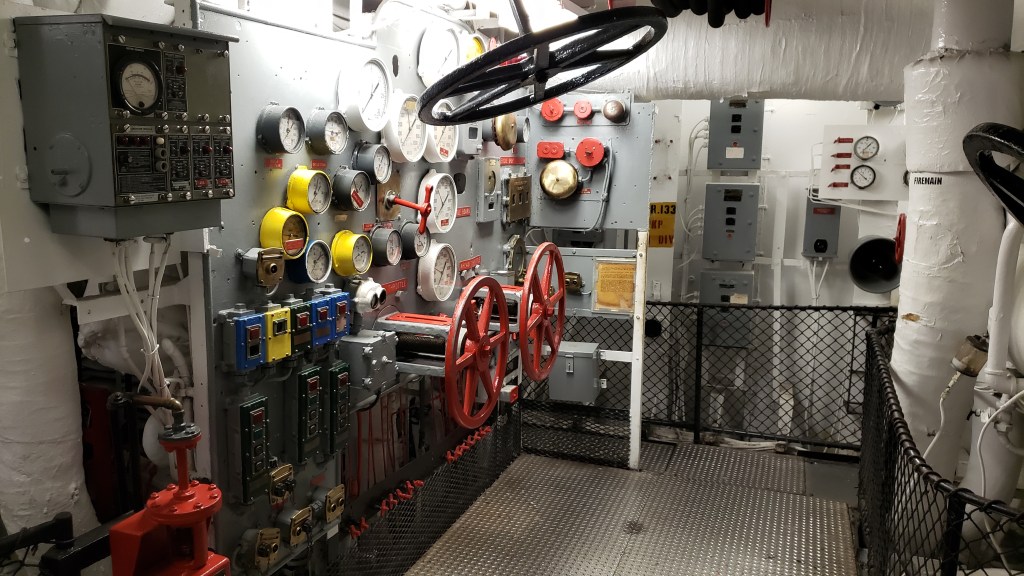
All this history is available on a series of self-guided tours, and I did two of them, starting with the Lower Decks tour that takes visitors deep into the bowels of a ship that needed a crew of about 3,000 during the War (and 1,550 in later years). It includes a visit to the engine room, galley, medical and dental facilities and much more, including several memorials to other aircraft carriers and their crews.
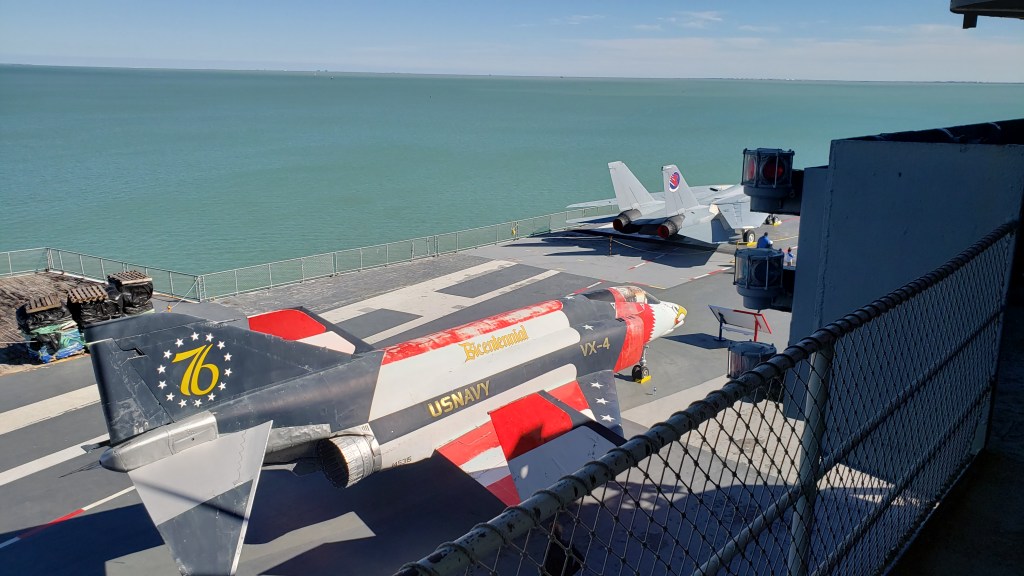
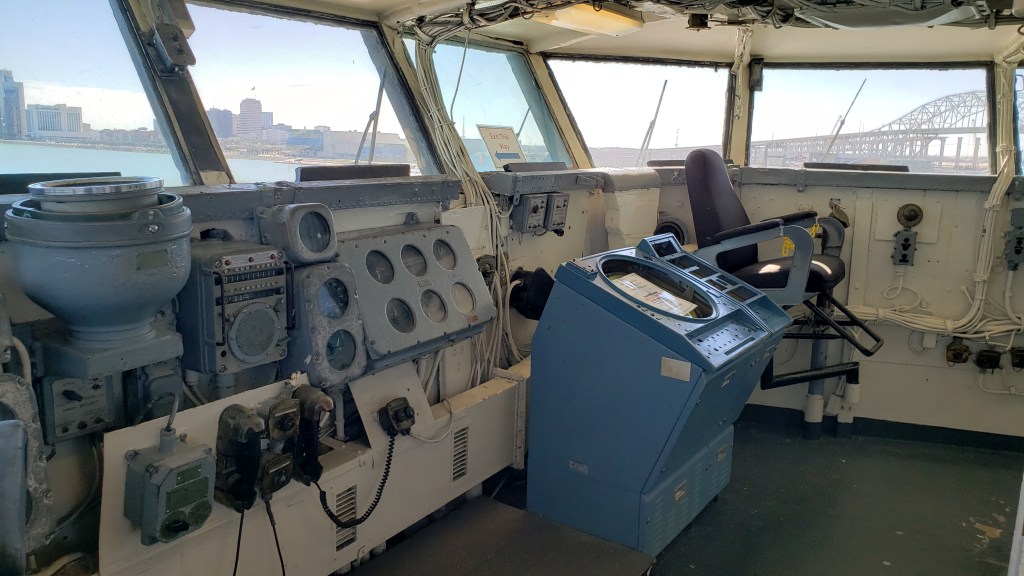
The other must-do tour is the Flight Deck, the vast open space that is the carrier’s “airport,” covering two full acres. It is 910 feet long and 460 feet wide and had to be reconfigured for jet aircraft in the 1950s, but is an immense experience that includes more than a dozen different aircraft. You can also visit the captain’s bridge for an excellent overview of the Flight Deck.
There is a LOT to like about the whole experience and it would take you most of the day to take it all in. It remains a formidable figure on the Corpus Christi shoreline and presents an educational history trip through a grim period of the 20th century. The ship was actually hit and badly damaged by a Japanese Kamikaze plane in late 1944, killing 50 crewmen and injuring another 132, and there is a very heartfelt tribute to all the victims, which really brings home the full magnitude of the War’s horrors. Perhaps a bit much for young children, but a valuable lesson for older ones.
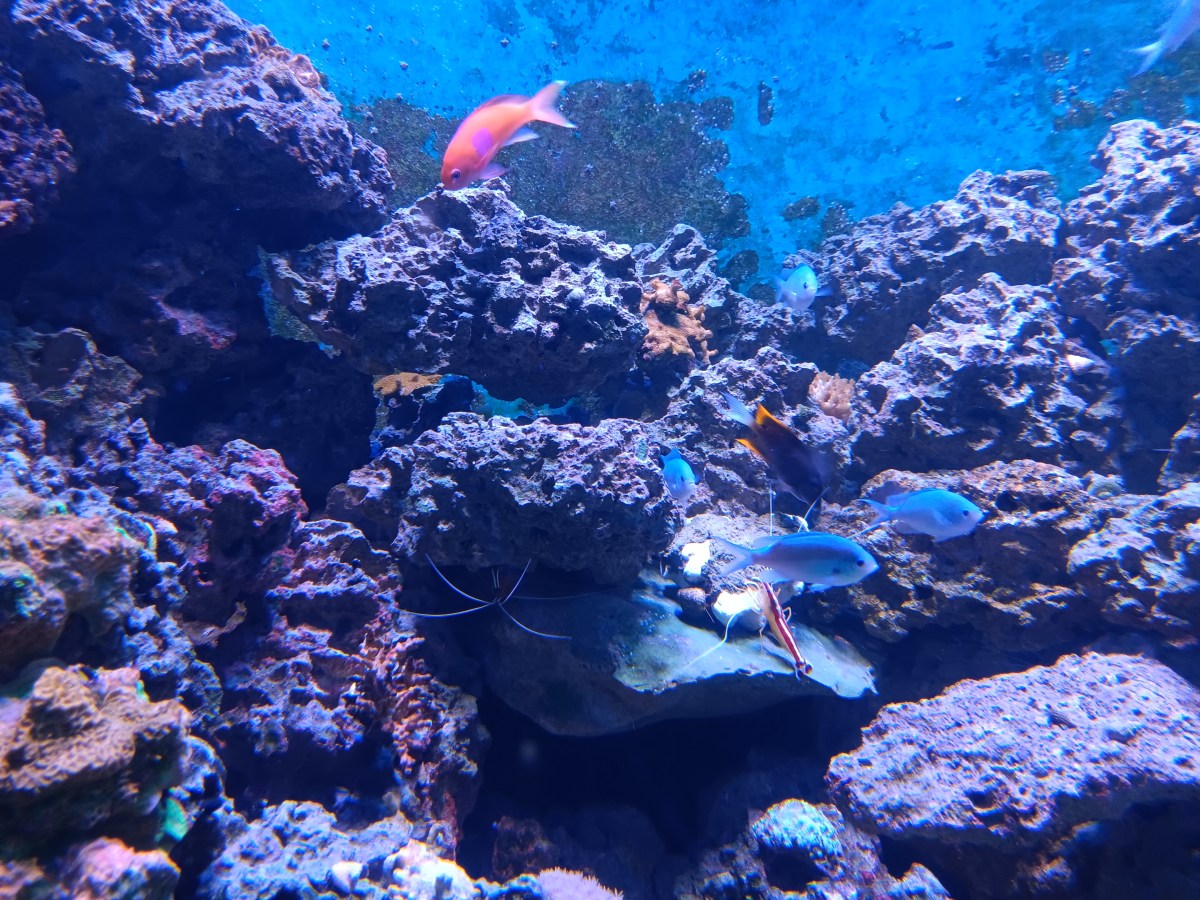
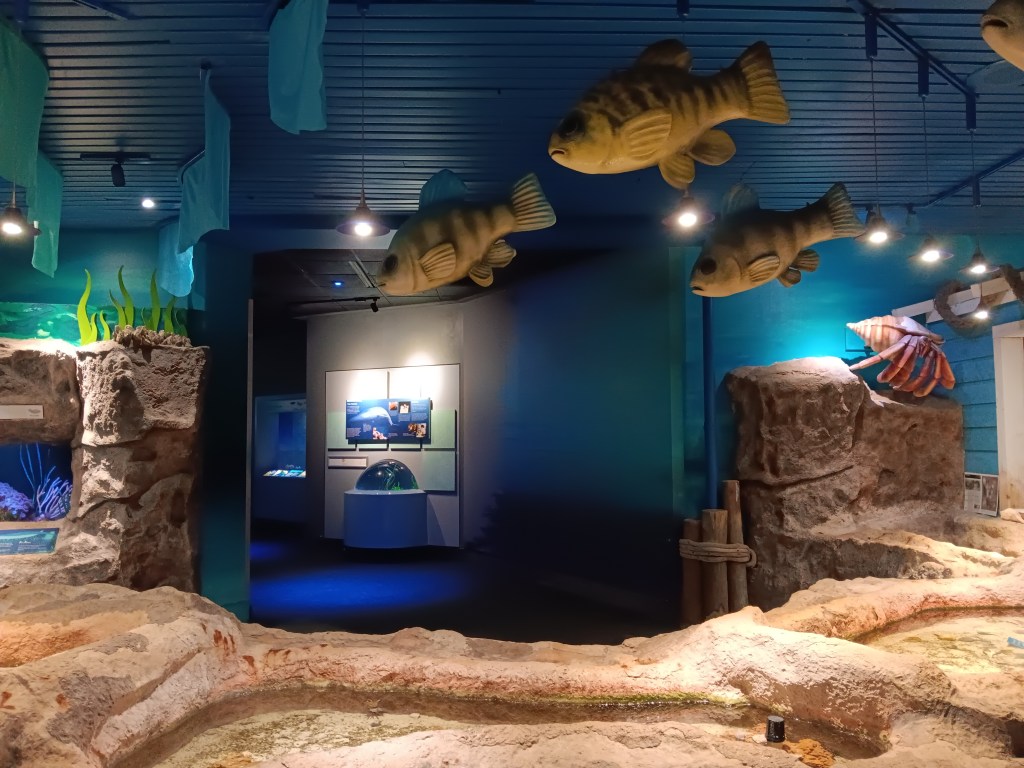
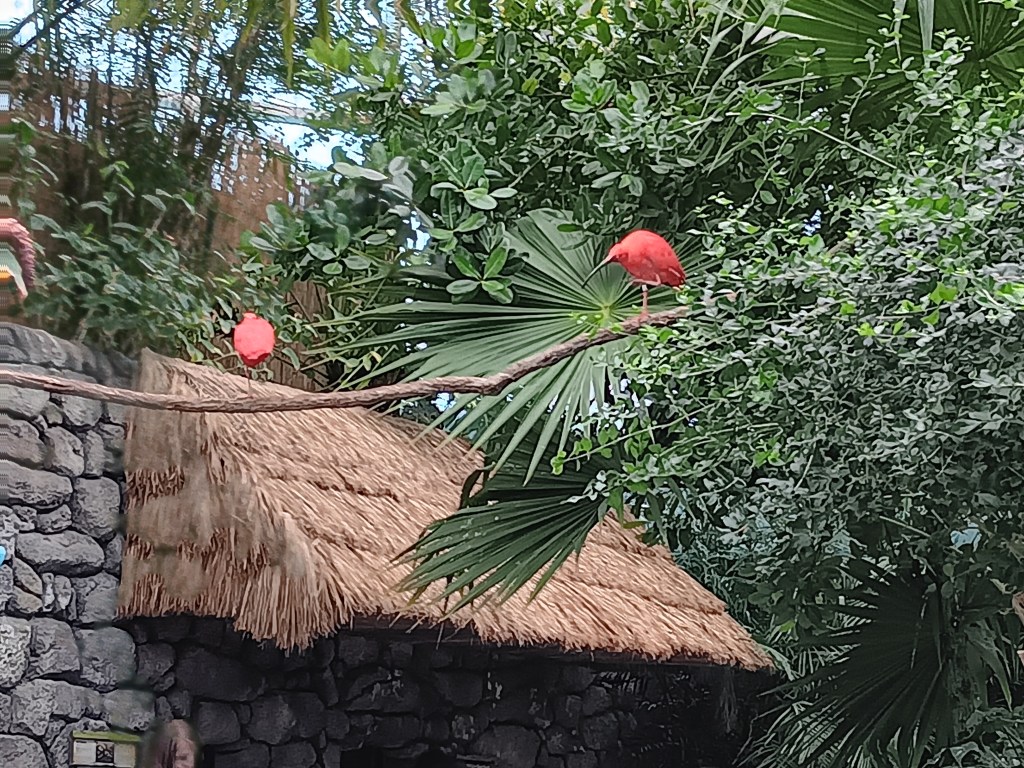
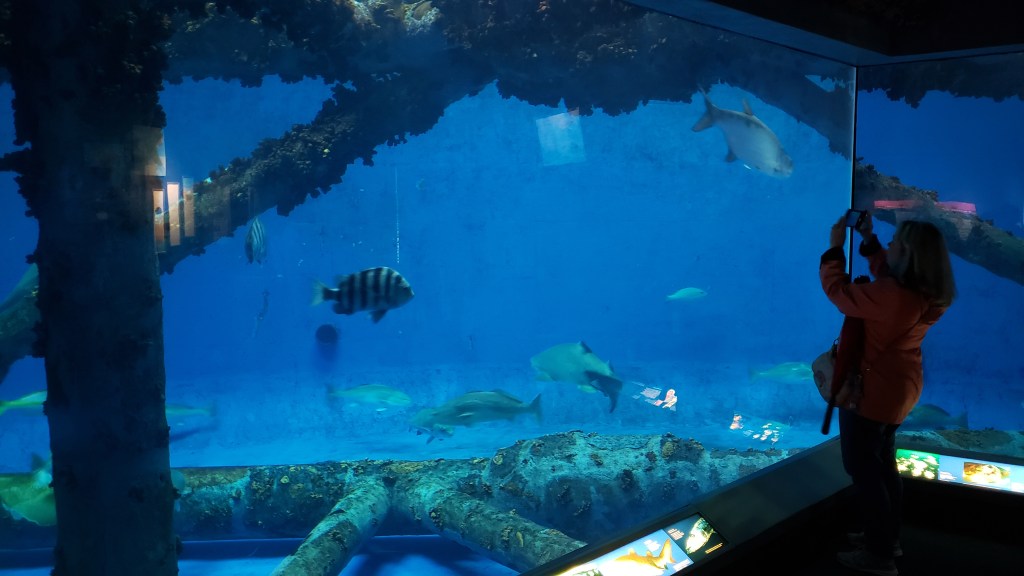
(Susan here again) With crummy weather heading in the next day, we drove out to the Texas State Aquarium for some time exploring what’s under Corpus Christi’s coastal waters. Obviously, we know SeaWorld in Orlando very well, with it’s big-scale experience, and this was on a much more intimate scale. Where the Lexington may have been beyond most youngsters, the aquarium is ideal for them and the grownups who love them.
We have a thing for themed environments when it comes to educational experiences, and the aquarium didn’t disappoint.
The most peevish beings in the world. They are SO LOUD, and they squabble constantly, which is actually quite hilarious
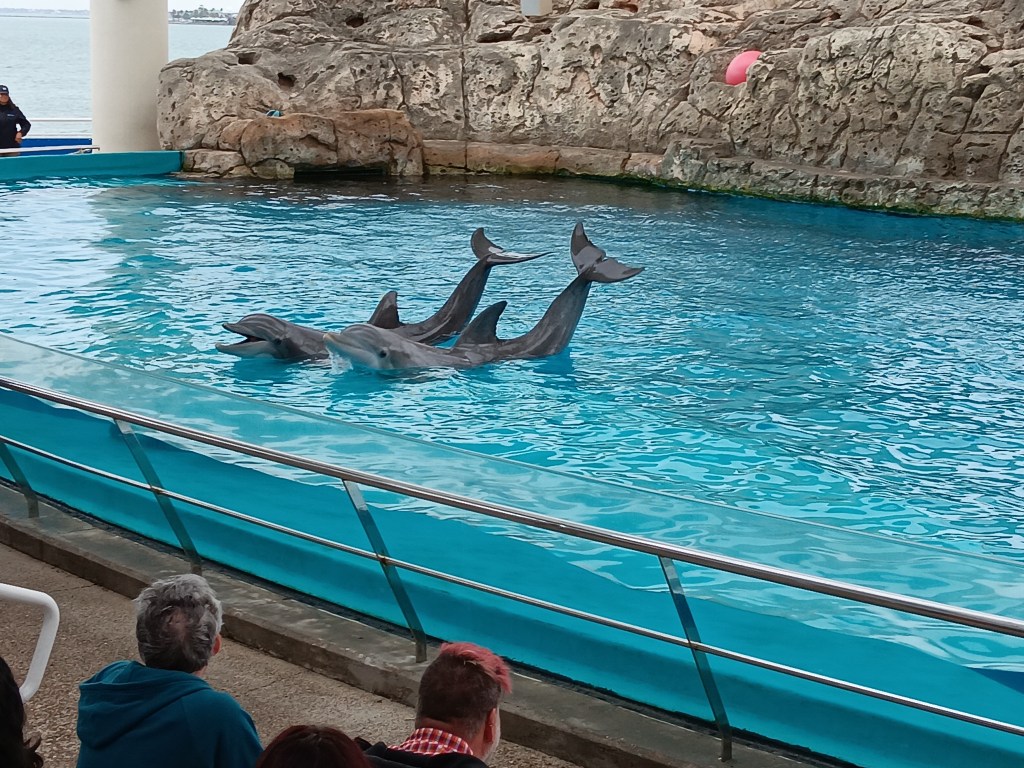
There was also a dolphin show, but we only arrived in time for the finale.
Our five days in Corpus Christi went by fast. We tried a few recommended restaurants, we spent a lot of time on the Island, and we were glad to have been there during the calm before the storm, when Spring Breakers and then the summer crowds would descend on this wonderful gem of a city.
Texas has two Rivieras. One is the conceptual “Riviera” claimed by towns along the Gulf Coast’s Padre and Mustang Islands, and the other is the actual burg of Riviera, our next destination as we started our eastward bounce along the coast toward Florida.
We chose Riviera purely because of its location, a half-way point on the drive from Donna to Corpus Christi. We’d have three days on the inlet to Baffin Bay, get our minds onto “island time,” and maybe take advantage of the campground’s activities.
All activities were cancelled during our stay because Covid, RSV, and flu were going around the campground, which is not what you want to hear, but one of the benefits of this lifestyle is that most socializing takes place outdoors. Most of the campers were seasonal “Winter Texans,” (like Florida’s “snowbirds,” who come from Northern states and spend the winter in a warmer climate), including our neighbors on both sides (Hi Linda and Erik and Linda!), and we enjoyed several happy chats with them, hearing about their travels and telling them about ours.
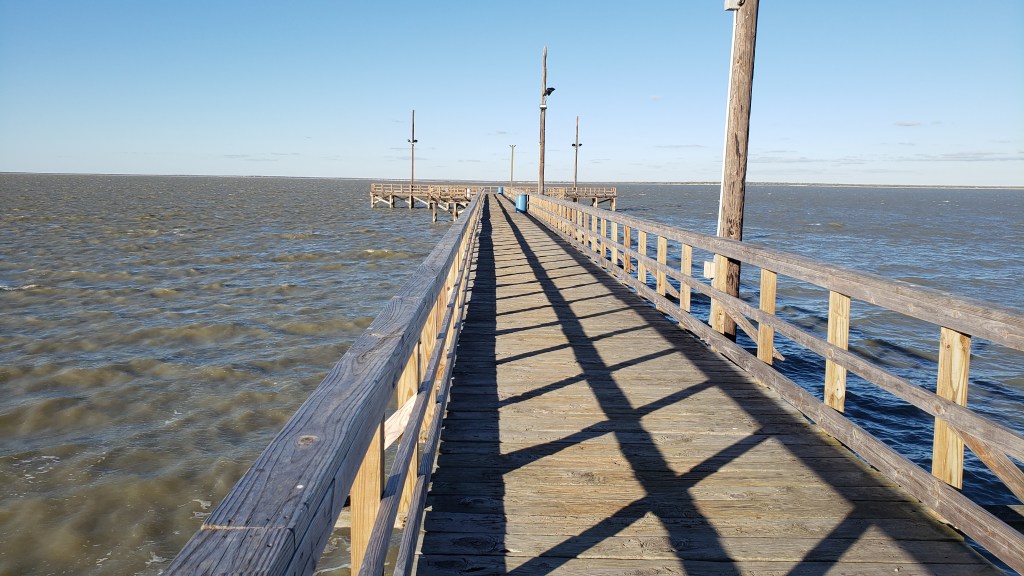
We also took advantage of the good (if chilly) weather and took Ruthie for a walk out the pier. Now, anyone who shares a home with a rescue dog probably has moments when they recognize their pup’s former life is showing up. For Ruthie, there seems to be something about being on a pier over salt water that gives her tremendous joy. She was found along Florida’s Gulf Coast, and our Riviera adventure must have felt like home to her. It was lovely to see her scamper and dance like a puppy!
If you’ve been following along on Facebook (SimonSusanVeness), you already know we had fun with “Caption This” for the following photo, and we had a good laugh about the fantastic captions people came up with.
The real story behind it is, when we arrived at the campground we were told the nearest grocery store was a 40-mile round-trip to Kingman (where we’d Wallydocked the night before we arrived in Donna ((Hi Karin and Darren! Hi Gary and Mary!))), or we could drive eight miles to the local Dollar General, which carried basic foodstuffs. We were happy with soup and a short drive, and I only took the photo to remind us that we actually shopped for comestibles at a Dollar store. Simon’s facial expression, though; priceless!
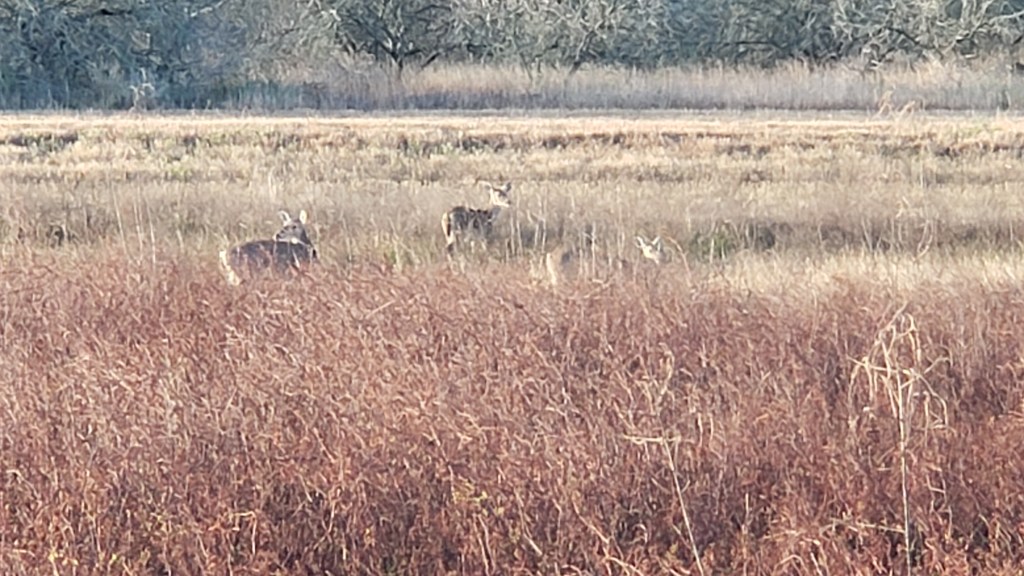
Anyway, our time in Riviera was short, so this blog will be short, too. We strolled the pier just outside the campground, did a little bit of writing, and enjoyed the fabulous view outside our front window, which included sightings of what we were told were Nilgai, the massive, pointy-horned animals that look like big-barreled deer but are really related to antelope.
They were brought to the area by King Ranch as game for the ranch’s hunting expeditions, but, happily, at least some of their descendants are living a free life. We were so thrilled by these unexpected sightings, and when our time in Riveria came to an end, we felt it had been something truly special.
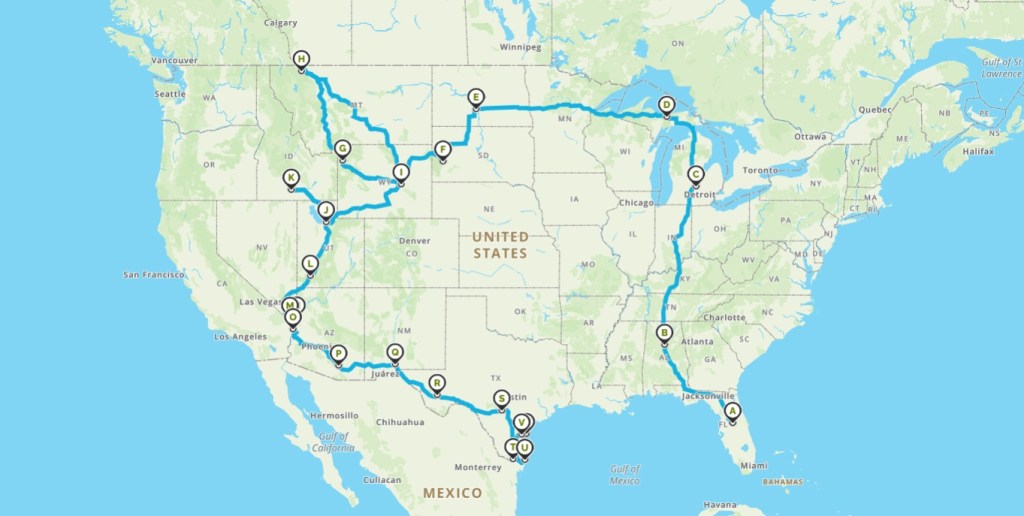
Somehow we’ve reached the three-quarter mark of our grand RV adventure, and we’re looking at another month of travel that completes nine full months on the roads of America.
The full scope of our 9-month journey to date, starting from our Florida base, then heading north and west, taking a loop from Yellowstone National Park (G) to Glacier National Park (H), then down through Montana and Wyoming (I) before heading west again to Twin Falls, Idaho (K) and south through Utah and Nevada. We’ve then headed east and south through Arizona, New Mexico and Texas
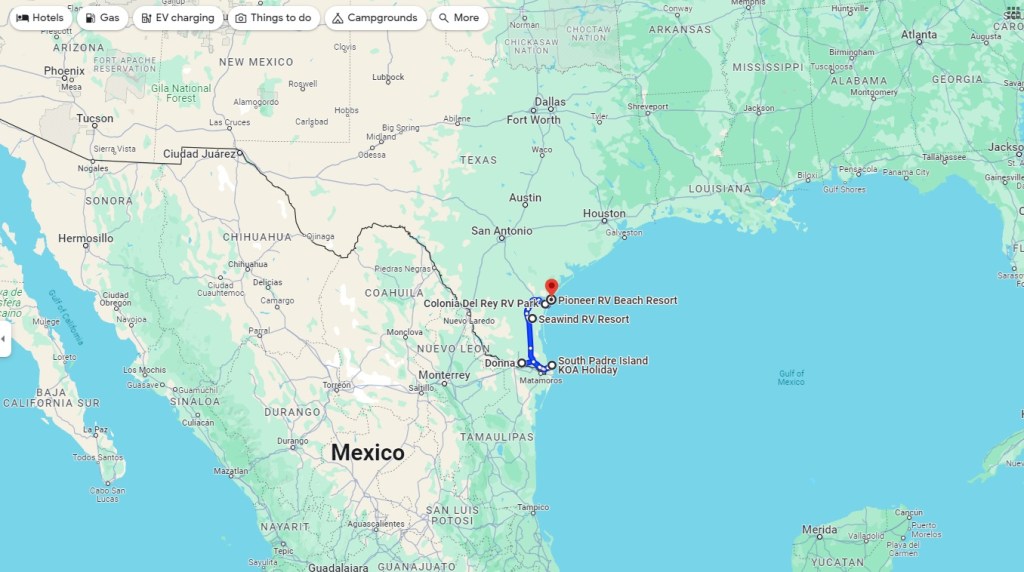
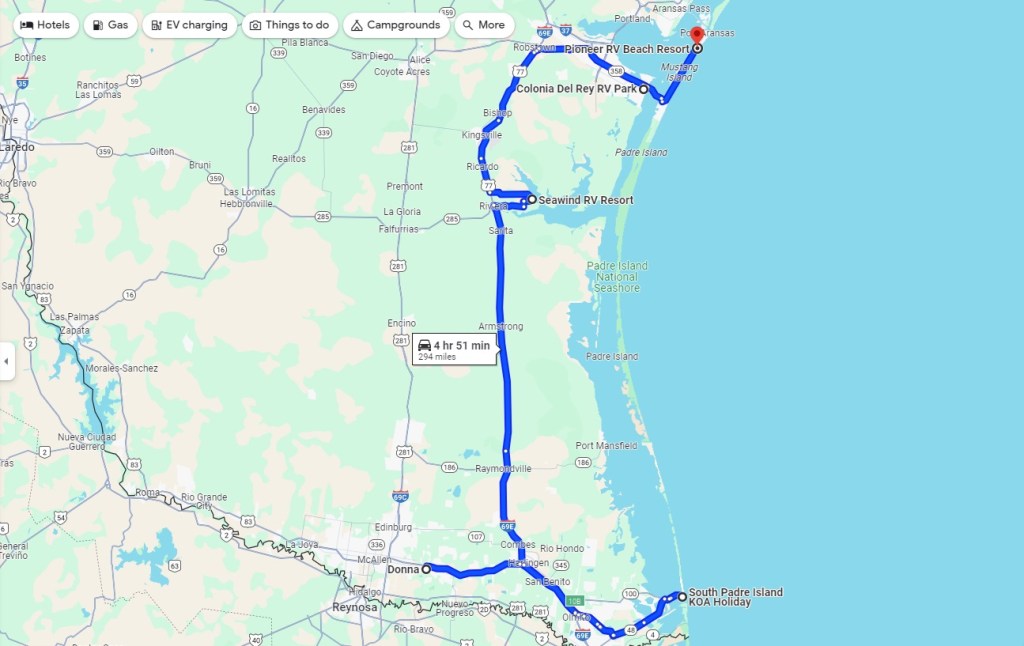
January was very much a “rest” month, in which we were largely in one place, down in the southwest of Texas, but we got back under way again at the beginning of February, turning north and east to skirt along the Gulf Coast of the Lone Star State, a part of Texas we’d heard a lot about but had never visited before.
Setting out from Donna, close to the Mexican border, we drove due east to beautiful South Padre Island, part of the barrier island system along the coast that is laced with wide, open beaches. Here, we were lucky enough to find accommodation at the KOA Journey close to the long stretch of SPI Beach.
The long-distance view of Month 9, down in the southwest corner of Texas
From there, we back-tracked slightly and then headed north for more coastal experiences, first at a tiny but lovely spot on Baffin Bay called Riviera (and the wonderfully natural Seawind RV Resort, part of the Kaufer Hubert Memorial Park), then it was on to the busy port city of Corpus Christi, where we were lucky enough to stay at the Colonia Del Rey RV Park, ideally situated between the beaches and the city itself.
Finally, the last week has brought us to another idyllic spot on the epic Texas seashore, Pioneer Beach RV Resort, where we are only a few hundred yards from the unbroken 18-mile stretch of gorgeous beach hideaway.
The close-up view of Month 9, showing our route from Donna to South Padre Island and then north to Corpus Christi and Port Aransas, truly a lovely part of the state
It is a total of 294 miles, which is barely a day’s drive under normal circumstances, but we’re looking to stay out of the way of all the winter weather immediately to the north and explore an area we’ve never been to before, hence the slow pace and the chance to really savor the journey at this stage.
That compares with 928 miles in Month 8, and takes us to a grand total of 8,536 miles since we left home.
However, we have managed an additional 945 miles in the past month in our little Ford Fiesta, Nippy, exploring the state parks, small towns and wonderful open countryside of this part of the world. Our extra mileage in the car is now at 20,653, and the grand total of miles covered in both Fati and Nippy has reached a whopping 29,189 across the USA, or enough to fly back and forth from Orlando to London almost four times!
We still have at least another 1,500 miles before we get back to our Florida base, and another three states to visit, but we can safely say at this stage that our grand RV adventure has definitely lived up to our expectations, and more besides!
Today marks nine months since we locked the door to our house in Florida and set off for a year-long adventure in an RV. Here’s what we learned during the past month:
Now that we’re in the depths of winter and have survived a bone-chilling Arctic blast, with so much of the country getting hammered with snow, our respect for and appreciation of truckers and farmers is immense. We’ll remember that when the trip is over, and never take the growing and moving of our food for granted again.
You really can wear three pairs of pants at the same time, when you’re cold enough.
Some of the best food comes from places you wouldn’t go into if you didn’t have a recommendation from a person you trust. The dives, where all the attention is on the food and none of it is on the ambiance. We love our five-star dining with wine pairings, but damn, son…authentic BBQ or Mexican food from those grubby joints with lines out the door are heaven on a plate.
Appreciation. When you experience something completely new, that’s WAY out of your comfort zone, or you meet people who are not at all like-minded, taking time to slow your thought process and find a place of appreciation broadens your mind. We all grow up with preconceptions, and putting those preconceptions on hold allows you to fully experience the gifts this lifestyle can give. We don’t have to agree on everything to be able to agree on some things.
Hello, humidity! We forgot what humidity feels like. The dry heat of the deserts was challenging, and we went through a lot of water and moisturizer and Chapstick trying not to dehydrate completely, but now our jeans and our pillowcases are ever so slightly damp, and we’re not sure we like it.
Doggie diapers and tinkle pads are our new reality, as are 3 a.m. potty runs for our Ruthie. Campsites with grass around the rig are a blessing. Having to hike to the dog walk area makes Simon swear under his breath so as not to wake the neighbors. Ruthie sniffing around the dog walk area as if she doesn’t have to go, then pooping in the road, makes him swear out loud. Lovingly, of course.
In our blog, What We Learned During Our Fifth Month On The Road, we wrote the following words about Jacques De Paep, a kind, generous, funny man we met at a campground in Sheridan, Wyoming, who, with his wife and their dog, was at the start of a grand retirement adventure: “We had no idea how much you’ll care about these new friends when they’re facing a sudden challenge. There is something very special about this community. How wonderful it is to have your heart expand this way.” Now, in our ninth month, our hearts are broken. We’ve kept up with Jacques’ health through his loving wife, Louise, and are devastated that his Earthly journey came to an end on February 10. Connections sometimes happen quickly, and our own RV adventure will continue with Jacques – the wild-haired man who was the first one out there to help another camper in need, getting rained on, but with a laugh in his voice and a genuine attitude of caring – firmly in our hearts. We are honored to call him our friend.
We only had four days on South Padre Island, so we packed in as much as we could. We knew one of our outings would involve the work of someone we consider a five-star jerk, but we didn’t know there was another total git who had a big impact on what would become Texas, and on the country as a whole.
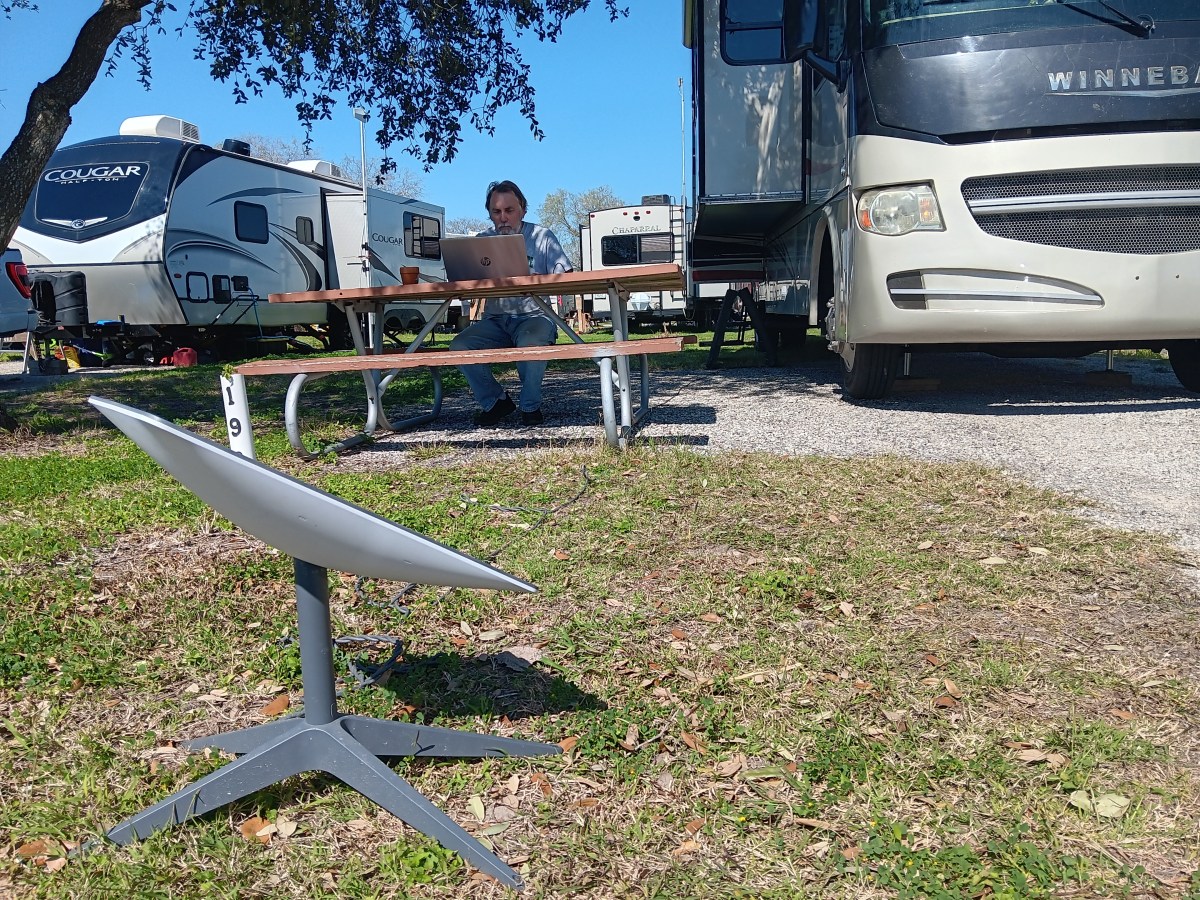
If you’ve been following our blog or follow us on Facebook, you know we’ve mentioned having Starlink as our internet system. For RVers, it’s the only fully reliable connection, and that’s something we are not able to take risks with; we have to have internet powerful enough to deal with large files being transferred, because we’re working as we’re traveling.
Starlink and Simon, both hard at work.
You might also know who owns Starlink. And if you do, you know Elon Musk is a controversial character, to say the very least. Perhaps he’s nice to dogs and babies, but we absolutely cannot stand his attitudes or behaviors. It was a huge moral dilemma when we had to decide how to deal with internet on the road.
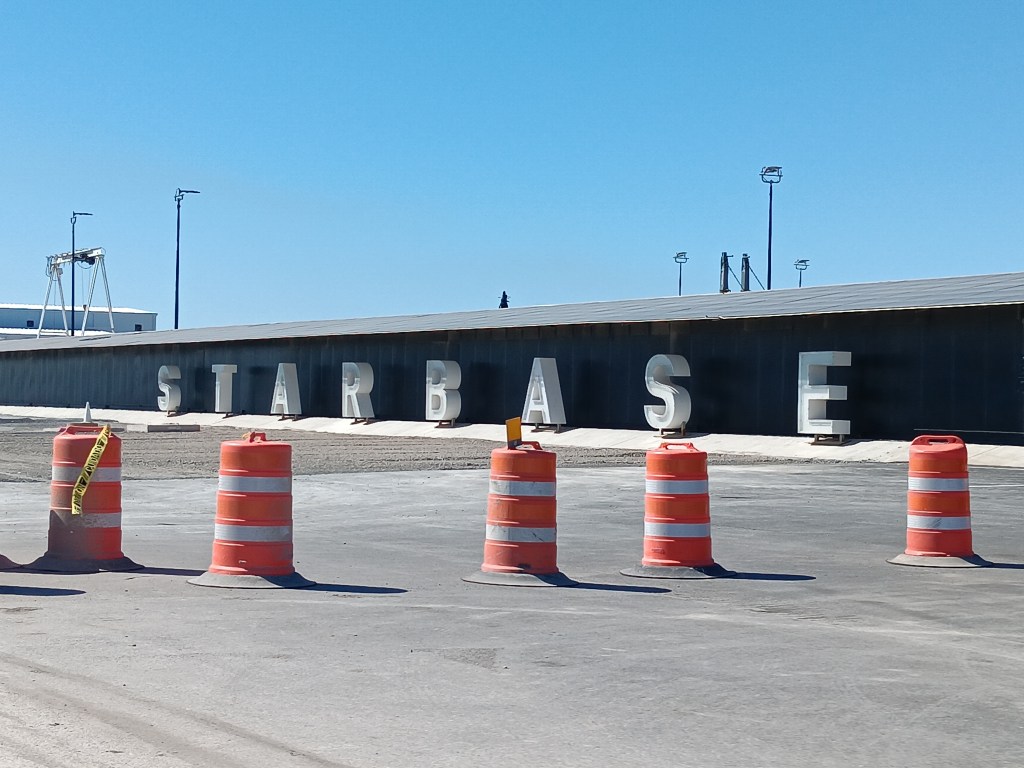
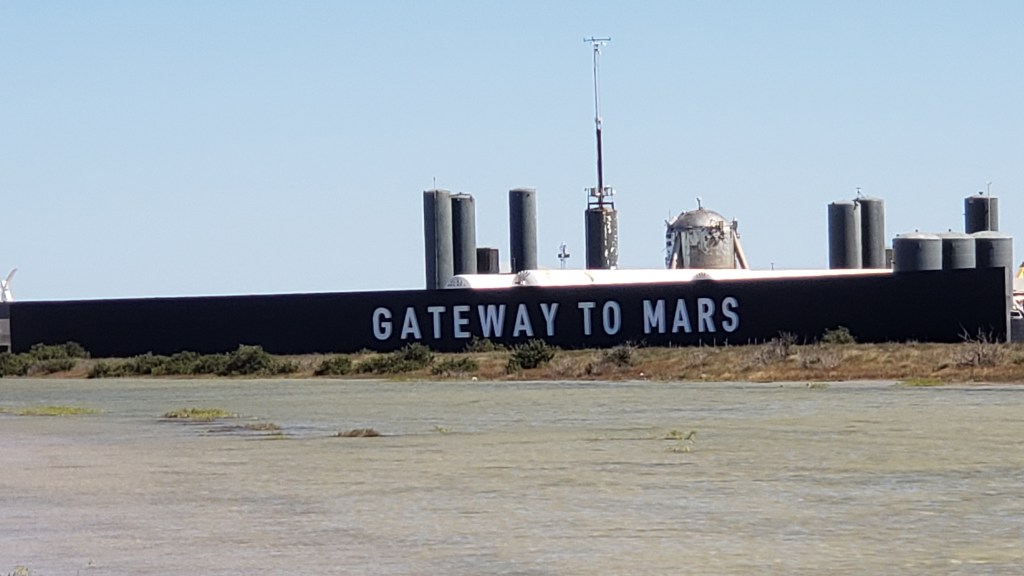
All of that is a long tirade leading up to us saying we made the trip to Starbase, about 40 miles from our campground (by car; maybe 5 if there wasn’t a gigantic ocean inlet in the way), out in the boonies of Boca Chica.
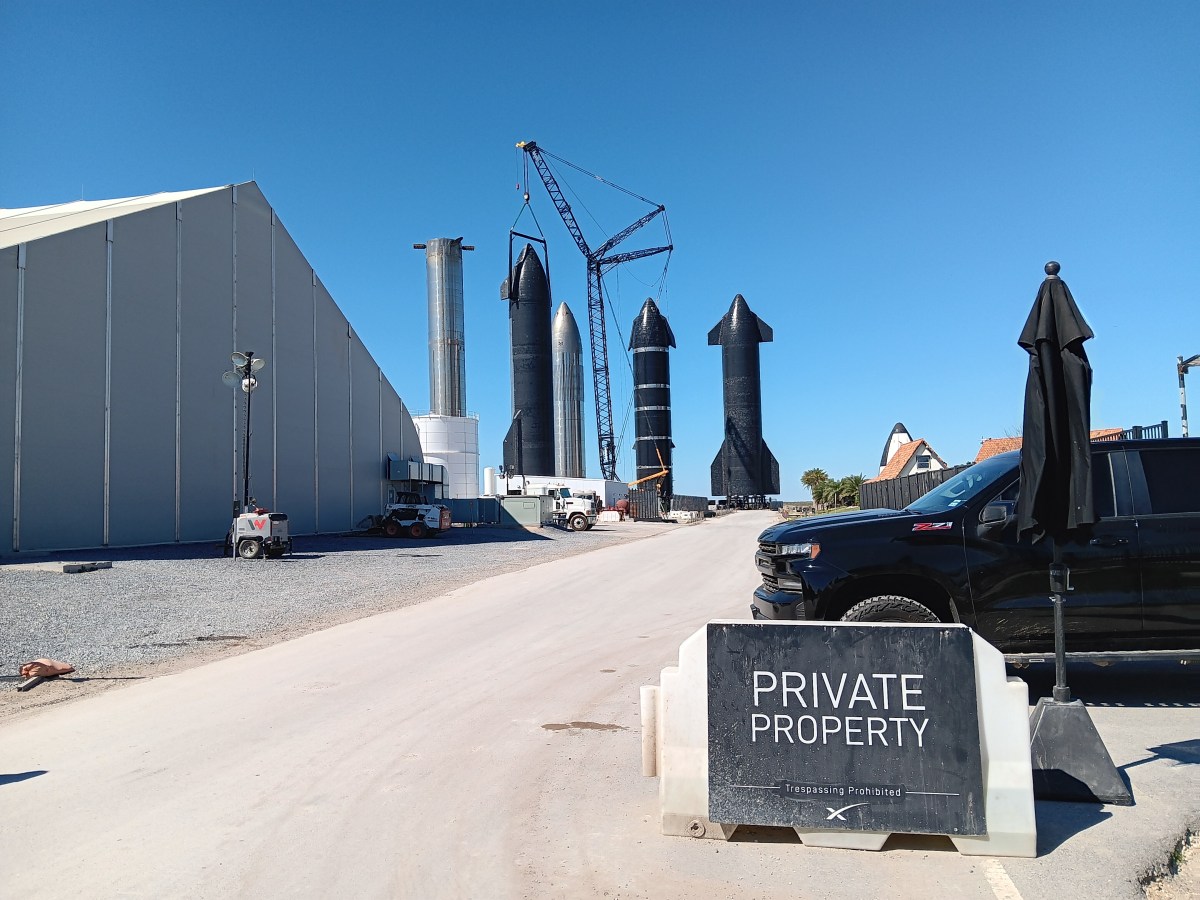
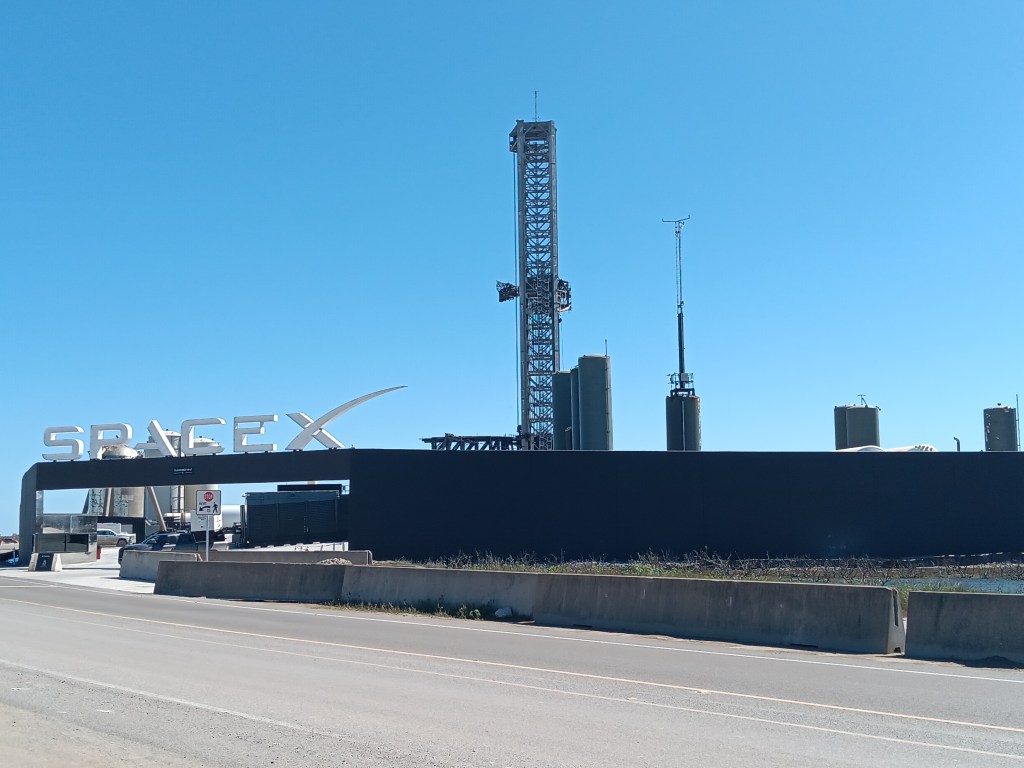
If Elon ever convinces more than one human being to implant a microchip in their brain, he might enclose his Starbase compound and carry out whatever plan he’s working on, but for now you can drive right up to it, and we did. We were impressed by what we saw, in the same way we were impressed by the Reichstag in Berlin – with a mix of admiration for the building and fear of its owner.
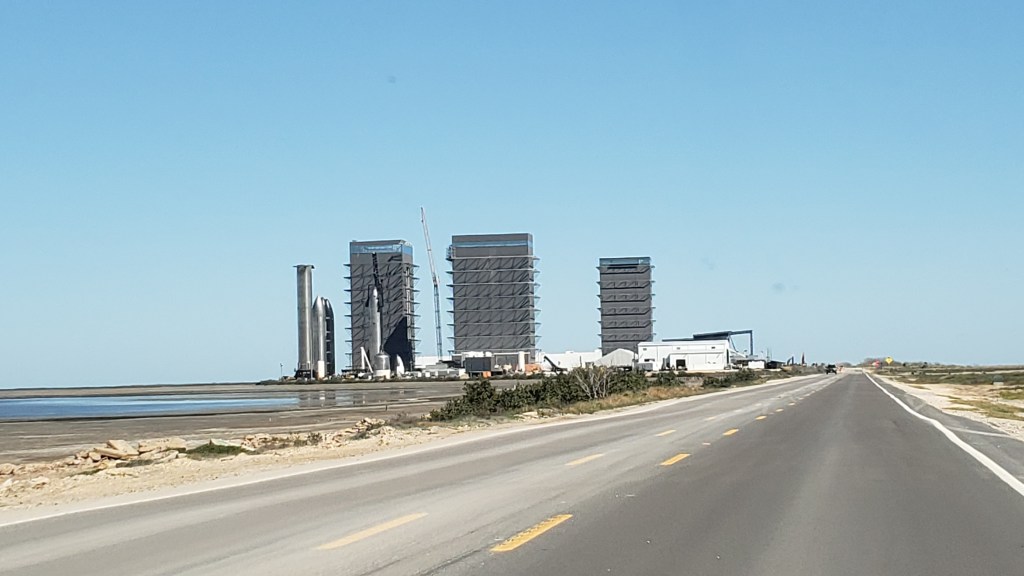
This long road goes straight to the beach, past Starbase and the Starlink compound.
Starbase consists of an area that features rockets and big, mysterious buildings; an area where small, pre-fab homes are stored, presumably for future employees who want to live onsite; the Starlink center; and a launch pad. A massive amount of empty land and the sea surround the compound.
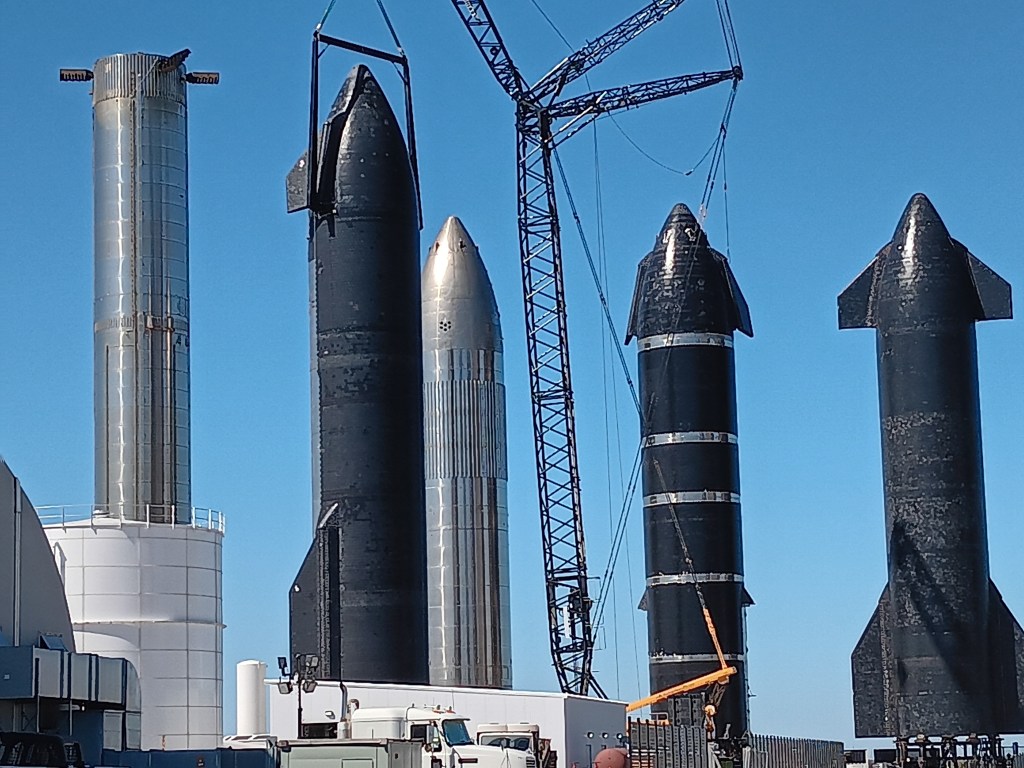
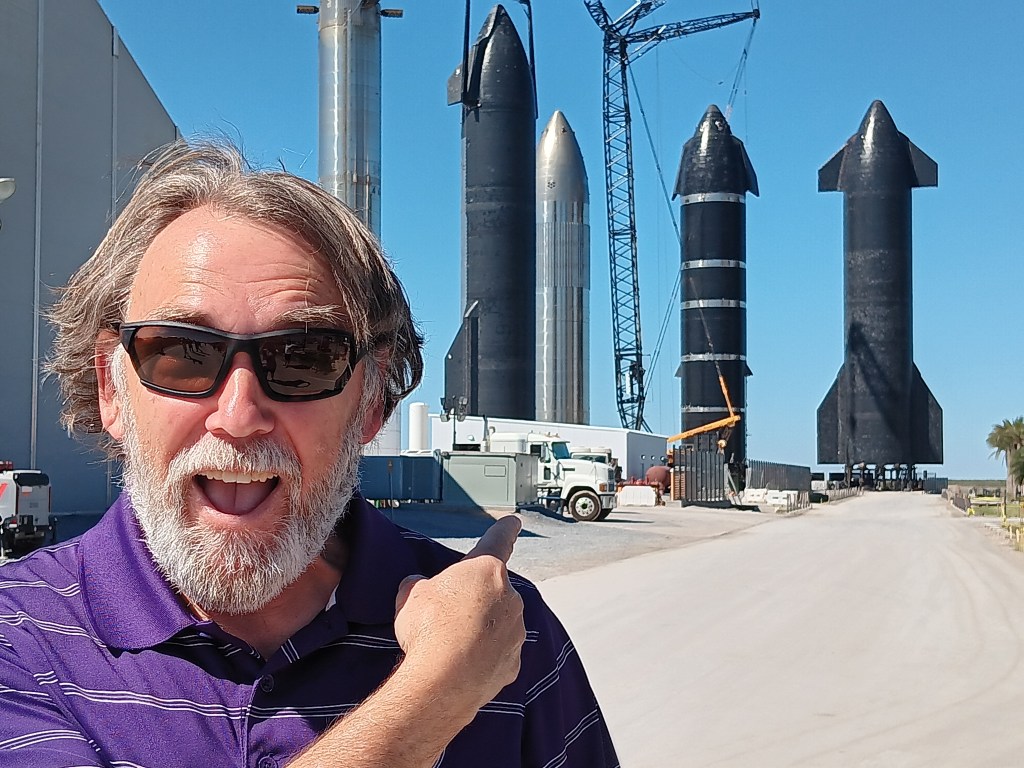
It’s possible these giant…um…rockets…reminded us of their creator in more ways than one.
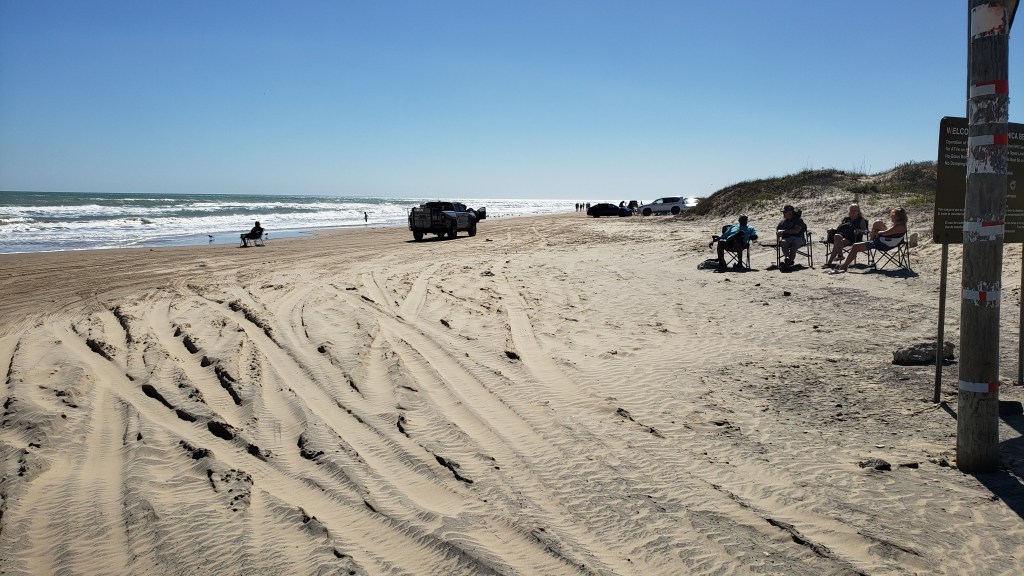
A few hundred feet past the Starlink base is Boca Chica Beach, which, for now, is the reason you can drive right past Elon’s private property. You can also drive on the beach, because of course you can; this is Texas, and it won’t be messed with by paltry safety rules. Admittedly, Florida has a driveable beach where accidents happen every year, but…well…Florida.
We were actually glad we saw Starbase. There’s no question the place – and the ambition – is impressive. But we’re never going to agree to having microchipped brains or treating people as expendable.
We didn’t expect to be able to get this close to the rockets.
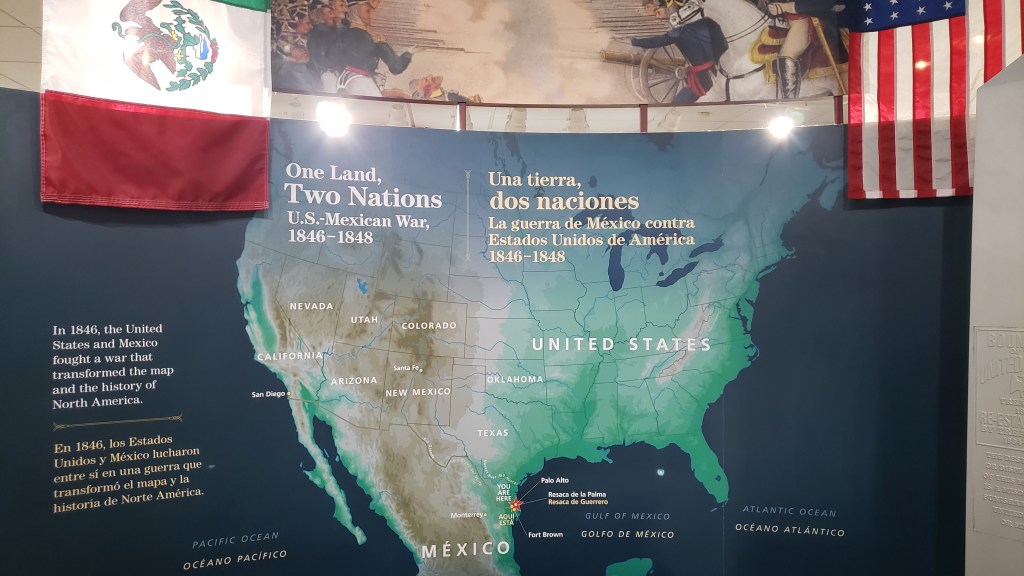
The next day we drove to Brownsville, in part because we were supposed to spend three days camping there and we honestly weren’t sure we wanted to, and in part because we wanted to see Palo Alto, where the first battle of the Mexican War took place when President Polk decided, in 1846, that part of Mexico was now his.
My “unimpressed” face.
I (Susan, obviously) am going to go even more preachy on you than usual, so skip this paragraph if you don’t want to hear it. I won’t be offended, and you’re probably making the right call. But the fact is, I cannot for the life of me understand most wars. Nazi Germany and other wars whose goal was a land grab with a massive side order of genocide is something completely different. That’s a war that needs fighting. Inciting war against people living peacefully just because you want what they have, that’s not how young lives should be lost. Getting along and sharing billions of acres is an option. If you have absolutely no self-control whatsoever and cannot live one more minute without taking someone else’s territory, set up a big speaker and…I dunno…maybe yodel at them without ceasing until they relent. It all ends in negotiation anyway, so skip the murder and get straight to the talking.
Okay, done. Mostly.
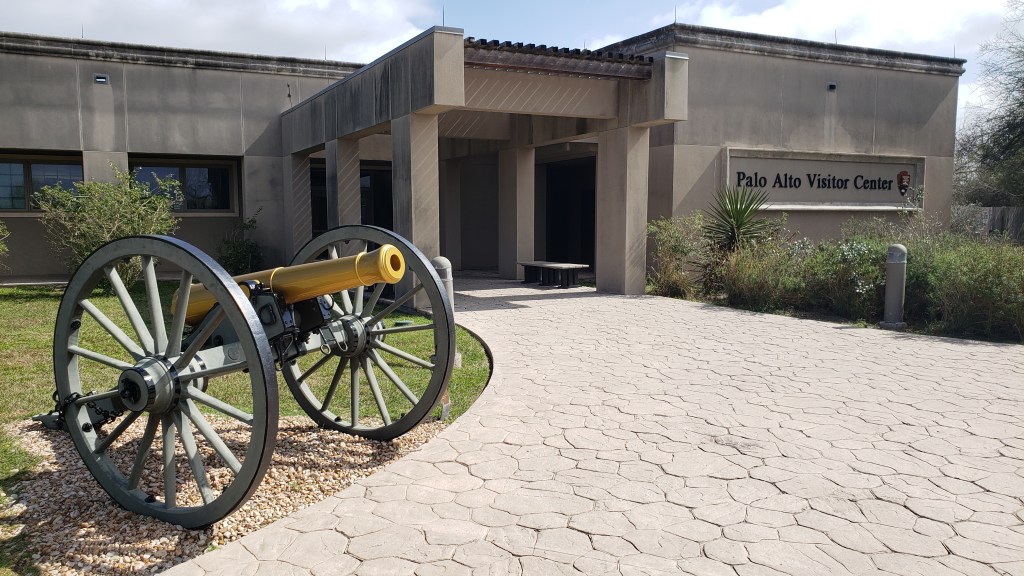
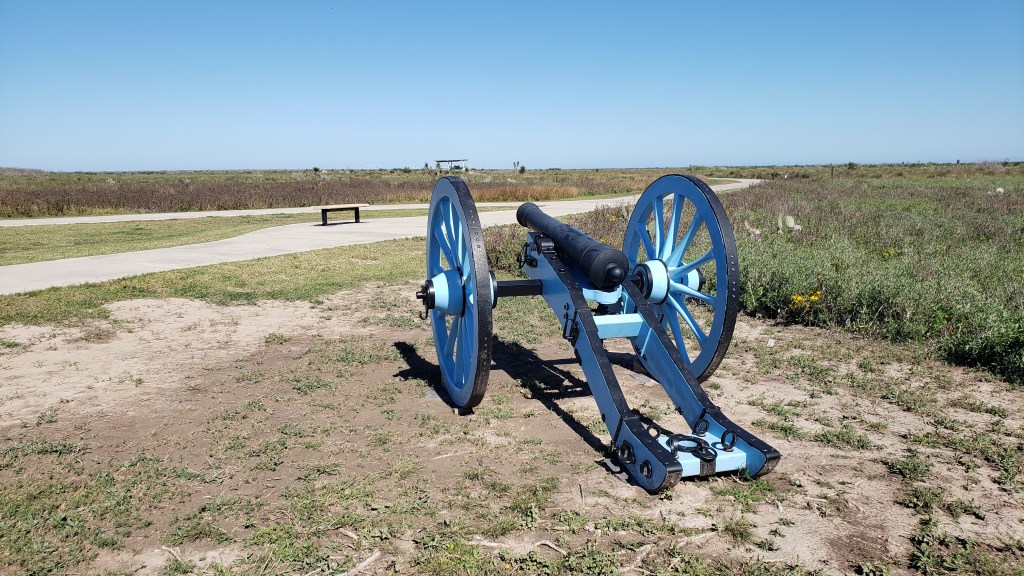
Palo Alto Battlefield National Historical Park features a battlefield marked with U.S. flags and Mexican flags, to show the front lines where the armies faced off as Mexico insisted its territory was its own and the U.S. said, “Nuh-uh. Ours now.” It also has a small interpretive center. We’re here to say it’s one of the best little museums we’ve seen on this trip, and that’s saying something.
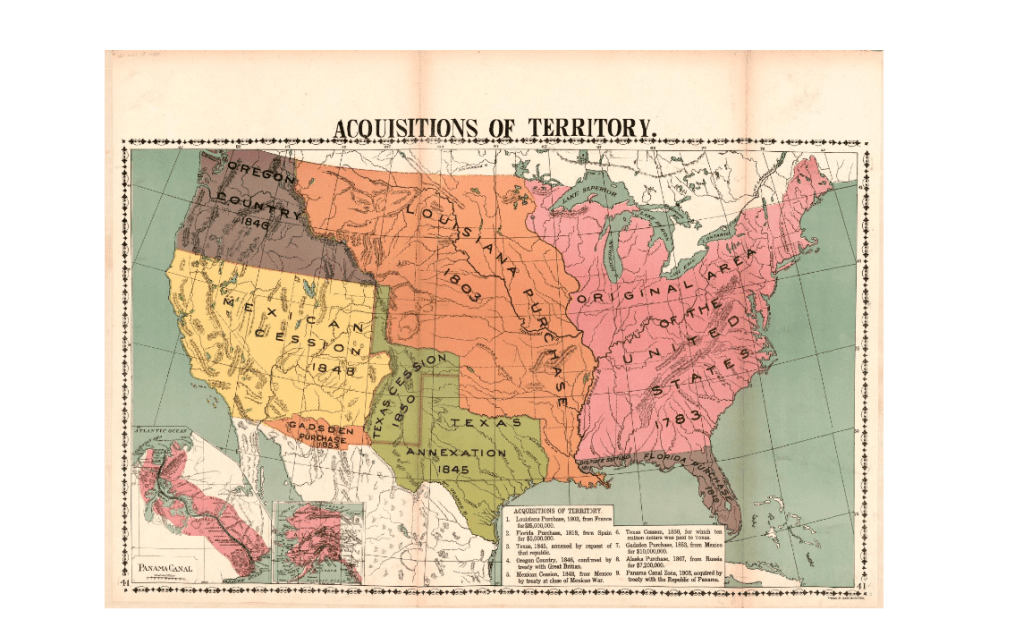
Jeager, one of the park rangers, was the right man to answer our question: Didn’t this land come with the Louisiana Purchase? The short answer is, “No.” The long answer is, “Nooooooooooooo.” And the reason it’s “No” is because Mexico’s territory extended up into what is now southern Oregon, while the Brits still held what is now northern Oregon, Idaho, and Washington (state, not D.C.).
Part of what is now Texas was annexed as its own republic, but Polk wanted more. So why not lose a bunch of lives and make the Rio Grande the new U.S./Mexico border? What a jerk.
At the same time as the U.S. was deep in the two-year war for Mexican land, the British decided they weren’t interested in a long fight that would probably end in the loss of their territory below the 49th parallel, so they signed the Oregon Treaty and, at the end of the Mexican War, the continental U.S. enjoyed the boundaries we now know.
General Zachary Taylor, a non-political General who didn’t think the war was justified but ultimately led the successful campaign, became a national hero, and then the 12th President of the United States. Fascinating.
Simon was captivated by how well defined the Palo Alto battlefield was, and by the clarity of the interpretive center’s exhibits, which made it easy to see what had happened there. Susan was drawn in by the human side, and by the way researchers unearthed buttons torn from the soldiers’ uniforms during the violence of the battle, and used them to track the troops’ movements, even down to individual soldiers at times.
For us, the ripples and ramifications we’re encountering on this trip explain so much about what is wonderful and heroic and admirable and outrageously generous about this great country, and they also bring into stark focus the events that stand as lessons about the past and warnings for the future, and the decisions that do not represent our better selves.

























 Veness Travel Media